Demo the BrightEdge Platform
[[nid:4916]]



Despite the ever-changing nature of search engine algorithms, organic traffic remains one of the most stable and valuable sources of leads and customers for businesses. Research published by Milestone showed that search engines, through a mixture of generic and local results, accounted for 69% of all digital traffic from January 2020 to June 2021.
As you look towards 2022, it’s essential to recognize the need for a structured, research-based approach to SEO that accounts for a broad set of ranking factors. In this post, you’ll learn about five considerations that will be of central importance in the coming year.
Google’s market share sat at 87% in September 2021. As such, this article will focus on the acknowledged giant of the industry. That said, a well-rounded strategy will also impact rankings in secondary search engines like Bing, Yahoo, DuckDuckGo, Ecosia, etc.
Let’s dig in.
1. Expertise, Authority, and Trust (EAT)
The acronym “EAT” refers to a bundle of three ranking factors used to determine the quality of content on a site: expertise, authority, and trust. Included in Google’s Search Quality Rater Guidelines, EAT is also cited among the most significant ranking variables in the widely-respected SEO Periodic Table published by Search Engine Land.
Various experts have echoed this position. Google’s Public Search Liaison Danny Sullivan tweeted, “We...use a variety of signals as a proxy to tell if content seems to match E-A-T as humans would assess it.”
Here’s a brief overview of each factor:
Google’s BERT (2019) and MUM (2021) updates reflect Google’s commitment to providing users with highly relevant content based on limited keyword information. Companies that focus on maximizing EAT factors will find themselves best placed to meet Google’s content quality criteria.
2. Desktop Page Experience (UX-Driven SEO) and Core Web Vitals
Google’s “page experience update” is one of the biggest algorithm changes of 2021 and is expected to have lasting ramifications well into and after 2022. Google announced that it would finish adding page experience ranking signals to desktop sites by February 2022.
Google describes the update in the following way: “Page experience is a set of signals that measure how users perceive the experience of interacting with a web page beyond its pure information value.”
In addition to several other factors, the update targets three aspects of user experience, collectively called “Core Web Vitals”: largest contentful paint, first input delay, and cumulative layout shift. Ensuring that these on-site elements are accounted for will mean that user experience is optimized beyond EAT-based ranking criteria.
3. Link Building and Citations
Link building is still a key ranking factor and one of Google’s oldest and most foundational ways of establishing a site’s reputation. The counterparts of links for local businesses are citations.
Link building is an essential part of any SEO strategy, and there are no signs that this will change going into 2022. Three factors are relevant when taking an active approach to link-building (which will typically take the form of outreach):
For citations in business directories, which are a key ranking factor for local businesses, the same principles apply.
4. Spam, Cloaking, Stuffing, Low-Quality Links and Other “Toxins”
Google has renewed its efforts to discount sites that rely on “spammy” optimization strategies. November 2021 saw a spam-related update. And this has been preceded by several algorithm rollouts targeting low-quality content, like the June and July core updates.
Deceptive SEO tactics are referred to as “toxins” and constitute questionable practices that violate Google’s Webmaster Guidelines.
There are five strategies that you should take particular care to avoid:
Given the expected significance of EAT factors in 2022, poor quality content should also be considered as something to avoid as a priority.
5. Voice Search
Google’s emphasis on voice search comes on the heels of increased user activity in regards to IoT (Internet of Things) devices. And while voice search hasn’t dominated in the way that many predicted several years ago, data from Adobe Analytics clearly shows that the use of voice-based interfaces is growing.
In September 2021, Google announced the release of its “latest research breakthrough,” which took the form of advanced voice technology LaMDA (Language Model for Dialogue Applications). LaMDA is notable because it signifies Google’s efforts to further streamline search results based on changing user habits.
Structuring content to include featured snippets, targeting long-tail keywords (especially local terms), and optimizing for mobile are all ways of catering to the increasing number of voice searches.
Conclusion
It’s easy to fall into the trap of thinking that nothing about SEO is constant. The reality, however, is that ranking factors change much more gradually than many businesses assume.
The fundamental criteria of user-focused site design, high-quality content, and citation-based trust have remained largely unaltered since the earliest days of Google’s presence on the web.
As you build your SEO strategy, it is important to keep this in mind. While specific technical priorities may change, properly laid groundwork that prioritizes customer experience above all else will ensure success over the long term – in 2022 and well beyond.


Thank you for everyone who joined our State of SEO webinar in mid-November; we welcome you to access the on-demand recording at your convenience. We wanted to use this webinar as an opportunity to engage and see how the community was feeling about various aspects of SEO as we all plan for 2022. We appreciate everyone who participated in the interactive webinar – full results of the polls can be found in this 2021 State of SEO blog post.
We received a lot of questions throughout the webinar and unfortunately due to the volume of content being presented, we weren’t able to have a proper Q&A. We want to address some of the questions that seemed to have common themes here. If we weren’t able to address any questions or concerns you have going into next year, we encourage you to reach out to your BrightEdge Customer Success Manager so we can help you and your organization have the best 2022 possible!
There were three themes that we identified in the questions, so let’s look at those now!
1. What specifically were the 3 spam updates in 2021 targeting?
Google doesn’t typically get into specifics about what each spam update addresses each year. Based on what we have been able to uncover and what the community has flagged as pertinent to the updates, there does appear to be some areas that these updates were designed to help with. As you may have expected, they are right in line with many of the other initiatives Google has undertaken in 2021!
With the Summer update, the details Google gave implied that this was a global update that would impact web and image results. In its communication to webmasters during the rollout, Google shared its general webmaster guidelines and when we look at those in conjunction with spam updates in the prior year, we believe this spam update was primarily focused around eliminated automated and scraped content.
We did not see significant shifts one way or another (while this spam update rolled out, Google also had Core updates over the Summer which may have impacted your results, rather than a spam update). We did not see significant changes in sites being targeted looking at Black Hat resources which leads us to believe the targeting nature of that update was no different than the trajectory Google is on. If you are scraping or automating content you may see those pages suffer from that update.
The November update is early to say for sure, and we aren’t registering significant movements in rankings this month, but we are seeing chatter that webmasters are being impacted. There were not any specific updates to Google’s Webmaster Guidelines on what is considered spam, which suggests no new types of spam are being targeting. Based on those conversations, it appears this update has impacted sites that are using cloaking in order to inject links into their sites. We have no hard data on this, but as always, we believe the best policy is to ensure your tactics and strategies fall within Google’s guidelines.
2. Since the quality of content is king, is it still necessary to have long articles if shorter content is more relevant?
One of the things we discussed about 2021 advancements was that it suggested Google is interested in finding ways to make content useful without its format being a barrier to the user. This means that updates like Passage Based Indexing and bigger initiatives like MUM could sort of democratize content, so regardless of how you did a search, Google can distill a useful answer for you by drawing on content from multiple formats, languages and origins. Pretty cool stuff!
We actually believe these advancements should allow you to focus even more on what’s most relevant for your direct customer. For example, if you are creating a page that’s all about caring for your lawn mower, you probably will need to cover a lot of ground – from cleaning it, to replacing parts, to general upkeep etc. This update should allow Google to decipher and surface the specific parts of that content that is relevant without you having to factor that into how you design that content (the UX, readability, and how you break the content out should be based on building a good experience for the audience).
On the flip side, and more to the spirit of the question, if you are creating a spec sheet for a set of speakers, and you’ve leveraged schema to provide context for what the page is about, that is probably more relevant to your customer than long form content that would require them to read passages about all things speakers before they can see what wattage the speakers are!
These updates should allow you to think in those terms rather than whether the format will be rank-able in SERPs. That said, it’s still critical to pay attention to what Google is treating as quality content and what intentions it believes users have when they are doing searches!
3. Is there any particular preparation you suggest we should take for SEO markup on pages behind a paywall?
Paywall content has long been a challenge for SEOs. There are ways of surfacing this content to engines which could be construed as a form of cloaking if you are not communicating to Google what the site is. Fortunately, this is pretty easy to do. There’s a schema for that!
Google’s official recommendation for paywall content is to either meter the content (I.e., allow a certain amount of free content until you ask for a registration), or use a lead-in, which essentially lets the user see the first couple paragraphs to get a sense of what the article is about, and then require them to subscribe to read the full article. In both cases, you can allow Google to crawl the full depth of the articles.
Regardless of which approach you take, you need to signal to Google that this is paywall content, so it isn’t perceived as cloaking or misleading the engine. You can do this with schema. Per Google’s guidelines, this will help ensure Google can differentiate between content targeting subscribers and cloaking to deceive engines on the pages’ intent.
It remains to be seen how this could change or evolve with the advent of Passage Based Indexing and the launch of MUM, but based on prior advancements, we expect the guidelines and transparency in communicating to Google what the pages’ intention is to remain intact.
There is a lot to think about for next year. We look forward to partnering with you and helping you see more value out of organic search in 2022 than ever before!


When it comes to leveraging keywords in SEO, there’s more to it than simply selecting words and plugging them into a webpage. Search engines are now more intuitive when it comes to understanding and ranking content on the web. Where previously the authority of a topic could be determined by how many times a keyword was used on a webpage, search engines now consider the context of a keyword (i.e., how the keyword is being used and for which purposes).
When we consider the context of a keyword, we are considering the keyword’s search intent, or user intent. Understanding keyword search intent is highly valuable when creating content for the website; by doing so, you can ensure you are creating content that is useful and relevant to your target audience’s needs.
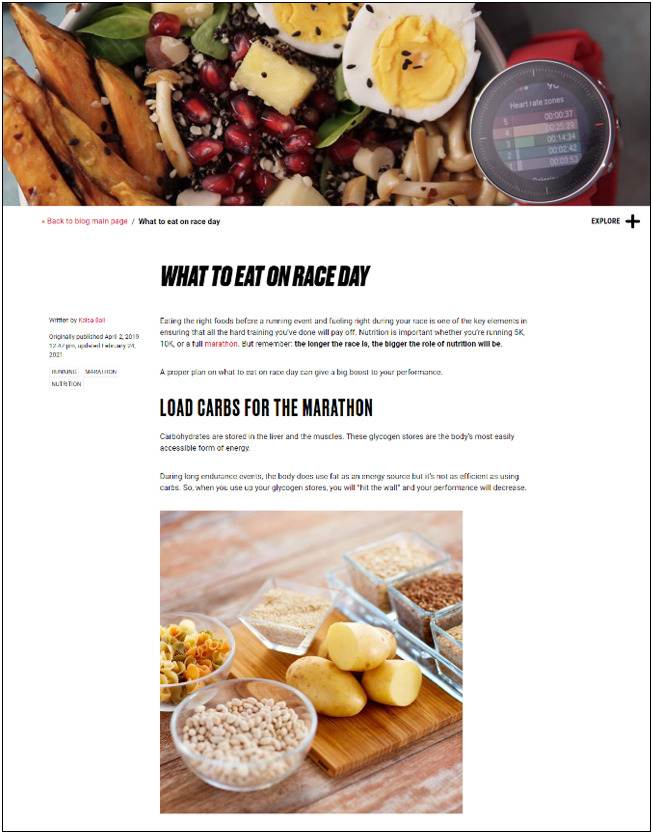 Search intent is the user or audience’s purpose of a specific online search. Keywords can carry different meanings (i.e., “race” as in “marathon race” vs. “ethnicity”), so search engines use search intent to understand and deliver results they think the audience is looking for. Again, search engines understand search intent because they address the context of a keyword, not just the definition itself.
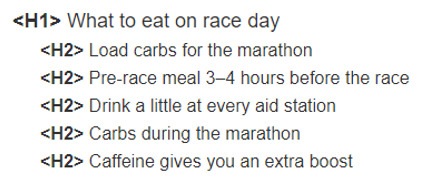
This context includes factors such as on-page headings (H1s, H2s), internal and external links, anchor text of links, images, and image alt text. These factors inform search engines on how a keyword is being used and defined.
For example, the webpage “What to Eat on Race Day” optimizes subheadings (H2s) to include terms such as “marathon”, “carbs” and “pre-race” to inform search engines of the context the keywords “race” and “race day”.


Pages that gain the most visibility and attract the most site visitors for a specific keyword in specific context begin to earn authority for that keyword (i.e., it is understood by search engines to be the most relevant and authoritative result for that keyword in that context), and will garner a top spot on the search engine results page.
There are 4 common types of search intent:
1. Informational Search Intent: this is when a user is looking for information, such as definitions and explanations. The results for these search intents are usually How-To, What, and Why types of evergreen content (e.g., Wikipedia pages, blog posts, and instructional videos).
Examples: “what is tomato sauce?,” “types of beer,” “history of Spain”
2. Navigational Search Intent: users with this search intent want to go to a specific place, such as a site or a physical location, or even a specific spot on a webpage
Examples: “YouTube,” “Starbucks,” “compare electricity pricing”
3. Transactional Search Intent: this search intent signals someone who wants to complete a transaction of some kind. Usually, the user already has a specific idea in mind (branding, product, pricing, etc.) more than any other type of search intent and is ready to convert or make a purchase.
Examples: “water bottles,” “AAA batteries,” “Apple tablets”
4. Commercial Search Intent: this type of search intent is to investigate or research something with the aim of eventually completing a transaction of some kind. The difference between transactional search intent and commercial search intent is customer readiness. With transactional search intent, the customer is ready to transact now, as where with commercial search intent, the customer intends to transact at some point in the near future. This is also distinct from informational search intent, which usually aims to find evergreen content that doesn’t have a time limit or seasonality. Keywords with commercial search intent usually contain qualifiers such as “discount,” “deals,” “best,” or a date.
Examples: “deal on tires,” “wine discount,” “best washing machines 2022”
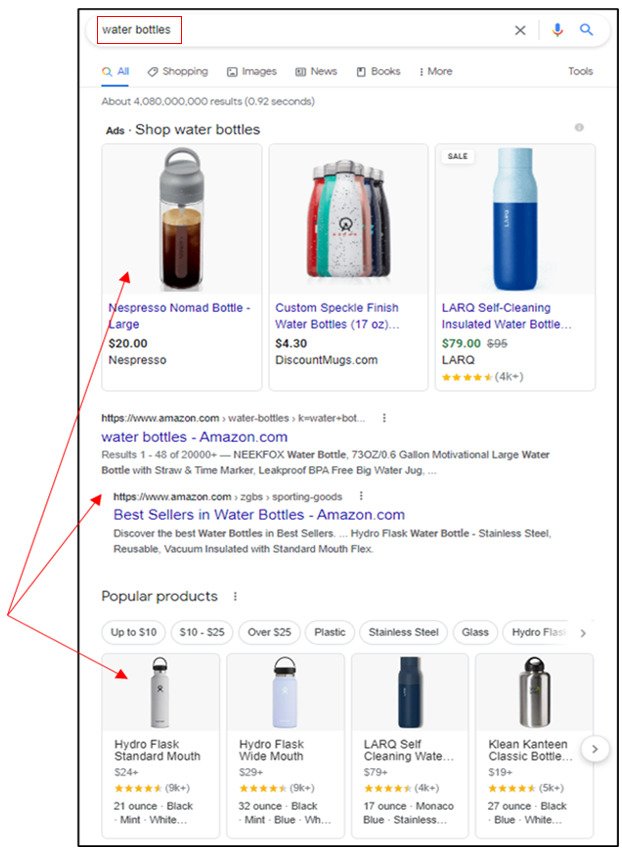
The keyword “water bottles” has transactional search intent, meaning when someone searches online for “water bottles” they are likely searching with the intent to purchase water bottles. Therefore, the best, most relevant, and authoritative search results for this keyword would be product pages on e-commerce sites, versus a Wikipedia page defining “water bottles.”
When thinking about content strategy, search intent can help determine the best content type and page outline for a topic. Taking intent into consideration helps ensure you are creating content that is relevant and useful to the target audience.
1. Analyze SERP Results for Your Primary Keyword
Once you have selected a topic to target, you may have also already selected a primary keyword to craft your content around (i.e., “water bottles,” “marathons,” “net zero”).
To begin analyzing the search intent of this primary keyword, you should start by searching for your keyword in a search engine to see the top SERP results. This will help you understand how search engines are interpreting the context of your content.
For example, let’s say you are interested in creating content for the primary keyword “net zero” in the context of how to invest in net zero stocks.
First, search for “net zero” to see the top organic search results for “net zero.”
Analyze the meta titles for how the topic “net zero” is being addressed (i.e., there is a lot of “what is,” “why,” or informational content).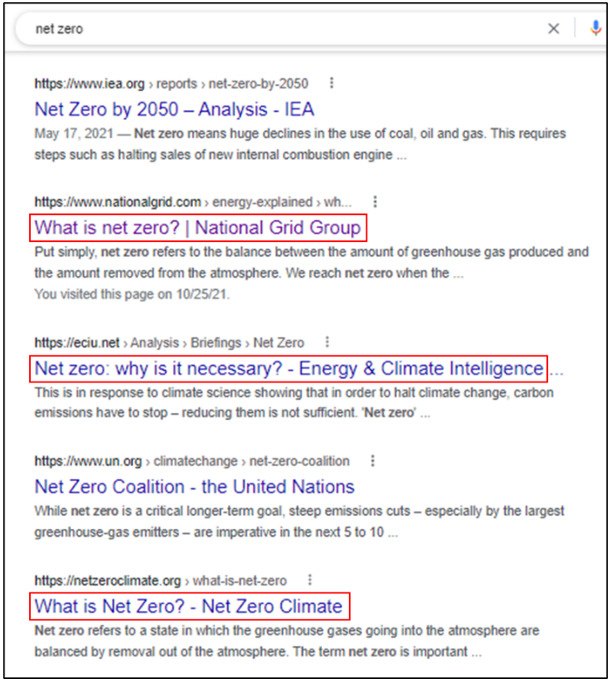
Analyze the sites and companies themselves to understand your top competitors for this topic (i.e., which sites or companies are ranking authoritatively for “net zero”).
It can be observed from the SERP results that “net zero” is dominated by energy companies and industries delivering informational “what is” or “why” content. This is slightly off mark for the content you want to create (i.e., how to invest in net zero stocks), but initial SERP analysis of your primary keyword helps you understand the type of search intent associated with your primary keyword, the preferred content type for this keyword or topic, and top-ranking competitors (that can used for competitive analysis for your content).
2. Build Your Keyword Cloud
After checking your primary keyword in the SERP, you can start to brainstorm keywords to build out your keyword cloud or cluster. These will be long-tailed keywords related to your primary keyword with added qualifiers to further specify your content’s intent (i.e., to create content on how to invest in net zero stocks).
For example, long-tailed keywords for your “net zero”+“invest” keyword cloud may include (with the bolded word as the search qualifier):
Each of these long-tailed keywords carries slightly different search intents, which will help inform which search qualifier carries the search intent best for your content. Ideally, in the research process, your initial, general primary keyword will be replaced by a more long-tailed, niche keyword.
Once you have a list of long-tailed keywords you think are aligned with your content’s intent, you can analyze the search intent of these long-tailed keywords by searching for them in search engines as you did with your primary keyword.
3. Map Out the Spectrum of Search Intent
Once you have a better understanding of the search intent behind your long-tailed keywords, you will find your keyword cloud changing to re-prioritize keywords that have search intents that are not aligned to your content intent or to help spur ideas for more long-tailed keywords that prove to be aligned with the needs of your content.
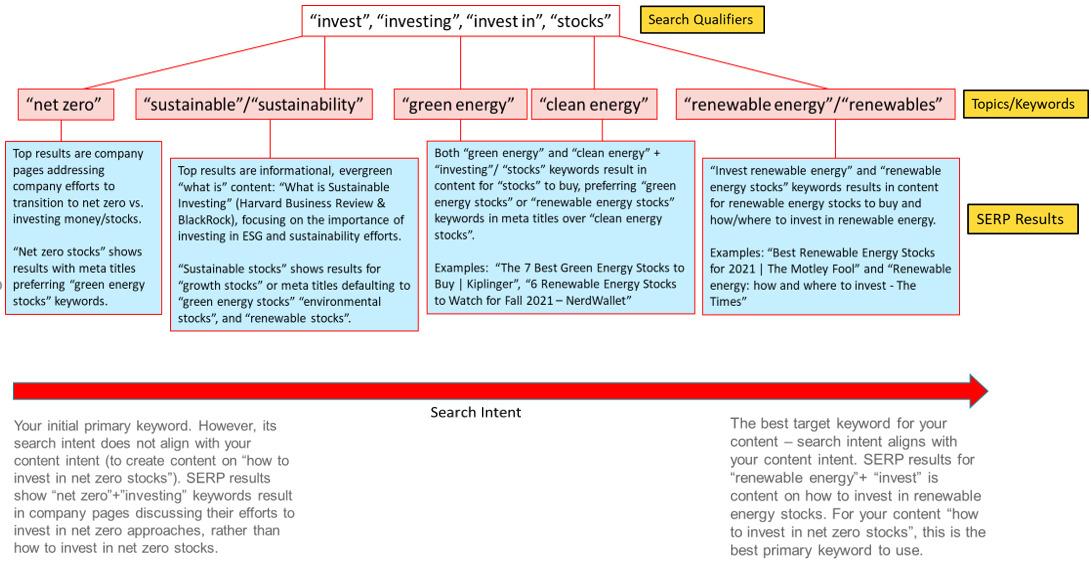
You can now start mapping out a spectrum of search intent to track which keywords and search intents are best and closest to your content goals and which are furthest away.
This diagram shows one way to map out keywords, their search qualifiers, and SERP results to determine their search intents. In this example for “net zero,” you can see the progression of search intents on a spectrum, from “net zero” and “sustainability” keywords (which contain search intents furthest away from your content goal) to “green energy” and “renewable energy” keywords (which contain search intents closest to your content goal).
Tip: refer to your spectrum of mapped-out search intents to create content for other keywords your current content goals are not targeting.
Once you have fact-checked the search intent of your primary keyword, you can begin creating or optimizing your content to that primary keyword and its search intent.
Again, search engines are much more intuitive when it comes to understanding a keyword or topic and they consider the context of a keyword.
This includes optimizing on-page and off-page factors such as:
While there are many factors determining the performance, rank, and authority of content on the web, understanding how to discover the search intent of your keywords and topics, and how to create or optimize your content to those search intents, will put you on the path to creating relevant, useful, and authoritative content for your readers.


In mid-November we hosted a webinar reflecting on the search-related events of 2021 and looked ahead to what changes may come to search engines in 2022. We recapped major updates the search engines implemented and how those changes impacted results and the countless brands that rely on organic search. Check out a recording of the webinar.
During the live event, we asked our 750+ attendees about their experiences and perspectives on 2021 along with their plans for 2022. Respondents include people across a diverse range of marketing disciplines from SEO to demand generation, digital marketing, content development, IT and executive management, and across multiple industries including e-commerce, retail, software, manufacturing and finance. Here’s what they had to say.
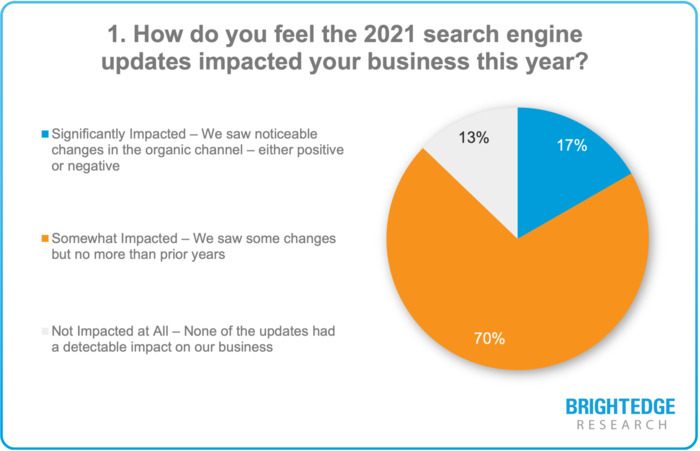
1. How do you feel the 2021 search engine updates impacted your business this year?
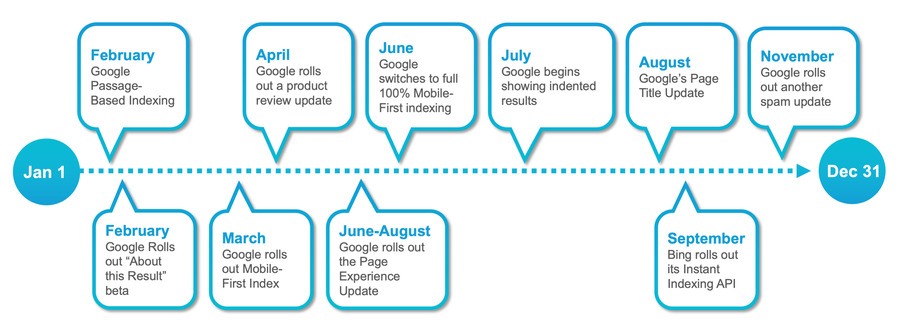
Per the timeline above, it was a busy year for the search engines. In the webinar we touched on the major search engine updates and asked our audience how those changes impacted their businesses. A minority – 13% – of respondents noted no impact to their business. A full 87% of respondents saw some impact, with 17% seeing significant impact.
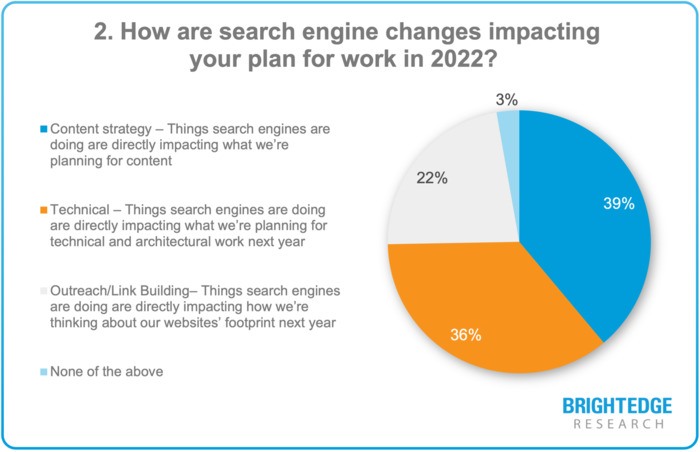
2. How are search engine changes impacting your plan for work in 2022?
Our audience is paying close attention to the changes in search and adjusting their plans for 2022 accordingly. Only 3% of respondents noted no impact on their 2022 work plans.
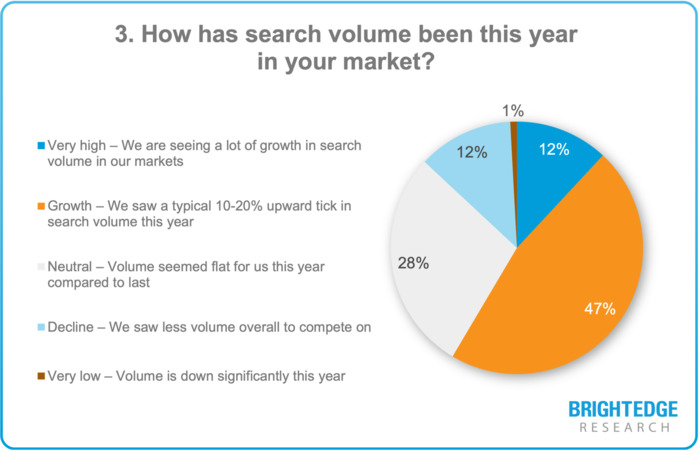
3. How has search volume been this year in your market?
A majority of respondents (59%) described growth in the search channel this year. Only 13% of the audience saw a decline in the channel for 2021.
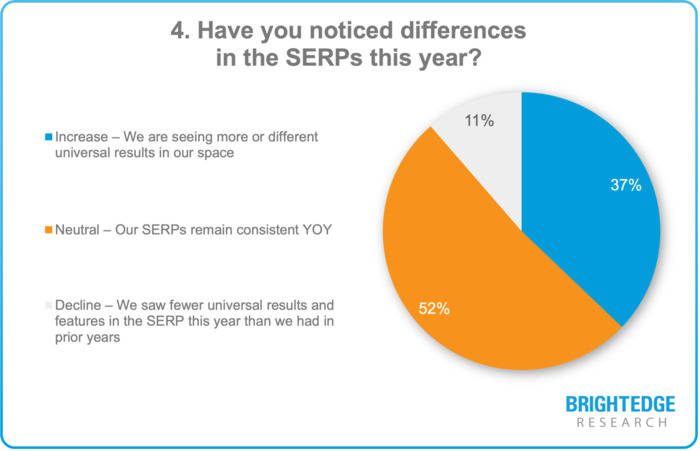
4. Have you noticed differences in the SERPs this year?
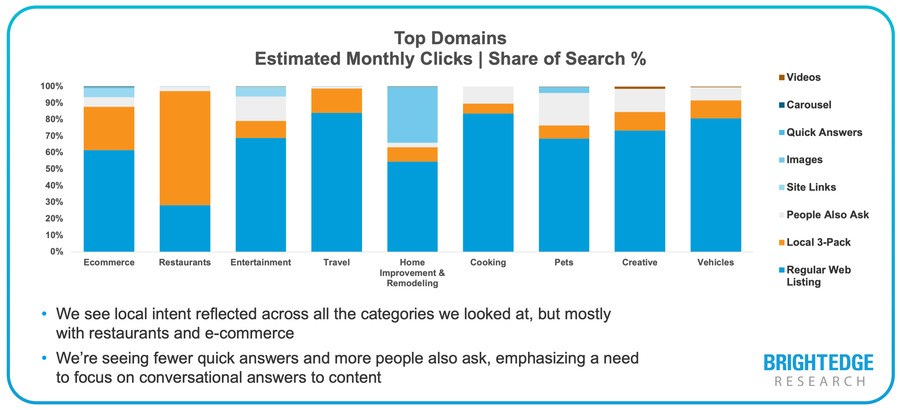
When we looked at the types of results presented in the SERPs for the top domains, we noted some changes compared to prior years including increased local intent reflected across all market segments, fewer quick answers and more people also ask results.
Our audience’s experiences were mixed. A slight minority (48%) saw some differences in the SERPs with 11% seeing fewer universal results and features and 37% seeing more universal results and features. More than half (52%) did not note any differences in their search results.
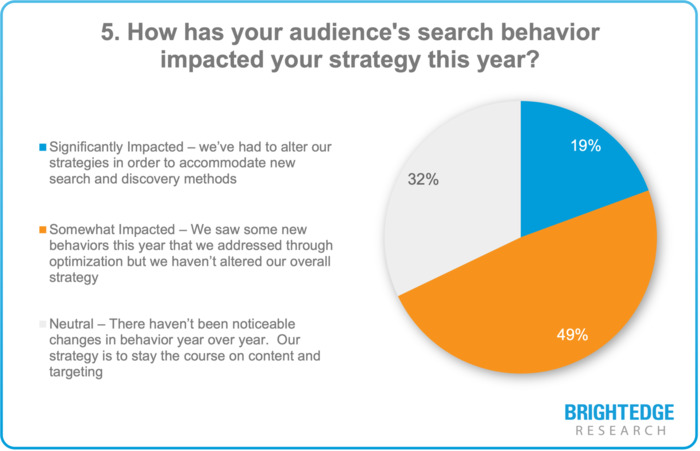
5. How has your audience's search behavior impacted your strategy this year?
More than two-thirds of respondents (68%) have had to address changes in their audience’s search behavior at some level. Just under half of respondents (49%) were able to handle behavior changes through optimization, while nearly one in five (19%) made additional adjustments in their strategies to accommodate search behavior changes.
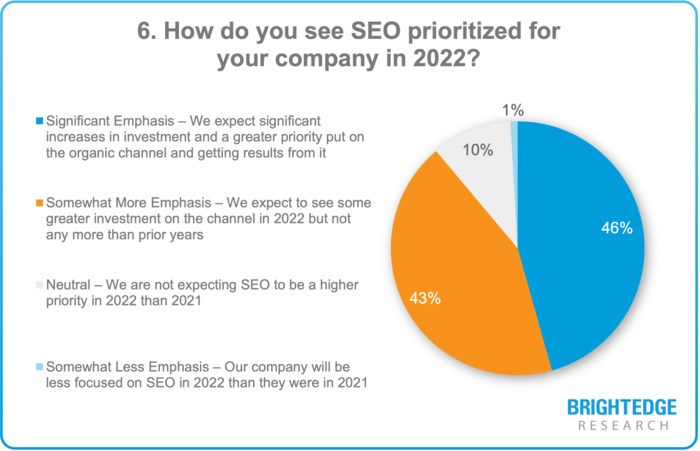
6. How do you see SEO prioritized for your company in 2022?
In 2022, SEO will take on greater importance in a vast majority of respondents’ companies (89%). Notably, nearly half of respondents (46%) expect the organic channel to be an area of significant investment in the new year.
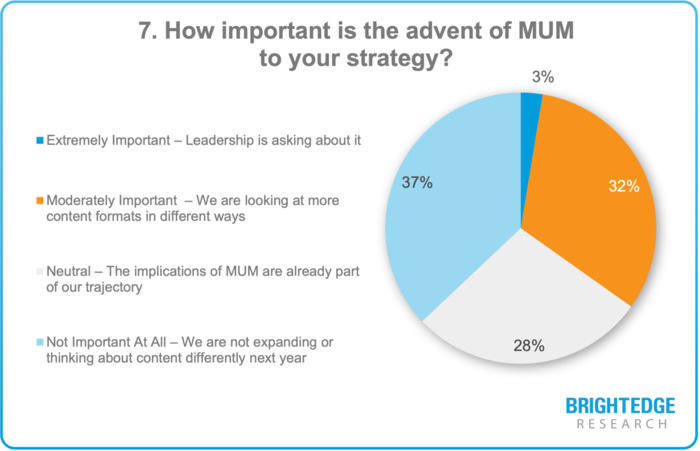
7. How Important is the advent of MUM to your strategy?
Earlier this year, Google introduced its Multitask Unified Model (MUM) technology designed to help users accomplish more with fewer searches. The company described MUM as 1,000 times more powerful than its current search model, BERT, and says it will begin rolling it out over the next few years.
We noted in the webinar that MUM reinforces the need for quality content and creates a virtual mandate that all content (video, images, PDFs, etc.) have SEO and query-intent factored into their development. Though it’s early days for the new search model, we asked webinar participants to what extent MUM is factoring into their strategies.
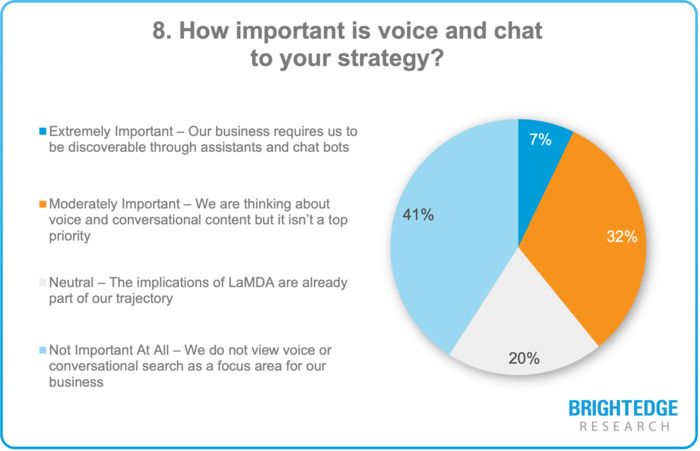
8. How important is voice and chat to your strategy?
Google is deeply focused on understanding search intent, decoding not just the content of a search, but the context. While details are still sparse, its announcement of LaMDA (Language Model for Dialogue Applications) in May 2021, crystallizes its interest in facilitating AI-driven conversation, an application highly dependent on understanding context. With this increased focus on voice and conversation from the organic search leader, we asked our audience to chime in on the role of voice and chat in their search strategies.
The results reflect the developing nature of the technology with 41% of respondents putting no emphasis on voice or conversational search, 52% of the audience noting some level of planning around it and only 7% of respondents placing significant emphasis on voice and conversational search.
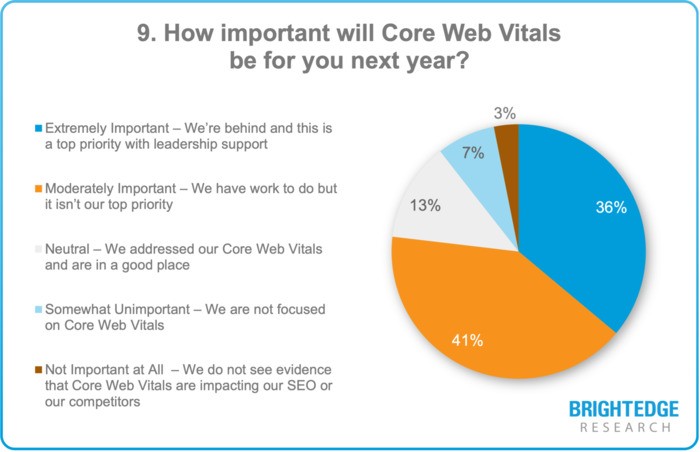
9. How important will Core Web Vitals be for you next year?
Core Web Vitals rolled out in 2021 and places greater emphasis on key user experience metrics including how quickly a page begins to “paint” in the browser, how soon a visitor can interact with the content and how stable the content is once it begins to load. Most importantly for companies that rely on the organic search channel, Core Web Vitals is a search ranking factor.
Many companies began work to improve their sites for Core Web Vitals this year. To better understand our audience’s progress, we asked them how important Core Web Vitals will be for them in 2022. The vast majority (90%) have completed or are prioritizing their work to support Core Web Vitals. Roughly three-fourths of the audience (77%) still has work to do, while just 10% are not prioritizing it.
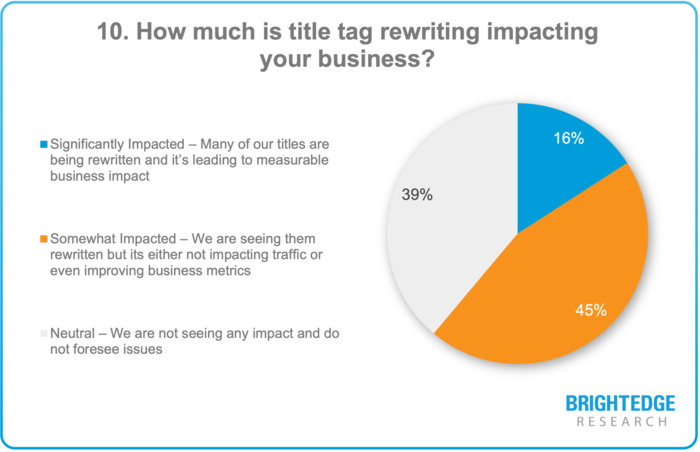
10. How much is title tag rewriting impacting your business?
In August of this year, Google announced a change in the way it handles title tags, confirming that it rewrites tags to better reflect what it believes to be the context of the content. As we noted in the webinar, Google’s rewritten tags can impact your search ranking negatively. The best thing you can do is write title tags that focus on the core intent of the page, avoid keyword-heavy title tags and ensure the query intent you’re trying to capture matches what your page provides.
Just under half of our poll respondents (45%) have observed rewritten tags, but did not note any negative consequences, but another 16% of respondents noted measurable business impact for the changes. We advise keeping an eye on title tag changes as these numbers may begin to shift as more tags are rewritten.
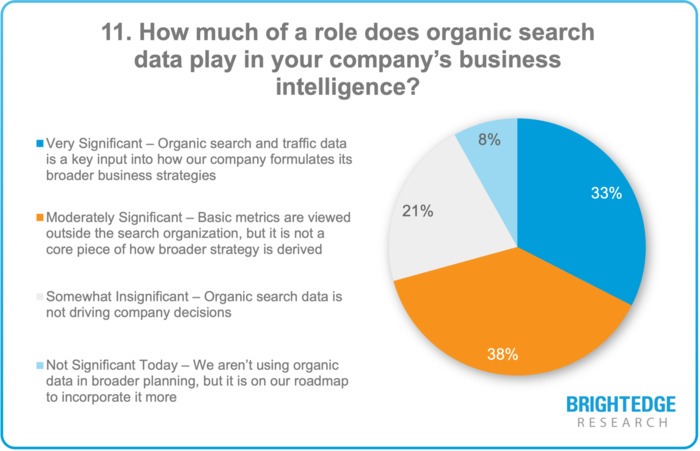
11. How much of a role does organic search data play in your company’s business intelligence?
Organic search is a rich source of consumer tastes and intent. Now, as the quality of user data from other digital channels diminishes in the face of privacy concerns, we expect organic search data to take on greater importance as a source of business intelligence. We wanted to understand to what extent search data is a factor in our webinar attendees’ business intelligence operations.
According to respondents, most (79%) said search data is or will be part of strategy planning. Notably, roughly one-third (33%) of those polled described search data as “a key input into how our company formulates its broader business strategies.”
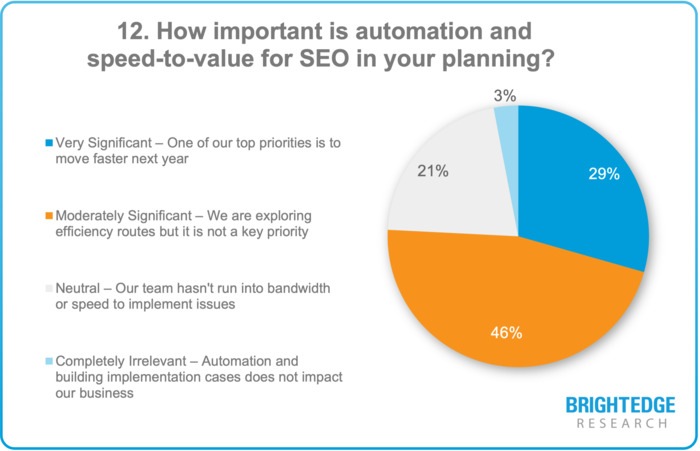
12. How important is automation and speed-to-value for SEO in your planning?
Finally, we predicted that SEO teams will need to find ways to do more and do it more quickly as conversational and contextual updates create more search paths, major updates released in 2021 like Page Experience and Mobile-First reach their full impact in 2022, and SEO becomes a bigger input into other channels.
We wanted to see if our audience’s plans reflect the same level of urgency for SEO that we are forecasting. One-quarter of respondents do not share our outlook that automation and greater speed-to-value are key SEO priorities in 2022. However, among the 75% that share our outlook, 39% (29% of all respondents) are making automation and speed-to-value a top SEO priority in 2022.
Looking Ahead to 2022:
We received a number of questions from participants during the webinar, and in the coming days, we’ll address a number of them in a follow-up post. Keep an eye out for answers to these questions:
What we can safely say about 2022 is that the year will continue to bring the types of changes to organic search that make us grateful to work in such a dynamic space. Much of the progress will come from the updates and new technologies introduced in 2021 as they continue to roll out and impact more content. At BrightEdge, we pay close attention to how the evolving search landscape generates new opportunities and potential impact for our customers. Bookmark our blog for ongoing guidance on new changes and updates to search throughout 2022.
To better understand how BrightEdge can help your business, schedule a demo today.

In mid-October 2021, Google began gradually rolling out continuous scrolling for mobile search results for English-language searches in the U.S. Mirroring the user experience on sites like Instagram and Pinterest where users scroll through results infinitely, continuous scroll will automatically load results beyond the first page – the first ten organic results – in mobile SERPs (search engine results pages). According to Google, a searcher will be able to scroll through roughly four pages of results before they are presented with a “see more” button.
While it is early in the rollout, it stands to reason that continuous scrolling will impact SEO. For starters, it blurs the lines between page one and page two (and beyond) results. Few people click on page two results partly because they may find what they need on page one, but also because they have been conditioned to perceive results beyond the first page as being low quality. Google reasons that searchers do, in fact, want to explore results beyond the first page. Currently, page 2 results produce an average click-through rate (CTR) of less than 1%. With continuous scrolling, what may previously have been a low-performing page two or three search result will likely reach more people. To measure the impact of continuous scrolling on your website, it will be valuable to measure if and how CTRs and other engagement metrics change for your mobile audience.
What is less clear right now, is how the presentation of results in a continuous scroll will change the rank of results. If Google is right and engagement improves beyond what was traditionally the first page of results, the increase in engagement, which is a ranking factor, will feasibly shake up the algorithmic rankings pushing some results further up in the SERP and others further down. At a minimum, by removing the inherent bias in presenting results in a paginated format, users will likely focus more on the perceived quality of the result vs. its position on the SERP.
How to Optimize for Continuous Scrolling
From a user’s perspective, because continuous scrolling places greater emphasis on the quality of the search result you will need to take extra care to ensure your content is created and optimized to meet a specific need. In other words, your content should be tailored to address a specific search intent for a specific audience. This way, you are creating personalized, quality content with the purpose of engaging with the audience you are attempting to target (vs. creating thin content for the sake of creating content).
Additionally, your content will need to be optimized impeccably (i.e., meta titles and descriptions optimized correctly with target keywords) to attract the attention of your target audience and be seen as click-worthy, because again, searchers may no longer see page rankings as the major determining factor in what they click on – it will be content relevance.
Key Takeaways
Overall, continuous scrolling reaffirms Google’s efforts to encourage the creation of relevant, focused and engaging content as judged by visitors to the search engine. It will take some time to discern the impact of continuous scrolling, but as always, brands should monitor anomalous changes in search rankings – up or down – especially for high-value content. If all works as Google intends, we expect that continuous scrolling will be a net positive with clicks being distributed more evenly across the top 40 results in mobile search.