POV: Does the Recent Google Search Console Update Matter?

The potential impact of a change to a core SEO and site admin tool

POV: Does the Recent Google Search Console Update Matter?

The potential impact of a change to a core SEO and site admin tool

Starting in January 2018 Google is rolling out the new Google Search Console Beta to all of its customers. The beta introduces a modern new interface for GSC's most popular features, with most of the remaining features being migrated over the next year. This is a significant change to business as usual for webmasters, SEOs, and other heads of digital, many of whom use GSC as part of their core website administration and analysis toolset.

What does this mean for you as a website owner? Will the updated Google Search Console impact your SEO workflow in a significant way, or is it just a new set of bells and whistles? Read BrightEdge's point-of-view to find out.

Download the full whitepaper to find out if the GSC update impacts your site.

CAPTCHA
Solve this simple math problem and enter the result. E.g. for 1+3, enter 4.
This question is for testing whether or not you are a human visitor and to prevent automated spam submissions.

Digesting the GSC Enhancements and How BrightEdge Customers Stay Ahead

cbao
cbao
M Posted 8 years 2 months ago
t 9 min read

Google is rolling out the first phase of the new Google Search Console (GSC) Beta this week to all of its customers. Google says it will be releasing additional functionality and enhancements in the new GSC over the next rest of the year. For Google Webmaster Tools diehards, it will allow you to toggle back if you miss the interface or some of the coming-soon features. Here is the in-platform message that appears in the classic version:

  • Search Console is introducing a redesigned product to help you manage your presence on Google Search. The new Search Console was rebuilt from the ground up to provide the tools and insights that site owners and SEOs have been asking for.
  • You can now confirm which of your pages are indexed and get information on how to fix indexing errors. You can also monitor your performance on Google Search with 16 months of data (to enable year-over-year comparisons).
  • We recommend checking your current status using the new Search Console today as we will only notify you if your site data changes from the current state.

The Webmaster Central Blog explains: "The functionality will include Search performance, Index Coverage, AMP status, and Job posting reports. We will send a message once your site is ready in the new Search Console."

Let’s dive in on new Google Search Console

The default view is Status, which looks pretty similar to classic GSC:

gsc enhancements to dashboard - brightedge

If you click on OPEN REPORT in the right, it gives you the additional controls of Result type, Country, Page, and Device.

gsc enhancements with data - brightedge

The controls are above the graph and allow you to visualize additional data. The Index Coverage reporting is below the Status and shows crawl errors in colors we have not seen in Google products before - Red for Errors and Yellow for warnings.

gsc enhancement site errors visualization graph - brightedge 

Google also reports on AMP errors and Job Postings errors.

What do GSC enhancements mean for you?

Google Search Console will continue to be a key utility in your website management toolkit. In GSC, you can submit a sitemap, see the broken links to URLs of your site, server errors encountered by Googlebot, see a sample of links, or test robots.txt, etc. The limitation with GSC, however; is that it is not designed for marketers to mine data and synthesize insights. For instance, how many clicks does it take for you to find out what keywords are driving traffic to your page? Furthermore, GSC Search Analytics data mainly shine a light on the efficacy of traffic acquisition through Google, including Clicks, Impressions, CTR, and Position. Users still need to manually marry their SEO metrics and website analytics to paint a full picture of the performance of their website content.

Where do GSC data fit into the content performance workflow?

  • In cyberspace
  • On the SERP
  • On your web page
  • On external websites

First, we should briefly discuss the holistic workflow of content performance by reviewing the cyber life stages of content, and where GSC data fits into the life cycle.

BrightEdge helps marketers throughout the content optimization life cycle and gsc enhancements

  1. In cyberspace. When your web page is ready to publish externally, you’ll need to first ensure that this page is discoverable by Google. As discussed above, you use GSC to submit a sitemap, validate indexation, and test robots.txt, to make sure that Googlebot knows to crawl this page and add it to Google’s index.
  2. On the SERP. Then, your SEO strategy is validated by whether or not Google finds your content relevant to the search query that you target to rank for. Every time Google presents your page against a specific search query, the page receives an impression, no matter what ranking position it may get. SEO is the art to help you increase your ranking position, which influences the total clicks you may receive. The other key element that influences the total clicks you receive is the content presented on Search Engine Results Page (SERP), where your page title and meta description may influence how much your SERP listing will resonate with the searcher in that moment when he/she is browsing the SERP and determining which web listing to click. If your SEO strategy is effective, you will see total Impressions, Clicks, and CTR gradually increase, while Position improves. To improve your SEO strategy, it will be important to understand whom you are competing with for that search intent, where you rank for each of the SERP, which could contain many different content types before organic web listings, and what your true ranking position is. These are the types of data that savvy SEO marketers turn to BrightEdge for. BrightEdge’s proprietary SEO data has been the gold standard in the industry, helping marketers develop and optimize their SEO strategies. With increased investment in R&D, we have also launched several new data collection and syntheses methodologies, such as visual parsing technology, which mimics the search experience through the eyes of a human.
  3. On your web page. Once the searcher clicks on your web listing, he/she will start engaging with the user experience presented on your website. You can lean on web analytics data to understand how long they stay on each of your webpage (Time on Page), what pages they click in that same session (Entrance Page vs. Exit Page, etc.), and whether or not they leave your site without clicking anything during that same session (Bounce Rate). Engagement is important, but not enough. With effective placement of CTA (call-to-action) links and/or buttons, you will be able to guide your visitor further down the conversion funnel to learn more about your company and product, and eventually, perform the critical conversion actions that your website is designed to do, be it “Request a Demo,” “Sign Up for a Free Trial,” or “Buy Now.” For some, this is where the life cycle of content ends - the ka-ching sound of conversion.
  4. On external websites. There is actually a way to stretch the life stage of your content - social sharing. Imagine your content is undeniably humorous, contains unique insights not easily attainable, or simply doesn’t exist anywhere else. Your content will sure receive lots of social sharing. These social shares will generate buzz for your content as measured by social mentions, backlinks, and increased SEO equity for your site. Digital marketing ninjas know about this and some spend a considerable amount of money driving social shares. BrightEdge has made it easy for you to see social signals and backlinks for each of your pages. With the introduction of AI-powered BrightEdge Home + Insights, BrightEdge customers receive instant alerts on quality backlinks they have acquired for the most important pages on their site each week.

How to fully unlock the value of GSC enhancements data

GSC data are used in many situations.

  • We just launched a new page, I want to know what keywords I’m ranking for this page.
  • I want to see if my page is ranking for more keywords after I have implemented content optimization efforts
  • For the whole site, I use GSC to review growth trajectory of organic visibility with Google
  • I use GSC to review the full list of non-branded queries that my site is ranking for
  • Did I drop out of the relevance for certain keywords? When did that happen? I wish I could be the first to know about it

With some of the latest innovations, most of these use cases can be fully accomplished directly from BrightEdge. BrightEdge recently launched deeper integration of the Search Analytics data from GSC into the BrightEdge platform. Customers can now easily see Clicks, Impressions, CTR, and Position of each page or search keyword in the Clicks and Impressions report in the Site Report module of BrightEdge, and they can slice and dice the data by device types. Better yet, users can easily click on each page URL to see the full list of keywords that this page has ranked for. The data are available for either tracked or not-tracked keywords or pages. This deeper integration makes it much easier for SEOs and content performance marketers because they can lean on one platform, BrightEdge, to easily review the KPIs of their content throughout the life cycle of each piece of content. No switching tabs. No jumping back and forth. No spot checking on top of your typical SEO workflow and data mining activities.

Richer data visualization and analysis

  • BrightEdge provides powerful ways to compare, contrast, and trend data. You can easily add trend charts of Clicks and Impressions for any given Page or Page Group to your existing dashboards in StoryBuilder.
  • You can now easily see if the Clicks, Impressions, CTR, or Position data have gone up or down compared to the week before when reviewing these data points from BrightEdge - something not possible in the current or new GSC portal.
  • In the drill-through report of all keywords that are driving Clicks and Impressions to a given page, you can also easily add that entire list of keywords to any dashboard. Thanks to the API integration, this list of keywords will automatically be refreshed each week. This will come in handy, especially when you want to monitor the total list of keywords that the page is ranking for each week - say the landing page of an integrated campaign to support the release of an important new product. 

Be the first to know

  • The integration of GSC data into BrightEdge platform also unlocks the additional capabilities that BrightEdge offers that will enable you to be the first to know of critical SEO KPI variances. For instance, BrightEdge customers can now use Anomaly Detection to be alerted if any of the key pages see a spike of Impressions or Clicks, beyond the expected Impressions or Clicks.

integrate gsc enhancements with the brightedge platform

Perpetual GSC data archive

  • Customers’ GSC data will be stored by BrightEdge indefinitely as long as the customer remains active. This helps customers to build longer history and richer context of the SEO performance of their content. For instance, when reviewing year-over-year performance variance, there might be an exciting moment, when you see Impressions for a page surged by 30% compared to last year. However, if you review the YoY data of the year before last, you might see that Impressions have been growing by 50% that year also. So, this 30% growth, although still excellent, is perhaps a warning sign that your growth rate has declined.

Conclusion

Google continues to innovate with this recent update to GSC. We will keep you posted on any nuances that will have a significant impact to your site management workflow or results. As stated above, this UI update to the GSC modernizes GSC. However, GSC data do not paint the full picture of content performance workflow. It remains critical for marketers to review the full range of data throughout the content performance life cycle in order to improve on SEO discoverability and the business ROI that their content can produce. BrightEdge’s commitment to on-going investments in providing comprehensive data makes it easy for marketers to succeed. Log into BrightEdge today and see the familiar GSC data, presented with the new and powerful visualization capabilities.

Google is rolling out the first phase of the new Google Search Console (GSC) Beta this week to all of its customers. Google says it will be releasing additional functionality in the new GSC over the next rest of the year. For Google Webmaster Tools diehards, it will allow you to toggle back if you […]

The post Digesting the GSC Enhancements and How BrightEdge Customers Can Stay Ahead appeared first on BrightEdge SEO Blog.

BrightEdge at Adobe Summit 2018

Join the BrightEdge Customer Dinner on Tuesday

BrightEdge at Adobe Summit 2018

Join the BrightEdge Customer Dinner on Tuesday

March 25-29, Las Vegas

BrightEdge welcomes you to Las Vegas for an evening of networking, drinks, and dinner conveniently located at the Carnevino, a critically recognized Italian steakhouse and private dining venue on Las Vegas Boulevard, located in the Venetian.

  • Carnevino, Barbaresco Room; 3325 S. Las Vegas Boulevard; Las Vegas, Nevada 89109
  • 7:00-7:45PM Cocktail reception
  • 7:45-10:00PM Private seated dinner

Register for Adobe Summit with the BrightEdge promo code and receive $200 off your ticket price: onebxwtt10265_133

Thank you for your interest, registration is now closed.


brightedge at adobe summit customer dinner 2018 carevino venue photo

SEO Best Practices 2020: Seizing Opportunities

enewton@brightedge.com
M Posted 8 years 2 months ago
t 9 min read

What are the SEO best practices for the year 2020?

SEO best practices for 2020 SEO management are numerous, but can be divided into five categories:

  1. Multichannel & hybrid marketing
  2. Using Schema
  3. Meta descriptions
  4. Optimizing site-wide
  5. Journey Diversification and micro-moments

The impact and influence of a brand’s online presence cannot be underestimated. Seventy-two percent of millennials say that they conduct online research before they go shopping in person. For those buying directly through websites, online spending in the US alone is expected to exceed $420 billion by 2020 according to Statista, up from just $231 billion in 2012. On the B2B side, approximately 94 percent of buyers said that they conduct online research before making a purchase. Regardless of whether you are in the B2B or B2C sector, it is clear that having a strong online presence is necessary for a brand to grow.

Despite the clear directive that all brands should be investing in SEO and content marketing, many organizations are left stranded as the algorithms continue to change at lightning speed, forcing changes in SEO best practices as well. Just in the past year we have seen changes in the SERP layout and the growth in the popularity and use of AMP pages. Google has also been experimenting with the titles and meta descriptions on the SERPs, offering some sites extra space, but this has yet to be rolled out universally. For brands to thrive in this environment, they must be able to adopt the latest industry advice. Understanding SEO best practices can help brands build a strong site as we prepare to finish up this year and head into the next.

Demo SEO Platform BrightEdge

Emphasis on multi-channel integrated marketing and hybrid marketers

Multi-channel marketing describes campaigns that reach across platforms and devices to connect with customers, taking into account channel agnostic consumer behavior. An estimated 95 percent of marketers say that they know multi-channel marketing is important, yet only 14 percent are successfully coordinating these hybrid campaigns. This creates a huge disconnect between what people know to be Google SEO best practices and how they are able to build their own organizations to meet the needs of these consumers. Building these multi-channel marketing campaigns requires professionals who have hybrid abilities that can stretch across specialties. These individuals should cultivate their skills by:

  • Using self-training options, such as online classes and videos to start learning about different areas of marketing
  • Building relationships with those in other departments
  • Encouraging coordination and collaboration with other specialties to learn their strategies and best practices

Brands themselves must also work on building multi-channel campaigns that will help them better reach their customers across all platforms. Customers are active on a variety of platforms and channels including:

  • Mobile
  • Desktop
  • Social media
  • Email
  • Organic search
  • Paid search

Brands interested in effectively reaching these customers need to coordinate their campaigns across these different areas. This means understanding SEO best practices and thoroughly mapping the buyer’s journey to their target personas, taking into account the different devices and platforms that a prospect might use. This will help them create effective content for the different touch points. Campaigns should also be run that take into account the consistency that customers want to see.

Sixty percent of millennials say that they expect a consistent brand experience across all channels, including offline. This means the promotions you run in paid search should match what is being delivered in store, for example. To excel in SEO best practices, you need to incorporate this cross-channel trend into your marketing model.

Schema and SEO best practices in 2020

Schema is a type of markup that helps to label the parts of websites, making it easier for algorithms to ‘understand’ the site and types of content available. This helps to increase your visibility and reach. Schema has also become increasingly important throughout 2016 and will likely to continue to grow in significance as we head into the new year. Google uses these markups in a variety of ways. For example, they are used:

  • Schema is important for getting the Google for Jobs listing details correct
  • Schema is important for review information and star ratings
  • To know what sites qualify for rich listings, such as the cards appearing at the top of the results page for movie and recipe queries
  • They may be helpful to guide the machine learning part of the algorithm, also known as Rankbrain
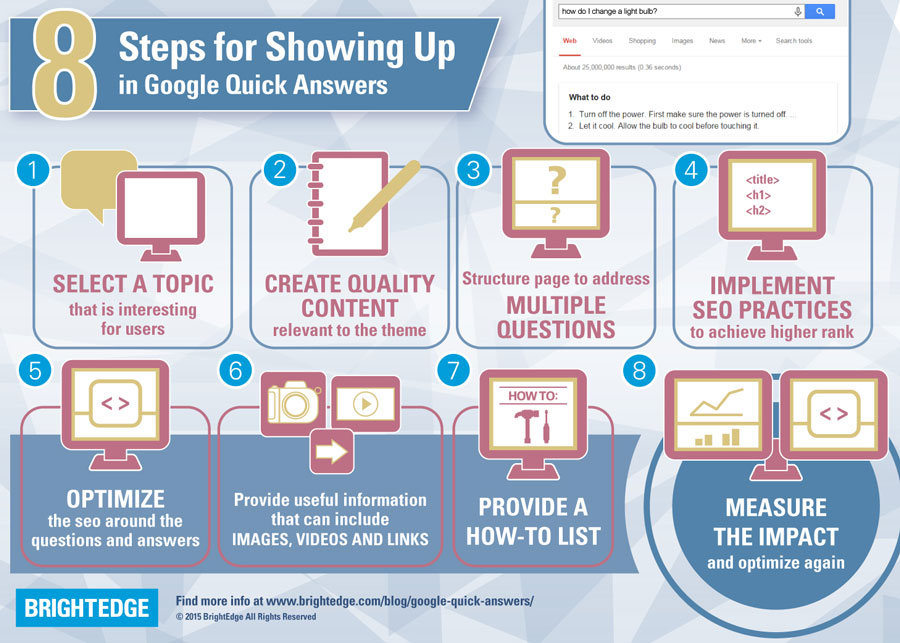
  • It may also help with getting your website selected for Google Quick Answers

How critical is schema to your digital success? Find out here.

Create more robust meta descriptions

Your meta description is the few sentences that appears under your URL on the SERP. Google has increased the number of character spaces they allow brands to around 300 in their meta descriptions among the top three results. The brands that do receive the additional space have been noticeable. The meta descriptions have more lines and stand out on the SERP. These brands now have more space to use keywords to match user intent and show why their site is the superior choice to the others on the SERP. All brands should be focusing on their meta descriptions in light of these changes.

Although not everyone will have the extra space, it is possible that there could be a greater roll-out at any point. Brands that are prepared for this boost will have greater success with their meta descriptions. It is also common for some websites to have short descriptions - under 100 characters - that did not really cause much of a problem when the general maximum was 156 characters. Now, since many brands have significantly more, the websites that have the excessively short descriptions look even more out of place and incomplete.seo best practices for the new year - brightedge

It becomes easier for these sites to be hidden and overlooked on a SERP that has multiple long descriptions. All sites should make sure they have descriptions of about 150 characters that include their keywords and relevant information to entice people to click. Meta descriptions are important in SEO best practices.

Optimizing your entire site

With each passing year, we see an increased number of people building websites and producing content. Ninety percent of the world's data was produced in the past two years alone. If you want your site to succeed, you need to make sure you are not overlooking any potential optimization opportunities for SEO best practices.

Alt Tag SEO best practices

Since humans process visual stimuli as much as 60,000 times faster than text, images are a great way to reach your audience. Your alt tag should include your targeted keyword and make the value of your image clear to the search engines. Remember, the search engines cannot see your image, it is up to you to tell them what it is and why it is important.

youtube seo best practices 2016 - brightedgeYouTube SEO best practices

Videos and are also becoming increasingly significant aspects of SEO. YouTube has also become the second largest search engine, behind only Google. Remember, however:

  • Include keywords in your description and title to make your purpose clear
  • Create videos that provide value, not ones that are basically advertisements
  • Focus on building a strong channel overall, followers will help boost the rankings of all your videos

You can find more optimization suggestions for YouTube.

Journey Diversification and Micro-moments

Micro-moments are intent-filled moments when people reach for an online device, often a mobile phone, to answer a need that has suddenly presented itself. Google has outlined four main types of micro-moments that it wants sites owners to focus on to improve the quality of the results. These are the:

  • I-want-to-know moments
  • I-want-to-go moments
  • I want-to-do moments
  • I-want-to-buy moments.

micro moments and google SEO best practices 2016 - brightedge The better brands are able to meet the needs of these customers, the easier it will be to begin to build relationships with them. Google introduced AMP pages in 2015, and they have been increasing throughout last year. These pages are stripped of anything extra so that the page loads faster, meeting the needs of customers who are becoming increasingly frustrated with slow-loading pages. A one-second delay when a website loads results in an estimated seven percent decrease in conversions. AMP was originally designed for news sites, serving many of those in the I-want-to-know micro-moment.

The year 2016 saw the major e-commerce site eBay introduce the new structure on millions of their site pages, helping them to serve the I-want-to-buy demographic even faster.

How important is AMP in the success of your site? Learn more here. For SEO best practices, it is important for sites to focus both on speed and serving people in these particular micro-moments. Consider how your content addresses the needs of each group and create material, especially on mobile, that is designed to provide people with the quick, thorough answer they are often looking for on these searches. You also want to emphasize speed on your sites. Even if your pages would not be served well by AMP, you still want to make sure you maximize your loading speed. This means:

  • Avoiding images that take too long to load
  • Not using unnecessary cookies or other add-ons that will slow the site
  • Enabling browser caching
  • Allowing the site to be compressed

For more information on how to tailor your content to these customer micro-moments, be sure to explore our free research report on how to produce content in a way that delivers results. SEO best practices continue to change and evolve as Google adjusts its algorithm and consumer expectations evolve. For brands to succeed in the increasingly competitive digital landscape, brands want to make sure they stay abreast of these latest developments so their website remains relevant, visible, and useful for the search engines and customers.

L'Oréal Increases Conversions for Kiehl's Using BrightEdge Insights

Carlos Spallarossa, director of SEO for L'Oréal, explains how he used BrightEdge Insights to drive 30% growth in Quick Answers placement for Kiehl's

,