



Voice represents a significant transformation to the way end users interact with Search. The convergence of Voice, vertical search engines, and mobile will accelerate the fragmentation of Search and the need for agile and targeted SEO. Organic continues to be a critical channel for marketers. The expansion and modification of paid search placements on Google, […]

The post SEO for Voice Search: Are We Looking at Optimization the Right Way? appeared first on BrightEdge SEO Blog.

Three out of four believe that AI applications are the next mega trend

English, British
News Item Title
Three out of four believe that AI applications are the next mega trend
News Item Author Name
Eileen Brown
News Item Published Date
News Item Summary

In a follow-up to its 2017 survey on the future of marketing and content, Foster City, Calif-based organic search and content platform BrightEdge has released new finding from a survey of Fortune 500 marketers.

15 Mind-Blowing Stats About Artificial Intelligence

English, British
News Item Title
15 Mind-Blowing Stats About Artificial Intelligence
News Item Author Name
Giselle Abramovich
News Item Published Date
News Item Summary

When asked about the next big marketing trend, survey respondents identified consumer personalization (29%), AI (26%), and voice search (21.23%). These top three responses, which total 75% of all AI applications, demonstrate that AI is more pervasive and prominent than respondents realize.

Hyperlocal SEO: How to Optimize for Micro-Moments

English, British
News Item Title
Hyperlocal SEO: How to Optimize for Micro-Moments
News Item Author Name
Cynthia Johnson
News Item Published Date
News Item Summary

Mobile search results are frequently different from desktop SERPs. BrightEdge reported that 79% of keywords overall and 47% of the top 20 SERPs are different on a mobile device.

Marketers on the Lookout for Artificial Intelligence in 2018

English, British
News Item Title
Marketers on the Lookout for Artificial Intelligence in 2018
News Item Author Name
Ricky Costa
News Item Published Date
News Item Summary

Recent research from BrightEdge investigated the future trends of artificial intelligence, its benefits, and challenges for today's digital marketer.

Online Marketers: The Next Big Trend in Marketing

English, British
News Item Title
Online Marketers: The Next Big Trend in Marketing
News Item Author Name
Ayaz Nanji
News Item Published Date
News Item Summary

What do online marketers believe will be the next big trend in marketing? To find out, BrightEdge surveyed 500 search, content, and digital marketers in February of 2018.

Powering Modern Marketing Stack with Smart Content

A BrightEdger
A BrightEdger
M Posted 8 years 6 months ago
t 9 min read

Integrating modern marketing and smart content allows brands to optimize performance for Organic and other digital marketing channels along the buyer's journey and funnel.

BrightEdge developed the Smart Content framework partially as a response to many brands’ struggle to make their regular content highly visible in organic listings on search engine results pages (SERPs). The core challenge of marketers today is something we call “content congestion:” the deluge of articles, blog posts, social posts, emails, videos, glossaries, and other types of content vying for customers’ attention online. The smart content framework provides something akin to a fast lane: it packs enough SEO and mobile-friendliness best practices into the content from the moment it is published so that it gets to the top of the SERP in a relatively shorter amount of time, offering strong organic search success. marketing and smart content - brightedge As more brands adopt an augmented marketing with smart content, it becomes increasingly clear that the framework provides marketing benefits far beyond the organic channel. We’re seeing early adopters of the framework successfully implement smart content in paid search, email, and social media campaigns. The key to smart content success in all of these marketing channels is, to a great extent, its ability to identify specific customer intent. The content pieces are developed less as a platform for top-down brand messages and more as a targeted and direct response to  specific customer needs. And because of that smart content tends to perform well in any direct response campaign. Let’s look at several examples.

Smart content for paid search

Paid search and organic search work hand-in-hand, occupying the same touch point--the SERP. Historically, the overlap between paid and organic was not extensive: often paid search managers developed their own campaigns and landing pages with little regard to organic objectives or performance. These days paid search managers are working more closely with their SEO counterparts, coordinating, for instance, paid investments for important organic topics that have no organic real estate above the fold of the SERP. Some of these PPC managers go a step further. They examine the user questions that smart content pieces target and start bidding on them for paid search campaigns. Since these pages are fully tuned for their respective queries, and since they perform very well given their integrated CTAs and content recommendations, they tend to outperform traditional paid search campaigns. One such advertiser, WhiteHat Security, a BrightEdge Content customer, saw its average quality scores nearly doubled for smart content PPC campaigns, which helped them lower cost per click, increase total clicks for its budget, and boost website lead generation by 150%.

Plugging in a smart content topic in can easily extend to email marketing. When the topic is developed using the voice of the customer, it lends itself well to email subject lines that quickly resonate with their target audience, boosting email open rates. Some early adopters of the Smart Content framework leverage their new page content by incorporating it into the email body. Tuned copy and imagery, built-in CTAs, and even suggestions for further reading work exceptionally well to drive email clicks and website visits. And once they have landed on the site, visitors are introduced to other compelling content developed through a cohesive content strategy to solidify utility and thought leadership on emerging topics. marketing and smart content with brightedge

Smart content for social media

Lastly, smart content also works for social campaigns. We have seen brands extend their marketing and smart content from the website into LinkedIn, Facebook, and Twitter posts and articles. Again, since the content leverages the voice of the customer faithfully, it resonates well with social media users who engage with and share smart content. Social amplification of content is a key tenant of the smart content framework, whereby writers promote their new content as soon as it gets published. With its attention to the voice of the customer and performance-first approach, smart content fuels the heart of marketing. Even though smart content was born out of the need to win on the SERP, it’s becoming clear that forward-thinking brands are leveraging their initial content investment and reaping great benefits across channels and touchpoints to provide customers with consistent and engaging experiences that drive engagement, trust, and loyalty.  

Integrating the modern marketing stack with Smart Content allows brands to optimize performance for Organic and other digital marketing channels along the buyer’s journey and funnel. BrightEdge developed the Smart Content framework partially as a response to many brands’ struggle to make their regular content highly visible in organic listings on search engine results pages […]

The post Powering the Modern Marketing Stack with SEO Insights and Smart Content appeared first on BrightEdge SEO Blog.

Success in Financial Marketing Requires AI and Machine Learning

English, British
News Item Title
Success in Financial Marketing Requires AI and Machine Learning
News Item Author Name
Jim Marous
News Item Published Date
News Item Summary

A survey from BrightEdge asked 8 key questions related to the future of marketing and topics centered around the challenges, solutions, and adoption of Artificial Intelligence.

Question-Answer SERPs: Search Intent Is Nearly Certain

maspillera
maspillera
M Posted 8 years 7 months ago
t 9 min read

3/22/2018 Update: Google's test of question-answer SERPs is now officially on hold. Danny Sullivan stated that, in response to a week's worth of data and user feedback, Google is concluding the experiment and looking at "improving when and how it appears," suggesting the question-answer SERP could reappear in the future in a re-optimized format.

Google is testing a new type of "question-answer SERP" that shows just one answer for a basic query. This is another evidence that Google is making search a helpful and personalized utility to help each search user as immediately as possible. However, marketers do not have to worry about immediate negative impact to their search efforts. 

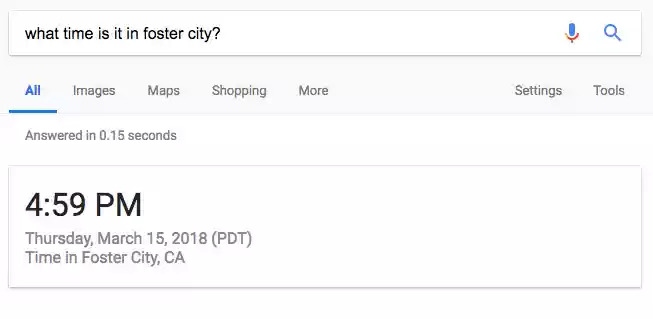
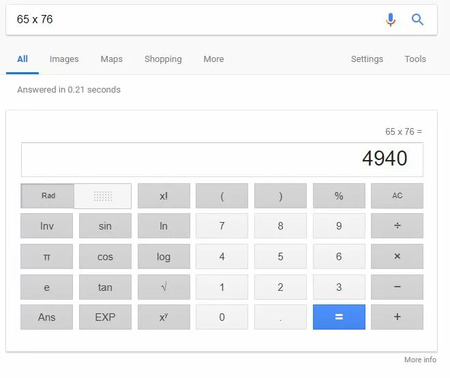
What is happening? Stop and think about it. When someone asks you a question you don't provide a menu of ten answers framed with extra visual content at the top and on the right. You just pick the best answer and reply, and if you are unsure, you might use "It depends" as a way to collect more specific information. It is a logical evolution of artificial intelligence (AI) that Google and its RankBrain algorithm are so confident in interpreting some search queries that they provide just a single result. In a sense this is Google being helpful and providing the user the answer in the quickest and most direct method possible. This week Google started a large-scale experiment where they show a single answer for a simple query like, "what time is it." "what time is it" example of a question-answer serps result - brightedge Another type of question-answer SERP is for temperature, and another comes up for calculating the results of a mathematical query. example of a google query-answer serps for a multiplication problem - brightedge
What does this mean to you? As usual, BrightEdge synthesizes industry trends and provides context and perspective to help our community of SEOs and digital marketers explain new phenomena like this. Because this kind of one-result SERP typically are presented for search queries which are purely informational in nature, we expect there will not be a dramatic drop in Impressions, Clicks or Position for marketers. For most marketers, these are the type of keywords you either do not currently rank for, or do not want to focus your efforts creating content for.

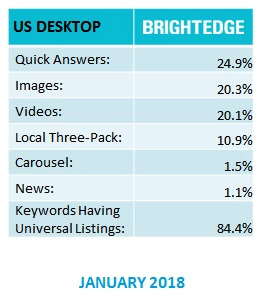
How is the SERP evolving? Let's zoom out a bit and look at the broader picture. Universal SERP elements are increasingly present in search results. BrightEdge Research found that 84.4% of SERPs in January 2018 had at least one universal results SERP element. When these results are ads, all organic results are pushed further down to the fold. When the universal results link to Google assets, this also reduces the opportunity for organic traffic. BrightEdge Research has counted more than 40 different Universal SERP elements but 6 types make up 79% of that 84.4%. BrightEdge research displaying percentage distribution for question-answer serps So, the other 34 SERP elements make up about 5% and are unlikely to have a commercial impact on the BrightEdge Community. So while interesting to observe it doesn't change workflow or approach.

How do you handle this change?  BrightEdge has developed what we call visual parsing technology, to help our customers understand each content type that is occurring for every single keyword. Thinking about keywords in 40 SERP types is not realistic, so we recommend organizing keyword opportunities into 4 main buckets: Defend, Optimize, Create, and Collaborate. The main difference between each bucket is looking at if there is organic content above the fold and is your content above the fold.

BrightEdge has created a StoryBuilder template to help customers organize around this structure with its Intent Signal Dashboard. Intent Signal analyzes if a keyword has any organic listing above the fold (by Desktop, Tablet or Smart Phone) and whether you have content shown above the fold for that keyword. This insight helps you refine the optimization work plans for the most valuable keywords you are trying to optimize or create content.  Log in to your BrightEdge account, go to StoryBuilder, click on the templates icon (which is to the left of the edit pencil) and select Intent Signal Dashboard. In closing, content marketing and SEO needs to be guided by where the return of traffic promises to outweigh the costs of creating content to target it. Understanding the SERPs and prioritizing keywords is the best way to intelligently develop and deploy your content assets for your audience. Learn more about SERPs and universal SERP elements in this post.


​

,