
[3/22/2018 Update: Google’s test of question-answer SERPs is now officially on hold. Danny Sullivan stated that, in response to a week’s worth of data and user feedback, Google is concluding the experiment and looking at “improving when and how it appears,” suggesting the question-answer SERP could reappear in the future in a re-optimized format.] Update! We have enough […]

The post Question-Answer SERPs: When Search Intent Is Nearly Certain appeared first on BrightEdge SEO Blog.

How communicators will use AI in content marketing this year

English, British
News Item Title
How communicators will use AI in content marketing this year
News Item Author Name
Bulldog Reporter
News Item Published Date
News Item Summary

Marketers have become more receptive to the adoption of artificial intelligence technologies, according to new research from SEO and content performance marketing firm BrightEdge.

Google Adds Multiple Quick Answers to SERPs

maspillera
maspillera
M Posted 8 years 7 months ago
t 9 min read

Google has begun displaying multiple Quick Answers on certain search engine result pages (SERP). How does this impact optimizing for the Quick Answer box and featured snippet placements?

Buried in a January article on Google's The Keyword webmaster blog was a mention that the search engine giant was going to start displaying more than one Quick Answer featured snippet on a single SERP. The article stated:

"Another format coming soon is designed to help people better locate information by showing more than one featured snippet that’s related to what they originally searched for... Showing more than one featured snippet may also eventually help in cases where you can get contradictory information when asking about the same thing but in different ways."

By displaying more than one Quick Answer on certain SERPs, Google hopes to expose searchers to a wider array of information sources, especially in cases where an authoritative answer to the query is under contention. Of course, for SEOs and digital practitioners this change presents a lot of questions: Does this affect the process for going after placement? Will it lower the click-through rate for sites that hold the Quick Answer spot on a key SERP?

SEO benefits of having the Quick Answer

It might be hard to remember now, but there was a brief time when some SEOs viewed the featured snippets, and the Quick Answer box in particular, with mixed feelings. Early on there were worries that being in the Quick Answer position, especially for query-based keyword phrases, would actually lower the CTR to a brand's site from that SERP. After all, if the user's query is answered right there on Google's page, why bother clicking through to the site that Google is citing in its featured snippet? A 2015 case study by SearchEngineLand columnist Glenn Gabe noted a loss of more than 39,000 clicks for a site that lost the featured snippet placement for a competitive keyword. The following year HubSpot published a study that was even more conclusive: In looking at SERPs for high-volume keywords it found that sites in the featured snippet position enjoyed a CTR increase of over 114%, even when the same site already ranked #1 in the organic listings. We also know that Quick Answers, along with other featured snippet types, is playing a large role in voice search results, as noted by Danny Sullivan of SearchEngineLand back in 2016:

While not the same kind of direct impact as a click, the source attribution provided by Google Home still provides a marketing touch that connects the searcher with your brand, encouraging them to explore further if your content resonates. Having that position also prevents your competitor from getting the mention and branding. It's clear now that the Quick Answers box is a desirable place to be. But what happens when there's more than one?

Do multiple Quick Answers hurt SEO impact?

Your first inclination might be to think that this will reduce the CTR boost provided by holding the Quick Answers position. If the Quick Answers box, "Position 0" on the SERP, provides X amount of CTR boost then it should follow that introducing a "Position -1" would reduce that boost to X/2, right? (or maybe that's just if you're a pessimist like me). It's still too early to make any definitive statements, but we are not necessarily convinced that a reduction will be the case.

What is Google saying about multiple Quick Answers?

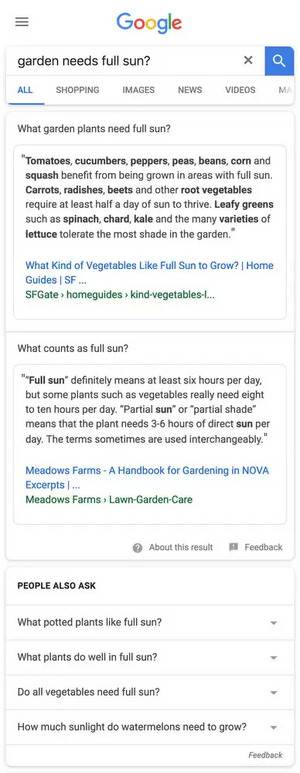
As noted earlier, Google said that it is rolling out multiple Quick Answers on a single SERP as a means of presenting additional data sources and/or points of view, especially for queries where the answer is in contention and contradictory answers exist. In another blog post, Google stated that it intends to start with what it calls "multi-intent queries" where there could be several potential intentions associated with the question being asked. For example, the query below, "garden needs full sun?": example of a featured snippet box with multiple quick answers present - brightedge The query isn't in written in full sentence structure, so Google has gone out on a semantic limb to present answers for associated queries "what garden plants need full sun" and "what counts as full sun?" in addition to a People Also Ask box underneath.
Why multiple Quick Answers won't likely affect CTR

By its own admission, Google is still in the experimentation stage of having multiple Quick Answers for a single query, so it isn't prudent to make too many predictions until there's been time for more user data to come in.

Google has said, however, that its aim in the near future is to expand the feature from multi-intent queries to also cover "guidance-seeking queries." This would entail multi-faceted queries like "is it worth aggregating smaller SEO tools?"

Theoretically, the Quick Answers section of the SERP would present you with answers covering various facets, such as cost-benefit analysis, IT compliance, onboarding, integration requirements, etc.--all of which pose a variety of new and potentially interesting opportunities for organic search marketers and SEO to get their content in front of the eyes of low-volume, high-intent audiences who are asking highly specific questions about a product or service.

In short, it doesn't seem like multiple Quick Answers will create a global drop in CTR for lower-placed answers because Google's intent is to provide different types of answers, not simply a flat architecture of competing answers.

What it likely will create, however, is a need for additional focus on optimizing the query-answering sections of your ranking content to provide the best possible answer versus competitors within the Quick Answers grid. Ascertaining the customer intent behind keyword phrases that have featured snippets on them will be more important than ever.

Effect on optimizing for Quick Answers box

Because of how Google has rolled out this change to featured snippets, we don't anticipate that the best practices for appearing in Quick Answers will change either. We suggest that for the time being, SEOs and digital practitioners stick to the Quick Answers optimization practices we detailed in a variety of places, including our comprehensive white paper on How to Get Into Quick Answers.

If your site ranks in Quick Answers for keyword phrases that you've identified as valuable to your brand, begin monitoring those results over time to see if multiple Quick Answer boxes begin appearing on the SERPs. You should also continue to monitor two other basic metrics:

  • Total number of Quick Answers positions you rank for
  • Total number of tracked keywords that have Quick Answers featured snippets, but you don't rank for them

Knowing the Quick Answers you do rank for will help you to narrow down your search for SERPs with multiple Quick Answers. You can create a keyword group to monitor the progress, and make sure you defend those positions. Additionally, knowing the keywords with Quick Answers presence will help you to identify and isolate ones to pursue in the near future. Once you have identified these keywords you can optimize and create content to rank for those Quick Answers. And now with this change in Google, you can run a Data Cube analysis to find all semantically related terms to make sure your content covers all major areas for that one topic. For example, keyword phrases containing more nuanced, multi-faceted queries like "benefits of marketing automation" could now possibly be opened up to many more ranking opportunities as opposed to the simple binary win-lose of having a basic Quick Answer featured snippet on the SERP. You can easily track both of these metrics by using the Universal Search Results view in the Keyword Reporting module of BrightEdge.
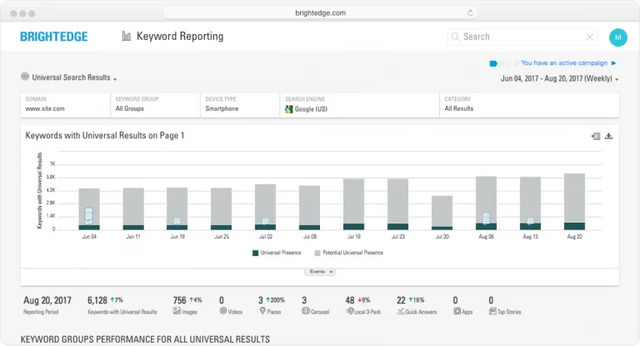
universal listing for multiple quick answers - brightedge

The caveat to all of this is that, as most SEOs working within a smart framework know, any amount of hypothesizing isn't nearly as valuable as real data. Observe the SERPs for the keyword phrases you care about, monitor your CTR both globally and on a per-page basis, and adjust tactics dramatically only when the data supports it and/or a Defend/Recover crisis seems imminent. For an in-depth walkthrough of how to optimize for Google Quick Answers, be sure to download our collection of 20+ best practices. 

Google has begun displaying multiple Quick Answers on certain search engine result pages (SERP). How does this impact optimizing for the Quick Answer box and featured snippet placements? Buried in a January article on Google’s The Keyword webmaster blog was a mention that the search engine giant was going to start displaying more than one […]

The post Google Adds Multiple Quick Answers to SERPs: What It Means for SEO appeared first on BrightEdge SEO Blog.

Digital Marketers Point to AI-Powered Applications as Their Next Big Trends

English, British
News Item Title
Digital Marketers Point to AI-Powered Applications as Their Next Big Trends
News Item Author Name
MarketingCharts
News Item Published Date
News Item Summary

What's "the next big trend" in marketing? BrightEdge asked more than 500 search, content, and digital marketers that very question.

Search Engine Optimization 101

Search Engine Optimization 101

This webinar will help you build a strong foundation of SEO knowledge.

Available on-demand

Whether you're new to the world of SEO or looking to help educate others in your organization, this webinar will help you build a strong foundation of knowledge. We will talk through real-world example and best practices.

  • What is SEO?
  • How do search engines work?
  • How to succeed in SEO?
  • How to identify quick wins?

Download now.


AI, Content and Search: 5 Macro Market Trends for Micro Marketing

English, British
News Item Title
AI, Content & Search: 5 Macro Market Trends for Micro Marketing
News Item Author Name
Andy Betts
News Item Published Date
News Item Summary

A recent BrightEdge survey of over 500 search, content and digital marketers found that more than 30% of respondents cited a better understanding of the customer as the foremost advantage.

WhiteHat Security Uses Smart Content Framework

cbao
cbao
M Posted 8 years 7 months ago
t 9 min read

We recently caught up with Avi Bhatnagar, Senior Director of Digital Strategy at WhiteHat Security, to learn about how he increased website traffic and leads using the BrightEdge Smart Content framework. Avi oversees several marketing channels and often comes up with a new approach for one program that he later reapplies elsewhere. The interview below covers his recent experiences.

The New Era Of Smart Content

Smart Content framework interview

BrightEdge: Avi, what does WhiteHat Security do?

Avi Bhatnagar: WhiteHat Security has been in the business of securing applications for over 15 years. It offers a cloud service that allows organizations to bridge the gap between Security and Developers. We are the leading application security provider that combines the best of technology and human intelligence to ensure a safe digital life for our customers.

BE: You’ve been focusing on brand awareness and top-of-the-funnel traffic lately. Tell us about that.

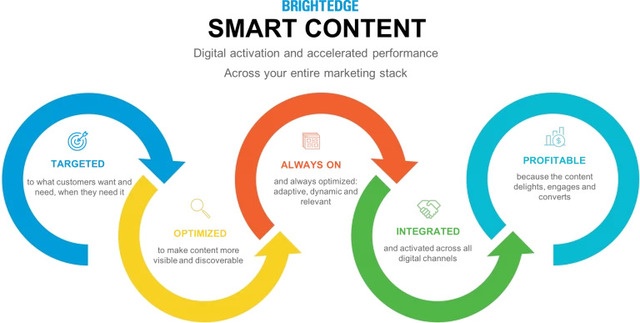
AB: Yes, as we all know, the last few years have seen an enormous increase in data breaches, malware attacks, and other security nightmares. Just few months ago, there were several high profile data breaches reported, including the news about Equifax. It became a priority to educate security teams and developers about the importance of security best practices in the application development process, as opposed to treating security as an afterthought. Increasing brand awareness through valuable content becomes an apparent opportunity. Therefore, we developed a Knowledge Center glossary for our audiences to leverage as a source for Quick Answers. We leveraged a framework called Smart Content to ensure that those new website pages would be optimized for search engines and accessed by lots of people much faster than how traditional content performs. smart content framework for seo - brightedge

BE: How did you apply the Smart Content framework?

AB: Traditional content development starts with an ideation process around the topics that are aligned with our integrated marketing campaigns. It’s a very inside-out approach to content development: The story will be based on a particular topic, so the persona is limited to a specific target audience. There’s always a challenge to market this content to a niche persona. Smart Content takes an outside-in approach. It evaluates the marketplace of ideas: what questions prospects and customers are asking, and how well brands and their competitors are addressing those questions with quality content. We took a comprehensive approach by partnering with our Engineering teams to define topics that were outside of our product taxonomy. We looked at specific questions that our target audience raised around security testing tools, application vulnerabilities to specific threats and attacks. We leveraged the results from our Stats Reports and we developed glossary entries specifically for these topics. More and more brands are coming to realize that search engines are a great way of reaching out to new audiences and establishing wider brand awareness. In traditional content development, a writer creates a piece of content, publishes it, and then a search engine optimization (SEO) professional needs to optimize the content to make it more visible in search. Smart Content flips this approach on its head: it injects all the SEO and mobile-friendliness wisdom into the content right in the writing process, which helps ensure that the content is optimized for SEO at the get-go. Smart Content makes it easy for search engines to understand the content, and so the content ranks high on search result pages.

BE: There’s almost parallelism between Smart Content that bakes SEO into the content writing process, and WhiteHat Security that bakes security practices into application development process.

AB: It’s almost poetic, isn’t it? Yeah, maybe that’s why I got so drawn to Smart Content.

BE: You were able to increase website leads too, which is a primary business metric for you guys.

AB: Yes, we increased our lead conversions by 150% year-over-year by implementing this type of Smart Content. Again, in traditional content development, the messaging is focused on writing the value statements, but risks neglecting content performance. The Subject Matter Experts (SMEs) write to explain things, but often times pay little or no attention to the marketing funnel or customer journey. Smart Content focuses on content performance: from prioritizing content topics that have strong demand, yet weak competition, to driving relevant internal links that will help bots and humans find the content and take the desired CTA (Call to Action). Performance is key.

BE: So what happened next?

AB: The glossary took off instantaneously, and started to generate almost 10% of our overall traffic within months. With Smart Content, we have increased our organic search traffic by 60% year-over-year. I was amazed by how fast the content performed on the SERPs. So I developed a hypothesis that maybe I could increase my SEM efficiency also, if tied my paid search ads to the Smart Content pages.

I ran an experiment for Integrated Search - SEO + SEM alignment. I placed bids on some of my glossary terms and set my Smart Content pages as the landing pages in my SEM ads. Below is an example for the term "os command injection," for which we rank on position six organically. WhiteHat Security "os comman injection" SEM ad for smart content framework - brightedge

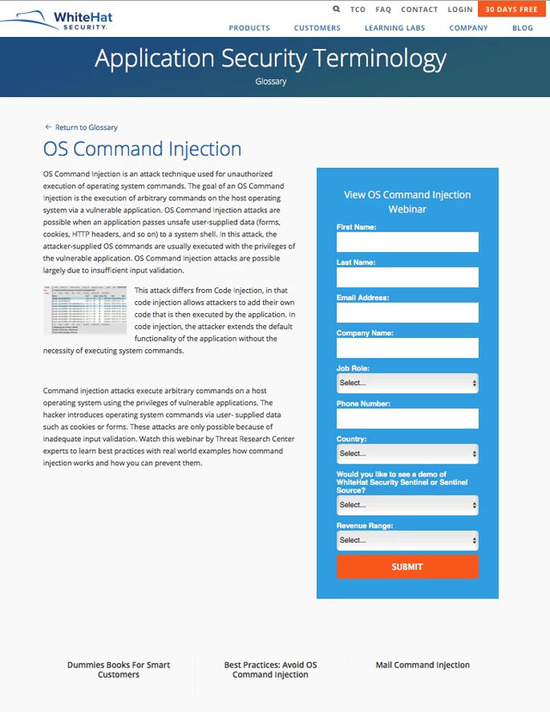
My destination URL is the Smart Content glossary page for this term: WhiteHat glossary page for os command injection The content is well-tuned for SEO and has a clear CTA directly related to the topic. I also included dynamic content recommendations at the bottom of the page to keep non-converting readers from abandoning the site.

Using Smart Content to power paid search campaigns has proven fruitful: because the pages were so tuned, the Quality Scores increased from a site average of 3.4 to 6.1. So I was able to maintain my ad positions while reducing Cost-Per-Click by about 15%.

When I compared the Smart Content SEM campaigns with the traditional SEM campaigns, Click-Through-Rate increased by 55%, and Form Submissions - our measure for lead generation activities - increased by a substantial 125%.

BE: What was the reaction when people saw the results?

AB: The extended team was ecstatic to have such positive results and see the true value of investing in organic and paid search together. I used the results to make a case for - and was able to secure - additional SEM budget. I will increase the spend on paid search ads that will drive relevant new visitors to my Smart Content pages.

BE: What’s the key lesson from all of this?

AB: Marketing organizations need to realize creating content to tell a story isn’t enough. The new mindset to adopt is "if you optimize it, they will come." It should function more like a connective tissue between what customers are looking for and the actions that the brands ultimately want them to take.

Content development must be pragmatic: It should focus on precise interests and intents that your target audiences care about the most; some of which may seem to be outside of your product terminology, blog topics, or typical taxonomy. While it’s important to provide something interesting, useful or shareable, branded content should also clearly lead readers to conversion points, so that they don’t have to guess what to do next.

This helps to continuously build your website into a marketing engine.

BE: Thanks for sharing your experiences with us.

AB: My pleasure. And if anyone wants to learn more, feel free to DM me on Twitter: @avibay.   

We recently caught up with Avi Bhatnagar, Senior Director of Digital Strategy at WhiteHat Security, to learn about how he increased website traffic and leads using the BrightEdge Smart Content framework. Avi oversees several marketing channels and often comes up with a new approach for one program that he later reapplies elsewhere. The interview below […]

The post WhiteHat Security Increases SEM Efficiency Using Smart Content Framework appeared first on BrightEdge SEO Blog.

,