At the beginning of December, Google rolled out an algorithm update that is proving to be the most significant update to local search in several years. The search giant confirmed the update last week. In its typical understated fashion, Google described the update as “a rebalancing of various factors we consider in generating local search results.”
The three factors determining rankings for local searches are: proximity, relevance, and prominence. While Google doesn’t disclose the precise weighting of each factor, it is evident that with the rebalancing, proximity is taking on greater weight. These changes could impact your business listing in local search.
While Google has not announced changes to its guidelines for local search optimization, the update does not change the company’s goals around local search, but rather focuses on improving the quality of local search results. In simple terms, it is achieving this improvement by increasing the weight of proximity in its ranking.
Previously, the relevance of a business listing to the search terms played a greater role in determining the top rankings in local search results. Too often, this meant the SERP would return a search result even if the business was not close to the searcher’s location.
By giving more favor to proximity, the update helps to combat efforts to game the previous algorithm, especially by less-than-local businesses that were appearing in the local SERPs. Over time, more businesses have been able to manipulate their content to win local rankings for searches that, in reality, are geographically distant from the business’ actual location. Following this update, businesses that are in close proximity to the searcher are seeing an improved presence in the SERP, while businesses further away from the searcher are seeing a decline in local share of voice.
While the algorithm update’s emphasis on proximity is the headline, Google’s longstanding, closely related secondary goal of fighting spam is underlined by another observation: we are seeing a reversal, to some degree, in the share of voice for keyword-optimized business names to businesses without keywords in their names. Google has not released any special guidance on this point, but its guidelines against keyword stuffing provide some insight.
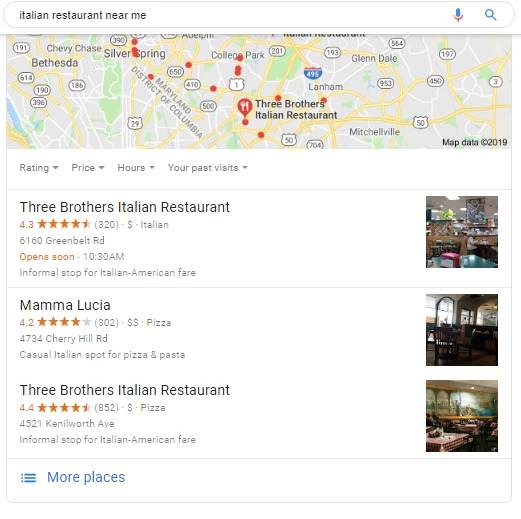
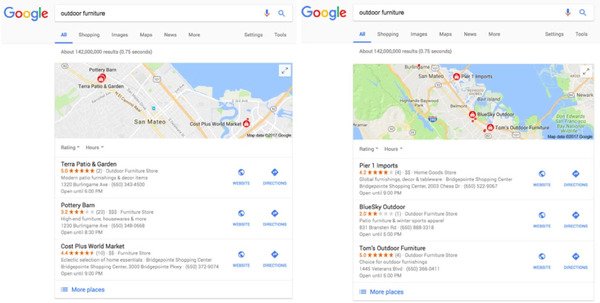
All of this is happening concurrently with an update to the local 3-pack results and map design in the SERP. The new design for desktop search places the results on the left side of the page with a new square map to the right of the results. Because it’s being rolled out alongside the algorithm update, it’s not entirely clear yet what impact the design change is having on results.
Key Takeaways
Google’s latest algorithm update for local search is placing greater weight on proximity as a ranking factor. The rebalancing effort is already impacting search results: prominent and relevant business listings that are further away geographically from the searcher are declining in search rank, while closer, relevant businesses with previously less prominence are ranking higher. Reduced consideration for keywords in the business name is additionally protecting the SERP against attempts to game the system.
Going forward, businesses that rely on patronage from local customers have an improved opportunity to reach those customers and should invest the time and effort to optimize their business listings. On the other hand, businesses that were previously performing well in local searches happening relatively far away from their locations will need to recalibrate and find new ways to serve customers in further away locations.
For small businesses to be easily found by users searching for your products or services, your site needs to rank well in the local listings. While studies show that 28.5% of clicks come from the first organic SERP, and drop significantly after that; the local 3-pack has the highest percentage of clicks overall at 44% CTR.
In order to maximize visibility and increase your opportunity to ranking well, it’s important to own your local listing, otherwise known as a Google My Business page.
Claiming your business profile using Google My Business
A business profile can be added to Google by anyone. A profile is a listing of your business – or a local citation. Any place added to Google Maps is given a profile, because of this you may not have control over your business location. In order to manage your business profile, you’ll need to have a separate Google My Business account for your profile’s page. You cannot manage your business profile without a Google My Business page.
You’ll need to claim ownership over your business profile and once it’s approved by Google, you’ll have a business profile to properly manage the accuracy of information consumers see.
Essentially, Google My Business is a tool used to increase the visibility of your profile. It is important to maintain accurate and up-to-date information on your business profile as other channels including Yelp and Bing get their local business information from Maps and Search as well. If possible, maintaining consistent NAP information through local directories and your site’s location information is essential.
Interacting with consumers on Google My Business
Within GMB, you can manage how your business appears in local searches and Google Maps. You can manage your NAP, images, videos and more – including reviews.
Through GMB, you can interact with consumers and engage with them when they leave you a review. This is a great way to show other consumers that you’re interested in what users have to say about your products and services. You can also enable direct messaging via your Google My Business page to be contacted directly by consumers.
It is important to know that you cannot turn off GMB reviews. If you have negative reviews, decide with the rest of your marketing team a good strategy to address them as they are likely to impact sales down the line.
Harvard Business Review found that businesses will increase sales and ratings if they respond to reviews, good or bad. Forbes recommends moving the situation offline by providing contact information of a specific company representative. By responding, you have the opportunity to increase ratings and also show potential customers that you care about your consumers experiences.
Optimizing your Google My Business page
Having a well-optimized Google My Business page can attract visibility to your site and is a crucial part of local optimization efforts.
Add a unique and detailed description of your business that encourages people to learn more. Use relevant keywords for products and services to increase rank opportunity for those queries.
Choose a specific business category to better connect you to consumers. Some category options include grocery store, beauty supplies or fitness center. Use a category that describes your business as a whole. If your beauty supply store offers in-house services like haircuts, create a separate business profile for the services.
Use high-quality images and videos of your products and business.
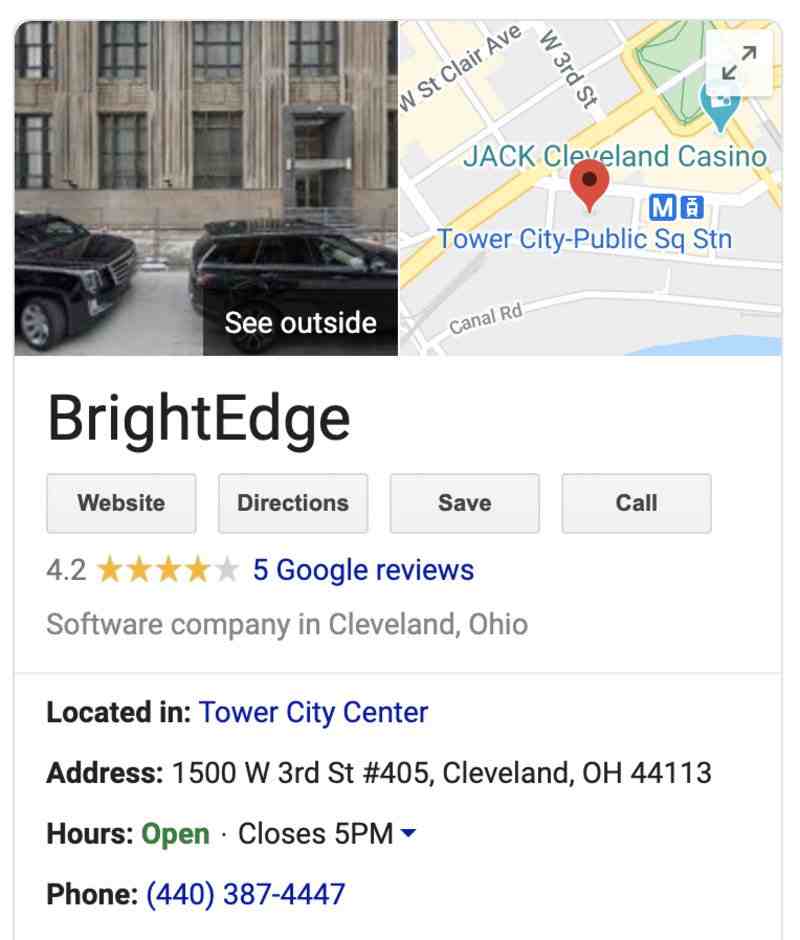
Make sure your NAP – name, address, phone number - is completely accurate for potential local consumers.
Encourage positive reviews from consumers. You can provide a CTA for after a purchase is made, send a thank you email requesting a review, etc.
You can leverage Google My Business to both increase visibility and your chances of outranking competitors. Manage how your business is seen on search engines and correct as much NAP information as you have control over with GMB.
Citations are online references to a local business displaying company info which can include their name, address, or phone number, or NAP. Citations can be found in the form of virtual business directories, review sites, local blogs, etc. and help influence local search results, helping users discover local businesses. Citations can appear whether you submit them or not – businesses don’t always have control over where citations appear. When consumers post about your business and include elements of your NAP, that’s a citation.
While the minimum information for a local citation is the NAP, additional business information including business descriptions, email addresses, driving directions and more, can contribute to a well-rounded citation.
Local search has evolved greatly over the last decade especially citations. As Google My Business became the leading source for local search and citations, the citation landscape shifted significantly. GMB is influential in Google Local, Google Maps, Knowledge Graph, and aggregator sites. This is why it’s so critical to leverage GMB and give it the necessary time and budget to grow your leads.
Local Seaarch Citations
Citations are critical to local SEO. You can leverage citations to gain referral traffic by appearing in directories and users catching your citations. Citations with links back to your site have more SEO value than those without links, as having quality backlinks play an influential role in ranking in the SERPs. You won’t want to link back to just any page, though. Choose a page that makes sense for a user to click to after finding your citation. Also, be sure to link to an existing page. Linking to a broken link or an error page can provide the user with a poor UX when they arrive on your site.
Optimizing local citations
In order to maximize the visibility of your citations, it is important to claim and edit the directory citations you’re able to. Below are a few simple ways to begin optimizing your citations.
Have consistent citation listings. If any of your information is inconsistent, it can hurt your rankings, create a poor UX for users trying to find you, and make your citations difficult to manage. When there are different data points, Google and Bing don’t know which to use.
Choose a secondary and tertiary category. If you have the option to, choose a category beyond your definitive one in order to maximize exposure on directory sites.
Leverage keywords in your business descriptions. Keywords are an essential part of SEO. To optimize your citations, include the keywords you want to rank for in the descriptions.
Link to your locations page. Instead of linking to a variable landing page from your description, link to your locations page that includes more of your business information.
Strive for success in your reviews. While reviews aren’t part of citations, they’re often paired with them and positive reviews are a great way to increase traffic and brand awareness. Share your positive reviews and work with consumers to keep them coming. Users will see them alongside your directory listing.
Build a strategy for local citations on directories
Remember that directories aren’t the only place for your business citations, though. Local bloggers, review sites, and any person can create a citation for your business with a simple mention of your business name. If you’re hoping to land a mention on a popular local blog site, you can reach out to the owner of the blog via email and submit your citation for review.
Otherwise, focus your larger efforts on building citations via directories. While bigger businesses without local storefronts may focus their off-site SEO on building links, local businesses should be focused on gaining citations.
Having your business citations on reputable, trusted listings, and directories, will help your site rank better in search engines. Both the quality of the directory and your citation impacts how search engines view you.
There are numerous directories that relate to specific industries and getting listed on them is important. In the local world, some of them include Google My Business, Yelp, Yellow Pages, Chamber of Commerce, Bing Maps, Facebook, and hundreds more. There are also more specific directories for different industries including lawyers.com and doctordirectory.com. Facebook, Yelp, and the industry specific sites are the most relevant and the ones that will help your site rank better in the SERPs.
There is also the dilemma in which you may not get listed on some directories, therefore, it’s important to focus on the ones that will benefit you the most first and work on the others at a later date. We suggest coming up with a list of directories you want to appear on and rank them yourself by priority.
Tracking your local citations
Visitors will lose trust in your business if the information on your citations are inaccurate. You can use different software features, including a citation checker, to track your local citations. Leverage a citation management tool in order to create a workflow to track which directories you appear on and which citations you need to clean up. You can also do a site search for your citations. You can take the below steps to do a site search:
Open a search engine
Enter “site:www.website.com [key term you want to search]”
Alter your search if necessary
The golden rule of citations is quality over quantity. Remember that while you can add citations to social platforms, business directories, websites, and more, it’s important to first focus on the most valuable outlets first. Verify to search engines that your business exists with local citations and optimize accordingly in order to maximize SERP real estate for your business.
Since 2014, local search has been adapting at an incredible pace. It fits with Google’s relevancy mantra—delivering the best search results to users based on their location. But that means businesses and marketers have to keep up with the changes—especially brick-and-mortar shops that rely on local traffic.
Outside of the formal algorithm rollouts, we’ve seen fluctuating local search and changes to Google My Business. The carousel was replaced with the local pack. The local pack was trimmed from 7 results to 3 items. Local directories were also evaluated heavily for their quality guidelines.
More recently, it’s become vital for a business without a storefront to define its service radius. It has also become more difficult for brick-and-mortar businesses to target cities too far outside their physical address.
Think about what you search for when you have a specific local intent. The verticals affected most by this ever-changing landscape are the ones you’d think of first—the restaurant, hotel, and travel industries.
Although Google has not launched a major algorithm update for local search results since the Pigeon update back in 2014, they have made several changes to the Google My Business Pages. These changes have made it easier for businesses to engage with customers through the SERP, encouraging them to visit the business page and hopefully visit the store in person or make an online purchase.
Here is what every business interested in excelling in local search needs to know.
Google’s Local Search Goals
Google’s local ranking emphasis and ongoing local efforts contribute to the overall goal of Google—personalization and relevance. Someone searching for a local product or service, whether they’re at home on a desktop or walking down the street searching on mobile, should see the best possible results.
In order to deliver on this, Google aimed to define the parameters of local search as precisely as possible. Instead of general city targets, geolocation was further dissected into neighborhoods. This gave new emphasis to the importance of a correct NAP (Name, Address, Phone Number) and a shift in how successful local marketing would be.
In order to understand how local search rankings fluctuate, you have to monitor your brand and keyword targets at a local level, instead of just the US. BrightEdge can help you determine your geo-targeted market and create specific localized campaigns for your brand or service.
The local search ranking factors are important to monitor on a yearly basis. The existing ranking factors are present here, albeit with a local focus—on-page optimization for local terms, link signals with local relevance, social signals. There is also a heavy focus on specific local SEO factors—Google My Business signals, NAP consistency across citations, and the strength of your review portfolio. Now quality is favored over quantity, and the search radius continues to shrink with laser-like precision to the business’s storefront address and neighborhood.
In addition, signals like reviews and citations are also becoming more refined under the Google microscope. Accuracy and relevancy can enhance citation signals along with the quality of the directory or aggregator used. Just a large volume of reviews isn’t enough to rank either—the timing, consistency, and the quality of review sites are all factored into the local search ranking algorithm.
In addition to your existing strategy that targets your brand, products or services with high-volume keywords, you’ll need almost an entirely different strategy that targets your local neighborhood, or to at least weave some local search elements into your existing content.
First you want to identify your radius and your local audience. What neighborhoods do you want to reach, and who makes up those neighborhoods? What are they searching for, and how can you help them?
This is where your content strategy can go outside the grid when it comes to your brand. If you’re a maternity clothing store in Astoria, you want to build content for new moms and maternity clothes. But you can also hone in on your local keyword targeting by writing about the best daycares in Astoria and your surrounding neighborhoods—relevant and hyperlocal.
In order to identify your audience and their needs, you can use the tools already at your disposal—Google Analytics demographic information and interest categories, Facebook Insights, AdWords Keyword Tool and more.
It’s important to monitor your content performance for your local search strategy. Identify the goals you want to achieve—do you want more traffic from your surrounding neighborhoods? Do you want to rank for local search queries? Do you want more sales from your immediate location? Once you’ve identified your goals, tailor your local content strategy to achieve them.
In addition to just creating content, make sure you are optimizing it. Craft local-focused meta titles and descriptions and optimize your images for local search.
Pay attention to your industry. If you’re in real estate or hospitality, you can corner the local content market with neighborhood guides, local landing pages, and “best of” lists.
The key for local content is to be useful to your market. That can mean promoting events, news, sports teams, or little-known spots and becoming the go-to resource for your neighborhood.
If you’re looking to ramp up your current SEO strategy, or if you’re starting from scratch, there are best practices to consider for your local SEO.
Consistency
Both on and off site, your Name/Address/Phone Number listing needs to be consistent. It’s worth spending the time to update anywhere your business might be located on the web to match exactly how you’re listed on your website.
Citations
Speaking of your business listings, check to make sure you’re listed everywhere that’s relevant to your business and seen as a quality site. Sites like Yelp, Foursquare, and of course:
Optimize your Google Business Page
Update and optimize your Google My Business page with your NAP, categories, keyword-targeted description, photos, and more.
Optimize on-page for local
Your content and site architecture should reflect your local search strategy. Make sure your city and neighborhood targets are present in your copy and metadata. Take advantage of Schema markup to boost this content.
Manage your reputation
Your online reviews can make or break your local business—and Google knows this too. Review signals are quickly climbing the ranks as part of the ever-changing local algorithm.
Do not neglect mobile
Remember that Google has found an estimated 94 percent of smartphone users have looked for local information. Make sure that your page is fully mobile compatible and that your content has been optimized for users on-the-go.
A local content strategy and citation building strategy should be ongoing. Make sure to start with your site foundation to create an optimized local template for copy and metadata. Don’t Overlook These Crucial Parts of Local SEO
Taking advantage of Google Business Pages
Most businesses know that claiming their Google Business page comprises step one of a successful local search strategy. Over the past few years, however, Google has also introduced a number of new features for the pages. These features offer opportunities to engage even further with prospective customers and attract attention to their pages.
Google Q&A
Prospective customers can ask questions of businesses right from the SERP. These questions appear on your local search listing when your business pops up. Many businesses fail to pay attention to these questions, which results in long lists of questions that appear on the page with no answer. Sometimes even worse, the answers that do appear come from other users and might not be helpful for the business or might even be detrimental.
Neglecting to answer your questions can detract from your efforts to demonstrate that you care about your customers. Remember also that the questions people submit, chances are other prospective customers want to know, too. Prioritizing answering these questions will improve your appearance on local listings and give customers a better understanding of how you can meet their needs.
See What’s In Store
You have the option of allowing customers to see what is in your store, before they even step foot in your building or visit your ecommerce site. Those looking for a particular product will appreciate this opportunity to verify that you carry what they need before they go through the effort of going to your business. For customers deciding which store to use, your ability to provide with concrete evidence that you will meet their needs will encourage them to convert.
Google Business Posts
You can create temporary posts on your Google Business page that will allow you to notify customers about various important events, services, or listings right when it is most likely to have an impact. You can create posts directly from the Google My Business App. Posts do expire and the purpose is to highlight timely news or promotions. Google displays the posts to customers on your Google Business Page, so use them to give prospective customers one more reason to visit.
Reputation Management and Local SEO
Reviews are crucial to your local SEO strategy. Not only are they considered a ranking signal, but managing your reviews should be extremely important to you as a business owner. Why? Because it’s extremely important to your customers.
Earning favorable reviews on the top sites—Google My Business, Yelp—will help that first interaction that local searchers will see on their desktops or mobile phones and tablets. The process of getting reviews is tricky, and one that is monitored more and more by Google. Here are some key takeaways for reviews:
Whenever possible, acquire naturally
Speed and velocity of reviews are monitored—keep track of your requests and promotions to avoid an influx of reviews
Responding to negative reviews is easier than trying to remove them
You can get creative with asking your customers to post reviews, but you should always let them know where you’re listed and how to leave a review—especially in the case of a favorable sale or interaction.
The response to negative reviews can’t completely combat the effect of that negative review on a potential customer, but a smart and thoughtful response can negate some of the backlash.
In addition to reviews, social media is a great way to maintain your reputation for local SEO. Using and optimizing sites like Twitter and YouTube can help boost your local content and dominate your local SERP presence.
Google confirmed that its search algorithm automatically alters its weighting depending on the type of search query the user enters.
Over the past few days, Google representatives have participated in a series of conversations that reveal a bit more about the Google algorithm, confirming what many people had already suspected. It is likely that the Google algorithm actually changes how much it weights different ranking factors depending upon the nature of the search query.
Understanding what the representatives exactly said, and how this impacts marketers, can help our community craft their digital strategies.
What did Google actually say?
Google representatives Gary Illyes and John Mueller have made it clear that there are no concrete "top three" ranking factors on the Google algorithm. John Mueller also says it "makes sense" to have the Google algorithm weigh factors differently depending upon the nature of the query.
To hear the full conversation, watch the Google Webmaster Central office-hours hangout below.
It is important to note that this seems to be in opposition to what Andrey Lipattsev said about 18 months ago. At the time, Andrey had listed content and links as being the top two important criteria in the Google algorithm, with RankBrain being quoted elsewhere as the third most important ranking factor. In our opinion, however, these two conversations don't have to be mutually exclusive.
For example, take the criteria of "content." Even if the Google algorithm weighs factors differently, the quality and value of the content will likely always be a top factor. Other content factors, such as freshness, likely vary in weight depending upon the query. With backlinks, although the importance to individual pages might vary, it's reasonable to assume that the Google algorithm still looks at the number of backlinks to the domain as a whole, bringing the concept of domain authority into the front.
The importance changing weights among Google algorithm factors makes sense when you consider the different types of search results people expect depending upon the type of query they input. For example, someone interested in current events will likely want to find sources that have been published within the last day for up-to-date and accurate information. Thus the freshness of the page will be taken into account to determine the rankings.
On the other hand, a person looking for scholarly research topics will want to find sites that have greater longevity, backlinks, and other authority markers that indicate the trustworthiness of this individual page.
What does this mean for marketers?
Google weighing factors differently depending upon the exact query and intent behind it is another manifestation of Google’s desire to promote optimal user experience. For example, if backlinks were weighed heavily for every search result it might be difficult to get updates on the latest in current events. On the other hand, if they were never considered, it would likely be too easy for sites promoting incorrect academic studies and insight to gain a foothold in the search engine.
For website owners and search marketers, it continues to be impossible to tell exactly what Google weighs heavily for a particular industry, but we can make educated guesses based on what customers likely want to see when making queries. We do know that Google likely considers content, links, and RankBrain to be among the top considerations, and thus SEO strategies should consider these factors. Within each category, however, considerable variability remains.
You should focus on the factors that make the most sense for your individual content, such as reviews and local SEO for brick-and-mortar businesses or fresh, regularly updated sites for news companies.
the factors that will be the most important in the rankings.
You can also use the BrightEdge platform to find keywords that relate to Quick Answers and other rich answer displays on Google to create a stronger, more intent-driven strategy. As you create content, monitor your progress in BrightEdge to see how well you rank and drive traffic that actually drives revenue.
Google's end goal is to ensure that they're matching users with the content that has the greatest relevance and value for their needs. Though we now know that Google doesn't have a "top 3" ranking factors that applies uniformly to all SERPs, we can make educated estimates about what Google prioritizes for particular user intents. Brands that align themselves well with a positive user experience will increase their chances of earning a strong Google ranking.
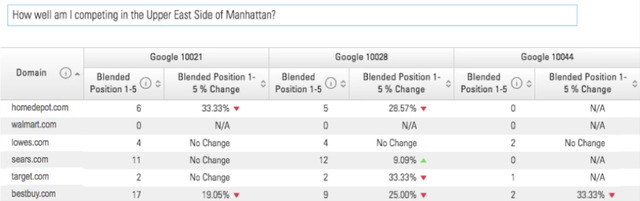
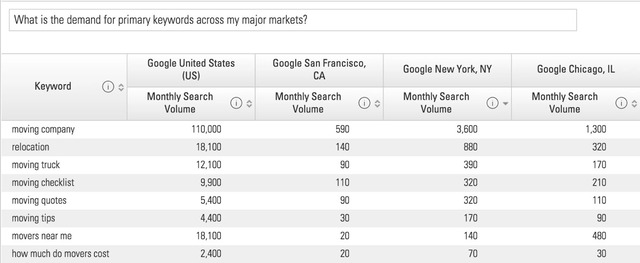
Enhanced HyperLocal capabilities allow digital marketers to understand demand and content performance for the locations that matter most to their business.
Digital experiences are now localized to the areas where searches are conducted
Google has taken the next step in providing the most relevant results to consumers – displaying different results pages for small geographical locations, even cities just miles apart, called hyperlocal.
With digital experiences varying according to location, you can get a skewed view of how your customers experience search locally if you confine your analysis of organic demand (search volume) and content performance (organic ranking) to a single location. You may fail to see the variances in search volume between a metropolitan area and a small nearby town. And using a single-location view of organic performance can hide the fluctuations in ranking across multiple geographies.
To prioritize SEO and content marketing investments effectively, it’s critical to have the clearest picture of how customers experience your brand in organic search results – where and when they are searching.
Marketers need a more granular view of demand and content performance with hyperlocal
HyperLocal capabilities within the BrightEdge platform now allow customers to understand how topics and content perform for searches conducted in every corner of the globe. Digital marketers can track demand and content performance for over 32,000 US and 36,000 non-US city search engines, or submit custom locations, for both desktop and mobile.
Accessing data at the most granular level is a best practice for effectively optimizing for organic performance. Here are a few instances where it makes sense to understand your brand’s digital performance down to the specific areas critical to business success:
To target customers for hyperlocal marketing
To drive customers to physical locations
To understand fluctuations in demand
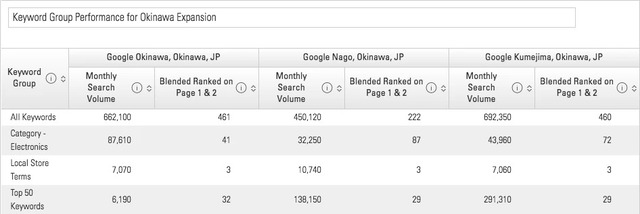
To expand into new regions
1. When you are looking to target customers in a (hyperlocal) very specific location
Let’s say that you know geographically where your highest-converting customers are searching – for example a specific city or a neighborhood. While you care how you are turning up in search results in general, you care even more about how you are showing up (or not showing up) for the audiences in these highly targeted areas. By using our HyperLocal capabilities, you can now see how your content is displayed in SERPs for these specific locations.
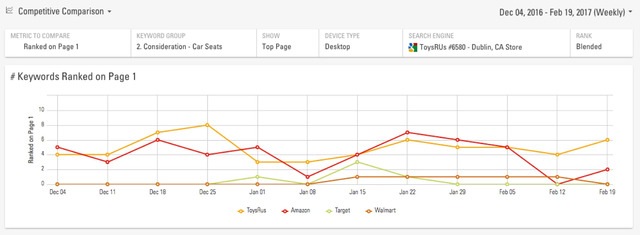
You can also view trending of performance over time in a specific location.
By targeting the locations that matter to your business, you secure a more accurate understanding of how you are performing in search for the precise audiences you are targeting.
2. When you want to drive customers to one of your retail locations
Google research shows that 50% of consumers who conduct a local search on their smartphone visit a store within a day. With the increase in smartphone searches (which now make up more than half of total searches online), it is increasingly important to ensure that your brand is showing up for relevant topics in order to drive visitors to your brick-and-mortar locations.
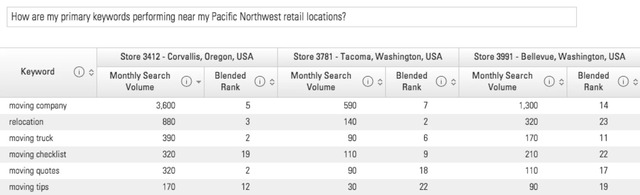
Using our HyperLocal capabilities, you can view performance for the local search engine closest to each storefront location.
With these insights, you can understand demand for specific topics, as well as how you rank for people searching in that immediate vicinity. You can choose to optimize for the areas and topics where you are falling behind in local search.
3. When you are trying to understand fluctuations in demand for your products or services
Consumer interests are incredibly regionalized. Something that is popular in one area can fail to capture the attention of consumers in another area. An aggregated search volume figure fails to show you how search volume for that topic can fluctuate across locations. With our HyperLocal capabilities, you can view search volume across the different locations that matter to your business.
Knowing this can help you allocate your marketing resources and create strategies to optimize for topics in the regions where demand is the greatest.
4. When you are looking to expand and want to compare differences in demand across regions
Similar to the use case described above, you want to understand nuances in demand for your product or services in different regions where you are aiming to expand – either domestically or internationally. There can be a drastic difference in search volume for the same topic in cities that are separated even by a few miles.
With access to the most granular search insights, you can compare demand across potential target regions and take a data-driven approach to selecting how you allocate resources as you grow your business.
Providing volume and granularity of search insights unmatched by other SEO platforms, BrightEdge is the only search and content solution that allows customers to understand how pages are performing in the specific locations that are most critical to their business success.
You can contact us to learn more about optimizing for content performance using our HyperLocal enhancements.
Google's changes to the SERP for local-related queries impacts how brands effectively boost their visibility online with a local search strategy. We want to draw your attention to some of the recent adjustments seen in the ad portrayal on local search so you can adjust your local search strategy accordingly. Local search strategy comprises a critical segment in the marketing for many businesses. It impacts both in-person commerce and e-commerce significantly. A huge 78% percent of local-mobile searches result in offline purchases and 50% percent of mobile visitors will visit stores within one day. Given the significance of search in the success of local businesses, when Google makes changes to the SERP for local search, brands need to prepare themselves and make the appropriate adjustments to their local search strategy so they can continue to have the rankings and visibility they need to grow their business.
Google’s experiments with ads in local search
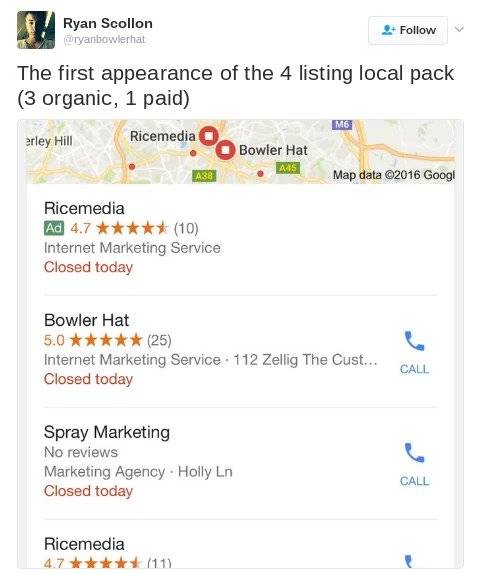
Over the past few months, we have seen some experimentation from Google on the use of ads in local search. We had heard rumors that Google intended to start using ads in the local 3-pack, but we did not know exactly how the search engine planned on combining organic and paid results on the local pages. Last summer, people first spotted a local search pack that had one ad followed by 3 organic listings.
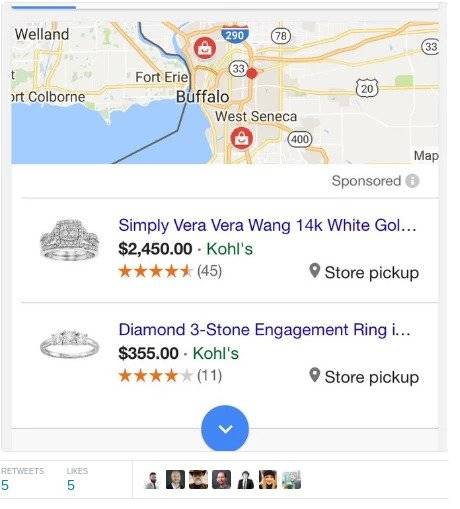
A few months later, in January, reports also emerged that Google shopping ads were appearing for purchase-related local queries on mobile.
In both examples, however, these ads have not been replicated everywhere and do not seem to be widely used, yet. These changes have been significant because customers do pay attention to ads when they make local searches - 60 percent of customers say that they have used information provided in ads. The increasing prevalence of ads in local search means that many companies will need to make adjustments to their local search strategies to maximize their ability to attract customers interested in patronizing their stores.
How Google’s new ads impact local search strategy
Given that such a significant portion of customers say that they pay attention to the information in ads for local search, it makes sense that this segment of optimization has been the subject of experimentation. This is all a part of Google’s trend towards ad visibility. We all remember Google’s changes to the SERP layout at the beginning of last year, when they increased the number of ads along the top of the results page while eliminating the ads that were once along the side. For many queries this change means that minimal organic results, and sometimes none at all, appear above the fold. Thus, brands need to pay closer attention to the intersection between PPC and SEO. Do not view hybrid marketers as a nice-to-have, but rather as an essential resource of the marketing team.
Using systems, like the BrightEdge platform, brands can quickly uncover which keywords that relate to their business have local 3-packs. They can also research the level of competition and the average search rates for these local results, empowering them to improve their targeting so they can focus their local search strategy on the terms that will provide the most return. Brands can use their PPC and SEO together to better target these important keywords. Since ads are incorporated closely into the standard local results, focusing your PPC efforts on the keywords that have high significance for your brand, but that you do not have the ranking you need, can help you gain the visibility necessary.
To maximize your opportunity, you should also pay close attention to how Google structures the local 3-pack. Google displays the information that customers want to find when they make a local query. Model your ads to include the same valuable information, such as hours, address, and phone number. This can help boost engagement with your visitors by ensuring that people have access to the information that they need and expect when they make a local search. Note also that when we first started hearing the rumors about the introduction of ads into the local SERPs, many marketers thought that we would see a 2-pack plus one ad. Although Google still seems to be in the early stages of introducing ads into local search, right now we are still seeing three organic slots open. This means that brands cannot neglect their standard local search strategy.
Brands that want to grow in local search need to focus on building their Google business page, including adding clear, appealing images, and by cultivating reviews. You also want to pay close attention to your Name, Address, and Phone Number, or NAP, as this has been shown to have a sizable impact on your rankings within Google. For more tips on optimizing for local search, visit NAP and Local. As you build your local search strategy with both organic and paid search, you want to make sure you continue to monitor your progress to make sure that you use your resources effectively. BrightEdge offers you measuring capabilities to ensure that you can look at your performance on a local level. See your rankings improve with local search optimization and monitor keywords in specific geographic areas to ensure your efforts match the needs of your local consumers.
Google continues to experiment with the SERPs to better serve the end user, and this includes their efforts to balance both paid and organic results. They have been experimenting recently with including ads in certain local searches, which is a trend that cannot be ignored by brands interested in developing a strong local search strategy. At BrightEdge, we will continue to help you remain on top of the latest developments and how you can use the platform to maximize your performance in the face of the ever-changing industry.
Local search optimization is the careful process of helping your website appear in relevant searches in the area around the user. These local searches are often answered by a local 3-pack that provides easily-digestible listings for businesses in the immediate vicinity.Local search is quickly becoming a dominant component in commerce. An estimated 78 percent of local-mobile searches result in offline purchases with 18 percent leading to sales within a day. As mobile usage continues to rise, the importance of these on-the-go devices in local business continues to grow as well. Sixty percent of American adults say that they use smartphones or tablets to look for local product or services information.It should be clear why local search optimization and helping your brand stand out in local searches is important. You should also note that Google answers 93 percent of searches with local intent with a local 3-pack. In others words, in the vast majority of the searches performed for local businesses, users will automatically be drawn to three main listings in the top center of the page. The better that businesses are able to understand how local SEO works and what they can do to boost their chances for success, the easier it will be for them to appear in these key listings and help their businesses stand out in their area.
How does local search optimization work?
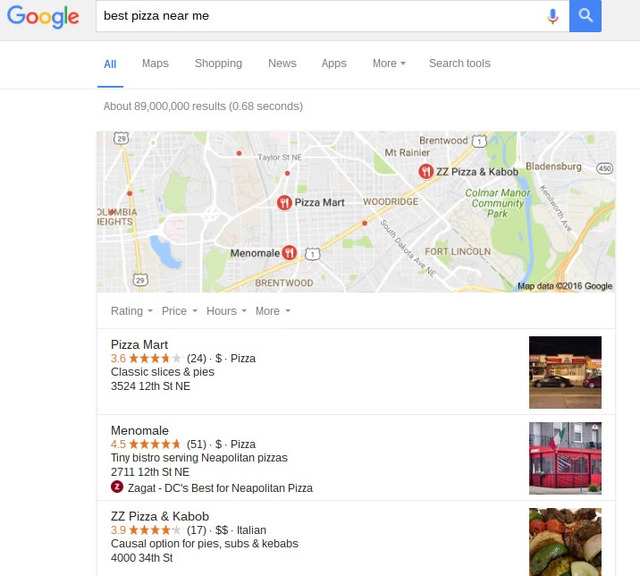
Google creates local search results based upon the businesses that are located the closest to the exact location of the user. This means that a position change of just a few miles will impact the results. The results that appear for local searches, particularly on the local 3-pack, are continually changing. For businesses, this provides both benefits and drawbacks.Since the results are continually in a state of flux, brands have ample opportunity to enhance their local SEO and start to see an increase in their own appearance in local search. On the other hand, it means that no matter how well their site is optimized, if they are on the other side of the city and there are other quality businesses located closer to the user, they likely will not appear in the critical 3-pack.There are some opportunities to boost one’s appearance in local search. For example, if a user searches for the ‘best’ pizza place near them, the results will differ than if they just searched for a pizza near them. This means that Google is filtering through the results around the user to find those with the highest ratings. This may encourage the algorithm to widen its parameters, even slightly, to focus on the top-rated local businesses. Brands that therefore focus on cultivating positive reviews and using related keywords can therefore increase their chances of appearing in a greater number of local search 3-packs.
Do not neglect standard optimization for the local 3-pack
When the 3-pack is displayed for a local search, it automatically dominates the page. Other organic results are pushed to the very bottom. On mobile, the standard organic results are not even visible without scrolling. Brands that want to succeed in local search optimization cannot neglect this key area.
Focus on the NAP. Make sure that your name, address, and phone number are consistent on all your listings so that Google is confident in your information.
Claim your Google+ page for your business and build it out. This means including quality pictures and writing descriptions using local keywords.
Cultivate reviews. As explained before, high-quality reviews can help increase the chances of your brand being listed on the 3-packs. It will also help your business appear even more reputable on any 3-pack where it is listed. Take steps such as encouraging satisfied customers to leave reviews after transactions and including links to your Google+ page on newsletters, business cards, and your website.
What can I do to make my local search optimization efforts stand out?
Since the local search results change easily and are so user-dependent, it is easy to feel some level of frustration over how much influence you can have over your local search optimization efforts. Fortunately, there are a few steps you can take to make your business and domain stand out.
Remember the power of PPC
Ads appear even above the local 3-pack and can provide you with an additional opportunity to attract local attention. They can help you tap into a prominent position on the SERP for important local keywords and thus boost brand awareness and click-throughs.To do local search ads correctly, however, you need to make sure that your ad fits with local search intentions. A study conducted by Neustar Localeze and 15 Miles examined the purpose of local searches. They found that the top three reasons for conducting these types of searches were:
Finding the address or location of a business
Searching for area organizations with the products or services being sought
Looking up the phone numbers for businesses
The Google local 3-pack makes most of this information obvious right from the listing, so your PPC ad needs to similarly serve the needs of these local customers. Including information about your location, click-to-call links, or links to information about your business can help you increase your success with paid search. When the user clicks on your ad, you want to continue the positive user experience. This means having the landing page optimized for local users - with information about who you are, what you do, where you are located, and how to contact you featured prominently.
Create content for local searches
You can also enhance your local search optimization by creating content designed for people in your area. You can use BrightEdge to uncover keywords directly related to your area and put them in a specific group to track their progress. Create content that focuses on events and developments in your area and how they impact your industry. Build a reputation in your area as the local expert in the business.You can also expand your brand reach and awareness by participating in local events. For example, set up a booth at local fairs or sponsoring local charities and events. You can then promote the event on your website for even more attention.
Do not neglect the I-want-to-go micro-moment
Google has recently been impressing upon marketers and businesses the importance of micro-moments. These are intent-filled instances when users want to accomplish a specific task. During the I-want-to-go moment, users often turn to mobile devices to help them reach a specific destination, such as a local business. Customers want quick answers that address their needs. To match these desires, brands should construct their websites to ensure that critical information, such as locations and content information are prominently featured on the landing page. With the rise in mobile device use and the importance of mobile search with commerce both on and offline, brands need to understand how local search works and how they can improve their own local SEO. While it can seem frustrating to try and optimize for perpetually changing, user-dependent results, these search optimization tips can help brands better prepare for the local 3-pack while also boosting their reputations and reach in the region. This helps local search optimization and ensures that the organization takes advantage of search opportunities around them.
Google Local optimization underlies a strong online strategy for any business with a physical presence or storefront. An estimated 73 percent of online activity relates to local. In other words, people regularly use the internet to find information about businesses and other places of interest around them.
What brands should pay even closer attention to, however, is the impact of these local searches on business. Customers look for local information throughout the buyer’s journey, and when they reach the conversion point, local searches are twice as likely as non-local searches to result in a purchase. In fact, an estimated 78 percent of local-mobile searches resulted in a purchase often within a few hours.
For brands to succeed on a local level, they need to prepare for their regional audience. Even if you regularly work with people well outside your geographic area, failing to optimize for the local users will hamper your reach, reputation, and business growth.
What is Google Local?
Google Local involves making your page more locally relevant for users looking for businesses or places of interest that are geographically near them. This refers to queries such as “SEO companies near me” or “pizza places open now”.
When people conduct local searches, Google will currently present to them three main businesses, which are featured on the local 3-pack. These three businesses are at the center of the page with their name, address, number of stars, and a photo, immediately drawing the eye. Underneath these results, users have the option of clicking to see more businesses or just scrolling through the organic results. The high-profile location of this 3-pack makes it particularly important for those who want to optimize their content for local search.
Optimizing your content for Google Local, therefore, means designing your site and your Google+ page to improve the frequency with which you appear in this 3-pack and the positive impression you make upon users who see it. As in all SEO efforts, high rank means awareness and traffic and an implied endorsement from Google.
How do I succeed with Google Local?
Pay attention to the NAP
The NAP refers to your name, address, and phone number. Google wants to see businesses that keep this information consistent across all websites and listings. When the NAP is consistent, the search engine can be confident that it is displaying the right information to users on the SERPs. Google wants to provide its users with an optimal user experience, and inaccurate information would confuse people and detract from this goal.
Every time your name, address, and phone number are written online, it can create a listing in other directories. Regularly monitor the web for mentions of your brand and reach out to sites to correct any incorrect information. If you find one that needs to be updated, look for the "Claim this business" or similar link to update and control the information,
You want to create your own listing on the various popular online directories, such as Yelp, to ensure that they receive the right information. Style the name of your brand always the same way, ensuring consistency with ‘and’ versus ‘&’, for example. When your NAP is consistent, it can influence the performance of your brand properties on Google Local by as much as 16 percent.
Fill out your Google+ business profile thoroughly and correctly
Google Local pulls from your Google+ business profile when creating your listing for the local 3-pack, so you want to make sure that you pay attention to how your brand is presented on the popular social media platform. Therefore, fill out your profile thoroughly and correctly. This means paying attention to the categories you select to ensure that they accurately reflect your type of business. Use keywords when describing your brand, including both your products and services as well as your location. One study found that using notable keywords, the right categories, and being located near where the person performs the search can impact your performance in Google Local by as much as 19.6 percent.
Attract reviews on Google
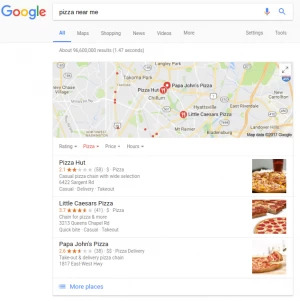
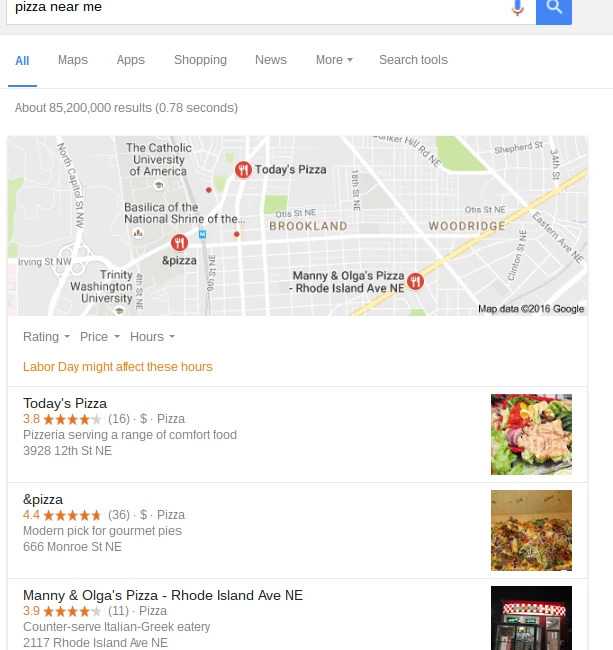
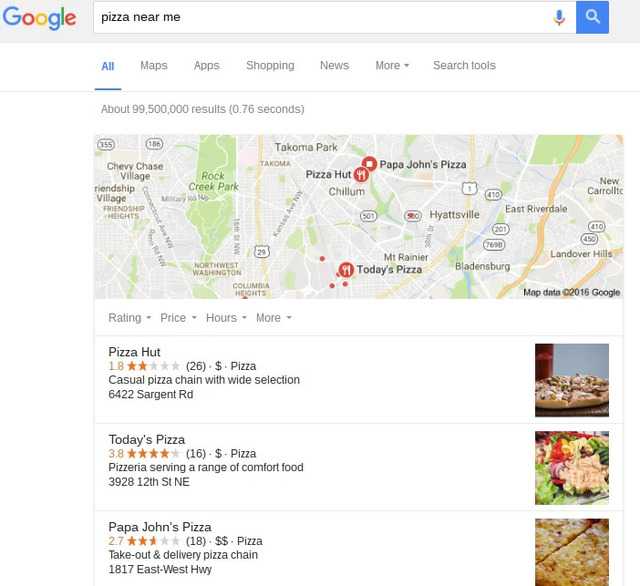
Reviews can be very influential on the results that you are listed for as well as the amount of attention your listing receives. As an example, here are the results from the query ‘pizza near me’.
Then here are the results, ‘best pizza near me’.
According to Nielsen, 92 percent say that they trust earned media, such as reviews from friends or family, more than all other forms of advertising. The reviews on your website might not be from someone that a particular user knows personally, but they do offer third-party validation of your brand and can help you lay the foundation for building a relationship of trust.
There are a few ways that you can encourage your customers to leave you these valuable reviews. Consider:
Letting customers know after they make a purchase, such as in a follow-up email, that reviews are appreciated.
Include links to your Google+ profile on your brand’s correspondence, such as emails and newsletters.
Invite people connected to you on Google+ through your circles to leave you reviews.
How BrightEdge can help with Google Local
As you begin to develop your optimization for Google Local, use a platform with the ability to help you throughout the process. BrightEdge has numerous capabilities for businesses interested in growing their local audience.
Content creation
The BrightEdge Data Cube will help you uncover local keywords that you can use throughout the optimization process. For example, your local keywords can be used to produce content that is geared towards your local audience. The keywords can also be used in your brand description on Google+ and your website. This will help you improve your relevance to your local audience, and appear higher on organic queries.
Creating local keyword groups
As you uncover the important local keywords that you want to optimize your site for, you can create a keyword group to use to track your progress. You can create charts that monitor the correlation between your local keywords and the brand’s growth and revenue.
Monitoring your appearance with Google Local searches
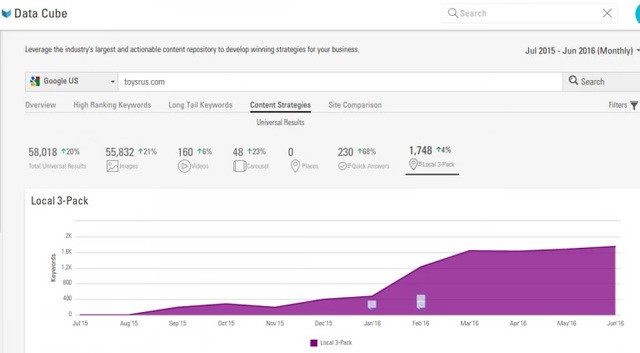
When you open the BrightEdge Data Cube, you can also perform a site analysis that will enable you to see how your site is performing in the universal search results. You can also narrow your data down to show just how you appear in local 3-packs. This will allow you to see your progress and the keywords for which you are successfully appearing in these local searches. You can then do the same for your competitors to gauge their progress as well.
Local search engine insight
BrightEdge also provides local SEO support for more than 100 cities throughout the US and around the globe. You can use these Google local tools to look directly at your search performance and that of your competitors in your targeted geographic area.
Google local is a powerful means of reaching out to the customers in the same area as you. Customers often like to do business with those in their region, so optimizing your page to meet these customers can help you grow your business and improve your reputation.
Since 2014, local SEO has been adapting at an alarming pace. It fits with Google’s relevancy mantra—delivering the best search results to users based on their location. But that means businesses and marketers have to keep up with the changes—especially brick-and-mortar shops that rely on local traffic. Outside of the formal algorithm rollouts, we’ve seen fluctuating local SERPs and changes to Google My Business. The carousel was replaced with the local pack. The local pack was trimmed from seven results to three items. Local directories were evaluated heavily for their quality guidelines.
More recently, it’s become vital for a business without a storefront to define its service radius. It’s also become more difficult for brick-and-mortar businesses to target cities too far outside their physical address. Think about what you search for when you have a specific local intent. The verticals affected most by this ever-changing landscape are the ones you’d think of first—the restaurant, hotel, and travel industries. The biggest change to local SEO has been, of course, Google’s own local algorithm update, Pigeon.
Local Algorithm Updates
Google’s Pigeon update wasn’t the first step toward hyperlocal search, but it was a turning point for SEO strategy moving forward. Released in 2014, the update aimed to tie local search results more closely to traditional web search ranking signals. Google’s intent in rolling out Pigeon was to improve and fine-tune their current ranking signals in terms of distance and location. Although it’s not a penalty-based algorithm, the introduction of Pigeon also meant the usual scramble in regards to traffic and rankings. The use of local packs allowed Google to establish authority within a query for local businesses with a good search presence.
The rollout of Pigeon tried to eliminate duplicate results—businesses were less likely to show in both organic and a map pack—so those featured prominently in the pack were seeing favorable results. In order to give the best possible results, Google’s Pigeon reduced the search radius for local queries as much as possible. This continues to have an effect on businesses that used to rank for their closest metropolis—now without a physical address in the query city, you likely won’t rank high in organic search and probably not at all in the local packs.
Good news for mom and pop shops—Pigeon affected how universal brands showed in local results, and mostly negatively. Local businesses, even without a strong search strategy, continue to rise in the ranks of organic and pack results—think Amy’s Pizza vs. your local Dominos chain. But there were industries that took a hit after the Pigeon roll out—real estate and insurance in particular. BrightEdge’s Data Cube saw a significant drop in Google Places results from those queries.
Google’s Local Goals
Google’s local ranking emphasis and ongoing local efforts contribute to the overall goal of Google—personalization and relevance. Someone searching for a local product or service, whether they’re at home on a desktop or walking down the street searching on mobile, should see the best possible result. In order to deliver on this, Google aimed to define the parameters of local search as precisely as possible. Instead of general city targets, geolocation was further dissected into neighborhoods. This gave new emphasis to the importance of a correct NAP (Name, Address, Phone Number) and a shift in how successful local marketing would be. How Google Ranks Local Listings
With the new algorithm and Google’s local mission statement in play, it’s important to understand how this changes rankings for the SERPs. In order to understand how local rankings fluctuate, you have to monitor your brand and keyword targets at a local level, instead of just US. BrightEdge can help you determine your geo-targeted market and create specific localized campaigns for your brand or service. The local search ranking factors are important to monitor on a yearly basis.
The existing ranking factors are present here, albeit with a local focus—on-page optimization for local terms, link signals with local relevance, social signals. There is also a heavy focus on specific local factors—Google My Business signals, NAP consistency across citations, and the strength of your review portfolio. Most sites saw a positive or negative effect of these signals, depending on their local strategies before Penguin. Whereas sites rose or dropped for the existence (or lack of) NAP, reviews, and a Business page immediately following the rollout, the signals have become more defined over the past two years. Now quality is favored over quantity, and the search radius continues to shrink with laser-like precision to the business’s storefront address and neighborhood. In addition, signals like reviews and citations are also becoming more refined under the Google microscope. Accuracy and relevancy can enhance citation signals along with the quality of the directory or aggregator used. Just a large volume of reviews isn’t enough to rank either—the timing, consistency, and the quality of review sites are all factored into the local ranking algorithm.
The world of “content is king” was hardly expected to escape the impact of local search. For local businesses targeting specific neighborhoods, it’s important to tailor your content strategy to fit these needs. In addition to your existing strategy that targets your brand, products or services with high-volume keywords, you’ll need almost an entirely different strategy that targets your local neighborhood, or to at least weave some local elements into your existing content. First you want to identify your radius and your local audience. What neighborhoods do you want to reach, and who makes up those neighborhoods? What are they searching for, and how can you help them? This is where your content strategy can go outside the grid when it comes to your brand. If you’re a maternity clothing store in Astoria, you want to build content for new moms and maternity clothes. But you can also hone in on your local keyword targeting by writing about the best day cares in Astoria and your surrounding neighborhoods—relevant and hyperlocal.
In order to identify your audience and their needs, you can use the tools already at your disposal—Google Analytics demographic information and interest categories, Facebook Insights, AdWords Keyword Tool and more. It’s important to monitor your content performance for your local SEO strategy. Identify the goals you want to achieve—do you want more traffic from your surrounding neighborhoods? Do you want to rank for local queries? Do you want more sales from your immediate location? Once you’ve identified your goals, your local content strategy should be tailored to achieve them. In addition to just creating content, make sure you are optimizing it. Craft local-focused meta titles and descriptions and optimize your images for local search. Pay attention to your industry. If you’re in real estate or hospitality, you can corner the local content market with neighborhood guides, local landing pages, and “best of” lists. The key for local content is to be useful to your market. That can mean promoting events, news, sports teams, or little-known spots and becoming to go-to resource for your neighborhood.Best Practices for Local SEO If you’re looking to ramp up your current SEO strategy, or if you’re starting from scratch post-Pigeon, there are best practices to consider for your local SEO.
Consistency
Both on and off site, your Name/Address/Phone Number listing needs to be consistent. It’s worth spending the time to update anywhere your business might be located on the web to match exactly how you’re listed on your website.
Citations
Speaking of your business listings, check to make sure you’re listed everywhere that’s relevant to your business and seen as a quality site. Sites like Yelp, Foursquare, and of course:
Optimize your Google Business Page
Update and optimize your Google My Business page with your NAP, categories, keyword-targeted description, photos, and more.
Optimize on-page for local
Your content and site architecture should reflect your local strategy. Make sure your city and neighborhood targets are present in your copy and meta data. Take advantage of Schema markup to boost this content.
Manage your reputation
Your online reviews can make or break your local business—and Google knows this too. Review signals are quickly climbing the ranks as part of the ever-changing local algorithm. A local content strategy and citation building strategy should be ongoing. Make sure to start with your site foundation to create an optimized local template for copy and meta data. Don't Overlook These Crucial Parts of Local SEO
The increase in mobile queries was skyrocketing during Google’s rollout of Pigeon, and it’s easy to see how the two go hand in hand. If you’re a brick-and-mortar shop, your potential customers are walking around the neighborhood, searching on their mobile for the closest fill-in-the-blank. In fact, the percentage of mobile searches with local intent is as high as 60%. If you don’t have a mobile presence, they might not find you at all. According to Google’s Smartphone Insights:
94% of smartphone users have looked for local info and 84% have taken action as a result
57% of smartphone users look for local info at least once a week
25% of smartphone users look for local info daily
Of smartphone users who searched for local info:
65% visited the business they looked up
47% looked it up on a map and/or got directions
So how do you optimize for mobile in a hyperlocal world? First and foremost, your site should be mobile-friendly. Google has started displaying this quality under each site in the mobile SERPs, so users don’t even have to visit your site to know the mobile experience they’re facing. Since many mobile searches are being done on the go, you want to be prepared with the information they need. This falls back on consistency across citation sites and your mobile site—especially when it comes to your address, phone number, and directions. Important details like parking or hours of operation should be prominently featured. Again, on the go searchers don’t have time for slow loading sites or Flash-heavy web pages. Make sure your mobile site is not only friendly, but optimized for page speed. Finally, if someone is comparing you to your competitors, the first thing they’ll look for on mobile (and desktop) will be your reviews.
Reputation Management and Local SEO
Reviews are crucial to your local SEO strategy. Not only are they considered a ranking signal, but managing your reviews should be extremely important to you as a business owner. Why? Because it’s extremely important to your customers.
Earning favorable reviews on the top sites—Google My Business, Yelp—will help that first interaction that local searchers will see on their desktops or mobile phones and tablets. The process of getting reviews is tricky, and one that is monitored more and more by Google. Here are some key takeaways for reviews:
Whenever possible, acquire naturally
Speed and velocity of reviews are monitored—keep track of your requests and promotions to avoid an influx of reviews
Responding to negative reviews is easier than trying to remove them
You can get creative with asking your customers to post reviews, but you should always let them know where you’re listed and how to leave a review—especially in the case of a favorable sale or interaction. The response to negative reviews can’t completely combat the effect of that negative review on a potential customer, but a smart and thoughtful response can negate some of the backlash. In addition to reviews, social media is a great way to maintain your reputation for local SEO. Using and optimizing sites like Twitter and YouTube can help boost your local content and dominate your local SERP presence. Can’t get enough local? Check out our other local SEO blogs.


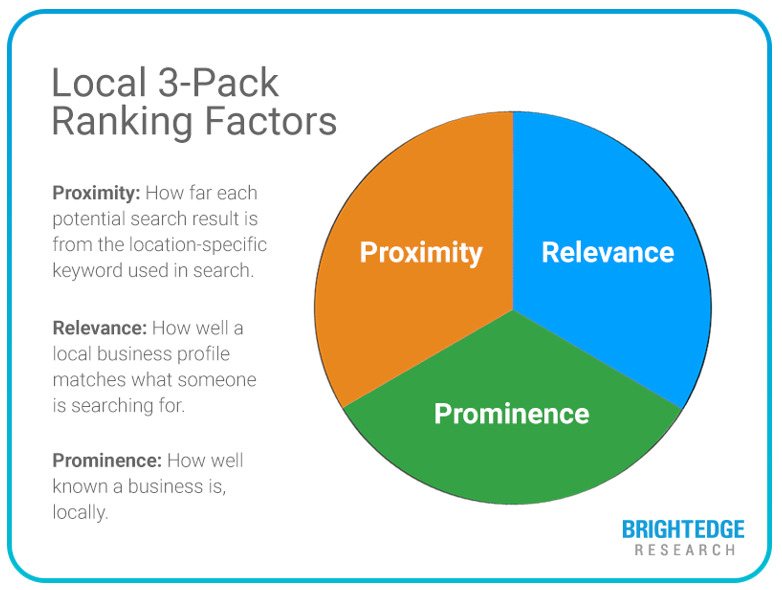 The three factors determining rankings for local searches are: proximity, relevance, and prominence. While Google doesn’t disclose the precise weighting of each factor, it is evident that with the rebalancing, proximity is taking on greater weight. These changes could impact your business listing in local search.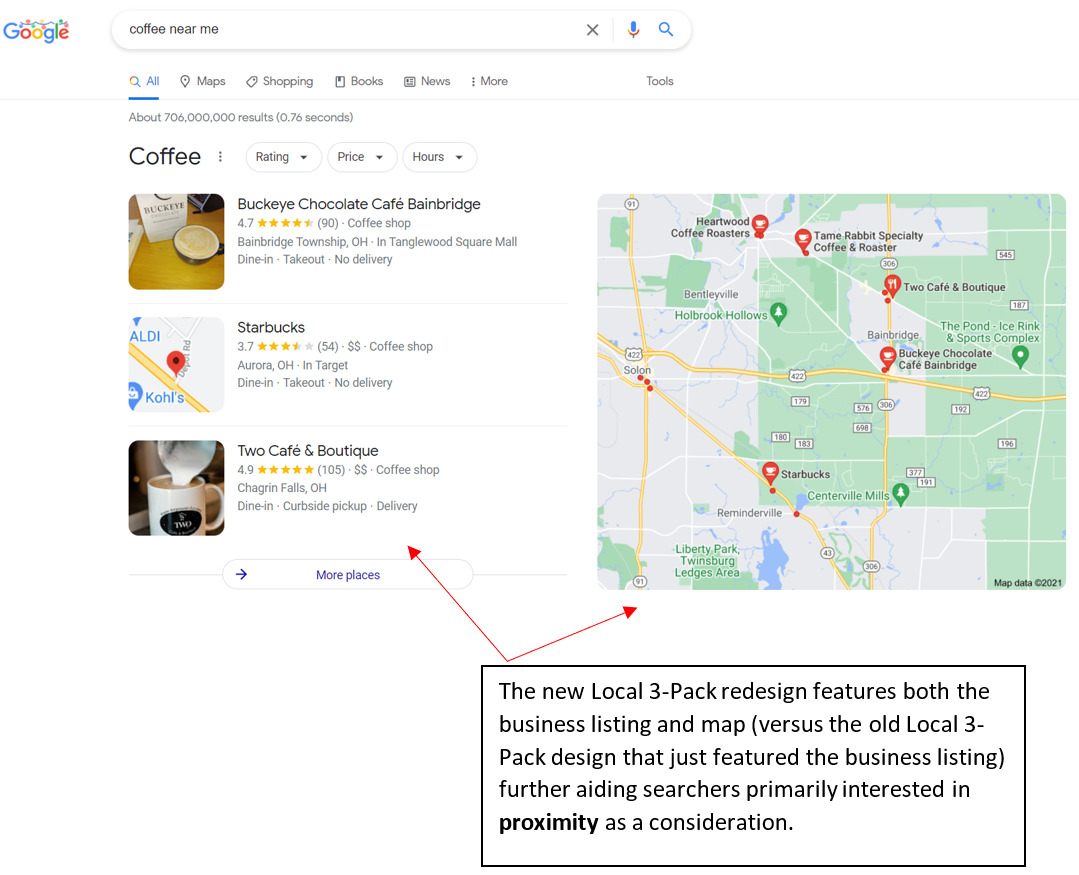




 More recently, it’s become vital for a business without a storefront to define its service radius. It has also become more difficult for brick-and-mortar businesses to target cities too far outside their physical address.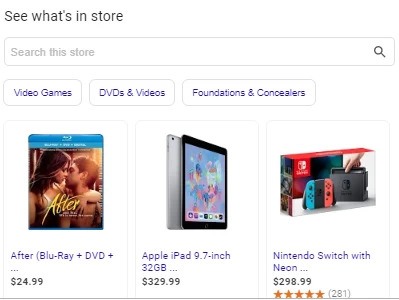









 current ranking signals in terms of distance and location. Although it’s not a penalty-based algorithm, the introduction of Pigeon also meant the usual scramble in regards to traffic and rankings. The use of