Guide to Structured Data and Schema Markup

Marketers, developers and SEO specialists have been talking about structured data since before 2011, when Google, Bing, Yahoo! and Yandex decided to collaborate on and support an open-source platform to define entities and their attributes. Structured data helps search engines better understand the content on a website so that information can be accurately portrayed in the search results. Studies have shown that search listings with rich results typically get more organic impressions, organic clicks, and see increased audience engagement with more time being spent on the pages.

On top of that, structured data can help you control the information presented in your brand’s Google Knowledge Panel and may even help optimize your website for voice search in Google Assistant. Some Googlers have hinted that structured data is going to become more important to search over the next several years, if not sooner – meaning now is a great time to get onboard and become comfortable understanding and speaking about structured data within our own organizations.

Check out the resources and articles below to learn more about structured data and snippets and how to implement on your site.

SERP Rankings Are More Important Now For The Buyer's Journey

koleary
koleary
M Posted 5 years 6 months ago
t 9 min read

Update: This blog has been updated with 2020 data and information.

The buyer’s journey used to be a simple circular route from Awareness to Consideration to Purchase and (hopefully) back around again. Digital has transformed the buyer’s journey into a complex maze of multiple touchpoints and increased the potential for crossed wires.

With 4.57 billion people using the internet in July 2020 alone, the buyer’s journey now begins and, for many industries, ends in the digital landscape. 87% of consumers begin their journey digitally. This is a huge percentage jump since 71% in 2018. By focusing your attention on how your brand appears in search results, you can reduce the overwhelming nature of the modern buyer’s journey, and make sure you are targeting the right content to the right audience at each moment in their journey to minimize poor bounce rates.

Naturally, you're going to want your content to rank above competitors. If prospects have discovered pain points and begin searching for solutions to them, this is your opportunity - right at the initial stages - to grab your prospects attention. If your content isn't optimized to rank well, prospects are finding your competitors resources at the beginning stages of their journey and therefore not finding yours.

What buyers discover in searches along their journey

A simple Google search has become complicated. Buyers no longer get the same results with the same search terms. Instead, each individual’s buyer’s journey is personalized based on the type of intent, device, location, time of day and any other past search history.

The layout of the search engine results page (SERP) is also up for grabs. There are now 50 different SERP elements and an infinite number of combinations where Google is understanding the intent of each search to present the most relevant and helpful information during the buyer’s journey.

For example, if the user asks a question during a micro-moment search, Google might prioritize a Quick Answer, the highlighted section that appears at the top of the SERP whenever a user asks an information seeking question, like “How to…” or “What is…”. Or when a location seems like the most appropriate result, the buyer will see a Local 3-Pack view showing nearby businesses who offer what they’re looking for.

The four micro-moments of the customer journey

Micro-moments are when users leverage their devices to search for solutions with the intent to do something whether they're looking to do something, see something, buy something and more. You'll need to know the different moments as they're a crucial part of the customer journey and aid you in being there for prospects during these moments when they're looking to reach you via content. The four micro-moments include the following:

  1. I want to know. During this type of search, users will search for a topic without a specific business in mind. Simply put, users are looking for their questions to be answered at this stage.
  2. I want to go. Here, users are looking to go somewhere. This can include a vacation destination, a local business or any other physical place a user is looking to go to.
  3. I want to do. At this stage, users are looking to learn to do something. During COVID-19, search engines saw a huge jump in searches for baking bread and at-home workouts. These are two examples that fall under "I want to do" moments.
  4. I want to buy. At this moment, users are looking to purchase. Queries including "near me" or an actual product like "65" smart TV" indicate users are looking to solve their pain point with a purchase.

Buyers are expecting the straight-forward answers they're looking for

All of this has transformed the buyer. They now expect to see only the most relevant search results linking to dynamic content that reflects where they are in their journey. If your brand is still reciting the same stock answers, you’re missing out, especially as millennials – now “the world’s most powerful consumers” – are more loyal to brands that provide a personalized approach.

When the majority of every buyer’s journey starts with search, you need to ensure buyers see signs for your brand on that first results page. Here are three ways to ensure you earn their attention.

  1. Know the queries users are searching for 

New York sports center Aviator Sports created a new webpage to promote its figure skating rink and classes. When it didn’t generate the anticipated traffic, the company used BrightEdge’s deep learning SEO technology to analyze the relevant keyword landscape. This revealed that while “figure skating” is the widely-accepted term in the sports world, regular people typically search for “ice skating.” By optimizing this term on their webpage, Aviator boosted its potential search volume by more than five times.

Don't assume that buyers use the same language as you. It’s critical to establish which relevant terms people actually search for the most. You should also explore which terms your competitors are ranking for and find out if there are any important categories where your brand does not rank.

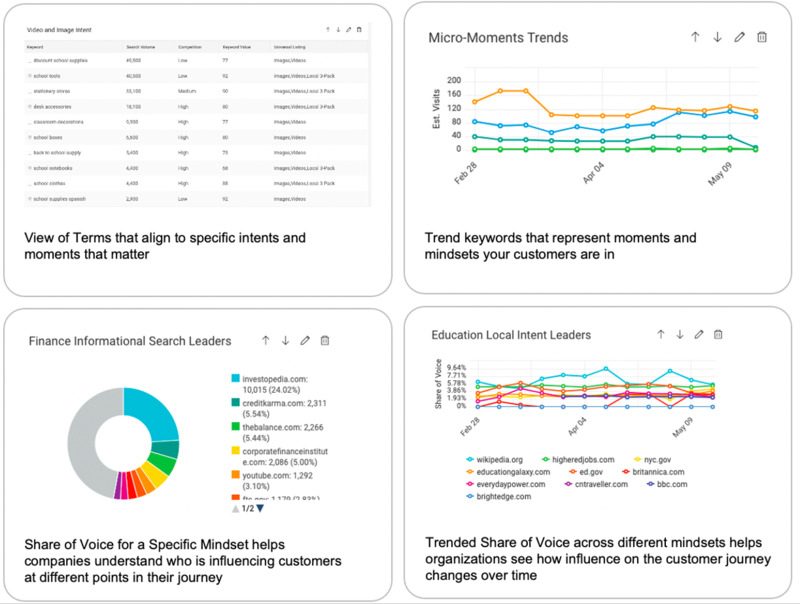
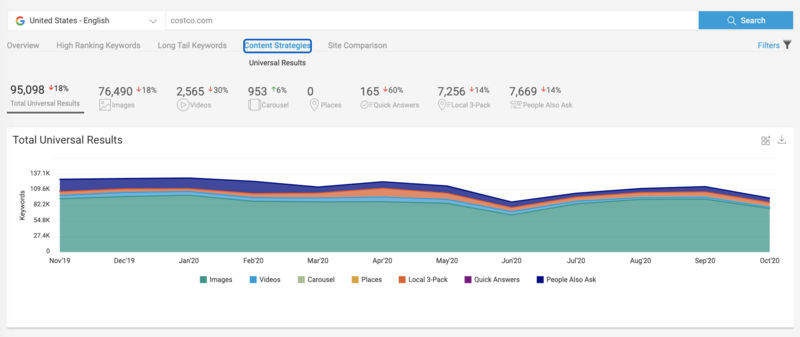
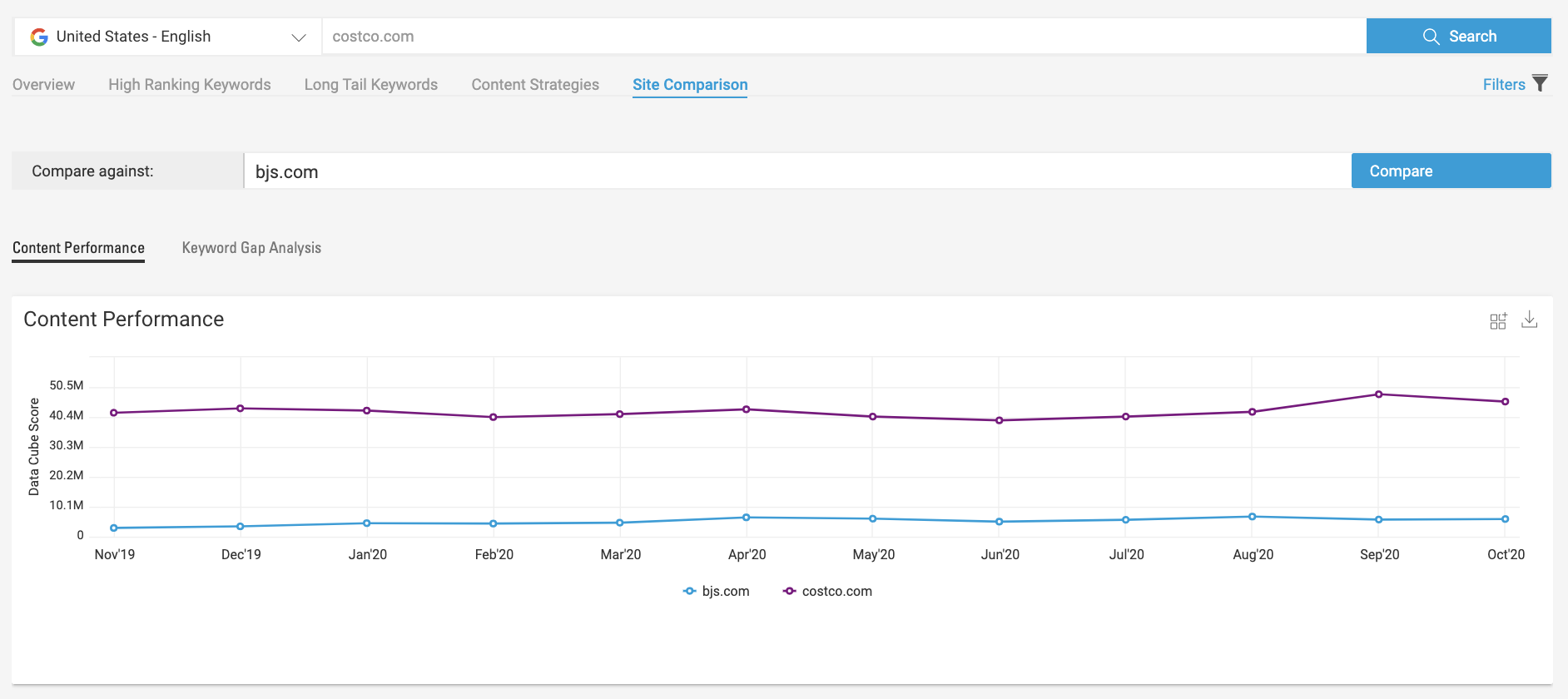
Using Instant, you can easily discover real-time insights into the relevant queries users are searching for. You can also use Data Cube to locate the terms where your brand ranks and what language is used. You can also quickly compare your domain to any competitor to see what terms they rank for in the first page of search results that you are not.

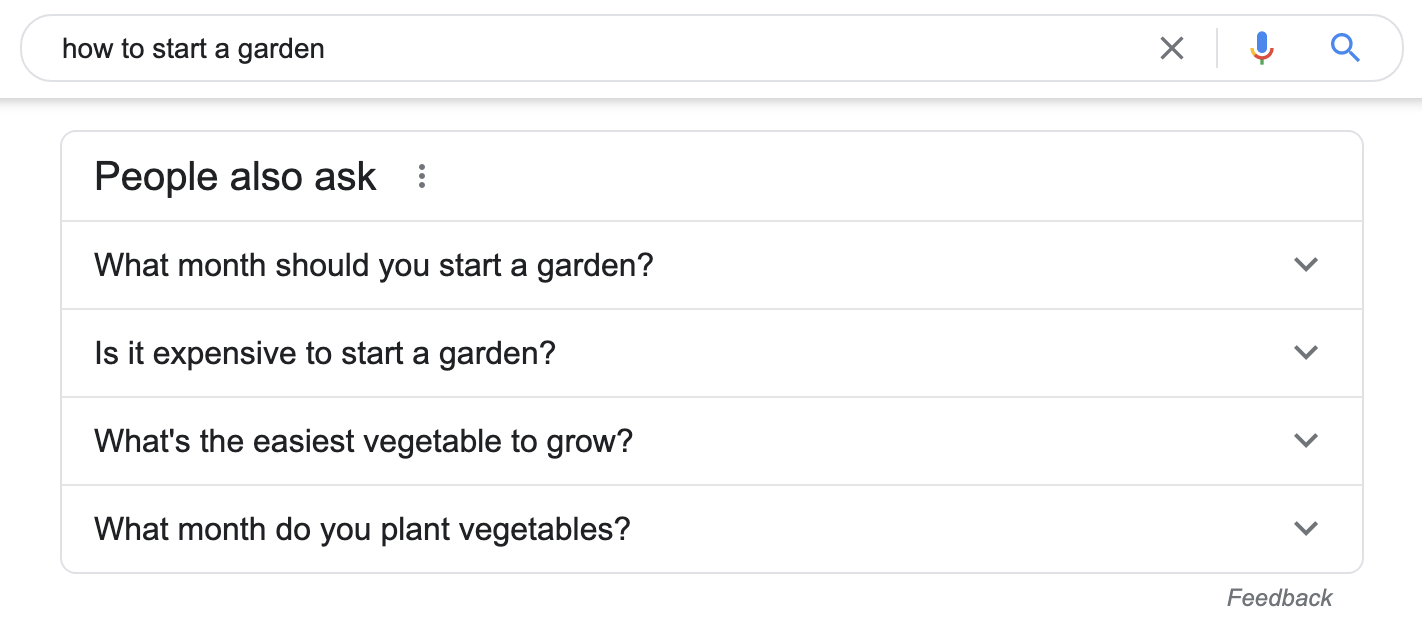
Not only will you need to know which keywords you're ranking for, not ranking for, and which your competitors are ranking for, but you'll also want to find the searches that are most relevant to your prospects when solving their pain points. You can do a search for the queries you want to appear for. Look at what Quick Answers and People Also Ask results appear and ask yourself if your content is answering those questions consumers are looking for.

Demo Instant For Real-Time Search Results

A chart of analyzing keyword trends in Data Cube - BrightEdge

  1. Create unique content for different search types

When cosmetics brand Kiehl’s noticed that lots of people were searching for advice on using skincare products, it produced content to specifically answer the most common questions. As a result, the brand saw a 30% increase in its Quick Answer ranking. Are your prospects downloading resources from your site? Are they checking out blog content or watching videos? Discover the content your prospects are looking at on your site and create more of it for every step in their buyer's journey to help them move along.

Words used in a search are often an indicator of where a buyer is on their journey and you need to create relevant content for each type:

  • “How”/“What” – The buyer starts their journey by searching for information about a category. This is your opportunity to become a Quick Answer and produce interesting category content.
  • “Reviews”/“Best” – The buyer is interested and now considering their options. Help them by creating brand comparison content and promoting your good reviews and case studies.
  • “Buy”/“Order”/“Download”/brand term – The buyer is ready to make a purchase. Close the deal by showing them product pages and ensuring your brand features on Google Images and in the Local 3-Pack.

Using BrightEdge Keyword Reporting, you can easily organize and strategize on all of the terms where your brand is ranking on informational, consideration, or purchase terms. Keyword Reporting will also help you identify which terms have universal rankings, such as a Local 3-pack or Quick Answer, to help you optimize your pages for the right intent to secure those prized search spots.

Show Keyword Reporting to identify universal listings - BrightEdge

  1. Optimize your content to rank for different search types

Digital Media Publisher targeting athletes Stack.com discovered 120 keywords initially and narrowed down their target list to focus only on terms with the highest organic potential. The brand then created targeted content for this subset, which increased site visits by 61%.

Once you understand the intent of each targeted keyword, you can maximize your organic effort by grouping keywords into three categories:

  • Defend – terms whose high ranking you need to maintain
  • Optimize – terms where you can achieve a higher ranking with some minor tweaks
  • Create – terms you are not ranking for and need to boost with new content

Leveraging BrightEdge’s Visual Parser, the Intent Signal dashboard template will automatically do this analysis and categorization for you. Or consult Insights, which automatically scans your site for pages with errors that affect ranking or those where additional content like an image or Quick Answer might boost results.

How to build a dashboard in StoryBuilder - BrightEdge

Adjust your strategy if your content isn't resonating with buyers

In order to understand whether your content is resonating with prospects, you'll want to measure and track your data. You can use Data Cube and Page Reporting to understand how your pages are ranking and for which keywords they appear in the SERPs. BrightEdge integrates with Google Analytics, therefore you can uncover all the necessary data to alter your strategy or keep it the same.

By keeping track of conversions, you'll be able to uncover whether or not your pages are working for users. If you notice a page isn't converting well, investigate the content and decide next steps. Why aren't prospects converting? If there isn't a CTA, add one and track whether or not conversions increase. If your page offers a CTA but it's not converting well, consider your options whether repositioning the CTA, choosing a more relevant one, etc. 

Keep pace with technology

The world’s leading search engine never sits still, therefore the buyer’s journey will continue to change. Using a leading industry technology like BrightEdge will give you the ability to automate these processes and it is how the best SEO marketers keep pace for SEO reports. With all the tools you need to stay on the same path as your buyers, BrightEdge will keep you two steps ahead.

Organic Search Is An Invaluable Business Intelligence Tool

monique.johnson
monique.johnson
M Posted 5 years 6 months ago
t 9 min read

Businesses have had to make drastic changes this year to accommodate the new normal. Likewise, consumer needs and concerns have also zig and zagged this year. This dynamic is quickly creating new market realities and navigating them requires businesses to put a greater focus in their agility. They need to know what the customers care about, how their environment is impacting their intentions and where opportunities are to meet their needs and create meaningful interactions. This will require re-imagining how they gain market and business intelligence to be faster, more accurate and actionable in new environments.

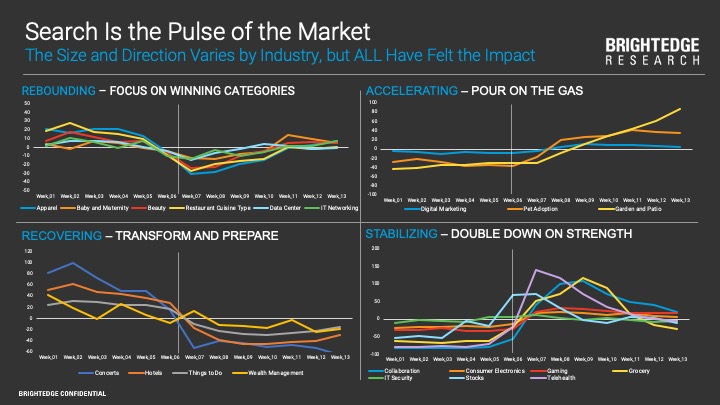
At Share 2020, a key theme we hit on is the convergence of search data and business intelligence. How consumers search and how search engines are serving up trillions of historical search results reveal a rich portrait of what consumers want, how they want to consume it and what messages are resonating with them. For many marketers, the challenge is turning what we see in search results into macro trends that can serve as an input into your broader marketing and omnichannel strategies.

Using a combination of AI and trending billions of searches, BrightEdge provides digital marketers with the technologies to elevate search data into macro consumer insights with Market Insights. We built this platform because we believe when organized and positioned correctly, search represents the most accurate and agile representation of consumer behavior.A guide to search behavior with Market Insights - BrightEdge

There are three key aspects of macro consumer behavior that search data can help your organization uncover:

  1. Who is changing purchase and discovery patterns?
  2. What are your opportunities?
  3. How should you realize these opportunities?

Who is changing purchase and discovery patterns? 

Let’s say you’re a business with an e-commerce component selling thousands of products online. You need to understand across your categories what trends are emerging across those consumers looking for your products and be able to answers to these questions:

  • What product attributes are becoming more important?
  • Are they becoming more price sensitive?
  • Do they have strong brand preferences that inform purchase?

With over 75% of shoppers doing a search before making a purchase, your search data is the perfect consumer measurement. Market Insights aggregates granular search data into consumer categories that empower you to answer these questions. Beyond the search and content value, you are now armed to:

  • Inform product strategy for what inventory needs to be prioritized
  • Help shopper marketing and retail teams understand where price sensitivity is on the rise
  • Inform branding and omnichannel teams on how consumer brand preferences are changing faster than any focus group or lookback data with real time search data. 

What are your opportunities?

Core to the convergence of search and business intelligence is the chance to become even more agile in opportunity identification. Granular search data reveals a lot about what consumers care about and how they think. Market Insights consolidates granular search data into meaningful macro trends. Insights revealed in this data can help businesses:

  • Determine what represents an actual trending change in consumer preferences vs. an anomaly. Move quickly on emerging ones and avoid costly investments chasing the wrong ones. 
  • Identify blue ocean trends—where are net new behaviors emerging that your brand has a right to win?
  • Determine how macro trends are impacting existing sales. Correlate negative conditions or consumer attitudes to impacts on sales. 

Armed with this data, marketers have an agile way of observing the market that is fresh and reactive to current events and conditions. Using search in this way helps brands:

  • Make strategic omnichannel decisions faster and determine what opportunities are significant enough to warrant an orchestrated omnichannel approach
  • Get ahead of new market opportunities faster than competitors and organize your branding, messaging and product teams.
  • React faster with your branding, content and media teams to prevailing macro trending needs and frustrations.

How should you realize those opportunities? 

Once we understand what the opportunities are with our consumers, Market Insights also tells us how we need to orchestrate content and build our omnichannel strategies to realize the opportunity. One of the benefits of search is that we are marketing with the most powerful arbiter of intent the world has ever known. Search engines like Google use powerful search algorithms to receive trillions of results, reflecting on what users really want.

Market Insights harnesses the real-time search results from search engines to help businesses better plan their macro strategies. This help you to:

  • Prioritize what pain points being expressed with search behavior warrant broad communication. Anticipate market opportunities fast. 
  • Determine what content is resonating with consumers across multiple screens.
  • Identify the formats and content delivery methods that align to how consumers prefer to engage.

Demo Instant For Real-Time Insights And Results

Armed with this data, marketers have a near-real time method for measuring what consumers want when they engage. Beyond search, this data helps brands: 

  • Build their macro communication strategies across channels through their content teams.
  • Address new consumer trends by enhancing your content team’s ability to be agile and pivot messaging when needed.
  • Define the formats they need to create in order for that content to resonate with the intended audiences. 

When we start thinking of search as both a channel and a real-time audience listening platform and scale the insights across our business, we make decisions faster and more accurately. 

BrightEdge Takes SEO into New Digital Era with Market Insights & Intelligent Log Analyzer

BrightEdge Takes SEO into New Digital Era with Market Insights & Intelligent Log Analyzer

Market Insights & Intelligent Log Analyzer Accelerates Digital Transformation

FOSTER CITY, Calif., Sept. 17, 2020 - BrightEdge, the global leader in organic search and content performance, today released BrightEdge Market Insights and BrightEdge Intelligent Log Analyzer at its annual Share20 industry event to thousands of marketing professionals. Together, these innovations allow search and digital marketers (for the first time) to incorporate the power of Business Intelligence (BI) and also automate how they optimize webpages and infrastructure in real-time, with high precision.

BrightEdge Market Insights provides customizable macro-market trends for strategic planning and reveals prescriptive opportunities. Combined with the newly released BrightEdge Intelligent Log Analyzer, the company is integrating massive data, powerful analytics, BI, and web infrastructure optimization in one platform.

"The digital marketing landscape has changed dramatically in the last 6 months. This has forced companies to fast-forward digital transformation and how they think about SEO and digital as a whole," said Jim Yu, CEO of BrightEdge. "For too many years, enterprise marketers have used disparate point tools for reporting, analytics, workflow, and optimization, too often looking back rather than ahead. They can't keep up with such a fragmented approach."

BrightEdge Market Insights: Bringing together business and search intelligence

BrightEdge Market Insights signifies the convergence of search with BI for the very first time, with analytics powered with real-time search data. Marketers are already sitting on a wealth of information that can guide business strategy. Still, they cannot efficiently process all the data quickly enough to reveal relevant business insights hidden in all that search intent data.

BrightEdge Market Insights is built into the BrightEdge S3 platform, which already supports over a hundred thousand marketers today. Now, a robust and customizable BI layer helps search professionals quickly understand key market drivers, get instant answers using natural language, and simplify complex data analysis with machine learning technologies such as Google’s TensorFlow™ - across billions of data points in real-time.

Amy Shipman, Manager of Worldwide Search Strategy & Analytics at HP Inc., used BrightEdge Market Insights to drive a new approach to search that aligns tightly with their global business. "We needed a solution to quickly assess Search opportunities across multiple markets with both agility and consistency," said Shipman. "The Market Insights solution BrightEdge is developing for HP gives us a powerful new way to advance our global strategy, enables both the in-house paid and organic efforts across over a dozen markets, and empowers the team to respond to rapidly changing needs of our customers and the business. They have been great partners in listening to new ways that we envision leveraging the strengths of the BrightEdge Platform and working closely with us to make that a reality."

Rafael Baptista, VP of Product SEO at Kayak/OpenTable, used BrightEdge Market Insights to quickly create an entirely new type of marketing insight that combines intent-based search streams of keywords with market data about competitor factors driving performance. "We can evaluate the market with statistical accuracy across our entire portfolio of 7 brands and across our geo markets," said Rafael.  "The data is impressive, the visualization capabilities are sophisticated, and it can reveal broad market shifts and highly specific localized opportunities in a single platform that aligns to the way we work.”

According to BrightEdge COO, Krish Kumar, "Marketers need platforms that leverage big data on a massive scale that can scan the entire marketing landscape but also quickly pivot to dive deep to find opportunities and understand rapidly shifting search patterns. Old models don't always fit the new reality.  Recent times have upended markets, and marketers increasingly need a robust unified platform with agility, breadth and depth, and execution speed with high precision. Our announcements today show where our industry is really heading."

BrightEdge Intelligent Log Analyzer: Powering content and technical performance in one platform

BrightEdge Intelligent Log Analyzer is a new version of BrightEdge's Log Analyzer utilizing the popular machine learning stack TensorFlow™ Sonnet for deep insights and relational web insights across hundreds of billions of webpages, which has never been done before. Using this, BrightEdge Intelligent Log Analyzer instantly pinpoints technical errors on hundreds of thousands of webpages that can be optimized immediately at scale.

A New Era in Search: SEO Innovation is powering new ways to maximize the digital opportunity

​This latest series of product announcements mark a new era for the search professional and the SEO and digital industry. For the first time in the industry, BrightEdge has blended big data with machine learning, business intelligence, real-time insights and automation. BrightEdge's latest innovations mark a significant leap forward for search and digital marketing professionals.  These new products will reshape the search space and are designed to help SEO and digital professionals deliver compelling customer experiences and outstanding business results.

About BrightEdge

BrightEdge, the global leader in enterprise organic search and content performance, empowers marketers to transform online content into business results, such as traffic, conversions and revenue. The BrightEdge platform is powered by a sophisticated deep learning engine and is the only company capable of web-wide, real-time measurement of content engagement across all digital channels, including search, social and mobile. BrightEdge's thousands of enterprise customers include global brands and 64 of the Fortune 100 and 9 out of 10 leading global digital agencies. The company has a global presence across North America, APAC, LATAM and EMEA and is headquartered in Foster City, California.

Visit our website:  www.brightedge.com


Press Release Date

What Is Anchor Text?

The term “anchor text” refers to a snippet of clickable text that takes a user to a web page. Anchor text masks hyperlinks—the “naked” address of the page that is linked to. It is distinguished from other words in a block of content by its color, which tends to be blue. 

For example, “Mobilegeddon” is the anchor text in the following sentence: Google rolled out Mobilegeddon on April 21, 2015. 

If you look at the HTML code, you will see the following:

<a href="https://en.wikipedia.org/wiki/Mobilegeddon">Mobilegeddon</a>

Learn how to boost your rankings with anchor text.


Definition

<p>The term “anchor text” refers to a snippet of clickable text that takes a user to a web page. Anchor text masks hyperlinks—the “naked” address of the page that is linked to. It is distinguished from other words in a block of content by its color, which tends to be blue.&nbsp;</p>

<p>For example, “<a href="https://en.wikipedia.org/wiki/Mobilegeddon&quot; target="_blank">Mobilegeddon</a>” is the anchor text in the following sentence: Google rolled out Mobilegeddon on April 21, 2015.&nbsp;</p>

<p>If you look at the HTML code, you will see the following:</p>

<p class="rtecenter">&lt;a href="https://en.wikipedia.org/wiki/Mobilegeddon"&gt;Mobilegeddon&lt;/a&gt;</…;

<p>Learn how to <a href="https://www.brightedge.com/blog/anchor-text-everything-you-need-know-bo… your rankings</a> with anchor text.</p>

<p>&nbsp;</p>

<p>&nbsp;</p>

<p>&nbsp;</p>

2020 BrightEdge Holiday Planning Guide

2020 BrightEdge Holiday Planning Guide

With the holiday season fast approaching, are you be prepared for how this year will be different?

That's right, the happiest time of year is upon us and while the excitement will likely still be the same, it's time to be sure you're prepared during what is traditionally your peak season. Due to the COVID-19, many businesses are wondering what this season will hold.

  • Will the volume of purchases in a given day slow down?

  • Is Black Friday going to be as critical this year?

  • Will Cyber Monday be bigger than ever?

  • How will businesses handle supply-chain and shipping concerns?

Shopping trends have already shifted and using BrightEdge data, we’ve seen many these trends first-hand. We examined analytics of 144 e-commerce clients from a wide variety of business sizes and diverse product profiles. Our insights into shopping behavior over the past year show how brands will need to adapt to meet new consumer shopping behavior.

Find out how augmented reality, digital marketing, and SEO solutions will all be beneficial to your business going forward, especially this holiday season. Use this holiday shopping guide to get started on planning for your SEO and digital marketing strategies in Q4.

Use the full report to guide you through your holiday shopping marketing strategies.

CAPTCHA
Solve this simple math problem and enter the result. E.g. for 1+3, enter 4.
This question is for testing whether or not you are a human visitor and to prevent automated spam submissions.
,