
Graco Drives B2B Lead Gen with SEO and BrightEdge

BrightEdge powers Geoff Angell of Graco's global keyword research and SEO strategy.

Transcript of Graco's SEO Story:

I'm Geoff Angell, Senior SEO Specialist at Graco. I think our next focus here at Graco is going to be all around how do we optimize our images, not only with image alt-text, but contextually optimizing those images and creating some of the relationships between the image and then the page that's ranking for that image. People Also Ask has been a great way for us to uncover other new opportunities around Quick Answers or featured snippets.

As a B2B manufacturer we sell through channel and through distribution. Our primary KPI is either lead generation, or also activity on our distributor locator - all of our SEO measures kind of focus on those two primary KPIs on our site. SEO drives the majority of all web leads, and I guess the majority of all leads at Graco.

I continue to do demos of other platforms, I think it's worth you know constantly exploring other tools and know what they have to offer, but I've continued to stick with BrightEdge.

So when I have content writers, I need them to think SEO first when they're creating that content. BrightEdge is a really easy way of getting that content creator into BrightEdge and using it. So they're doing keyword research on their own and I'm not constantly doing keyword research across the multiple business units that I support. BrightEdge is appealing to a broader audience than just the SEO. 

The visibility I get from competitors for my own website makes BrightEdge a really good platform for me. I can quickly see how I'm performing at any given time. And with other tools, it's just not as clear. And I think the Data Cube aspect of BrightEdge along with the tracking of my keywords really gives me a clear understanding of where I stand at any given time.

Request a demo of the BrightEdge platform and see how you can utilize Recommendations for your company!

Building Engagement with Keyword Awareness

Default avatar
kartiky
M Posted 9 years 3 months ago
t 9 min read

As a valuable strategy for marketers, keyword awareness can boost a site's flow of organic traffic as well as engagement metrics.

A few months ago, I was returning from a concert when I noticed a small flier placed on my car window, which read "If you enjoyed this event, lookup [artist name] on Google". It was an ad for another concert organized by the same company whose event I had just attended.

I ended up searching for [artist name] as per the flier on Google a few days later to look for tickets and found myself clicking on the management company's website. While clicking around the site and learning more about their upcoming events, the strategy from a marketing standpoint intrigued me.

The flier was essentially a way to explicitly build keyword awareness, that when searched, would lead to more traffic on the company's website - a feedback loop to generate repeat customers. By encouraging people to research a particular term that they already ranked highly for, the company was able to secure the organic traffic and build engagement. This untapped strategy can build brand awareness and boost engagement metrics for companies that employ it.

Understanding the role of awareness in brand promotion

We understand brand awareness to be the likelihood that consumers recognize the existence and availability of a brand's product or service. Keyword awareness could be similarly described as the likelihood that consumers recognize the existence of search terms. When terms enter the vocabulary of those familiar with a particular topic or industry, they become more likely to use these phrases in their searches, thus increasing the traffic for those sites that were already optimized for the topics.

Marketers can use keyword awareness to drive up their organic search traffic. Similar to the experience above, brands can suggest keywords and promote different terms to particularly receptive audiences and begin to build themselves a strong audience for their particular areas of expertise.

When you build keywords in the minds of consumers, you can help influence both current and future behaviors. For example, if someone sees a list of related search terms on your site, even if they do not choose to click on one right now, they have a higher chance of remembering that term in the future and using it to search. When you rank highly for this term as well, the search will lead them back to your site, helping you to further build your relationship.

Before you can build keyword awareness, however, you have to have an understanding of which terms will align with your target audience's needs. If you're still trying evaluate which related topics will resonate, try our free 30-minute webinar on 3 Steps to Boost Content Marketing Results.

Building keyword awareness

One way to build keyword awareness is to publicize the high-ranking keywords via your product recommendation engine. Typical product recommendation engines calculate the likelihood of a product attracting a visitor’s attention by computing a likability score for related products and ranking them. This is done through a mathematical indexing formula that takes into account the browsing behaviors of other users.

In addition to the browsing behaviors, if the product likability score is made a function of organic keyword search volumes and ranking, marketers could have recommendations that are influenced not just by product likability but also search engine optimized content. In addition, publishing the list of keywords as a social proof-- for example, listing current popular search terms-- reinforces these keywords in the visitors’ minds, thereby creating an organic traffic feedback loop.

Boost engagement with keyword awareness and brightedge

A strong keyword awareness campaign can encourage people to visit your site while also boosting the engagement of those who have already landed on your page. Linking to related topics will encourage people to explore more material, keeping them on your page and laying the foundation for a strong relationship.

Improving engagement on your website serves a critical purpose in encouraging more prospects to enter your sales funnel. Customers today are inundated with content and information from a variety of different sources. Experts believe the digital ecosystem will grow from 130 exabytes to 40,000 exabytes by 2020. While the growth in digital usage is beneficial for customers, this means also that brands will have to compete even harder for attention.

Building engagement on your platform will boost your brand recognition and reputation. It lays the foundation for your relationship with the prospect, demonstrating that you can answer their questions and address their needs. Strong engagement metrics can also boost your ranking on the SERPs and encourage more people to enter your sales funnel.

Building keyword awareness and demand with BrightEdge

BrightEdge is a powerful tool that will help you find the right keywords to capitalize on, empowering you to raise awareness for visitors and build the positive feedback loops.

  1. Using the BrightEdge API, you can easily pull your top ranking keywords, search volumes and other SEO metrics, out of the BrightEdge platform. This will let you see the terms for which you regularly rank highly.
  2. Monitor and measure the search volume and the ranking URLs to better understand the keywords that will be the focus of your keyword awareness campaign. See our on-demand BrightEdge API webinar
  3. Create a site recommendation engine that uses the data pulled out of the BrightEdge platform, to help bolster your target keywords while using social proof to boost interest in the terms. Link people to content that is likely to interest them, encouraging them to explore more terms and the topics where you excel.
  4. Use A/B testing to further optimize your recommendations. Look at a variety of KPIs including how well the recommendations boost engagement, encourage people to enter the sales funnel, and result in repeat customers.

Keyword awareness and demand can be an important part of building an online strategy. By interesting people in your terms and topics, you can encourage them to engage with your brand through your website. Used correctly, it will boost your traffic arriving from organic search engines and it will encourage people to remain on your site longer.


request a demo

Use Keyword Research to Enhance Content Creation

enewton@brightedge.com
M Posted 9 years 7 months ago
t 9 min read

Keyword research is the process of choosing the best queries to write and optimize your content around. Keyword research allows you to write in the language appealing to your audience. It can influence the amount of traffic your content will receive. Keyword research impacts how well you your content aligns with your audience. Our research at BrightEdge has found that 51 percent of the channel traffic arriving on your site comes through organic search. Your ability to create content that resonates with your target audience, provide them with value, and rank higher in the SERPs to drive the visibility and success of your website is all part of SEO management.Using keyword finder, doing keyword research and keyword search are essential to content success Properly used, preparing for content development with keyword search will allow you to identify topics that your target customers are most likely to appreciate. This helps you build a relevant website that will boost engagement metrics, encourage social sharing and backlinks, and help you build your domain authority and rank. Considering that an estimated 93 percent of online experiences begin with search, improving your reputation online and building your visibility will influence your digital success.

How to perform keyword research with a keyword finder

Keyword research involves carefully analyzing the behavior of your target audience so that you can identify the topics that are most likely to interest them. There are a variety of factors that you can explore to make sure that you are uncovering topics that will appeal to your target audience.

  • The search rate or query volume
  • The top-ranking pages for the keyword
  • The traffic pages on your own website

As you look at the search rate, you can see how often people search for the term. This can offer great insight into the popularity of the topic. After identifying topics with strong search rates, you can then explore the top-ten ranking pages for that particular keyword. By looking at the top-ranking pages, you can understand the intent of people searching for this term to ensure that it aligns with your brand. You can also see what helps those pages stand out for the search engines and users and find areas where you can improve within your own content to boost your rankings. As you create your content and begin to build strong traffic to your site, your own domain itself can also offer insight for your keyword research. You can examine patterns and trends within your visitors’ behavior, such as the types of content that draw the most traffic, the content that results in the most conversions, and the topics that generate with revenue. This will help you understand the areas that are the most popular with your specific customers. As you create content, you want to ensure that you select topics that will drive traffic to your website while also using the vocabulary that your customers are likely to use themselves. This will help you build a website full of useful content that will appeal to your customers.

How keyword research impacts your business

Keyword research can help you effectively optimize every level of your business because of its ability to help you tap into trends. It can:

  • help you identify trends in products and naming
  • make your PPC spend more efficient
  • create marketing emails more aligned with customer interests

Organic search should be viewed as the focal point of your marketing campaign planning given that 94 percent of B2B buyers and 81 percent of customers research online before making a purchase. These insights, therefore, can help you ensure that all parts of your site will be prepared for search and to drive them down your funnel.  

A keyword finder, for example, can identify trends in products and naming that will help you as you prepare for product development, product launch, and PPC advertising. With PPC, you will be able to efficiently use the right keywords and leverage the content that these searchers want to see. This will help you improve your ROI and performance. The information from a keyword search can also help you tap into the interests of your target audience so that your marketing emails are more engaging for users, thereby improving your response rates. See how Verifi doubled their indexed longtail keywords and saw a 37% increase in organic traffic

How Data Cube can help with a keyword research

A keyword finder can help marketers identify valuable keywords, trends, and insights that will guide their content production. The problem that many run into, however, is the sheer amount of time required to track down the statistics and information needed to understand the necessary insights about a particular keyword or topic. The Data Cube from BrightEdge, however, has the information for billions of keywords in one convenient spot, making the entire process faster and easier. Using the Data Cube as a keyword finder, people can:

  • plug in topics that they believe would be a good fit for their website
  • receive information about that keyword as well as related keywords
  • look at the traffic rates and the estimated difficulty of ranking for these matches
  • sort their results by categories, including high-volume keywords, high-value keywords, and long-tail keywords, helping them uncover the topics that will work best for their particular situation with a single click.

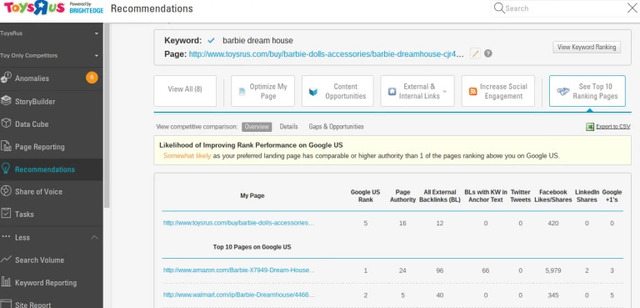
From the Data Cube, you can also click through to see the top-ten pages for the keyword in question. If the keyword is one you track, you can click on it. Once you arrive on the keyword page, you will see a View Recommendations button in the upper right hand corner. Uncover more insights by clicking through to the keyword recommendations.

By clicking on this, you will be taken to a new page, where you can select Top Ten Pages. Here you can see the pages that rank the highest for this particular keyword. You can analyze them to better understand the characteristics which help these pages rank highly and what your site needs to do to earn a spot on the first page of results. View the top ten pages for a keyword to build your own content development strategy.

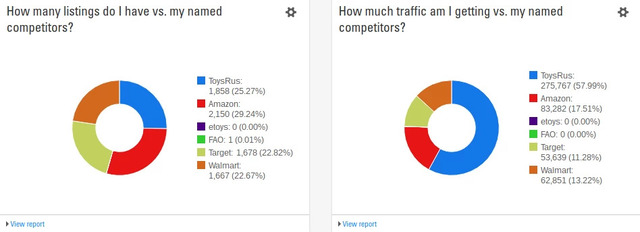
The Data Cube can also be used to uncover insights into competitor sites. By putting in the URL of a competitor, you can perform a site comparison, which will reveal keywords for which your competitor ranks but you do not. This can help you start to build prospective keyword ideas. You can also look at how they are performing in other aspects of the SERPs, such as universal search. If they are earning a number of Quick Answers, for example, you can examine the highlighted pages to see what changes might benefit your own internal strategy. Perform a competitor gap analysis to build keyword ideas.

Keyword search can be a valuable component of a marketing strategy because it guides your content creation and site development. With this research, your entire domain is prepared for the search engines and the customers who land on your page from the SERPs. Using a keyword search platform, like Data Cube will help you uncover the valuable information you need for optimal optimization without wasting time.

Using Keyword Analysis To Improve Content Strategy

enewton@brightedge.com
M Posted 9 years 8 months ago
t 9 min read

Performing a keyword analysis as you develop your content can help you accurately target your intended customers and create material that resonates with their interests and needs. When performed correctly, a keyword analysis will help you identify topics that your targeted customers want to read, effectively weeding out those who have no interest in making a purchase. Keyword analysis to better reach online customersAn estimated 67 percent of the buyer’s journey is now believed to take place online. Additionally, 94 percent of B2B buyers and 81 percent of customers say that they do research online before making a purchase. Effective keyword analysis will help you connect with this online audience, inviting them to get to know your brand and enter your sales funnel. As you prepare to perform your keyword research, you should understand what needs to be uncovered and how you can measure the results of your efforts moving forward. Here is how to perform an effective keyword analysis.

What do I want to learn from my keyword analysis?

There are a few main areas where you should focus on analyzing your keywords. By uncovering the answers to these central questions, you will gain a far better understanding of how well a particular keyword will work for you and your marketing goals.

Is this keyword valuable for the right audience?

The keywords that you use should address topics that your target audience finds valuable. Gaining traffic is not enough to have strong conversions. The topics that you cover should attract the people most likely to be interested in your products.

For example, if you are a plumber, writing articles that are highly technical about the right configurations of piping might end up attracting more competitors - who are interested in maximizing the efficiency of their services - than customers - who are not likely to configure their own pipes.

Understanding whether the keyword attracts the right audience is a multi-faceted process. It can be helpful to look at content you have developed around related keywords. Look for trends in the pieces that attract customers that convert. You can also look at the top-ranking websites for a given keyword and see the audience that they are geared towards. See if those particular sites are written for members of your target audience.

You can be confident that the top-ranking sites have proven themselves to be attractive to those entering the keyword into the search engine. Therefore, if they are written for your target audience, you know this keyword will be valuable. The BrightEdge platform makes it easy to analyze the top 10 ranking pages.

Keyword analysis and top pages in brightedge

Do I have a reasonable expectation of my site ranking highly for this keyword?

Your keyword analysis should also explore whether or not your site can reasonably expect to achieve a high, first-page ranking for this keyword. Certain keywords might have a great value for your organization, but your site does not have the domain authority to achieve the ranking needed to attract the right attention. It is important to weigh this factor carefully. When you are first building a site, you will want to create content for important, central topics, even though you do not have the authority to rank highly for them. As you build your site, however, you would likely see these sites start to rise in the rankings. If a particular keyword is highly competitive and the other sites are well-optimized so that there are few opportunities for moving into top-ranking positions, you might want to consider variations of the keyword that might afford you more possibilities. For example, adding location keywords to attract local traffic or turning a basic keyword into a long-tail keyword may allow you to gain the rankings you need to attract traffic and conversions you desire.

Will I gain enough traffic for this keyword?

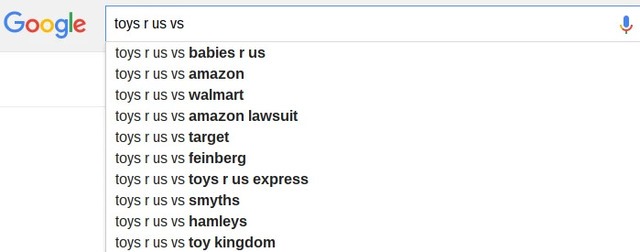
You want to focus the majority of your efforts on topics that will draw strong traffic to your website. As you create a content strategy, you will notice that most of the people arriving on your site are at the top of the sales funnel. This means that they are least interested in highly-branded material - instead, they want to find information that answers their questions. With this in mind, you want to select pieces intended for those at the top of the funnel that have high traffic rates. The more popular a keyword is, the more people indicate that the topic interests them, which will help you engage your audience. It will also help ensure that you bring enough people to your site that you can start attracting loyal readers, backlinks, and other metrics that show Google that readers find your site to be useful. As you move down the funnel and your keywords become more specific, you will notice drops in the targeted keyword traffic. Pay attention, however, to the most popular formulations of different branded keywords, such as the competitors people are most interested in comparing to you. This will let you know where to focus your efforts through the funnel.

Keyword analysis and competitors in google search - brightedge 

How do I test a keyword’s value for my site?

Once you have decided on the keywords that you want to focus on for your website, the next step is to test your theories and see how your brand is performing.  Tracking this value will make it easy to see if your keyword analysis has been accurate. Here are a few ways to uncover this valuable information.

Use Google AdWords

You can use Google AdWords to set up a campaign for your new keyword. This will let you see directly how many people click on your site and then explore your domain further. The people who click and convert will provide insight into how well you are aligning with consumer expectations and how relevant this keyword is to your target audience. This keyword analysis is important because you can gauge your success without having to wait for your page to rank highly enough to see results.

Track the behavior of people on your site

Watch what people do when they arrive on your site. See how often they visit pages with a particular keyword. Pay close attention to the behavior of people who arrive on the site through the page you have optimized. See if they bounce off, click on to other content, and even convert. This will provide you with insight about how well your content meets their needs.

Use the BrightEdge platform to better judge the success of individual pages

On the BrightEdge platform, you have access to Keyword Reporting and Page Reporting features that make it easy to see how well your targeted keywords impact your broader content strategy. You can track individual keywords to see your rank and how much traffic your pages or keywords are attracting. You can use the StoryBuilder tool to set up charts that will let you easily uncover the pages that are contributing the most towards revenue. This will make it simple to understand your progress and the types of keywords that are the most popular for your audience.

Keyword analysis is an important step in the development of an effective content marketing strategy. It will help you better pinpoint the topics your targeted audience wants to read about while also gaining a superior understanding of the vocabulary they use. Understanding the value of performing a keyword analysis will help make your process more effective and productive.

Why You Need More than Just a Keyword Tool

enewton@brightedge.com
M Posted 9 years 10 months ago
t 9 min read

When people think about SEO, keywords are often the first topic that pops into their minds. It is no wonder that the phrase ‘keyword tool’ receives nearly 10,000 searches every month and ‘keyword planner’ receives over 60,000. Keyword research is an important part of any SEO strategy. It helps you uncover the topics that matter the most to customers and monitor traffic rates so you can grasp the popularity of particular phrases. You can use your keyword tool to help you better understand the seasonality of particular searches and develop a better understanding of your targeted audience and intended customers. It is important to recognize, however, that this is just one small piece of the puzzle. Using a keyword tool successfully will help you plan your editorial calendar, but that is the extent of its usefulness. When it comes to the other important aspects of developing a successful online marketing campaign, this aide will fall short.

To see the optimal success with your keyword research efforts, they need to be a part of a greater SEO platform and strategy. Here are five key types of knowledge where you will need to expand your SEO skills beyond keyword research.

A keyword planner cannot help you understand the top performing pages for your topic

Although your keyword tool will help you uncover various phrases and topics that your intended audience would be interested in reading, you are left starting from scratch when it comes to developing your actual content. Your keyword planner will not tell you what has already been successfully ranking for a particular phrase. When you combine your keyword planner with a recommendations engine that allows you to see the top ranking pages for your targeted keyword, then you have a strong starting point for your content creation. You can uncover what helps those pages rank highly, understand what the audience searching for this keyword is likely to be interested in reading and build from this starting point to create superior content that is worthy of a highly ranking position. When your keyword tools work with this type of recommendation system, you will have a far greater understanding of which keywords you are in a position to rank for and how to go about creating the content that will accomplish this goal.

keyword tool - brightedge

A keyword tool cannot tell you if you were successful

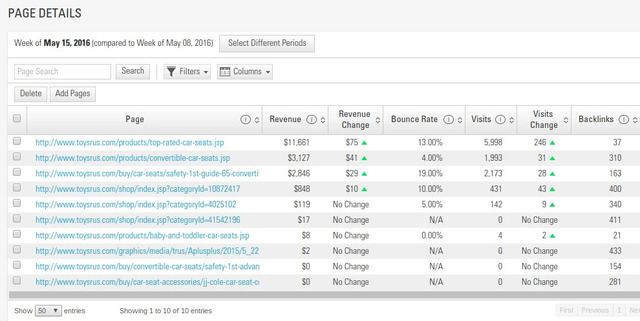
Once you have created your content for a particular keyword, you likely then want to know the success of your efforts. While you might be able to see your traffic report, you will not be able to see where you are ranking overall and how that ranking is impacted by other SEO efforts, such as backlinks. You also want to be able to tell if the content you develop effectively engages the target audience instead just bouncing off the page. A page reporting tool can help you gain this level of insight. You can see exactly where your content is ranking on the SERPs instead of just estimating based on traffic rates. When you know your rank, you will then be able to gain a better understanding of how well your content efforts have performed.

A thorough SEO platform will also offer you insight into how well your material is performing on social media. You can see likes and shares and compare this activity to your engagement and traffic rates. When customers regularly share your piece, you will have a better idea of how well readers are connecting to your material.

page reporting screenshot - brightedge

The keyword planner will not tell you how your efforts impact the bottom line

Drawing traffic is just one small part of a successful SEO strategy. It is the first step towards creating a marketing plan that will bring in paying customers. Although it is always nice to see the numbers rise on your traffic reports, to know if your content development has been truly successful, you need to make sure that your research with your keyword tool and your content creation has been helping the bottom line. As you do keyword research and create your content, you want to to have a specific goal in mind for this material, such as revenue or brand reach.

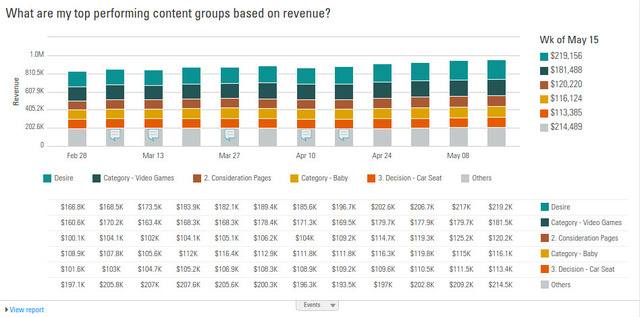
Creating dashboards with the useful metrics can help you compare the data from your marketing efforts and see how well they are helping you to meet your predetermined goals. You can establish keyword groups for particular campaigns and create easy-to-understand graphs and charts that clearly communicate the correlation between your content and your goals. You can use this data and insight to refine your strategy. If you are generating traffic, for example, but have a high bounce rate and few conversions, perhaps your keywords and not well-aligned with your targeted audience. It is only with a platform that can generate this level of insight that you will be able to make these adjustments and avoid wasting time and effort.

keyword tool revenue ROI - brightedge

The keyword tool does not offer competitive insight

Keyword research will not provide you with any level of insight into what your competitors are doing and how you compare to their progress. Succeeding in the SERPs means not only creating and optimizing content, it also means strategizing better than your competitors. Insights from others in your industry, such as the keywords they rank for and their site statistics, can help you accurately plot your own strategy and make adjustments based upon what has worked or failed for others.

A keyword planner does not offer insight about how other aspects of your site are performing

Although your keyword tool can help you find topics and phrases for which you can optimize your content, it will not do anything to help the rest of your site. Content performance is not established based upon a single page - Google also takes into account the authority of the entire domain as well as the user experience on your site. When you have a well-established, reputable website, your content will naturally rank higher than a new blog (learn how to choose a blog topic), no matter how well a particular page of content might be written. This means that to succeed in SEO, you need to look beyond keywords to the entirety of your website. You need site audits that will help you uncover potential gaps in your overall optimization efforts, such as incorrect redirects, page errors or missed opportunities to rank a particular page of content for a word. You also need a tracker that will help you monitor your progress with off-page SEO, including social signals and backlinks. The stronger you create your website as a whole, the better your individual pages of content will perform.

A keyword tool is helpful for brands as they develop their editorial calendar. For your content to gain readership, you want to make sure that you cover topics that your intended audience wants to read, and this research will help you find the popular subjects to focus your efforts. Brands need to carefully avoid the mistake, however, of relying too much on keyword research and neglecting the rest of the instruments needed to create a thorough, successful online marketing strategy.

7 Things You Must Do to Rank for Your Keywords

enewton@brightedge.com
M Posted 11 years 4 months ago
t 9 min read

In this age of Panda, Penguin and Hummingbird, ranking for your keywords in the search engine results pages (SERPs) requires both strategic SEO intelligence and a systematic approach. SEO is very much alive and well -- when done correctly -- and is integral to a winning organic search content strategy. With that in mind, we’ve distilled seven essential steps you need to take to rank for your keywords.

1. Keyword research

Keyword research lays the foundation for optimizing your site. Beginning from scratch, the fundamentals for keyword research and discovery are:

  • Build a keyword portfolio, starting with a core keyword list (aka “seed list”). Organize your research in a spreadsheet (for instance, Excel or a Google Drive sheet) that includes keyword ideas from competitor sites as well as your own.
  • Extract the keywords that drive the most impressions from your site’s Google Webmaster Tools (GWT) account and add them to your core list.
  • If you have access to the BrightEdge Data Cube, perform a search of your website to discover those keywords you’re ranking for (including which pages), and add those to your list. Next, do the same for your competitors.
  • Next, use Google’s Keyword Planner tool for more research to uncover additional keyword ideas.
  • Finally, organize and prioritize your keywords into categories in your spreadsheet, such as “products,” “services” and “news.” This step will help you in creating your website structure, which we’ll discuss next.

For a detailed description of the keyword research steps outlined above, you can refer to my guide to keyword research at the BrightEdge blog.

2. Site structure

Your keyword research will help you build an optimized site structure (aka navigational framework) that helps the search engines understand what your site is about, and allows your users to navigate with ease. Organizing your site’s structure around targeted keyword categories, or themes, will help the search engines understand that your site is relevant to a user’s query. With your keyword research spreadsheet as a guide, your next steps are to:

  • Clarify your website’s overarching themes, incorporating your more general keywords.
  • Define your website’s main categories and subcategories with more specific keywords, again informed by your keyword research.
  • Optimize individual pages with even more refined keywords, including “long-tail” keywords (discussed below) specific to that page. This is where you can “move the needle” by making small tweaks that result in drastic improvement in your pages’ SERP positioning (what we refer to as “striking distance”).

BrightEdge CEO Jim Yu provides an overview of these concepts in his article for the BrightEdge blog.

3. SEO content audit

While this is an optional step, conducting an SEO content audit is recommended, as it helps you assess what content on your site is performing well versus what is falling flat in terms of search rankings and ROI. Establishing this initial benchmark will help you inform your content strategy going forward. There are several tools you can employ for gathering the data you’ll need to conduct an SEO content audit, depending on your needs. For enterprise-level firms and larger websites, the BrightEdge SEO platform has both analytics and reporting tools that measure organic search and revenue performance for individual pages as well as site categories and subcategories.

  • As with keyword research, you’ll want to export and organize the data you’ve culled from your content audit into a spreadsheet. Some of the key SEO metrics to analyze are pageviews, organic visits, bounce rates, conversions, and page speed.
  • Focus on the performance of website pages that are central to your business, such as key landing and sales pages.
  • Your blog requires measuring social metrics such as Facebook sharing, tweets and re-tweets, Google +1s and shares, as well as the quality and quantity of backlinks that search engines use to gauge the authority and credibility of your content (which in turn influences your blog’s search ranking).

For further reading on how to conduct an SEO content audit, see my post on the BrightEdge blog.

4. Content creation, optimization, and on-page SEO

At this stage, you’ll need to create content for new site pages and/or optimize existing ones with the relevant keywords gathered from your research. The guiding principles here include:

  • Strive for a good word count that makes the content feel complete (no less than 250 words, depending on the topic and purpose of the page). Optimize with keywords that are relevant to the page topic, but avoid keyword “stuffing” or adding unnecessary text. Also, make sure that written content is immediately visible to viewers near the top of the page (don’t make ads the first thing they see).
  • Guard against duplicate content, which can be a result of inadvertent mistakes such as replicating pages’ Meta information (discussed below).
  • Create Meta data unique to each site page to inform search engines of the content’s topic via a page title and description. This is also the “clickable” information displayed in the SERPs, and factors heavily in search ranking performance.
  • Rich media, such as images and video, also require written titles, descriptions and tags so search engines can understand their contents. Optimize on-page rich media so keywords match that in the corresponding text and Meta data.
  • Structure the page content headers and subheads using an hierarchy of heading tags (H1, H2, H3) to help search engine bots better understand what the page is about, and to assist readers in scanning your page.
  • Use internal links to connect individual site pages to each other, as applicable. Search engine robots read Web content by following links, so providing an internal, connected structure helps them – as well as your site visitors – navigate your website.
  • Create and submit an XML Sitemap to search engines to further inform them of your site’s individual page content using the Web “robot” code of XML tags. For very large and/or new sites, as well as sites with large archives of remote content pages and/or use rich media, this helps “Googlebot” and other search engine robots to “crawl” and index your site in the SERPs more quickly and accurately.

I provide more details of these on-page SEO principles with Part 1 and Part 2 of our Basic SEO Guide at the BrightEdge blog. You can also check out the blog on XML Sitemaps in non-technical terms.

5. Link earning

Simply put, link “earning” means creating content that others want to associate themselves with and/or express a vote of confidence in by linking out to it. These “inbound” links may be to your home page, an internal products or services page, or an exceptional blog post. Inbound links from others on the Web comprise your site’s backlink profile. Search engines factor in both the quantity and quality of your site’s backlink profile when weighing its relative importance, authority and credibility. This assessment, in turn, factors into your site’s organic search content rankings. As with SEO content audits, monthly or quarterly link audits are a recommended best practice to benchmark and monitor the health of your site’s backlink profile. (We refer to this simply as backlink management). You can learn more about how to conduct a qualitative and quantitative link audit using a basic four-step process with my article on the BrightEdge blog. I also share creative (and legitimate) link-building tactics to explore. If you are looking for something to implement in a day, these 10 backlink building ideas could be of great help. If you’re strapped for time and resources, Mark Mitchell outlines 10 simple link-building initiatives that you can accomplish within a day. He also shares best practices for conducting a backlink analysis, and disavowing “bad” links to avoid a Google “Penguin slap.”

6. Social media

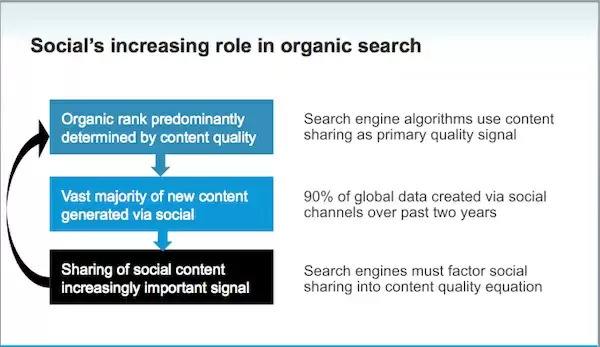
As alluded to above when discussing the SEO audit of blog content (Step 3), social media engagement and sharing now play an increasingly significant role in your organic search visibility and content ranking. Given the incorporation of Google Plus social activity in Google’s SERPs, as well as Bing’s exclusive partnership with Twitter for its SERPs, “social SEO” has become a content marketing reality. check keywords ranking, ranking for keywords, rank for keywords, rank for keywords that best benefit your website - brightedge The explosion of online data over the past few years is mostly due to social media, and there are no signs that this trend will be slowing down. Search engines now use content sharing as a “quality” signal. The synergy of search and social is evidenced by a Twitter case study of Tiny Prints, a specialty online boutique that depends on organic search for its Web traffic and revenue. By leveraging the Twitter platform, it realized a 47 percent increase in organic search rankings for long-tail keywords and tripled its Twitter follower engagement. For more on search and social synergy, check out Mark’s post on social signals and SEO, and Andy Betts’ article on how search and social data work in tandem to produce search ranking results.
7. Track performance

Benchmarking your organic search content performance is the first step towards a smart content strategy. The BrightEdge SEO platform has an array of analytics and reporting tools to help you do just that. Perhaps most cogent to keyword ranking is our content-centric page analysis and reporting technology, referenced earlier in Step 3 (content audit). As mentioned previously, our page reporting tool can measure and report on organic search and revenue performance not only at the individual page level, but for entire groups of pages within your site. Finally, remember this entire step-by-step process is not a one-and-done project. To gain the insights you need to keep ahead of the competition in the organic search content space, you’ll want to revisit each step in a cyclical manner to achieve superior SEO content performance!

,