As a savvy digital marketer, you are probably figuring out ways to address the recent Google announcement on making all searches secure, as part of the Hummingbird update. I wanted to take a minute to discuss this change, explain how BrightEdge customers are already set up to make the most of this change and give you an overview of the BrightEdge Secure Search Release that allows you to respond even more effectively to secure search.
Starting in October of 2011, Google began making secure search the default for authenticated users. This shift signaled to the market that the existing model of keyword-centric SEO, a holdover from PPC bidding, was undergoing major change. This week, Google has made secure search the universal default, meaning that 100% of searches are now secure and site analytics will no longer be able to provide user search query data to correlate keywords with site visits and conversions.
You are already set up for success
The secure search update in Google Hummingbird is a huge opportunity for marketers to focus on a content-based approach to organic search and manage performance at the page level. BrightEdge customers are uniquely positioned to make the most of this opportunity. In the words of Lowell Orelup, VP, Marketing at LendingTree:
"While our competition may see "the end of SEO" as a result of Google's recent Secure Search changes, we at LendingTree believe that this gives us a competitive advantage. For months, as Google has been stripping out more and more keywords, BrightEdge has helped us move our focus to a content-based approach, placing us ahead of the curve. And BrightEdge's latest announcement offers a clear path to proactively manage SEO at the level of revenue, conversions and traffic."
Existing BrightEdge innovations already enable page and content centric SEO
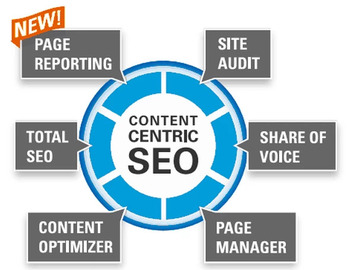
At BrightEdge, our top value is customer success, and we innovate to keep customers ahead of the changes in search and digital marketing. We saw the move towards 100% secure search coming and we have been investing in our platform to address this. Our platform is already infused with page and content-centric SEO analytics and recommendations that help you win in a secure search world. These innovations include Share of Voice, Page Manager, Site Audit, Total SEO and Content Optimizer.
BrightEdge secure search release sets you on a path to even greater success
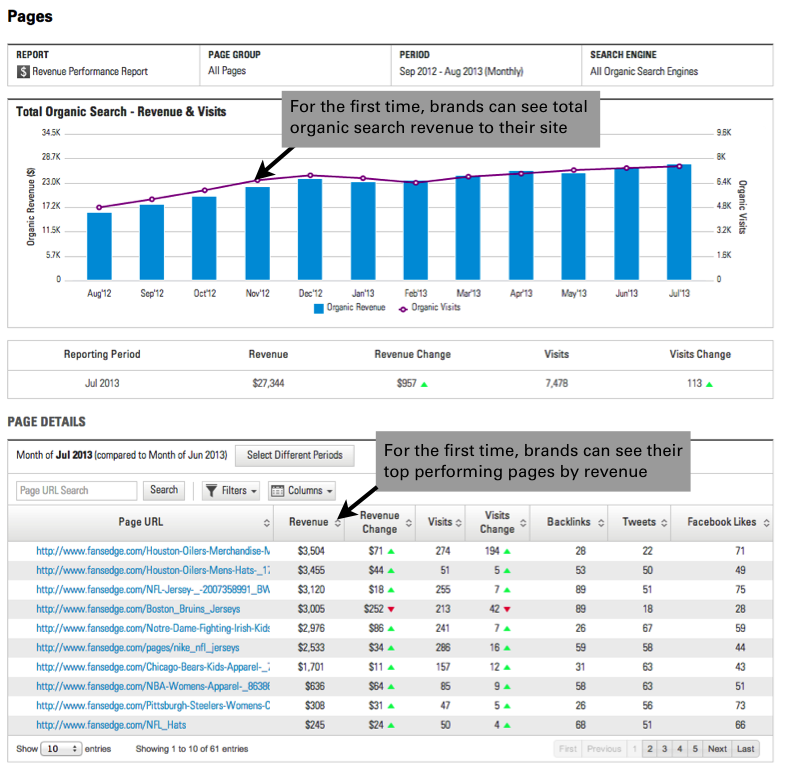
Building upon these features to take you to a more content and page centric approach to search, we recently announced Page Reporting, a new technology that helps brands understand the true value of pages provided by organic search traffic, at Share13. For the first time, brands are able to understand their SEO performance across revenue, visits, and conversions at a page level. Performance can be rolled up into Page Categories/Business Units (i.e. Men’s Apparel, Women’s Apparel, Baby Apparel, etc.) as well as at a total site level. We are pleased to announce the Limited Release of this innovation and this will soon be available to all of our customers. Please feel free to browse Page Reporting to understand how it helps you address the challenges and opportunities of Secure Search.
Deeper integration with Google Webmaster tools will smooth the transition
The BrightEdge team is hard at work on deeper integration with Google Webmaster Tools, and further enhancements to help brands make the transition from legacy keyword-centric SEO to content-centric SEO.
Rest assured, we are on top of trends
I also want to emphasize that our innovations around secure search are guided by our investments in research and thought leadership so that we catch trends earlier than anyone else in our industry. Last month at Share13, we discussed a new research report showing the impact of secure search across our 8,400 brand customers. You can download the report here: http://goo.gl/Ib9OCP. We actively track the changes in marketing and are the first to address new trends.
Six ways to solve secure search within BrightEdge
How can you address these transformation in search? First, don’t panic! As a BrightEdge customer you have access to data and insight to help you make the transition to content-centric SEO right now. You have the product functionality, the people power to guide you through this change as well as our assurance that we will continue to keep you ahead of changes!
1. Adopt a page-centric approach to search with page manager
We recommend that customers log in and make use of Page Manager to understand the content-centric recommendations that are available today. Page Manager was designed specifically to help our customers transition from a keyword dependent SEO model to a page-centric model. All of our customers can make use of Page Manager today to see the performance of their site and access recommendations for their pages (as opposed to keywords).
2. Uncover competitive performance with share of voice and custom click curves
Building from there, you may use our patented Share of Voice capability in concert with Custom Click Curves to gain a true understanding of how your content performs across all device types vs your competition. Feel free to review the ShowMe videos on the page for each feature to get a guided tour. What are BrightEdge’s Custom Click Curves? This capability allows you to apply a custom Click Curve for your business that estimates the actual search traffic based on historical or projected trends. This is a feature that was delivered back in 2011 to help brands create an accurate model of the traffic being driven by search keywords. For more information on this feature, please contact your dedicated customer success manager via support@brightedge.com.
3. Optimize your contnet from day one with content optimizer
Content is front and center of marketing. To make your content perform better from the time it is published, use Content Optimizer to integrate SEO best practices with the content authoring process. With Content Optimizer, authors gain access to SEO recommendations right within their CMS so that content is high-converting the moment it goes live!
4. Align your site with content best practices at scale with site audit
One of the most powerful set of features in BrightEdge, Site Audit helps you automatically assess your entire site for best practices and search engine quality guidelines, identifying issues across different page types, and of course, telling you how to fix them. As you pursue a content and page centric approach to search, use Site Audit to grasp how your pages are setup for conversions, across devices.
5. Gain an understanding of your total SEO performance
The transition to content centric SEO means that it is more essential than ever to gain a 360 degree view of your content performance across conversion metrics, geographies, local cities and devices. Total SEO gives you this understanding and look beyond keyword rank so that you know how your content impacts your business.
6. Contact us for page reporting
If you would like to deploy Page Reporting, which provides revenue reporting for pages independent of keyword data, please be sure to contact your customer success manager to let them know. We are actively tracking customer interest and working to help as many customers as possible with this transition. If you have an urgent need to understand your page specific revenue data today, BrightEdge Professional Services can help. Please email ps@brightedge.com for more information.
We are focused as ever on making you successful
Now that Secure Search is here to stay, we hope that you will find the innovations that BrightEdge has delivered more helpful than ever. Even in the face of massive changes like Secure Search, with accurate and scaled rank data, page-centric data and features, custom click curves and powerful content marketing capabilities, you can continue to manage your organic search channel successfully at scale. With a customer base of 8400+ brands, we have a strong pulse on what matters in marketing and you have my promise that we will continue to deliver ground-breaking innovations that will fuel your success!
<p>Page-based reporting sheds light on how site changes can affect the bottom line.</p>
Page Reporting
Google has made secure search the universal default, meaning that 100% of searches are now secure and site analytics will no longer be able to provide user search query data to correlate keywords with site visits, revenue, and conversions. By encrypting 100% of search results Google has proactively enabled the privacy of its users searches from Internet eavesdroppers. This change aligns with online sharing services like Facebook which have raised user awareness around the need to specify which friends and general public see their Facebook posts.
At BrightEdge our top value is customer success, and we innovate to keep customers ahead of the changes in search and digital marketing. Just as Google, Facebook and Twitter are all Silicon Valley technology innovators, BrightEdge innovates with these leaders to help you succeed.
Secure Search also marks a fundamental shift for measuring performance by taking a content-centric approach as opposed to a keyword-centric approach. BrightEdge Page Reporting is the only comprehensive solution for addressing secure search.
For the first time brands are able to understand their total content performance across revenue, visits, and conversions at a page level. Performance can be rolled up into Page Categories/Business Units (i.e. Men’s Apparel, Women’s Apparel, Baby Apparel, etc.) as well as at a total site level.
Page Reporting Provides:
Comprehensive analysis of total organic search performance – Gain visibility into your business performance metrics (revenue, conversions, visits, etc.) at a site-wide level.
Complete business unit analysis – Track performance for individual page categories/business units.
Page Reporting Includes the Following Reports:
Revenue Performance Report – Tracking revenue is a key performance metric for many Digital Marketers, as such BrightEdge enables users to understand their revenue performance from total organic search (all organic search engines combined as well as for individual engines configured).
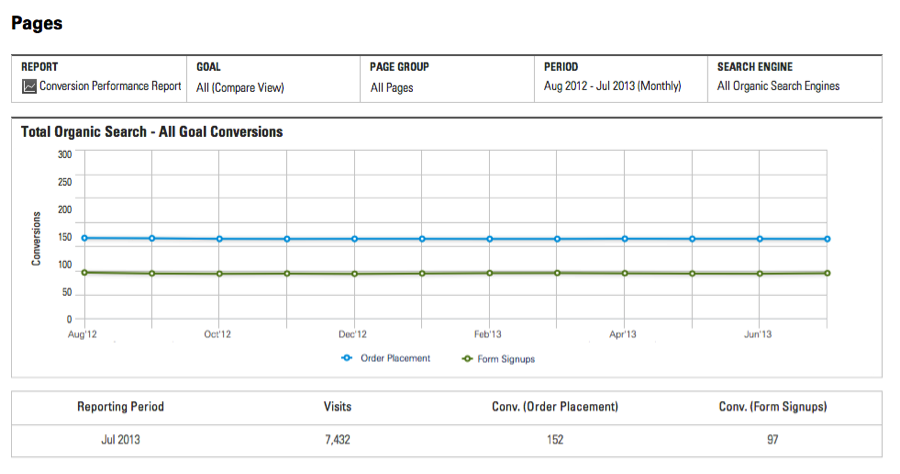
Conversion Performance Report – Allows brands to understand how well their pages are converting against the goals they have set.
Metrics Aligned With Your Business
Page Groups – View organic search revenue at a page level, or page group level (such as grouping pages for a particular business unit), or site-wide across all pages.
Time-based – View business performance metrics by week, month, or quarter, as well as MTD or QTD.
Search Engines – View business performance metrics across all organic search engines.
Page-based reporting sheds light on how site changes can affect the bottom line.
The End of an Era: Google Says Goodbye to Keyword-Centric SEO
News Item Author Name
Max Starkov & Sue Wiker
News Item Published Date
News Item Summary
Since late 2011, Google has been moving in the direction of secure search; put simply, this means that Google users’ keyword searches are 'protected' and are not disclosed to any website analytics tools, including Google Analytics, therefore showing up in analytics data as [not provided]. In other words, Google is not disclosing to website owners the keyword terms visitors use to find the site, e.g. “downtown Houston Hotels” or “Hotel near Times Square.”
Global SEO And Localization Excellence – What Localization Really Is
News Item Author Name
Jim Yu
News Item Published Date
News Item Summary
Enterprise SEO marketers developing a global footprint see tremendous value in global SEO. Targeting greater performance from global search engines is a top priority for enterprise search marketers since it is a gateway to increase leads, conversions and revenue. Successful global SEO can translate to even greater marketing ROI since extending SEO success to global markets can be built on the reuse and repurposing of existing investments in people, content and best practices. Marketers need a global, connected approach to SEO marketing to realize these benefits.
BrightEdge Accelerates Content Marketing Vision With Breakthrough Tech
Company Unveils Mobile, Page Reporting and Forecasting Solutions to Help Brands Manage and Measure Their Performance
SAN MATEO, CA – August 22, 2013 – Today at BrightEdge Share13, the premier industry event for digital marketers, BrightEdge announced a suite of new product offerings that will further empower brands to seamlessly engage with consumers across all channels. BrightEdge is leading a fundamental shift in how marketing is practiced with its S3 platform, which harnesses big data analytics to help businesses optimize their content and drive revenue from mobile, search and social in a predictable way. The enhanced platform will allow marketers to better manage and measure their content across channels with a new complete mobile solution, advanced page reporting and integrated forecasting capabilities.
"Brands are now recognizing the importance of creating content that resonates with consumers, and it's crucial that they measure the impact of that content to deliver business results that translate directly to ROI," said Jim Yu, CEO and founder of BrightEdge.
Marketers that capitalize on data-driven insights across mobile, social and search are poised to connect with customers in powerful and meaningful ways. BrightEdge builds technology that measures performance based on massive volumes of data, helping brands to develop campaigns that drive traffic, promote engagement and deliver value.
"The scale of this release is unprecedented for an R&D company of our size," said Brad Mattick, VP of Marketing and Products at BrightEdge. "We've been able to deliver an entire mobile solution and build out our complete page reporting technology because we've invested in a scalable platform that supports continued innovation."
Complete Mobile Solution
Mobile is changing the way brands and consumers interact with each other, presenting a challenge for marketers that struggle to convert traffic to revenue. To quantify how mobile generates business impact, BrightEdge recently released the Mobile Share report, tracking thousands of brands and 5 billion web pages. The report highlights a massive and largely untapped opportunity for brands to convert traffic into revenue by optimizing their web properties for mobile. Based on these findings, BrightEdge identified the questions that matter most for mobile marketers and developed an entirely new mobile suite to deliver a comprehensive solution.
Mobile Share of Voice builds on patented BrightEdge technology to quantify how brands engage with consumers and stack up against their competition.
Mobile Site Audit scrutinizes customers' entire websites to determine best practices and identify missed opportunities for mobile optimization, revealing how brands can restructure their mobile sites to drive conversions.
Mobile Analytics tools deliver micro- and macro-level insights, providing a detailed yet holistic view of mobile value.
Page Reporting
Analog marketing is driven by art rather than science, whereas digital marketing is data-driven and inherently measurable. BrightEdge has patented the ability to measure organic search and now looks to the future of content marketing, harnessing the power of big data analytics to give marketers insight into the performance of their content. New page reporting capabilities allow marketers to understand the revenue value of a page, its interactions with social channels, and its search performance.
Search Opportunity Forecasting
Marketers have historically struggled to forecast the future returns of their investments. BrightEdge has extended its patented forecasting capabilities into the S3 platform so that marketers can predict the business impact of campaigns before they take action, allowing them to make informed decisions that drive ROI. With these tools, marketers can forecast outcomes, set goals and hit numbers while measuring the success of their campaigns in real time.
More than 8,400 brands leverage patented BrightEdge technology to drive revenue in a measurable, predictable way. The latest updates to BrightEdge's S3 platform reflect the company's ongoing commitment to helping brands optimize their marketing performance across channels and devices.
About BrightEdge
BrightEdge is the essential content marketing and search platform for modern business. It transforms online content into tangible business results such as traffic, revenue and engagement. BrightEdge's S3 platform is powered by a sophisticated big data analysis engine and is the only company capable of web-wide, real-time measurement of content engagement across all digital channels, including search, social and mobile. More than 8400 global brands including 3M, Microsoft, Netflix and Nike leverage BrightEdge technology. The company is based in San Mateo, CA with offices in New York City and London.
BrightEdge Announces Business Momentum Led by 87% Revenue Growth
Company Unveils Suite of Patents and Expansion of Customer Base
SAN MATEO, CA – August 22, 2013 – BrightEdge, the leading platform for science-driven content marketing, today announced significant company momentum at Share13, the premier industry event for digital marketers. BrightEdge reports 87% revenue growth year over year, with an expanding customer base reaching more than 8,400 brands, up from 3,200 brands in 2012. The company's accelerated growth, paired with five new patents, is the foundation for providing brands with the technology and services they need to deliver impactful marketing results across channels, including social, search and mobile.
"Our business continues to grow at an incredible rate and we're excited about our recent $42.8M Series D funding led by Insight Venture Partners, which is opening up new opportunities for us across the board," said Jim Yu, CEO and founder of BrightEdge. "Our strong capital position enables us to invest aggressively in research and development and corporate growth initiatives, so we can continue to provide customers with outstanding service and unrivaled content marketing technology."
BrightEdge continues to demonstrate its accelerating technology leadership with a substantial and steadily growing IP portfolio. Affirming its position at the forefront of innovation, the company has recently patented several technologies that are core to its robust S3 platform. This patented technology is transforming the way marketers practice their craft by helping them to precisely measure the impact of their marketing activities, predict the ROI of their campaigns and evaluate their competitive position.
Newly issued BrightEdge patents include:
Opportunity Identification and Forecasting for Search Engine Optimization, which covers the technology behind forecasting conversions, revenue and ROI from optimizing pages for search.
Operationalizing Search Engine Optimization, which covers the technology behind measuring share of voice for organic search, social, mobile and video, including competitive analysis of share of voice over time.
"I've never worked with a company that is so committed to our success," said Beth Ramshaw, Digital Strategy and Innovation Asia-Pacific Program Lead at HP. "BrightEdge's work with us has been truly exemplary, both in working hand-in-hand as a partner and in providing us with powerful technology to drive measurable business results."
As the BrightEdge customer base continues to grow, its S3 platform has become recognized as a leading content marketing solution and a global standard. BrightEdge counts more than 20,000 active users across the globe, demonstrating strong industry demand for the technology. BrightEdge increasingly sees job descriptions that call for technical expertise in its S3 platform and has developed the BrightEdge Certified Professional Program to help individuals market their skills while empowering brands to hire the best talent. The program is an involved certification that tests users' S3 know-how, presenting those who pass with a "BrightEdge Certified Professional" LinkedIn badge that can be highlighted on the user's profile. BrightEdge will introduce the program at Share13, where more than 250 attendees have signed up to get certified.
As digital marketing is becoming more complex, marketers need to harness technology that will transform content into conversions that drive revenue in a measurable and predictable way. BrightEdge continues to enhance its S3 marketing solution, reflecting the company's ongoing commitment to help brands optimize their marketing performance across channels and devices.
About BrightEdge
BrightEdge is the essential content marketing and search platform for modern business. It transforms online content into tangible business results such as traffic, revenue and engagement. BrightEdge's S3 platform is powered by a sophisticated big data analysis engine and is the only company capable of web-wide, real-time measurement of content engagement across all digital channels, including search, social and mobile. More than 8400 global brands including 3M, Microsoft, Netflix and Nike leverage BrightEdge technology. The company is based in San Mateo, CA with offices in New York City and London.
Search, Social and Mobile: The Three Pillars of Modern Marketing
News Item Author Name
Jim Yu
News Item Published Date
News Item Summary
Until recently, marketers faced a dilemma: try to establish a ubiquitous presence across countless different channels, or somehow decipher which avenues to pursue based on guesses as to which would be the most fruitful. Without a crystal ball or any other method to predict results, marketers found themselves in a crippling position with limited resources and too many potential scenarios. Fortunately, in today's digital world, marketing doesn't need to be the balancing act it once was.