
2017 Holiday Shopping Update

BrightEdge research uncovers the new holiday shopping journey

2017 Holiday Shopping Update

BrightEdge research uncovers the new holiday shopping journey

The Rise of Sofa Sunday and Mobile Friday BrightEdge Research Uncovers the New Holiday Shopping Journey with Sofa Sunday and Mobile (Black) Friday Overshadowing Cyber Monday 

The Christmas and holiday shopping season from November through December is a critical time to observe shoppers’ online behavior. With several holidays and the most important shopping days of the year, this eight-week period in the United States is filled with ubiquitous marketing messaging, massive discounting, and general shopping euphoria. For retailers, it is a make or break time of the year.  

Following on from BrightEdge’s Holiday Shopping Report based on 2016 data, fresh new research notes changing trends of 2016 and 2017 audience digital traffic in the weeks leading up to Thanksgiving weekend, Black Friday, and Cyber Monday. This new research provides clues for marketers on how to prepare for the holiday shopping season. The report confirms holiday shopping is happening sooner and consumers are more and more comfortable making purchases on their mobile phone or tablet. Additionally, data findings point to Black Friday surpassing Cyber Monday in digital importance.  

The holidays provide plenty of opportunities to create more personalized content and provide intelligent experiences both at the store and online. As online retail spending increases over the holiday season, marketers need to focus on creating smart content and shopping experiences to attract, engage, and convert customers at the right time.  

Sofa Sunday - the Sunday before Black Friday, is THE major online research day The Sunday before Thanksgiving and Black Friday was a day of high traffic, especially mobile traffic. BrightEdge dubs this Sofa Sunday because it was the highest mobile traffic day until that point, but it shows relatively modest transaction volume. This suggests that consumers use Sofa Sunday to research and prepare their holiday shopping lists ahead of Black Friday. Mobile traffic on Sofa Sunday is 21% higher than a typical Sunday in the holiday season. 

Black Friday mobile traffic outperformed Desktop by 75% Brands are aware that Mobile traffic exceeds Desktop traffic by 10% to 40% most days, but may be surprised to find Mobile exceeds Desktop by 75% on Mobile Black Friday but only 5% on Cyber Monday. Mobile is dominant and simply a way of life for consumers. 

Mobile Black Friday sales exceeded Mobile Cyber Monday sales by 9% Black Friday mobile purchase activity was so strong that BrightEdge has dubbed it Mobile Black Friday. Mobile purchase revenue on Black Friday exceeded mobile purchase revenue on Cyber Monday by 9%. Deals that were previously available only in stores are now available anywhere and on any device. BrightEdge research suggests that Mobile Black Friday will continue to gain momentum as shoppers replace store visits with mobile visits and purchases. 

Download the full report for all of 2017’s holiday shopping trends.

SEO 303 - Win the Micro-Moments That Matter

SEO 303 - Win the Micro-Moments That Matter

Available on-demand

So you’ve done a great job increasing organic site traffic, but site conversion rates are frustratingly low. It’s time to think outside the SEO box and look at conversion optimization.

Join Stefan Zechner, senior global marketing manager for Western Union, who will share a series of success stories that will provide guidance around mapping site offerings to target personas, identifying content gaps, reducing abandonment rates, optimizing call-to-actions (CTAs), and A/B testing key conversion funnels.

Register now.


The changing SERP: Understanding and adapting to dynamic search results

English, British
News Item Title
The changing SERP: Understanding and adapting to dynamic search results
News Item Author Name
Jim Yu
News Item Published Date
News Item Summary

Search results have become more personalized and dynamic over the years, creating a more challenging SERP environment for search and content marketers. But columnist Jim Yu shows how these changes can create opportunities for those willing to do the work.

What is Visual Parsing Technology & Why Care?

cbao
cbao
M Posted 8 years 10 months ago
t 9 min read

The SERP is changing. Only focusing on ranking #1 on organic search results is no longer effective to succeed in website traffic acquisition. Keyword prioritization must account for whether this keyword has any chance to be shown above the fold organically. BrightEdge visual parsing technology is the solution to this problem.

According to recent BrightEdge research, more than 51% of website traffic is driven by the organic channel, a figure that has remained steady since 2014. However, many search marketers have reported a decline in YoY (year-over-year) organic website traffic, despite holding their organic search ranking positions steady. Ask any search marketer and they probably have an example of a top-ranking keyword that has a steady ranking position but is not generating the same amount of organic traffic as it did a few years ago. Why is this happening? Welcome to the world of the ever-changing SERPs. It’s no secret that Google search has been personalized on many fronts over the years. We all have seen it. Type in a keyword like “lifecycle of a butterfly,” you’ll see mostly informational content, led by a Quick Answer box. Once you interact with that Quick Answer box, there are two more Quick Answer links shown at the bottom of the Quick Answer box. Page 1 of the SERP, essentially, expands indefinitely. What’s the cure for SEO marketers? Search has fundamentally changed with no turning back, making it critical for SEO practitioners to leverage visual parsing technology to stay competitive.

Key drivers of SEO have proliferated

What used to work for SEO strategy is not sufficient anymore. We used to focus on creating a landing page for one primary keyword and a few related keywords, but the format of our content is simply a web page with graphics and text. Sure, we have videos for some of the pages now. But is that enough? No. New SEO now requires us to think about content with a few more variations.

  • Keyword and topics: What is the question or problem that people need answers for?
  • Content format: What kind of content format is more likely to be the best format that can help search users quickly get their problems solved? Is it a video, or news article, local 3-pack, or Quick Answer box?
  • Content relevancy: Is the content written or created in such a way that is relevant in the  “eyes” of search engine bots and in the eyes of search users?
  • Content resonance: Is the content perceived as the right content, for the right search intent, at the right time? If someone is searching for “Rihanna shoes”, is she looking for Rihanna's latest street fashion styles or the shoes that she co-designed with some clothing label?
  • Content optimization for different device types: Is our content optimized for mobile search so that we don’t lose out on top ranking spots on mobile SERP?

SERPs are getting increasingly complex. Below is an example of 21 permutations of a SERP, where one of your content elements could be shown.
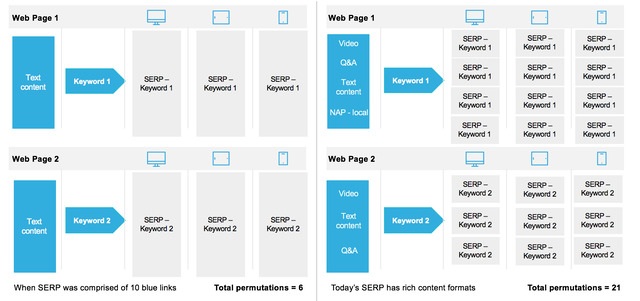
visual parsing example - brightedge

Is there a solution to this “quicksand” of change?

Yes. There is. Instead of just referring to SERPs like a restaurant menu with mainly plain text, think of the Google SERP like an interactive billboard - the new homepage of the internet for any topic that you can fathom, and that homepage intelligently changes depending on the topic. For marketers, the SERP is the new top-of-funnel. What you need is a headless browser that can be launched to meticulously scan the SERP, inspect it just like human eyes would, and then synthesize the common themes of content types and ranking results by device types for each keyword in the search universe. And, that data better be trended. That sounds like a lot of work! Luckily, BrightEdge has developed a technology that does just that: the visual parsing technology.

What is visual parsing technology?

BrightEdge visual parsing technology analyzes the dynamic SERP through the eyes of a human. Instead of just inspecting the backend codes, visual parsing technology looks at the visual layout of each SERP in relationship with each keyword to help you determine what content type is more likely to win the top spots on SERP. For instance, “insurance” will likely have many PPC ads above the fold before the organic web listings; while “kids ballet class" will have local 3-pack dominating the top spots on the SERP.

What are the applications of visual parsing technology?

One of the first applications of visual parsing technology is the BrightEdge Intent Signal dashboard. By analyzing the visual ranking position of every content element on SERP, Intent Signal informs marketers whether a keyword has any organic web listing shown above the fold on SERP. Meanwhile, it tells marketers if their web content page is ranking above the fold or not for that keyword. You can read more about Intent Signal here.

How you can leverage Intent Signal

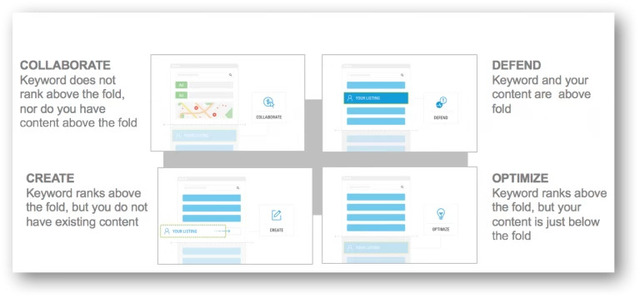
Leverage Intent Signal to refine your SEO keyword target list, today. Intent Signal helps to refine your SEO target list into four sensible workgroups.

  • Keywords to defend
  • Keywords to optimize
  • Keywords for content creation
  • Keywords for collaboration with PPC ads
visual parsing - what is it and why care? discover it with brightedge

Some keywords do have organic web listings above the fold on the SERP. Depending on the performance of your current content, you have one of three optimization options.

  1. Keywords to defend. If your content is already one of those shown above the fold, defend your winning position by creating Anomaly Detection when these content pages drop below the fold.
  2. Keywords to optimize. These are the “striking distance” keywords, but even more refined. Previously, you might have organic web listings shown above the fold, but your content is not shown above the fold.
  3. Keywords for content creation. These keywords have organic web listings above the fold, but you don’t have content shown in the top 10 pages. This is the subset of keywords that you can send to the core content creators across the organization.

Some keywords are so commercial in nature that there are too many ads competing above the fold, pushing organic web listings below the fold. These are the keywords on which you can invite your PPC team to collaborate with the SEO team. A quick way to get started is to schedule a weekly report to have this group of keywords emailed to the PPC lead.

Intent Signal supercharges keyword strategies to maximize traffic acquisition

If you haven’t refreshed your SEO target keyword list. Now is a great time to review and redo it. This time, your SEO target list will be even better, thanks to the insights from Intent Signal. Let’s revisit the typical process to develop our SEO keyword list.

  1. Develop an initial set of keywords that we’d like to rank high for
  2. Refine that initial list to make sure we work on the keywords that will make the most impact
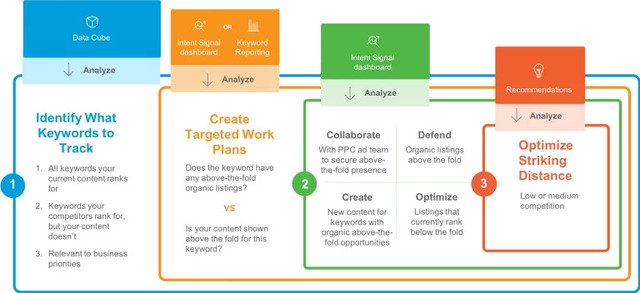
With Intent Signal, you can further refine your keyword list so that the resources spent on content optimization, content creation, and PPC campaigns are laser-focused on the keywords that will give you the biggest payout in quality website traffic. The BrightEdge platform can help you run this entire process within a few clicks. For instance, you can start the initial research using Data Cube. Then, leveraging key insights from Share of Voice and Keyword Reporting, you can identify high-value keywords quickly. Lastly, you can run Intent Signal to refine the keywords into four sensible groups and rally troops around the most impactful projects.

Visual parsing and its many applications will soon become mainstream for digital marketers. Start today to leverage its first application -  Intent Signal - to see how easy it is to leverage visual parsing technology and improve your website’s overall traffic acquisition. Watch this video to learn more about Visual Parsing technology here.


The SERP is changing. Only focusing on ranking #1 on organic search results is no longer effective to succeed in website traffic acquisition. Keyword prioritization must account for whether this keyword has any chance to be shown above the fold organically. BrightEdge visual parsing technology is the solution to this problem. According to recent BrightEdge […]

The post What is Visual Parsing Technology – And Why You Should Care appeared first on BrightEdge SEO Blog.

Smart shopping season checklists: Mobile and desktop, content, and SEO

English, British
News Item Title
Smart shopping season checklists: Mobile and desktop, content, and SEO
News Item Author Name
Jim Yu
News Item Published Date
News Item Summary

Constantly changing consumer behaviors and the demand for more personalized, meaningful experiences have retailers facing huge challenges this year.

HREFlang Tags: What Are They?

Yulia Kronrod
Yulia Kronrod
M Posted 8 years 10 months ago
t 9 min read

Global companies must ensure that international customers enjoy the same quality user experience when interacting with their brand as their domestic counterparts. Localization helps create targeted content tailored to the needs of customers in different countries. But how can we ensure understanding hreflang tags with brightedgethat the right content actually reaches those customers? The answer is HREFlang tags.

To help search engines identify URLs to be served to regional users, webmasters can use rel="alternate" hreflang="x" attributes. In this blog, we’ll focus on the technical side of hreflang tags implementation and cover some common mistakes and misconceptions. In a follow up blog, we’ll share a case study of how we implemented hreflang sitemaps for our company, how we tracked rankings and what the results were. Stay tuned!

Which search engines recognize hreflang tags annotations?

At this time, hreflang tags annotations are recognized by Google and Yandex.

  • Google: HTML link element in header, HTTP header, or XML sitemap
  • Yandex: HTML link element and HTTP header but not XML sitemaps (details here)

Bing does not recognize hreflang tags and recommends using “content-language” meta tags instead.

XML sitemaps vs HTML link element

For sites targeting a large number of geos, XML sitemaps are probably the best option as they are easier to generate, maintain and, importantly, QA as opposed to on-page code that can change without SEOs’ knowledge. Additionally, including hreflang tags in the page code adds to HTML size and slows the page load speed. While Google says that the location of a URL within your sitemap files does not matter and you can structure the sitemaps in any way that makes sense for you, please note the limits for an XML sitemap file: 10MB or 50,000 URLs (<loc> elements). You can choose to include hreflang annotations for a larger set of URLs in individual geo-specific XML sitemaps or create line-of-business sitemaps with a smaller number of URLs but spanning all regions.

5 Common Mistakes and Misconceptions about HREFLang

  1. Use of wrong country and/or language codes. Values for the hreflang tags attribute should either be a language code in ISO 639-1 format ("en" for English) or a combination of language and country code where the country code is in ISO 3166-1 Alpha 2 format ("en-US" English for US, non-capitalized “en-us” is also acceptable). UK versus Ukraine: “en-uk” would not mean English for UK (correct: “en-gb”, Great Britain) but rather English for Ukraine. Latin America is may also present a challenge for hreflang tags values: many sites create a single site to target these countries – /la/ or /latam/. “es-la” would unfortunately mean that you’re targeting Laos (!). “es-latam” is not an acceptable ISO code. So, to target Latin America, one needs to either include multiple country annotations (“es-ar” for Argentina, “es-cl” for Chile, “es-pe” for Peru, etc.) with the same Latin American URL (www.site.com/latam/), or use “es-es” for the Spanish site while targeting the /latam/ site to global Spanish speakers by using the language “es” annotation only. We’ve also seen sites use “es-br” for their Brazilian sites in Portuguese (correct: “pt-br”), “uk-ua” (Ukrainian for Ukraine) for a site in Russian, and “en-be” (English for Belgium) for a site in French.
  2. Lack of hreflang tags for the page itself. Hreflang tags annotations should be bi-directional, and each language page must identify all language versions, including itself. For example, if your site provides content in English, French, and German, all three language versions must include the same references to the English, French, and German pages.
  3. Use of non-canonical or redirecting URLs. An example would be the use of a URL with parameters (www.site.com/page.html?trackingid=123) instead of the canonical URL version (www.site.com/page.html) or use of an old URL that got redirected. John Mueller recently confirmed this in his Google+ post: “Make sure any rel=canonical you specify matches one of the URLs you use for the hreflang pairs. If the specified canonical URL is not a part of the hreflang pairs, then the hreflang markup will be ignored.”
  4. You have to implement hreflang for the entire site otherwise, it will not work. Wrong. Hreflang tags will work for any set of URLs you choose, as long as you cover all language/country variations. Clearly, you’d want to focus on top traffic and revenue drivers. An interesting observation: after we implemented hreflang for all 60 regional home pages and a small set of priority URLs, we’ve seen a collateral effect that other not-covered, regional URLs started to rank in place of US URLs.
  5. Using rel=canonical across different language or country versions. Google recommends not using rel=canonical across different language or country versions, and only use it on a per-country/language basis.

,