Long-Tail Keywords: A Comprehensive Guide

monique.johnson
monique.johnson
M Posted 4 years 1 month ago
t 9 min read

Updated: February 2022

Long-tail keywords account for over 90% of search queries. 

Accessing that traffic pool can be incredibly profitable. The good news is that identifying, targeting and ranking for long-tail keywords is a straightforward and cost-effective process. 

In this post, we’ll clear up some common misconceptions about long-tail keywords, cover the benefits of having a dedicated long-tail strategy, and describe how to conduct thorough, extensive keyword research. 

Where Does the Idea of the “Long Tail” Come From?

The concept of the “long tail” has been instrumental in shaping how organizations understand markets. Chris Anderson popularized the concept  in his 2004 book The Long Tail: Why the Future of Business is Selling Less of More but statisticians have been studying it in various forms since at least the 1950s. 

In his now-famous article on Wired and his subsequent book, Chris Anderson argued that there is more profit to be made by selling lots of different products, each with low demand and few competitors, than by attempting to create one big hit that relies on leveraging unified demand in a crowded space. The advent of democratized marketplaces with low barriers to entry - just like the good ol’ internet - has made this approach possible.

Applied to search engine optimization, the idea is simple: target lots of low-volume, low-competition keywords instead of wastefully expending resources on highly competitive, high-volume counterparts. 

Now, while that strategy looks uncomplicated on paper, it’s a little more multifaceted in practice. So let’s dig into the specifics. 

What Are Long-Tail Keywords? 

There is no shortage of definitions of the term “long-tail keyword” on the web. But despite its importance and uniqueness, search engine experts still get things wrong when describing the concept. 

Long-tail keywords are search queries that have relatively low search volumes compared to high-volume “head keywords.” You can understand this idea in terms of specific, thematically related groups of keywords, say around the topic of “home improvement,” or as applied to the totality of Google search queries over a given time (or any other search engine).
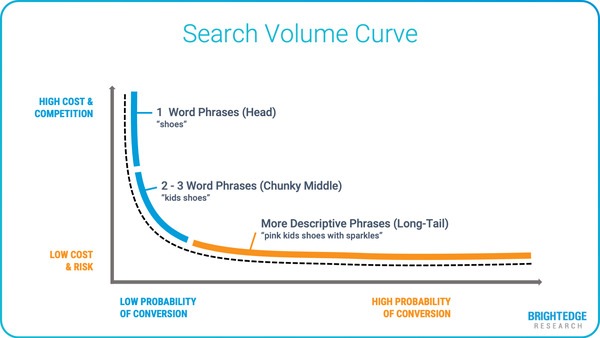
Low-volume queries sit on the “tail” of a curve of a graph that maps search volumes on the y-axis against keywords on the x-axis. If you could see the whole graph, the long-tail would stretch for miles. 

High-volume keywords comprise what is called the “head.” Middle-volume keywords are sometimes said to constitute the “thorax” or “chunky middle.” 

Misconceptions About Long-Tail Keywords

To say that long-tail keywords are phrases of multiple words with search volumes of ten or less isn’t entirely accurate, although this is often the case. There are many single-word long-tail keywords. What’s more, the term “low” has to be understood relatively for the concept of the long tail to make sense.

Another common mistake people make is to define long-tail keywords as always being highly specific. While this is usually true, there are exceptions. For example, the low-volume keyword “bog snorkeling” (yep, it’s a recognized sport) is just as semantically general as “golf.”

The key takeaway here is that long-tail keywords should be understood primarily in terms of volume (or number of monthly search volume). Applying other attributes just serves to needlessly muddy the waters and is usually unhelpful from a marketing perspective. 

Why Are Long-Tail Keywords Important?

Long-tail keywords are important because they are effective at driving traffic. A well-executed long-tail keyword strategy can result in significant amounts of new visitors and high value leads.

Here’s a quick rundown of the main reasons that long-tail keywords are worth your attention: 

1. Long-Tail Keywords Have Low Competition

Long-tail keywords tend to be less competitive from a search perspective than high-volume keywords. As such, they are easier to rank for. 

This is due to a mix of reasons. First, many companies focus exclusively on high-volume terms, leaving long-tail keywords wide open. Moreover, the sheer number of long-tail keywords means that competitor activity is more widely distributed. 

2. Long-Tail Keywords Are Easy to Target From a Practical Perspective

Creating content for long-tail keywords is a relatively straightforward process. Specific terms typically only require short and precise explanations. For example, a query like “radiators” easily lends itself to an article of thousands of words of content, with numerous sub-sections. A term like “where to buy cheap radiators in Honolulu,” on the other hand, can be targeted with a comparatively brief piece of text. 

It’s also possible to target numerous long-tail keywords within a single webpage or piece of content. Using long-tail keywords to structure content will enable your website to rank for terms that might otherwise have been missed. Additionally, there is little cost required to  optimize longer-form content for long-tail traffic. 

3. Long-Tail Keywords Have High Conversion Rates

Consider the difference between the keywords “water bottle” and “two-liter blue water bottle with a folding cap.” The second one carries a highly specific intent. As a result, the searcher responsible for tabbing it into Google is more likely to follow up by purchasing a product related to the keyword.

Because long-tail keywords are usually very precise, companies can tailor highly-targeted offers and opt-in incentives to capture site visitors. 

4. The Pool of Long-Tail Keywords Is Large

There are billions of long-tail keywords. You can’t see it on a typical graph because it has to be truncated for practical reasons, but the long tail goes on for miles. If you’re in a well-known industry, it will be practically impossible to run ou

t of keywords. And even niche organizations will have their work cut out for them in attempting to capture even a portion of all available long-tail traffic. 

How to Find and Use Long Tail Keywords: A 5-Step Guide 

Here are five general steps that can help form the basis of your long-tail keyword strategy: 

1. Create Buyer Personas and Identify Broad Keyword Topics

Before you dig deeper and pinpoint specific terms, you need to identify the broad topics you will be researching. This definition will normally be in terms of generic keywords. Having clearly-defined parameters will enable you to stay on track during the later stages of this process. 

In particular, you should ask two questions:

  • Who is your target audience?
  • What topics are they interested in?

Keep in mind that your answers will likely be different depending on which part of the customer journey you’re considering. Profiles for first-time searchers will be different to those of returning visitors, and your long-tail keyword targeting should account for this. 

2. Use a Keyword Research Tool Like Data Cube

Once you’ve identified “tier one” terms, enter them into a research solution like BrightEdge’s Data Cube. Data Cube has dedicated functionality for discovering long-tail keywords. You can use it to sort potential target queries by volume, competition, potential value, and more. 

While it’s not unusual for SEOs to use ancillary tools and apps, particularly those that specialize in semantic keyword and long-tail query generation, it is good practice to leverage one high-quality solution as the basis for finding and organizing long-tail keywords. In this way, your workflow will have a central, easily accessible hub. 

3. Evaluate Competitors

Competitor tracking is another effective way of identifying profitable long-tail keywords. The Share of Voice functionality within the BrightEdge platform allows you to uncover long-tail terms for which other sites are ranking.

Many of your competitors’ search results will not be the outcome of actively targeting a particular long-tail keyword. Often, existing content will be ranking “accidentally.” This presents you with an opportunity to create content of a greater quality and achieve better results.  

4. Collect Questions From Community Spaces

Analyzing user-generated content on sites like Reddit, Quora, Facebook, Amazon and topical forums can give you a range of insights into the ways potential customers are talking about their interests and problems. 

Trawling through forums and discussion boards is a time-consuming process, and you will still need to run gathered terms through your software. That said, you can find lots of hidden gems this way and, depending on their value to your company, it may be worthwhile as a long-term approach. 

5. Organize and Rank Long-Tail Keywords

Once you’ve collected a set of “raw” keywords that show promise, you should organize them into a coherent structure that can act as a guide for creating content. Metrics to consider when undertaking this process include value, relevancy, competition and, of course, volume. 

You should also account for the following semantic distinctions:

  • Synonyms - The terms “how to get over the January blues,” “feeling down in January,” and “tips for beating January blues” are synonymous. They all mean the same thing. Google is smart enough to recognize this. Rather than creating individual pages for each one, you should target synonyms in the same piece of content. 
  • Primary terms - These terms will act as the main subjects of individual pieces of content. Some primary terms, like “how to dye curly hair naturally” or “how to revive a dying spider plant,” will be obvious in the sense that they cover quite a lot of ground. Others may look like secondary terms but actually warrant their own page. “How to dye curly hair naturally for women” could be added as a subtopic to an article about dying hair, for example, but will probably be targeted more effectively individually. 
  • Secondary terms - Secondary terms should constitute part of a larger piece of content. One of the best ways to decide whether or not to designate a term as a primary or secondary keyword is by checking existing results and seeing whether Google is ranking dedicated pages or ones covering a broader topic. 

Organizing keywords semantically and topically isn’t an exact science. The decision of whether to create a new piece of content or update an existing one will often come down to personal judgment. 

Conclusion: What’s Next?

So you’ve done your research and built a jam-packed list of long-tail keywords. What’s next? 

Well, it’s time to start creating content. A long-tail strategy is an invaluable business asset. But it’s nothing without a well-developed content plan. 

SEOs that can target high-value, low-competition keywords can guarantee a steady stream of website visitors and leads. Dedicating time and resources to ongoing research will pay dividends well into the future. 



Let Your CMS Guide Your Content Workflow

ksoosOLD
ksoosOLD
M Posted 5 years 5 months ago
t 9 min read

A CMS, otherwise known as a Content Management System, is software used to develop and manage your content through various marketing channels. While most content management systems mainly focus on content management for your website, some also grant marketers the ability to manage content across multiple channels such as web apps, social media and more. A CMS allows for multiple users across your organization to collaborate on marketing efforts without requiring them to have deep technical or coding skills. 

How does a CMS work? 

A CMS helps guide content creation in an easy-to-use application by allowing users to create, manage and publish content with a few clicks of the mouse. Rather than building a website or landing page from scratch, a CMS removes the need for heavy development and simplifies content creation through drag and drop or WYSIWYG (What You See Is What You Get) editors. This allows marketers to control more of the website, streamlining workflows and bringing both the business and technical teams together to collaborate in real time. 

Evaluating what CMS you should use

Start by identifying the problems your team is currently facing and whether you’d benefit more from a SaaS or a hosted CMS solution. Be sure to fully understand your site and content management needs and the basic features you’ll require from a CMS before you begin your evaluation. We recommend making a list of need-to-have and nice-to-have features to assist with your evaluation.  

Most CMS platforms will allow you to build web pages, save your favorite page templates, store and deliver content, allow you to collaborate with teammates and even create workflows, calendars and processes to help keep your team organized. 

When evaluating the price of a CMS solution, you’ll need to consider more than just the upfront cost of the product. Not all CMS solutions come out-of-the-box with everything you’re looking for, some will require additional features or integrations and may have add-on costs for large support requests or SLAs, WYSIWYG editors and more. Consider all your business needs and be sure you’re aware of the CMS’s limitations and other costs that may come up. 

Consider what kind of upkeep and daily management will be required. What will the creation and upkeep of the site look like after the initial migration and set up is completed? Will you need a developer to assist with your day-to-day tasks? How will this solution work with your team’s skillset(s)? Does the solution offer WYSIWIG or drag-and-drop type editors for your non-technical (non-developer) team members? Look at what kind of support is included or available as well and consider what would be best for your business. Do they offer 24/7 support, or will an SLA be required? 

Be sure to evaluate whether this CMS can easily integrate with your current tech stack. If the out-of-the-box solution can’t solve some of your needs, how much customization is needed or available and what is able to be integrated? This is where you should consider all features (the need-to-have and nice-to-have features you listed out earlier) and see what will require additional integration or may have additional costs. 

You’ll also want to make sure the CMS software is scalable. Find a solution that meets your current requirements, but always be thinking about future goals and where your site and company are heading and find a CMS software that can grow and adapt with you. What features will you need moving forward to assist with your company’s growth? 

CMS software features for SEO & digital marketing 

Not only will a good CMS allow you to create outstanding web content with ease, it should give you the ability to manage your site’s SEO as well. Basic SEO features include page titles, meta descriptions and image alt text. Think about how much control your team would like to have over more of the technical SEO features such as updating sitemaps, robots.txt, adding schema, canonicals or setting redirects. Being able to quickly make these changes without waiting for development can be critical for SEO success. 

Have questions about schema and structured data? Learn more here. 

Page speed and mobile responsiveness are important factors to keep top of mind as well. Your site may look great, but it won’t perform well for users and may not rank as well on search engines if the site loads slowly or isn’t mobile-friendly. A faster site not only helps your search rankings, but increases user engagement and conversions as well as lowering your site’s bounce rate. If the CMS you’re considering comes with CDN capabilities, be sure it’s lightning fast with proven page speed performance. 

Read more about the effects of page speed 

Other features to consider include social media marketing/integration, site chat to assist inbound sales, e-commerce features, A/B testing, dynamic content for personalization, blogging capabilities, SMS functionality, CRM and sales features or email marketing. Will your team benefit from using features like content calendars or structured workflows?  

In conclusion  

As you review solutions, think about what will be most useful and relevant to your business. Does this solution meet all/the majority of your needs or will you need to add on products and features or need to integrate with other technology?  

Every website will have different needs – some may require event registration while other sites may require e-commerce features or a site chat for inbound sales.  Most platforms will allow users to sign up for free trials, or sandbox versions of the CMS software to get a hands-on experience to truly see if a CMS is right for you. 

How to Develop a Content-Driven Backlink Strategy

gregalbuto
gregalbuto
M Posted 6 years 4 months ago
t 9 min read

When search engines evaluate websites, they do not only look at the content on a particular page but also how that page connects to the rest of the digital ecosystem. How other websites and reputable brands engage with your site gives the search engines valuable signals about the authority of your own content.

What are backlinks?

Backlinks, or links that point from outside web pages back to your own site, provide your content with a number of different benefits. First, Google looks at backlinks to better understand how this particular piece of content should be viewed. Content that receives numerous backlinks from other sites with positive reputations appear more reputable. A good backlink strategy can help build the reputation of the site and boost your rankings.discover an awesome backlink strategy - brightedge

Additionally, even though many people create backlinks to sites and mark them as ‘no follow’, they still provide benefits. Google has already said that they will begin to view ‘no follow’ commands more as a suggestion in their algorithm starting in the beginning of 2020, even though they previously ignored them completely. Furthermore, this backlink strategy can still drive traffic and engagement to your site, regardless of whether or not the link itself was ‘counted’ by Google as a positive point toward your reputation.

Consider also that if your site regularly receives backlinks from others in the industry build a reputation for your organization. Customers who often see the name of your business or your business leaders across various websites and publications will come to view you as a thought leader. This can boost their confidence in your organization and help give your site credibility as a thought leader, and 82 percent of c-suite leaders say that thought leadership encourages them to engage with brands.

This additional publicity also helps to build your brand awareness and recognition. In turn, this keeps your organization on the forefront of the minds of potential customers, encouraging them to engage with your organization when they find themselves evaluating options.

To build a strong backlink profile, you want to engage in a positive backlink strategy. You want to cultivate links from solid sites within your industry and customer demographic. Links that come from sites with poor practices and bad reputations will not provide your site with an advantage. Although you can disavow these links, all site owners should do what they can to prevent their sites from being associated with unsavory sites.

Cultivating a backlink strategy can help you build the backlinks you want to see from your site. Here is what you need to know.

Why is a backlink strategy important?

A content-driven backlink strategy is important because it encourages your brand to focus on thought leadership and building a positive reputation within your online space. It allows for more natural backlink building, encouraging people to view your business in a positive light. 

By focusing on using strong content to build a backlink strategy, your brand name becomes associated with positive situations. You begin to cultivate your reputation across the digital space in a variety of different channels and publications. This will result in a big impact on your SEO results.

3 proven tactics for building a content-driven backlink strategy

  • Surveys
  • Research
  • Newsjacking

1) Surveys

Conducting surveys builds insight into your customers and their individual needs. You gain a better understanding of the customers your organization targets and what they think. You will learn more about their pain points and the obstacles they face as they work to improve these situations.

As you get to know your customers better, your marketing becomes more powerful. You can speak more directly to these targeted customers with material specifically aimed at their needs. This helps you create more targeted content and engage your readership. The content you create will be more likely to spread across multiple channels and entice people to link to it.

Additionally, taking surveys lets customers know that you care about them and their experiences. They begin to trust your organization more to address their needs and place them first. This also enhances your reputation, encouraging people to read and share your material.

Finally the results of your survey can provide content for publishing and PR coverage. You can share the insights you gain with others in your industry. As you drive interest in these results, you will naturally create opportunities for people to link back to your original results and commentary. 

2) Research

what is a backlink strategy - brightedgeResearch provides you with excellent opportunities to add original and helpful knowledge to your industry and niche. You have the chance to provide something of immediate value for your field. This encourages others to look to your research and results and create their own content and backlink strategy that incorporates the findings. As people call upon your research in their own content, you will build helpful SEO backlinks. You will also build your reputation as a thought leader, which encourages other people to look to you for ideas and insight. 

As you publish research and new insights for your field, you also present yourself with excellent opportunities for backlink-rich PR and publishing in industry publications. You can create releases on reputable websites that let people know about your interesting results. You can also find opportunities to write about your research and your thoughts on the results for various industry publications.

Altogether, these opportunities with the research present many opportunities for people to link back to your original results, while your name and reputation grow across these different channels.

3) Newsjacking

People today have become accustomed to news on a nearly instantaneous level. Thanks to social media and the 24-hour news cycle people expect to remain regularly updated on what happens near them and around the world. The people interested in your business and industry have also begun to expect regular updates regarding the latest events and developments of interest.

Newsjacking provides you with a great opportunity to become a trusted news source for potential customers. When you are one of the first to break the latest news in your niche, customers and others in the industry begin to see you as someone they can rely on to always have the latest insights. This will help your backlink strategy as people trust your opinion and use your insight to inform their own opinions on the latest developments in the field.

Your brand will become a trusted place to receive news and learn the latest in the industry. You will become an authoritative source of information, which encourages attention and therefore regular linking. It will become easier to tap into the needs of your customers and encourage them to look to you for information.

You can use the news cycle to incorporate the latest developments with your new research and new data you can surface about the industry. This provides you with greater opportunities for thought leadership and engagement.

Backlinks provide your site with a wide range of benefits, including the ability to drive traffic, build a reputation, and help to increase the ranking of a particular page on the SERP. By calling upon a content-driven backlink strategy, you will earn high-quality backlinks through natural means that enhance your site and help to build your business. Use the backlink strategy above to start encouraging other brands to start linking back to your organization.

CION Investments Increases Position One Keywords 58%

Follow how they avoided competing with their own ranking content using BrightEdge

98%
increase in position two keywords
100%
increase in position 5-10 keywords

CION Investments Increases Position One Keywords 58%

Follow how they avoided competing with their own ranking content using BrightEdge

Background

CION Investments, a B2B finance company based out of New York, has always used SEO best practices to optimize their website and remain very user-friendly. Their SEO goal was to anchor down on paid search and increase organic traffic. CION utilized BrightEdge and the expertise of several team members, including marketing and operational positions, to play important roles in regular optimization.

The Solution

CION used BrightEdge to check in on data on a weekly basis. They drive simple wins for better optimization. Alison Tyler, Digital Marketing Strategist at CION, says BrightEdge acts as a home base for them to come back and reference daily.

Their various team members utilized Recommendations and Keyword Research to take advantage of SEO opportunities that led directly back to their goals. Keeping strategy in mind, CION dove into keyword grouping where they created multiple principal keyword groups to focus on. They understood the importance of differentiating articles and content to avoid in-house competition. Using those keyword groups, CION created unique content that steered them around and away from their existing pages. 

The Results

CION used BrightEdge to help guide customers straight to their product pages. Tyler said, "BrightEdge lets us perform better organically". That helped keep the bounce rate low and time spent on site high with BrightEdge.

At CION, they write and optimize content their consumers want to read, including educational pieces that elevate CION Investments as a thought leader in the finance industry. From the end of their first quarter to the end of the second quarter using BrightEdge, CION saw a 58% increase in keywords ranked in position one, a 97.9% increase in keywords ranked in position two, and a 100% increase in keywords ranked in position five through ten.

As organic search is our number one website traffic driver, BrightEdge empowers our team to move with speed and confidence. Whether it's identifying content opportunities in Data Cube or optimizing our existing content using ContentIQ, we leverage BrightEdge daily to inform and enable our SEO strategy. This allows us to ensure we're ranking effectively for both branded and non-branded keywords we want to win on while staying focused on hitting our brand awareness goals throughout the year. - Alison Tyler, CION Investments

Request a demo of the BrightEdge platform today!

United SEO Uses BrightEdge to Make the Case for SEO

SEO Manager Jerome Harvey uses BrightEdge to resolve technical errors from site migration, praises Dashboards and Community for SEO insights and support

Transcript of United Airlines' SEO Story:

Right now, we're working on a massive content migration to a new CMS. We have a lot of technical issues right now with our website. We're also building a lot of the new pages in the React JavaScript framework. That's been a big challenge for us. We have about 180,000 pages indexed right now. And about 1000 of those are content pages and those are the ones that we're focusing on with this migration.

We're working on international SEO, as part of our content migration and our new CMS has the capability to translate in nine different languages. We're in the process of getting all the hreflang tags set up. Getting site maps set up for every different language version.

I'm a big fan of the BrightEdge dashboards. I'm able to log in, look at the dashboards, find the data that I need rather quickly. I can go in with data and show the leaders of our company, how much money they could potentially be getting from SEO and it's really caught a lot of people's attention at United.

But in March of this year there was a core algorithm update, and we lost 17% of our traffic. Without BrightEdge I wouldn't have the data I need to make a case for SEO.

Request a demo of the BrightEdge platform and see how you can utilize Recommendations for your company!

Health Provider Ochsner Recommends BrightEdge

Kristin Fletcher relies on the BrightEdge platform and customer service to build content and mobile SEO strategies, using Hyperlocal and Recommendations for optimization

Transcript of Ochsner's SEO Story: 

We use BrightEdge. They help us to find keywords to help incorporate on our web pages, so we can show up in Google. They also help us to find content that our patients are looking for; so we can develop content catered to them.

We're more than just the health care system. We want our communities to be healthy overall, have a healthy lifestyle, and they help us to find the content that our patients want.

I really like the Recommendations. If a page, for instance, if the service line leader is like "we're not showing up on Google," I really like the Recommendations and going there and planning out how we can optimize our pages so we can show up in Google.

Local strategy is just to cater to our local patients and each region. Like I mentioned earlier, wer'e more than just the health care system. We want our patients to be healthy overall. The majority of our users are mobile users. We're very focused on being mobile friendly and BrightEdge has definitely been helping us with that.

We've just mainly been using BrightEdge and we're very happy with their service. BrightEdge has helped us to develop really good content for our patients. Just letting us know what our patients are looking for and searching within our regions.

We have a CSM. And his name is Chris and he is very helpful. If I have any questions within the platform he is always there to help me out to better use it and to get content and keywords to help with our Google listings.

I would definitely recommend BrightEdge to other customers.

Request a demo of the BrightEdge platform and see how you can utilize Recommendations for your company!

Teradata Achieves High Rank and B2B Lead Generation

Teradata's Global SEO Strategist, Ron Weber, utilizes BrightEdge to optimize all aspects of their Content and SEO strategies

Transcript from Teradata's SEO Story:

The current program at Teradata really was when I took over it was a house on fire. We had a lot of technical issues. We had a lot of content issues. And really it was starting from scratch. It was really analyzing what was happening with the site from all angles and figuring out what to do next.

I am the only person in SEO at our company. I do work with a content team. I have a vast array of resources at my disposal. We have a lot of content-rich assets that are already in place - just a lot of pages that needed to be optimized.

My digital team, which was four people back in March, is now eight. The commitment from management is there. We're pulling resources from all other departments. SEO-led, digital-led; is really what the call to arms is at my company.

The house was on fire when I took it over - a lot of technical SEO work had to be done. Now, we're to the point where we are driving leads. B2B lead gen is the sole focus of our website - that's what SEO is driving towards - that's what everything is driving towards.

As an example, when I first took over SEO I realized that that our cloud section was under-served, under-utilized, under-optimized. I took the section, and I had an SEO led strategy which doubled the number of pages. We went from 14 pages to 28 pages within the span of six weeks put up those pages quickly. They all had SEO journeys in mind. They were all SEO optimized.

The number of keywords in the first position have doubled, the number of keywords in our second position have doubled, and the number of keywords, just across the board, have doubled rankings, all the way from page one to page four to 10. The net impact on the leads that we’re gathering specifically to cloud have been three times what they were back in June.

Our company focuses on megadata customers. I can't quantify what that is, but I do know that the number of leads that are coming from our megadata customers are significant; much more so than prior to doing SEO.

ContentIQ and, as I mentioned, our platform was on fire when I first started in and so being able to see that from BrightEdge perspective was great. And seeing that score tick up, week after week has been really part of my winning strategy.

BrightEdge affects my content strategy in the most impactful way which is looking at competitors. That is something that has served me well for the number of years I've had BrightEdge. And being able to know what my competitors are ranking for that we absolutely should be ranking for is one of those things that I can bring to any content team and bring them the reason to believe why they need to produce content.

Request a demo of the BrightEdge platform and see how you can utilize Recommendations for your company!

AGA Uses BrightEdge to Restore Traffic After Site Redesign

Senior Communications Manager, Arnulfo Moreno, says small changes have had large impact on AGA's Mobile Strategy, Content Research, and Technical Optimization, thanks to BrightEdge

Transcript of AGA's SEO Story

Our SEO program at AGA is relatively recent. On our old website, we didn't focus too much on SEO. We did gain a lot of organic search traffic just because of the content we had. We didn't put a lot of focus into SEO until our recent website redesign. Because we lost a lot of credibility, due to inaccurate redirects and things like that.

At AGA, we have a combination of three teams that work on SEO. We have our communications team, our IT team, and also our marketing team. And we're kind of going there for different reasons.

Our marketing team uses the Data Cube so that way they can expand their reach through organic search.

Our IT team, they implement things on our website directly, that our communications team can’t. So, if we find coding, something wrong with our JavaScript or something like that they'll handle that.

But the communications team, they're the ones who are really in there. They're the ones working with the Data Cube & Content IQ and also looking at the reports and setting up dashboards for different team members.

I mainly use the Content IQ portion of BrightEdge. It really helps identify areas of our website that really need to be spruced up. One of the main things we noticed is a lot of H1 tags were missing. And that was flagged by the system itself. That really helped us gain credibility, especially with our content pages. But it also flagged that we had a problem with our JavaScript. Some of the pages weren't being read by Google bots. The BrightEdge system and it was able to flag that for us.

And that's kind of why we're actually going to go through another redesign. And we have that in mind, we have the knowledge gained from that in mind for that redesign, so we avoid that problem in the future.

When we did our technical optimization with Content IQ, we actually saw a lot of gains. There's a very clear example with our patient GERD page. It went from being on the second page to the first. BrightEdge has a huge impact on the content we produce at AGA. As everything is tied to essentially how it performs.

So, our marketing team is in IT to make sure that programs and events that we have gain a lot of exposure. And so that we understand how much of it is coming from organic search, and how we're increasing that through things like the Data Cube.

BrightEdge also plays a role in how we push out patient-targeted content. It helps us ensure that we're reaching the right audience. Who's searching for the right terms.

And that's especially important because we're competing with websites, like Web MD and Wikipedia and other associations.

So BrightEdge has been instrumental in our mobile strategy. We've switched to a mobile-first website. Some of the insights we've gained from the BrightEdge platform really help us. What it showed us actually is that our pages are mobile friendly, but they're not loading as fast as they could be. And that's going to ding us in the future because we weren't aware of how slow the pages were. And we also weren't aware how much Google prioritizes mobile so that's been really key in that.

BrightEdge has actually helped us a lot in doing more SEO work because it lets us show the metrics and show the actual wins and also more importantly it lets us show the potential wins. I think when you see all you do is make these small little changes and you can gain a lot of impact, that's huge.

Especially when we're presenting to VPs, or the Board or things like that. The organization as a whole has become more metric-focused. It’s not just about doing a program but showing how that program actually performed on which platforms and what can be learned about what we did.

Request a demo of the BrightEdge platform and see how you can utilize it for your company!


B2B Finance CION Investments on SEO Optimizations

Alison Tyler, Digital Marketing Strategist for Cion Investments, leverages BrightEdge to bring multiple teams together for site and content optimization

Transcript of CION Investment's SEO Customer Story:

We are always optimizing pages on our website and making sure that it's very user friendly. Our marketing team is pretty much involved; there's one person on our operations team who sometimes plays a role. And then we outsource the dev team which also plays a role.

I found Recommendations really useful either keyword groups or pages and understanding what we can adjust based on of what our goal is. I found that really interesting and insightful.

We have a few main keyword groups that we use. But understanding how we can differentiate different articles and pieces of content within those keyword groups so that they're not almost competing against each other is valuable.

We are using a local strategy in terms of territories, more so for the sales team, to enable them when they're doing individual emails or communications to understand what these people respond to. But local SEO could potentially be something we use, you know, in terms of marketing strategy in the future.

BrightEdge has really been able to guide us in terms of data or on a weekly basis what we can look into--just little things to optimize our site better. That's really helped guide us in that sense. We kind of have a home base to come back to and understand.

BrightEdge lets us perform better organically. What are these little things we can do? The way BrightEdge helps a lot with that keyword research is huge, something we need to be tapping into a lot more I think because of compliance reasons because of the nature of the financial industry, we can't sell product.

We can really guide people straight to our product page. In order for them to get there they have to be interested in where they land. And be able to stay on the page and continue browsing pages enough to get to that product page. It's really important to make sure that the content that they're getting is what they want to read.

Organically, the main driver is educational pieces, also thought leadership. Educational pieces to kind of pull them in and just understand who we are as a brand. They may bring up to their financial advisor that they're interested in alternatives, or even better Cion.

Request a demo of the BrightEdge platform and see how you can utilize Recommendations for your company!

Topic Expertise and Google Rankings

enewton@brightedge.com
M Posted 6 years 6 months ago
t 9 min read

Topic Expertise and Google Rankings

Google’s Quality Guidelines says a lot about Topic Expertise. However did you know that expertise in a topic is a sliding scale that depends on the topic?

Google’s Search Quality Raters Guidelines in the section about E-A-T (3.2) advises:

“Some topics require less formal expertise.”

This article explores what “less formal expertise” means for Google rank and how it applies to ranking in competitive Your Money and Your Life (YMYL) categories.

Sliding Scale of Expertise in YMYL Categories

Even within YMYL categories, there are levels of search intent within those categories where Google ranks web pages from news organizations and even a well written blog post that is supported by authoritative links from around the web.

This Google rank sliding scale of expertise is visible in the search results and it is discussed in Google's Search Quality Raters guidelines.

While the Search Quality Raters Guidelines are not a template for how to do SEO for Google rank, the guidelines do present ideas of what position Google is taking in terms of search quality.

Thus we know that Your Money and Your Life (YMYL) categories are held to a high standard. But that standard for Google rank embraces a wide spectrum, like a sliding scale, and is less strict than is generally acknowledged.

This is what it says in Section 3.2: Expertise, Authoritativeness, and Trustworthiness (E-A-T):

brightedge advises on google rank, importance of feedback and reviews online“Some topics require less formal expertise. Many people write extremely detailed, helpful reviews of products or restaurants. Many people share tips and life experiences on forums, blogs, etc. These ordinary people may be considered experts in topics where they have life experience.


If it seems as if the person creating the content has the type and amount of life experience to make him or her an “expert” on the topic, we will value this “everyday expertise” and not penalize the person/webpage/website for not having “formal” education or training in the field.

It’s even possible to have everyday expertise in YMYL topics. For example, there are forums and support pages for people with specific diseases. Sharing personal experience is a form of everyday expertise. Consider this example.

Here, forum participants are telling how long their loved ones lived with liver cancer. This is an example of sharing personal experiences in which they are experts not medical advice." 

Further down in that section Google advises more on Google rank:

"Think about the topic of the page. What kind of expertise is required for the page to achieve its purpose well? The standard for expertise depends on the topic of the page.”

It is clear in the Search Quality Raters Guidelines (and in Google's search results) that some topics within YMYL categories can be answered with everyday expertise. There is not one standard for YMYL categories when it comes to Google rank but different levels of expertise.

It's important to set reasonable expectations for Google rank because certain queries are tightly focused on established facts. For medical queries that demand a scientific medical answer that means it's going to be held to a higher Google rank standard.

The sentence following the above=quoted passages says:

"Specific medical information and advice (rather than descriptions of life experiences) should come from doctors or other health professionals."

Which YMYL Queries Require Different Expertise?

In the medical niche, for example, certain health-related search queries do not need a health professional to provide an answer. This is true with queries that do not require medicine, medical treatment, or a medical diagnosis.

As referenced in the Search Quality Raters Guidelines, queries that are tips related to life experiences may tend to be on the sliding scale of Google rank topic expertise.brightedge advises on google rank, customer search queries on mobile

These kinds of search queries make themselves known when you see non-traditional YMYL sites ranked in the search results.

It is useful to review those pages to see what about them makes them authoritative for Google ranking. This is important because sites ranked in YMYL search results tend to have something in their background online that makes them authoritative.

What Makes a Site Authoritative?

Below is a partial list of the kinds of signals that indicate Google rank authority:

  • Quality of links
  • Quantity of links
  • Quoted, interviewed and/or cited from news publications
  • Quoted and linked in articles outside of the context of a guest post

Here is a list of activities that Google might not use as authority signals for Google rank but nonetheless are the kinds of activities that build authority. What's notable about these activities is that most don't require credentials or degrees.

Kinds of Activities that Build Google Rank Authority

  • Does the site provide an app?
  • Is the site publisher active on podcasts?
  • Has the publisher of the site published a book?
  • Is the site publisher active on YouTube?
  • Does the site publisher have an active Twitter account with a respectable amount of followers?
  • Is the site/page cited and discussed on Facebook?
  • Has the site won awards?
  • Is the site publisher a member of industry trade groups?
  • Has the site publisher spoken at industry groups?

How Do You Write for Topic Expertise?

brightedge advises on writing content for google rankThe topics covered in your web page must closely align with the topics covered on sites already shown in Google rankings. Being more comprehensive helps, but keeping your content tightly focused on the topic tends to win in the search results.

This does not mean to copy or rewrite top-ranked content. It means to identify the key elements of a topic that satisfies the user intent for that particular search query. Then turn those elements into questions to influence Google ranks.

Publishers tend to think in terms of keywords and then write content related to those keywords to increase Google ranking opportunities.

Topic expertise is about focusing on answering a question, not writing about keywords. Topic expertise meets the need. Meeting that need includes answering the follow-on questions.

When someone asks A, they also tend to discuss B, C, D, and E.

Here is an example:

Question A: "How do I _______?" That can be considered an aspirational question. The searcher aspires to achieve a goal.

FOLLOW-ON QUESTIONS:

B. What are the symptoms of X?

C. What causes X?

D. What can I do to fix X?

Topic expertise is rarely about answering just question A.  Judging by what Google ranks, topic expertise tends to involve answering the follow-on questions.

Achieving that topic expertise may involve several steps in a process. If so, then a section of your page should be dedicated to supplying a short step-by-step explanation.

Two Factors for Topic Expertise

There are many important factors, but two relate directly to topic expertise.

  1. Expert author
  2. Content addresses meeting the need that underlies the search query.

Google's Search Quality Raters Guidelines goes into granular detail on different kinds of expertise. But there are two general factors that can apply to topic expertise.

1. Expert Author
It helps Google rank if the content reflects the author's personal experience, knowledge or skill. There is a reason that on some level makes the author an expert and it should show in the content.

It pays to revisit what was quoted earlier from the Search Quality Raters Guidelines:

“If it seems as if the person creating the content has the type and amount of life experience to make him or her an “expert” on the topic, we will value this “everyday expertise...” "

2. Address the Need
Content should addresses the need, not the keyword, for Google ranking.

Topic expertise is about turning keywords into aspirations by asking, 'What is the searcher trying to achieve, what are they trying to accomplish?' Once those questions are formulated you can then proceed to writing content that helps site visitors achieve their goals and better your Google rank.

That doesn't mean being wordy. In a mobile first world, it's more important now than ever to be direct in answering the questions.

From the Search Quality Raters Guidelines:

"What makes a high-quality page? A high-quality page should have a beneficial purpose and achieve that purpose well."

Expertise-Authority-Trustworthiness (E-A-T)

Content that displays topic expertise is more important for Google rank today than ever before. Truth, accuracy, and trustworthiness are all important. But the most important Google ranking factor resides in the content itself and that's where top Google ranks begin and end.

,