Diving into the Hospitality Industry at Share15

A BrightEdger
A BrightEdger
M Posted 10 years 7 months ago
t 9 min read

Hospitality Marketing Best Practices

For professionals working in the hospitality industry, online marketing presents its own set of challenges. Our own research has indicated that businesses in these industries have a very high rate of engagement with online content - up to 87 percent. Customers are paying attention to what hotels have to say, but you need to make sure you are getting the right information in front of the right customer. We have worked to bring together some of the brightest minds in the industry to Share15 so that those representing hotel brands could walk away feeling confident in their online marketing strategies. We look to tackle some of the biggest issues facing this vertical.share15 - brightedge

Dealing with an international audience

By their very nature, hotels and others in the hospitality industry regularly welcome people from far outside their local area. Many larger brands are also interested in growing their brands beyond their native borders to other countries where they can further serve their clientele.

Learning how to write content to engage and international audience is crucial. Creating an international website requires careful thought and consideration. Translations themselves can often be an issue as the literal translation of an English word might not be the term used in another language. It is also important to know about the search engines that dominate other countries and how to reinforce a brand when facing an international audience. Melissa Walner, the Director of Global SEO for Hilton Worldwide, will be one of 6 speakers who will be addressing these issues for those in the hospitality industry and others interested in international search. Her unique perspective on taking a hospitality brand worldwide should offer fantastic insight for those in the hotels vertical.

Facing the competition in an engaging and competitive marketplace

There are nearly 53,000 hotel and lodging properties with at least 15 rooms in the United States and the total industry revenue was $163 billion in 2013. Those in the hospitality industry face stiff competition as they seek to get their locations noticed. Richard Mastriani of Wyndham Hotels and Resorts will be speaking about how brands can find their unique spot in the digital ecosystem and engage with customers across search and social through outstanding content. His insight into reaching audiences across the various parts of the web will providing an incredible amount of information for attendees.

Felipe Carreras of Best Western will also be speaking about making content stand out in an intensely competitive marketplace. Along with his co-speakers, he will focus on using tools and strategies to manage content and brand strategies. They will touch upon leveraging the different channels and how to use amplifications, influencer marketing and other techniques to ensure that the brand’s information is heard.

The role of earned, owned and paid advertising for hotels

Earned, owned and paid advertising all have vital roles for hotels. People traveling for both professional and personal reasons often end up staying in hotels for lodging. Surveys conducted by TripAdvisor found that 70 percent of those who travelled during the summer of 2013 planned to stay in a hotel. The high rates of hotel booking and value per transaction means that those who offer lodging can also use paid advertising to drive traffic to their websites when people search for travel terms or visiting sites related to travel, such as booking a flight or researching attractions. As already discussed, hotels tend to experience high engagement with their content, which means that their owned media is also critical. An estimated 57 percent of all travel reservations are made online and 65 percent of hotel reservations made on the same day are made from a smartphone. These customers expect content that answers their needs. It is also worth noting that hotel guests read 6-12 reviews before booking according to another TripAdvisor survey.

The value of earned, owned and paid media cannot be overlooked in the hospitality industry. Those who learn to get these components to work together will experience tremendous online success. That is why Alex Edlund of Marriott International will be joining a few co-speakers to explore the intersection of these three components and how to leverage them for online success. The hotel industry continues to grow and change to meet the demands of modern consumers.

At Share15, we believe that we have brought together a fantastic lineup of experienced professionals who can offer you unique insights about how to succeed in the competitive modern marketplace. If you have not yet registered to attend, we invite you to do so on our event page. We look forward to seeing you there!

Conference Details September 21-23 Westin St. Francis San Francisco, CA.
SEO and Reputation Management: Duy Vu, Assurant

A BrightEdger
A BrightEdger
M Posted 10 years 8 months ago
t 9 min read

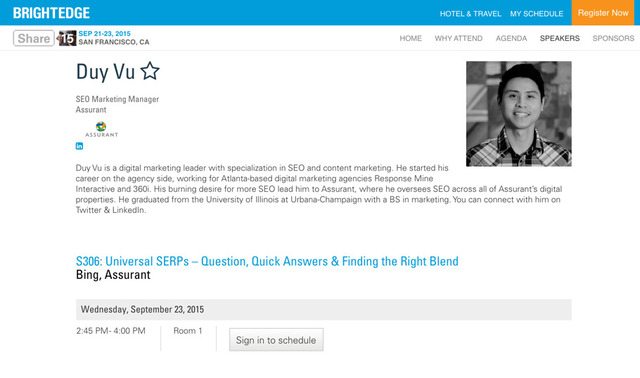
Duy Vu is the SEO manager at Assurance, overseeing all the SEO initiatives for their web properties. He is their self-described ‘go-to’ SEO guy, and we thought that it sounded like he would have some excellent insights into the ever-developing digital marketing industry. Duy Vu will be joining us in just a few weeks for Share15, so we took the time to sit down with him and talk about the upcoming conference and his latest insights into the digital marketing world.

Duy Vu Share15 Assurant - brightedgeBuilding Your SEO Brand and Reputation

Bright Edge (BE): What project will you speak about at Share15?

Duy Vu (DV): I plan on exploring the intersection of SEO and reputation management. It is a topic on the mind of many marketers and brands who want to venture into digital marketing but worry about controlling how their brands are perceived online. They want to know how to remain up-to-date on what people are saying about their brands and what they can do to improve their brand perception.

I plan on delving into a variety of tactics people can employ to strengthen their SEO while also improving their reputation and their relationship with their customers. The people who are most successful with SEO and managing their brand perception focus chiefly on building a strong, positive relationship with their customers.

Understanding How People Search for Your Brand at Share15

BE: Why will attendees want to be sure to attend your session?

DV: Search and reputation management are critical subjects for all brands. We all know how quickly a bad customer experience or a poorly thought-out ad campaign can go viral and hurt a company’s reputation overnight. This prospect scares many companies. They know that they need to leverage digital media, but they want to make sure they do it right. It is becoming increasingly common knowledge that digital media and SEO offer you powerful tools for getting your message in front of customers, but people do not want to get burned by those same methods. I think that attendees at my session will learn a lot about search and reputation. I will delve into understanding how people search about your company, including brand and non-brand queries. I believe that reputation management is an area of SEO that does not get enough attention.

BE: How do you leverage BrightEdge to succeed in your goals?

DV: When you are looking to monitor and manage your reputation through social media, you have to be able to accurately measure your Share of Voice and what people are saying about you. The BrightEdge platform makes it easy to analyze your site and how it is performing as well as your Share of Voice and how people are responding to your brand across the digital world. It is an excellent tool that allows us to leverage all that our SEO strategies are capable of accomplishing.

The Mobile Opportunity

BE: What do you think are some of the biggest challenges facing people in SEO?

DV: I think fully-integrated marketing is definitely up there. Many companies have siloed experiences rather than integrated. The problem with keeping your various channels separate, however, is that every challenge and development in one area of your campaign has implications across the other channels. It is important to learn how to bring the groups together. This past year has also been big with the various algorithm updates, particularly the mobile update. Some of our web properties had not been mobile-optimized and we really had to get on the ball and make sure they were ready. I think that experience was shared by people across the marketing world. It is important to always be looking ahead and staying abreast of the latest developments to try and stay in front of the changes.

The Need to Experiment with Content and SEO

BE: What would you recommend to people looking to succeed in SEO?

DV: Always experiment. It sounds simple, but so many people get caught up in just doing the recommended updates and implementing the advice from the latest gurus. The reason why those thought leaders have obtained their position, however, is that they are always looking for new ways to improve their SEO-- they are experimenting. You also need to play around with different aspects of your content and see how your website and brand reach responds. You could find some great new broad insights or just learn new ways to implement techniques specifically for your brand.

It is always a pleasure to chat with Duy, and we look forward to continuing the conversation at Share15 in just a few weeks. If you have not registered to join us, sign up now!

Conference Details September 21-23 Westin St. Francis San Francisco, CA

Wiley CMO: Transforms Traditional to Digital Excellence

A BrightEdger
A BrightEdger
M Posted 10 years 8 months ago
t 9 min read

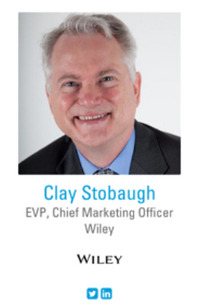
This year Clay Stobaugh, EVP and Chief Marketing Officer at Wiley will be delivering a fascinating general session keynote on how Wiley has transformed their digital business. For those familiar with digital marketing thought leaders and influencers Brian Solis from Altimeter/Prophet, Lee Odden from Top Rank, Rob Garner (formerly i-crossing), Paul Roetzer from PR 20/20, Dan Siroker from Optimizely and Ann Handley from Marketing Profs all have books published with Wiley.

Wiley: Helping people and organizations to develop the skills and knowledge they need to succeed.

Wiley is a global provider of knowledge and knowledge-enabled services that improve outcomes in the areas of research, professional training and practice, and education. Through the Research segment, the Company provides scientific, technical, medical, and scholarly journals, magazines, databases and websites. The Talent Solutions & Education Services segment provides services, technology, insights and content that support learners and institutional partners in business and higher education to improve effectiveness by developing knowledge and skills. In Knowledge and Learning, higher education clay stobaugh interview with brightedgeinstitutions, faculty and students benefit from Wiley’s print and digital content, online program management services and course management tools.


As Chief Marketing Officer at Wiley, Clay Stobaugh is responsible for the company’s marketing, communications and government affairs efforts worldwide. He leads Wiley’s revenue-driving marketing initiatives through key disciplines in the global “Marketing Revenue Center” including customer experience, demand generation, CRM, sales enablement, social media, content marketing, digital commerce, digital analytics and SEO/SEM.

Clay is focused on developing customer relationships and driving new revenue opportunities, he is helping to lead Wiley’s transformation from a traditional book publisher to a global provider of digital content and content enabled solutions. Last week BrightEdge had the privilege of meeting with Clay to talk through the Wiley digital marketing transformation. Below are a few extracts and insights from our conversation.

A brief history of change at Wiley

BrightEdge (BE): Please tell us a little about the history and the transformation at Wiley

Clay Stobaugh (CS): Wiley operates in three closely connected fields – higher education; professional development and lifelong learning; and scholarly research. In higher education many people still think that we’re simply a book publisher. That perception is changing as Wiley is actually helping people to learn online. In higher education we have witnessed a transformation from traditional textbooks to adaptive online learning environments. If I take a business or accounting class using WileyPlus, for example, the platform will not just provide me the digital book content, but it will also offer assignments, tutorials and study aids that help me understand the material better, as well as the social capability to interact anywhere at any time virtually with the instructor and other students taking the course.

In our Talent Solutions and Education Services business, Wiley is investing in technology that will help a corporation skill-test people to ensure that they’re ready for the job. We also provide certification and online learning solutions such as Cross Knowledge so employees can continue to grow and learn once they have the job. Finally, in our Research business, Wiley works with authors, societies and librarians to publish research that has an impact on our day-to-day lives. Here we are seeing some great changes in how information is used and shared, and as the needs of the research community continually transform, Wiley invests in tools and technology that supports these changes. What makes Wiley unique is that through each of these fields, we support all the elements of the knowledge economy – from education, to job skills, and research and innovation.

Digital transformation at Wiley – mind-sets, skillsets, and toolsets

BE: How do you view the role of the modern day digital marketer at Wiley?

CS: If you think about modern marketers there are three things we talk about - mindset, skill set and tool set. You are not a modern marketer if you have the mindset, but not the skills or tools. As management, it is our job to provide the tools, but they are expensive and complex, so we are responsible for training and creating organizational structure around those tools. As a marketer, I look at the digital tools and platforms that will give us the ability to measure and derive performance. We can then choose the tools that best drive revenue and have a place at the executive table.

Transformation, training,and certification

BE: How did you go about transforming Wiley to a digital organization? wiley authors with brightedge

CS: I work very closely with Dan Mooney (who is going to share more insights on this at Share15), and the digital and SEO team, in our marketing revenue center and we’ve been working on centralizing our efforts for SEO. Search and content are pivotal to digital transformation success. BrightEdge is our trusted enterprise Content and SEO platform, and we have mirrored the excellent BrightEdge training and certification program to establish a certification for content and SEO within Wiley. There are three levels (beginner, intermediate and advanced).

Basically, we are making it easier for people to understand content and SEO — we have over 340 of our colleagues around the globe enrolled in our SEO certification. Bottom-up we have certifications and top-down we have SEO scorecards that evaluate the ‘SEO health’ of our businesses. It helps people to understand the importance of content and SEO and then how to act on that. The skill development and roll out of BrightEdge training and certification has been key. As with other marketing channels and disciplines we’re making this a part of our culture to be modern marketers.

Measurement and success

BE: How do you approach measurement and results of content success?

CS: We are currently building out our CRM and our measurement capabilities, but we need that holistic single customer view of what we are doing. But before that is beneficial we need to make sure our employees know how to use/are trained on the sales and social and CRM tools and BrightEdge content and SEO platform. This mindset of delivering the skills and ultimately holding people accountable by measuring results is important.

BE: How does BrightEdge help you with this digital transformation?

CS: With BrightEdge the ability to identify content and SEO areas where we can improve and then show the transformation of that work has a high-value impact.

The BrightEdge platform enables us to identify problems most people didn’t know existed.

Removing silos in the organization

BE: What is your approach towards digital collaboration?

CS: We have created an internal customer engagement framework. This is an 8-step process that goes through all the steps of modern marketing best practices. It starts with research to identify personas and customer journey maps and determine the correct KPIs. We then use these insights to drive our content strategy. Throughout the process, we measure and optimize.

BrightEdge’s Data Cube has been an incredibly valuable tool for researching and measuring our content strategy.

With this framework marketers are equipped to evolve into modern marketers and they are not siloed into a single business department. I will be sharing much more on this and a framework for modern-day marketing success at Share15. To hear Clay speak register for Share15 before tickets sell out fast. 

End Note: digital thought leaders - further reading

For those who like to read we highly recommend looking through the list of Wiley authors and the wealth of digital content and information. 

Blogging and SEO: A Relationship It Pays to Nurture

A BrightEdger
A BrightEdger
M Posted 10 years 8 months ago
t 9 min read

Content Performance Marketing is a driving force in digital marketing, which requires an organized and disciplined approach to producing and tracking multiple asset classes, including the site, images, videos, graphics, and importantly the blog. Understanding how prospects and customers interact with content on the customer journey helps plan and manage content assets. In Google Analytics, under Audience/Users Flow you can visualize the customers’ paths into, through and out of the site. discover why seo for blogging is important - brightedge

Why blog? Blogs usually work toward the top of the funnel to build initial awareness and brand recognition. Related content suggestions will help move visitors laterally through the blog and internal links in the blog will help pull visitors deeper into the website. Getting readers to subscribe to a newsletter or download a white paper will transition them from the outer funnel into the middle prospect funnel where you can better control the interaction with outreach.

As of May 2015, there were approximately 47 billion web pages indexed on Google. For businesses looking to leverage the internet to find customers, that number can be intimidating. Read more on blogging and SEO and learn the eight Steps to a Successful blog in Jim Yu's popular post on SearchEngineWatch.


Building a Landing Page for Success

dpatel
dpatel
M Posted 10 years 8 months ago
t 9 min read

29% of companies report that they do not do site and page testing and we suspect the number is even higher. Landing pages are where content meets psychology. These pages are optimized to entice customers not only to read the content but to click on the offer, fill out the form, and convert into leads. While these pages might look simple to the viewer, a well-optimized landing page has actually been carefully constructed and tested to capture the attention of the customer. building a landing page how to - brightedge The landing page is your opportunity to convince customers that your initial offer is worthwhile and get them to become a lead, connect to your brand, and do business with you.
Optimizing the Design

The key to a successful landing page is simplicity. A 2012 study co-published by Google found that website visitors are far more likely to favor websites that are less visual complex and have more predictable layouts. When customers become overwhelmed by excessive information, images, and other content on the page, they will become more likely to bounce off the page without converting. A high-quality landing page will follow these guidelines:

  • The desired customer action is clear: the form and offer are both easy to find and understand.
  • The layout is simple: there should be no excessive information or images that detract from the desired customer action. Use one to two images that help to communicate the nature of the offer but eliminate any distractions.
  • One CTA: One landing page per CTA, too many confuse customers about what they are supposed to be doing and it decreases conversion rates.
  • Use a simple form: The form should be as short as possible to minimize the ‘cost’ that the brain perceives. Asking for too much information --even ‘optional’ information-- decreases conversions.
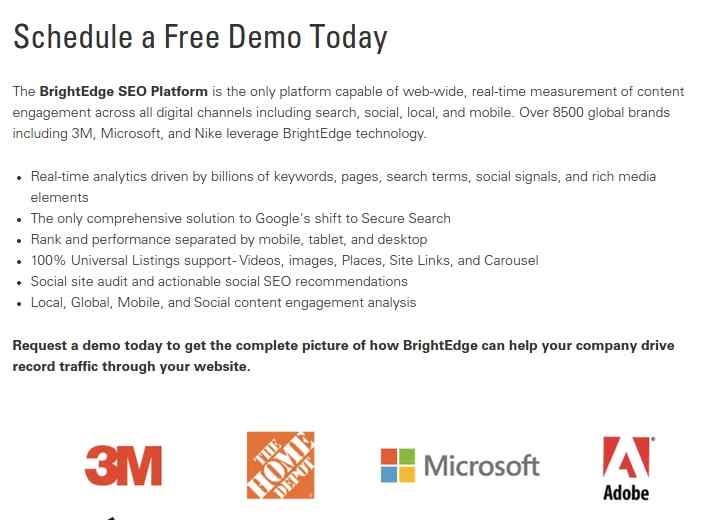
  • Build trust: assure visitors of secure servers, use customer testimonials, and display badges, logos, and awards that increase trust in your company. BrightEdge works to build trust by displaying the logos of companies they have worked with.

Pay Attention to Language

The language you use on the landing page should be consistent with the offers you used to bring the customer to the site. That means keywords that had been used to entice people to visit the site should be repeated on the landing page. They should be used in the URL, the headings, and in the content. This will help reassure site visitors that they have landed on the correct page. Technology like the BrightEdge Data Cube can help you identify meaningful keywords that will help the landing page speak to visitors and identify their needs and user intent. People also have an innate desire to avoid loss.

A study run in 2007 monitored how college students responded to two emails. One asked them to sign up early for an offer to receive a discount. Another warned them to avoid signing up late and receiving a penalty. Although the frequency the same in both emails, 93 percent responded to the warning to avoid a penalty, compared to only 67 percent that responded to the offer to receive a discount. This is a psychological phenomenon called loss aversion. People worry more about avoiding losing out on an opportunity than receiving a potential award. Language used on the landing page should reflect this insight. Remembering to keep the content on the landing page brief and to the point, use the opportunity to point out to your visitors what they would be missing by passing on your offer. Bullet points and short paragraphs can be wonderful for communicating this information.

Look at how BrightEdge has their content arranged on the landing page for their demo offer. Schedule a Demo to learn how building a landing page with seo in mind works - brightedge Language also can make a difference in the wording of buttons and sign-up forms on the page. People generally respond better to buttons that speak to them from their point of view, such as “Start My Free Download” vs. “Start Download” or “Start Your Free Download”.
Landing Page Testing

When a landing page is visited by thousands of people per day, even increases by just a few percentage points can mean a dramatic increase in leads and revenue. A/B testing gives you the power to optimize your landing page to maximize your conversions. In a basic A/B test you will create two versions of your page.

For example, you might want to test two images on the page or the wording of your offer. A/B testing will allow you to run both pages simultaneously. The program will randomly show either site A or site B to your visitors in equal amounts. The site that gains the highest percentage of conversions will be the winner. You will then make this site your standard landing page. A/B tests can also be used to compare several pages at once in more complex tests. Landing pages can be used to test nearly everything about a landing page, from major differences, such as layout changes or bounce rate, to small details, such as the color of the conversion button.

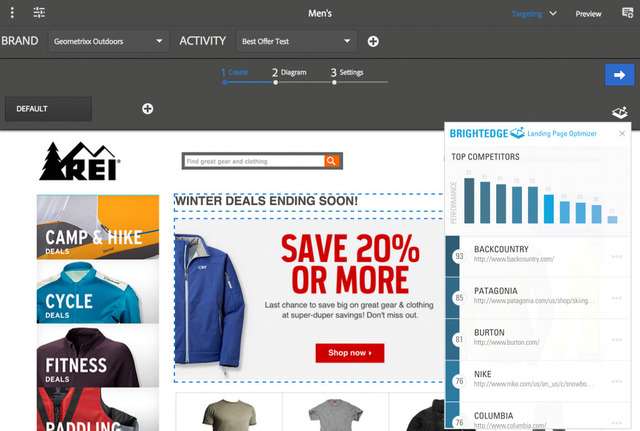
Conversion optimization specialists have seen measurable differences in conversion rates from making very small changes, such as a red button or a green button. There are a variety of different A/B testing tools available. Google Analytics Experiments is an option. This platform lets you test up to ten versions of a single page and allows you to customize who participates in the test. VWO is another popular A/B testing tools that allows you to create separate versions of the website by inserting a small JavaScript code into the webpage. Adobe Target offers sophisticated multivariate testing options and BrightEdge has announced an integration with it call Landing Page Optimizer, which enables marketers to:

  • Gain access to in-depth, real-time competitor landing page data
  • Quickly create landing page tests based on your actual competitors’ content

 Quality landing pages can make an enormous difference in conversion rates and the success of a digital marketing campaign. According to Econsultancy, companies who have improved their conversion rates have used 50 percent more tests on their websites to identify weaknesses and maximize the impact of landing pages. While landing pages might look simple, the thought and care that must go into the development is enormous. As you prepare to build landing pages, remember to put yourself in your customer’s shoes and then test repeatedly to refine the methods.

Brand Mechanics: Content and Public Relations SEO

Default avatar
Andy Betts
M Posted 10 years 9 months ago
t 9 min read

Did you know that you can leverage content and SEO for public relations (PR) in several ways? In this post, we’ll discuss how SEO practices, including quality content, works in tandem with public relations by combating negative queries and reviews, building your brand online and managing your reputation. discover how to do public relations seo - brightedge

Search Engines + Reputation

There’s no question that reputation management and search engines go hand-in-hand. In fact, reputation management has been the center of many “take-down” requests for Google search results that claim to damage the reputation of both individuals and businesses. A high-profile 2013 lawsuit in a French court, reported at Search Engine Watch proved to be a landmark case in search and reputation management. It involved compromising pictures allegedly of Max Mosley, former president of Formula One racing, engaged in acts with prostitutes According to Reuters, the court ruled that Google was to “remove and cease, for a period of five years beginning two months after this decision, the appearance of nine images.”

SEO + Reputation Management

Although brands today are dealing with far less traumatic reputation management issues than Mosely, they still need to pay attention to their brands online. Take bad reviews as an example. Just one way SEO practices can help with reputation management when faced with bad reviews online for queries related to your brand is to put out a steady stream of quality content for any queries that may demand it. Building your brand through creating authoritative content: what’s better reputation management than ranking in the search engine results pages (SERPs) with useful content for a query? The more your quality insights surface for search queries, the more authoritative and credible your brand is online. This is a long-term SEO content strategy, and could take up to a year to be effective, according to this article by Samantha Wanner over at SEER Interactive.

Wanner suggests creating and building “assets that are more authoritative in rank to slowly detrude” negative reviews and search listings. Among some of the good tips she recommends, take note of: • Creating a blog. • Building links to a positive news story, review or blog post that emphasizes your brand. • Build and cross-link your company’s social media profiles. • Upload any presentations to SlideShare, titling it using the exact match keywords for which any negative reviews are ranking. She further suggests – as many SEO practioners do – that you monitor your brand’s reputation.

SEO + Traditional Public Relations

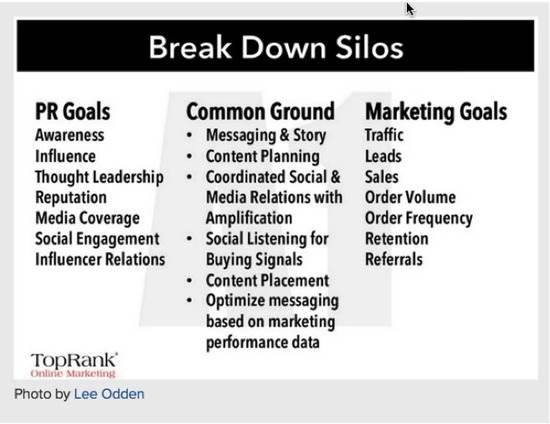
With Google’s emphasis on quality content, publis relations SEO has become intertwined, as SEO and PR teams often share joint goals: spearheading brand visibility being the ultimate one, as John Rampton recently discussed at Forbes. Creating valuable content that established, reputable sites and publishers vouch for by linking to your site has become the cornerstone of brand building online. And while some of the big PR firms today merely dabble in social media with “one-off” announcements, the smarter PR companies “get it,” says Julie Liesse in Advertising Age’s “The PR Factor 2010.” Part of PR firms “getting” social media management is by partnering with SEO professionals that create great organic content for their search strategies.

Some PR firms are now often hired to help manage a brand’s social media, and by joining forces with SEO practitioners, they have compelling organic content in the form of blog posts and articles to share on their client’s social accounts. breaking down silos for public relations seo - brightedge Thanks to Lee Odden of TopRank Online Marketing for the image above that eloquently highlights how to break down silos. For more on these ideas, check out this post.

I did on the evolution of the content marketing system at Relevance.com. SEO can further boost PR efforts towards brand visibility with well-optimized social media profiles that will show up in search engine results pages (SERPs), notably Google+ and LinkedIn (Facebook and Twitter have little to no organic reach). Tips for optimizing your brand’s LinkedIn profile are shared by Jim Yu at Marketing Land, here, while SEO for Google+ profiles is discussed by Kristi Hines at Search Engine Watch. An informed SEO content strategy also provides your PR team with the “right stuff” for initiatives like getting out a particular brand message, as well as helping to get the word out about an event.

One example is the content we featured right here on the blog leading up the BrightEdge Share14 conference, which featured interviews and tips from speakers ahead of the event. Stay tuned for something similar with next year’s Share15  event. And it’s future is destined to grow as mutual goals of brand building, messaging and reputation management converge. What do you think? Tell us about it below!

Adobe Summit 2015 Wrap Up

A BrightEdger
A BrightEdger
M Posted 11 years ago
t 9 min read

Adobe Summit 2015 was the largest and best Summit yet. The event attracted 7,000 attendees this year - far exceeding the 5,500 they expected. The key themes of Adobe Summit could be summed up as:

  1. Context Means Everything - getting the right message to the right person in the right place and at the right time,
  2. Agile Analytics and real-time marketing,
  3. Content Tracking. The Adobe team put on a great conference, and BrightEdge was proud to be a major sponsor.

The BrightEdge team had a fun and productive time at the Adobe Summit and had valuable interaction and exchanges with marketers and executives from nearly 1,000 companies. BrightEdge Booth at Adobe Summit 2015 - brightedge Many people stopped by and talked with our team at our booth in the community pavilion, including existing customers and future customers. We demonstrated BrightEdge S3, our industry-leading search and content management platform. Visitors and press were excited about Content Optimizer 3.0, the latest release of that  product that integrates with Adobe Experience Manager (AEM) and provides actionable insights,  guiding you to create in-demand content which outperforms your competitors and is optimized at the time of creation.
The conference was abuzz about Landing Page Optimizer (LPO) Intelligence, a new BrightEdge product we announced during the conference and which Adobe featured during a number of their sessions. It provides valuable industry and competitor insights to marketers using AEM’s new performance-targeting capabilities. It was great to get to show off our current and new products and hear first hand how impactful they are to our existing customers. At the Summit Adobe introduced innovations to Adobe Marketing Cloud to help marketers deliver customer experiences that get results:

  • Marketing extends to IoT. Adobe Marketing Cloud enables brands to extend the impact of marketing across more touch points including wearables and Internet-of-Things (IoT) devices. Adobe Experience Manager Screens and Adobe Target now bring personalized experiences to physical spaces like retail stores and hotel rooms and enable marketers to optimize content across any IoT device. The new IoT SDK lets brands measure and analyze consumer engagement across any of those devices. And new Intelligent Location capabilities allow companies to use GPS and iBeacon data to optimize their physical brand presence.
  • Mobile app development. Adobe announced a new mobile app framework that gives companies an end-to-end workflow to manage the complete mobile app lifecycle — from app development and user acquisition to app analytics and user engagement. Also, half a dozen mobile app technology providers are integrating their tools into Adobe Marketing Cloud.
  • Ad tech meets marketing tech. Adobe announced a solution, combining a new algorithmic engine and advances to Audience Core Services to unify audience targeting, buying, data and billing in one platform.
  • Two new solutions in Adobe Marketing Cloud: Adobe Audience Manager, which provides greater insight into customer journeys and Adobe Primetime will deliver personalized ads across platforms, and ensure that a single user with more than one device doesn’t have to watch the same ad with more than the desired number of exposures.
  • Adobe Campaign Standard enables more contextual, integrated, and coordinated emails as part of a real-time customer engagement strategy. This new offering features native integration into Adobe Marketing Cloud and a new mobile-friendly user interface, allowing marketers to create and manage email campaigns across devices.
  • Adobe Analytics has several new features including Contribution Analysis to help marketers understand the reasons for anomalies in millions of data points as well as Customer Attributes, a new feature that imports data from CRM systems or any other source of online or offline enterprise data that includes a unique customer ID.
  • Accenture and Adobe have expanded our alliance with Accenture Customer Engagement, a cloud-based managed service that simplifies the development, execution and measurement of digital marketing.

And the winner of the drone is: Besides learning about our products and grabbing some swag, booth visitors entered into a drawing for a Parrot AR2.0 Drone, which includes a live HD video feed to your phone. I’m happy to announce that C. Moore of U.S. Bank was the winner and will soon have a whole new perspective of his neighborhood.

The BrightEdge team will be heading up to Seattle at the beginning of June for SMX Advanced,  and we hope to see you there. And, we are actively planning for BrightEdge’s Share15 event, which will be in San Francisco September 21-23 and have an open call for speakers. You can nominate yourself or someone else on the Share15 speaker nomination page.

SEO for Multiregional Websites

Yulia Kronrod
Yulia Kronrod
M Posted 11 years ago
t 9 min read

Geotargeting challenges and tips

One of the biggest challenges with SEO for multilingual and multinational websites is to ensure that searchers in various countries find your locally-relevant content. In this blog, we’ll talk about geotargeting – the practice of customizing content to a specific market based on the geographic location of potential customers and, most importantly for SEO, ensuring this content is findable in local search.

Structuring multiregional websites

Companies targeting customers in multiple regions have the following options to structure their international sites:

  • Country-code top-level domains (ccTLDs) tied to a specific country, e.g. site.fr for France and site.de for Germany
  • Subdomains or subdirectories on generic top-level domain (gTLD) such as .com, .org, .net:
    • Subdomains – fr.site.com, de.site.com
    • Subdirectories – site.com/fr/, site.com/de/
  • URL parameters (generally, not recommended), e.g. site.com?loc=de, site.com?country=france.

Geotargeting signals

Google uses many signals to identify target audiences for country sites – ccTLDs, server location, the use of local language and currency, local phone numbers and physical addresses, Google My Business listings, and links from other local sites are among them. Webmasters can also set a country target in the International Targeting section of Google Webmaster Tools for country subdomains or subdirectories on generic top-level domains. Unfortunately, those signals may not be sufficient for Google to properly map your international sites to your target countries and display relevant content to searchers. Many companies prefer to host international sites in subdirectories of a single domain, some country sites may not be translated from English, B2B sites lack pricing information, physical addresses, and local business listings, and many websites use distributed content delivery networks (CDNs) or are hosted in a country with better webserver infrastructure, so Google tries not to rely on any of these signals alone.

“Which one should I pick?” Google is wondering

For lack of sufficient geotargeting information, Google may present local searchers with results that are not actually targeted at them, which leads to lower click-through rates from natural search, higher bounce rates, and poorer user experience and business KPIs. Consider a few possible scenarios where site are facing geotargeting challenges:

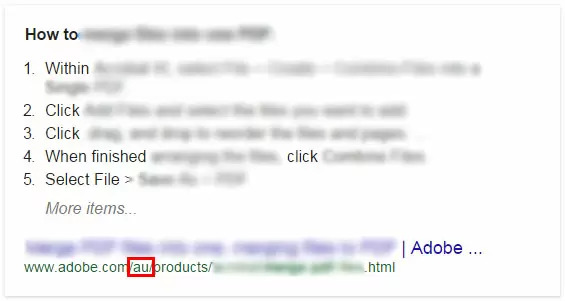
  • Global English (generally, US) pages are exposed in local search – google.co.uk, google.com.au, google.ca – where UK, Australian, and Canadian sites, respectively, should be ranking instead
  • Global English pages outrank localized content for branded searches (i.e. company brand and product names)
  • Multiple sites in one language compete with each other: for example, a company’s German site is beating Austrian and Swiss German sites in local search, and the French site is outperforming Swiss French and Canadian French – for both branded and non-branded queries.

This may be happening for two main reasons. For one, your global English site (or the predominant site in a group of same-language sites) is inherently more authoritative with more inbound links, which are a very important SEO ranking factor. Another reason is that Google treats same or similar content available on different URLs as duplicate content and therefore assigns lower relevancy to the duplicate pages and ranks them lower or, worse, stops displaying them in search results.

Duplicate content warnings in Google Webmaster Tools

You can validate if Google treats your international pages as duplicate content by checking your main Webmaster tools account (site.com) for duplicate title tags and duplicate meta descriptions in ‘Search Appearance > HTML Improvements’ section. In the example below, French-language sites for Belgium, Canada, Switzerland and France are viewed as duplicates:

GWMT Duplicate Descriptions

Once hreflang annotations are in place, you should see Google remove duplicate title and duplicate meta description warnings – they will no longer be treated as such after you’ve made it clear for Google that they target different regional audiences.

HrefLang to the rescue

To help webmasters identify the correct URLs to serve to regional searchers, a few years ago Google introduced an amazing protocol to achieve desired geotargeting results: hreflang tags, also referred to as rel-alternate-hreflang or country and language annotations. These annotations can be placed in XML sitemaps, HTTP headers, or on-page HTML link elements. Google provides detailed hreflang instructions in Webmaster Tools help, so we won’t cover them here. Instead, we’d like to present the results from our own implementation. In a related post, we provide a few tips and touch on common misconceptions and mistakes. mobile seo - brightedge

Adobe HrefLang case study

Adobe has 60 regional sites in 30+ languages. We started off with a pilot covering the top 15 product pages for 10+ regional sites and focused on the UK site to measure the impact. About 10 days after the sitemaps were submitted to Google, we saw a spike in SEO visits to UK pages. In fact, the increase in daily average entry page SEO visits to the UK pages was a whopping 720% and average daily revenue grew over 400%.

The BrightEdge SEO Platform helped us track how rankings were changing – UK pages started replacing US pages in Google UK:

Shortly after Google rolled out Quick Answers globally, we started seeing not only US pages showing in Quick Answers but also regional URLs displayed in regional search engines – yet another sign of proper hreflang implementation:  After the pilot, we rolled out hreflang sitemaps to all major lines of businesses and have consistently seen strong results.  

Leveraging Machine Learning to Share Insights

A BrightEdger
A BrightEdger
M Posted 11 years ago
t 9 min read

We are proud to announce the release of Landing Page Optimizer (LPO) Intelligence. Our latest ground breaking innovation integrates seamlessly with Adobe Experience Manager to provide strategic landing page insight to marketers using AEM’s new performance targeting capabilities to test landing page success. Alongside our customer and partner Adobe, BrightEdge is empowering marketers with unmatched and accessible web-wide competitive insights to create high-performance landing pages. Powered by the BrightEdge Data Cube, LPO Intelligence leverages machine learning to automate decisions and systematize landing page testing, helping to increase conversion rates and deliver solid business impact.

Empowering marketers with the competitive edge

Today, marketers operate on a content battleground where they fight for their content to be heard above competitive noise. In order to win, marketers need to produce content that resonates with their audience, wins consumers’ attention and converts. It is increasingly important for marketers to understand the performance of their content within the context of the broader marketplace. Marketers have data visibility limited to their own content but no insight into content across the web that they are competing with. As a result many marketers struggle to build content that performs as they solely rely on first-party data rather than understanding the complete landscape of competing content across the entire Internet. Utilizing Landing Page Optimizer Intelligence marketers can:

  • Understand the content battleground for their landing page
  • Uncover page elements and offers that are used by pages that perform well in their vertical
  • Generate new test experiences automatically based on what is working for competing landing pages

BrightEdge LPO Integration

“As a data-driven marketer I am very excited about the BrightEdge LPO Intelligence integration in the Adobe Experience Manager environment. BrightEdge machine learning and the subsequent data-driven insights will further empower me in my role to ensure that content marketing performs with maximum efficiency and scale ” - Michael Kirchhoff, Director at PennWell Media

The power of complete sets of data compared to singular first-party data

For years, marketers have been stuck relying on first-party data to power their strategies — but this incomplete view simply hasn’t provided a full understanding of how content is performing. LPO Intelligence integrates with Adobe Experience Manager and automatically provides landing page recommendations that marketers should consider when using AEM’s new performance-targeting capabilities (powered by Adobe Target) to test landing page variations. Following on from our Content Optimizer 3.0 release last month, marketers can now understand the competitive battleground, optimize content at point of creation at scale and now gain the ultimate competitive edge through automation of landing page optimization. BrightEdge is integrating data insights with machine learning technology to further empower our customers, ensuring that their content performs with maximum efficiency and scale. Marketers who use LPO Intelligence alongside Content Optimizer 3.0 will now have access to an industry first complete set of data actionable insights and recommendations for all types of content.

“In any customer acquisition strategy, optimized and relevant landing pages are a competitive advantage, especially as brands vie for consumer attention. Marketers need strong content, analytics and personalization capabilities to come out on top. Our customers will be confident knowing that they are delivering the best digital experiences with Adobe Marketing Cloud and innovations from partners such as BrightEdge." - Loni Stark, Senior Director of Strategy and Product Marketing, Adobe

Some of the key LPO Intelligence features include:

  • Competitive Insights: LPO Intelligence is built on top of the powerful BrightEdge Data Cube, offering a unique web-wide view of content performance. It not only analyzes a brand’s own webpage but also offers unique insights into competitors’ landing pages. With inside insight on strategy and success, we’re delivering the same level of web-wide intelligence at scale that Facebook and Twitter bring to their consumers.
  • Mobile Best Practices: With our mobile-analysis component, we’ve identified the most competitive page elements across each vertical and have developed a set of common mistakes that negatively affect page performance. These tailored insights help marketers bring landing pages as close to ideal performance as possible, and actionable recommendations help marketers develop effective A/B testing.
  • Landing Page Experimentation and Optimization: Our LPO Intelligence technology also works to identify and dissect page layouts by industry and by competitors, helping unlock specifics, such as minimum spend necessary for free shipping across e-commerce company channels, or elements like effective CTA color, text and size. Instead of iterating with no improvements, marketers are offered prescriptive knowledge on boosting landing-page performance and can utilize this knowledge to inform landing page optimization through AEM’s performance-targeting features.
  • Internet Categorization Powered by Machine Learning: While many businesses are limited to their own websites in their use of machine learning, BrightEdge LPO Intelligence uses sophisticated natural language processes to crawl all headlines and CTAs across the web. In addition, search volume trending capabilities identify patterns to understand effective strategic elements. Finally, predictive analytics offer data-driven recommendations to bring landing page success to new heights.

Check out LPO Intelligence at Adobe Summit! Join us at Adobe Summit this week (March 10-13) to witness the LPO Intelligence in action! We’re at Booth #414. We hope you’ll come by to say hello and schedule a demo.  

Making Data-Driven Strategic Decisions

Matt Saunders
Matt Saunders
M Posted 11 years 1 month ago
t 9 min read

The BrightEdge platform provides unparalleled insight into the natural search competitive landscape for your clients. BrightEdge gives you the information you need to wow your clients while empowering you to make data driven strategic decisions. Talk with your CSM for more recommendations on driving strategic competitive insights!

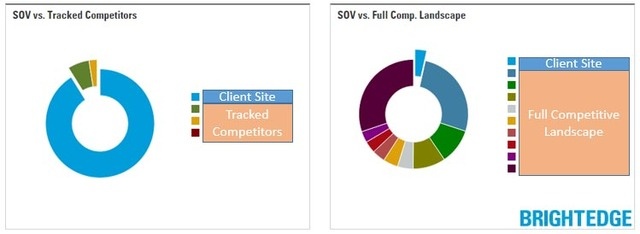
  • Share of Voice (SOV): Differentiate your reporting to compare against both “perceived” (tracked) competitors and “actual” (SOV full landscape) competitors. Paint a picture to clients on how they’re performing against most important core competitors and actual market share against all competing sites. 

making data driven decisions - brightedge

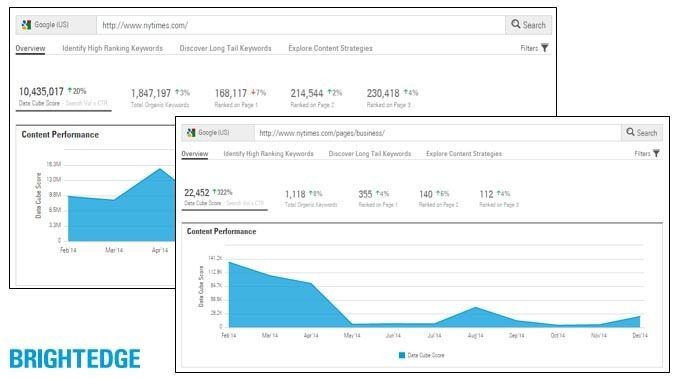
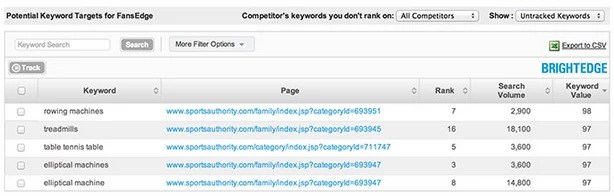
  • Data Cube: Identify content gaps and opportunities for expansion for your clients. Explore Data Cube results for any keyword or competitor (including full domain, sub-folder or individual URL). Build a case for developing new content by uncovering new terms that are driving qualified visitors to competitor sites. 

making data driven decisions for your site - brightedge

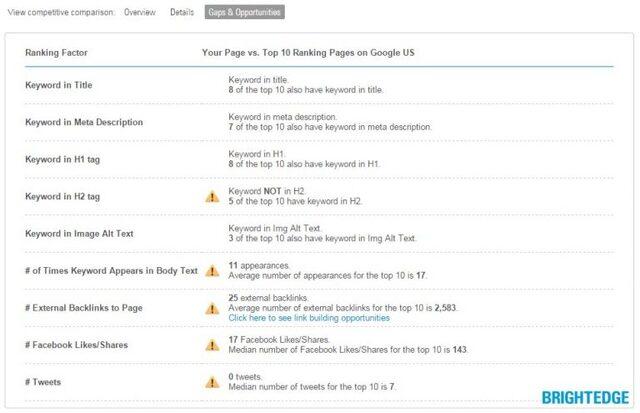
  • Content Analysis: Compare how competitors are leveraging keywords and marketing copy in the most important on-page elements (including: page title, description, heading tags, body copy). Mirror commonalities such as the primary keyword listed first in the page title and communicate your differentiators within the meta-description. 

using data to make decisions - brightedge

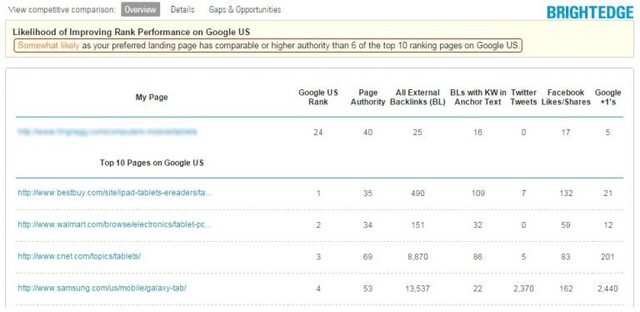
  • ‘Likelihood to Rank’ Analysis: Determine how difficult it will be to improve upon current rank based on offsite factors such as inbound links, anchor text and social media activity. Prioritize low hanging fruit for quick wins while building a long-term strategy for highly competitive keywords. 

use data to make decisions with brightedge

,