Sites Need Actuals and Not Estimates for SEO

ssharma@brightedge.com
M Posted 11 years 1 month ago
t 9 min read

In an attempt to reward sites creating quality content, keep searchers secure and to deter blackhat SEO tactics that focus solely on keyword ranking, Google no longer shows you how your site ranks for keywords. However, any SEO professional worth their weight in salt understands that keywords are still an important part of search engine optimization.

The important question most of the SEOs have is: How to get keyword-level data which is actual and not an estimate?

It's not good enough to simply estimate your rank and visits especially when those estimates might be way off. You'll need to find the right SEO platform to provide the information that Google once offered.

BrightEdge’s Page-Based SEO and Real Metrics Based on Actuals

BrightEdge is the first and only platform to solve secure search to reproduce keyword-level data. We use various APIs to integrate seamlessly with your Analytics and Google Webmaster tools data enabling you view the keyword data at page level. Through and API the BrightEdge platform imports actual performance data from Adobe Analytics, Google Analytics, Coremetrics and Webtrends. Google Webmaster Tools data is integrated within BrightEdge labs. Real Metrics - brightedge We know that SEO for the greater part of a decade has focused on keyword research and usage. There's no denying that this has been effective, but with Google’s shift towards 100% secure search, the metrics and methodology SEO practitioners have been using have dramatically changed.
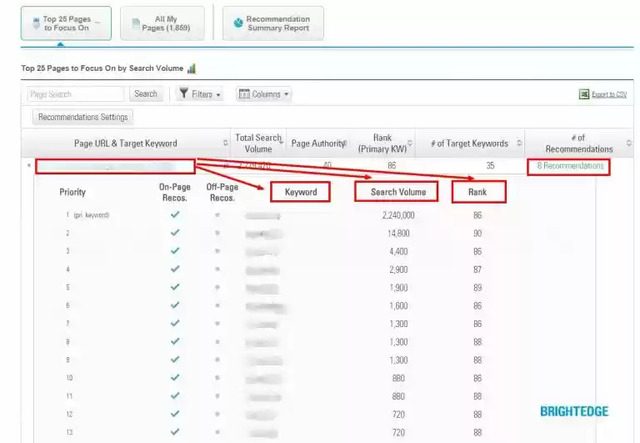
BrightEdge saw the shift to secure search coming and doubled-down on its page reporting solution and created the Secure Search Manifesto as a guide book on the not provided highway.  SEO in 2015 can use some of the tried-and-true tactics that incorporate keywords, including site structure; however, search engine optimization must now be more than that. This is why page-based reporting and SEO makes so much sense. But what exactly does this method mean? This page-centric approach does away with the single-keyword optimization, for example. Webmasters and SEO experts alike need to recognize when multiple keywords apply. However, not all keywords are created equal, either. Prioritizing is important with page-based optimization efforts.

Let's say your website sells shoes, and woman's shoes are among the most popular. When creating the page for this category, there are obviously several semantic keywords you can use. But you should prioritize high heel shoes over woman's oxfords if those are the more popular product. To continue with your page-centric search engine optimization, you'll want to beef up internal links to your site's most popular pages. After all, that's what people are looking for, isn't it? Then, you'll want to use traditional SEO tactics such as earning quality backlinks to your most popular pages not just to your domain.

You'll want to follow suit by promoting these pages via social media, too. Share the newest styles of women's dress shoes on Pinterest, post coupons for a specific category on Facebook and let people know when you've updated stock on Twitter. Every post can include a keyword to help your SEO efforts. Plus, page-specific promotion helps to draw in visitors who want to do more than just window shop. For each of these shares, you'll want to use tracking links that you can plug into your SEO. Page-Based Reporting - brightedge
Making the Move to an SEO Platform

Obviously, it takes more time and effort to optimize and promote multiple pages than it does to work with a single page, but your results should prove more fruitful. You'll need to have the right tools to verify this, however. Site analytics you can get from a single source, whether it be Google, Facebook or Twitter, are limited and don't always paint an accurate picture of your entire SEO campaign. You might get information about keywords from one tool but have to use another to analyze keywords. That's why you need a rounded SEO platform such as BrightEdge.

A full-fledged SEO platform provides answers to multiple questions and integrates with social media and other tools you already use, so you truly get the big picture and not just estimates. There are other perks to BrightEdge including the ability to scale with the possibility of tracking millions of pages and the associated data, which is important for larger sites and even enterprises that are concerned with SEO. However, there's no point to an SEO tool that is this robust if it's rigid. Fortunately, BrightEdge is flexible, and you can customize it to your own needs to track specific data that might be important to you.

BrightEdge and Webmaster Tools

While your marketing efforts will undoubtedly become easier when you use a capable platform such as BrightEdge, this doesn't mean that you won't find tools such as Google's Webmaster Tools useful. In fact, Webmaster Tools and BrightEdge work quite well together, and we've got some advice that will help them marry you to understand your metrics even better. BrightEdge can fill in the gaps while Webmaster Tools still provides with data about click-through, clicks, impressions and backlinks -- the very real analytics we've been focusing on this entire time. In fact, Webmaster Tools even enabled site owners and SEO pros to filter by specific keywords, which is crucial to getting the most out of your SEO campaign efforts. BrightEdge also has a feature that will "reverse index" your website to determine exactly which keywords are working for your pages. With this feature, you can even find keywords that might be helping you even though you're not actively utilizing them in your SEO strategy. You can then add any of those keywords to your campaigns to leverage them. BrightEdge and Web Master Tools - brightedge
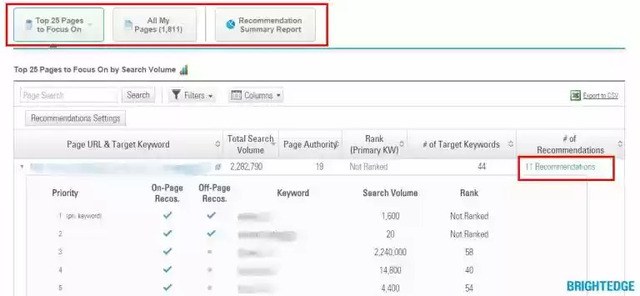
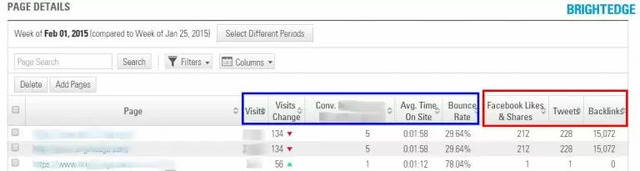
How well does BrightEdge work with individual page reporting? You'll get actual analytics detailing visits, backlinks and even social media mentions of specific URLs. BrightEdge will also show you changes in revenue and visits over time. BrightEdge integration with Webmaster Tools is nearly seamless after initial setup, and there's one extra key feature to point out.

With BrightEdge, you're not just limited to search and visit data in the last 90 days. This enables you to form a more complete picture of your search engine optimization success over time without having to export data to spreadsheets to ensure you can still see it three months in the future!

Webmaster Tools integration is just one of the features the engineering team at BrightEdge has worked hard to leverage. The innovations at BrightEdge have resulted in a comprehensive platform that provides more benefits than any singular SEO tool or even a multitude of tools awkwardly combined together. Any webmaster who also keeps these tenets in mind will be able to develop strong and comprehensive search engine optimization strategies that won't just work in 2015 but into next year an beyond! You'll be able to roll with any changes from Google, even if those changes suddenly exclude data you'd been relying on for years. But tracking these real analytics would be nearly impossible without an all-encompassing SEO platform, especially if you had only relied on Google's tools in the past. Don’t forget:

  1. You need real and not estimated analytics
  2. Rank will always matter for CTR and traffic
  3. Focus on page-centric search engine optimization
  4. All data is important and connected to other data
  5. The platforms and partners you rely on for SEO must be trustworthy and provide data and recommendations based on actuals and not estimates

The ability to report on actual business metrics is hyper-critical to your overall SEO program as it gives you the best foundation on which to react, make decisions and generate forecasts. Page Reporting is the only SEO technology that enables measurement of actual traffic and conversion in the world of Secure Search.

Winning on the Content Battleground

A BrightEdger
A BrightEdger
M Posted 11 years 1 month ago
t 9 min read

An evening with BrightEdge

Last night over 25 of the industry’s leading content and search marketers gathered at an exclusive BrightEdge hosted event at the Silicon Valley Capital Club in downtown San Jose. Leading brands from the likes of Adobe and Sony met to discuss strategies and share insights with their peers on how to win on the content marketing battleground. At BrightEdge customer success is our top value and we invest significantly in the content and digital marketing communities. Since 2011 BrightEdge, in addition to our leading industry event (regularly hosts exclusive dinners and community events with many of the industry’s brightest marketers. 

Brad Mattick, VP of Marketing, previewed some game-changing product innovations with the audience that will redefine the way that marketers optimize, measure and attribute content marketing performance.

“Our commitment to customer success, customer feedback on the roadmap and building innovative products enables marketers to win on the content battleground)”


Join The BrightEdge Community At Share15 This year, the industry’s leading, brand-driven, peer-to-peer content marketing and SEO event takes place on September 21 to 23 at the Westin St. Francis, right in the heart of San Francisco. This year at Share15, we are setting the industry bar even higher with a larger venue, multiple tracks, visionary keynotes and numerous networking events and opportunities that only a Share conference can provide. We expect more than 1,000 people to attend this year and already have speakers lined up from the world’s largest brands. Find out more about Share15, here. Hope to see you there. Feel free to test your knowledge with BrightEdge Digital Marketing Quiz or SEO Quiz.

BrightEdge and the Adobe Summit 2015

A BrightEdger
A BrightEdger
M Posted 11 years 1 month ago
t 9 min read

The Adobe Summit in Salt Lake City is the place to be from March 9-13 to learn how other marketers are succeeding and how they are using Adobe Marketing Cloud. Last year marketing executives from more than 5000 companies participated in this top-tier event. BrightEdge is once again a major sponsor, and we are looking forward to seeing current and future clients there.

Stop by our booth to talk with our team and to see a demo of the industry-leading search and content management platform, BrightEdge S3, and you maybe even win a fun prize. Our team will be showing the latest enhancements to the BrightEdge platform as well as the just-released BrightEdge Content Optimizer 3.0, which integrates with Adobe Experience Manager to help you create high performance, search-optimized content even before it’s first published. Adobe Summit 2015 - brightedge

What to expect at the Adobe Summit

When you’re not hanging out with the BrightEdge team, there’s plenty more to see and do at Adobe Summit this year. There are great keynote speakers such as writers Michael Lewis and Nate Silver and Lauren Bush, founder of FEED Projects. Together, there is quite a baseball connection with the author of MoneyBall, a baseball (and political) statistician and blogger and the niece of George W. Bush, who co-owned the Texas Rangers prior to being the 41st U.S. president, although with all that these folks have going on, I’m not sure if baseball will even be mentioned.

Adobe Summit also has 135 sessions in 10 tracks, including hands-on labs, all of which feature experienced marketers from top companies around the world. Besides speakers, there will be over 5000 innovative marketers from every imaginable industry attending the event. Beyond enhancing your skills and learning about emerging trends, lots of announcements are made at this conference, and you can be amongst the first to know, whether it’s coming from Adobe or even BrightEdge. While the days will be filled with exciting and exhilarating work, there are lots of fun parties at night. In fact, the Summit Bash is featuring the Grammy Award-winning band, Imagine Dragons. If you are able to stay through Friday, your conference pass gives you a ski lift ticket and transportation to the Canyons resort in Park City, Utah with its 19 chairlifts and 4,000 acres of beautiful terrain and great snow.

Preview our latest content technology stack integration for marketers

This year we will share a new enhanced version of Content Optimizer and also be announcing our groundbreaking latest innovation!. It is not be missed so please keep an eye out for more information over the coming weeks. We hope you are able to join BrightEdge at Adobe Summit this year. If you do come, please stop by and say hello or contact us to arrange an exclusive demo of our new technology for content marketers

Winning the Content Battleground: Content Optimizer

Jim
Jim
M Posted 11 years 1 month ago
t 9 min read

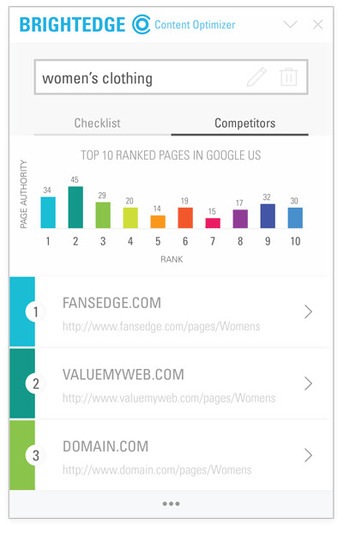
Today, we're excited to announce the release of Content Optimizer 3.0 which integrates with Adobe Experience Manager. As clear leaders in the market BrightEdge has designed this product specifically with our customer feedback in mind to address the challenges they face on the increasingly competitive content battlefield. Content Optimizer 3.0 provides an in-depth snapshot of your competitors' content along with actionable insights into how you can adjust your own content accordingly to gain a competitive edge.  see Content Optimizer 3.0 - brightedge Intrigued? Schedule your demo today. With 27 million pieces of digital content being shared every single day, we believe that understanding your competition is critical. The bottom line is that if you don’t have a competitive view, your content will not thrive in the long run.

With this new technology you no longer have to rely on trial and error to see what works; Content Optimizer 3.0 gives you an unrivaled understanding of the competitive landscape at every step of the process. Last year over 50 household name brands upgraded to the BrightEdge platform as more and more marketers share in the BrightEdge Content Performance Marketing vision. Available today, Content Optimizer 3.0 harnesses Data Cube intelligence to enable marketers to better understand how their content performs against competitors.

Content Optimizer 3.0 is powerful enough to be a standalone solution in its own right. With competitive analysis alongside actionable recommendations, Content Optimizer 3.0 helps marketers to produce quality content that is targeted for the user, optimized at the time of creation and measured at scale. Key features of Content Optimizer 3.0 include:

  • Competitor Analysis: Marketers have access to a detailed analysis of competitors’ digital content. It’s presented in a beautifully designed interface that offers immediate insights to quickly take action. Content Optimizer is the only content marketing technology that looks at competing content, breaks it down in detail, and provides recommendations so marketers can create content that wins from day one.
  • Consumer Demand Targeting: The easy-to-navigate dashboard makes Content Optimizer 3.0 more configurable to the unique needs of every marketer, regardless of industry, geography or scale. Content Optimizer 3.0 guides content authors to better understand consumer demand around specific keywords and topics, so they can take action and boost the performance of their own content.
  • Content Optimization Progress Bar: The new progress bar feature offers marketers a detailed look at the momentum of their content optimization process, while also providing real-time best practices that allow marketers to optimize all content at point of creation.
  • Tailored Content Solutions:Content Optimizer 3.0 operates within the constraints of mobile and stubborn website templates to help content authors generate tailored content solutions to maximize the performance of their content within the boundaries in which they work. 

Join BrightEdge at the Adobe Summit on March 9th-13th The Adobe Summit in Salt Lake City is the place to be from March 9-13 to learn how other marketers are succeeding and how they are using Adobe Marketing Cloud. BrightEdge is once again a major sponsor, and we are looking forward to seeing current and future clients there. We hope you are able to join BrightEdge at Adobe Summit this year. If you do come, please stop by and say hello or contact us to arrange an exclusive demo of our new technology for content marketers.

Leveraging SEO and PPC Synergy for Search Results

enewton@brightedge.com
M Posted 11 years 2 months ago
t 9 min read

There was much discussion about “SEO vs. PPC” this past year, with many search marketing thought leaders arriving at the same conclusion: they need to learn to get along as one not only complements the other, but improves its performance. As Andy Betts wrote here at the BrightEdge blog, when your organization’s paid and organic search teams are competing rather than collaborating, it makes for a no-win overall in terms of search performance and ROI with redundant - and sometimes counterproductive - efforts.

Heading into the New Year, a more profitable and enlightened enterprise search strategy should consider how to corral paid (PPC) and organic (SEO) team efforts for a greater share in the search engine result pages (SERPs) and smarter resource allocation. So here we thought we’d highlight what search marketers had to say about PPC and SEO in 2014.

Frenemies? How SEO and PPC complete each other

It’s seemingly unavoidable with enterprise-level search firms: one department competes with the other as it hopes to win a bigger slice of the annual budgetary pie in a zero-sum game mindset. Heading up your organization’s search marketing, you’re likely well aware that such divisiveness between your SEO and PPC teams doesn’t serve your bottom line well.

In her recent article for Search Engine Watch, Erin Everhart underscores the need for SEO and PPC “to stop being enemies” as both search strategies contribute to the same conversion funnel. She writes that organic search is a research-based “top-of-the-funnel marketing tactic,” while paid search is an action-based strategy that “targets consumers who are further down your marketing funnel and thus further along in the buying process.” Everhart emphasizes a point made by BrightEdge CEO Jim Yu in his column for Search Engine Land back in June, namely that SEO and PPC is not an “either/or” strategy. He writes:

Most marketers would agree that to be competitive, we do not operate in an either/or environment. It’s not a choice between either SEO or social, or SEO and PPC. It’s a requirement that we understand how these channels work together to impact one another and a website’s ability to stay afloat in the growing search results.

Discussing how SEO and PPC work together for site visits (“clicks”) and conversions, Jim refers to research from Google at Search Engine Land, which shows the synergy of the two search strategies. According to the search giant, even for brands that position first in organic SERP rankings, paid ads provide a hefty 50 percent in incremental clicks - meaning that half of the No. 1 site’s visits would not have occurred in the absence of PPC ads. The contribution of PPC to organic SERP incremental clicks increases even more for listings No. 2 and lower, as detailed by Google in its study (noted above).

On the flip side, SEO informs PPC with page-level metrics such as Web traffic, conversion rates and revenue. Crispin Sheridan also recently addressed how SEO helps PPC strategy in his article for ClickZ, writing, “the need for content creation in SEO provides PPC with more landing pages to satisfy the intent of the user. Learning what content is most effective through SEO can provide PPC with new avenues for growth.”

Sheridan also discusses how PPC can inform SEO via immediate results, noting that the “time advantage” of PPC allows for the testing of keywords and “phrase matches” that drive Web traffic, leading to the creation of content that bolsters SEO. He further notes, “having your company displayed in both paid and organic results can be an indicator of trust to a user.” Google Analytics (GA) provides a multi-channel funnel report that shows what channel contributed to your firm’s conversions, including SEO, PPC and social media. Tapping into Google AdWords data here at BrightEdge, we can further determine:

  • Which of your Web pages have a better Quality Score.
  • The keywords on which of your site pages have the best Quality Score.
  • How users “judge” your Web pages via metrics such as bounce and exit rates, as well as time on page.

We hope this post assists you going forward with a healthy, integrated picture of how SEO and PPC work together for search strategy!  

5 Quick Tips for Optimizing Blog Posts

ssharma@brightedge.com
M Posted 11 years 4 months ago
t 9 min read

So you have a blog, and you aim to provide useful posts that address your readers’ interests. Take that content a step further by optimizing those posts with SEO best practices in mind that will help inform search engines about your content, and make it more relevant to show up for a searcher’s query. In this post, we’ll go over five quick tips for optimizing your blog posts to boost search rankings and generate more Web traffic.

1. Create unique meta information

Meta information (also called Meta data) is one thing search engines use to understand the content of your site’s pages, including blog posts. When implemented well, it's often one of the first things a search engine bot encounters when crawling a page. So it's your first opportunity to tell the bot what the page's content is about. The most important components of Meta data are titles and their corresponding descriptions. Meta titles are brief lines of text that summarize the content of each post on your blog. A best practice for composing Meta titles is to include at least one of its keyword terms for optimization purposes, while keeping the character count to 55 (including spaces).

The Meta title is displayed as the “clickable” result in the search engine results pages (SERPs), so it’s essential to make it as compelling as possible. Meta descriptions elaborate on what a person can expect to see when they click through, and are comprised of a brief summary of the topic or page. You’ll want to allow for more room here -- up to 156 characters (again, including spaces) -- and incorporate the keyword term(s) you’re targeting without stuffing. For more on Meta information, refer to Part 1 of our guide to basic SEO concepts.

2. Optimize your content

Of course, your SEO strategy should also include optimizing the actual text of individual blog posts. While content is often naturally optimized simply by writing about a topic, it is a best practice to review the post with an eye for more optimization opportunities to include those keywords you are targeting – given that they naturally “fit” into the text. For more specifics about on-page elements to pay attention to, see Part 1 of our guide to basic SEO concepts, noted above, which also covers:

  • How to handle Heading tags
  • Video optimization

… And more!

3. Optimize your images

As with blog content, your images should also have concise titles and descriptions optimized with keywords whenever possible while avoiding “keyword stuffing” that the search engines may interpret as spam. Image titles (also referred to as “filenames”) should briefly summarize its content, with hyphens ( - ) separating the individual words. For example, washable-cashmere-sweater is preferable to simply cashmere_sweater, both in terms of keyword use (“washable cashmere sweater”) and search-engine friendly style (using hypens rather than underscores). Image descriptions (also called “alt text”) are key for helping those with disabilities who may be using screen-reading services understand what the images are on the page. Generally these descriptions are brief, and literally describe the image in question. For more on image optimization, refer to Part 1 of our guide to basic SEO concepts, as cited above.

4. Link appropriately

Linking internally to useful resources on your site that are relevant to your blog post, or externally to other (trusted) websites pertaining to your post, is another best practice for blog post optimization. It’s important to ensure that the external site you link to is reputable in order to avoid being hit with a Google Penguin penalty, as discussed in Part 2 of our guide to basic SEO concepts, as well as in our guide to link audits.

5. Include social media sharing

It is well documented that social signals such as Google, LinkedIn, Twitter and Facebook work in tandem with organic search rankings. (For more on that, Mark Mitchell discusses “social SEO,” explaining how social media and SEO work together on the BrightEdge blog.) A best practice for leveraging social media sharing of your blog content is to include “buttons” in the form of social media icons that readers can readily “click” to share or endorse your posts. At a minimum, it’s recommended that you include the power of 4: Facebook, Twitter, LinkedIn and Google+. If your posts tend to be visually heavy with images, a Pinterest button would also lend itself to social sharing. (Note: For more info on this, Mark Mitchell discusses how to optimize your brand’s Pinterest presence at the BrightEdge blog). There you have it; we hope these five quick tips provide you with the preliminary info you need to optimize your blog posts. Refer to the resources cited to learn more, and if you have any questions, please note them in the comments below!

Scaling In-house SEO: the Secret to Success

Default avatar
Andy Betts
M Posted 11 years 4 months ago
t 9 min read

Capturing the economy of scale is a fundamental principle for achieving efficiency within an organization. One example is Henry Ford revolutionizing the car manufacturing industry with his assembly-line business model, making scale possible for the automotive industry. Anyone can appreciate the ingenuity of Henry Ford, and apply the same inventiveness to scale what they’re working on. But to do that, every process needs its parts to facilitate that well-oiled machine. Central to this process is workflow. In this post, we’ll look at how workflow scales SEO, and how you can create your own workflow for in-house SEO.

Why workflow is crucial to scale in-house SEO

A simple definition of “workflow” (via the “New Oxford American Dictionary”) is: “The sequence of industrial, administrative or other processes through which a piece of work passes from initiation to completion.” Workflow can be envisioned as raw materials systematically improved upon through a workforce in a series of specialized processes to produce the final, refined result. With SEO, that raw material likely is data resulting from keyword research and competitive analysis. (For more information about how to do keyword research, refer to Sudhir Sharma’s guide; for more on how to conduct competitive analysis, see Daniel Sitner’s guide, both on the BrightEdge blog). Using these raw materials, your SEO team will perform analyses that ultimately determine the strategic optimization of your site’s architecture and individual page content.

Informed by SEO, your in-house writers will then create content in the form of Web pages, blogs and marketing materials, which SEO editors, content strategists and marketing managers will further refine before publishing. As you can see, each piece that each worker produces must be executed well to create the end product. As an SEO project manager, your job is to oversee and coordinate this workflow in order to scale. This is no small task. Managing the workflow for multiple SEO tasks means tracking and coordinating assignments and project progress of your various in-house teams, all the while keeping in mind:

  • Long-term business goals
  • Campaigns goals and metrics

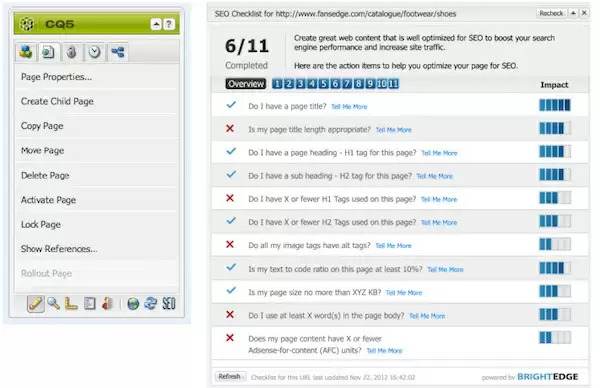
A common pain point in SEO project management is a lack of collaboration among SEOs and content due to siloed teams and compartmentalized skills; BrightEdge CEO Jim Yu discusses this in a post he wrote for Search Engine Land. One solution is technology. For example, BrightEdge’s “Content Optimizer,” developed in partnership with Adobe, is designed to bridge the gap between SEO and content teams at the enterprise scale, specifically providing for integrated workflow. Here’s a screenshot showing our Content Optimizer at work: here is what you need to know about in-house seo - brightedge Another common pain point for enterprise-level SEO project management is tracking the seemingly myriad tasks and workflows across your organization – and a whiteboard diagram is simply not going to cut it.

Getting your entire SEO and content team on board in an integrated and collaborative effort requires more advanced tools, such as BrightEdge’s project management platform’s tasks and workflow support technology. Designed for enterprise SEO management, it features dashboard reporting for tracking projects with real-time visibility into their status, and automatically marks tasks that have been completed to save time and reduce duplication of efforts.

Insights from Experian and Microsoft at Share14 on scaling in-house SEO

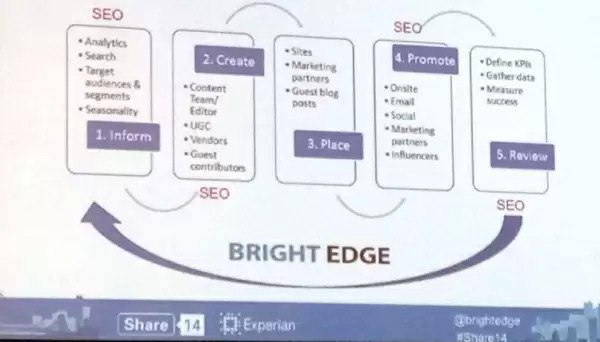
This year’s Share 14 conference featured speakers representing several global brands, some of which discussed how their organizations tackled the challenges of scaling SEO in house. Experian Consumer Direct’s Ngia Vang (who was also interviewed by Andy Betts here at the BrightEdge blog) addressed the issue of its siloed SEO and content teams. From her presentation is the following workflow graphic, showing how Experian integrated SEO into their content team’s process: discover the best in-house seo tactics for success - brightedge

In her talk, Vang reminded the audience that it’s a cyclical process, as the performance of SEO content is measured against business objectives and key performance indicators (KPIs), these metrics will then inform budget and resource allocation from one quarter to the next, and the process will start over again with fresh intelligence.

Another speaker, Alex Volk of Microsoft, said that when he first started at the company ten years ago, SEO didn’t even exist in-house. It was about seven years ago that he and colleague Derrick Wheeler initiated in-house SEO, facing challenges ranging from internal keyword competition to overlapping content and inconsistent UX, domain and subdomains. He and Derrick developed a “hybrid model” that involved enlisting 14 key people within the company to forge a bond for fueling SEO strategy. 

For more expert tips from Share 14’s speakers on scaling in-house SEO, you can refer to the liveblogging coverage of the session here at the BrightEdge blog. In sum, you don’t need to be an industrialist to appreciate scale economies, and luckily today, you can access advanced tools to scale SEO within your own organization to take it to the next level.

SEO Marketing and Marketing SEO in Your Org

Default avatar
Andy Betts
M Posted 11 years 4 months ago
t 9 min read

Ever look back on your younger years, and long for the simple decisions? Many of them were easily made using “decision tree” analysis.

seo marketing budget for your business - brightedge

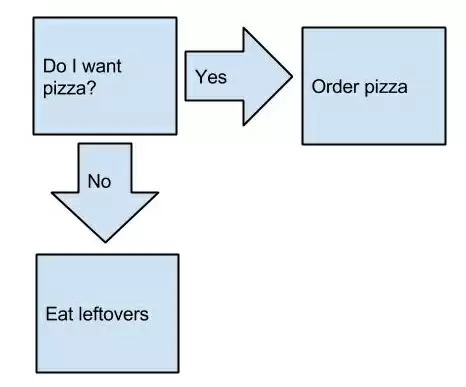
You have to admire the decision tree’s simplicity. The theory is that with each “yes” or “no” choice on any major decision, you are taken to a branch, each with its own “yes” or “no” choice. Even today with more complicated choices, the decision tree seems a relatively straightforward model for making informed, carefully considered and reasonably objective decisions. After all, we use decision-tree analysis in our everyday lives, whether it’s deciding between car purchase X or Y or moving to Place A or Place B.

However, in business, when it comes to marketing budget allocation, it’s a bit more complicated than a decision tree, right? Maybe not so much as you’d assume. When it comes to marketing dollars, if you consider your SEO initiatives as a branch of the CEO’s decision-tree, then the funds allocated represent the end-point of several weighted decisions.

So the question becomes: How do you shift the weight to your SEO branch of the tree?

Making your case for the SEO marketing money

Whether you’re the CMO pitching to the CEO, or the SEO pitching to the CMO, there’s a veritable soup of acronyms standing between you and your SEO marketing budget – especially at enterprise-level businesses. The issue isn’t a matter of just PPC vs. SEO in the decision tree when competing for marketing dollars; rather, it’s a matter of building a case for the value of your channel of choice – in this case, we’re talking organic search. How valuable is organic search? Pretty valuable to most marketers. In fact, 83 percent of marketers responding to the BrightEdge 2014 Search Marketer Survey stated that increasing content performance by optimizing for organic search in 2014 is “much more important” or “more important” than it was last year.

One of the simplest ways to support your case for SEO is to put on the CEO or CMO hat and school yourself on the following:

  • Economics: Identify those website pages that have the greatest potential to perform well with minimum investment in optimization, based on things like conversion rate and ranking potential. This is the low-hanging fruit.
  • History: Benchmark where the business and website is today with little to no investment in SEO marketing. Then, look at where it could be in the future with no effort versus what an investment in SEO and content marketing could bring in terms of traffic and leads. Don’t forget to think about how far ahead your competition will be if you do nothing and they do something.
  • Mathematics: Today, there’s a seemingly endless stream of search marketing data, and you can take advantage of that by showing the numbers to support your case. For instance, you could show the decision-maker what the projected lifetime value is of a single customer if SEO marketing brought more leads and conversions.

When all is said and done, CEOs care about mapping budget to business outcomes. When building a case for your slice of the marketing budget pie, the decision tree is simple: Will it impact the business’s bottom line – yes or no? For more detailed information on how to make the SEO case to your CMO or CEO, check out how BrightEdge can help.

Lessons in SEO and Site Migration: A Case Study

enewton@brightedge.com
M Posted 11 years 4 months ago
t 9 min read

The importance of ensuring that you have a detailed SEO strategy in place as part of any site migration cannot be underestimated. As an SEO, and from my own personal experience, the results can be catastrophic. Let me show you why with the following case study.

The beginning: SEO success

Consider this scenario: Company X had a well-structured SEO campaign running very successfully. Among the results, they had a first- or second-place ranking in Google U.S. on the following keyword phrases:

  • video over mobile
  • low latency video
  • wearables and training
  • guide to wearables
  • wearable areas
  • in-body wearables
  • field service video
  • streaming video field service
  • streaming video manufacturing
  • reduce AOG

Rankings were earned and key C-level stakeholders were very pleased with the results. These results were achieved by focusing pages on topics, writing blog posts on the topics, on-page optimization, internal linking, and some external linking with another domain run by the company, which had good domain authority. All rankings were tracked for Google U.S., but traffic came in from Google and Bing on those pages from all over the world, including India, Korea and the Middle East. Over a dozen industry-focused topical datasheets, which were provided in pdf, were indexed and ranked. A dozen videos were created, which were also indexed, and showed up in Universal Search results. Traffic was several hundred well-qualified B2B visitors per month, which must have generated a decent volume of leads. And keep in mind that buying the clicks with PPC would have cost $3 to $9 per click.

The loss: a site migration

In early October 2014, the company redesigned its website without the help of an SEO or an SEO platform. Of the keywords listed previously that the company was ranking for, none of the words rank today. In fact, none of them are even indexed because they took the topical blog pages down. The blog is gone and has been replaced by another press-focused blog, which does not have the same topical value or SEO value. The industry pdfs are gone, the videos are gone, and so is the traffic. In this case, Company X may have wanted to move away from the positioning strategy that led them to produce the original content about those topics. However, the content pages ranked and generated traffic and now the pages are traffic are gone.

Can You Have a Totally Successful Site Migration? The answer is yes. Keep in mind that in any site migration, even when done well, there’s a chance of a slight traffic dip for a period of time, or at best, everything stays the same initially, and then results grow from there. Mark Munroe of Trulia, director of SEO and a BrightEdge customer, shared an interesting site migration case at the Share14 conference earlier this year. In this instance, it was an integration of two sites, where one existing site became a subdomain of another. After carefully moving the site, the result was a 129 percent increase in traffic – a total success. You can watch a video of his session here, which illustrates the power of a strategic website migration.

Bottom line: you need the right people and tools in place for a site migration

Companies undergoing site migrations or redesigns must have an enterprise SEO platform and a success manager in place. Companies that are likley to lose traffic opportunities. Company X that we spoke about earlier could have refocused the website and still maintained the SEO value they developed through proper implementations, like 301 redirects. But today, any links they had now generate a 404 "not found" message. This haphazard approach to site migration destroyed any content equity, rank, link equity and free traffic that the company had. In sum, you would not consult an architect after you rebuild your house, so don’t forget to include an SEO manager and appropriate benchmarking and tracking resources when you plan your site updates, redesigns, and migrations.  

Understanding Share of Voice In Digital Markets

ssharma@brightedge.com
M Posted 11 years 4 months ago
t 9 min read

To get a truly competitive edge as a digital marketer or advertiser, it's important to understand and use the concept of share of voice. Share of voice is about how much of the pie you're getting; what percentage of the digital space is yours?

Even if you've heard the term before, you may have only heard it as applied to a traditional model. In a digital environment, there are multiple competitors and marketing channels to consider.

learn more about share of voice and how it works - brightedge

A study done by Millward Brown found that brands that increase their digital SOV are more likely to increase their market share over time. In this study, Millward Brown looked at over 4,000 brands from 28 countries in 56 different categories.

For each brand, they measured the brand's overall share of voice (both digital and traditional) and digital share of voice. They computed the changes in the SOV scores from 2009 to 2010 and compared them with the changes in the brands' Consumer Value scores during the same time period. (Consumer Value is an estimate of market share that is highly predictive of actual share.)

They found that the correlations—r=0.29 for overall share of voice with CV and r=0.22 for digital share of voice with CV — were statistically significant. Clearly, digital share of voice has a significant relationship with market share growth.

Businesses who measure their success and their share of voice tend to profit quite a bit more and do better overall than those that don't.

American company New Belgium Brewing Company makes it a point to measure their share of voice, and that of their competitors, and then to use this information to their advantage.

In 2013, the company found that its Facebook fans were bringing in $50.7 million annually, a great return on investment since they had spent just over a quarter of a million on social media as a whole.

These figures again drive the point that the digital marketing world is considerably more convoluted than that of traditional marketing, so it's important that you make share of voice a part of your strategy.

BrightEdge has a great tool for measuring share of voice that will help you not only measure your share of voice, but will help you discover share of voice of your competitors.

You'll be able to find new competitors, perform detailed competitive analysis, find competitive benchmarks, discover trend predictions, and find other helpful metrics.

discover the benefits of share of voice for your website - brightedge

When using BrightEdge's share of voice you'll find how much of the digital pie is yours, and you'll know where to invest your time and money to get the most ROI on your marketing efforts.

Maybe you find, that as a result of your marketing efforts, that mention of your company on Twitter goes from 100 to 200 mentions per day. This may seem like a win, but what if mentions of your competitors are closer to 1,000 per day? You would be missing out on a large slice of the pie, and you might not know unless you look into share of voice.

There are so many different avenues in which to market online, which means there are a lot of different channels to spend money on.

Before spending a massive budget on different marketing channels, it's best to know what will bring you the greatest ROI. Really understanding your share of voice will help you make better decisions and come out ahead of the competition.

Digital marketing has come a long way in making the craft more measurable, but there is still a lot of room for things to slip through the cracks.

The BrightEdge platform allows you to measure the right metrics to see how well your content and organic search is performing . The massive data repository in DataCube allows business leaders to analyze marketing data to more informed decisions based on maximizing return on spend and increasing revenue from all your digital marketing efforts.  


,