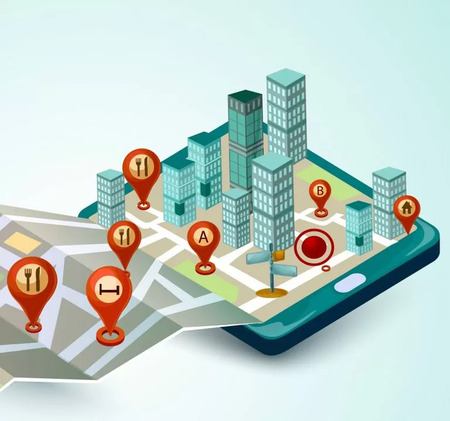
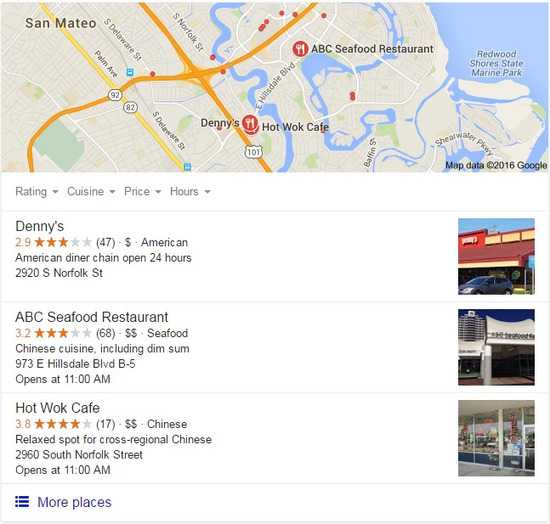
The 3-Pack is Google's method used to display the top three results for local SERP results. It references the user’s location to make the search more relevant. For instance, if a user searched “restaurants near me”, Google 3-Pack would display three restaurants near the user’s current location.
Google 3-Pack has undergone a couple of major changes, first in August of 2015 when the Google 7-Pack was cut down to three, creating the 3-Pack. At the time, the update placed more emphasis on links to the brand’s business websites. The way information was displayed also changed, making it easier for mobile users to navigate the 3-Pack by showing addresses and business hours, rather than phone numbers.
In December 2021, Google 3-Pack saw another major update. Google described the update as a rebalancing of its three key ranking factors for 3-Pack results: proximity, relevance and prominence. The rather rapid impacts to results made it clear that the rebalancing was to place greater emphasis on proximity as a factor. The 2021 update also integrated the results with a map.
How do I rank locally on Google?
You cannot optimize specifically for Google 3-Pack because businesses that appear on Google 3-Pack are location dependent. In other words, the local SEO results change depending on the searcher's location.
However, you can optimize your web presence in a way that will increase your chances of appearing in the 3-Pack.
How to optimize your web presence to increase likelihood of showing in the Google 3-Pack.
Make sure your Google Business Profile is filled in and up-to-date. This is the easiest component for you to control and is weighted heavily – about 25% – in your ranking potential.
Solicit customer reviews on your Google Business Profile. Receiving multiple positive reviews can be beneficial when it comes to boosting your visibility, both as a ranking factor (prominence), and because Google reviews and stars will be plainly visible to users on the 3-Pack.
Make sure your listings throughout the web are accurate and consistent. This includes business name, address, and phone number (NAP).
Cultivate locally relevant links to boost your visibility. There are a number of ways you can cultivate reputable links, such as sponsoring local nonprofits and events or joining a Chamber of Commerce.
Build standard backlinks to raise your organic rank. Backlinks are best cultivated through outstanding, well-distributed content that attracts readers.
Build a strong presence on social media and other platforms to establish yourself as a Google local listing with loyal followers.
Improve the user experience (UX) on your website, as Google favors better experiences. Since 2015, for example, Google has rolled out updates asking websites to be responsive and allow better usability for the mobile experience.
Appearing in the Google 3-Pack attracts attention to your brand and encourages people to engage with you. Keep these guidelines in mind when you create your web presence to maximize your chances of appearing on these lists.
Update: This blog has been updated with 2020 data and information.
The buyer’s journey used to be a simple circular route from Awareness to Consideration to Purchase and (hopefully) back around again. Digital has transformed the buyer’s journey into a complex maze of multiple touchpoints and increased the potential for crossed wires.
Naturally, you're going to want your content to rank above competitors. If prospects have discovered pain points and begin searching for solutions to them, this is your opportunity - right at the initial stages - to grab your prospects attention. If your content isn't optimized to rank well, prospects are finding your competitors resources at the beginning stages of their journey and therefore not finding yours.
What buyers discover in searches along their journey
A simple Google search has become complicated. Buyers no longer get the same results with the same search terms. Instead, each individual’s buyer’s journey is personalized based on the type of intent, device, location, time of day and any other past search history.
The layout of the search engine results page (SERP) is also up for grabs. There are now 50 different SERP elements and an infinite number of combinations where Google is understanding the intent of each search to present the most relevant and helpful information during the buyer’s journey.
For example, if the user asks a question during a micro-moment search, Google might prioritize a Quick Answer, the highlighted section that appears at the top of the SERP whenever a user asks an information seeking question, like “How to…” or “What is…”. Or when a location seems like the most appropriate result, the buyer will see a Local 3-Pack view showing nearby businesses who offer what they’re looking for.
The four micro-moments of the customer journey
Micro-moments are when users leverage their devices to search for solutions with the intent to do something whether they're looking to do something, see something, buy something and more. You'll need to know the different moments as they're a crucial part of the customer journey and aid you in being there for prospects during these moments when they're looking to reach you via content. The four micro-moments include the following:
I want to know. During this type of search, users will search for a topic without a specific business in mind. Simply put, users are looking for their questions to be answered at this stage.
I want to go. Here, users are looking to go somewhere. This can include a vacation destination, a local business or any other physical place a user is looking to go to.
I want to do. At this stage, users are looking to learn to do something. During COVID-19, search engines saw a huge jump in searches for baking bread and at-home workouts. These are two examples that fall under "I want to do" moments.
I want to buy. At this moment, users are looking to purchase. Queries including "near me" or an actual product like "65" smart TV" indicate users are looking to solve their pain point with a purchase.
Buyers are expecting the straight-forward answers they're looking for
All of this has transformed the buyer. They now expect to see only the most relevant search results linking to dynamic content that reflects where they are in their journey. If your brand is still reciting the same stock answers, you’re missing out, especially as millennials – now “the world’s most powerful consumers” – are more loyal to brands that provide a personalized approach.
When the majority of every buyer’s journey starts with search, you need to ensure buyers see signs for your brand on that first results page. Here are three ways to ensure you earn their attention.
Know the queries users are searching for
New York sports center Aviator Sports created a new webpage to promote its figure skating rink and classes. When it didn’t generate the anticipated traffic, the company used BrightEdge’s deep learning SEO technology to analyze the relevant keyword landscape. This revealed that while “figure skating” is the widely-accepted term in the sports world, regular people typically search for “ice skating.” By optimizing this term on their webpage, Aviator boosted its potential search volume by more than five times.
Don't assume that buyers use the same language as you. It’s critical to establish which relevant terms people actually search for the most. You should also explore which terms your competitors are ranking for and find out if there are any important categories where your brand does not rank.
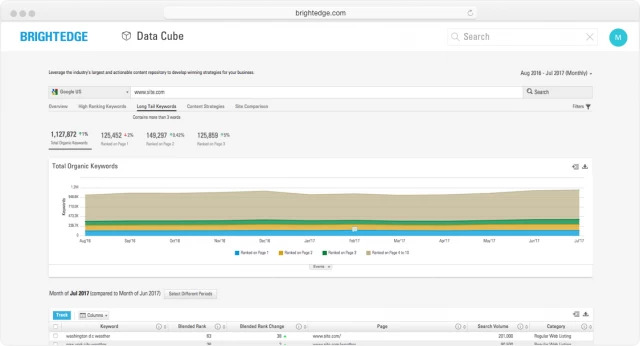
Using Instant, you can easily discover real-time insights into the relevant queries users are searching for. You can also use Data Cube to locate the terms where your brand ranks and what language is used. You can also quickly compare your domain to any competitor to see what terms they rank for in the first page of search results that you are not.
Not only will you need to know which keywords you're ranking for, not ranking for, and which your competitors are ranking for, but you'll also want to find the searches that are most relevant to your prospects when solving their pain points. You can do a search for the queries you want to appear for. Look at what Quick Answers and People Also Ask results appear and ask yourself if your content is answering those questions consumers are looking for.
When cosmetics brand Kiehl’s noticed that lots of people were searching for advice on using skincare products, it produced content to specifically answer the most common questions. As a result, the brand saw a 30% increase in its Quick Answer ranking. Are your prospects downloading resources from your site? Are they checking out blog content or watching videos? Discover the content your prospects are looking at on your site and create more of it for every step in their buyer's journey to help them move along.
Words used in a search are often an indicator of where a buyer is on their journey and you need to create relevant content for each type:
“How”/“What” – The buyer starts their journey by searching for information about a category. This is your opportunity to become a Quick Answer and produce interesting category content.
“Reviews”/“Best” – The buyer is interested and now considering their options. Help them by creating brand comparison content and promoting your good reviews and case studies.
“Buy”/“Order”/“Download”/brand term – The buyer is ready to make a purchase. Close the deal by showing them product pages and ensuring your brand features on Google Images and in the Local 3-Pack.
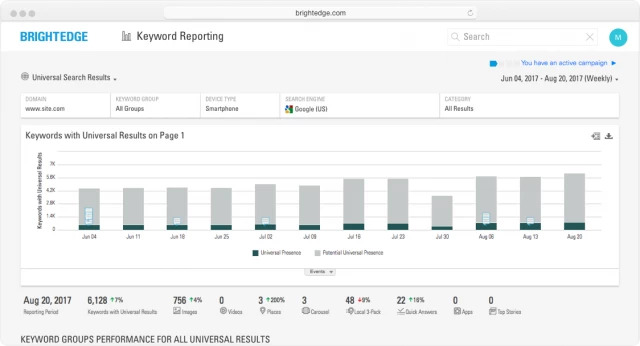
Using BrightEdge Keyword Reporting, you can easily organize and strategize on all of the terms where your brand is ranking on informational, consideration, or purchase terms. Keyword Reporting will also help you identify which terms have universal rankings, such as a Local 3-pack or Quick Answer, to help you optimize your pages for the right intent to secure those prized search spots.
Optimize your content to rank for different search types
Digital Media Publisher targeting athletes Stack.com discovered 120 keywords initially and narrowed down their target list to focus only on terms with the highest organic potential. The brand then created targeted content for this subset, which increased site visits by 61%.
Once you understand the intent of each targeted keyword, you can maximize your organic effort by grouping keywords into three categories:
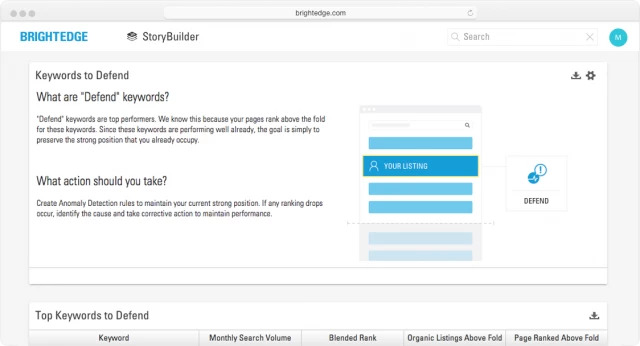
Defend – terms whose high ranking you need to maintain
Optimize – terms where you can achieve a higher ranking with some minor tweaks
Create – terms you are not ranking for and need to boost with new content
Leveraging BrightEdge’s Visual Parser, the Intent Signal dashboard template will automatically do this analysis and categorization for you. Or consult Insights, which automatically scans your site for pages with errors that affect ranking or those where additional content like an image or Quick Answer might boost results.
Adjust your strategy if your content isn't resonating with buyers
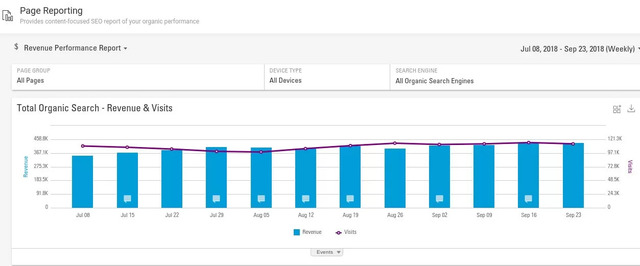
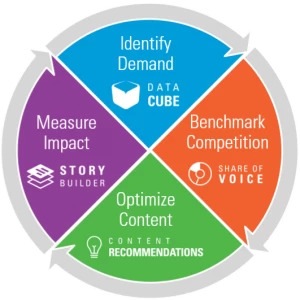
In order to understand whether your content is resonating with prospects, you'll want to measure and track your data. You can use Data Cube and Page Reporting to understand how your pages are ranking and for which keywords they appear in the SERPs. BrightEdge integrates with Google Analytics, therefore you can uncover all the necessary data to alter your strategy or keep it the same.
By keeping track of conversions, you'll be able to uncover whether or not your pages are working for users. If you notice a page isn't converting well, investigate the content and decide next steps. Why aren't prospects converting? If there isn't a CTA, add one and track whether or not conversions increase. If your page offers a CTA but it's not converting well, consider your options whether repositioning the CTA, choosing a more relevant one, etc.
Keep pace with technology
The world’s leading search engine never sits still, therefore the buyer’s journey will continue to change. Using a leading industry technology like BrightEdge will give you the ability to automate these processes and it is how the best SEO marketers keep pace for SEO reports. With all the tools you need to stay on the same path as your buyers, BrightEdge will keep you two steps ahead.
Since 2014, local search has been adapting at an incredible pace. It fits with Google’s relevancy mantra—delivering the best search results to users based on their location. But that means businesses and marketers have to keep up with the changes—especially brick-and-mortar shops that rely on local traffic.
Outside of the formal algorithm rollouts, we’ve seen fluctuating local search and changes to Google My Business. The carousel was replaced with the local pack. The local pack was trimmed from 7 results to 3 items. Local directories were also evaluated heavily for their quality guidelines.
More recently, it’s become vital for a business without a storefront to define its service radius. It has also become more difficult for brick-and-mortar businesses to target cities too far outside their physical address.
Think about what you search for when you have a specific local intent. The verticals affected most by this ever-changing landscape are the ones you’d think of first—the restaurant, hotel, and travel industries.
Although Google has not launched a major algorithm update for local search results since the Pigeon update back in 2014, they have made several changes to the Google My Business Pages. These changes have made it easier for businesses to engage with customers through the SERP, encouraging them to visit the business page and hopefully visit the store in person or make an online purchase.
Here is what every business interested in excelling in local search needs to know.
Google’s Local Search Goals
Google’s local ranking emphasis and ongoing local efforts contribute to the overall goal of Google—personalization and relevance. Someone searching for a local product or service, whether they’re at home on a desktop or walking down the street searching on mobile, should see the best possible results.
In order to deliver on this, Google aimed to define the parameters of local search as precisely as possible. Instead of general city targets, geolocation was further dissected into neighborhoods. This gave new emphasis to the importance of a correct NAP (Name, Address, Phone Number) and a shift in how successful local marketing would be.
In order to understand how local search rankings fluctuate, you have to monitor your brand and keyword targets at a local level, instead of just the US. BrightEdge can help you determine your geo-targeted market and create specific localized campaigns for your brand or service.
The local search ranking factors are important to monitor on a yearly basis. The existing ranking factors are present here, albeit with a local focus—on-page optimization for local terms, link signals with local relevance, social signals. There is also a heavy focus on specific local SEO factors—Google My Business signals, NAP consistency across citations, and the strength of your review portfolio. Now quality is favored over quantity, and the search radius continues to shrink with laser-like precision to the business’s storefront address and neighborhood.
In addition, signals like reviews and citations are also becoming more refined under the Google microscope. Accuracy and relevancy can enhance citation signals along with the quality of the directory or aggregator used. Just a large volume of reviews isn’t enough to rank either—the timing, consistency, and the quality of review sites are all factored into the local search ranking algorithm.
In addition to your existing strategy that targets your brand, products or services with high-volume keywords, you’ll need almost an entirely different strategy that targets your local neighborhood, or to at least weave some local search elements into your existing content.
First you want to identify your radius and your local audience. What neighborhoods do you want to reach, and who makes up those neighborhoods? What are they searching for, and how can you help them?
This is where your content strategy can go outside the grid when it comes to your brand. If you’re a maternity clothing store in Astoria, you want to build content for new moms and maternity clothes. But you can also hone in on your local keyword targeting by writing about the best daycares in Astoria and your surrounding neighborhoods—relevant and hyperlocal.
In order to identify your audience and their needs, you can use the tools already at your disposal—Google Analytics demographic information and interest categories, Facebook Insights, AdWords Keyword Tool and more.
It’s important to monitor your content performance for your local search strategy. Identify the goals you want to achieve—do you want more traffic from your surrounding neighborhoods? Do you want to rank for local search queries? Do you want more sales from your immediate location? Once you’ve identified your goals, tailor your local content strategy to achieve them.
In addition to just creating content, make sure you are optimizing it. Craft local-focused meta titles and descriptions and optimize your images for local search.
Pay attention to your industry. If you’re in real estate or hospitality, you can corner the local content market with neighborhood guides, local landing pages, and “best of” lists.
The key for local content is to be useful to your market. That can mean promoting events, news, sports teams, or little-known spots and becoming the go-to resource for your neighborhood.
If you’re looking to ramp up your current SEO strategy, or if you’re starting from scratch, there are best practices to consider for your local SEO.
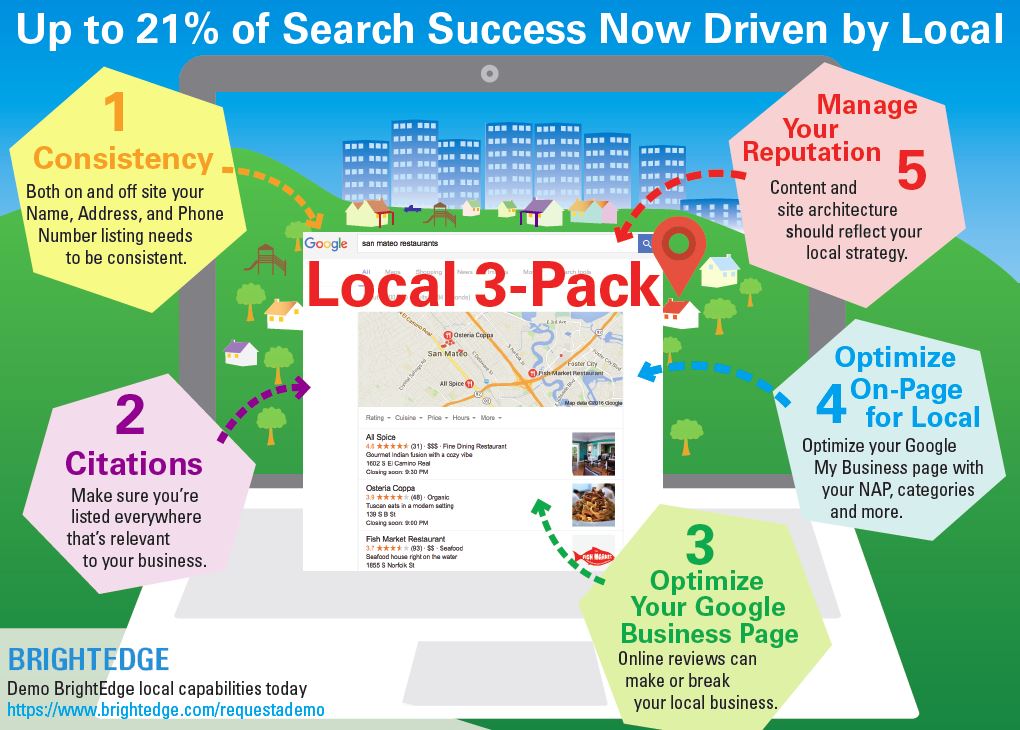
Consistency
Both on and off site, your Name/Address/Phone Number listing needs to be consistent. It’s worth spending the time to update anywhere your business might be located on the web to match exactly how you’re listed on your website.
Citations
Speaking of your business listings, check to make sure you’re listed everywhere that’s relevant to your business and seen as a quality site. Sites like Yelp, Foursquare, and of course:
Optimize your Google Business Page
Update and optimize your Google My Business page with your NAP, categories, keyword-targeted description, photos, and more.
Optimize on-page for local
Your content and site architecture should reflect your local search strategy. Make sure your city and neighborhood targets are present in your copy and metadata. Take advantage of Schema markup to boost this content.
Manage your reputation
Your online reviews can make or break your local business—and Google knows this too. Review signals are quickly climbing the ranks as part of the ever-changing local algorithm.
Do not neglect mobile
Remember that Google has found an estimated 94 percent of smartphone users have looked for local information. Make sure that your page is fully mobile compatible and that your content has been optimized for users on-the-go.
A local content strategy and citation building strategy should be ongoing. Make sure to start with your site foundation to create an optimized local template for copy and metadata. Don’t Overlook These Crucial Parts of Local SEO
Taking advantage of Google Business Pages
Most businesses know that claiming their Google Business page comprises step one of a successful local search strategy. Over the past few years, however, Google has also introduced a number of new features for the pages. These features offer opportunities to engage even further with prospective customers and attract attention to their pages.
Google Q&A
Prospective customers can ask questions of businesses right from the SERP. These questions appear on your local search listing when your business pops up. Many businesses fail to pay attention to these questions, which results in long lists of questions that appear on the page with no answer. Sometimes even worse, the answers that do appear come from other users and might not be helpful for the business or might even be detrimental.
Neglecting to answer your questions can detract from your efforts to demonstrate that you care about your customers. Remember also that the questions people submit, chances are other prospective customers want to know, too. Prioritizing answering these questions will improve your appearance on local listings and give customers a better understanding of how you can meet their needs.
See What’s In Store
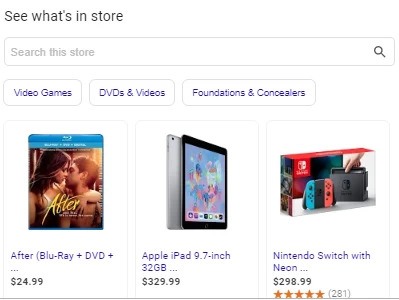
You have the option of allowing customers to see what is in your store, before they even step foot in your building or visit your ecommerce site. Those looking for a particular product will appreciate this opportunity to verify that you carry what they need before they go through the effort of going to your business. For customers deciding which store to use, your ability to provide with concrete evidence that you will meet their needs will encourage them to convert.
Google Business Posts
You can create temporary posts on your Google Business page that will allow you to notify customers about various important events, services, or listings right when it is most likely to have an impact. You can create posts directly from the Google My Business App. Posts do expire and the purpose is to highlight timely news or promotions. Google displays the posts to customers on your Google Business Page, so use them to give prospective customers one more reason to visit.
Reputation Management and Local SEO
Reviews are crucial to your local SEO strategy. Not only are they considered a ranking signal, but managing your reviews should be extremely important to you as a business owner. Why? Because it’s extremely important to your customers.
Earning favorable reviews on the top sites—Google My Business, Yelp—will help that first interaction that local searchers will see on their desktops or mobile phones and tablets. The process of getting reviews is tricky, and one that is monitored more and more by Google. Here are some key takeaways for reviews:
Whenever possible, acquire naturally
Speed and velocity of reviews are monitored—keep track of your requests and promotions to avoid an influx of reviews
Responding to negative reviews is easier than trying to remove them
You can get creative with asking your customers to post reviews, but you should always let them know where you’re listed and how to leave a review—especially in the case of a favorable sale or interaction.
The response to negative reviews can’t completely combat the effect of that negative review on a potential customer, but a smart and thoughtful response can negate some of the backlash.
In addition to reviews, social media is a great way to maintain your reputation for local SEO. Using and optimizing sites like Twitter and YouTube can help boost your local content and dominate your local SERP presence.
In recent years there's been a lot of discussion about personalized search and a personalized user experience on the web. A few years ago, search engines emphasized their efforts to create more personalized results on the SERP. Personalized search results attempted to connect the information you looked at before and how you interact with the platform to the query you just input, creating an improved and unique user experience.
Lately, however, there's been some pushback on personalized search. Customers began to voice concerns about how their info was stored and the amount of tracking that sites placed on them. If you're a search marketer, odds are you're familiar with the ritual of logging into an incognito browser window to run a Google search query so you can see the universal listing instead of the personalized one.
Recently Google announced it would be stepping back the extent of personalized search, focusing only on location of the user or the searches they made immediately prior to their current search. As a marketer, you want to understand what this means for the trend of personalization throughout the industry. Here is what we think everyone should know.
Why did Google step back from personalized search results?
Google’s Pandu Nayak explained Google’s rationale, saying, “A query a user comes with usually has so much context that the opportunity for personalization is just very limited.”
Generally, Google found that SERPs didn't offer much opportunity for effective personalized search. Their efforts did not do much for customers and did not improve the web results displayed.
In other words, Google discovered that while their ability to understand the likely intent of certain queries--and thus pair those queries with micro-moments--remains strong, their ability to interpret the individual desires of a particular user was ineffective. People enter queries influenced by a large number of factors which may or may not be connected to their past searches and/or other interactions with Google.
Keep in mind that you can often still find examples of personalized search with different Google products.
How this impacts marketers
Search marketers may find that this change makes it easier to track and measure optimization results. There'll be, theoretically, less overall variation in SERP layout between individual searchers, especially in the case of universal listing elements, like Quick Answers and Local 3-Pack. SERPs won't change as much from person to person, customization being limited to the nature of the search query.
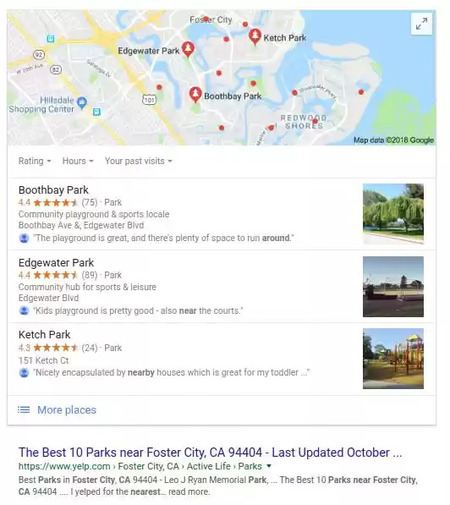
For example, the layout and types of content presented for personalized search will still adjust depending upon your vertical searches and efforts to create SERPs that conform to the likely micro-moment. Consider local searches. When a person makes a search with a likely “I-want-to-go” micro-moment, such as “parks near me,” Google focuses on the local 3-pack and score-based, UGC-driven review sites like Yelp.
This has the potential to help with personalized search optimization strategy. Brands can feel more confident that their listings will appear consistently when they achieve a high ranking on universal search results. That in turn will help them accurately measure their ability to interest and engage users. Measurements of the number of times their site will likely appear in organic listings, based on search volume, will be more accurate and can be better compared to their site traffic.
It is also important for marketers to note that this does not mean that personalized search overall is dead. The ability to customize content and be relevant to your users should still be a priority across multiple aspects of digital marketing.
Types of personalized search marketing that are still important
Personalizing for intent
Google will continue to display different SERPs depending upon their understood intent of the user. In other words, users searching for terms that align well with an “I-want-to-buy” micro-moment will see different types of results than those who have searches aligning with “I-want-to-go” micro-moments. This means that as you develop your content, you should also be keeping these different goals in mind.
To create content for the right micro-moment, you should spend time researching the likely user intent of your intended audience. Look at the current layout of the SERP for your target keyword and see where you should focus your efforts. You can read more about optimizing for the different micro-moments by reading the following BrightEdge blog posts:
Customers still like knowing that they matter to brands. They want to know that the businesses they buy from cares about helping them personally with their pain points and needs. Finding ways to personalize content on your site for return customers can be enormously beneficial. The individualized experience will boost your engagement rates while also letting customers know that you remember them.
You can personalize the content of known users by taking steps like these:
Suggesting purchases based on what the customer bought in the past
Offering tips and advice based on the purchases people have made
Making content suggestions based on the material they have downloaded from your site
Personalized email campaigns
Email allows you to speak directly to prospects and customers one-on-one, which makes it a prime vehicle to personalize your material. For email to successfully engage with prospects, it must be in alignment with their buyer persona and where they are on the buyer journey. A well-run email program will keep people engaged and encourage them to learn more about the brand and keep opening emails. This is an opening for you to continue to nurture them to progress through the sales funnel.
As the web continues to mature and grow with users and the development of new technology, experiments with personalization will continue. Customers want to reach their prospects directly and provide them with a user experience that encourages them to return.
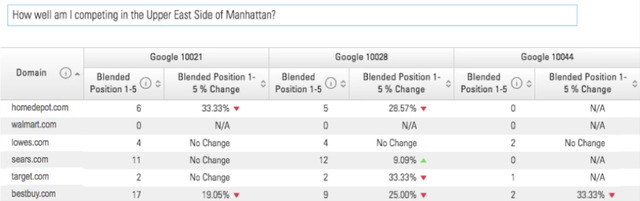
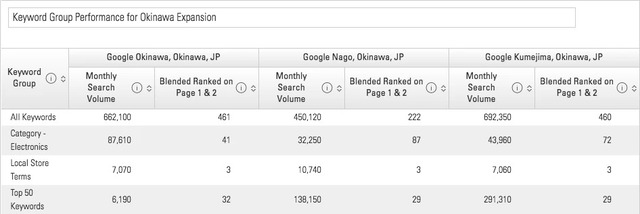
Enhanced HyperLocal capabilities allow digital marketers to understand demand and content performance for the locations that matter most to their business.
Digital experiences are now localized to the areas where searches are conducted
Google has taken the next step in providing the most relevant results to consumers – displaying different results pages for small geographical locations, even cities just miles apart, called hyperlocal.
With digital experiences varying according to location, you can get a skewed view of how your customers experience search locally if you confine your analysis of organic demand (search volume) and content performance (organic ranking) to a single location. You may fail to see the variances in search volume between a metropolitan area and a small nearby town. And using a single-location view of organic performance can hide the fluctuations in ranking across multiple geographies.
To prioritize SEO and content marketing investments effectively, it’s critical to have the clearest picture of how customers experience your brand in organic search results – where and when they are searching.
Marketers need a more granular view of demand and content performance with hyperlocal
HyperLocal capabilities within the BrightEdge platform now allow customers to understand how topics and content perform for searches conducted in every corner of the globe. Digital marketers can track demand and content performance for over 32,000 US and 36,000 non-US city search engines, or submit custom locations, for both desktop and mobile.
Accessing data at the most granular level is a best practice for effectively optimizing for organic performance. Here are a few instances where it makes sense to understand your brand’s digital performance down to the specific areas critical to business success:
To target customers for hyperlocal marketing
To drive customers to physical locations
To understand fluctuations in demand
To expand into new regions
1. When you are looking to target customers in a (hyperlocal) very specific location
Let’s say that you know geographically where your highest-converting customers are searching – for example a specific city or a neighborhood. While you care how you are turning up in search results in general, you care even more about how you are showing up (or not showing up) for the audiences in these highly targeted areas. By using our HyperLocal capabilities, you can now see how your content is displayed in SERPs for these specific locations.
You can also view trending of performance over time in a specific location.
By targeting the locations that matter to your business, you secure a more accurate understanding of how you are performing in search for the precise audiences you are targeting.
2. When you want to drive customers to one of your retail locations
Google research shows that 50% of consumers who conduct a local search on their smartphone visit a store within a day. With the increase in smartphone searches (which now make up more than half of total searches online), it is increasingly important to ensure that your brand is showing up for relevant topics in order to drive visitors to your brick-and-mortar locations.
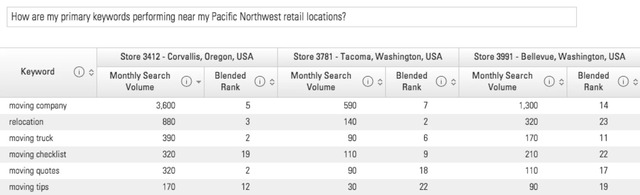
Using our HyperLocal capabilities, you can view performance for the local search engine closest to each storefront location.
With these insights, you can understand demand for specific topics, as well as how you rank for people searching in that immediate vicinity. You can choose to optimize for the areas and topics where you are falling behind in local search.
3. When you are trying to understand fluctuations in demand for your products or services
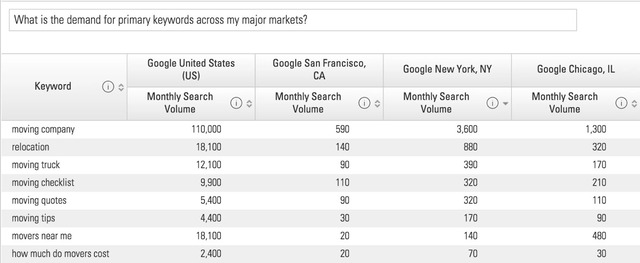
Consumer interests are incredibly regionalized. Something that is popular in one area can fail to capture the attention of consumers in another area. An aggregated search volume figure fails to show you how search volume for that topic can fluctuate across locations. With our HyperLocal capabilities, you can view search volume across the different locations that matter to your business.
Knowing this can help you allocate your marketing resources and create strategies to optimize for topics in the regions where demand is the greatest.
4. When you are looking to expand and want to compare differences in demand across regions
Similar to the use case described above, you want to understand nuances in demand for your product or services in different regions where you are aiming to expand – either domestically or internationally. There can be a drastic difference in search volume for the same topic in cities that are separated even by a few miles.
With access to the most granular search insights, you can compare demand across potential target regions and take a data-driven approach to selecting how you allocate resources as you grow your business.
Providing volume and granularity of search insights unmatched by other SEO platforms, BrightEdge is the only search and content solution that allows customers to understand how pages are performing in the specific locations that are most critical to their business success.
You can contact us to learn more about optimizing for content performance using our HyperLocal enhancements.
On 1/31 BrightEdge SVP of Marketing Kevin Bobowski and VP of Demand Generation Erik Newton hosted a webinar that generated a lot of interest from the BrightEdge community. You can view an on-demand version of the webinar.
We did not have time to answer all the questions, so we will address them in this blog post. The webinar topic was using customer journey analysis and micro-moments to approach and succeed in the Universal Content area of the Google SERPs.
The webinar explained the thought process and then went into detail on 4 micro-moments: I want to know, I want to go, I want to do, and I want to buy.
We combined a use case with a sample SERP, showed the BrightEdge reporting that gives insight, and then did several quick how-tos to help achieve those positions. We followed that with a review of competitive analysis and assessment.
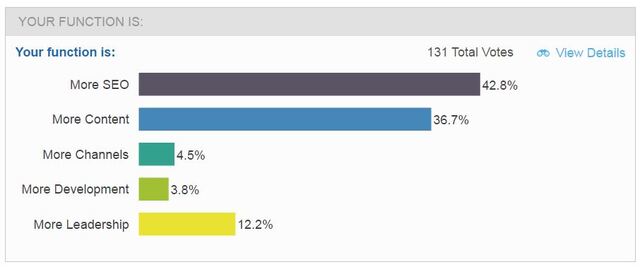
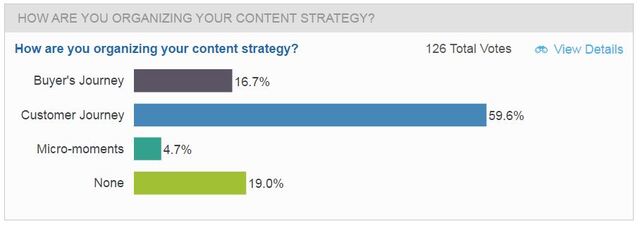
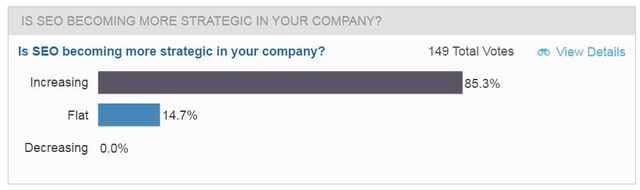
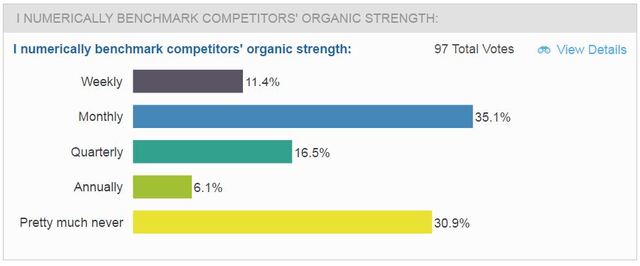
There were 6 live polls during the webinar, the results of one included below:
What is the best way to show revenue growth from SEO initiatives targeting Quick Answers?
The Quick Answer pages you rank for are likely to be specific and longtail style, meaning you will have a unique landing page for each topic. As you earn the Quick Answers, add them to a Page Group in BrightEdge Page Reporting to assess total traffic. Subtract the traffic to that page from before you had the Quick Answer and that will indicate the lift.
Go to BrightEdge Data Cube, type your URL, click on Content Strategies, select Quick Answers.
I see my competitors (personal injury law firms) listed in our local place listings as well as in other local searches in google, but they don't have a local office here at all. Why do they rank in so many local searches and page-one results of organic as well?
It is possible they are paying for the position in Local - look for the ad mark. It is also possible they have a shell office in your area and have done the footwork to register that location with Google My Business. As to why they rank well in general, I would have to guess that they are doing a decent job of content marketing, SEO, and generating backlinks.
What are the B2B stats regarding micro-moments? and Do you find the Local 3-Pack or the "I Want to Buy" or the Google Places queries are relevant for nationwide B2B firms?
This blog from Greg Sterling lists the data and the sources. While B2B data for Local and Places may be less relevant in B2B, the Quick Answers opportunity is highly relevant as customer journey analysis shows B2B buyers are doing extensive research online before even contacting providers.
Secondly, B2B buyers often use desktop for their queries, but peer-based reviews and recommendations or even social-targeted ads or account based marketing could cause them to make mobile queries. Younger generations are more mobile and sometimes entirely mobile, so micro-moments are an opportunity in all segments.
Do you have an example of good B2B content marketing?
Yes, there are many within the BrightEdge community. The asset types are: site, blog, white paper, research paper, e-book, case study, infographic, images, and audio. Take a look at the BrightEdge Resources Center for ideas.
How would a national or regional service provider compete with local providers?
If the national provider has local locations, the customer journey analysis says that you would optimize the location pages of the site aggressively. If it is an online national then I suggest content marketing to rank well generally and go for How-to as we showed in the Home Depot example in the presentation.
What if you're national with many local locations?
You will need to track and optimize each location separately to get those local store pages to rank.
What's a best practice for using real search queries for web or blog content?
Targeting demand is the best first step for content generation. Target high demand queries to "fish where the fish are". It increases your chance of generating traffic that impacts your business. This process is why more than 22,000 users love BrightEdge and the Data Cube.
Our web site is horrible. We sell nearly 100mm via Home Depot.com, Amazon, wayfair, etc. How can SEO up rankings inside those portals?
Well, congratulations on doing such great volume through your channel partners. Channel strategy and execution are always tricky. We are planning to cover shopping platform optimization in a future webinar, so watch for the webinar invites.
What kind of recommendations do you give for the existing content that is ranking - if you've done meta data/headline changes as well on-page?
If your meta data, H1 and H2 are tuned, then work on content depth and density. We are guiding to 1500 words and 2-4% keyword topic density. Then consider schema data. If that is on target then it is backlinks.
On the Share Insights Roadshow, we had audience members advocate for their cities.
The 4 cities we have announced are New York 5/8, Chicago 6/8, San Francisco 6/21, and London 10/5. We plan to add many more events across the US and internationally, so check back on the Share page.
Is there a suggested dashboard or report in BrightEdge that can display overall impact from applying some of these recommendations?
There is not a pre-formatted template, but the Data Cube is easy to view and from there you can save the reports to a dashboard. If you would like help with that, please let your CSM know. We will pass along your idea to the product management team.
I recently got access to BrightEdge. Do you have a webinar or recorded training for learning on how to use BrightEdge?
Yes, we do! Please contact your Customer Support or Onboarding Manager to view this.
What is AMP?
AMP is accelerated mobile pages, a markup defined and supported by Google to make content appear more quickly in mobile devices. Kirill Kronrod from Adobe sent all of us these links about AMP.
I would like to do a blog with BrightEdge on an AMP case study.
Great, customers are always welcome to propose and deploy blogs and case studies with us.
Is AMP just for news pages and local pages for now? Or do you see other possibilities?
Google is advocating for AMP strongly and has indicated it will become a factor in other types of content ranking. We believe the community should keep an eye on it by tracking AMP Preferred pages in BrightEdge and consider using BrightEdge Content to find and create content because it automatically creates AMP-enabled pages for our customers.
Thanks for the comprehensive presentation! Do you still consider Striking Distance terms, terms in positions 3-20?
Thanks for joining us. Yes, we think that is a good range because positions 3, 2, and 1 get disproportionate exposure and traffic, especially in mobile. Given the mobile-first push, we are recommending customers to track mobile and desktop separately as we are seeing different results on 73% of queries already and rising each month.
The care micro-moment is for the moment that a customer has the product and is using it. I think this is a really important.
Good point. At BrightEdge we see marketing as a vertical function across the whole customer lifecycle, and SEO plays a role all the way along. We focused on know, go, do, and buy in this webinar and could expand the micro-moments in a future webinar.
What else did Kevin buy at The Home Depot besides the dimmer switches?
I picked up light bulbs, grass seeds, and fertilizer with my 3 dimmer switches. Nice add-on sale from their successful I-want-do micro-moment how-to video.
Google Local optimization underlies a strong online strategy for any business with a physical presence or storefront. An estimated 73 percent of online activity relates to local. In other words, people regularly use the internet to find information about businesses and other places of interest around them.
What brands should pay even closer attention to, however, is the impact of these local searches on business. Customers look for local information throughout the buyer’s journey, and when they reach the conversion point, local searches are twice as likely as non-local searches to result in a purchase. In fact, an estimated 78 percent of local-mobile searches resulted in a purchase often within a few hours.
For brands to succeed on a local level, they need to prepare for their regional audience. Even if you regularly work with people well outside your geographic area, failing to optimize for the local users will hamper your reach, reputation, and business growth.
What is Google Local?
Google Local involves making your page more locally relevant for users looking for businesses or places of interest that are geographically near them. This refers to queries such as “SEO companies near me” or “pizza places open now”.
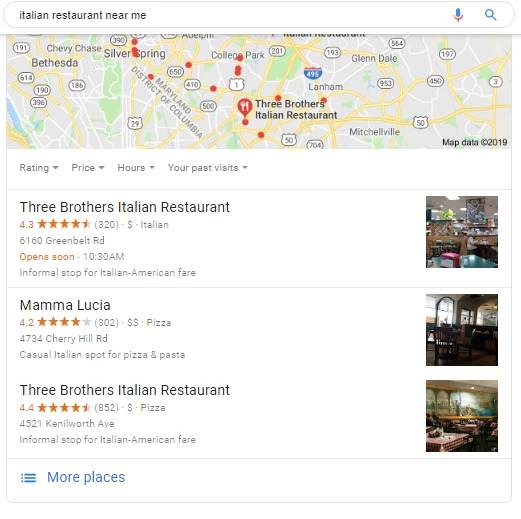
When people conduct local searches, Google will currently present to them three main businesses, which are featured on the local 3-pack. These three businesses are at the center of the page with their name, address, number of stars, and a photo, immediately drawing the eye. Underneath these results, users have the option of clicking to see more businesses or just scrolling through the organic results. The high-profile location of this 3-pack makes it particularly important for those who want to optimize their content for local search.
Optimizing your content for Google Local, therefore, means designing your site and your Google+ page to improve the frequency with which you appear in this 3-pack and the positive impression you make upon users who see it. As in all SEO efforts, high rank means awareness and traffic and an implied endorsement from Google.
How do I succeed with Google Local?
Pay attention to the NAP
The NAP refers to your name, address, and phone number. Google wants to see businesses that keep this information consistent across all websites and listings. When the NAP is consistent, the search engine can be confident that it is displaying the right information to users on the SERPs. Google wants to provide its users with an optimal user experience, and inaccurate information would confuse people and detract from this goal.
Every time your name, address, and phone number are written online, it can create a listing in other directories. Regularly monitor the web for mentions of your brand and reach out to sites to correct any incorrect information. If you find one that needs to be updated, look for the "Claim this business" or similar link to update and control the information,
You want to create your own listing on the various popular online directories, such as Yelp, to ensure that they receive the right information. Style the name of your brand always the same way, ensuring consistency with ‘and’ versus ‘&’, for example. When your NAP is consistent, it can influence the performance of your brand properties on Google Local by as much as 16 percent.
Fill out your Google+ business profile thoroughly and correctly
Google Local pulls from your Google+ business profile when creating your listing for the local 3-pack, so you want to make sure that you pay attention to how your brand is presented on the popular social media platform. Therefore, fill out your profile thoroughly and correctly. This means paying attention to the categories you select to ensure that they accurately reflect your type of business. Use keywords when describing your brand, including both your products and services as well as your location. One study found that using notable keywords, the right categories, and being located near where the person performs the search can impact your performance in Google Local by as much as 19.6 percent.
Attract reviews on Google
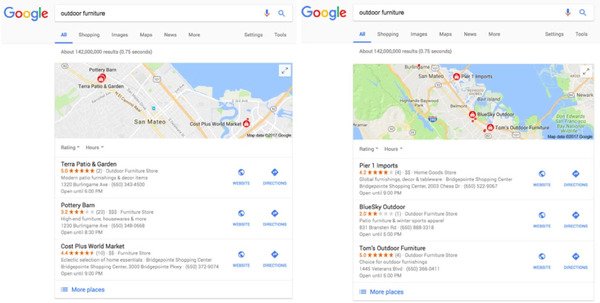
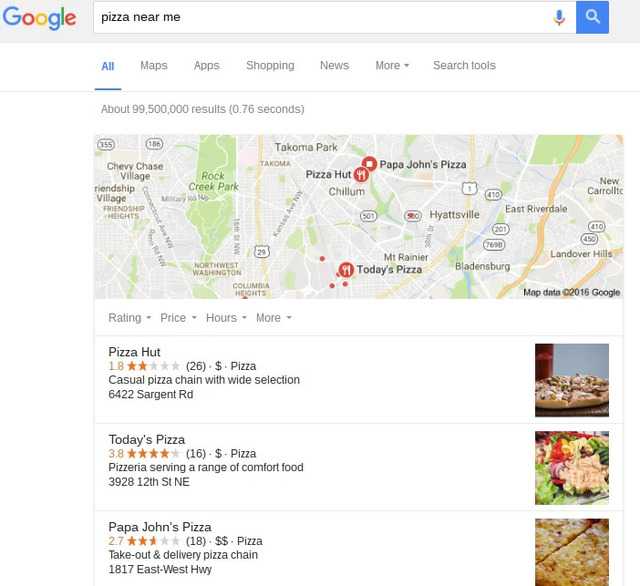
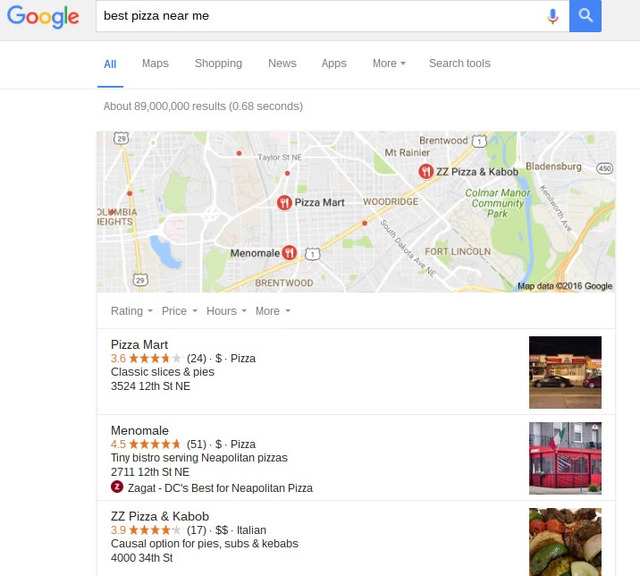
Reviews can be very influential on the results that you are listed for as well as the amount of attention your listing receives. As an example, here are the results from the query ‘pizza near me’.
Then here are the results, ‘best pizza near me’.
According to Nielsen, 92 percent say that they trust earned media, such as reviews from friends or family, more than all other forms of advertising. The reviews on your website might not be from someone that a particular user knows personally, but they do offer third-party validation of your brand and can help you lay the foundation for building a relationship of trust.
There are a few ways that you can encourage your customers to leave you these valuable reviews. Consider:
Letting customers know after they make a purchase, such as in a follow-up email, that reviews are appreciated.
Include links to your Google+ profile on your brand’s correspondence, such as emails and newsletters.
Invite people connected to you on Google+ through your circles to leave you reviews.
How BrightEdge can help with Google Local
As you begin to develop your optimization for Google Local, use a platform with the ability to help you throughout the process. BrightEdge has numerous capabilities for businesses interested in growing their local audience.
Content creation
The BrightEdge Data Cube will help you uncover local keywords that you can use throughout the optimization process. For example, your local keywords can be used to produce content that is geared towards your local audience. The keywords can also be used in your brand description on Google+ and your website. This will help you improve your relevance to your local audience, and appear higher on organic queries.
Creating local keyword groups
As you uncover the important local keywords that you want to optimize your site for, you can create a keyword group to use to track your progress. You can create charts that monitor the correlation between your local keywords and the brand’s growth and revenue.
Monitoring your appearance with Google Local searches
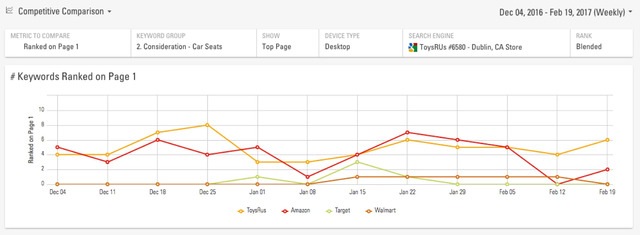
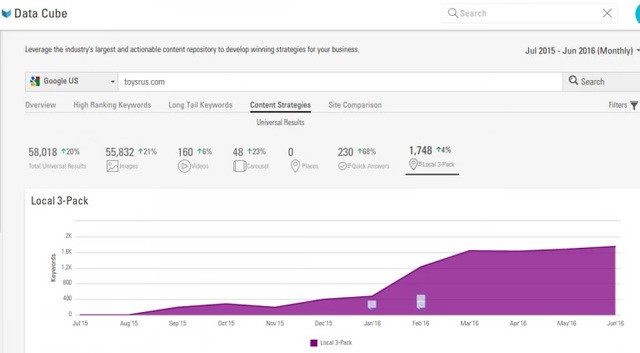
When you open the BrightEdge Data Cube, you can also perform a site analysis that will enable you to see how your site is performing in the universal search results. You can also narrow your data down to show just how you appear in local 3-packs. This will allow you to see your progress and the keywords for which you are successfully appearing in these local searches. You can then do the same for your competitors to gauge their progress as well.
Local search engine insight
BrightEdge also provides local SEO support for more than 100 cities throughout the US and around the globe. You can use these Google local tools to look directly at your search performance and that of your competitors in your targeted geographic area.
Google local is a powerful means of reaching out to the customers in the same area as you. Customers often like to do business with those in their region, so optimizing your page to meet these customers can help you grow your business and improve your reputation.
Introduced in 2014, the local three pack is a feature that occupies the top of the organic portion of the organic SERP, provides a map of the user's area, and provides address and contact information for three physical locations that might meet the needs of the user. It also provides review scores for each of the three listings. Here's what a typical local three pack looks like:
If a brand has physical locations this result drives traffic to physical locations as well as traffic to a website. If not, then keywords with this SERP feature need to be noted because significantly less traffic is going to make its way down to the traditional web listings. Now that we've covered what the local three pack is and what it is useful for let's dive into the world of micro-moments.
The "I Want To Go" Micro-Moment
Google has come on strong lately with the micro-moments concept. They believe that users have very specific motivations that brands can understand and help to answer. In response, Google is trying to provide content which is focused on providing a simple answer to the user's need. The micro-moment of interest to us is "I want to go." This moment represents a user who has intent to physically go to a location. They may be interested in a web page in order to find information about the location or to make an order prior to going there, but at the end of the day their goal is to go somewhere and do something. Since micro-moments are strongly associated with mobile search, "I want to go" is a very powerful example since a user can expect to not only look up a location to go to, but can actually be directed to that location.
Tying the Local Three Pack to "I Want To Go"
With a good understanding of the major components of the situation, let's look at the connection between the two. Google has the most sophisticated relevance engine in the world, especially since the introduction of RankBrain - the objective of which is to identify the content that will be best able to meet the quickly diversifying and evolving needs of their users. This helps them by driving additional searches and usage through their search engine. The result is profitable because it drives more market share and more ad revenue for Google. The interesting point here is that Google's algorithm is not only attempting to find the the best content for the user, it is also trying to provide content in the correct format for the user's consumption. The combination of the two factors provides the best possible experience for the user. In the case of "I want to go" micro-moments this means presenting the user with a local three pack full of relevant physical locations. This is the most efficient way to present the user with content to meet their needs. It also allows them to take action by linking directly to Google Maps for directions or turn-by-turn navigation.
Relating Back to SEO
Knowing how Google provides relevant content and appropriate types of results informs how marketers can benefit. The idea is to understand the micro-moment that you are dealing with in each situation. This will allow you to build the correct content to serve the user and be ranked by the search engine. To execute, group keywords together which have local three packs. Do so with the understanding that those keywords represent the "I want to go" micro-moment. Once that has been established then when you build or optimize content to earn traffic from a specific keyword, you will have a great indication as to what type of content to build for that keyword. Also, once you have built or optimized content for these keywords, your next objective is to get those pieces of content ranking in the local three pack.
Applying This Concept to Other Result Types
Can transfer this concept to other micro-moments. The simple answer is yes, you can. In order to do so, identify another type of content or universal category which Google has paired up with keywords representing another micro-moment. Once you have that, you can follow the same process of identifying keywords and taking the action that was outlined above.
In the long-term, this is a very strong way to organize your content creation and optimization effort, since it aligns with Google and helps to define what you need to build for any given keyword.
Scaling for Enterprise
The process of grouping, optimizing, and measuring results is fairly straightforward. The problem you may run into is trying to do this at a large scale, when the process of manually managing all of this becomes a huge hassle. BrightEdge can help with this. As the global leader in enterprise SEO, we are uniquely positioned to support you and make this process simpler and smoother. You can leverage the power of Keyword Reporting and Universal Results to identify which keywords have universal presence and where you are currently ranking. Once you have done that, you can track the impact of your optimizations on your bottom line by looking at traffic, conversions, and revenue performance using Page Reporting. Lastly, you can report on progress at scale by using StoryBuilder to create all the visualizations that you need and schedule them for delivery to your stakeholders.
As search becomes increasingly local, SEO strategies and technologies that do not address local could miss out on a large opportunity - with a shortfall of upwards of 30%.
In this case study you will learn effective tips for local SEO, including:
Gaining visibility on current performance
Registering your local business with search engines
Establishing a strong presence on online local communities





 More recently, it’s become vital for a business without a storefront to define its service radius. It has also become more difficult for brick-and-mortar businesses to target cities too far outside their physical address.