SERP Rankings Are More Important Now For The Buyer's Journey

koleary
koleary
M Posted 5 years 7 months ago
t 9 min read

Update: This blog has been updated with 2020 data and information.

The buyer’s journey used to be a simple circular route from Awareness to Consideration to Purchase and (hopefully) back around again. Digital has transformed the buyer’s journey into a complex maze of multiple touchpoints and increased the potential for crossed wires.

With 4.57 billion people using the internet in July 2020 alone, the buyer’s journey now begins and, for many industries, ends in the digital landscape. 87% of consumers begin their journey digitally. This is a huge percentage jump since 71% in 2018. By focusing your attention on how your brand appears in search results, you can reduce the overwhelming nature of the modern buyer’s journey, and make sure you are targeting the right content to the right audience at each moment in their journey to minimize poor bounce rates.

Naturally, you're going to want your content to rank above competitors. If prospects have discovered pain points and begin searching for solutions to them, this is your opportunity - right at the initial stages - to grab your prospects attention. If your content isn't optimized to rank well, prospects are finding your competitors resources at the beginning stages of their journey and therefore not finding yours.

What buyers discover in searches along their journey

A simple Google search has become complicated. Buyers no longer get the same results with the same search terms. Instead, each individual’s buyer’s journey is personalized based on the type of intent, device, location, time of day and any other past search history.

The layout of the search engine results page (SERP) is also up for grabs. There are now 50 different SERP elements and an infinite number of combinations where Google is understanding the intent of each search to present the most relevant and helpful information during the buyer’s journey.

For example, if the user asks a question during a micro-moment search, Google might prioritize a Quick Answer, the highlighted section that appears at the top of the SERP whenever a user asks an information seeking question, like “How to…” or “What is…”. Or when a location seems like the most appropriate result, the buyer will see a Local 3-Pack view showing nearby businesses who offer what they’re looking for.

The four micro-moments of the customer journey

Micro-moments are when users leverage their devices to search for solutions with the intent to do something whether they're looking to do something, see something, buy something and more. You'll need to know the different moments as they're a crucial part of the customer journey and aid you in being there for prospects during these moments when they're looking to reach you via content. The four micro-moments include the following:

  1. I want to know. During this type of search, users will search for a topic without a specific business in mind. Simply put, users are looking for their questions to be answered at this stage.
  2. I want to go. Here, users are looking to go somewhere. This can include a vacation destination, a local business or any other physical place a user is looking to go to.
  3. I want to do. At this stage, users are looking to learn to do something. During COVID-19, search engines saw a huge jump in searches for baking bread and at-home workouts. These are two examples that fall under "I want to do" moments.
  4. I want to buy. At this moment, users are looking to purchase. Queries including "near me" or an actual product like "65" smart TV" indicate users are looking to solve their pain point with a purchase.

Buyers are expecting the straight-forward answers they're looking for

All of this has transformed the buyer. They now expect to see only the most relevant search results linking to dynamic content that reflects where they are in their journey. If your brand is still reciting the same stock answers, you’re missing out, especially as millennials – now “the world’s most powerful consumers” – are more loyal to brands that provide a personalized approach.

When the majority of every buyer’s journey starts with search, you need to ensure buyers see signs for your brand on that first results page. Here are three ways to ensure you earn their attention.

  1. Know the queries users are searching for 

New York sports center Aviator Sports created a new webpage to promote its figure skating rink and classes. When it didn’t generate the anticipated traffic, the company used BrightEdge’s deep learning SEO technology to analyze the relevant keyword landscape. This revealed that while “figure skating” is the widely-accepted term in the sports world, regular people typically search for “ice skating.” By optimizing this term on their webpage, Aviator boosted its potential search volume by more than five times.

Don't assume that buyers use the same language as you. It’s critical to establish which relevant terms people actually search for the most. You should also explore which terms your competitors are ranking for and find out if there are any important categories where your brand does not rank.

Using Instant, you can easily discover real-time insights into the relevant queries users are searching for. You can also use Data Cube to locate the terms where your brand ranks and what language is used. You can also quickly compare your domain to any competitor to see what terms they rank for in the first page of search results that you are not.

Not only will you need to know which keywords you're ranking for, not ranking for, and which your competitors are ranking for, but you'll also want to find the searches that are most relevant to your prospects when solving their pain points. You can do a search for the queries you want to appear for. Look at what Quick Answers and People Also Ask results appear and ask yourself if your content is answering those questions consumers are looking for.

Demo Instant For Real-Time Search Results
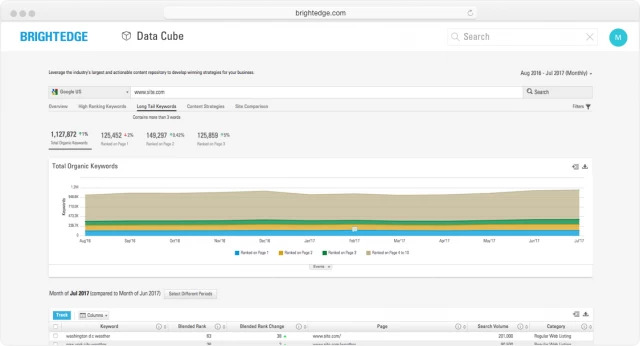
A chart of analyzing keyword trends in Data Cube - BrightEdge

  1. Create unique content for different search types

When cosmetics brand Kiehl’s noticed that lots of people were searching for advice on using skincare products, it produced content to specifically answer the most common questions. As a result, the brand saw a 30% increase in its Quick Answer ranking. Are your prospects downloading resources from your site? Are they checking out blog content or watching videos? Discover the content your prospects are looking at on your site and create more of it for every step in their buyer's journey to help them move along.

Words used in a search are often an indicator of where a buyer is on their journey and you need to create relevant content for each type:

  • “How”/“What” – The buyer starts their journey by searching for information about a category. This is your opportunity to become a Quick Answer and produce interesting category content.
  • “Reviews”/“Best” – The buyer is interested and now considering their options. Help them by creating brand comparison content and promoting your good reviews and case studies.
  • “Buy”/“Order”/“Download”/brand term – The buyer is ready to make a purchase. Close the deal by showing them product pages and ensuring your brand features on Google Images and in the Local 3-Pack.

Using BrightEdge Keyword Reporting, you can easily organize and strategize on all of the terms where your brand is ranking on informational, consideration, or purchase terms. Keyword Reporting will also help you identify which terms have universal rankings, such as a Local 3-pack or Quick Answer, to help you optimize your pages for the right intent to secure those prized search spots.
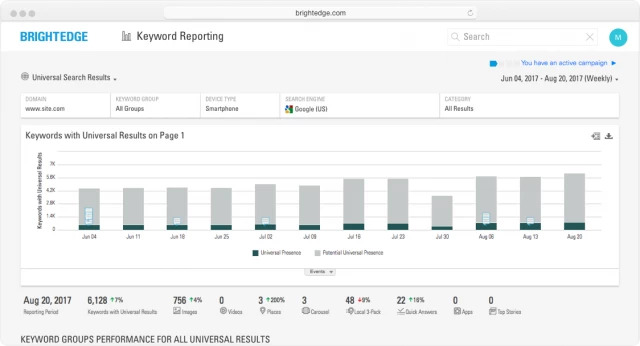
Show Keyword Reporting to identify universal listings - BrightEdge

  1. Optimize your content to rank for different search types

Digital Media Publisher targeting athletes Stack.com discovered 120 keywords initially and narrowed down their target list to focus only on terms with the highest organic potential. The brand then created targeted content for this subset, which increased site visits by 61%.

Once you understand the intent of each targeted keyword, you can maximize your organic effort by grouping keywords into three categories:

  • Defend – terms whose high ranking you need to maintain
  • Optimize – terms where you can achieve a higher ranking with some minor tweaks
  • Create – terms you are not ranking for and need to boost with new content

Leveraging BrightEdge’s Visual Parser, the Intent Signal dashboard template will automatically do this analysis and categorization for you. Or consult Insights, which automatically scans your site for pages with errors that affect ranking or those where additional content like an image or Quick Answer might boost results.
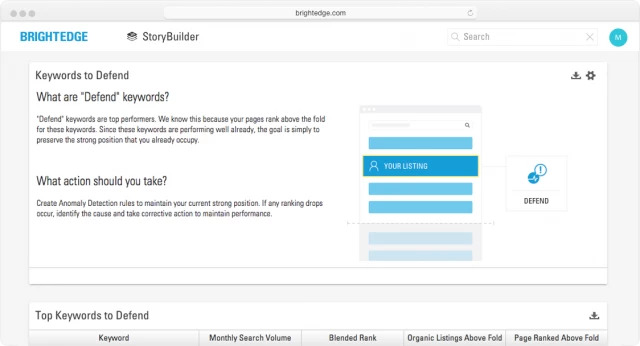
How to build a dashboard in StoryBuilder - BrightEdge

Adjust your strategy if your content isn't resonating with buyers

In order to understand whether your content is resonating with prospects, you'll want to measure and track your data. You can use Data Cube and Page Reporting to understand how your pages are ranking and for which keywords they appear in the SERPs. BrightEdge integrates with Google Analytics, therefore you can uncover all the necessary data to alter your strategy or keep it the same.

By keeping track of conversions, you'll be able to uncover whether or not your pages are working for users. If you notice a page isn't converting well, investigate the content and decide next steps. Why aren't prospects converting? If there isn't a CTA, add one and track whether or not conversions increase. If your page offers a CTA but it's not converting well, consider your options whether repositioning the CTA, choosing a more relevant one, etc. 

Keep pace with technology

The world’s leading search engine never sits still, therefore the buyer’s journey will continue to change. Using a leading industry technology like BrightEdge will give you the ability to automate these processes and it is how the best SEO marketers keep pace for SEO reports. With all the tools you need to stay on the same path as your buyers, BrightEdge will keep you two steps ahead.


Customer Journey Maps: What you need to know

ksoosOLD
ksoosOLD
M Posted 6 years 8 months ago
t 9 min read

The customer journey today has become an increasingly personal path. Consumers have the power to research their own pain points and potential solutions themselves. Brands who want to understand how customers progress need to have a guide, and that is the role of the content journey maps.brightedge customer journey maps, personalization and importance of mobile strategies

Modern buyers appreciate personalization. Nearly a third of consumers report that they wish their shopping experiences were more personalized than they already are. To provide this personalized experience, however, brands need to have a better understanding of what customers want to see at each stage -- they need to know who their buyers are and what they experience the closer they get to making a purchase.

The importance of consumer journey maps has risen in response. Here is what our community should understand how this strategy and the process of designing one for your organization.

Understanding the importance of customer journey mapping

The value of customer journey maps lie in their ability to help everyone throughout the organization understand how prospective customers go from leads to customers. Journey maps force organizations to dive in depth into this path, giving them greater insight and a better idea of what prospective customers want to see at each journey maps stage as they get closer to making a purchase.

Customer journey maps explore questions related to what customers want to know at each stage. It allows the marketing and sales team to know the types of inquiries they will receive and the types of content they should produce. Journey maps also help the brand understand how customers feel, which offers greater insight into the type of interaction they want to have. Brands will find it significantly easier to create customer-first experiences armed with this information.

Perhaps even more importantly, these customer journey maps can be used across departments and throughout the organization. Everyone at the business will find it easier to remain on the same page regarding customer expectations and wants. When a new lead lands on the sales team’s desk, for example, they will have a far greater understanding of the process and emotions this individual went through during the early journey maps stage of their purchase process, helping them to create a more tailored experience for the prospect now.

The journey maps improvement in the customer experience will also help the business better identify potential holes in the customer experience. They will find it easier to identify gaps that might hurt their ability to coax new leads through the journey towards conversion.

Similarly, all of the departments can work together to ensure that a person going through this journey encounters the right user experience at each journey maps stage. People will provide better service. For example, those who work in UX will better understand what brings new visitors to the site, what they feel, and what they want to see. This will improve their ability to create a highly-effective website.

Getting started with customer journey mappingbrightedge customer journey maps personas

Now that the importance of customer journey maps have become clear, let’s explore how to create an effective map that will improve your ability to engage with your customers.

Review your customer personas

You likely have already built customer personas for the rest of your marketing efforts. If you have not, this should be your first priority of starting your journey maps. Explore the core questions about your customers that let you see why they choose your brand and what pain points they want to solve. Ask questions such as:

  • What brought you to our site?
  • What problem did you want to solve?
  • What motivated you to buy with us over our competitors?
  • How helpful were our sales representatives? How could they have been more helpful?

These personas will give you ideas about the people you want to bring into your buyer’s journey and thus help you understand what they need and want to see from your organization.

Research how customers move through your journey maps

Now you want to analyze how your existing customers have gone through your buyer’s journey. You want to gain a better handle on the path they took, including the touch points they engaged with, how quickly or slowly they went from their first interaction towards a purchase, and what motivated them along the way.

brighetdge customer journey maps

Begin by looking at your website data. You should be able to gain a good idea of where your customers originated, such as whether they came from the SERP, a paid ad, social media, or a direct visit. You may use the StoryBuilder feature in BrightEdge to help you easily visualize this important information.

At this stage of your journey maps, you also want to see how customers behave on the site. Look at the rate of new and return visitors as well as how long customers spend on the page and the bounce rate.

In addition to your internal site data, take your inquiry outside your site to sources such as social media. Look at customer engagement rates on these channels and what they most likely want to see as they engage with your brand. At this journey maps stage, consider the questions they ask and the information they seem the most interested in obtaining.

The information you gather from this journey maps data should then be combined with interviews and anecdotes from customers to ensure you have a firm picture of customer behavior. For example, make sure that your bounce rate is not low because customers have trouble navigating your site and they have to jump around to multiple pages to find important information.

Ask your customers questions such as:

  • Did you have trouble finding important information on our website?
  • Did you need to speak with our customer support teams at all? Were they able to help?
  • What objections did you need to overcome to purchase from us? Can we do anything to help more with this process?
  • What were the most useful types of content and engagement you received from us during your buying process?
  • How did you feel at each stage of the buyer’s journey? How did we help? How could we help more?

List your important touch points

List out all of the different important touch points you have with customers throughout the buying process. Do not neglect any of the channels where customers might engage with you. In this stage of your journey maps, think about website, email marketing, social media, and conversational touch points that your customers progress through as they get closer to making a purchase.

You want to map out when customers will likely reach these touch points, so you know what stages of the buyer’s journey they will likely embody. When mapping out the touch points, consider both your interviews and conversations with your customers as well as research into consumer behavior to make the best projections for when touch points will be reached.

As you map out the touch points, also include how customers felt during the different stages of your journey maps. Record their likely questions and emotions that you want to address as they progress. Align their questions and feelings to the content you expect them to consume.

Watch customers move through your journey maps

Now that you have built your customer journey map, you need to test your ideas to see how well it aligns with the actual experience of your customers. 

When a new lead lands on your site, use journey maps to note their persona and the path they take. Compare their engagement with touch points and how they interact with your brand to your expectations. 

Watch for evidence of the lead stalling throughout the process. See how well your organization meets the needs of the customer as they progress through the journey. Once this customer converts, speak with them about their experience during the buyer’s journey and ask about any unexpected events-- such as delays in progression-- and see if you can make adjustments to better assist the buyer.

Analyze and adjust your journey maps

Now that you have your customer journey maps, along with evidence as to your maps’ accuracy, see if any adjustments need to be made. If customers do not follow the path you outlined, adjust your path or your strategy to better align them. Take into account what customers quoted as presenting problems for them and make changes to your marketing and sales process to better accommodate these needs.

Your customer journey maps will guide your organization as you work to improve your customer engagement. As you better understand how customers move through their journey as well as the questions, emotions, and obstacles they encounter along the way, your business will find it easier to nurture leads and produce the sales and marketing engagement they want to see using journey maps.

Discover how to rank well in Google's SERPs after you've mastered your customer experience and journey mapping.

Building Omni-Channel Marketing Campaigns | BrightEdge

gregalbuto
gregalbuto
M Posted 6 years 8 months ago
t 9 min read

Today’s digital world offers a number of different platforms for engaging with customers. Each one has a particular audience it reaches most effectively, targeting different populations and people at different stages of the buyer’s journey. Marketers must understand how the different platforms interact, how they line up with different touch-points, and where they can find their target audience at different stages of their journey towards conversion. 

An estimated 71 percent of customers say that they want a consistent experience across all channels where they interact with brands, but less than a quarter report actually receiving it during their buyer's journey. Brands that understand how to use cross-channel marketing will have the chance to capture the attention of these potential customers and demonstrate their commitment to the customer experience. Organizations must understand how to optimize their use of the different marketing channels during the buyer's journey so that these customers receive a consistent user experience.

As marketers begin to develop their buyer's journey digital marketing strategy, it is important for them to have an omni-channel approach. It is not enough to simply market to customers on different platforms. You do not want to run simultaneous campaigns through different channels. Instead, organizations should focus on having a consistent experience for customers regardless of where they interact with the brand. All the channels should work together to bring customers through the buyer’s journey across different touch-points on different platforms.

Here is what we wanted to share with our community about running integrated campaigns to enhance the buyer's journey sales funnel.

Understand the different types of digital marketing

Before we dive into building a firm understanding of running these omni-channel campaigns, let’s first explore the role that these different channels play in multi-channel marketing.

brightedge drives customers through the buyers journey through omni-channel marketing campaigns

What is SEO and content marketing?

SEO and content marketing describe the material you use to attract people through the SERPs. You optimize this material with keywords, topics, and promotion to help Google find the material and then to encourage the search engines to rank it highly on the SERP. You can utilize the BrightEdge Data Cube to drive your keyword research efforts. Using Data Cube before or during your SEO strategy will help you to create the content your audience wants to read. Decide which keywords to use before you spend time writing content or after you write it to revise and optimize existing content for new keywords. Your SEO strategy using Data Cube can increase organic traffic, results, leads, etc. Check out how Graco Inc. did it!

With content marketing and SEO, you need to have a firm understanding of keyword research to identify topics of interest for your target audience throughout the buyer's journey. You also must produce quality writing, video, and images to attract users and search engines. Website metrics will help you monitor your success with this material.

What is social media marketing?

Social media marketing involves engaging with prospective customers through the various social media platforms, including Facebook, LinkedIn, and Twitter. When running campaigns on these platforms throughout the buyer's journey, you might run promotions, promote content you think followers will appreciate, and inspire conversations to keep people engaged with your brand. The goal here lies in regularly producing high-value content. Discover how SEO and social media power together to create a strong bond with this BrightEdge POV.

What is email marketing?

Email marketing uses registration pages to capture the contact information for site visitors. This contact information can then be used to create segmented email lists. Brands that maximize their potential here during the buyer's journey understand how to send material that will interest their site visitors, encouraging them to engage more with the brand and continue to move through the sales funnel.

What is mobile marketing?brightedge drives the buyers journey through targeted mobile strategies

Mobile marketing involves understanding how to use these different channels throughout the buyer's journey and maximize your ability to engage with users accessing them through mobile devices. According to BrightEdge Research, nearly 2/3 of Americans are smartphone owners and 57 percent of searches are performed on mobile devices.

BrightEdge offers a mobile option for discovery. While you add and track keywords in BrightEdge Keyword Reporting, you can easily navigate through different device types including desktop, tablet, and smartphone in order to collect data on how your keywords and pages are doing by device. Knowing how to appeal to people on-the-go will enhance a brands’ ability to remain relevant.

What is paid marketing?

Paid marketing, also known as PPC, includes the ads you can post on several different platforms, including the Google SERPs themselves, social media platforms, and even on other, ad-friendly, websites. Success at this point in the buyer's journey involves knowing the keywords that correspond with the visitors who are most likely to find your content calendar helpful or finding contextually or behaviorally aligned sites on which to place your ads.

Before you decide to spend your budget on paid advertising, it is a good idea to do plenty of research to make sure you're getting the most for your money. By using BrightEdge Instant, you can see real-time results with real-time research to determine whether or not a keyword is worth paying to promote. 

What other channels should brands consider?

In addition to these central digital channels, many organizations also find it helpful to remember other traditional advertising areas, including radio and TV ads and in-store promotions. Although these channels function quite differently from digital options, ensuring that they remain consistent with digital marketing efforts will engage and advance customers at a better rate.

Understand the common platforms that influence customers throughout the funnel

To build effective omni-channel campaigns, you need to now take these different channels and bring them together. Understand the channels and touchpoints potential customers will most likely encounter as they move through your buyer’s journey. Some of this information will be customized to your precise customers, but here is a good starting point based on where most brands find their customers at various phases in the buyer’s journey.

Channels for the Awareness Stage

During the awareness stage of the buyer's journey, customers are looking for information about their pain points and potential solutions. Thus, they perform a lot of searches, building the importance of SEO and content marketing. Content production should also include videos and webinars as alternative ways to engage potential customers and interest them in the brand.

Complementing your SEO and content production efforts should be PPC campaigns, which will run for similar core topics as the content marketing and SEO efforts. Use PPC throughout the buyer's journey to attract attention to important keywords that your material does not yet rank for.

Similarly, during the buyer's journey, email can keep customers engaged and learning about your potential solution for their pain point.

Channels for the Evaluation Stage

During the evaluation stage of the buyer's journey, customers have narrowed down their options and seriously consider your brand as a potential solution to their pain point. Continue to demonstrate your expertise and ability to help with content on your website, webinars, and ebooks. This material will help them dive deeply into the solutions you offer during this step of the buyer's journey. Before launching a webinar, get your basic approach to creating a successful one with this BrightEdge checklist.

Social media will also play an increasing role here, as prospects turn to the platforms to engage directly with your brand and gauge your ability to help them.

Customers may also reach a stage of the buyer's journey where they want to see quality demos that allow them to see first-hand how you will help them. 

Channels for the Purchase Stagebrightedge drives the buyers journey, purchase stage

During the purchase stage, customers continue to engage with the content you produce and use the search engines to learn more about the product or service they have purchased. They want to make sure they get the best value possible. 

Events you host and meetings you can offer your customers during this period can also help keep them engaged with the company and be happy with their purchase. This sets the stage for repeat customers. 

Channels for the Usage Stage

While customers use your product or service, you want to make sure that what they have purchased solves their pain points and continues to benefit them. Your email list will provide value here as you can regularly send customers articles to help them maximize their usage of your product.

You can also continue to produce content that customers at this stage of the buyer's journey find helpful, such as FAQ pages and case studies, helping them to see how others have seen great results with your brand.

Channels for the Repurchase Stage

During the repurchase phase of the buyer's journey, you need to convince people who have purchased from you before that they want to purchase from you again. Creating content that once again demonstrates your superiority over the competition can help. Email messages that help customers learn more about getting the most out of their purchase and also remind them of the successes they have already seen will help at this stage of the buyer's journey. 

Channels for the Advocacy Stage

Once you have already convinced a customer to buy from you again, now you want to turn them into an advocate. Customers willing to speak highly of you to other prospects can be a powerful source of persuasion. Encouraging them to help you produce content, such as case studies or even writing reviews can benefit your organization. Use email, social media, and events to remain closely connected to these repeat customers. 

Bringing your different channels together

Now that you understand how these different channels typically interact throughout the buyer’s journey, let’s review how to bring the platforms together to create an omni-channel approach that nurtures customers through each stage of the funnel.

Understand buyer personas

To create a successful campaign across these channels, you must understand your buyer personas. Know what these customers want to see and the pain point they want to solve. The better you understand where the prospect is coming from, the easier it will be to produce content tailored to their unique needs. 

brightedge drives the buyers journey, funnelYou will also be better equipped to coax them through the sales funnel. You will find it easier to find the customers across the different channels, and you will know what they want to see as they get closer to conversion.


Create a common campaign

With your understanding of your customer personas and your use of different platforms, work with specialists across the different platforms within your company to create common campaigns. Your campaigns should follow the customers' buyer’s journey and work to coax them from one touchpoint to the next. The campaign should create a consistent user experience and operate with well-aligned goals.

Know how your different platforms and channels work together throughout the buyer's journey. For example, your PPC strategy will drive traffic, while your site content should then take that traffic and build engagement and the number of people who register for email lists. 

Measure progress

As you create your integrated campaigns, carefully measure your progress for each step of the buyer's journey. Your selected KPIs should explore how well your campaign brings people from one stage of the buyer's journey to the next. For example, measure top-of-the-funnel channels by looking at new visitors and engagement. As you move into the mid-funnel, gauge your return visitors, their engagement, and their rate of mid-funnel conversions.

Looking at all your channels and platforms together as a part of a single customer engagement picture will give you a better understanding of how your different strategies can work together to bring in new customers.

Building omni-channel campaigns throughout the buyer's journey will allow you to take your marketing strategy to the next level. You will improve your ability to engage with customers as they move throughout the digital atmosphere. Bring your channels together and help them function together as one and see how you can improve your own customer engagement ability for a repeated buyer's journey.

SEO for Social Media: How to Use Them Together to Drive Leads

enewton@brightedge.com
M Posted 6 years 10 months ago
t 9 min read

SEO for social media can play a powerful role in building a brand’s online presence. Although the links from social media are typically no-follow, they can benefit brands throughout the buyer’s journey in a variety of ways. With two billion users across the various platforms worldwide, the potential for engaging prospective customers is significant.

Namely, social media platforms can help build reputation and awareness, which are key to top-of-the-funnel engagement and can help with SEO indicators. The platforms can also help brands control their appearance on the SERP for branded searches. This benefits them at the mid-funnel and end-of-funnel stages. Finally, social media drives traffic back to the company’s site, which benefits engagement and SEO metrics throughout the sales funnel. 

Here is how you can use your SEO for social media strategy to build expertise in SEO and drive engagement and conversions throughout your sales funnel. 

SEO for social media at the top of the funnel

Your focus at the beginning of the buyer’s journey is on building brand awareness and recognition. Customers during this phase remain most interested in educating themselves on their pain points and potential solutions. Therefore, their searches revolve around educational queries such as ‘how-to’ pieces.

Social benefits SEO through topic generation

Use SEO for social media to uncover common topics and questions people have about your industry and your product. Look for the conversations that pop up among your prospective customers and use these topics to guide some of the pieces you develop. As you create this important content, you can then promote to your prospects through social media, driving traffic and recognition for your brand.

This method of topic research also makes it easy to find emerging trends and popular topics. Creating content for these talking points will help you get out in front of the competition, which in turn will help you achieve high rankings on the SERP.

Social benefits SEO through building brand interest

You can also use SEO for social media to build a strong brand following by regularly posting and tweeting. Using the platforms often will increase the recognition your brand receives and encourages people to follow you.

Try to post to your platforms several times a day, but be aware that different platforms move at different rates. Twitter for example, requires more regular posting than LinkedIn. If this seems burdensome, there are various apps that you can load with multiple days of post that will automatically send out the tweet at the designated day and time. 

You can also use WordPress plugins and tools to connect your blog to your Twitter account and automatically send a tweet whenever you publish a new blog post. 

In addition to promoting new content, you can also use the platforms to regularly share your evergreen content. This can increase your positive social signals for these pieces and increase the traffic to the pages receive. High traffic and engagement rates will in turn improve your SEO for social media and SEO reports.

To build interest in your account, post about interesting trends within your industry. Stay on top of news and engage with your customers about topics of interest for them. Do not be afraid to post articles that come from other sources if you think they would provide value for your followers.

Social media is not an advertising platform, it is a water cooler where customers want to converse and find interesting information. You want to engage personally with customers and demonstrate that you have their best interests in mind. Building engagement for your account will in turn build the prospect list you can send to your site through interesting content and increase your overall authority on the web.

Actively engage with others through your account as well. Follow other companies and influencers and interact with their tweets and posts. Use popular hashtags and converse about topics that others are interested in. Use hashtags for major conferences and industry events to build your community.

As you create your posts, also remember to use images, as Facebook posts with images receive 2.3 times the amount of engagement. Customers are visually driven and tend to appreciate visual posts more than plain text.

Social media and the appearance of the SERP

At this stage of the funnel, you also do not want to neglect the important impact SEO for social media can have on the SERP itself. Know the type of queries that Google pulls posts from Twitter and YouTube onto the SERP. Optimizing content for these types of queries will increase your chances of having a tweet or video featured. This would boost your appearance as an industry expert. 

Remember that Google has recently made changes to limit the number of times a particular domain appears on the SERP, so these types of universal results can offer great opportunities to build your online presence.

SEO for Social Media for the mid-funnel

When customers reach the mid-way point of the buyer’s journey, they begin to consider their options for resolving their pain points. During this stage, they tend to make more branded searches. They want to see what sets you apart from the competition and why your solution deserves their consideration.

Social media and branding on the SERP

Social media, including Twitter, can play an important role here. When prospective customers do a Google search of a major brand like Macy’s, for example, you’ll notice on the front page of the SERP, Macy’s Twitter stream pops up under the website information. This tweet carousel takes up vertical space on the results page and pushes down any potentially negative information while increasing brand visibility.

Optimizing your brand’s Twitter feed, therefore, by conscientiously tweeting about important trends and thought leadership ideas can also influence the impression you make through branded searches. Maintain a strong presence on this platform to take full advantage of this impact.

Social media and mid-funnel content topics

You can also continue to use SEO for social media to let you know what customers search for during the mid-funnel stages. Customers at this stage of the buyer’s journey often want to compare you to the competition, so look for insight about keywords people use for comparison purposes, the types of comparisons people want to see, and what the favorable reviews say about you in comparison to others in your industry. When you understand why existing customers prefer you to the competition, it becomes easier to create content that emphasizes these points.

Throughout your strategy, continue to use SEO for social media to promote content that clearly sets you apart from the crowd. Demonstrate thought leadership, promote case studies that articulate the incredible results people have seen, and otherwise help prospective customers understand what makes you different.

SEO for Social Media at the bottom of the funnel

As customers get close to conversion at the end of the buyer’s journey, use social media to emphasize the personal side of your business. Nurture personal relationships with your prospective customers. Answer their questions through the social media channels and encourage them to engage directly with the sales team.

You can also use social media to promote common bottom-of-funnel content, such as local demonstrations and coupons. Drive traffic back to your site, along with conversions, by promoting posts letting customers know the purchase bonuses available to them. 

SEO for social media will empower you to drive traffic and engagement to these important deals. Increasing their visibility will boost SEO and help persuade potential customers.

Social media can be a powerful driver for organizations interested in building their SERP and marketing touches throughout the buyer’s journey. Consider how social platforms can boost engagement and optimization efforts throughout the stages of the journey and how it can be used to build leads and encourage conversions moving forward.

brightedge request a demo banner

Understanding Attribution Models: When to Use Multi-Touch Attribution

enewton@brightedge.com
M Posted 7 years 1 month ago
t 9 min read

As we discussed in the first article in this series, customer journeys have become increasingly complex. This can make it challenging for brands to know precisely how customers interact with their organizations before they decide to make a purchase. The models we already discussed dealt with single-touch attributions - the model only attributed the income and ROI generated from a new customer to a single point on the buyer’s cycle. With customers hitting so many touch points before making a purchase, however, the inefficiency of these systems versus a multi-touch attribution model is clear.

Knowing which multi-touch attribution models bring in the best quality leads, as we learn from the first-touch attribution model, is helpful. Similarly, knowing the end-of-funnel strategies that encourage those conversions will help, but you will still not get the full picture. You don't know where people were nurtured and what convinced them to end up engaging them with the brand in the first place. You will not give enough credit to the top-of-funnel activities.

Multi-touch attribution models can help brands to better document the entire customer journey. They are designed to better articulate how customers found the brand, moved through the customer journey, and ended up making a purchase. Multi-touch attribution models are designed to document which type of touches customers interacted with throughout the organization as they moved closer to conversion.

Keep in mind that no attribution model will be perfect, including multi-touch attribution, and that they instead focus on providing an average value of how the different types of marketing strategies perform. To help you make the best decision for your group, here are a few of the most popular multi-touch attribution models that you can adopt for your organization.

Linear attribution

A linear attribution model is one type of multi-touch attribution model that divides the credit for a particular conversion evenly across all of the customer’s touch points. If a customer found a brand through organic search and signed up for an email list, followed an email link to engage again, clicked on PPC when product searching and then made a purchase, the organic search, email marketing, and PPC would all receive an equal division of revenue from the conversion that resulted from this lead.

This model can benefit many brands because they will find it easier to understand all the checkpoints that should receive credit for finding and nurturing the lead. This will help them develop strategies moving forward.

multi-touch attribution photo of hands piecing together an attribution puzzle - brightedge

Contrary to multi-touch attribution, this model does fall short in its ability to clearly demonstrate which strategies and promotions had more of an impact than others. For example, if your email campaign does little to generate conversions but does get clicked on by existing leads, then it will receive the same amount of credit as another strategy that had better success persuading leads to make a purchase. When used in conjunction with first- or last-touch attribution models, however, brands will come away with a good idea of their customer journeys and the strategies that give them the most success.

Time-decay Attribution

A time decay attribution model attempts to make up for the shortcomings of the linear attribution model by assigning increasing value to each touch point as the customer moves through the journey. In other words, the first touch will receive the least, a PPC ad that brings them back to the site gets little more, an email campaign that brings them back again a little more, and a white paper download that directly precedes their conversion receives the most.

This multi-touch attribution model does give credit to all the touch points in the buyer's journey, but it can minimize the top-of-funnel efforts. Similar to the last-touch attribution model, it can make it hard for organizations to properly understand how well their awareness efforts to bring in new prospects perform.

Since it does assign increasing credit to all of the touch points, however, it can be a great way to understand how well your bottom-of-the-funnel nurturing performs. You will clearly see what brings customers on the verge of converting to the tipping point and how they interact with the site through the final touch points before a conversion. This can help you refine your ability to nurture customers through these last stages.

U-Shaped Attribution

The U-shaped attribution model understands that the first and last touch points on the buyer’s journey hold particular significance. One introduced the prospect to the brand and started to show them how your company can meet their pain points. The last touch point lets brands see what finally convinced the prospect to convert.

This model also takes into account the importance of the funnel as a whole, noting the importance for organizations to understand how prospects interact with the site and brand throughout their buyer’s journey.

multi-touch attribution visualization of conversion funnel - brightedge

To accomplish this, the U-shaped model assigns 40% of the credit to the first and last touches and divides the remaining 20% among the touch points in between. This does give brands a more balanced idea of how their customers interact with the organization and how well the top and bottom of their funnel performs. Of course, brands can also customize this, or any, model if they find it does not best represent their objectives. For example, you can decrease the credit given to the first and last touch credit in the U-shaped model and offer more credit to the touches in the middle if you really want to measure your funnel performance.

How Do I Know Which Attribution Model to Use?

There is no clear right or wrong answer when it comes to using attribution models. Brands need to think carefully about what they want to measure, such as the strength of their awareness efforts or the power of their brand. They also need to think about how their typical customer progresses through their buyer’s journey. An organization with a quick buyer’s journey may perform better with a one-touch attribution model, while one with a longer process and a greater importance placed on the touch points in between will need a multi-touch attribution model to best understand their customers. Consider how these different methods and their measurements align with your objectives when making a selection.

Measuring attribution plays a critical role in how you will plan your future marketing strategies and present your ROI to decision makers. Understanding the benefits and drawbacks of multi-touch attribution and the other models covered in these last two posts will help you make the selection that fits your business best.

Multi-touch attribution - see a demo of what's new in the BrightEdge platform

Understanding Attribution Models: One-Touch vs. Last Touch

enewton@brightedge.com
M Posted 7 years 1 month ago
t 9 min read

In marketing, understanding the ROI of various strategies and advertising efforts is essential. With the sheer number of channels available, brands must carefully rank what works most effectively with their target customers. The better they understand the places where they best engage their users, the easier it will be to properly allocate resources and bring in more leads and customers.

The problem that many brands encounter when trying to measure the success of their different methods is the increasing complexity of the buyer’s journey. Customers today generally interact with brands in multiple ways before they end up buying. For example, they might land on a site organically, download a white paper, click through emails, engage with PPC, attend a webinar, and then finally end up making a purchase.

When a customer goes through a path this convoluted, it can be a challenged to determine what deserves credit for this customer and revenue.  Should it be the organic efforts since they initially introduced the customer to the brand? The webinar for finally convincing them to convert? Brands want to make their estimation as accurately as possible as a wrong measurement might end up drawing funds and resources away from effective means of engagement and overly investing in methods that did not have as much of an impact.

To solve this problem, marketers have developed several different types of attribution models. Each one emphasizes slightly different points in the buyer's cycle, allowing brands to pick the one that makes the most sense for them and their brand.

EKeep in mind that no attribution model will provide a perfect picture and the importance of different methods and strategies likely differs from customer to customer. The point of the attribution models is to provide a quality estimation and summary that brands can use in their reporting and when planning new strategies.

This post and this companion one will explore the different types of attribution models, helping our community determine the one that will work best for them. In this post, we will discuss the main forms of one-touch attribution models and when they can be useful.

First-touch attribution models

First-touch attribution models focus on the touch that first introduced the new customer to the brand. For example, in the example offered previously, with the customer that found the brand organically, then clicked on email links, and then watched the webinar before converting, only the organic search will receive credit for the customer and the revenue generated.

This model works on the assumption that the strategy that first brought the customer to the brand delivered the most value, and thus deserves the credit. This strategy can be a good one for brands that want to see how well their outreach, top-of-funnel efforts generate profitable prospects. It does not, however, give any insight into how well prospects are nurtured when going through the funnel.

The first-touch attribution model will likely be most helpful for brands that have a short buying cycle. For example, some types of ecommerce stores that have customers who tend to buy quickly and not spend too much time researching or engaging before buying will may find this helpful.

Brands might also find it helpful to use this model if they need to build a case for the ROI for their top-of-funnel activities. For example, if your organic team needs to create a presentation for brand leaders or shareholders and you want to show the strong value of SEO, demonstrating the value of your awareness efforts will bolster the points you make.

Last-touch attribution models

Last-touch attribution models work opposite to the first-touch model. This model measures only the last touch a customer had with the brand before they end up converting. The idea behind this attribution method is that the last channel a customer interacted with is the one that convinced them to convert and should thus receive credit.

Since this attribution model focuses on the last interaction a customer had before they purchased, it is a good means of measuring the end-of-funnel activities. On the other hand, you will not receive any insight regarding what first made the customer aware of the brand or how they were nurtured throughout the funnel before they ended up converting.

brightedge explains the differences between attribution models

This is a conservative approach and emphasizes the importance of the brand. Many organizations do find it helpful to know what ended up giving people the final push to convert, and this does help shape their strategies moving forward.

This attribution model also ends up being the simplest to measure and implement. This makes it a good starting point for brands that have not done much marketing tracking the past.

In addition to the standard last touch attribution models, which looks at the very last interaction people have with the organization before they buy, there is one key variation: the last non-direct touch.

What is a last non-direct click: a variation of the last-touch attribution model?

The last non-direct touch follows a similar format to the last direct touch, but it eliminates any touches that originate with the customer going directly to the website. In other words, if the last interaction the customer has with the brand involves them typing in your company’s web address and navigating directly to the site, this touch will not be counted. This system operates on the assumption that if your customer already knows your web address, all the hard work of attracting them and nurturing them has already been completed. Tracking this touch does not give much insight into how people learned about your brand, and therefore does not provide much information that can be used to build a strategy moving forward.

The last non-direct touch attribution model, therefore, offers much of the simplicity of the last touch model, while eliminating at least one of its shortcomings. It therefore offers greater insight than the standard model.

Which attribution model is right for your business?

Identifying the best attribution model can help brands better understand how their revenue has been generated and what they need to know to build a better strategy moving forward. Consider how these two models might serve your organization, and read our next post where we will explore the other major attribution models to help you make the best decision for your organization.

See a demo of what's new in the BrightEdge platform

Future of SEO and Content Marketing Survey

More than 250 marketing leaders confirm the need to converge SEO and content marketing practices

Future of SEO and Content Marketing Survey

More than 250 marketing leaders confirm the need to converge SEO and content marketing practices

The post-mobile world is here and it is providing marketers with new challenges for delivering results and meeting customer expectations. By 2020, over 50% of all consumers expect to use AI and voice-activated technology in their daily lives. Today, 30% of all mobile searches have location-intent, while 5G mobile speeds are predicted to further transform mobile search in the next three years.

A new survey released by BrightEdge, the leader in enterprise SEO and content performance marketing, reveals that marketers believe in a future ruled by the likes of Alexa, Artificial Intelligence (AI), voice search, and the Internet of Things (IoT). Yet, most in-house marketers and agency practitioners have done little to introduce these powerful components into their content marketing strategy.

BrightEdge surveyed 252 digital marketers at Fortune 500 brands that represent a split of B2B and B2C companies over a one-month period in April and May of 2017. The survey sought to understand how marketers are preparing for the accelerating consumer adoption of AI, voice search, and local search over the next year.

Download the full survey for the results of over 250 marketing leader’s opinions on the future of marketing and SEO.

CAPTCHA
Solve this simple math problem and enter the result. E.g. for 1+3, enter 4.
This question is for testing whether or not you are a human visitor and to prevent automated spam submissions.

Lou Malnati's Pizzeria Values Integrated BrightEdge Service

Kerri Phillips uses BrightEdge platform to target Awareness phase of Lou Malnati's customer journey

Understanding the Customer Journey's Micro-Moment | BrightEdge

A BrightEdger
A BrightEdger
M Posted 9 years 3 months ago
t 9 min read

Understanding the micro-moment has become the cornerstone to the modern customer journey. For marketers to accurately reach their consumers, they must be able to interpret these moments and anticipate what visitors want to see.

For marketers to optimize their marketing and sales process, they need to track how people move through the sales funnel. The greater the insight they have into this process, the easier it is to gauge how well they reach their customers. They also gain a better understanding of the decision-making process that their customers go through before they make a purchase.

As the customer journey becomes disrupted we need understanding the micro-moment - brightedge

In the past, this journey used to be linear and relatively straightforward. People followed a predictable step-by-step process that allowed marketers to measure their success at each stage and therefore understand their weaknesses and strengths. This has changed, however.

The customer journey has splintered and it has become increasingly difficult to understand what triggers purchases. Even though digital marketing is no longer a new industry, it remains challenging for many -- even seasoned marketers -- to understand what triggers a lead or sale and understanding the micro-moment.

Instead, marketers must look at a variety of metrics to try and find certain behavior patterns, such as ads that bring in more engaged traffic or keywords that attract more people interested in making an actual purchase. It has become clear to those in the industry that the customer journey no longer follows a straight path. It is now a series of fragmented moments that do not always occur in a predictable order or timetable.

This is the result of the transforming way that customers interact with brands online. They now control these interactions. They can reach out to brands directly, easily share their opinions and reviews with others through social media, and they can investigate a plethora of options to solve their problem with just a few searches on the computer.

For brands to meet the needs of these customers, they must be willing to use cross-channel marketing that empowers them to build bonds with customers no matter the device they use and where they are on the customer journey. Understanding the micro-moment will enhance brands' strategies and result in greater returns for brands -- US retailers see a 16 percent increase in search ad conversions when they use cross-device data. Here is what brands need to know about putting this strategy to work for them.

Understanding the micro-moment

To build a successful marketing strategy and reach consumers on this modern customer journey, understanding the micro-moment is important. These high-intent touch points occur when customers have an immediate need that they want addressed.

Google has been increasingly encouraging brands in understanding the micro-moment and taking them into account throughout their marketing strategies. A paper the company released stated that nearly a third of smartphone users switched to another site or app because the original one did not meet their needs.

More than half of smartphone users have also made purchases from brands other than their intended company because of the usefulness, or lack thereof, of the information provided. These micro-moments also impact purchases made offline.

An estimated 87 percent of customers do research before entering a store. As a result, the information people access during micro-moments on their devices impact where they shop and what they buy. The ability of brands to serve customers during their micro-moments impacts the bottom line.

Marketing to customers in the micro-moment across multiple devices

Brands that want to succeed with understanding the micro-moment must also know the types of content that are most likely to attract consumers throughout the various touch points.

Google has divided micro-moments into four main categories:

  • I-want-to-go moment
  • I-want-to-know moment
  • I-want-to-do moment
  • I-want-to-buy moment

1. The I-want-to-go moment. During this particular micro-moment, customers are interested in going to a particular place. Content that provides them with information about how to get to the desired location, such as maps, addresses, and other location-specific information will be the most helpful.

2. The I-want-to-know moment. Customers in this micro-moment are more interested in information than making a purchase just yet. They want to find content that helps provide them with insight and suggestions. These customers are not interested in finding a sales page, they want blog posts, videos, or other types of helpful content that provides them with the information they need.

3. The I-want-to-do moment. Customers interested in the I-want-to-do moment  have a particular task in mind that they want to accomplish, and they want to see content that guides them. This could include material such as how-to videos, instructional blog posts and images, recipes, or similar content that helps the visitor achieve their goal.

4. The I-want-to-buy moment. During this particular micro-moment people prepare to make a purchase. They want to hear about deals or coupons, options to buy their desired items online quickly, and any information that would be helpful to them as they finalize their purchase decision.

For brands to effectively market to people across the new buyer’s journey, they need to create the content that their target personas will appreciate throughout the different micro-moments. This requires creating a variety of different types of material that addresses the different micro-moments and the unique needs that people have. Think about how each of these touch points relate to your customers and what they might look for at each moment.

5 steps to successful marketing in 2017

  • Identify the keywords that interest your customers
  • Align content to the micro-moments
  • Create content that addresses the needs of your targeted customers
  • Measure your progress
  • Continue to refine and improve your strategy

1. Identify the keywords that interest your customers. You need to look at consumer patterns on your website, do competitive analysis, and monitor trends within your industry to gain a better understanding of what customers want to read.

2. Align content to the micro-moments. Once you have identified your keywords, determine the micro-moments that these terms most closely align with and the types of content needed to address people in those moments. Remember that Google is heavily invested in the micro-moment and thus works to tailor the SERPs to the micro-moment of the customer.

Looking at the types of content that appear most prominently on the SERP for a particular term or phrase will provide you with insight into the user’s likely intent. The BrightEdge platform also provides you with clear intent signal functions to help you understand the micro-moment you must cater to with a particular keyword.

3. Create content that addresses the needs of your targeted customers. Create a variety of types of material so that you offer clear value for people across the variety of touch points. Also make sure that your content is ready for users regardless of the device they use to access it. This means employing mobile-optimization best practices.

4. Measure your progress. As you develop and publish your content, you want to carefully track how that material performs. Look at engagement metrics to see how well people find your content and how much they interact with it. Look at its impact on your conversions and revenue.

5. Continue to refine and improve your strategy so that it becomes more effective and efficient. Use the insights from your measurements as well as regular competitive analyses and trend monitoring to continue to improve your marketing strategy for the micro-moments along your modern buyer’s journey.

Marketers need to be able to track how people progress towards conversion on their websites. Since this journey has been fragmented, however, it has become significantly more challenging.

Understanding the micro-moment has become critical for brands so they can impact their ideal personas, and create content that maximizes the use of these touch points. This will be your key to successful SEO in 2017.

request a demo

Today’s Customer Journey is like “Choose Your Own Adventure” Books

A BrightEdger
A BrightEdger
M Posted 9 years 5 months ago
t 9 min read

Forrester describes the customer journey as “[spanning] a variety of touchpoints by which the customer moves from awareness to engagement and purchase.” Typically represented in the form of a customer journey map, it is implied to be linear and sequential.

In truth, with the increasing reliance on digital and mobile today, the customer journey is splintered and does not follow a logical, straight path. Instead, the customer journey is really more of a network of quests for information. Altimeter Group says that it is now "[fractured] into hundreds of new ‘micro’ touchpoints where customers seek real-time, mobile-optimized content, reviews, shared experiences and direction online.” Google calls them “micro-moments” and says that “when added together, they ultimately determine how that journey ends.”

This change -- from straight path to meandering, multi-directional journey -- is reminiscent of the “Choose Your Own Adventure” children’s books that were popular during the 1980s and 1990s. Instead of a set story, these books gave the reader the option to choose the next event within the storyline -- resulting in a number of possible outcomes. Admittedly, a Google search on this topic revealed that others have also noticed the connection between content marketing, the customer journey and this children’s book series. However, beyond just a kitschy metaphor, there are takeaways that digital marketers should consider and strategies that should be employed -- to effectively connect with customers throughout this new customer journey framework and to win over customers during these critical touchpoints.

1) The journey is self-driven

As indicated in the name, books within the “Choose Your Own Adventure” series gave the power of the narrative to the reader. Every few pages, the reader was presented with a choice and each successive decision led to a different outcome. The same is true in the customer journey. Customers are no longer sitting back and passively consuming the outbound messaging that happens to make it their way. Instead, customers are actively researching and educating themselves on the best options throughout the decision-making process. Consider these facts about the digital behavior of customers:

  • Search engines are the 3rd most popular way that customers learn about new products. Almost half (47%) of customers use a search engine when engaged in product discovery.
  • This rings true for B2B customers as well: 74 percent of business buyers conduct more than half of their research online before making an offline purchase.

What this means for digital marketers Today’s customers are empowered to actively seek out information throughout their unique customer journeys. This makes it imperative for marketers to understand what troubles, plagues, interests and inspires customers and to deliver the right content during each touchpoint. With Google processing more than 2 trillion searches each year, search is your strongest and most direct source of information about your customers’ interests and needs. Organic search is your market-wide voice of the customer -- conveying critical information on what your customers care about at scale. Only by researching customer demand are marketers able to deliver the digital experiences that customers are seeking and to win the moments that matter.

2) There are twists and turns, and unpredictable outcomes

In the “Choose Your Own Adventure” books, each decision point sent you in a new direction, resulting in serpentine plotlines and upwards of 40 possible endings. The customer journey is equally complex. Customers now access a multitude of information to discover, compare, evaluate (and re-evaluate), and ultimately make their decision. In an interview for The Huffington Post, Matt Lawson, Google Director of Performance Ads Marketing, stated, "...[When] we see customers start on this journey, there’s typically a domino effect of new opportunities and greater insights that appear." 

Just when it seems that the story is set, the customer journey can take a rapid and unexpected detour. Google research revealed that 65 percent of smartphone users look for the most relevant information, regardless of the company providing it, when conducting a search on their smartphones.

This means that the battle to engage customers is never-ending and can be won by any brand that provides the most compelling, helpful and relevant content during these moments that matter.

Additionally, 82 percent of smartphone users consult their phones while in a store. And one in 10 of these customers ended up purchasing a different product than they had originally planned. That’s an ending that no one saw coming!

What this means for digital marketers

Marketers must ensure that their content is available and accessible at every step of the overall journey. There’s a saying: “It ain’t over ‘til the fat lady sings.” In today’s customer journey, it ain’t over ‘til the customer clicks “Confirm purchase” on their smartphone, signs the credit card receipt at the register, or until the business buyer puts their signature on the contract.

The customer journey is no longer a series of compartmentalized states of being -- with diminishing influence further down the funnel. Instead, digital marketers must acknowledge the opportunity that exists throughout the network of digital touchpoints. They must ensure a strong organic presence, providing customers with thoughtful and informative content throughout the customer journey, to influence customers towards a desired outcome.

3) Every moment matters

The books were able to maintain twists and turns in plotlines because each chapter ended in a question and required that the reader make a decision before proceeding to the next part. As such, each of these points was an important pivot in the overall storyline. The decision made at each and every one of these touchpoints influenced the direction of the voyage.

The same is true for today’s customer journey. From a company’s product pages to online reviews to social media influencers and user generated content to ecommerce sites (and back and forth again), customers consult multiple sources and types of content in making a decision. And each of these touchpoints is critical in influencing the customer and contributing to the momentum as they continue along their path to purchase.

Consider the impact of reviews on the customer journey. More than half (54%) of customers said that they read online reviews before making an online purchase. Or consider the impact of providing information and knowledge in driving customers from I-want-to-know to I-want-to-buy micro-moments. Outdoor products retailer REI created informative online buying guides to help customers understand how to best select the right outdoor products, including backpacks.

This I-want-to-know content had incredible impact on conversions, resulting in 60 percent of content consumers purchasing backpack products.

What this means for digital marketers

The takeaway for marketers is precisely as it is written above: every moment matters. The most successful digital marketers ensure that the right content reaches the right audiences at every phase of the customer journey. Taking a data-driven approach, digital marketers understand customer needs and interests, create the content that addresses these demands and positions their brand as the best solution, and ensures that this content can be easily found and accessed during the more than 2 trillion times that customers seek out insights and guidance on search engines every year.

If customers are the protagonists in their adventures, then your content can be thought of as a digital sherpa guiding them every step of the way. As they approach each touchpoint, ensure that your content is there and that it is helpful and useful in that moment. Create compelling digital experiences matched to each decision point to influence customers as they venture along and to drive them towards your “ending.” 

request a demo

,