To access on-demand videos please provide your name and email
(We respect privacy. Your personal information will not be shared with any outside parties.)
Please fill out the above form to access your on demand videos.
On-Demand General Session Keynote and Fireside Chat Spark: AI Innovation in SEO and Digital Marketing
Learn from BrightEdge CEO and founder Jim Yu's decade of AI expertise to navigate the rapidly evolving AI landscape with confidence. He shares how BrightEdge's ongoing innovations and exclusive insights can be used with practice takeaways and tactics to win in this rapidly evolving industry. BrightEdge CTO Lemuel Park leads a fireside chat with industry experts Steven Gross, Chief Marketing Officer at University of Phoenix, and Rohit Prabhakar, Chief Digital Officer, sharing opinions and knowledge on AI, search, digital marketing, customer intent, and more! Hear the AI success stories from Elizabeth Smolinski of Tombras, Merry Touch of Gap Inc., and Jonathan Obar and Kwame Shorter of American Dental Association, sharing how AI enabled marketing strategy execution and secured great business results.
On-Demand Certification AI Search for Content Strategies
AI's transformative impact on search engines has changed the industry's approach to digital marketing. It has reshaped the foundational principles of SEO and expanding the horizons of content discovery and consumption. Join BrightEdge for this groundbreaking AI-Search certification, as we share steps for AI performance and learn how you can future-proof your career by taking action on these new challenges, turning them into opportunities for success in AI!
On-Demand Certification AI Search for Technical Strategies AI continues to change many aspects of our world, but started with search! And BrightEdge has been at the forefront of these changes and providing knowledge and insights as to the impact on search and digital marketing, and importantly, to the impact on necessary changes to both content and technical aspects of digital marketing, SEO and AI. Backed by the credibility of BrightEdge—the world's largest enterprise SEO platform—this groundbreaking AI-Search certification can future-proof your career in these transformative times.
Get the playbook for optimizing your website for AI search
Learn how to audit your current digital footprint for AI readiness
Gain exclusive insights into the latest AI search trends
October and November AI Overview Trends: What They Mean for Holiday Campaigns
With Black Friday and Cyber Monday around the corner, we’re really looking forward to seeing how AI performs! Our BrightEdge Generative Parser™ has been tracking October and November’s shifts, shedding light on how marketers can prepare for the critical shopping period ahead.
Our most recent report offers insights into how Google AI Overviews are changing. For all the detailed data points and visualizations referenced in this post, here’s our full October/November trends report.
Key developments you need to know about:
1. YouTube Citations Stabilize After a Surge
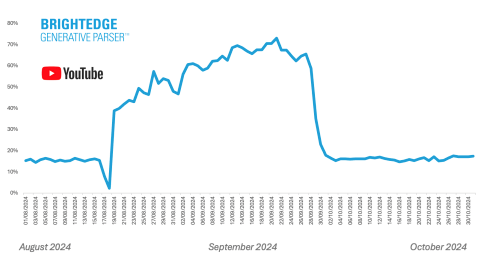
After a massive spike in September, YouTube citations in AIOs have stabilized at 115-120% above their August baseline. What’s especially compelling is that AI isn’t just referencing video descriptions—it’s citing spoken content within videos. This makes YouTube a must-focus platform for brands.
What to do: Think unboxing videos, in-depth product reviews, and how-to guides that resonate with holiday shoppers. Use Data Cube X to see how your YouTube Channels are cited in AI
Overviews to get a sense of where your videos could drive AI referrals and what your opportunities are.
2. Travel AIOs Surge by 700%
Travel-related AIOs saw a remarkable 700% increase from September to October. The focus is shifting from broad destination queries to localized, activity-specific searches like “things to do in Uptown Charlotte” or “fall festivals in the Midwest.”
What to do: If you are in the travel industry, think about creating content that helps users plan for things to do when they travel this holiday season. Cover lesser-known destinations and local holiday events to capture this growing demand.
3. Healthcare and Education Are Leading in Stability
Healthcare AIOs maintained the highest coverage at 73-75% of keywords, while education queries shifted toward more specific and complex topics like certification requirements and career pathways.
What to do: For healthcare and education brands, focus on creating structured, well-researched content. These spaces may require regulatory approval to publish content, which can take time, but the stability in these industries suggest time is on your side.
4. E-commerce AIOs Are Evolving
E-commerce AIO presence decreased by 15% in October but stabilized at a lower level. However, the AIOs that do appear are getting more detailed, with richer product comparisons and specifications.
What to do: Optimize your product content for depth. Include clear benefits, detailed specifications, and comparisons to stand out in the remaining e-commerce AIOs. Our data suggests AIO’s job in ecommerce is to help the top of funnel while the regular results drive the bottom of the funnel. You should plan your content citation strategies accordingly.
What This Means for Your Holiday Campaigns:
1. Video Content on YouTube has strong Citation Potential: With AI citing spoken content, now is the time to double down on video strategies. Ensure your videos are optimized for both YouTube SEO and schema markup to maximize their reach.
2. Don’t Rely Solely on AIOs: While AIOs remain important, traditional organic search results are still critical—especially for e-commerce queries. Make sure your citation strategy aligns to the top of funnel while your regular results prioritize the bottom of the funnel.
3. Go Big on Product Details: The more detailed and authoritative your product content, the better chance it has to appear in expanded AIOs. Think rich comparisons, clear specifications, and compelling benefits.
Looking Ahead to the Holiday Season
October’s trends point to a holiday season where AI Overviews continue to evolve, focusing on depth and detail rather than quick answers. This shift gives marketers a clear direction for optimizing their strategies. Want to dig into the full data and see what’s driving these changes? Check out our full analysis here!
New AI Capabilities from BrightEdge Empower Brands to See and Be Seen in the Age of Generative AI Search
New AI Capabilities from BrightEdge Empower Brands to See and Be Seen in the Age of Generative AI Search
With generative AI features, Data Cube X—the most expansive search database—provides brands with in-depth insights on their AI footprint, and intelligent content recommendations to drive mastery in Generative AI Search
SAN MATEO, CA (November 20, 2024) –– BrightEdge, the global leader in AI-driven organic search, content, and digital marketing automation, today announced innovative AI capabilities within its Data Cube X solution. Engineered for the AI search era, the platform is the first and only solution allowing customers to understand and act on their brand presence in Google AI Overview (AIO) search results in real time and at a global scale.
Brands, marketers, and publishers can now gain unprecedented visibility into their brand’s presence in the Google AIO search experience, and monitor changes that impact their digital footprint in real-time. A brand can use the new Data Cube X features to identify all touchpoints where they can connect with consumers via search, and then leverage BrightEdge’s platform to optimize their content with relevance, freshness, and strategic alignment to resonate in an AI-first world. Ultimately, the AI capabilities allow brands to identify and act instantly on opportunities in Google AIO to produce smart, purpose-driven content and drive meaningful engagement with consumers.
Many brands may be unaware of their swift rise in AIO mentions. For example, The New York Times (nytimes.com) increased its AIO presence by 31% from September to October. Specifically, its lifestyle content appeared most frequently with users searching for information related to cooking, health and exercise, for example. TechCrunch (Techcrunch.com) also saw an uptick in its AIO presence by 24% in the same period, as users searched for information related to Apple, free audio books and TikTok, for instance.
In fact, AI search is driving significant change and has touched every industry over the past 15 months. For example, the travel industry saw a remarkable 700% growth in AIO inclusions between September and October, showing that Google is gaining confidence in leveraging their AI offerings and getting ahead of searches for holiday travel planning. In retail, we’ve seen ecommerce keywords including collapsed content in AIOs rise 14% in September alongside the inclusion of comparisons and unordered lists. Even with varying stabilization for the retail industry, AI-driven search optimization will be essential to pair with a traditional SEO strategy during the holiday season.
“Marketers now have a complete solution to win in the age of AI search,” said Jim Yu, CEO and Founder of BrightEdge. “Brands have been blown away by how their AI presence is growing and shifting each month. Now we’re giving marketers the ability to see and be seen in the age of Generative AI Search, and unleash the power of content. Brands can see where and exactly what content will move the needle to inform AIOs and drive consumer engagement. While this may be a small part of a brand’s digital and search footprint today, this change is inevitable and marketers need to be ready to adapt to this new world.”
Data Cube X provides marketers with a starting point to understand their footprint and their competitive landscape within the rapidly evolving AI search ecosystem, equipping them with actionable insights to identify opportunities to capitalize and optimize content for those touchpoints. Building upon these insights, BrightEdge Copilot enables rapid content creation and optimization, while BrightEdge Autopilot structures the content to be easily discoverable and indexable by Google’s algorithm. By synthesizing the complex technical elements required for generative AI search optimization, BrightEdge’s intelligent solutions ensure brand content not only aligns with the latest search trends, but becomes a preferred trusted source. This seamless, proactive assistance empowers marketers to create and scale authoritative content efficiently, freeing up resources for high-value, strategic initiatives.
"Data Cube X has been truly revolutionary for our entire team," said Cole Mauer, Senior Vice President of SEO at advertising agency Tombras. "From day-to-day research to high-level brand comparisons, the platform’s speed, ease of use, and countless options make it an unparalleled tool in any SEO’s toolbox."
Data Cube X serves as the new foundation for navigating the AI-powered search ecosystem by fully equipping marketers with the framework, the technology, and the insights needed to thrive in AI and digital markets. To learn more about Data Cube X and its capabilities across content, digital and omnichannel marketing, click here.
About BrightEdge
BrightEdge, the global leader in Enterprise SEO and content performance, empowers digital marketers to transform online opportunities into tangible business results. Its all-in-one platform provides organizations with crucial market insights and intelligent AI-driven solutions. The BrightEdge platform contains the industry's most unique and extensive data set that connects key search, social, content, and digital media data points. Its deep-learning engine, DataMind, has been powering SEO AI-driven solutions since 2015, allowing marketers to benefit from high-fidelity data-led insights and automated action. Over 57% of Fortune 100 companies and nine of the top ten international agencies trust BrightEdge to help them provide the best performance by becoming an integral part of the digital experience.
AI Overview Trends: What to Watch for Black Friday and Cyber Monday
Recent trends in Google AI Overviews (AIOs) are giving us fascinating insights into what we might expect for Black Friday and Cyber Monday this year. Our BrightEdge Generative Parser™ has been tracking important shifts that will impact how brands approach these crucial shopping dates. For all the detailed data points and visualizations referenced in this post, here’s our guide to the trends we saw in September.
Key developments you need to know about:
1. YouTube Citations Are Exploding This is huge! We're seeing an absolutely massive increase in YouTube citations within AIOs. What makes this particularly interesting for marketers is that the AI (Gemini) isn't just looking at video descriptions - it's actually pulling information from the spoken content within videos. This opens up a whole new avenue for brands looking to influence AIOs during the holiday shopping season.
2. Shopping Queries Are Increasingly Stabilizing Here's some good news for everyone planning their holiday campaigns: Shopping-related queries with AIOs are becoming much more predictable. This means what you're seeing now is likely what you'll get during Black Friday and Cyber Monday. For marketers using BrightEdge's Data Cube X or Keyword reporting, you can be much more confident that the AIOs you're tracking today will still be there during the big shopping days.
3. E-commerce AIOs Are Changing Shape While we're seeing fewer AIOs overall for e-commerce queries, the ones that do appear are getting bigger. The AI is allocating more space for product details and comparisons when it does show an AIO. This is particularly important as we head into the holiday season, where detailed product information becomes crucial for shoppers.
What This Means For Your Holiday Campaigns:
1. With YouTube citations skyrocketing, you absolutely need to think about your video strategy. This isn't just about having product videos - it's about creating content that can serve as an authoritative source for AIOs. Unboxing videos, product reviews, instructional videos- all of these can be used to help influence how AIO’s help your customers shop.
2. Don't Put All Your Eggs in the AIO Basket Even though AIOs are important, we're seeing them appear less frequently for e-commerce queries. Make sure you're still optimizing for traditional search results - they're going to be crucial during the holiday shopping rush.
3. Go Deep on Product Details. When AIOs do appear, they're getting bigger and more detailed. Make sure your product content is rich with comparisons, specifications, and clear benefits that can be pulled into these expanded AIOs
Looking Ahead to Black Friday and Cyber Monday
All these trends point to a holiday shopping season where AI will play a bigger role than ever, but maybe not in the way we originally expected. The focus seems to be on deeper, richer content rather than just quick answers.
The landscape of AI Overviews is evolving fast, but now we've got a pretty clear picture of what to expect for the biggest shopping days of the year. The key is acting on these insights now, while there's still time to optimize your content for both traditional search and AIOs. Want to dig into all the numbers behind these trends? Check out our full guide for September’s Data here!
I'm incredibly impressed with the BrightEdge Chrome Extension. The ability to instantly access vital SEO data—metrics, page details, SERP features, keyword information, and technical insights—directly within my browser is invaluable. Plus, Copilot's real-time AI suggestions have completely transformed how I optimize pages for Discovery.
Jordan Bard (SEO Manager, Discovery Behavioral Health)
Effortless SEO Monitoring, Always Within Reach
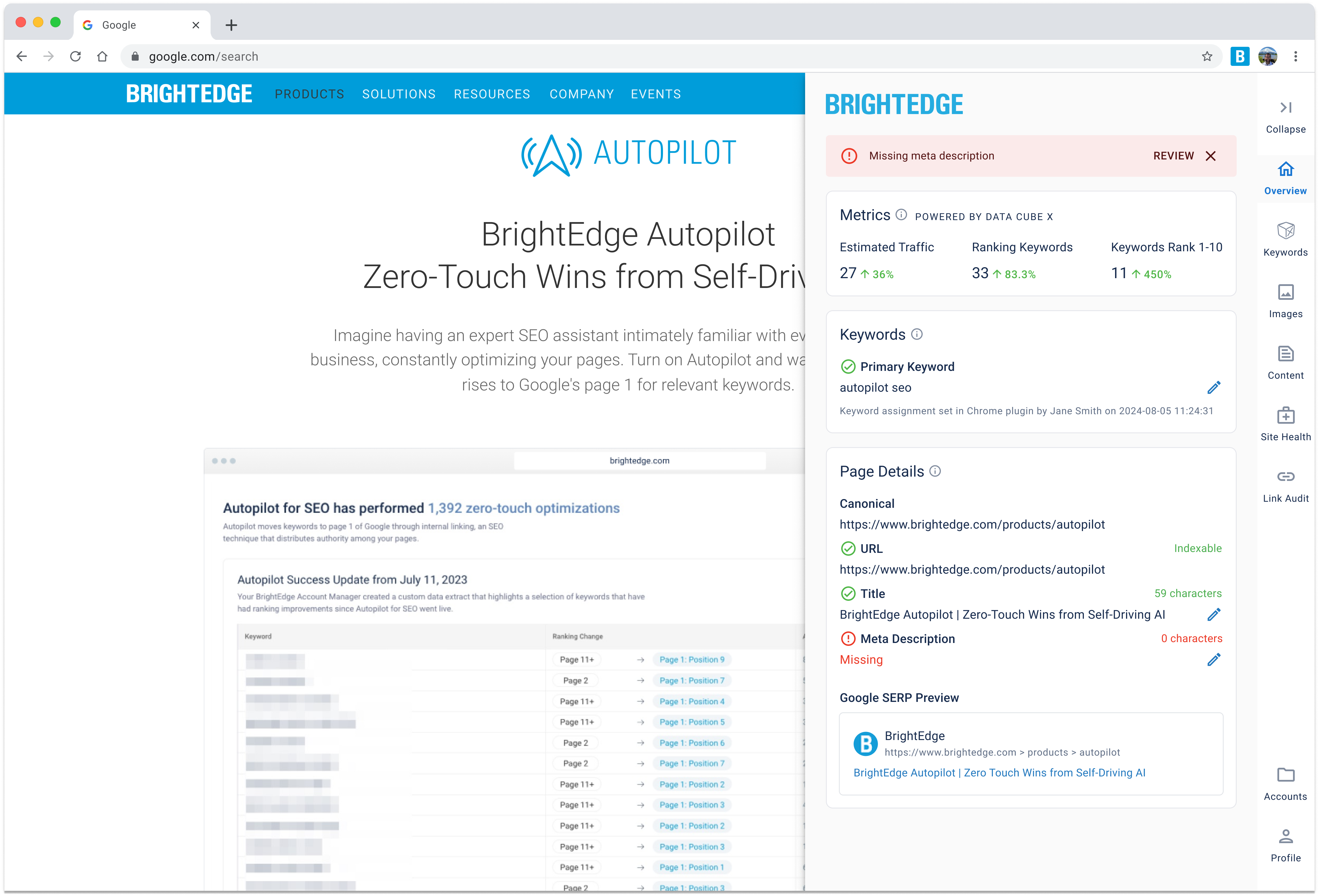
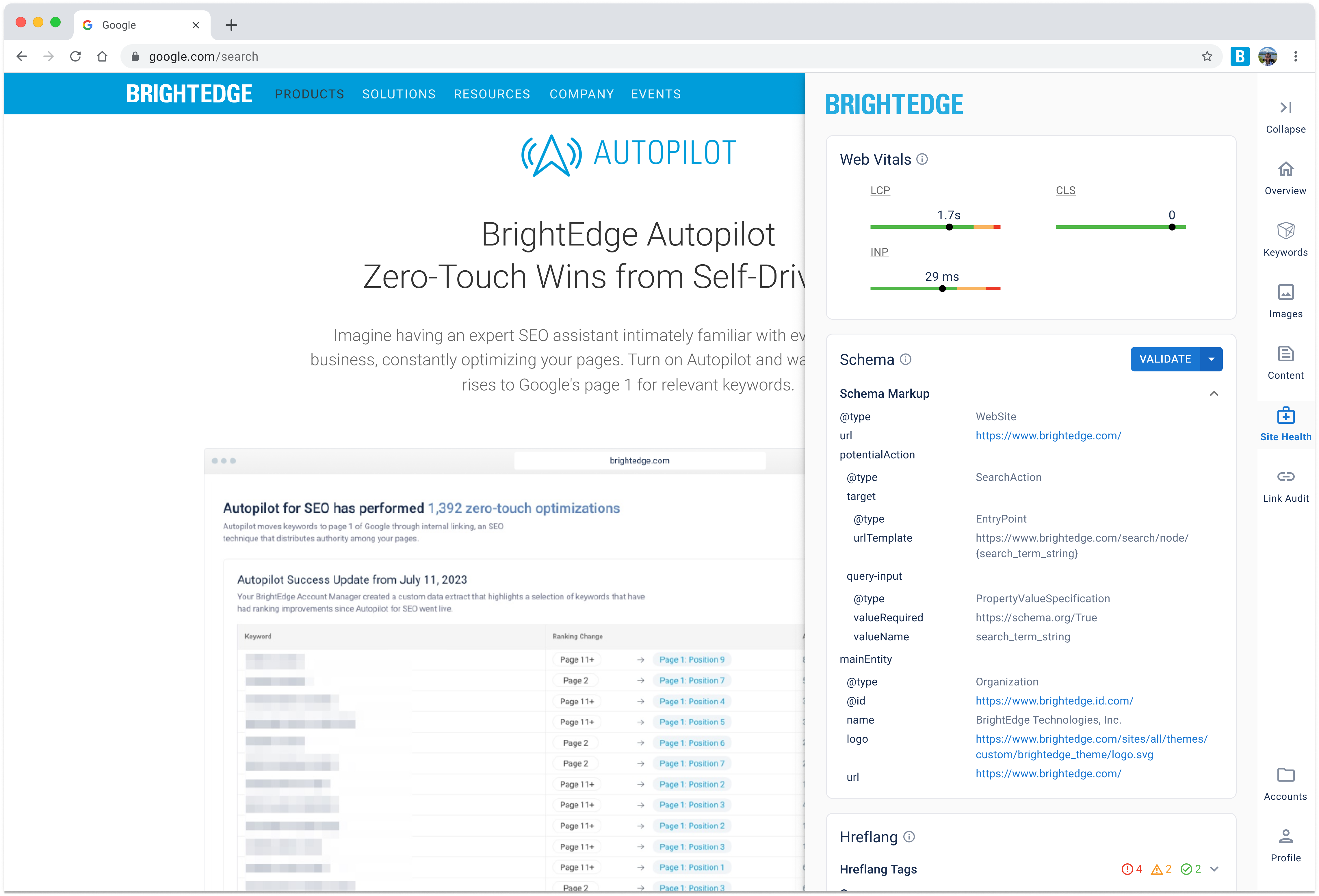
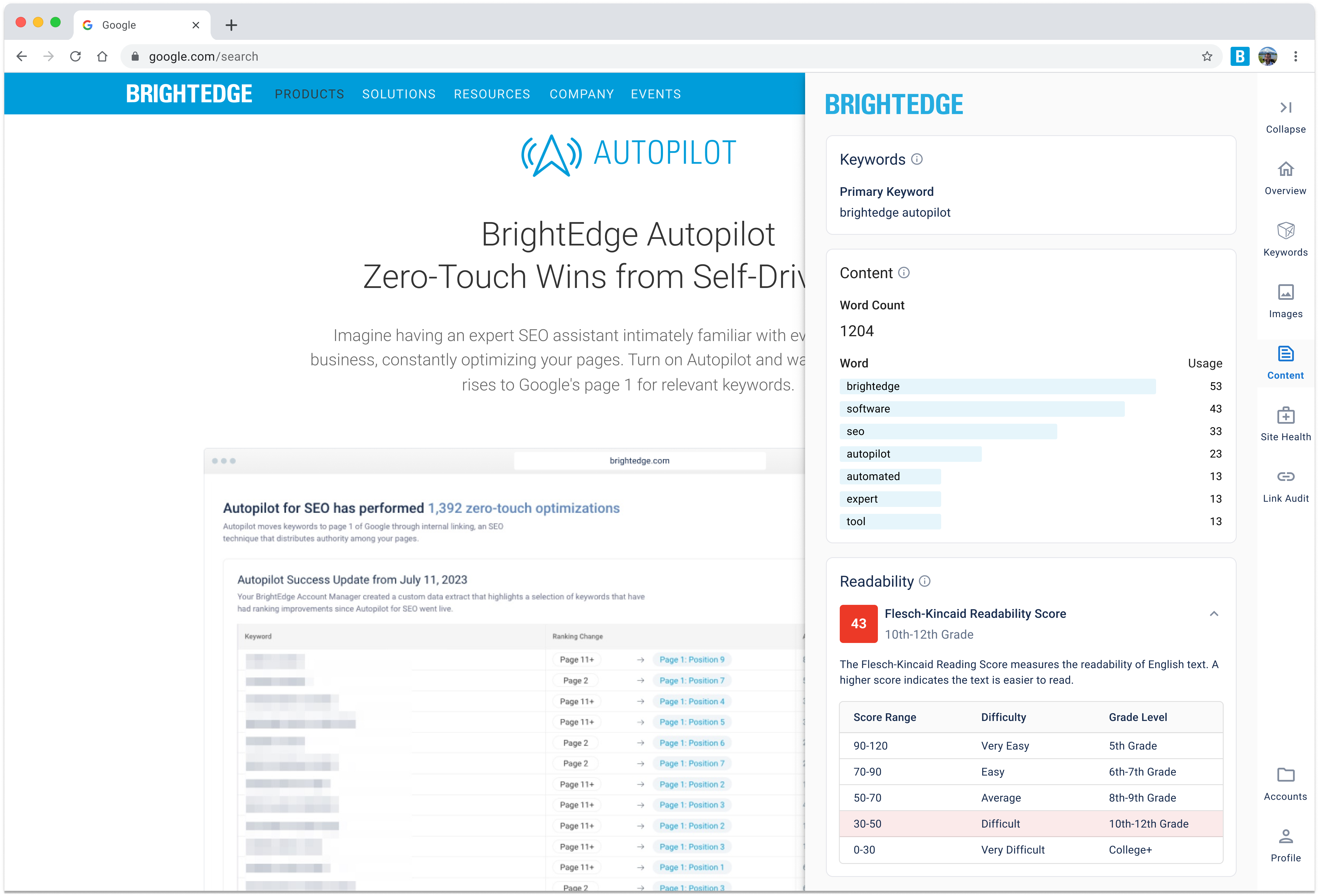
Designed to fit within your workflow, our intuitive interface highlights the SEO health of any page you visit with critical, need-to-know alerts. With the power to make informed decisions and take swift action without ever leaving your tab, this extension is an indispensable tool for anyone serious about dominating search engine rankings. Say goodbye to guesswork and hello to effortless optimization.
Optimize Your SEO Instantly with AI-Powered Precision!
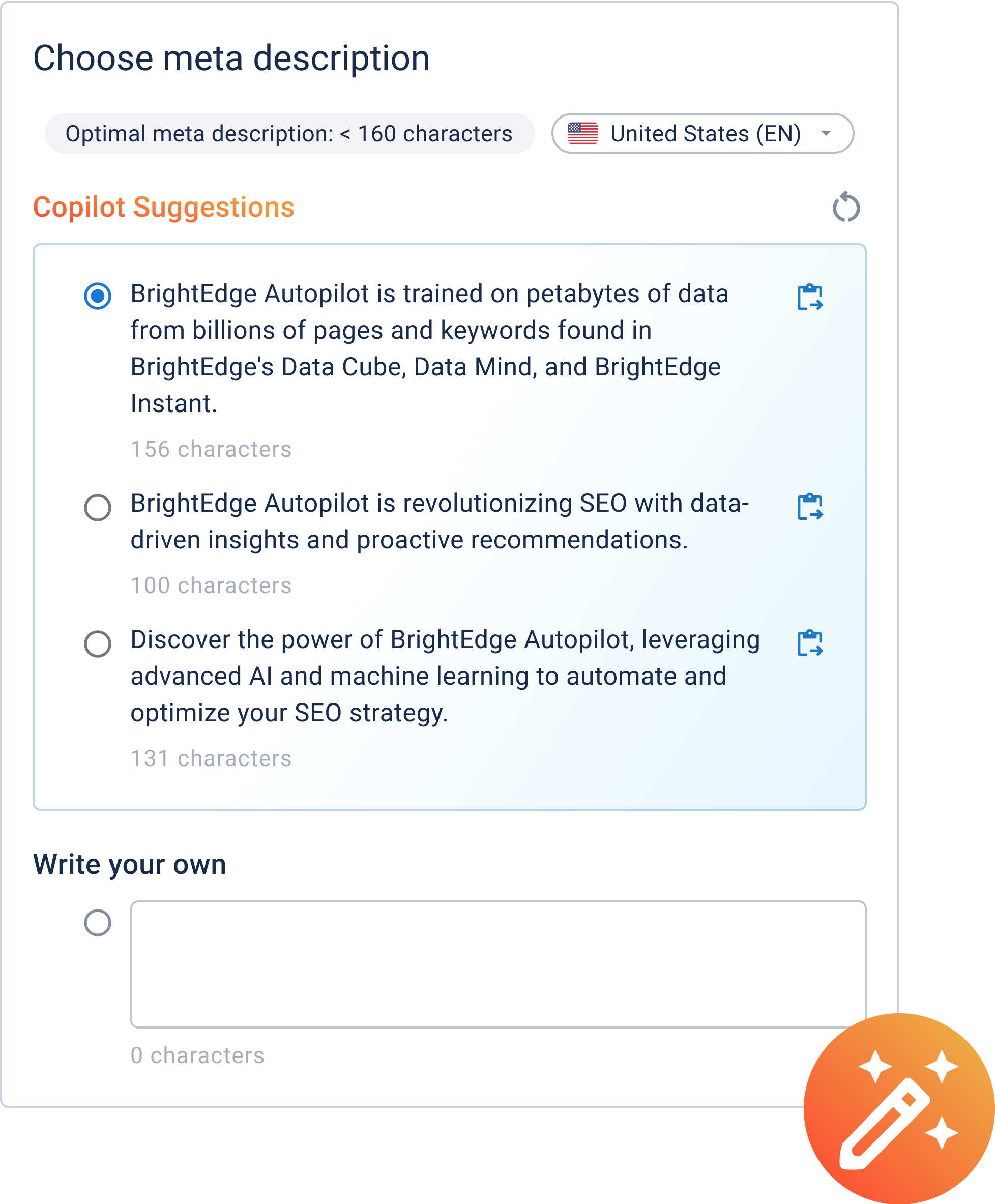
The BrightEdge Chrome Extension revolutionizes your SEO strategy by leveraging our latest AI technologies. For any page, Copilot, our AI-driven assistant, instantly uncovers the top-performing keywords and generates corresponding titles and meta descriptions to boost your click-through rates. Your polished, search-optimized edits can be published directly via Autopilot Page Publisher, saving you and your development team time. A history log of all published changes in the extension is also available for ease of tracking.
Leverage Data Cube X for Comprehensive Research, Right at Your Fingertips
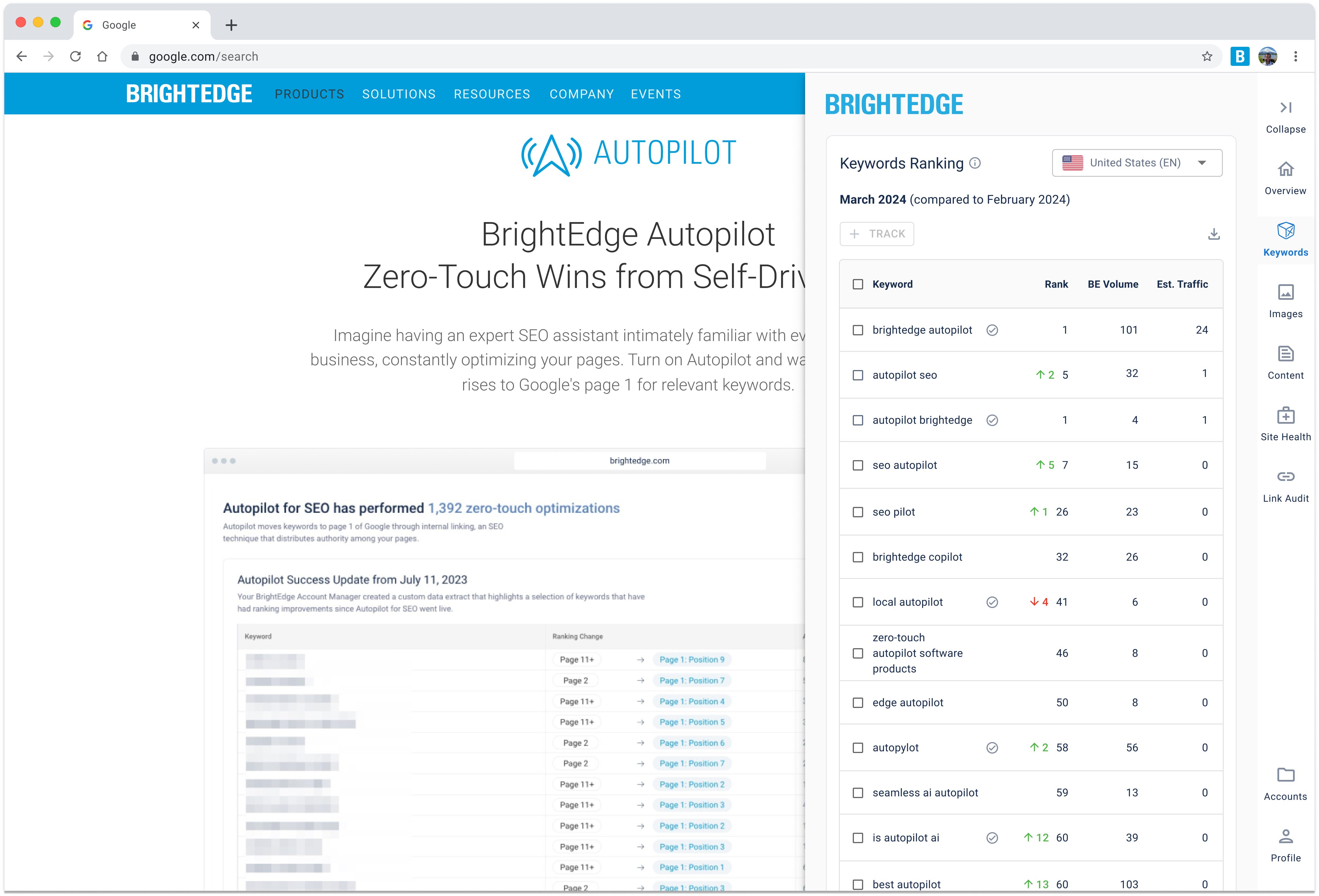
Unlock the full potential of SEO intelligence with our Chrome extension, powered by Data Cube X—the industry's most comprehensive SEO research dataset. Gain a competitive edge by accessing key performance metrics at a glance, including estimated traffic, keyword rankings, and top-performing search terms---not only for your pages but for your competitors' too. Data Cube X exclusively features BrightEdge volume, which uses big data analysis and AI algorithms to restore the precise exact match search volume that was lost when Google switched to broad search volume.
Purpose Built for Generative AI Search
BrightEdge Chrome Extension isn’t just another add-on—it’s a new way to operate in the era of generative search. It puts AI-powered SEO directly in your hands, right when and where decisions are being made. Whether you’re reviewing your own site or analyzing a competitor’s, you get instant clarity on what’s working, what’s not, and what to do next.