What is SearchGPT?
Introduction to SearchGPT
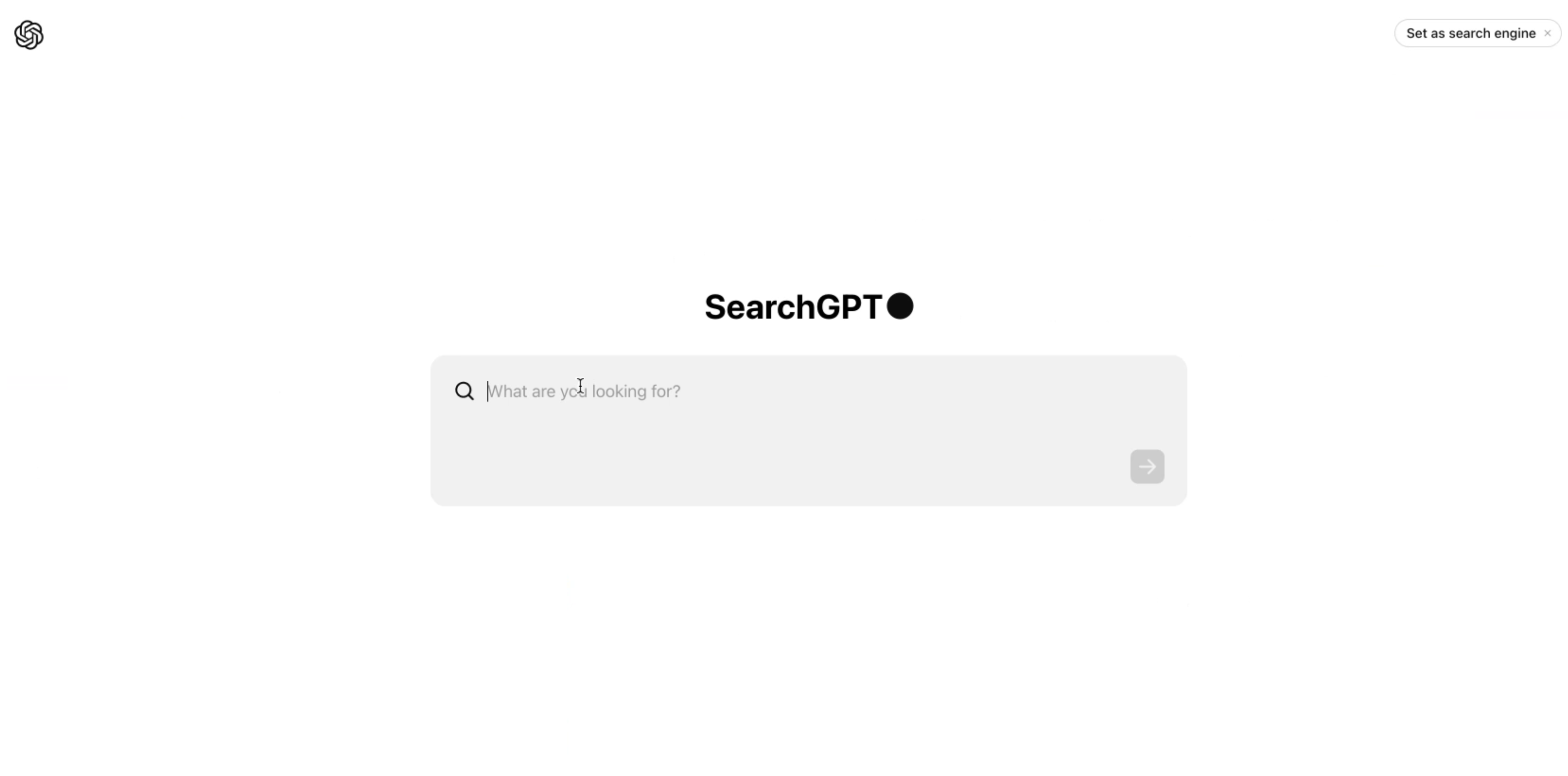
As of December 16, 2024, SearchGPT has been fully integrated into ChatGPT and is available to all logged-in users in regions where ChatGPT is available. This integration represents OpenAI's comprehensive entry into the search market, blending natural language capabilities with real-time web search functionality. Unlike traditional search engines, which rely on keyword matching and a predefined index, SearchGPT uses AI to understand and generate responses to user queries, providing direct answers and making the search process more intuitive and efficient.
Development Background and Current Status
Initially tested as a prototype, SearchGPT has now been fully integrated into ChatGPT's core functionality. The search feature is available at ChatGPT and through desktop and mobile apps. All ChatGPT Plus and Team users have immediate access, with Enterprise and Education users getting access in the coming weeks. Free users will receive access over the following months. The development reflects OpenAI's broader strategy to integrate its AI capabilities into everyday applications.
On October 9 of 2024, OpenAI's Head of Media Partnerships Varun Shetty revealed that the company plans to integrate SearchGPT into OpenAI by the end of the year. This move will likely accelerate SearchGPT's ability to deliver clicks and referall traffic to brands and publishers.
How SearchGPT Works
SearchGPT provides a clean and uncluttered interface that operates differently from other AI-first search engines by using a combination of technologies, including Microsoft's Bing for its live index. The system determines when to tap into web results based on queries, though users can also manually trigger web searches. Key features include:
- Real-Time Information: The system can access current information through its integration with Bing's index, allowing for up-to-date answers based on real-time events.
- Interactive Elements: Users can access features like interactive stock graphs, maps with location pins, and dynamic data visualization.
- Source Transparency: Results include clickable citations linking to original sources and a sources sidebar that lets users browse through relevant websites.
- Follow-up Capability: The system maintains context and can handle follow-up questions to refine results.
For SEO professionals, optimizing content for Bing remains crucial to ensure visibility on SearchGPT, as it relies on Bing's index for its source information.
The search model uses a fine-tuned version of GPT-4o, post-trained using novel synthetic data generation techniques, including distilling outputs from OpenAI o1-preview. The system determines when to search the web based on user queries, though users can also manually trigger web searches by clicking the web search icon.
SearchGPT Features and Interface
Development and Partnerships
As of October 31, 2024, OpenAI has secured numerous media partnerships to support SearchGPT's functionality, including agreements with:
- Associated Press
- Axel Springer
- Condé Nast
- Dotdash Meredith
- Financial Times
- GEDI
- Hearst
- Le Monde
- News Corp
- Prisa (El País)
- Reuters
- The Atlantic
- Time
- Vox Media
These partnerships give content providers more control over how their content surfaces in ChatGPT, though they don't automatically receive higher priority in queries. The system also respects publisher paywalls and allows publishers to opt out of the web crawler if desired.
Accuracy and Transparency
OpenAI has implemented several measures to ensure accuracy and reliability:
- Factual Accuracy: The system is designed to leverage real-time information access to improve accuracy and reduce hallucinations.
- Source Verification: Users can verify information through the sources sidebar and direct citation links.
- Special Attention Areas: The system pays particular attention to sensitive topics, such as election-related queries, and aims to elevate authoritative sources.
- Transparency Commitment: OpenAI has committed to being transparent about any potential mistakes or inaccuracies in the system's responses.
This integration represents a significant step in making AI-powered search more accessible and practical for everyday use, while maintaining a focus on accuracy and responsible content use.
The integration offers several key functionalities across all ChatGPT platforms (iOS, Android, and desktop apps for macOS and Windows):
A notable aspect of SearchGPT is its ad-free experience, distinguishing it from traditional search engines. While this provides a cleaner user experience, OpenAI has indicated that free users will have some limits on how often they can use the latest search models due to the higher operational costs of AI-powered search compared to traditional search engines.
Key Features and Functionalities
- AI-Powered Summarization: SearchGPT leverages OpenAI's GPT-4 models to generate direct and concise answers to user queries. This feature goes beyond traditional search results by providing synthesized responses, making it easier for users to get the information they need quickly.
- Leverages OpenAI's underlying search model, a fine-tuned version of GPT-4o
- Generates direct and concise answers to user queries
- Synthesizes information from multiple sources
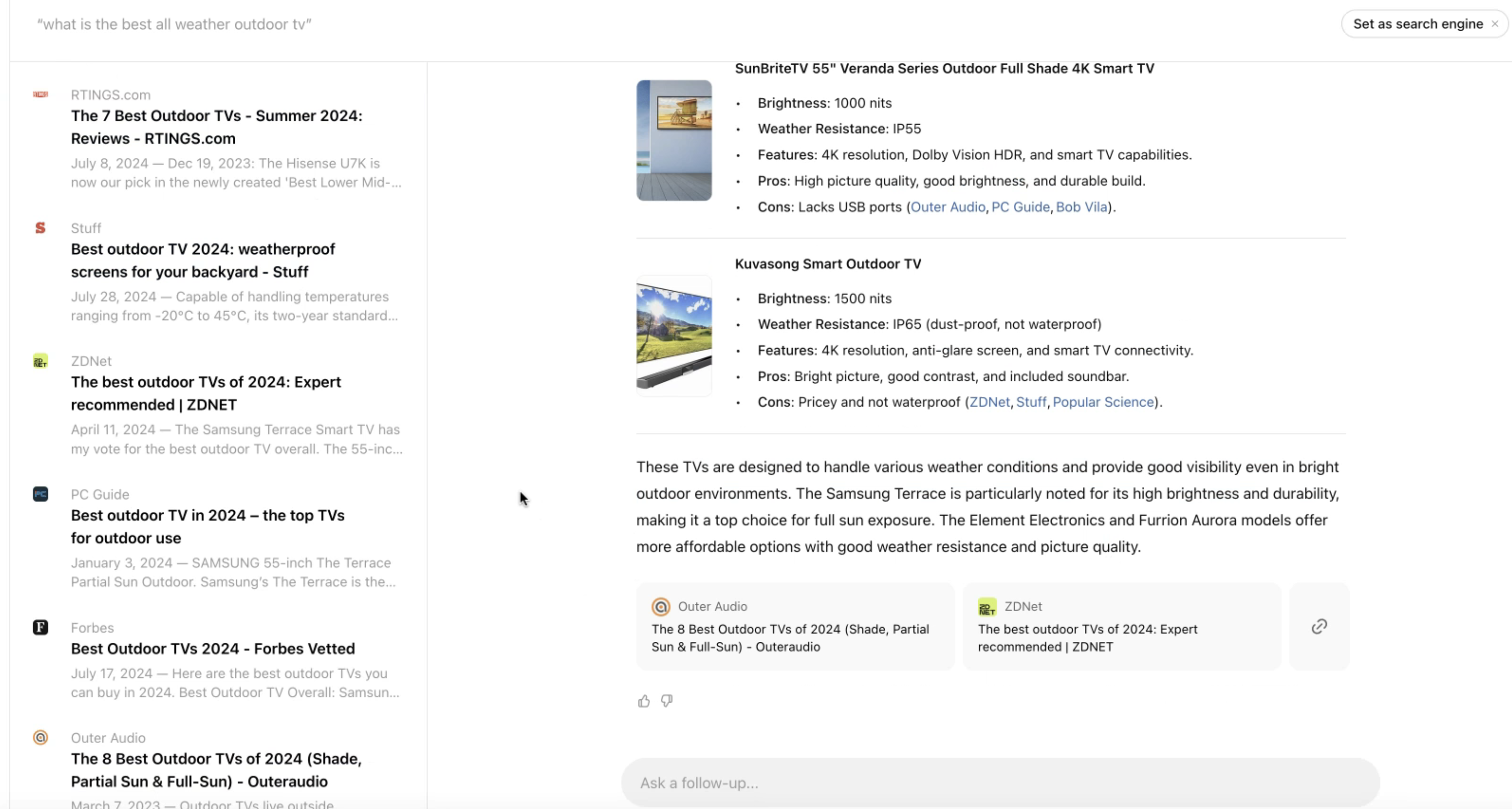
- Conversational Interface: Users can engage in a more interactive search experience, with the ability to ask follow-up questions that maintain the context of the original query. This conversational capability ensures a deeper exploration of topics without restarting the search process, enhancing user engagement.
- Maintains context through discussions
- Allows for natural follow-up questions
- Refines results based on user feedback
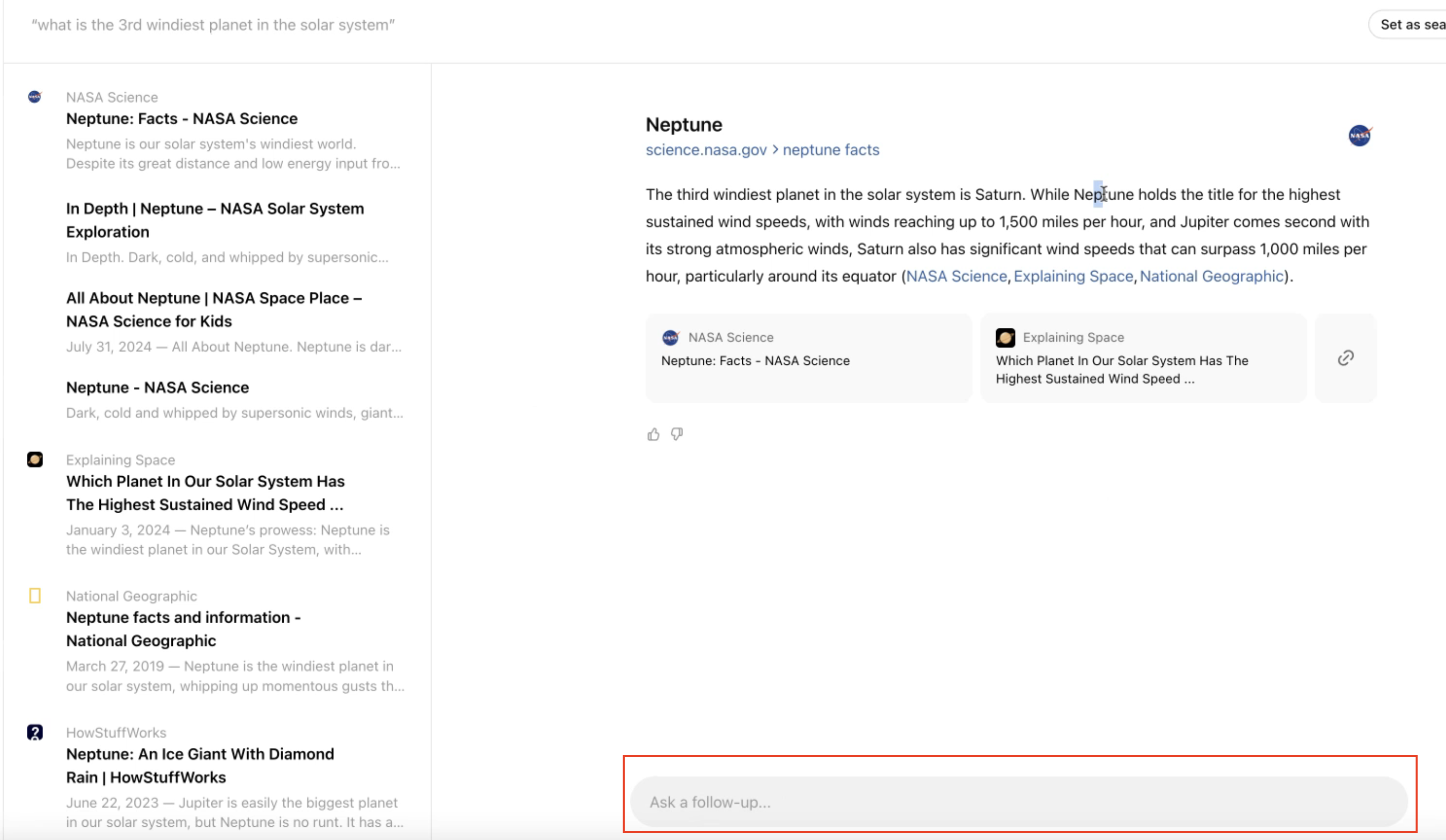
- Real-Time Information Access: By using Bing's index, SearchGPT ensures that the information provided is up-to-date and comprehensive. This integration allows SearchGPT to pull data from a vast array of sources across the web, ensuring accuracy and relevance in its responses.
- Provides current data through Bing's index
- Offers interactive elements like stock graphs and maps
- Updates information based on latest available data
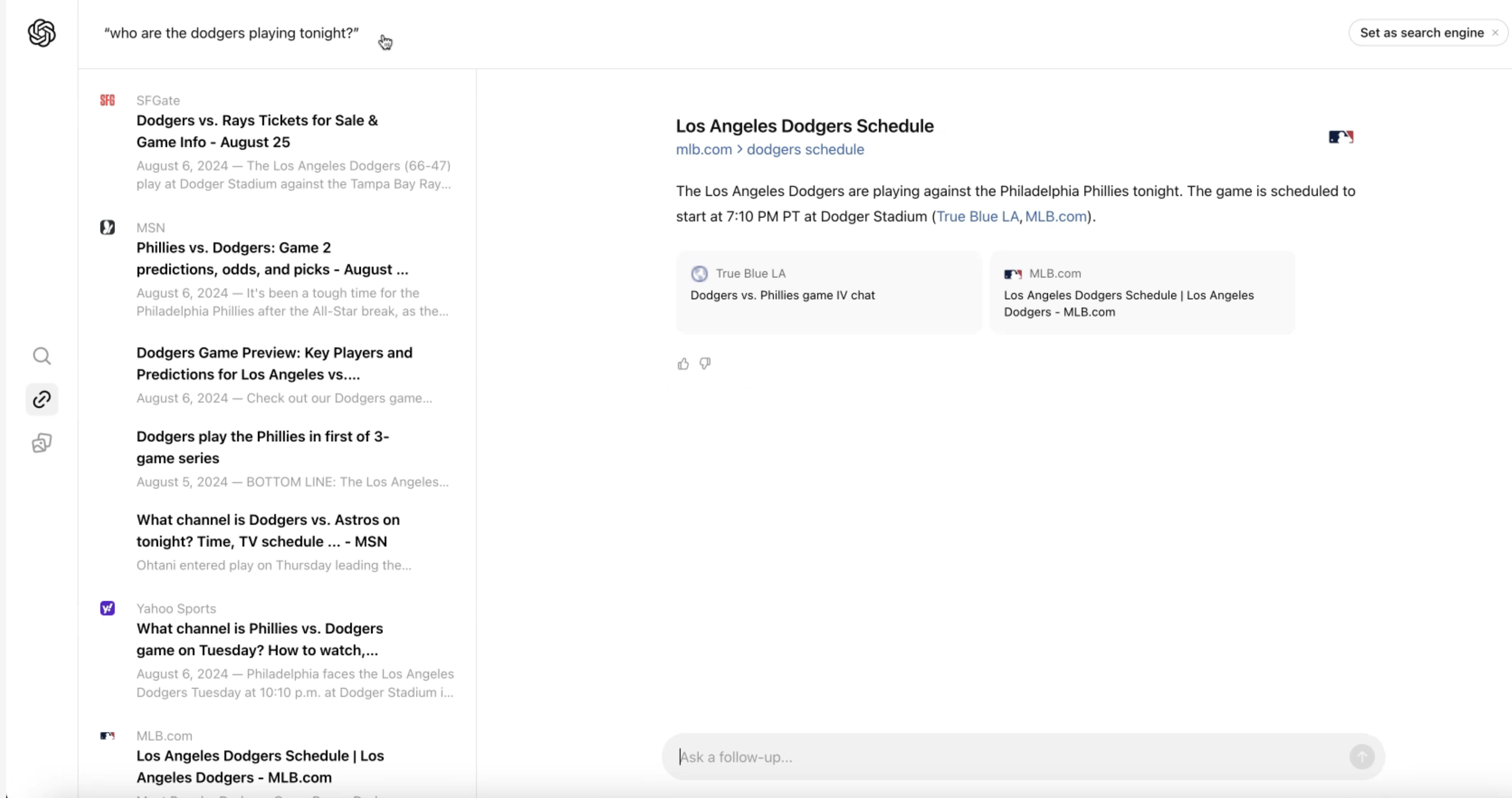
- Clear Attribution and Source Links: SearchGPT emphasizes transparency by providing clear attribution for all the information it presents. Each result includes links to the original sources, allowing users to explore the content further if needed. A sidebar with additional source links offers even more context and depth, supporting informed decision-making.
- Includes transparent citation system
- Features a dedicated sources sidebar
- Provides links to original content
- Cross-Platform Availability:
- Available on all ChatGPT platforms
- Consistent experience across devices
- Integrated into existing ChatGPT interface
How Cited Sources are Displayed
SearchGPT takes a unique approach to displaying cited sources, enhancing trust and credibility. Each search result is accompanied by a button which opens up a panel that displays all the sources cited for the result. This not only acknowledges the content creators but also minimizes the clutter on the page.
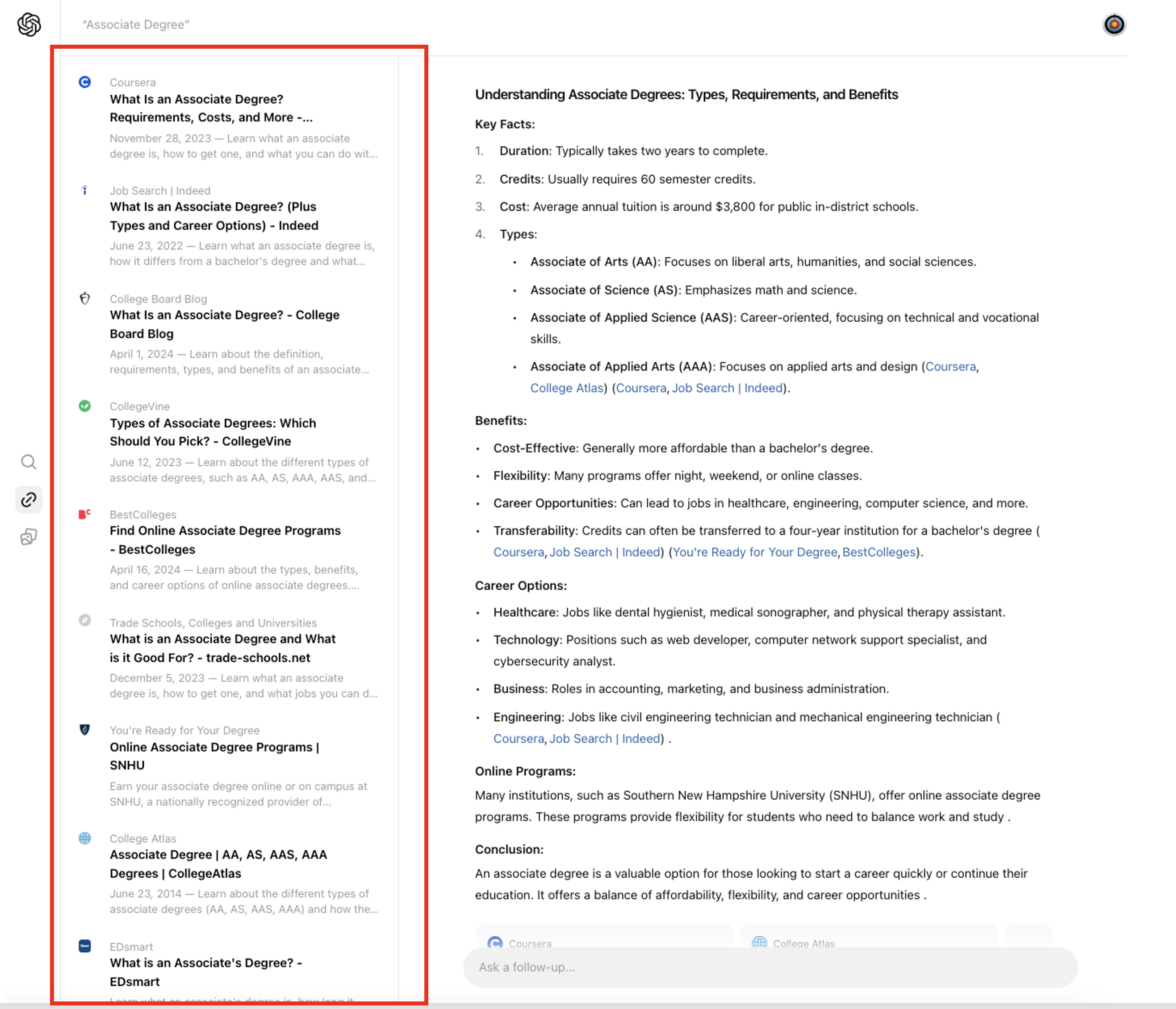
Additionally, , offering users multiple perspectives on their query. This feature is particularly useful for comprehensive research, as it encourages users to explore a variety of viewpoints and sources, thereby gaining a well-rounded understanding of the topic.
New Visual Data Features
-
Weather Information Integration
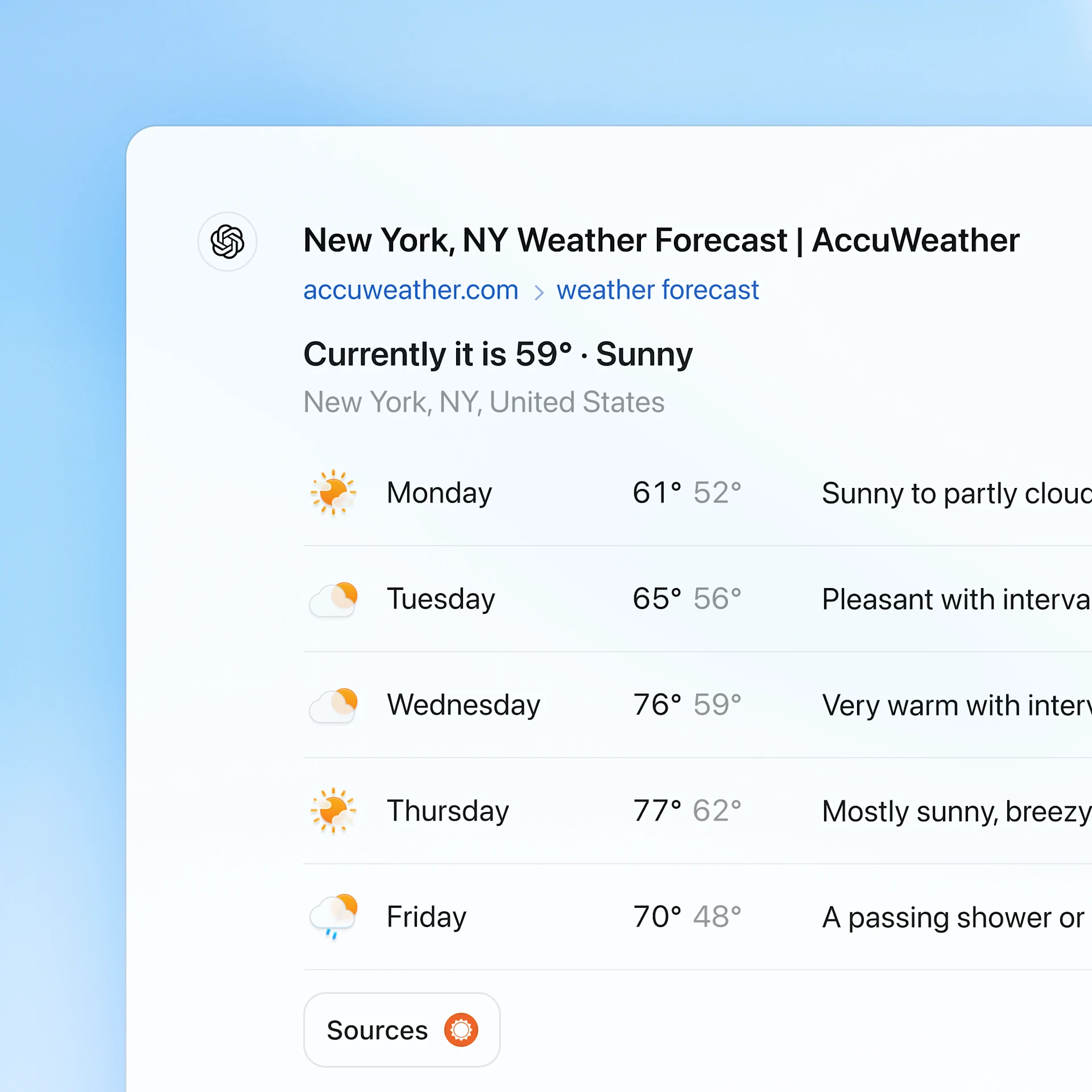
SearchGPT now provides comprehensive weather data through AccuWeather integration. Users receive detailed forecasts including:- Current temperature and conditions
- Multi-day forecast outlook
- Visual weather representations
- Temperature trends
- Precipitation forecasts
- Hourly breakdowns when requested
All weather information includes direct source attribution and timestamp indicators to ensure accuracy.
- Stock Market Data Visualization
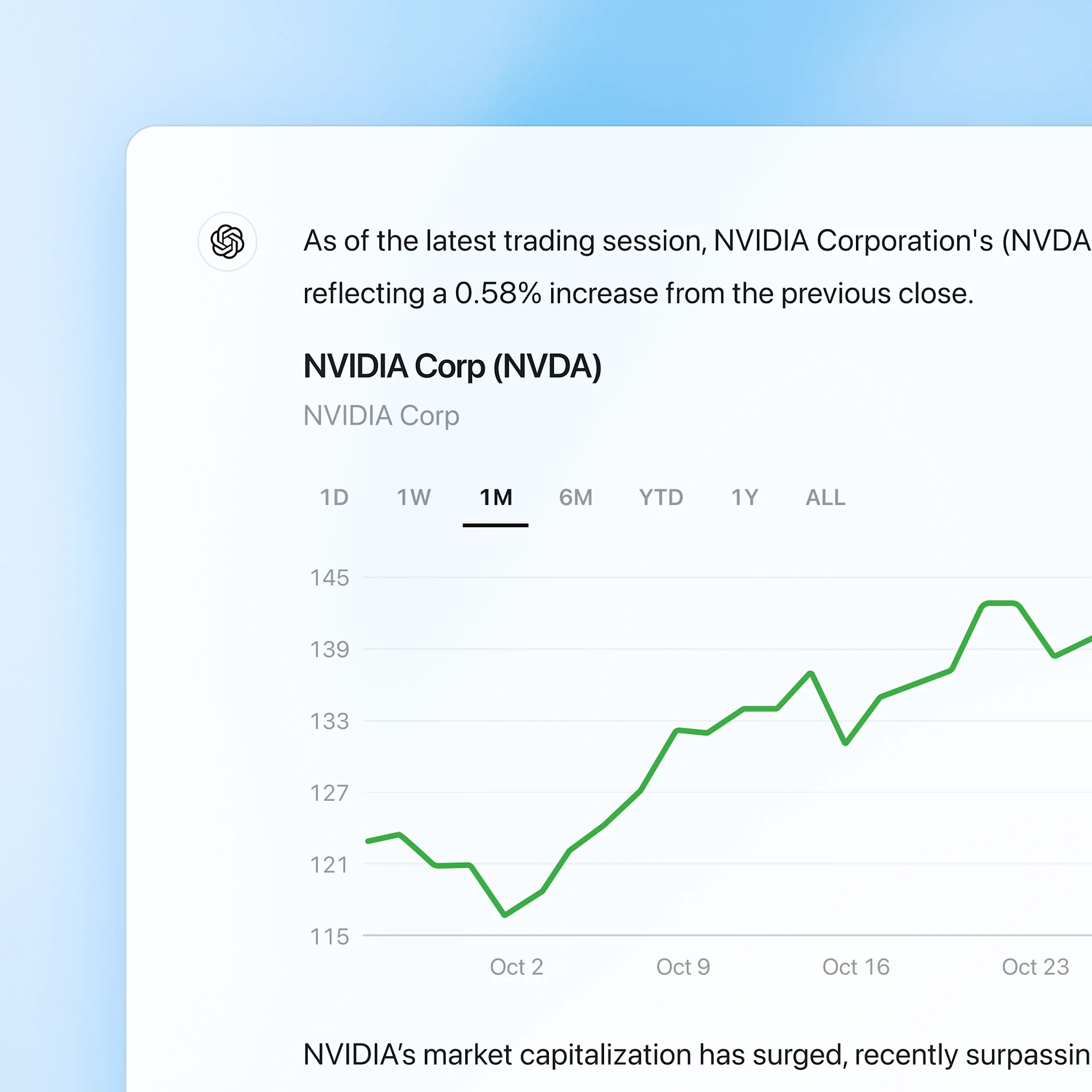
The platform offers real-time stock market information featuring:
-
Live stock price updates
- Interactive price charts showing historical trends
- Percentage changes from previous closing
- Market capitalization information
- Basic company metrics
- Historical performance data
Users can access this information through natural language queries about specific stocks or market segments.
-
-
Sports Information Interface
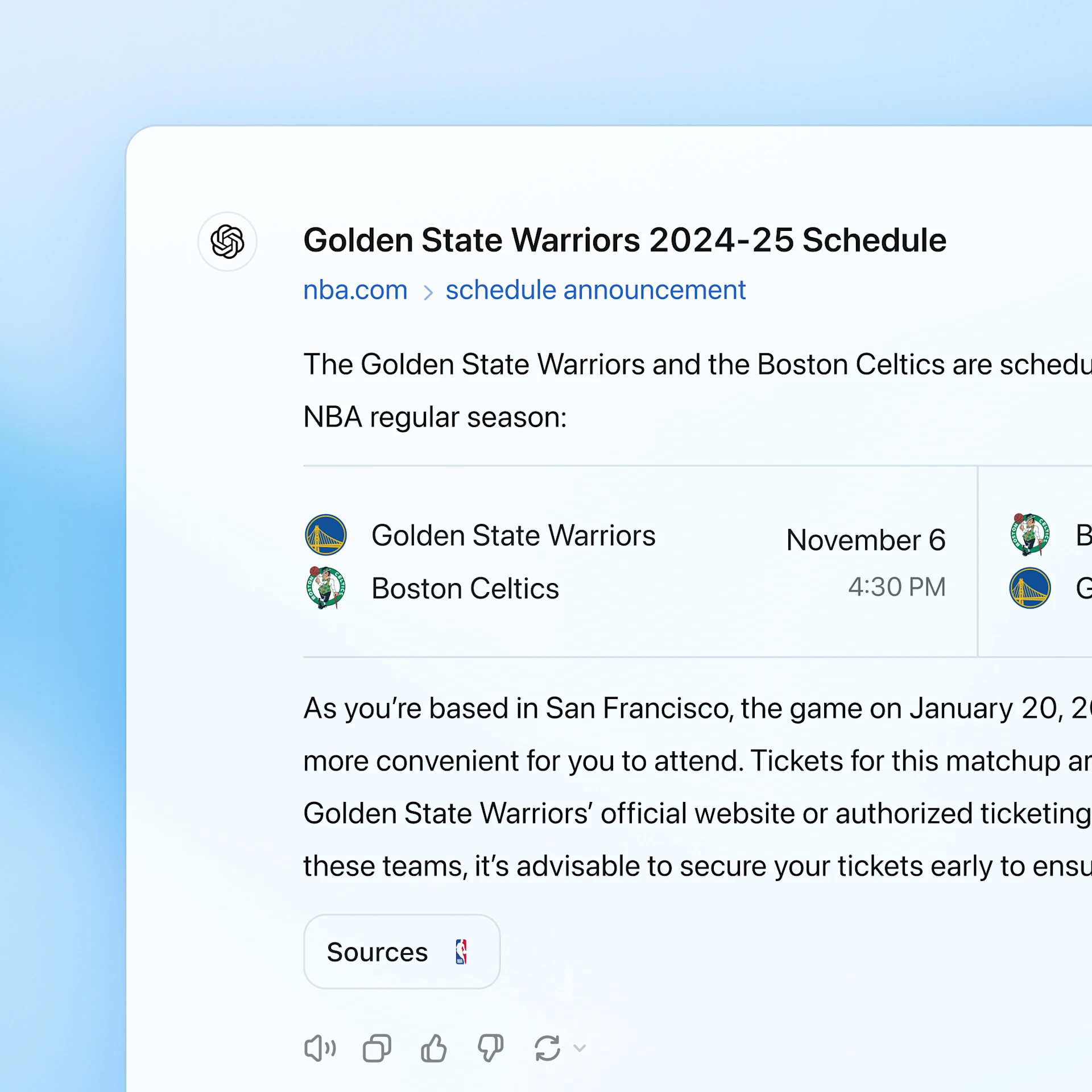
Sports-related queries now return structured data including:- Live game scores and updates
- Team schedules and upcoming matches
- League standings and statistics
- Game times and venue information
- Ticket purchasing guidance
The system maintains current information across major sports leagues and competitions.
- News Integration and Source Attribution
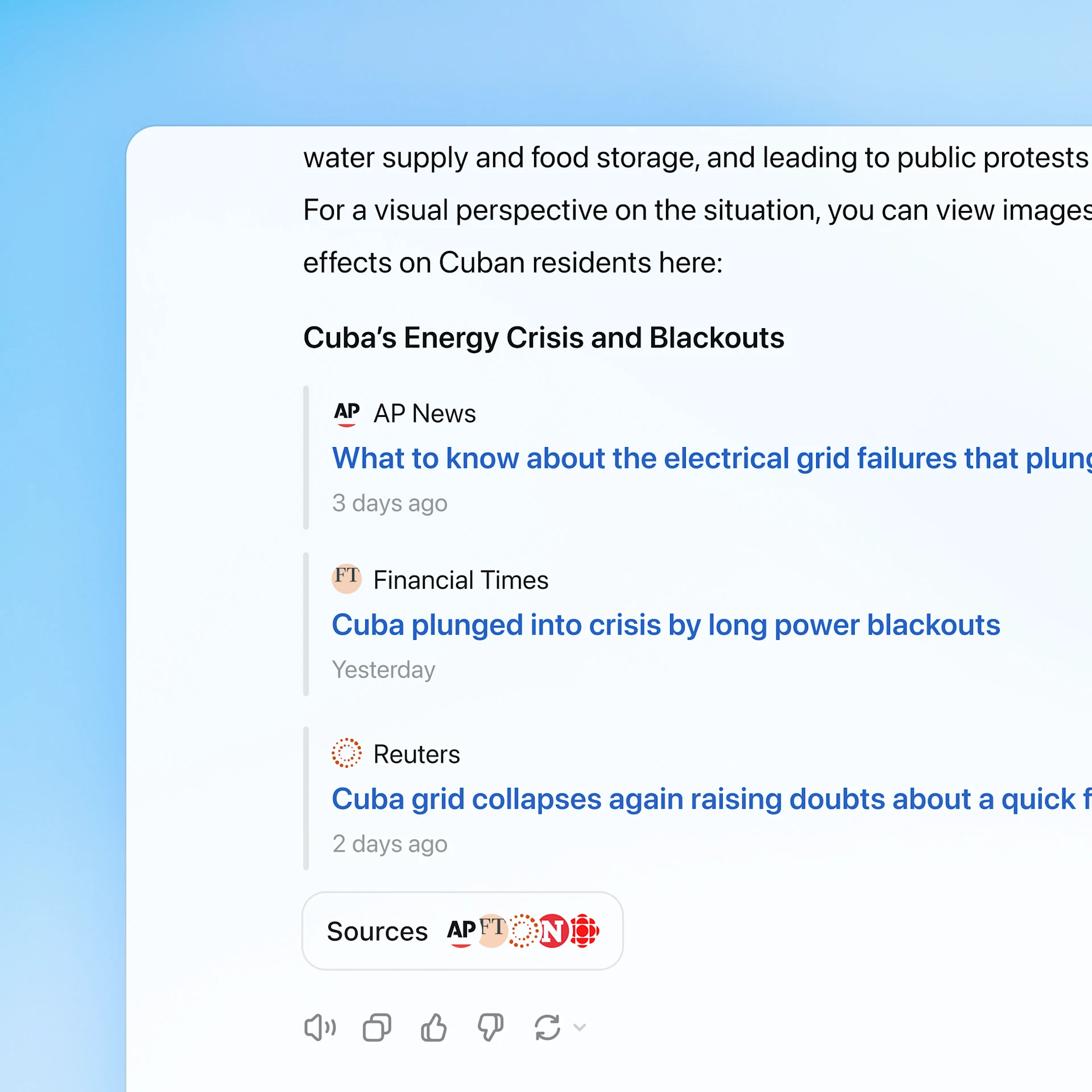
The news feature provides:- Current news from verified sources
- Direct links to original articles
- Clear source attribution for all information
- Multiple source perspectives on major stories
- Dedicated sources sidebar for reference checking
Users can access this through the new "Sources" button beneath responses.
- Location-Based Information
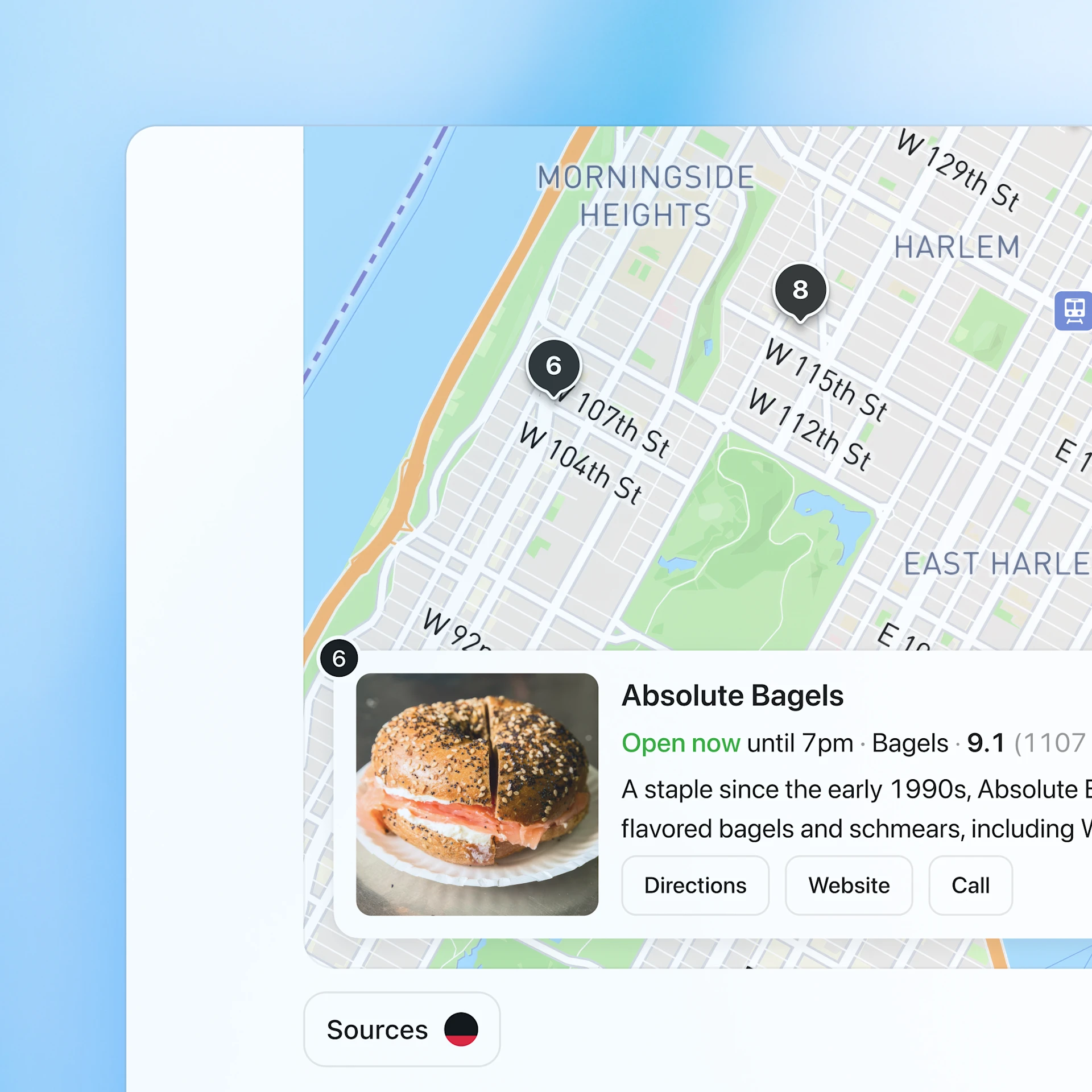
The maps integration offers:
- Interactive location searching
- Business hours and contact information
- Directional assistance
- Location-specific imagery
- Local business details
- Operating hours and contact information
This feature integrates seamlessly with other queries about specific locations or businesses.
How SearchGPT Compares to other AI-Search Platforms
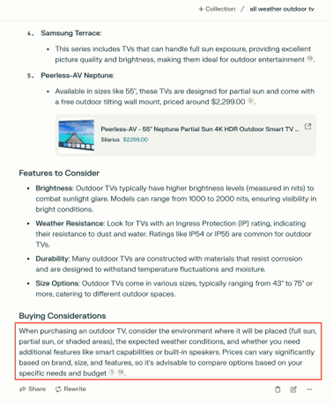
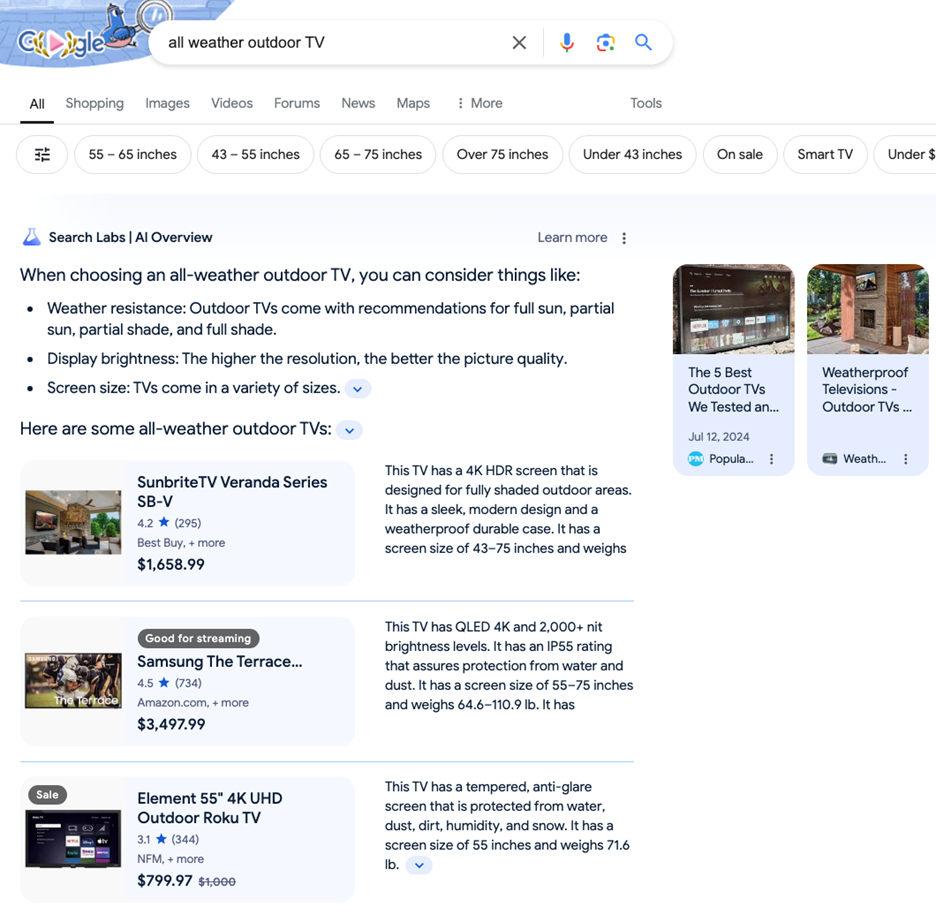
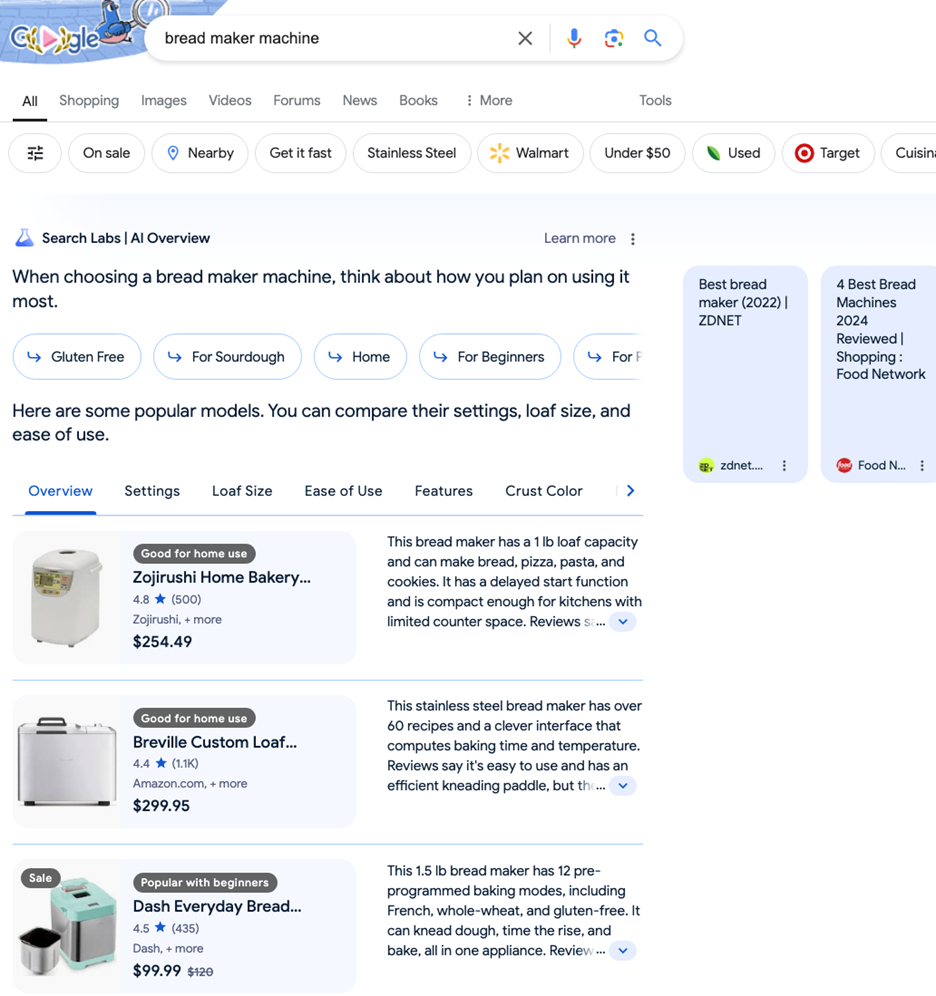
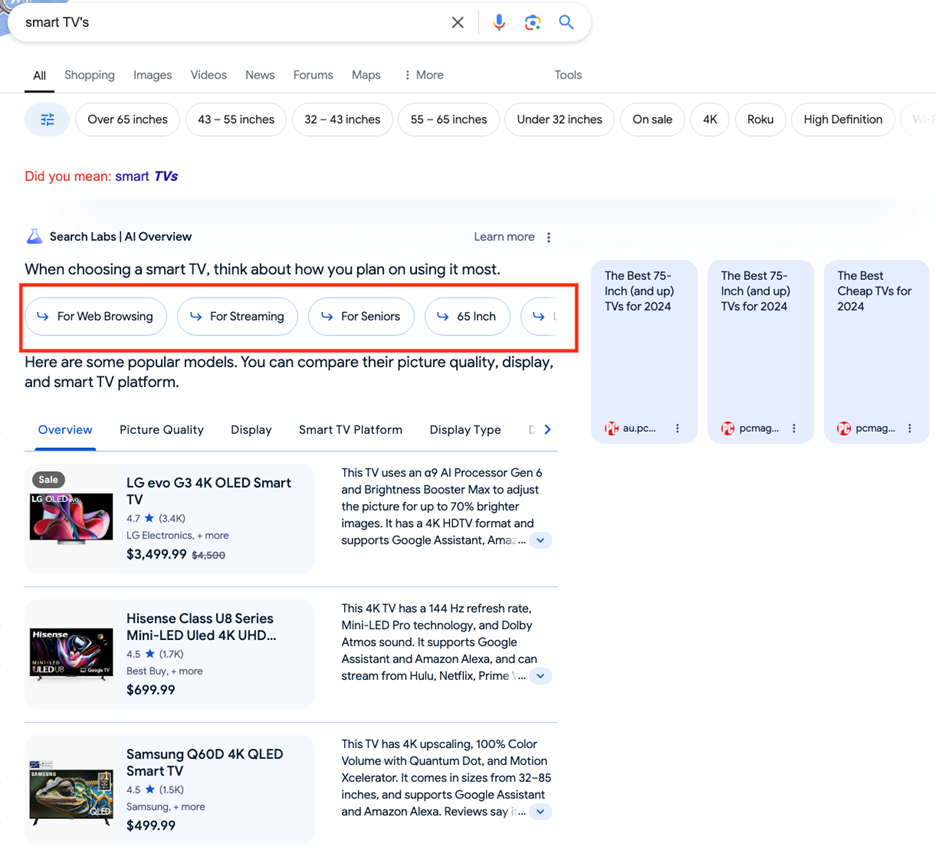
To analyze how SearchGPT compares to other AI search platforms, we conducted a comprehensive analysis across nine key verticals: Finance, B2B Technology, Education, Entertainment, Healthcare, Insurance, Restaurants, Travel, and E-commerce. We compared identical queries across SearchGPT, Google's AI Overview (AIO), and Perplexity to assess strengths, weaknesses, and overall user experience
A. Finance
Query analyzed: "What is a secure credit card?"
Google AI Overview
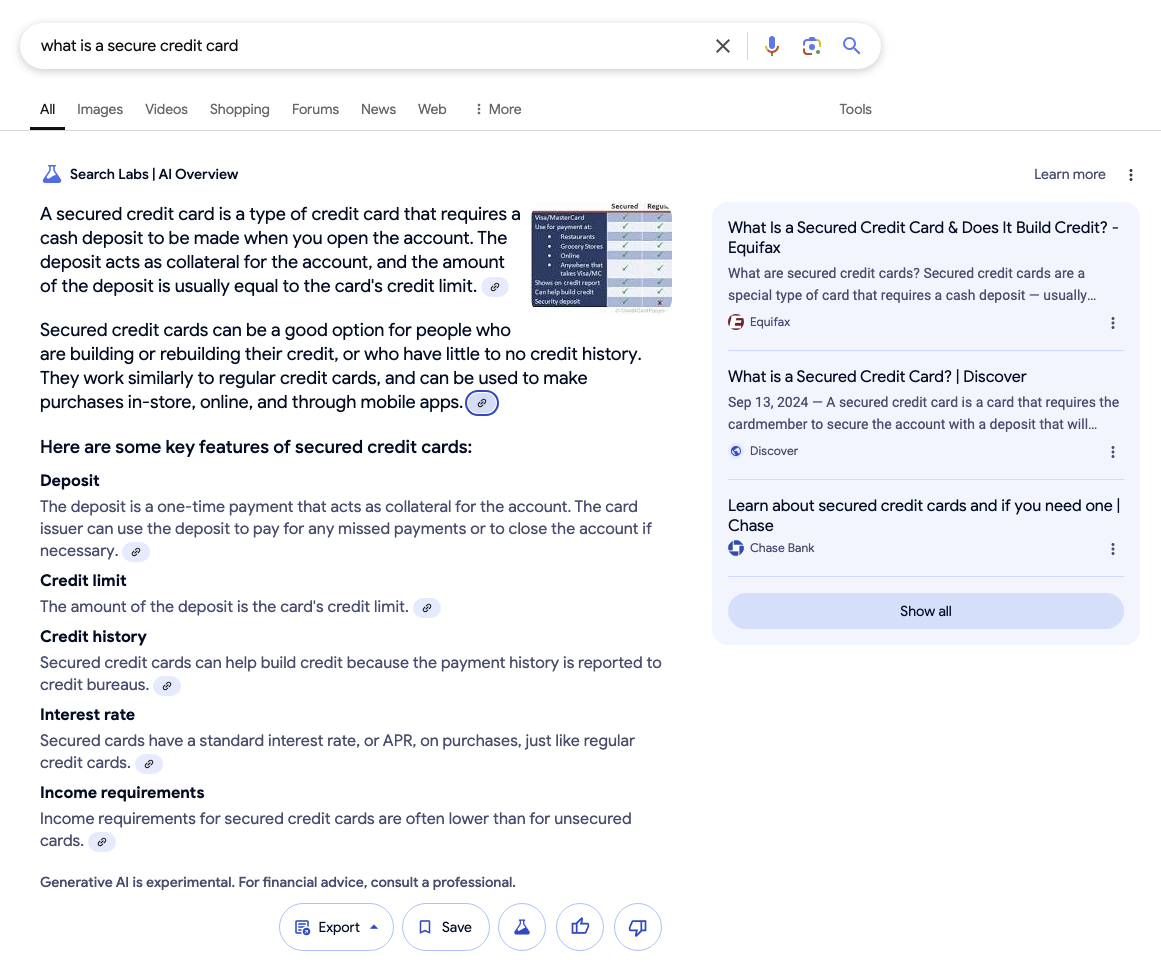
Strengths:
- Clean, modular presentation with clear sections
- Visual organization with expandable sections
- Integration of multiple trusted sources
- Shows related questions at top
- Clear differentiation between core definition and supplementary information
Weaknesses:
- Information somewhat fragmented across expandable sections
- Requires more clicks to get complete information
- Less immediate access to full context
ChatGPT Search
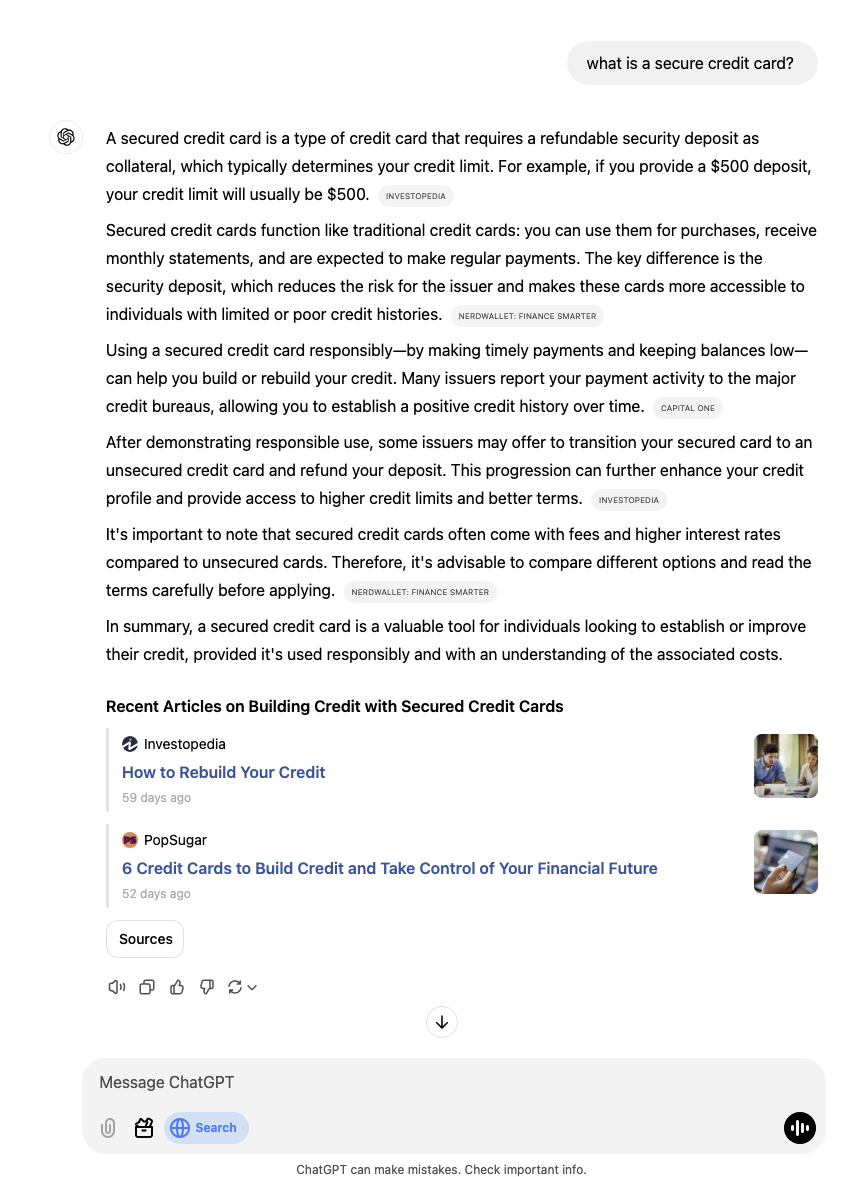
Strengths:
- Comprehensive, flowing narrative explanation
- Clear explanation of deposit-to-credit-limit relationship
- Includes important cautionary information
- Recent articles section with timestamps
- Strong focus on practical implications
Weaknesses:
- Dense text block might be harder to scan
- Fewer visual organizational elements
- Limited structured breakdown of features
Perplexity
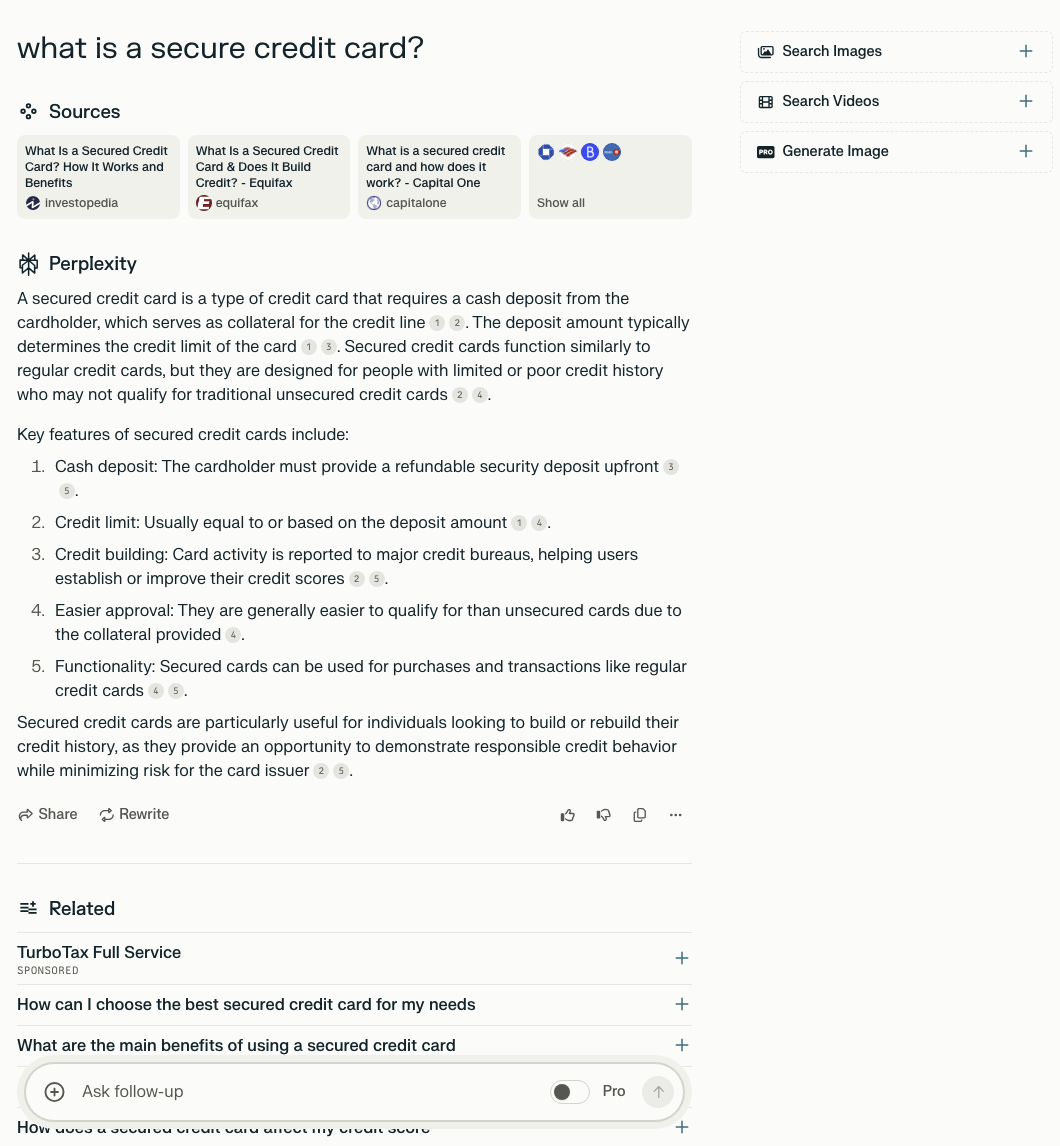
Strengths:
- Bullet-pointed key features make information easy to scan
- Clear source attribution
- Related questions presented in organized manner
- Balanced mix of definition and practical features
Weaknesses:
- More basic information compared to other sources
- Less detail about specific scenarios
- Fewer real-world examples
Optimal Use Cases:
- Google AIO: Best for users who want to explore specific aspects
- ChatGPT Search: Ideal for users seeking comprehensive understanding
- Perplexity: Most effective for quick reference
B. B2B Technology
Query analyzed: "What is data modeling?"
Google AI Overview
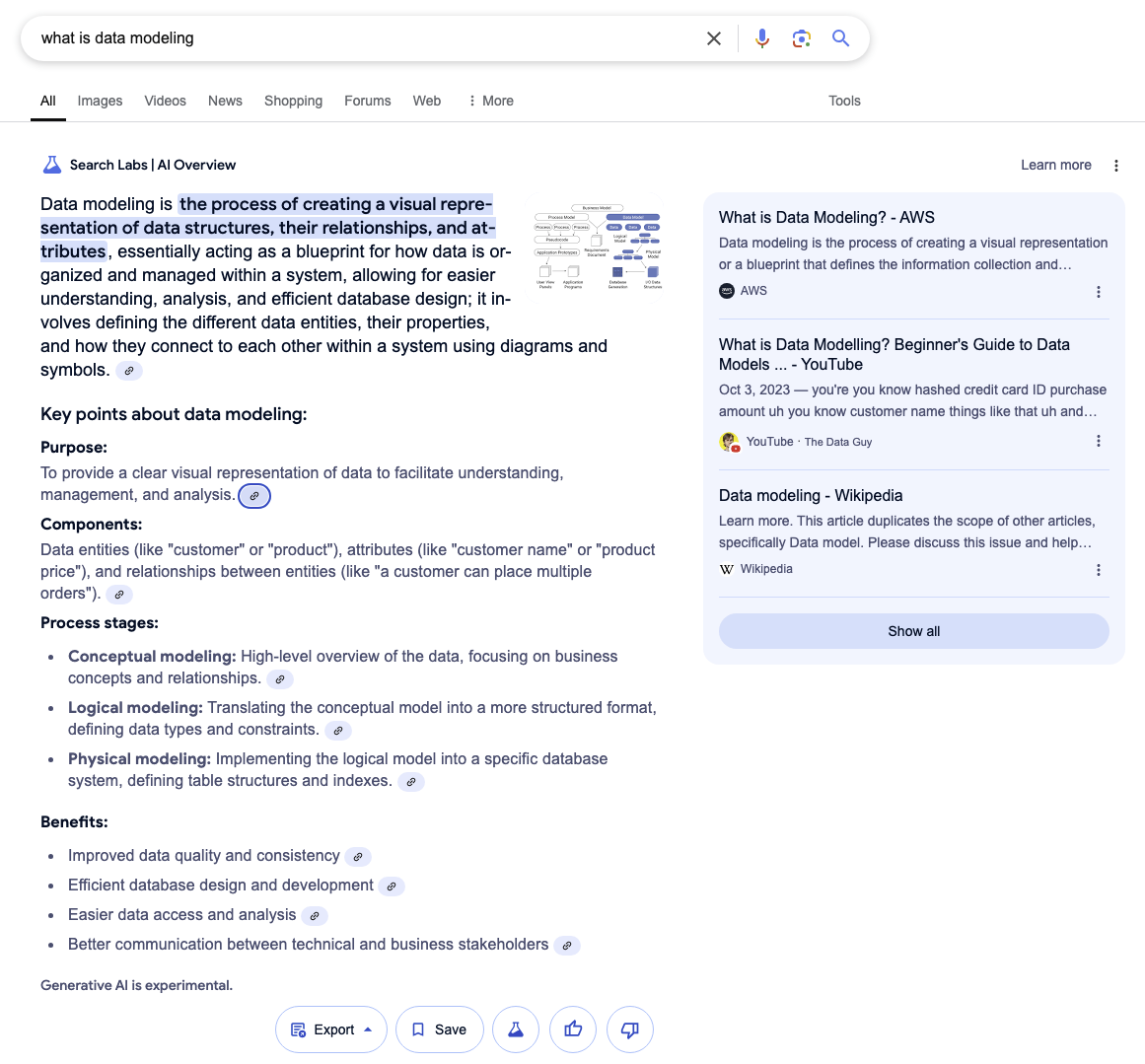
Strengths:
- Clear hierarchical structure with expandable sections
- Strong visual organization with key points highlighted
- Practical process phases clearly outlined
- Integration of technical terms with explanations
- Shows related visual resources and diagrams in sidebar
Weaknesses:
- Some technical concepts need more elaboration
- Information is segmented, requiring clicks
- Limited immediate access to examples
ChatGPT Search
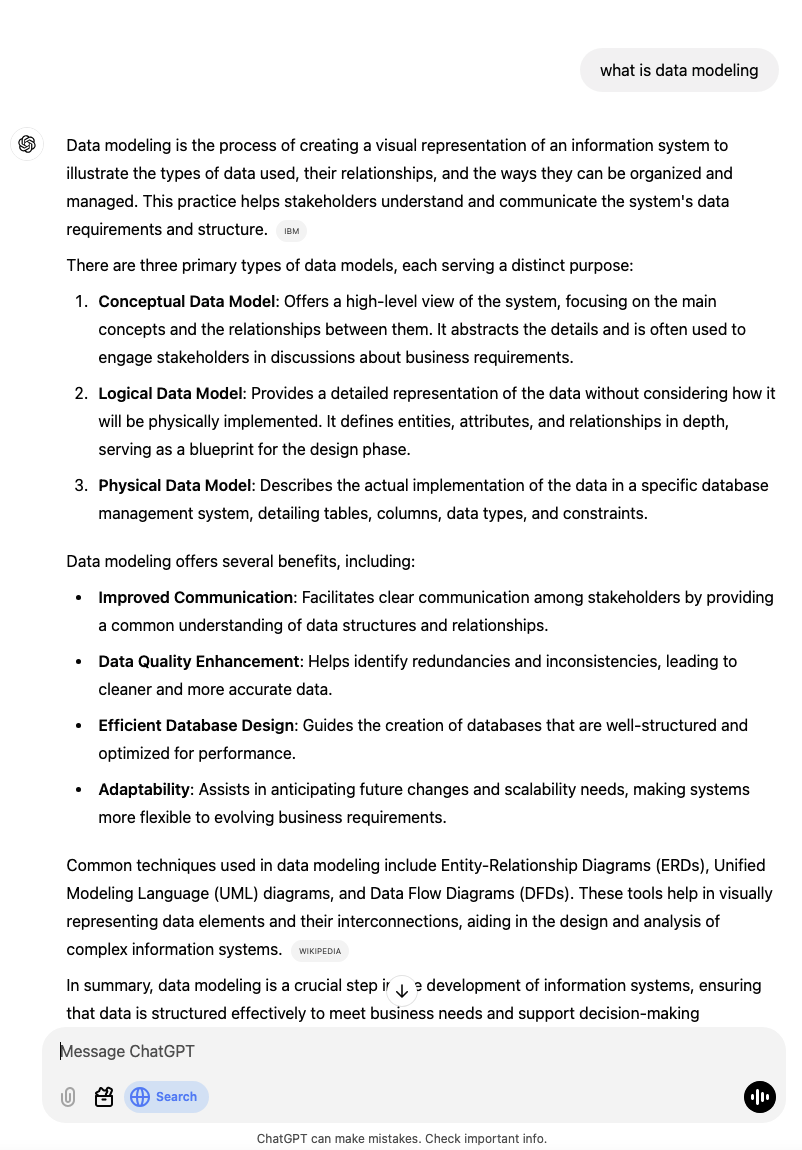
Strengths:
- Comprehensive, well-structured narrative
- Clear differentiation between three types of data models
- Strong focus on business benefits and applications
- Excellent balance of technical detail and accessibility
- Professional tone suitable for business audience
Weaknesses:
- Dense text presentation challenging for quick scanning
- Less interactive than other formats
- Limited visual aids in main content
Perplexity
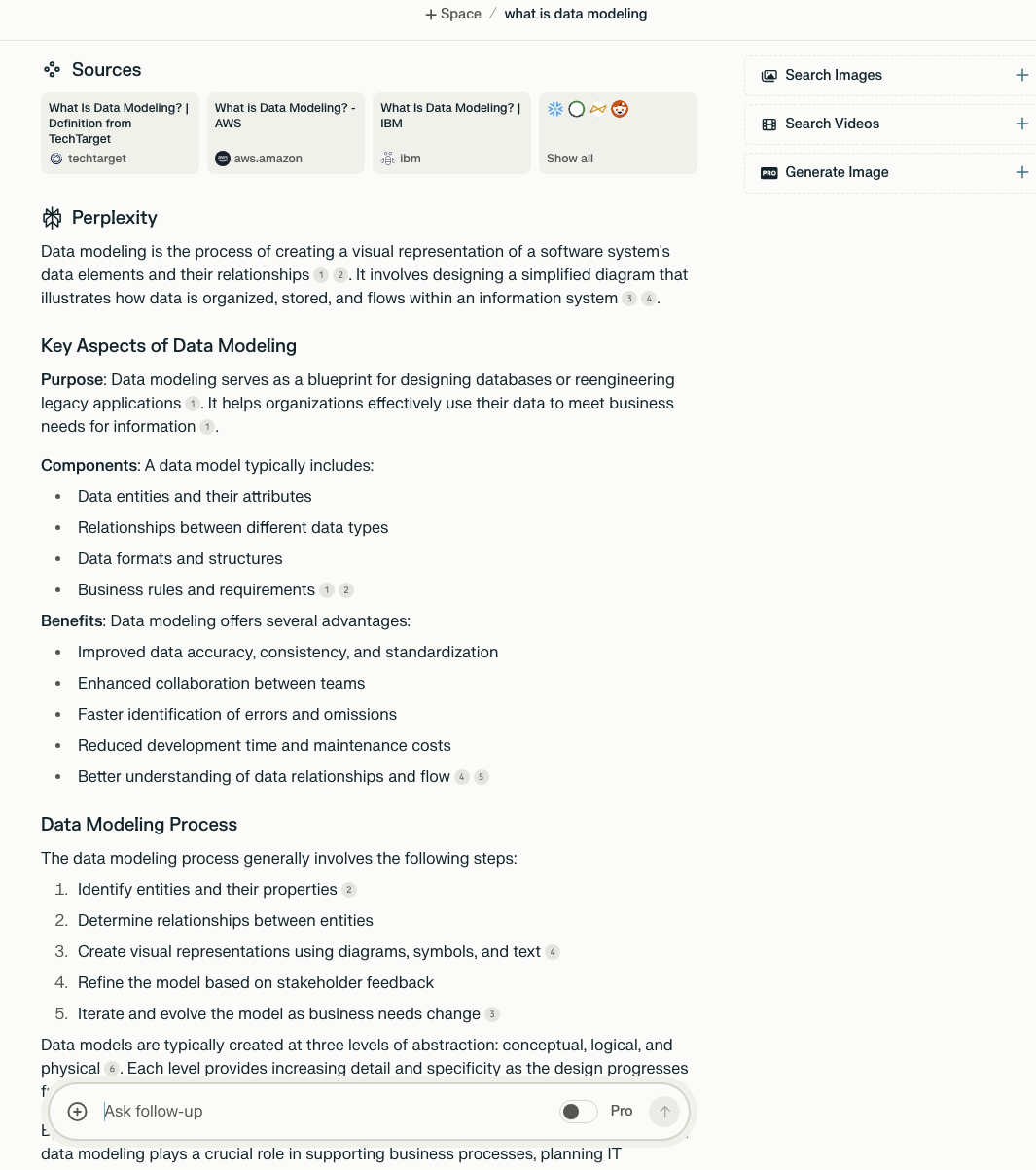
Strengths:
- Integration of visual examples alongside text
- Well-organized bullet points for easy scanning
- Clear separation of concepts and processes
- Inclusion of practical techniques
- Balance of technical accuracy and accessibility
Weaknesses:
- Some technical concepts could use more detailed explanation
- Benefits section more concise compared to others
- Less detailed on specific implementation scenarios
Optimal Use Cases:
- Google AIO: Best for technical professionals seeking structured methodology
- ChatGPT Search: Ideal for business stakeholders and strategic planning
- Perplexity: Most effective for visual learners and quick reference
C. Education
Query analyzed: "What is a BBA degree?"
Google AI Overview
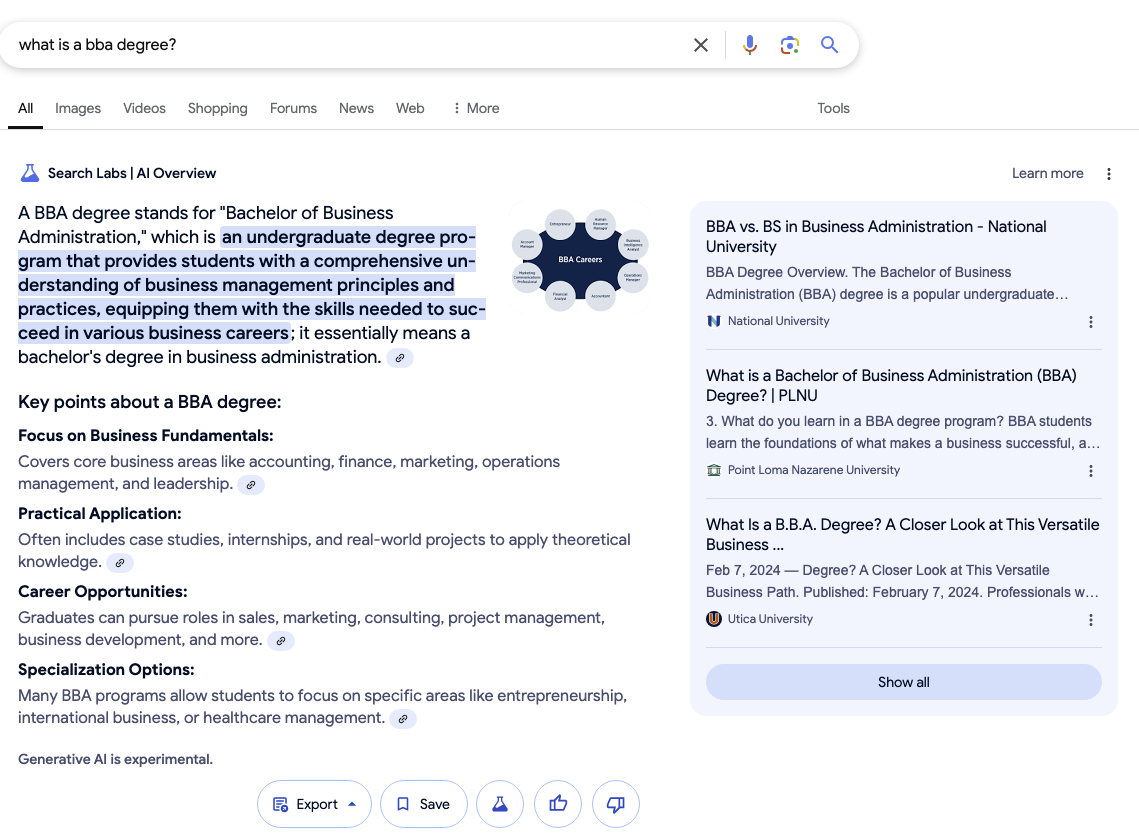
Strengths:
- Clean, concise definition at the top
- Visual organization with clear sections
- Graphical element showing degree components
- Learn more option for additional depth
- Succinct but informative expandable sections
Weaknesses:
- Some sections require expansion to view full content
- Limited information about career outcomes
- Could provide more detail about specializations
ChatGPT Search
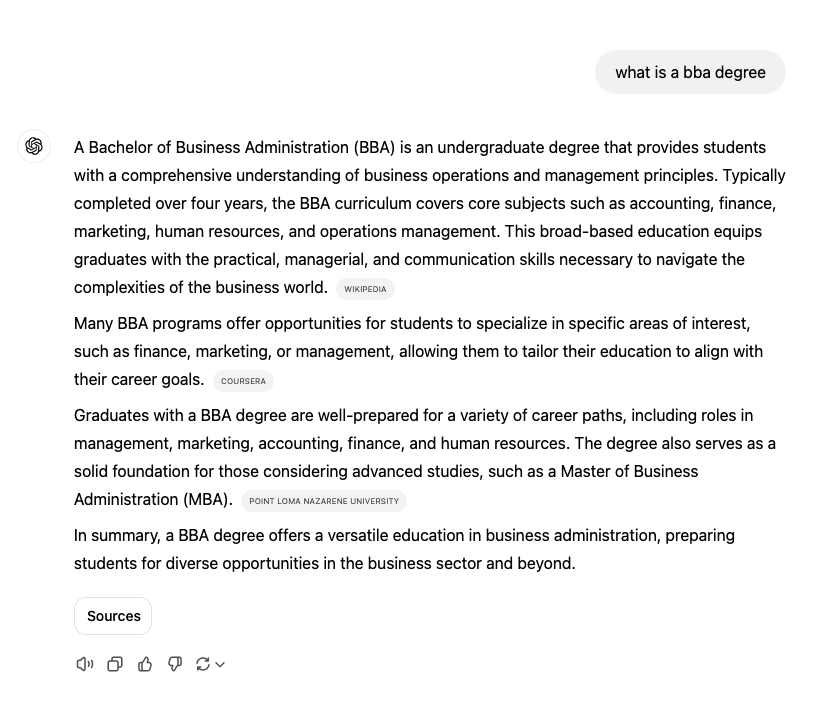
Strengths:
- Comprehensive narrative flow
- Clear explanation of timeline
- Strong focus on practical outcomes and career paths
- Includes advanced study options (MBA)
- Well-structured progression from definition to outcomes
Weaknesses:
- Dense text format
- No visual elements
- Less scannable than other formats
Perplexity
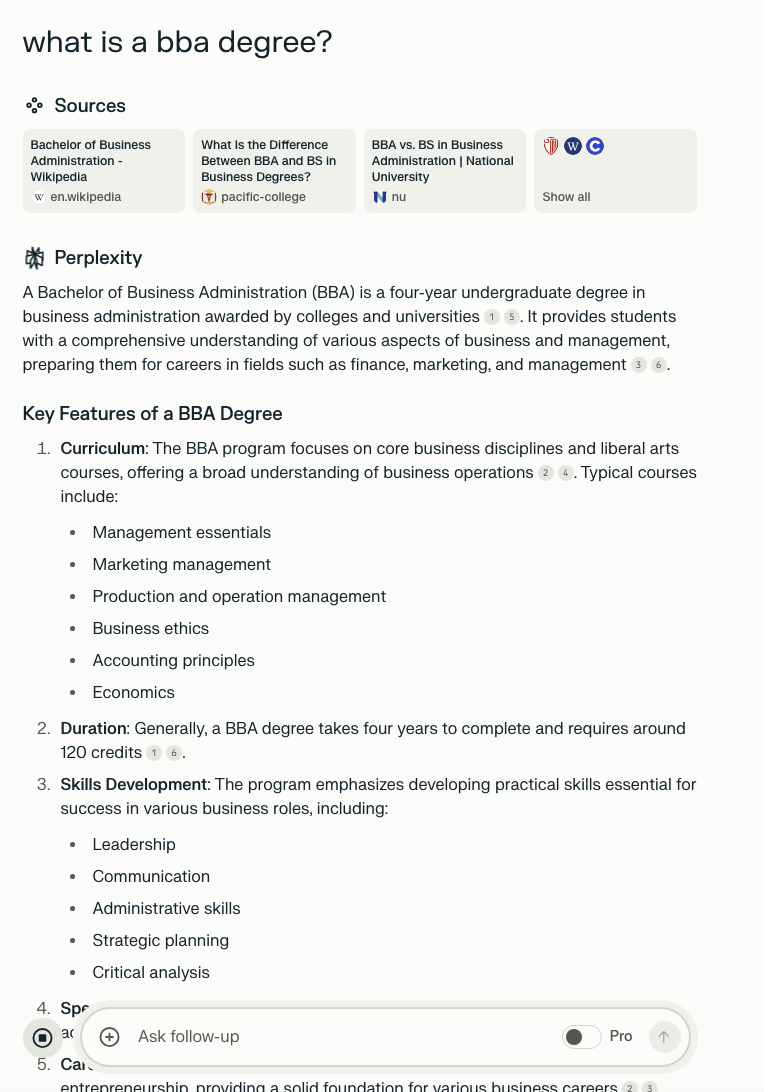
Strengths:
- Visual integration with relevant icons
- Clear curriculum structure with bullet points
- Comprehensive coverage of skills developed
- Strong organization with distinct sections
- Includes salary and job opportunity information
Weaknesses:
- Some redundancy in content organization
- Could provide more detail about program length
- Some sections could be more detailed
Optimal Use Cases:
- Google AIO: Best for quick understanding of degree basics
- ChatGPT Search: Ideal for detailed program understanding
- Perplexity: Most effective for career-focused exploration
D. Entertainment
Query analyzed: "What movies are getting good reviews right now?"
Google AI Overview
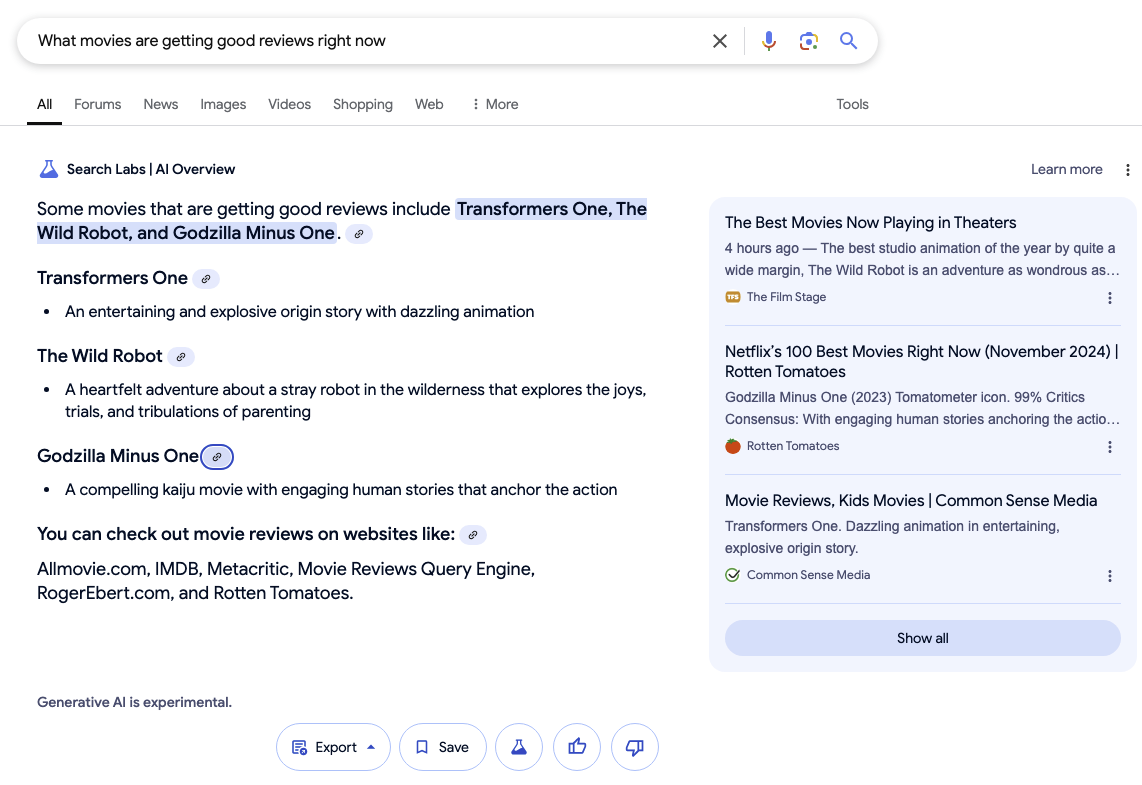
Strengths:
- Current, actually in-theaters movies listed
- Clear differentiation of movie status
- Includes Rotten Tomatoes scores
- Lists multiple viewing platforms
- Real-time review aggregation
Weaknesses:
- Could provide more context about each movie
- Limited detail about review sources
- Minimal plot descriptions
ChatGPT Search
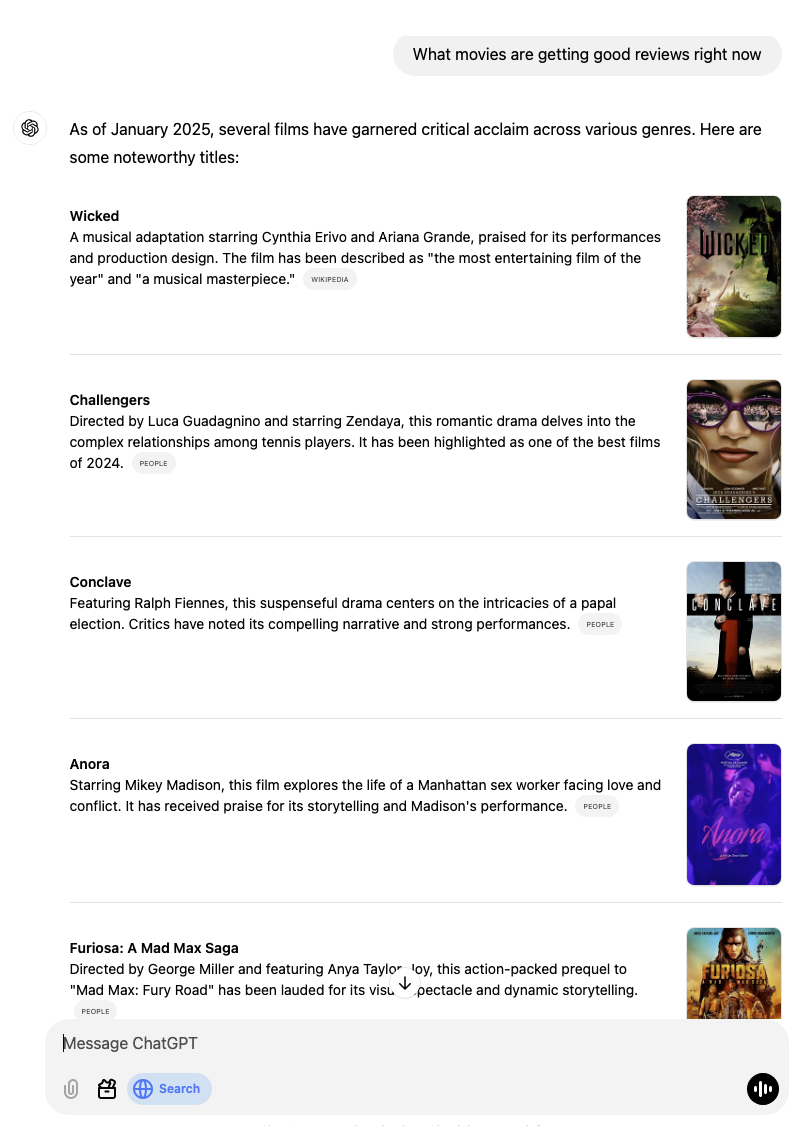
Strengths:
- Explicitly dates the information
- Includes movie posters/visual elements
- Provides brief but informative descriptions
- Good genre diversity
- Clear, organized presentation
Weaknesses:
- Would benefit from review scores
- Could include more specific critic quotes
- Limited platform availability information
Perplexity
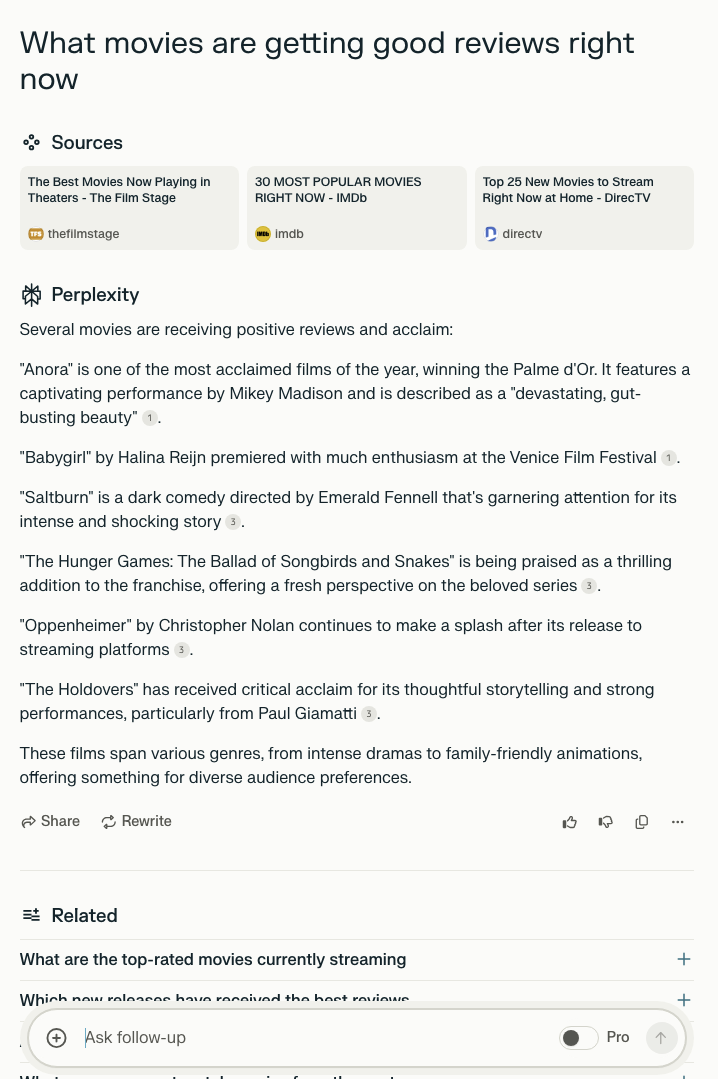
Strengths:
- Organized by viewing method
- Detailed movie descriptions
- Clear source attribution
Weaknesses:
- Information severely outdated
- Lists movies no longer in theaters
- Creates misleading impression of current options
Optimal Use Cases:
- Google AIO: Best for current movie-going decisions
- ChatGPT Search: Ideal for informed current entertainment choices
- Perplexity: NOT recommended for time-sensitive queries
E. Healthcare
Query analyzed: "What is gluten?"
Google AI Overview
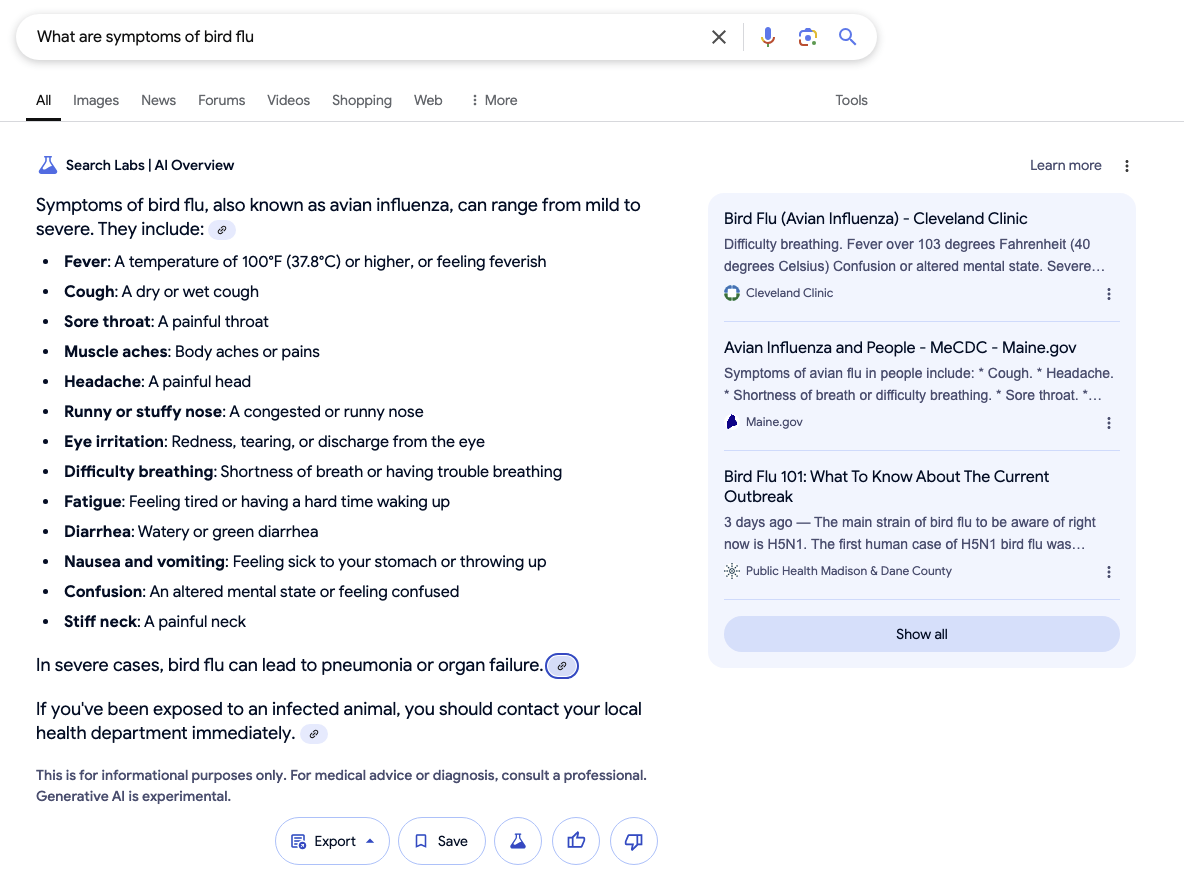
Strengths:
- Clear, layered explanation starting with basic definition
- Visual aids showing gluten-containing foods
- Organized sections with expandable details
- Includes practical applications
- Professional medical disclaimer
- Links to authoritative sources
Weaknesses:
- Some technical terms could use more explanation
- Information somewhat fragmented across sections
- Could provide more gluten-free alternatives
ChatGPT Search
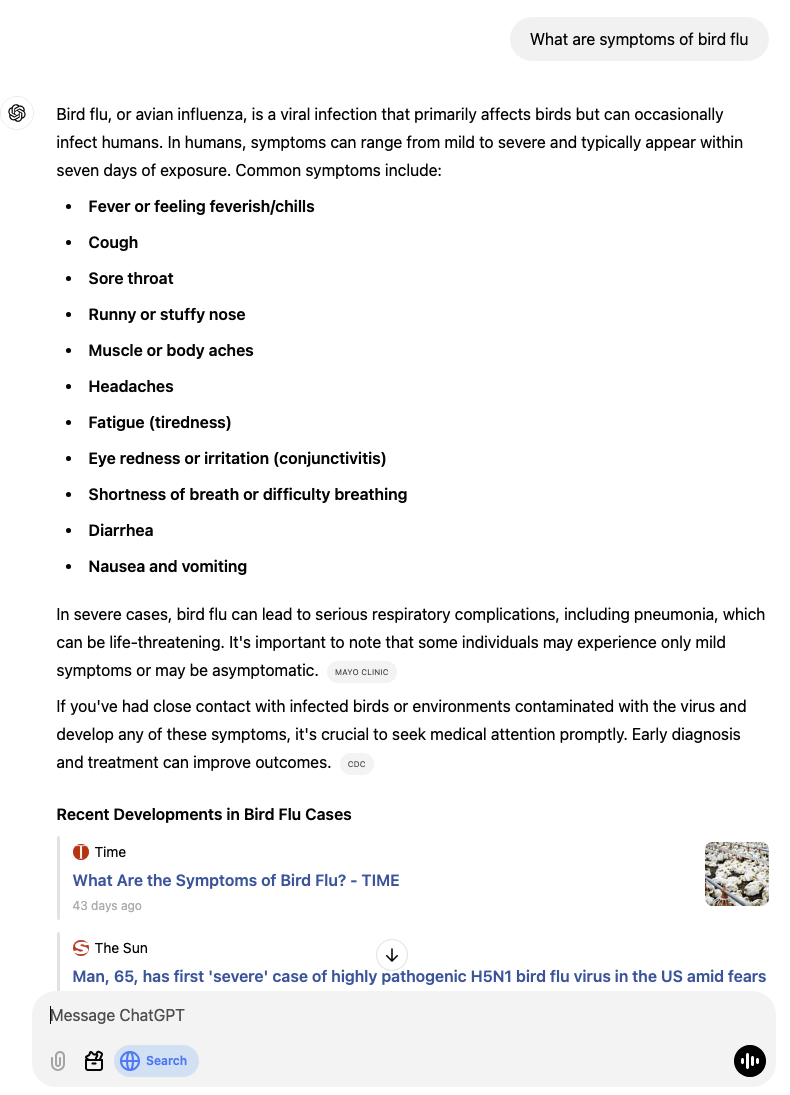
Strengths:
- Comprehensive narrative flow
- Clear explanation of medical conditions
- Well-organized health impact information
- Practical advice about hidden sources
- Recent relevant articles with visuals
- Strong focus on both scientific and practical aspects
Weaknesses:
- Dense text might be challenging for quick scanning
- Could benefit from more visual aids
- Technical terms introduced before full explanation
Perplexity
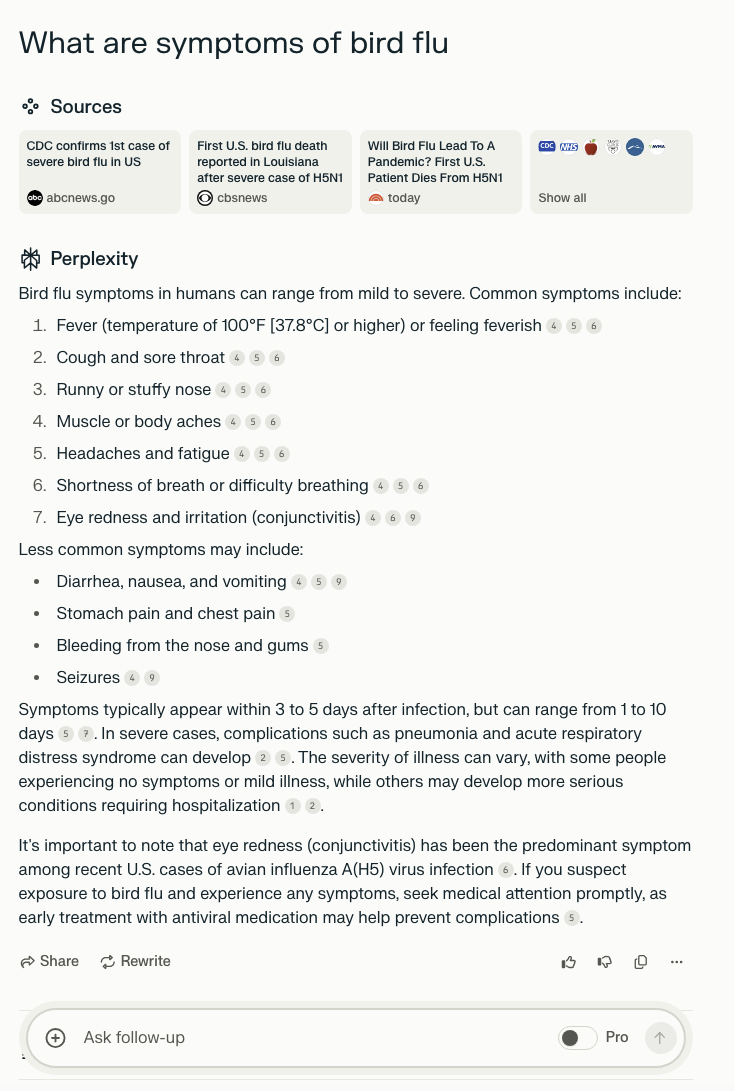
Strengths:
- Integration of informative visuals and infographics
- Clean separation of basic facts and health considerations
- Clear breakdown of properties
- Visual guides for food choices
- Good balance of technical and practical information
- Effective use of color-coded visual aids
Weaknesses:
- Some repetition in content
- Could provide more detail about testing and diagnosis
- Less information about practical food choices
Optimal Use Cases:
- Google AIO: Best for quick, authoritative information
- ChatGPT Search: Ideal for understanding health implications
- Perplexity: Most effective for visual learners and basic education
F. Insurance
Query analyzed: "What is Occupational Health?"
Google AI Overview
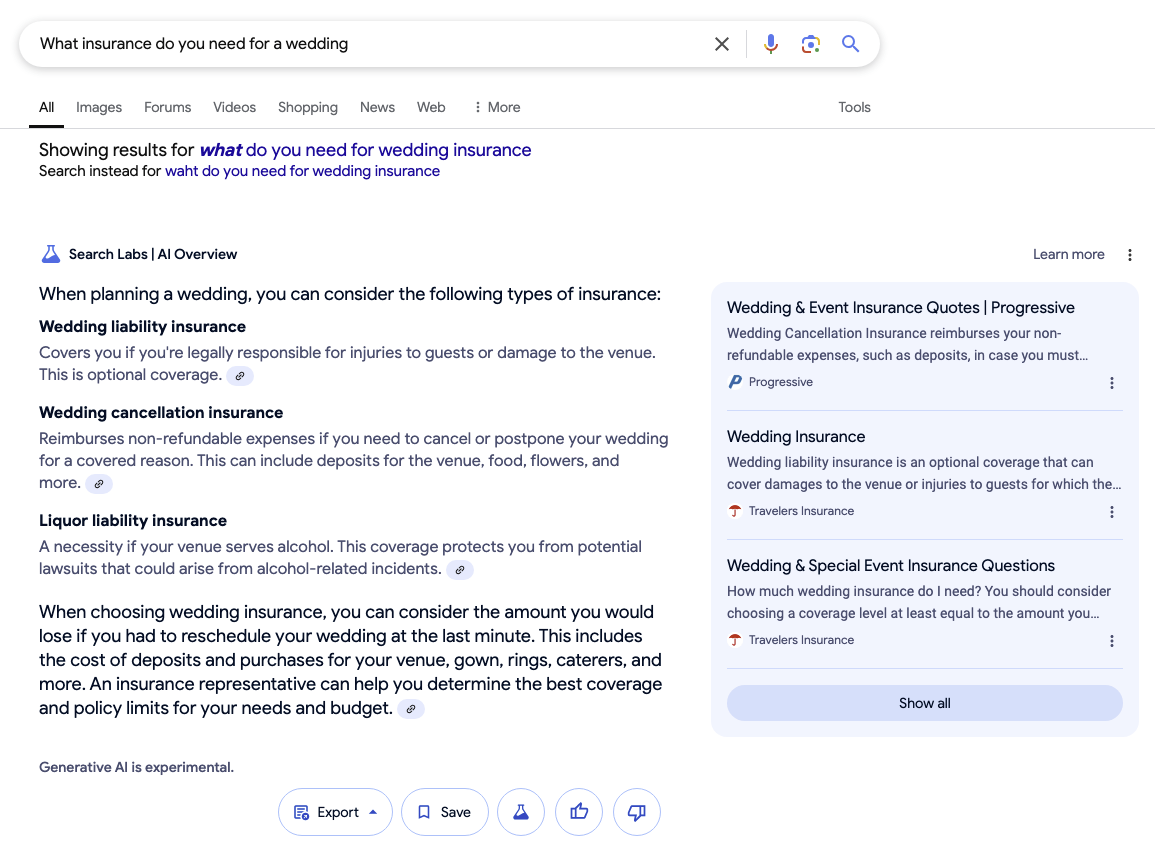
Strengths:
- Clear upfront statement about requirements
- Well-organized coverage types with explanations
- Specific provider recommendations
- Practical considerations for selection
- Includes timing information
- Comprehensive breakdown of components
Weaknesses:
- Could provide more cost information
- Limited information about regional variations
- Could include more specific requirements
ChatGPT Search
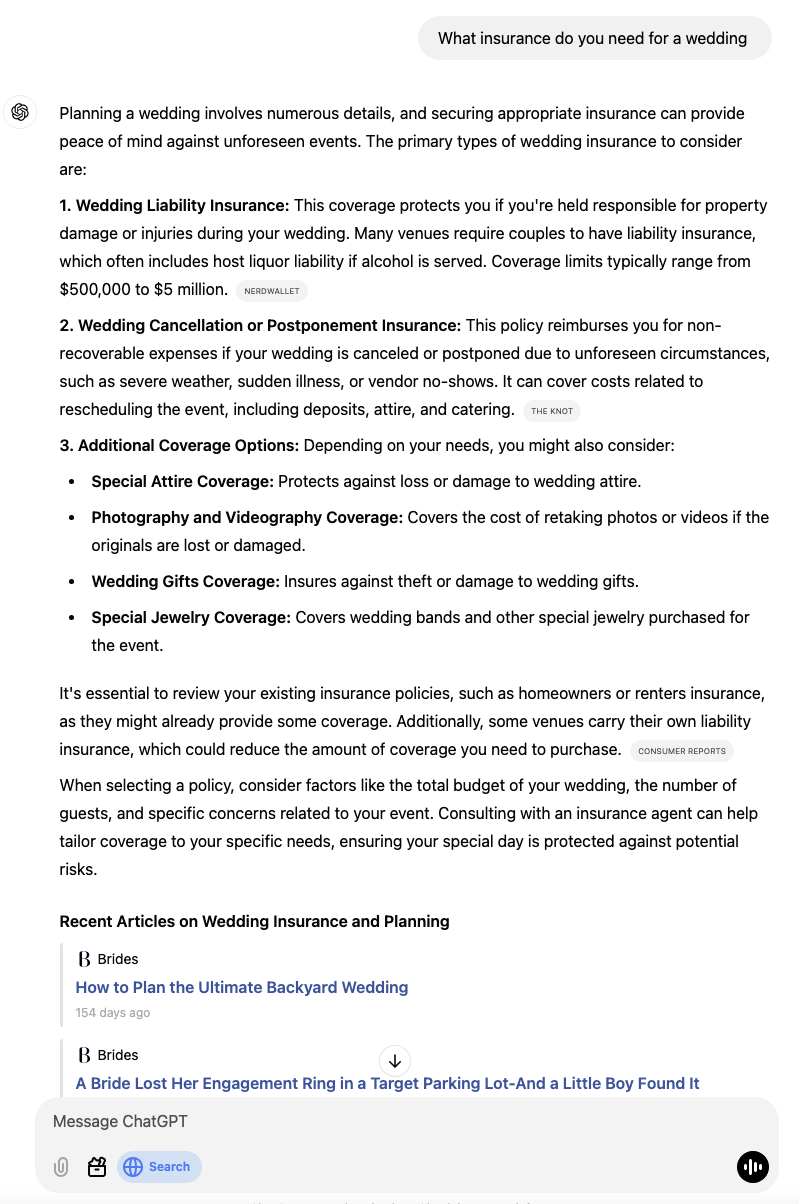
Strengths:
- Specific price ranges for different coverage types
- Clear action items
- Strong emphasis on requirements
- Practical considerations about existing coverage
- Good balance of detail and accessibility
- Clear source attribution
Weaknesses:
- Could include more specific provider information
- Less information about special coverage options
- Limited information about purchase process
Perplexity
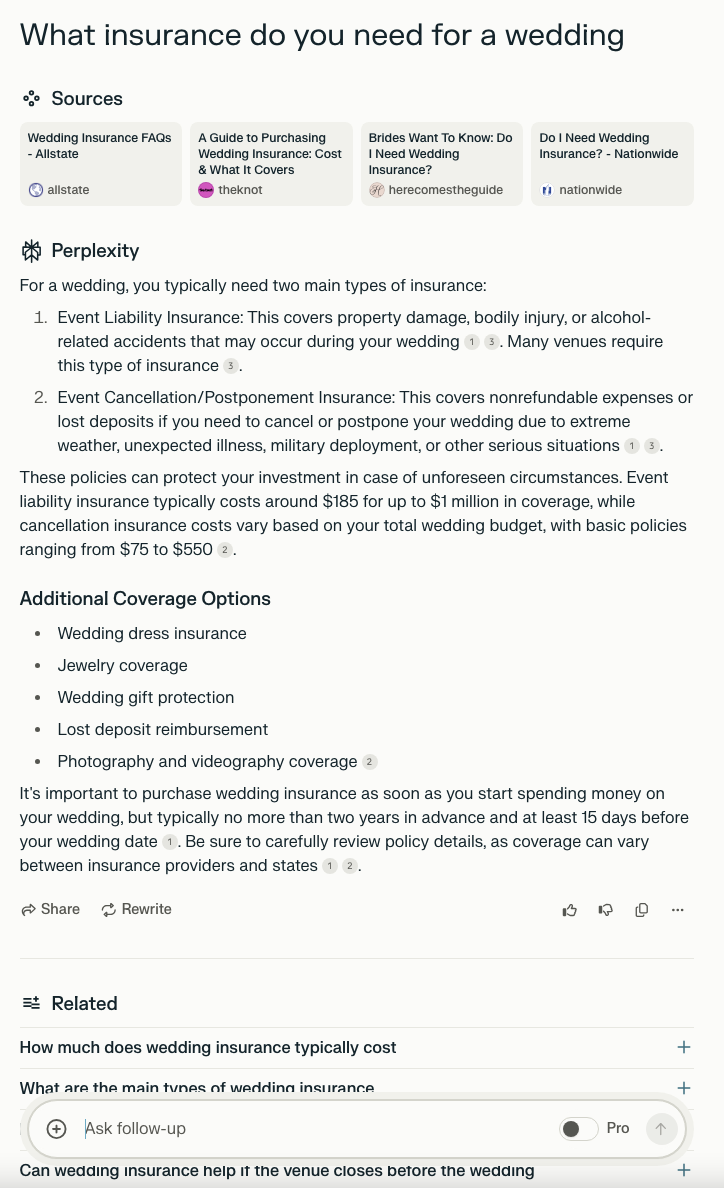
Strengths:
- Clear two-category breakdown of types
- Specific price range information
- Strong related questions section
- Good balance of required vs. recommended coverage
- Clear requirement information
- Expandable follow-up questions
Weaknesses:
- Less detailed about specific providers
- Could provide more information about special coverage
- Limited information about timing
Optimal Use Cases:
- Google AIO: Best for understanding insurance options and providers
- ChatGPT Search: Ideal for practical planning steps
- Perplexity: Most effective for initial research with follow-ups
G. Restaurant
Query analyzed: "What restaurants have tuesday specials near me?"
Google AI Overview
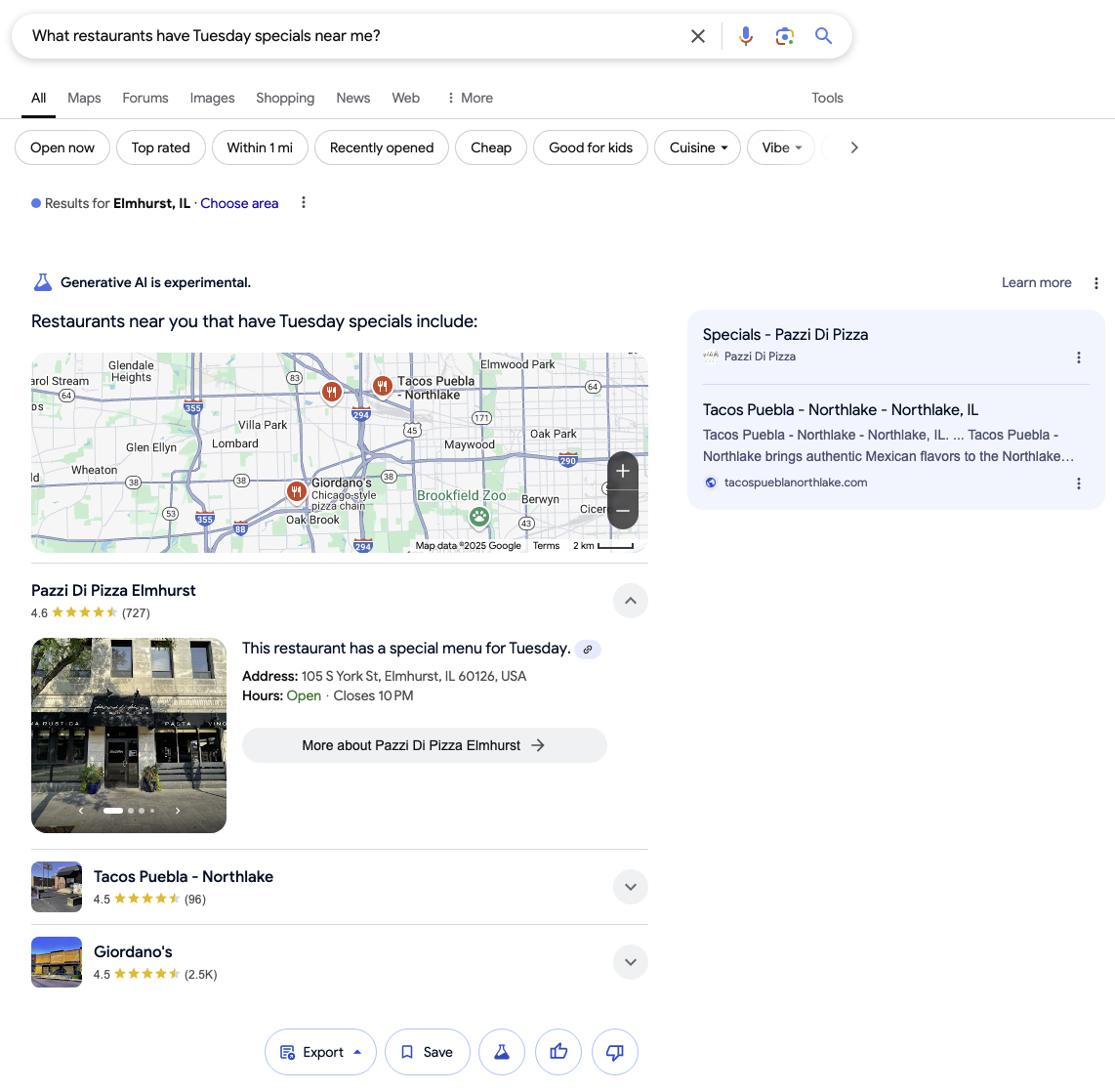
Strengths:
- Immediately addresses common specials
- Acknowledges variety of possibilities
- Keeps information general to maintain relevance
- Links to specific examples
- Conservative with information to maintain accuracy
Weaknesses:
- Very limited specific information
- No map integration visible
- Minimal detail about actual specials
- No pricing information
ChatGPT Search
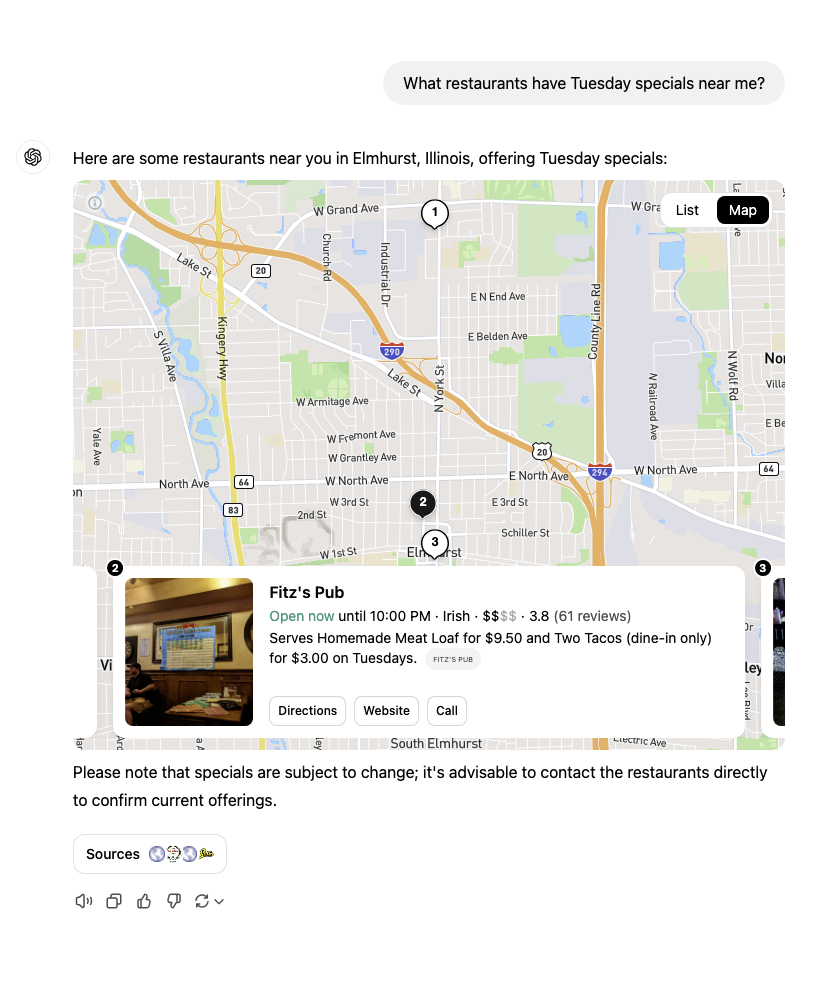
Strengths:
- Includes interactive map interface
- Shows specific restaurant locations
- Provides actual pricing information
- Includes business hours
- Offers directions and call options
- Clear disclaimer about confirming specials
Weaknesses:
- Limited to just one restaurant example
- Map shows multiple locations but only one detailed
- Could provide more variety of cuisine types
Perplexity
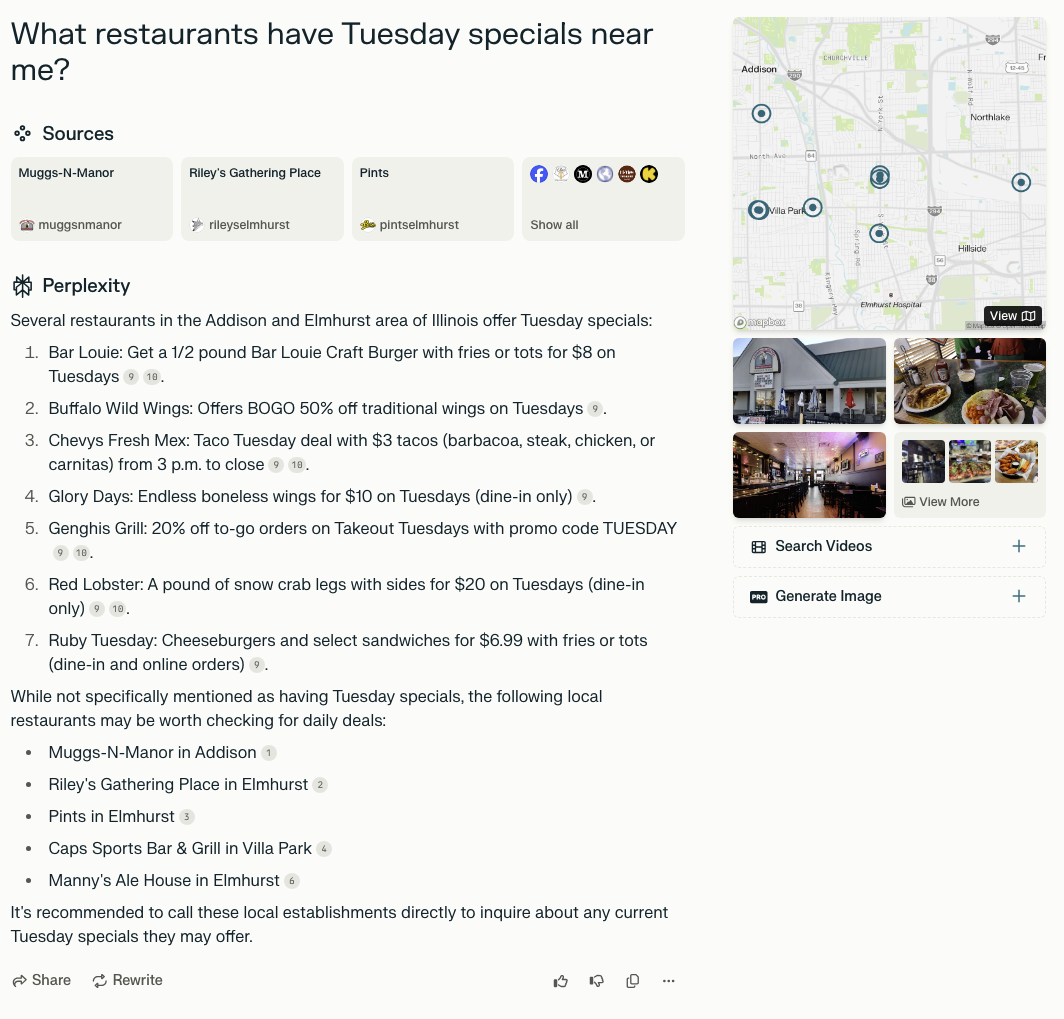
Strengths:
- Lists multiple specific restaurants
- Includes detailed descriptions of specials
- Provides price information
- Describes atmosphere and experience
- Variety of cuisine types
- Includes menu details
Weaknesses:
- Information appears outdated
- No indication of current validity
- No specific location context
- Missing interactive elements
- No way to confirm current specials
Optimal Use Cases:
- Google AIO: Best for general guidance about specials
- ChatGPT Search: Ideal for finding and navigating to specific locations
- Perplexity: Better for understanding types of specials (if verified elsewhere)
H. Travel
Query analyzed: "What are some good things to do in Milwaukee?"
Google AI Overview
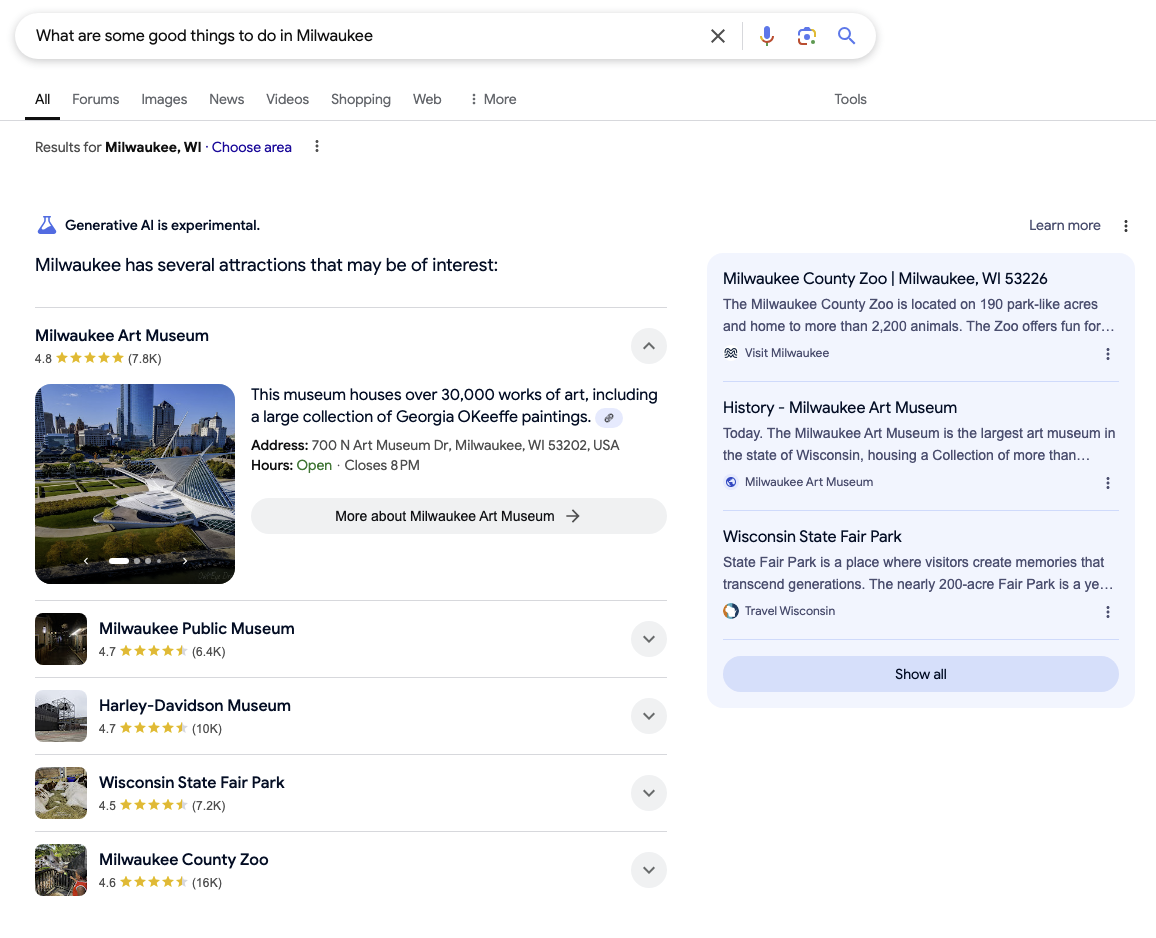
Strengths:
- Interactive map integration with attraction locations
- Star ratings for attractions
- Contact information and addresses
- Visual content with attraction photos
- Clear categorization of major attractions
- Quick access to essential visitor information
Weaknesses:
- Limited description of each attraction
- Minimal context about why to visit each place
- Could include more diverse activities
- Limited seasonal information
ChatGPT Search
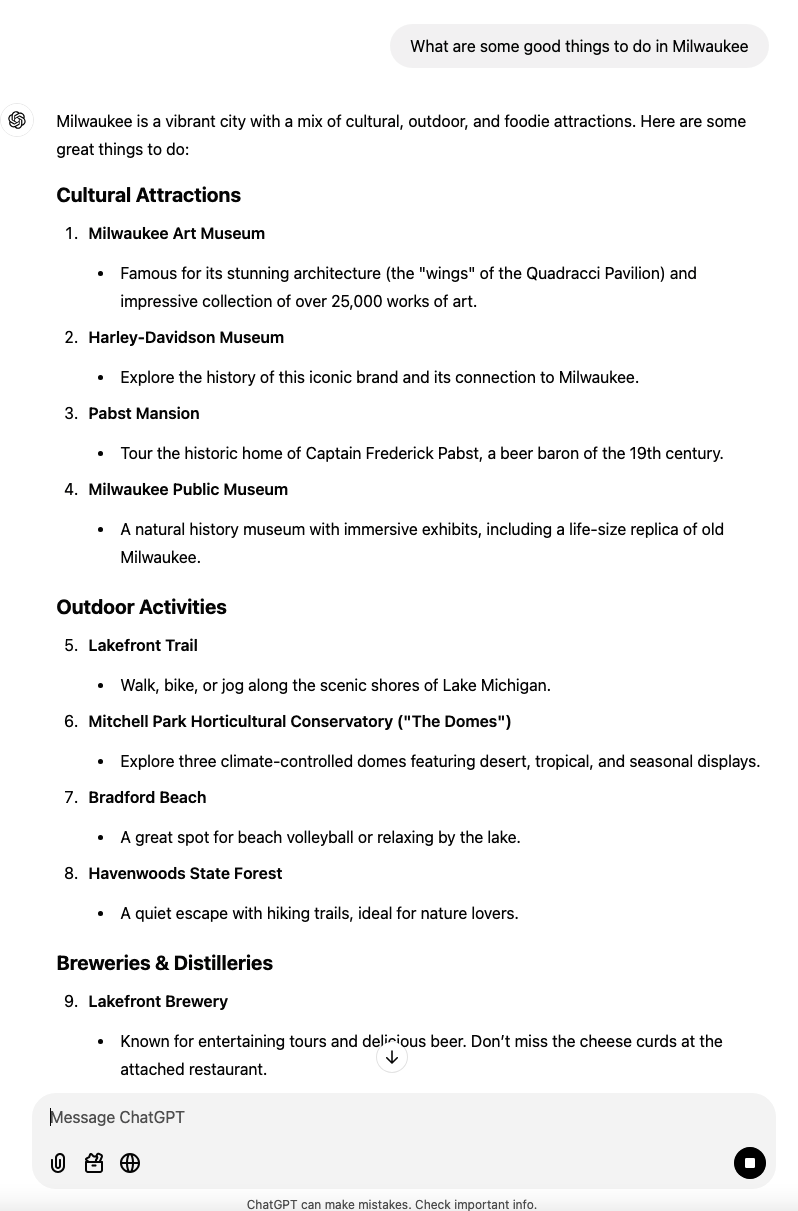
Strengths:
- Interactive map with multiple attraction pins
- Detailed venue descriptions
- Architectural details for attractions
- Directions and website options
- Cultural context for the city
- Visual integration with location photos
Weaknesses:
- Limited number of attractions shown
- Could provide more practical details
- Missing operating hours and pricing
- Limited variety of activity types
Perplexity
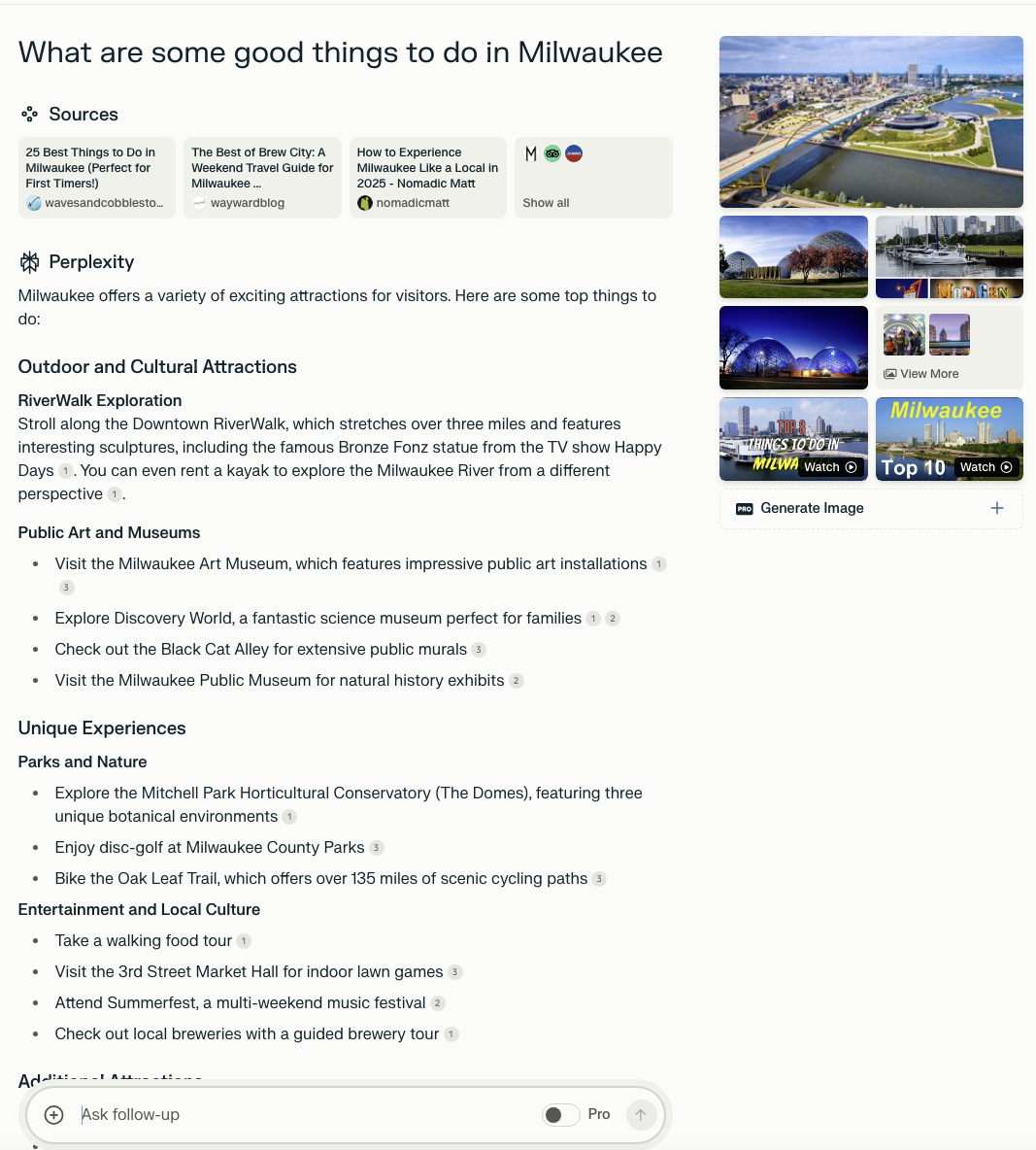
Strengths:
- Well-organized categories (Cultural, Outdoor, Brewing)
- Comprehensive variety of activities
- Detailed descriptions with context
- Visual integration with city photos
- Balance of different attraction types
- Includes practical activities
Weaknesses:
- No interactive map
- Missing practical details (hours, pricing)
- Limited transportation information
- No seasonal considerations
Optimal Use Cases:
- Google AIO: Best for quick attraction finding and navigation
- ChatGPT Search: Ideal for planning specific venue visits
- Perplexity: Most effective for comprehensive trip planning
I. E-commerce
Query analyzed: "What are some good gas powered RC cars and where can I buy one?"
Google AI Overview
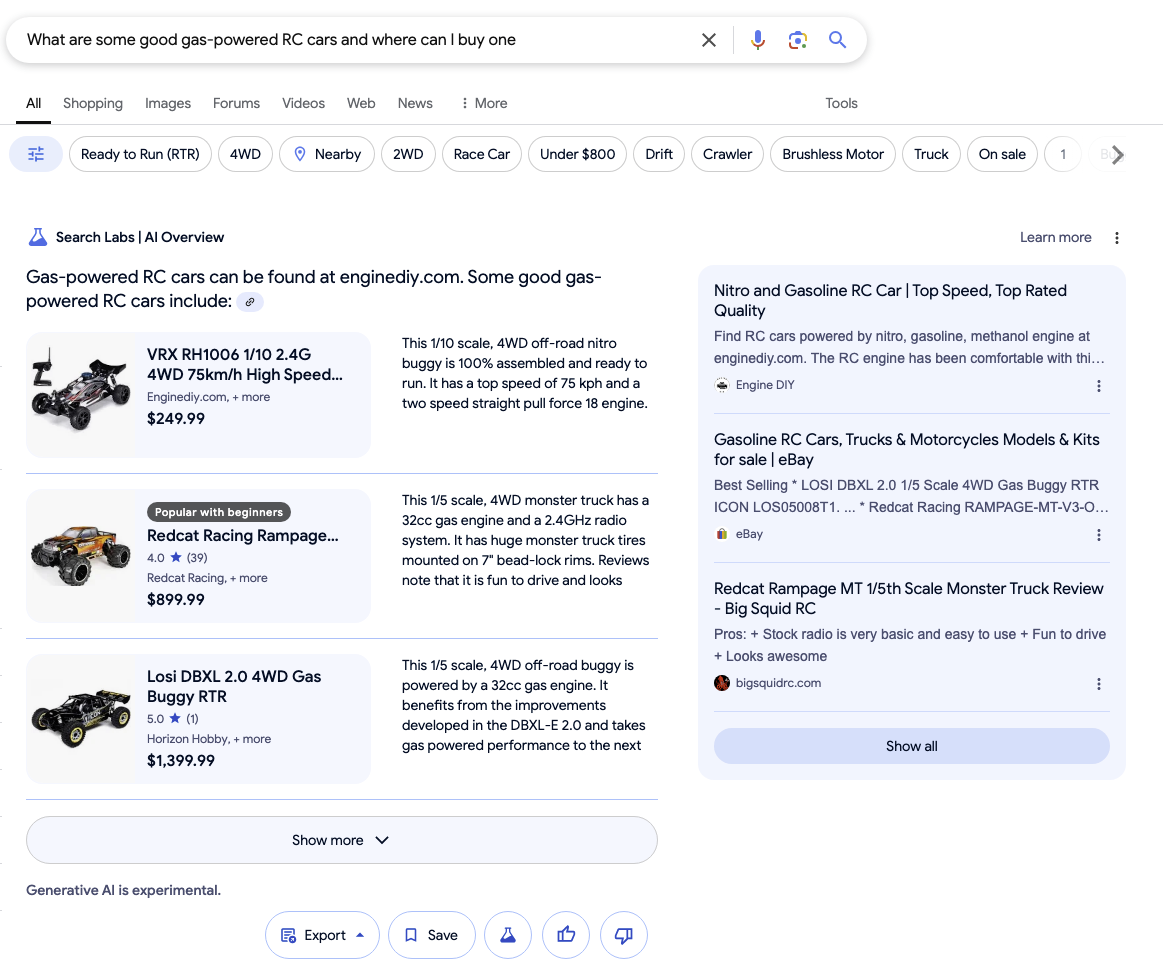
Strengths:
- Clear product images
- Specific pricing information
- Basic technical specifications
- Organized product listings
- Price filtering options
- Explains key features
Weaknesses:
- Limited purchase location information
- Minimal comparison between models
- Could provide more technical details
- No user reviews or ratings
ChatGPT Search
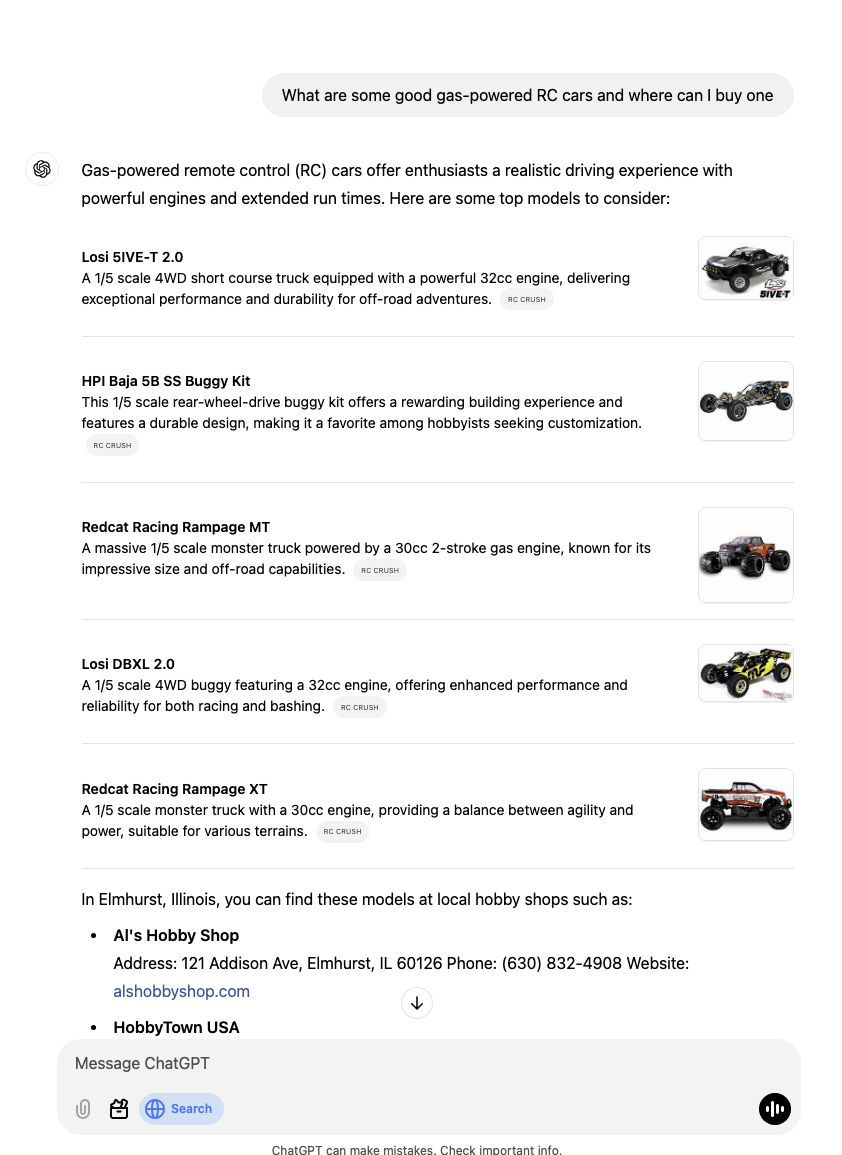
Strengths:
- Detailed product descriptions
- Multiple model recommendations
- Specific local store information
- Contact details for retailers
- Technical specifications
- Clear use-case scenarios
- Product images
- Geographic specificity
Weaknesses:
- Limited to one geographic area
- No online purchase options
- Missing price information for some models
- No user reviews
Perplexity
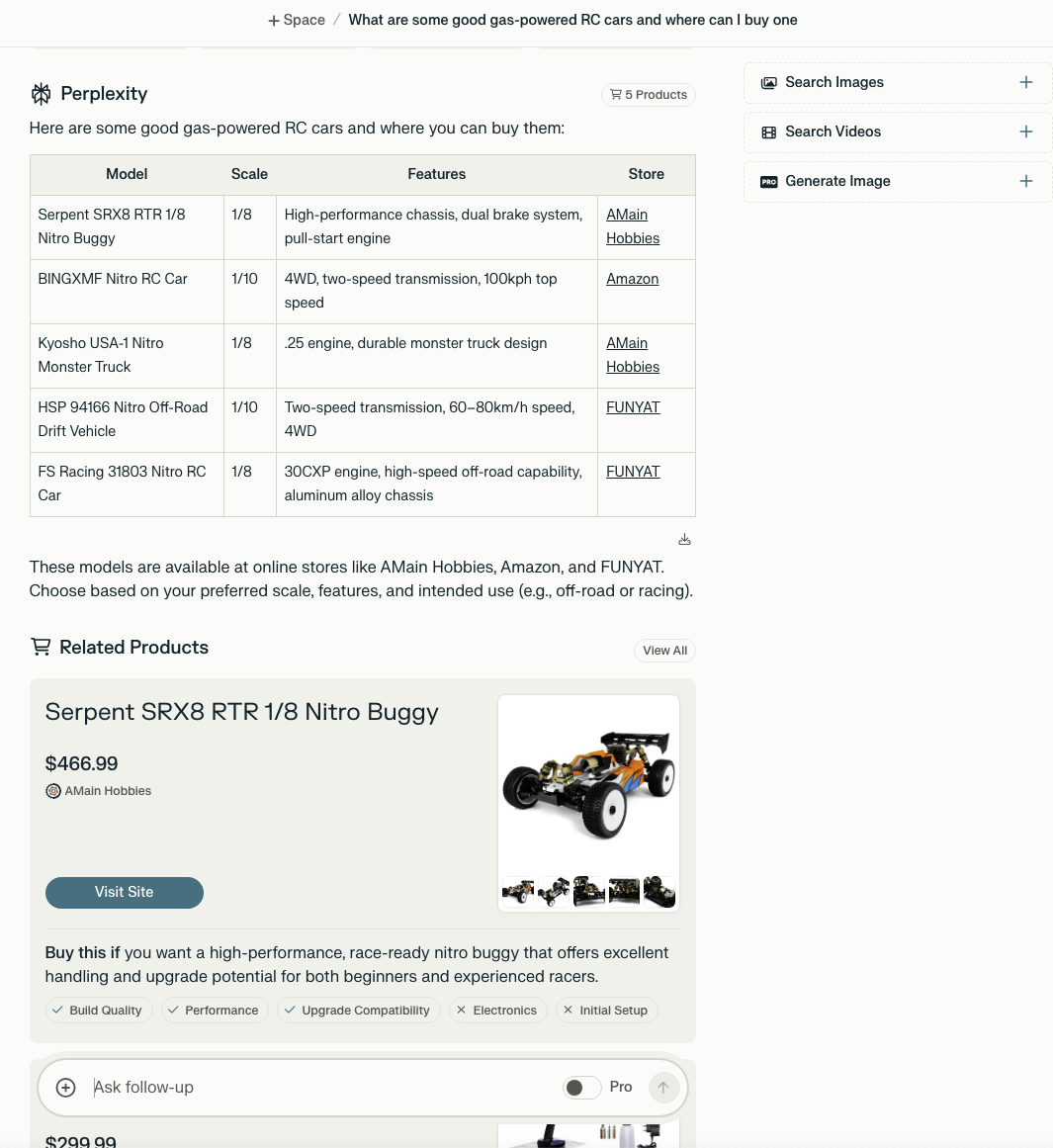
Strengths:
- Direct purchase links
- Product images with multiple views
- Specific retailer recommendations
- Clear pricing information
- Product features highlighted
- "Visit Site" direct purchasing option
- Related products suggestions
Weaknesses:
- Fewer model options
- Limited technical specifications
- Less detailed descriptions
- No comparison features
Optimal Use Cases:
- Google AIO: Best for initial product research and pricing
- ChatGPT Search: Ideal for local purchase with expert guidance
- Perplexity: Most effective for direct online purchasing
Summary of Key Findings:
- Time-Sensitive Information: ChatGPT Search and Google AIO excel at current information, while Perplexity sometimes shows outdated data
- Visual Integration: All platforms handle visuals differently, with ChatGPT Search showing strong integration of maps and images
- User Experience: Each platform has distinct strengths in different verticals
- Practical Application: ChatGPT Search consistently provides strong practical guidance and real-world context
How to Prepare for SearchGPT
SearchGPT replies on many elements that are familiar to SEOs. A major nuance is that it relies on Bing’s index for its citations. As a result, SEOs who may not have focused on Bing may need to incorporate it more into their strategies as SearchGPT is broadly rolled out. In addition to fundamental Bing SEO work, there are a few other key optimizations that this analysis suggest SEOs and digital content marketers should consider:
- Ensuring Content is Indexed by Bing
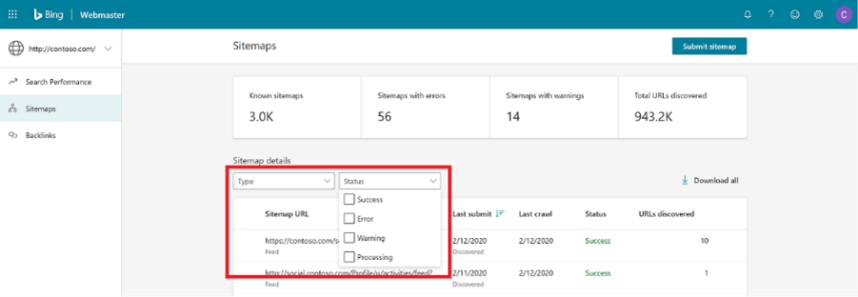
Since SearchGPT leverages Bing's index, it's crucial to ensure your content is properly indexed by Bing. As with other major engines, if it is not in Bing’s index, it will not be visible. There are a couple ways to ensure this is happening:
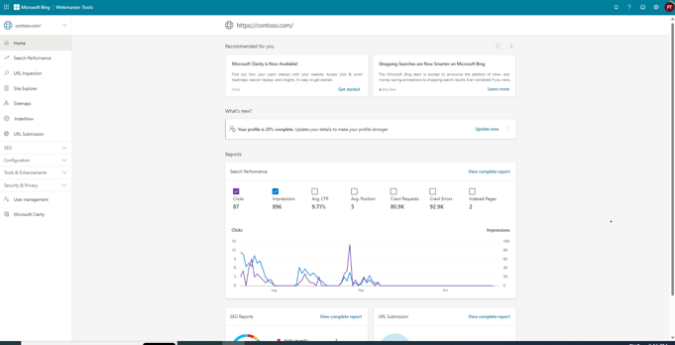
a) Using Bing Webmaster Tools:
- Submit your website's URLs and XML sitemaps regularly.
- Bing also provides a URL inspection tool which can be used to test new pages are indexed and thus eligible to be cited by SearchGPT: 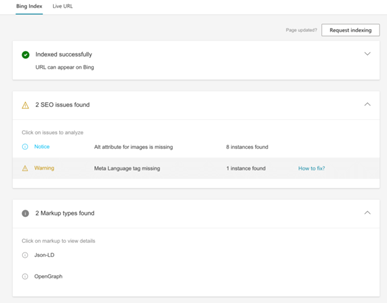
- Ensure your robots.txt file doesn't block important content.
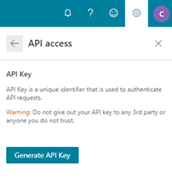
- For enterprise websites publishing multiple pieces of content daily, Bing offers an API to ensure it's indexed immediately. This is particularly important for websites that publish schedules, pricing information or other content that is prone to changing quickly.
- Optimizing Content for Comprehensive Coverage
SearchGPT tends to favor detailed, well-structured content. Based on the analysis, SearchGPT makes it easy to include lots of additional resources in the right panel, some of which aren’t directly used as citations for the answer. This means content that anticipates follow-ups and covers related subjects may have greater chances of appearing as a citation (which could lead to a referral). To optimize for this ensure content addresses multiple aspects of a topic. BrightEdge Copilot for Content Advisor can assist in this. By building briefs that assess the questions also asked by users as well as incorporate content addressed by high ranking pages, content marketers can start with a framework that has the required content to address topics for AI-powered engines like SearchGPT.
- Leveraging Schema Markup
Implement structured data to help SearchGPT better understand and potentially cite your content
a) Key Schema Types to Consider:- Article schema for blog posts and news articles.
- FAQPage schema for Q&A content.
- HowTo schema for step-by-step guides.
- Product schema for e-commerce pages.
- LocalBusiness schema for location-based businesses.
- Optimizing for Practical and Action-Oriented Content
SearchGPT shows a preference for practical, actionable information. This means content should address use cases, situational applications and how-to elements a user will want to know about the subject. Much of this can be pinpointed using Content Advisor, but Data Cube X can help identify the topics around a keyword that should be addressed. :
- Focusing on Industry-Specific Insights. SearchGPT relies on authoritative sites for citations. It often also cites stats and insights specific to the category of the keyword. Ensuring data points and unique insights are part of your content strategy should increase the likelihood of a citation for SearchGPT.
- Optimizing for Local and E-commerce Queries. While SearchGPT has a limited shopping experience compared to AI Overviews, they are key aspects SEOs can focus on to ensure their products are optimized for inclusion from SearchGPT. Similarly, for local-oriented content, there are aspects of Bing that SEOs can use to ensure their content is likely to be included:
a) Local SEO Optimization:- Ensure your Google My Business and Bing Places listings are up-to-date.
- Create location-specific content that addresses local customer needs.
b) E-commerce Optimization:- Implement detailed product schema markup.
- Create comprehensive product descriptions with specifications, uses, and comparisons.
Conclusion
SearchGPT represents a significant evolution in the AI search landscape, offering both opportunities and challenges for digital marketers and SEO professionals. As we've explored throughout this guide, SearchGPT's unique approach to information retrieval and presentation sets it apart from traditional search engines and even other AI-powered platforms.
Key takeaways for marketers:
- SearchGPT appears to favor in-depth, multi-faceted content that addresses various aspects of a topic. This underscores the importance of creating thorough, well-structured articles and resources.
- Answers observed draw from a wide range of authoritative sources, highlighting the need for content to be not just comprehensive, but also credible and well-cited.
- SearchGPT demonstrates a preference for actionable information and real-world examples, particularly in e-commerce and how-to queries.
- The integration of charts, infographics, and other visual aids can enhance content visibility and comprehension in SearchGPT's results.
- Anticipation of User Intent: SearchGPT's ability to predict and address potential follow-up questions emphasizes the importance of creating content that covers related topics and queries.
It's crucial to note that SearchGPT is still in its infancy, having been introduced to a limited user base. As such, the observations and strategies outlined in this guide are based on early interactions and may evolve rapidly. The platform's capabilities, ranking factors, and impact on search behavior are likely to undergo significant changes as it develops and expands its user base.
For SEO professionals and digital marketers, staying agile and adaptive will be key. Regularly monitoring SearchGPT's development, testing different content strategies, and keeping abreast of updates from OpenAI will be essential in navigating this new search paradigm.
While optimizing for SearchGPT presents new challenges, it also offers exciting opportunities to create more valuable, comprehensive, and user-focused content. By embracing these changes and adapting strategies accordingly, marketers can position themselves at the forefront of this AI-driven search revolution!