




What Share of Voice Really Means for Search in 2026

Jim
Jim
M Posted 2 months 2 weeks ago
t 9 min read

There has never been a more important time to understand your true share of voice in search.

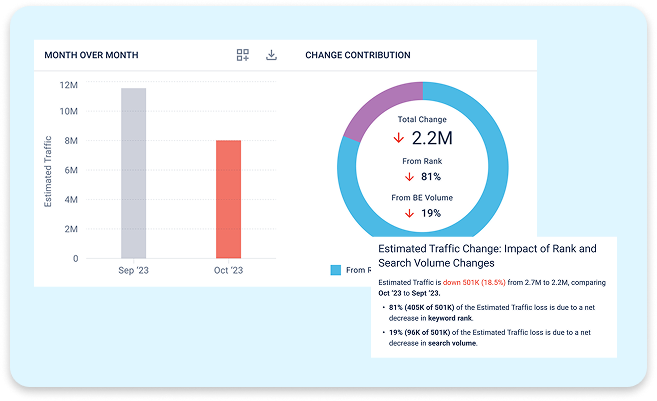
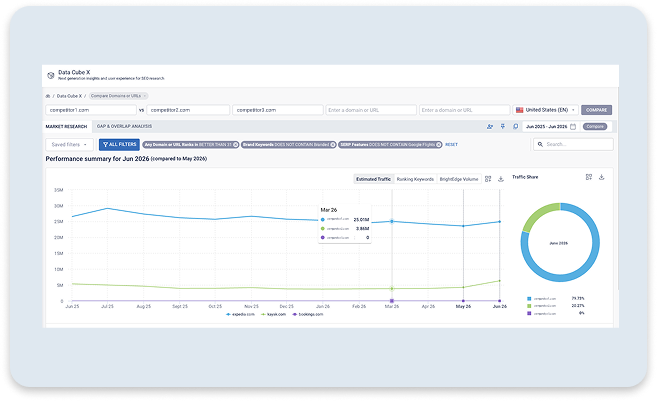
Share of voice has always been one of marketing's most critical metrics—whether you're measuring GRPs in TV, impression share in paid media, or brand mentions in social. The principle is simple: what percentage of the conversation do you participate versus your competitors?

As the industry and innovation leader, BrightEdge was the first company to define and patent Share of Voice capabilities for organic search. Search had become the most critical channel for brand discovery, and marketers needed the same competitive visibility they had in every other channel.

Share of voice used to mean measuring your brand's presence in Google results — because that's where most searches happened. Simple enough.

But AI has changed the landscape in two important ways. First, AI Overviews now appear across millions of queries, and brand presence there might be a mention buried in the middle of a summary rather than a blue link you own. Second, new discovery channels like ChatGPT and Perplexity have emerged — and people are using them to research brands and products.

The good news? This doesn't have to be complicated. Share of voice isn't broken by AI — it's extended by it. The core question is still the same: where does your brand show up versus competitors, and what do you do about it? You just need visibility across more surfaces now.

It All Runs on Search — Including AI

Organic search remains as important as ever.

BrightEdge AI Market Pulse data shows Google still commands over 90% of all search traffic. AI search platforms combined account for less than 1% of total referrals. And organic search consistently outperforms every other channel on conversions.

But the role organic plays in your customer's journey is evolving. AI is now part of how people research before they convert. Our research also shows AI search functions primarily as a discovery channel—users ask questions, gather information, then convert through organic search or direct.

AI isn't replacing the purchase journey. It's adding a layer to the top of it. That means you need visibility into both—not to choose between them, but to understand how they work together.  For share of voice, that means understanding where your brand shows up when customers are researching and being recommended by AI—and whether you're there in organic search when they're ready to visit or buy.

We Saw This Play Out Over the Holidays

The holiday season gave us a preview of what the competitive landscape looks like when organic and AI search work side by side.

Google AI Overviews acted as the trusted advisor—only 4% of citations went to direct retailers. The rest went to editorial sources, helping users research before buying. ChatGPT took the opposite approach, linking directly to retailers at 9x the rate of Google.

The result? Google maintained dominance because consumers still want help with the research phase. They're not ready to delegate purchase decisions to AI.

What does this mean for share of voice? You need visibility in both places. Your organic rankings get you in front of buyers ready to convert. Your AI presence gets you into the research phase where decisions are shaped.

Expanding How We Think About Share of Voice

You've always been able to see where you stand on the SERP. The question now is: can you see where you stand across the full discovery journey?

Think about how your customers actually search today. They might start in ChatGPT or Perplexity to explore options. They might see your brand—or your competitor—recommended in a Google AI Overview before they ever see a blue link. They're getting answers, recommendations, and comparisons from AI before they decide what to click.

This is where share of voice needs to extend. Not just your rankings on the SERP, but whether ChatGPT is recommending you when someone asks for options in your category. Whether Perplexity is citing your content or your competitor's. Whether you're appearing in AI Overviews for the queries that matter to your business.

It's not a replacement for organic visibility—it's an extension of where competitive intelligence needs to reach. The brands that understand their position across this full landscape will make better decisions about where to invest and how to win.

This Is Why Platform Matters

This is what share of voice looks like in 2026: your competitive position across organic search and AI discovery, connected in one place. When you can see both, you can optimize once and win everywhere. That's the power of an integrated platform.

It's not about tracking more dashboards or stitching together point solutions. It's about having a connected view of your true share of voice—one that shows how organic performance and AI visibility work together to drive business outcomes.


With BrightEdge, this happens without adding new views or extra manual work. It's all connected.

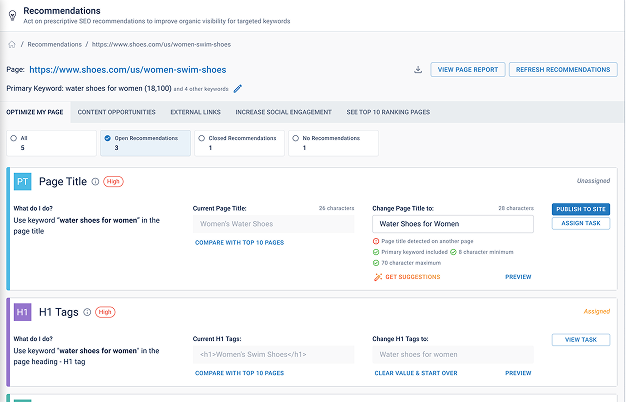
Share of Voice gives you the competitive landscape on the SERP—who's outranking you, how their content is structured, where you can win back real estate. It's the foundation.

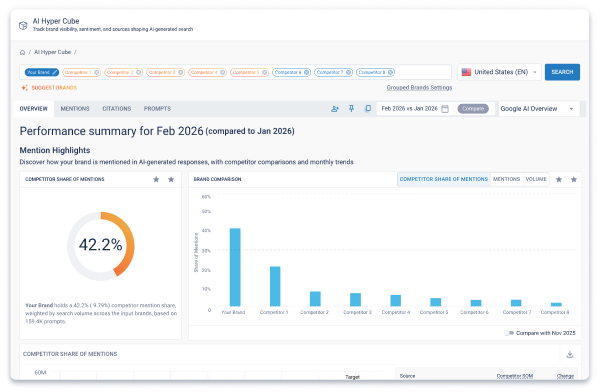
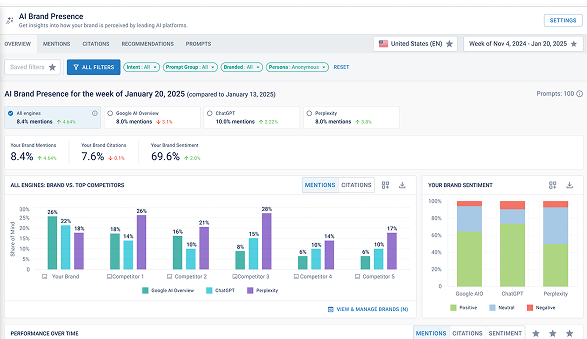
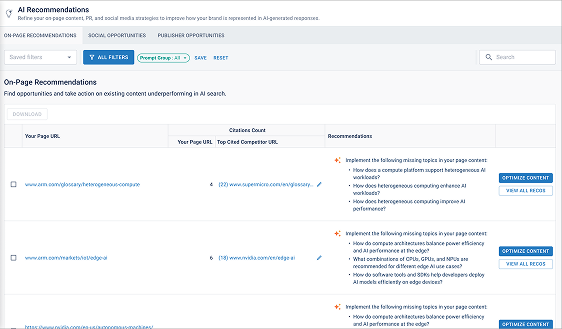
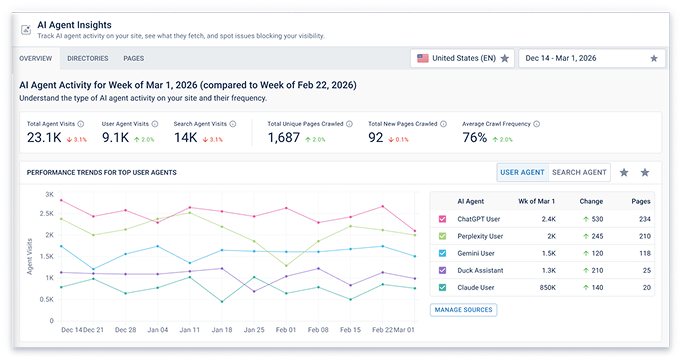
AI Catalyst extends that visibility into AI search—tracking your brand across Google AI Overviews, ChatGPT, and Perplexity, showing where you're being cited versus competitors. It's the emerging layer.

StoryBuilder brings it together—dashboards that are ready to use out of the box but adaptable to your specific business needs, combining organic rankings, AI visibility, and business outcomes in one unified view.

When these pieces connect, you're not just seeing data. You're seeing the full competitive picture—and that's what lets you optimize once and win everywhere.

Looking Ahead

The brands that win in 2026 will be the ones that understand the role each channel plays in their customer's discovery path. Organic search. AI Overviews. AI-first engines. They're not competing priorities—they're connected surfaces that require connected measurement.  And this is only going to matter more. Emerging capabilities like Instant Checkout and Google's Universal Commerce Protocol could collapse the entire journey from research to purchase into a single AI-driven experience. Understanding your share of voice across that full journey isn't a nice-to-have — it's how you stay visible when the path to conversion gets shorter.

Here's to making 2026 the year your brand wins across the full search landscape! We're excited to keep building alongside you!
If you want to see what your Share of Voice looks like across AI + organic in one view, let's connect!

Enterprise SEO Platforms vs SEO Tools: Choosing the Right Solution for Scale

lpark
lpark
M Posted 2 months 2 weeks ago
t 9 min read

2026 is shaping up to be the biggest year for SEO investment in half a decade. According to BrightEdge research, 90% of digital teams are increasing their SEO investment this year—the highest surge in five years, surpassing even COVID-era pivots. At the same time, over 90% of SEO professionals have either fully integrated AI search into their workflows or are actively testing it.

This convergence creates a critical decision point for marketing leaders: do you continue managing SEO complexity with a collection of specialized tools, or do you consolidate into a unified platform?

The answer depends on where your organization is today and where it needs to go. Here's how to think through the decision.

Understanding the Difference: Platforms vs. Point Solutions

SEO tools and enterprise SEO platforms both serve important functions, but they're designed for different contexts.

Point solutions excel at specific tasks. A technical crawler audits your site structure. A rank tracker monitors keyword positions. A backlink analyzer maps your link profile. Each does its job well—and for smaller organizations or focused use cases, that's often enough.

Enterprise SEO platforms take a different approach. Rather than solving individual problems, they provide an integrated environment where technical SEO, content optimization, competitive intelligence, and performance analytics work together. The goal isn't just functionality—it's alignment across teams, data sources, and strategic priorities.

The distinction matters because the challenges facing enterprise SEO teams aren't primarily technical. They're organizational.


The Hidden Cost of Tool Fragmentation

Here's the reality most enterprise SEO teams face: the tools work fine individually, but the system doesn't work as a whole.

According to the 2026 Marketing Intelligence Report from MarTech, 72% of in-house marketers say they're overwhelmed by the data they collect and find it difficult to turn into usable insight. When your rank tracker, site auditor, analytics platform, and content tools all operate independently, you end up with:

  • Multiple sources of truth. Is performance up or down? Depends on which dashboard you're looking at—and which metrics it prioritizes.
  • Siloed insights. Technical SEO lives with engineering, content optimization lives with marketing, and nobody has a unified view of how they connect.
  • Metric misalignment. Teams optimize for different KPIs because they're working from different data sets.
  • Duplicated effort. Extracting, cleaning, and combining data becomes a recurring project rather than a solved problem.

For organizations managing thousands of pages across multiple domains, markets, or business units, these coordination costs compound quickly.

When a Platform Becomes Essential

So when does a platform become the right choice? Certain conditions make consolidation not just helpful—but necessary.

You're coordinating across multiple teams. When SEO involves developers, content creators, product teams, and executives, a shared platform creates alignment that tool-hopping can't. Everyone sees the same data, tracks the same priorities, and measures success the same way.

Teradata's SEO transformation illustrates this well. Ron Weber, their Global Digital Strategist, inherited what he described as "a house on fire"—major technical and content issues across a large enterprise site. As the only dedicated SEO resource, he needed to coordinate with content teams, development resources, and leadership to drive change. Using BrightEdge's platform, Weber unified technical diagnostics, competitive intelligence, and content strategy in one place. The result: 723% traffic growth to key content in five months and a 3x increase in leads. More importantly, he could bring data to content stakeholders that gave them "the reason to believe" why they needed to prioritize SEO.

You're managing traditional SEO and AI search as one strategy. With AI Overviews now appearing in a significant percentage of search results—and AI-first search engines like ChatGPT Search gaining traction—optimizing for both traditional rankings and AI citations isn't optional. It's the same strategy executed across different surfaces.

This is where fragmented tools become particularly limiting. If your rank tracker can't show AI Overview presence, your content tool can't identify citation opportunities, and your analytics can't distinguish AI-driven traffic, you're flying blind in half the search landscape.

Overdrive Interactive faced exactly this challenge. The digital agency recognized that their clients were increasingly using AI to find and evaluate agency partners—meaning traditional SEO visibility wasn't enough. They needed to be cited in AI-generated responses. By leveraging BrightEdge's integrated capabilities—Recommendations for strategic insights, Data Cube X for keyword research, Copilot for content optimization—they executed what they called "The Authority Project." The outcome: 710% growth in AI Overview citations in just three months, along with #1 featured snippet rankings for competitive terms.

When you have a unified platform you can execute all of this in one motion.  They didn't treat AI search as a separate initiative requiring separate tools. AI is an extension of their SEO strategy, using a platform designed to connect those efforts.  This is how you optimize once and win everywhere.

You need enterprise-grade integrations. At scale, SEO doesn't exist in isolation. It connects to web analytics (Google Analytics 4, Adobe Analytics), search console data, CMS platforms, business intelligence tools, and existing workflows. Point solutions may offer individual integrations, but platforms provide unified data flows that maintain consistency across your marketing technology stack.

You're accountable for business outcomes, not just rankings. When leadership asks what SEO is contributing to pipeline or revenue, can you answer quickly and confidently? Enterprise platforms connect search performance to business metrics in ways that tool aggregation typically can't—because the data architecture is designed for that connection from the start.

Making the Transition: What to Expect

If you've ever been through a CRM migration, you might assume platform transitions are inherently painful—months of data mapping, legacy cleanup, and retraining teams on new workflows.

SEO platforms are different. There's no customer data to migrate, no historical records to reconcile, no integrations that break downstream processes. The platform connects to your existing data sources—Search Console, analytics, your site—and starts generating insights immediately.

That said, a quick audit of your current tool landscape is still valuable—not because the transition requires it, but because it clarifies what you're consolidating and helps you measure the efficiency gains. Which tools drive daily decisions? Where do you spend the most time on manual data work? That context makes onboarding faster and helps teams see the value sooner.

The right platform should feel like it's reducing complexity from day one, not adding another system to manage.

The Opportunity Ahead

The next year presents significant opportunities for organizations that get their SEO infrastructure right. AI search is expanding visibility for brands that understand how to optimize for it. Google's continued emphasis on quality and authority rewards organizations with strong technical foundations and unified content strategies.

But capturing that opportunity requires the ability to execute—quickly, at scale, and with alignment across teams.

Point tools have their place. For focused use cases or organizations with limited SEO complexity, they can be exactly the right choice. But for enterprise teams facing the dual challenge of scale and the AI search transition, a platform approach solves problems that tools alone cannot.

The question isn't whether platforms are "better" than tools. It's whether your current infrastructure can support where your SEO program needs to go.


EMEA Webinar: Optimizing Your WebsiteContent for AI Search

Exclusive survey insights and proven tactics to adapt your SEO for AI search success in 2026

This webinar originally aired on  February 10, 2026. Watch the full recording to learn how marketers are preparing for AI-infused search in 2026.

AI has fundamentally changed search. Google has infused AI into core features across the results page, from AI Overviews to enhanced "People also ask" and beyond. Platforms like ChatGPT search continue to grow their user base. Marketers who ignore these shifts risk falling behind.  

But here's what we've learned: success in this new landscape doesn't require juggling separate strategies for every platform. The teams seeing the best results are those building unified approaches, adapting their SEO practices for an AI-infused world while recognizing that organic search remains the predominant revenue driver.  

Access this recording to discover 2026 adaptations, enduring tactics, and BrightEdge tools for optimizing content across AI-infused search landscapes.  

What You'll Learn 

  • How leading teams strengthen core search foundations first to excel in AI-driven experiences.
  • What has shifted in search behavior and proven ways to adapt content without separate strategies.
  • How to measure success through visibility, authority signals, and perception in AI results.
  • How to streamline content workflows for conversational queries while staying campaign-focused.  

Key Takeaways 

  • Why strengthening SEO basics is non-negotiable before chasing AI opportunities.
  • The new metrics that matter most for proving content impact in zero-click searches.
  • Cross-team strategies that position your brand as the go-to authority across all digital touchpoints. 

Featured Speakers:

Mark Mitchell

Watch On-Demand Webinar

* indicates required


Gemini's December Surge: What Citation Data Reveals About Where It's Sending Traffic

BrightEdge data shows Gemini surpassing Perplexity with a 25% referral traffic lead. Gemini grew 33% MoM in December after October upgrades, marking a key moment in AI Darwinism.

This week, BrightEdge released data showing Gemini officially overtook Perplexity in referral traffic share — a 25% lead and a landmark moment in what we're calling AI Darwinism. Gemini's referral traffic grew 33% month-over-month in December, signaling a meaningful increase in user engagement following the October model and product upgrades.

But referral growth only tells us that more users are engaging with Gemini. It doesn't tell us where Gemini is likely sending them. To understand that, we went deeper.

Data Collected

Using BrightEdge AI Catalyst™, we analyzed Gemini's citation behavior throughout November and December to understand:

  • Whether citation depth and source diversity changed as usage scaled
  • How week-to-week citation patterns shifted during December
  • Which query intents saw increases or decreases in citation exposure
  • What this means for SEOs trying to earn visibility in Gemini's answers

Key Finding

Gemini scaled without closing off. Despite 33% referral growth, citation depth, domain diversity, and publisher concentration all remained flat. But under the hood, Gemini became more dynamic — week-to-week variance increased 34% — and citation exposure shifted toward research and planning queries. Gemini is scaling as an open discovery layer, not a compressed answer engine.


The Stability Story: Gemini Grew Without Compressing

When AI platforms scale rapidly, there's a concern that they'll compress answers, reduce citations, or concentrate traffic to fewer publishers. Gemini didn't do any of that.

Citation Depth:

  • November: 8.09 average citations per answer
  • December: 8.06 average citations per answer
  • Change: -0.3% (effectively flat)

Domain Diversity:

  • November: 4.85 unique domains per answer
  • December: 4.85 unique domains per answer
  • Change: 0%

Top 10 Publisher Concentration:

  • November: 23.7% of all citations
  • December: 23.7% of all citations
  • Change: 0%

Share of Source-Heavy Answers (10+ citations):

  • November: 33.6%
  • December: 33.3%
  • Change: -0.3 percentage points (effectively flat)

What This Means

As Gemini's audience expanded in December, the platform maintained consistent openness to the web. No collapse in citation depth. No concentration to fewer publishers. No reduction in how often it produced highly-grounded, multi-source answers.

For SEOs, this is encouraging: opportunities to be cited in Gemini — regardless of your site's size — remained unchanged even as usage surged.


Under the Hood: Gemini Got More Dynamic

While overall citation volume stayed flat, Gemini's answer composition became more variable week-to-week in December.

Week-to-Week Standard Deviation:

  • November: 0.117
  • December: 0.156
  • Change: +34% increase in relative variability

Coefficient of Variation:

  • November: 1.44%
  • December: 1.93%

Weekly Citation Fluctuation

WeekAvg CitationsWoW % Change
Nov Wk 18.06
Nov Wk 28.20+1.7%
Nov Wk 37.90-3.6%
Nov Wk 48.08+2.3%
Nov Wk 58.07-0.1%
Dec Wk 17.88-2.3%
Dec Wk 27.99+1.3%
Dec Wk 38.21+2.8%
Dec Wk 48.18-0.4%

What This Means

The increased variance suggests active tuning and optimization as usage ramped. Gemini wasn't just scaling volume — it was adjusting how it composed answers week-to-week. This is consistent with a platform in active development, testing what works as adoption accelerates.


Query Intent Changes Everything

The most actionable finding: Gemini's citation increases were concentrated in specific query types.

How-To / Instructional Queries:

  • November: 8.34 average citations
  • December: 8.77 average citations
  • Change: +5.2% (the largest category-level increase)

Travel & Planning Queries:

  • November: 9.88 average citations
  • December: 9.90 average citations
  • Change: +0.2%

Comparison / Shopping Queries:

  • November: 6.14 average citations
  • December: 6.11 average citations
  • Change: -0.5%

The Pattern

Gemini increased source grounding in "decision-support" moments — the queries where users move from exploration toward action. How-to queries, travel planning, instructional content. These are high-value research stages where users are learning, evaluating, and forming intent.

Meanwhile, transactional queries (comparison shopping, pricing, "best deals") saw no increase in citation exposure. Gemini held flat in checkout-adjacent moments.

What This Means

If you're only optimizing for transactional queries, you're missing where Gemini is building its connective tissue to the open web. The opportunity is in the research phase — the how-to's, the planning queries, the instructional content that helps users move from awareness to decision.


Why This Matters Beyond Gemini

Gemini isn't just the standalone Gemini app. It's the foundational model powering Google's AI products:

  • Google AI Mode runs on Gemini
  • Google AI Overviews runs on Gemini
  • Apple's Siri is set to be powered by Gemini

Understanding how Gemini cites and connects users to the web matters beyond just one product. As Gemini's reach expands across Google's ecosystem and into Apple's, the citation behaviors we're tracking now will have implications across multiple surfaces where users encounter AI-generated answers.


What This Means for SEOs

Gemini Scaled Without Closing Off: 33% more referral traffic, but citation depth, domain diversity, and publisher concentration all stayed flat. The open web stayed open.

Decision-Support Moments Are the Opportunity: How-to queries (+5.2%) and travel/planning queries (+0.2%) saw citation increases. Transactional queries stayed flat. Optimize for the research phase, not just the purchase moment.

Active Tuning Means Active Opportunity: The 34% increase in week-to-week variance suggests Gemini is still testing and optimizing. Citation patterns aren't locked in — there's room to earn visibility as the platform evolves.

Monitor Gemini Now: With Gemini set to power Siri and already powering AI Mode and AI Overviews, this platform's citation behavior is about to matter a lot more. Anyone with AI Catalyst can track how Gemini's patterns are shifting in their own vertical.


Technical Methodology

Data Source: BrightEdge AI Catalyst™

Analysis Approach:

  • Gemini citation data analyzed across November and December 2025
  • Weekly aggregation of average citations per answer
  • Query intent categorization: How-To/Instructional, Travel & Planning, Comparison/Shopping, and others
  • Volatility measured using week-over-week standard deviation and coefficient of variation
  • Domain diversity and publisher concentration tracked across the analysis period

Time Period: November 2025 (Weeks 44-48) through December 2025 (Weeks 49-52) and early January 2026 (Week 1)


Key Takeaways

Gemini Scaled as an Open Discovery Layer: Despite 33% referral growth, citation depth (-0.3%), domain diversity (0%), and publisher concentration (0%) all remained flat. Gemini grew without becoming more closed, more shallow, or more concentrated.

Week-to-Week Variance Increased 34%: Overall citation volume stayed flat, but answer composition became more dynamic. Gemini was actively tuning as usage scaled.

Research Queries Saw the Biggest Gains: How-to/instructional queries: +5.2% citation increase. Travel & planning: +0.2%. Comparison/shopping: -0.5%. The increases are concentrated in decision-support moments.

Gemini Powers More Than Gemini: AI Mode, AI Overviews, and soon Siri all run on Gemini. Citation behavior here has implications across Google's AI ecosystem and beyond.

The Opportunity Is in the Research Phase: Gemini is strengthening its role as connective tissue to the open web during learning, planning, and evaluation moments. Brands that optimize for these stages — not just transactional queries — will capture more visibility as Gemini scales.

Download the Full Report

Download the full AI Search Report — Gemini's December Surge: What Citation Data Reveals About Where It's Sending Traffic

Click the button above to download the full report in PDF format.

Published on January 22, 2026

APAC Webinar: 2026 SEO Kickoff – Planning Your SEO Strategy for AI Search

Exclusive survey insights and proven tactics to adapt your SEO for AI search success in 2026

This webinar originally aired on February 19, 2026. Watch the full recording to learn how marketers are preparing for AI-infused search in 2026.

Description 

AI has fundamentally changed search. Google has infused AI into core features across the results page, from AI Overviews to enhanced "People also ask" and beyond. Platforms like ChatGPT search continue to grow their user base. Marketers who ignore these shifts risk falling behind. 

In this on-demand webinar, listen to Kylie unpack what’s genuinely evolving in search, what remains critical to success, and how top-performing teams are evolving their SEO strategies for an AI-powered future without starting from scratch. 

Why Watch: 

  • Understand what’s actually changing in AI search – The session cuts through hype to explain how AI Overviews and generative results are reshaping visibility, and where SEO still wins.
  • Learn how top SEO teams are adapting for 2026 – Speakers share real patterns, priorities, and planning approaches SEO teams are using right now to stay competitive.
  • Get clarity on what still drives rankings and performance – The webinar reinforces which fundamentals continue to matter and how engagement, efficiency, and content structure are evolving.
  • Avoid fragmented AI and SEO strategies – It emphasizes why disconnected tactics fail and how to approach AI search with a unified, scalable SEO strategy.
  • See practical examples, not theory – The discussion is grounded in real data, observed trends, and applied use cases rather than speculation.

Featured Speakers:

Kylie Tabrett

Watch On-Demand Webinar

* indicates required


AI Darwinism: New BrightEdge Data Reveals AI Pioneers Stalling

AI Darwinism: New BrightEdge Data Reveals AI Pioneers Stalling

Perplexity and ChatGPT slip while Gemini surges; BrightEdge data suggests 2026 the era of natural selection in AI search


San Mateo, Calif. — January 21, 2026 — BrightEdge, the global leader in AI-driven organic search, content, and digital marketing automation, today released new findings from BrightEdge AI Market Pulse, revealing the first clear signs of AI Darwinism. As the AI market matures, a shift in traffic suggests early AI-native challengers face significant hurdles in maintaining market share as established giants reclaim territory.

While Google continues to command the vast majority of total search traffic, a secondary battle is unfolding within the AI search sector. BrightEdge’s data suggests that the initial honeymoon phase for standalone AI engines has ended, giving way to a new era where only the most integrated platforms survive.


Survival of the Fittest: Gemini Overtakes Perplexity

The most striking evidence of this natural selection is the volatility among early AI leaders in the last month. In December 2025, Google’s Gemini officially overtook Perplexity in market share for the first time, a landmark shift in the industry. Despite being viewed as a broad-based AI assistant, Gemini now drives 25% more referral traffic than Perplexity, which has long been positioned as the industry’s premier AI-native search engine.

This "flash and fall" pattern is becoming a hallmark of AI Darwinism. After a year of steady gains, Perplexity’s momentum has slowed, and ChatGPT has continued a downward trend in referral market share that began two months ago. Within the remaining slices of the market not held by traditional search, the hierarchy is constantly shifting, proving that while it is anybody’s game among AI players, the winners are those that can move beyond novelty toward utility.


Awakening the Giant: Google’s Resurging Dominance

As the AI challengers fight each other, the industry’s largest player continues to reassert its gravity. Google has not just stabilized — it is reclaiming the board. From November to December 2025, Google’s search market share ticked upward from 90.80% to 90.88%. Despite aggressive attempts by new challengers to chip away at its lead, Google is successfully holding its dominant position by accelerating innovation and integrating AI into its core experience. Rather than losing ground, Google’s massive ecosystem remains the primary anchor for global search behavior, effectively neutralizing the initial surge of specialized competitors.

“We are witnessing the end of the AI search gold rush era and entering the brutal period of natural selection,” said Jim Yu, CEO of BrightEdge. “Google is proving its strategy for durable success is working. With Gemini set to serve as the foundational model of Siri, we are seeing the ultimate power of the bundle where users don’t have to look for a new place to search. Search will simply find them within the tools they already use.”


What 2026 Will Mean For Marketers

The emergence of AI Darwinism marks a new shift in the marketing landscape. While search was originally the front door for brand discovery, it now permeates the entire consumer journey. As AI assistants and search engines further blur, marketers must move beyond a simple content-production mindset.


In 2026, more than ever, marketers must deploy solutions that allow them to optimize once, win everywhere, but it must be applied across a more fragmented landscape. To remain visible, brands must master both traditional SEO and Generative Engine Optimization (GEO). While Google remains the definitive anchor for search, the AI landscape is a revolving door of players; to ensure durable success, brands must provide authoritative content that is ready to be surfaced by whichever AI engine holds the momentum at any given moment.


To access the latest updates in search, reporters and analysts can visit BrightEdge’s AI Market Pulse.

About BrightEdge
BrightEdge is the global leader in Enterprise SEO and AI-powered content performance. For more than 18 years, BrightEdge has helped thousands of brands and digital marketers, including 57% of the Fortune 500, transform online opportunities into measurable business results. Its industry-first platform integrates the most comprehensive dataset in search, combining insights from traditional SEO, digital media, social, and content with cutting-edge generative AI capabilities, including its deep learning engine DataMind and AI Catalyst platform. Trusted by enterprises, mid-market companies, and leading digital agencies, BrightEdge continues to set the standard for innovation in search and AI, enabling brands to win by becoming an integral part of the digital experience.

Contact: press@brightedge.com

Press Release Date

Terms of Use

1. Acceptance of Terms. Welcome to the BrightEdge Technologies, Inc. web site (the "Site"). By accessing the Site you agree to and are bound by all these terms of use and the associated privacy policy. If you do not agree you must not access or use the Site. If you are a BrightEdge customer these terms will supplement your current subscription agreement to the extent not inconsistent with such current subscription agreement. BrightEdge reserves the right to update these terms of use at any time. If we make any changes to our terms of use, we will post the new terms on our Site and update the "last revised" date set forth below. The updated terms of use will govern each use of the Site from the date of update forward. Therefore, we encourage you to check our terms of use whenever you use the Site.

2. Access and Use of Site. BrightEdge customers are granted access to the Site pursuant to these terms of use and the current subscription agreement in effect. All others are permitted access to this Site pursuant to these terms of use and solely for the purpose of evaluating the desirability of becoming a BrightEdge customer. Without limiting the foregoing restriction, access to the Site is not authorized or permitted by actual or prospective competitors of BrightEdge. You may not use the Site for any illegal or unauthorized purpose and you shall not, in using the Site, violate any laws including but not limited to intellectual property laws.

3. Customer Accessible Portions of Site. Certain portions of the Site are accessible only via password to existing BrightEdge customers. If you are not a BrightEdge customer you may not access or attempt to access these portions of the Site. If you open an account via an online registration process, you must complete the registration process by providing us with current, complete and accurate information as prompted by the applicable registration form. You also will choose a password and a user name. You are entirely responsible for maintaining the confidentiality of your password and account. Furthermore, you are entirely responsible for any and all activities that occur under your account. You agree to notify BrightEdge immediately of any unauthorized use of your account or any other breach of security. BrightEdge will not be liable for any loss that you may incur as a result of someone else using your password or account, either with or without your knowledge. However, you could be held liable for losses incurred by BrightEdge or another party due to someone else using your account or password.

4. Reservation of Rights. The Site is the intellectual property and copyrighted work of BrightEdge and/or its licensors. Functionality available through the Site is also patent-pending. All rights, title and interest not expressly granted with respect to the Site are reserved. All content provided through the Site is provided on an "As Is" and "As Available" basis.

5. Links to Third Party Sites. The Site may provide links to third party web sites. BrightEdge is not responsible for third party content, products or services provided on or through such third party web sites and you bear all risks associated with the access and use of such web sites and third party content, products and services.

6. User Provided Material. You grant BrightEdge and its affiliates and assignees a worldwide, perpetual right and license to use in any medium all information and material you submit to or through the Site, including without limitation, all blog comments.

7. Indemnity. You agree to indemnify and hold harmless BrightEdge, its officers, directors, employees and agents from and against any and all claims, liabilities, damages, losses or expenses, including reasonable attorneys' fees and costs, due to or arising out of any material that you upload (via blog or otherwise), your violation of the terms of use for the Site, or your violation or infringement of any third party rights.

8. Disclaimer. EXCEPT WHERE EXPRESSLY PROVIDED OTHERWISE, THE SITE, AND ALL CONTENT PROVIDED ON OR THROUGH THE SITE, ARE PROVIDED ON AN "AS IS" AND "AS AVAILABLE" BASIS. BRIGHTEDGE EXPRESSLY DISCLAIMS ALL WARRANTIES OF ANY KIND, WHETHER EXPRESS OR IMPLIED, INCLUDING, BUT NOT LIMITED TO, THE IMPLIED WARRANTIES OF MERCHANTABILITY, FITNESS FOR A PARTICULAR PURPOSE AND NON-INFRINGEMENT WITH RESPECT TO THE SITE AND ALL CONTENT PROVIDED ON OR THROUGH THE SITE. BRIGHTEDGE MAKES NO WARRANTY THAT: (A) THE SITE OR CONTENT WILL MEET YOUR REQUIREMENTS; (B) THE SITE WILL BE AVAILABLE ON AN UNINTERRUPTED, TIMELY, SECURE, OR ERROR-FREE BASIS; (C) THE RESULTS THAT MAY BE OBTAINED FROM THE USE OF THE SITE OR ANY CONTENT PROVIDED ON OR THROUGH THE SITE WILL BE ACCURATE OR RELIABLE; OR (D) THE QUALITY OF ANY CONTENT PURCHASED OR OBTAINED BY YOU ON OR THROUGH THE SITE WILL MEET YOUR EXPECTATIONS.

ANY CONTENT ACCESSED, DOWNLOADED OR OTHERWISE OBTAINED ON OR THROUGH THE USE OF THE SITE IS USED AT YOUR OWN DISCRETION AND RISK. BRIGHTEDGE SHALL HAVE NO RESPONSIBILITY FOR ANY DAMAGE TO YOUR COMPUTER SYSTEM OR LOSS OF DATA THAT RESULTS FROM THE DOWNLOAD OR USE OF CONTENT.

BRIGHTEDGE RESERVES THE RIGHT TO MAKE CHANGES OR UPDATES TO, AND MONITOR THE USE OF, THE SITE AND CONTENT PROVIDED ON OR THROUGH THE SITE AT ANY TIME WITHOUT NOTICE.

9. Limitation of Liability. IN NO EVENT SHALL BRIGHTEDGE BE LIABLE FOR ANY DIRECT, INDIRECT, INCIDENTAL, SPECIAL OR CONSEQUENTIAL DAMAGES, OR DAMAGES FOR LOSS OF PROFITS, REVENUE, DATA OR USE, INCURRED BY YOU OR ANY THIRD PARTY, WHETHER IN AN ACTION IN CONTRACT OR TORT, ARISING FROM YOUR ACCESS TO, OR USE OF, THE SITE OR ANY CONTENT PROVIDED ON OR THROUGH THE SITE.

10. Exclusions and Limitations. SOME JURISDICTIONS DO NOT ALLOW THE DISCLAIMER OR EXCLUSION OF CERTAIN WARRANTIES OR THE DISCLAIMER, EXCLUSION OR LIMITATION OF CERTAIN LIABILITIES. TO THE EXTENT THAT THEY ARE HELD TO BE LEGALLY INVALID, DISCLAIMERS, EXCLUSIONS AND LIMITATIONS SET FORTH IN THESE TERMS OF USE, INCLUDING THOSE SET FORTH IN SECTIONS 8 AND 9, DO NOT APPLY AND ALL OTHER TERMS SHALL REMAIN IN FULL FORCE AND EFFECT.

11. Minors. This Site is not directed to minors, minors are not eligible to use the Site and we ask that they do not submit any information to us.

12. Applicable Laws. All matters relating to your access to, and use of, the Site and content provided on or through or uploaded to the Site shall be governed by U.S. federal law or the laws of the State of California. Any legal action or proceeding relating to your access to, or use of, the Site or content shall be instituted in a state or federal court in San Francisco, San Mateo or Santa Clara County, California. You and BrightEdge agree to submit to the jurisdiction of, and agree that venue is proper in, these courts in any such legal action or proceeding.

13. Copyright/Trademark. BrightEdge, the BrightEdge logo, SEO XRAY and Ad DNA are trademarks of BrightEdge Technologies, Inc. Other names appearing on the Site may be trademarks of their respective owners.

Last Updated: February 9, 2010

For the latest privacy policy, click here.
For information regarding BrightEdge's patents, click here.

Finance AI Citations: How ChatGPT and Google Define Trust Differently

As we continue our analysis of critical YMYL categories, this week we're examining Finance. When AI answers questions about money, investments, and taxes, accuracy directly impacts users' financial decisions. So who does each platform actually trust?

Data Collected

Using BrightEdge AI Catalyst™, we analyzed finance citations across ChatGPT, Google AI Mode, and Google AI Overviews to understand:

  • Which source types each platform cites for finance queries
  • How citation patterns differ by query type (stock lookups, tax questions, retirement planning, educational queries)
  • Platform stability and volatility in finance citations
  • Where Google is experimenting with new content formats like video

Key Finding

Unlike healthcare — where we saw a two-way split between ChatGPT and Google — finance reveals three completely different trust philosophies. ChatGPT trusts financial data aggregators (70%+). Google AI Mode trusts trading platforms (40% — 7x higher than ChatGPT). Google AI Overviews trusts consumer education and video (34% video citations vs. 0% for ChatGPT). Same YMYL category, three fundamentally different approaches to authority.

The Trust Gap: Three Platforms, Three Philosophies

ChatGPT Trusts the Data. AI Mode Trusts Where You Trade. AI Overviews Trusts Where You Learn.

When we analyzed where finance citations actually come from, the platforms diverged sharply:

Financial Data/News: ChatGPT leads at 70%, followed by AI Mode at 51% and AI Overviews at 44%.

Trading Platforms: AI Mode dominates at 40%, with AI Overviews at 30% and ChatGPT far behind at just 6%. Trading platforms appear 7x more often in AI Mode than in ChatGPT.

Consumer Finance Education: AI Overviews leads dramatically at 96% combined share, compared to AI Mode at 42% and ChatGPT at 24%.

Video Content: AI Overviews cites video at 34% — the #2 source category. AI Mode shows 7%. ChatGPT cites zero video for finance queries.

Government (.gov): All three platforms show similar trust levels — ChatGPT at 11%, AI Mode at 12.5%, and AI Overviews at 17%.

ChatGPT leans heavily on financial data aggregators and market news — the platforms that provide real-time stock data, market analysis, and financial journalism.

Google AI Mode goes all-in on trading platforms — the brokerages and investment apps where people actually execute trades.

Google AI Overviews favors consumer finance education and video content — the explainers and educational resources.

The One Thing They Agree On

Government sources (.gov) are trusted at similar rates across all three platforms (11-17%). Regulatory and official sources like IRS, SEC, and FINRA form a baseline of trust. Everything above that baseline diverges dramatically.

Why the Difference? The Interface Explains the Trust Model

This three-way split actually makes sense when you consider the user experience:

AI Overviews still sits atop traditional search results. Users are in browse-and-learn mode — they expect to click through to educational content and watch video explainers. The trust signals reflect that intent.

ChatGPT and AI Mode are chat interfaces where users want direct, data-backed answers. ChatGPT leans toward authoritative data feeds. AI Mode — still within Google's ecosystem — bridges toward transactional sources where users might take action.

The interface drives the trust model.

Query Type Matters: Different Questions, Different Sources

Stock Lookups: Everyone Agrees

When users ask for stock prices or ticker information, all three platforms converge on financial data/news sources — but ChatGPT concentrates trust more heavily:

ChatGPT: 72% from financial data/news, less than 1% from trading platforms.

AI Mode: 50% from financial data/news, 8% from trading platforms.

AI Overviews: 47% from financial data/news, 4% from trading platforms.

ChatGPT trusts fewer sources more deeply for stock data. Google spreads trust wider, giving trading platforms a meaningful share.

Tax Queries: ChatGPT Trusts Government 2x More

For tax-related questions, ChatGPT shows the strongest preference for government sources:

ChatGPT: 50% government, 14% consumer education.

AI Mode: 37% government, 10% consumer education.

AI Overviews: 26% government, 14% consumer education.

ChatGPT is twice as likely to cite IRS and other government sources for tax queries compared to AI Overviews.

Retirement Planning: Same Pattern

For retirement and 401(k) queries, ChatGPT again leads with government sources:

ChatGPT: 39% government, 18% trading platforms, 24% consumer education.

AI Mode: 32% government, 19% trading platforms, 9% consumer education.

AI Overviews: 17% government, 16% trading platforms, 15% consumer education.

ChatGPT takes a government-first approach. Google's products split between government sources AND the platforms where you'd actually open a retirement account.

Educational "How-To" Queries: The Big Divergence

For educational finance queries, the platforms diverge most dramatically:

ChatGPT: 40% consumer education, 0% video, 13% government.

AI Mode: 15% consumer education, 0% video, 12% government.

AI Overviews: 14% consumer education, 9% video, 7% government.

ChatGPT trusts established consumer education publishers. AI Overviews pulls video into financial education queries — a content format ChatGPT isn't touching at all.

Trading/Investment Concepts: AI Overviews Bets on Video

For queries about options, ETFs, dividends, and other investment concepts:

ChatGPT: 23% consumer education, 0% video, 31% financial data/news.

AI Mode: 16% consumer education, 0% video, 15% financial data/news.

AI Overviews: 17% consumer education, 11% video, 12% financial data/news.

AI Overviews is betting that video can explain complex trading concepts. ChatGPT cites zero video for these queries.

The Pattern

For data queries (stock lookups): Everyone agrees — financial news wins.

For sensitive YMYL queries (tax, retirement): ChatGPT trusts government 2x more than AI Overviews.

For educational queries: ChatGPT trusts publishers; AI Overviews trusts video.

Query intent drives trust signals within each platform.

The Volatility Factor: Stability vs. Experimentation

ChatGPT Has Conviction. Google Is Testing.

Beyond source preferences, the platforms differ dramatically in stability:

ChatGPT: 65% average citation volatility (most stable).

AI Mode: 75% average citation volatility.

AI Overviews: 95% average citation volatility (most volatile).

Google's finance citations — especially in AI Overviews — are significantly more volatile than ChatGPT's. What you see in Google AI results today may shift. ChatGPT's citations have remained more stable over our tracking period.

What This Means

ChatGPT appears to have made decisions about finance authority and is sticking with them. Google is still actively experimenting — testing different source mixes, adjusting weights, and iterating on what works. AI Overviews shows the most experimentation, which aligns with its role as a newer feature sitting atop traditional search.

Google's Video Experiment in Finance

The Video Gap Is Massive

ChatGPT: 0% video citations.

AI Mode: 7% video citations.

AI Overviews: 34% video citations.

Google AI Overviews cites video as its #2 source category for finance queries. ChatGPT cites none. This is the most dramatic divergence between the platforms.

Which Query Types Trigger Video?

When Google does cite video for finance, it's concentrated in certain query types:

Trading/Investment Concepts: 11% video in AI Overviews.

How-To/Educational: 9% video.

Retirement Planning: 5% video.

Stock Lookups: 4% video.

Tax Related: Less than 1% video.

Video shows up most on conceptual and educational queries — not tax or stock data. Google appears to be testing where video adds value, starting with explanatory content before expanding to more sensitive YMYL queries.

What This Means for Financial Services Marketers

Track Citations Across All Three Platforms: ChatGPT, AI Mode, and AI Overviews have fundamentally different trust signals. You may be winning citations in one platform and invisible in the others. Measure all three.

Query Intent Matters: Stock lookups, tax questions, and retirement queries all pull from different source mixes. Understand which query types your content targets — and who gets cited for each.

Know Your Source Advantage:

  • Financial data aggregators have an edge on ChatGPT
  • Trading platforms have an edge on AI Mode
  • Consumer education sites have an edge on AI Overviews
  • Video content has an edge on AI Overviews (and no presence on ChatGPT)
  • Government sources are trusted across all three — the baseline

Google Is Still Testing — ChatGPT Has Decided: Google's higher volatility means your visibility there may shift. ChatGPT is more stable — what you see now is likely what you'll get. Plan accordingly.

Video Is a Major Opportunity (On Google): If you're considering video for finance content, know that AI Overviews is already citing video heavily (34%). But ChatGPT isn't touching it. Your video strategy is a Google play, not a ChatGPT play — at least for now.

Technical Methodology

Data Source: BrightEdge AI Catalyst™

Analysis Approach:

  • Finance URL-prompt pairs analyzed across three platforms: ChatGPT, Google AI Mode, Google AI Overviews
  • Source categorization by type: Financial Data/News, Trading Platforms, Consumer Finance Education, Government (.gov), Video, Social/Community, Reference, and others
  • Query intent categorization: Stock Lookup (Ticker), Stock Lookup (Company), How-To/Educational, Tax Related, Retirement Planning, Trading/Investment Concepts, Credit/Banking, Market Data
  • Volatility measured using average percentage changes across citation sources

Data Volume:

  • ChatGPT: 11,000+ URL-prompt pairs
  • Google AI Mode: 35,000+ URL-prompt pairs
  • Google AI Overviews: 30,000+ URL-prompt pairs

Key Takeaways

Three Different Trust Philosophies: ChatGPT trusts financial data aggregators (70%+). AI Mode trusts trading platforms (40% — 7x higher than ChatGPT). AI Overviews trusts consumer education and video (34%). Not a two-way split — a three-way divergence.

Query Intent Drives Trust Signals: Stock lookups converge on financial news. Tax and retirement queries show ChatGPT trusting government 2x more than AI Overviews. Educational queries show AI Overviews pulling in video while ChatGPT trusts publishers.

The Video Gap Is Massive: AI Overviews cites video at 34% (the #2 category). ChatGPT cites 0%. Video is a Google play, not a ChatGPT play.

Government Is the Baseline: All three platforms trust .gov sources at similar rates (11-17%). That's the floor. Everything above it diverges.

ChatGPT Is More Stable: Google's finance citations show higher volatility (75-95%) vs. ChatGPT (65%). Google is experimenting; ChatGPT has conviction.

The Interface Explains the Trust Model: AI Overviews sits atop search results where users browse and learn. Chat interfaces serve users who want direct, data-backed answers. The UX drives the source mix.

Download the Full Report

Download the full AI Search Report — Finance AI Citations: How ChatGPT and Google Define Trust Differently

Click the button above to download the full report in PDF format.

Published on January 15, 2025

BrightEdge

Presents

Celebrating Excellence in Search, Content Strategy, and Digital Marketing Innovation

Nominate your team, colleagues, or yourself for BrightEdge’s premier awards program
Submissions open January 13, 2026. Winners announced live at Spark Live 2026

Nominations Closed

Recognizing Game-Changers in the BrightEdge Community

The Edgie Awards honor the achievements of brands, agencies, and individuals who are leading the way with search and content strategy. These awards recognize BrightEdge customers who have delivered measurable business impact through search, content, and AI-driven strategies. Whether you've driven breakthrough revenue growth, pioneered innovative AI implementations, or elevated SEO's strategic value across your organization, this is your moment to shine!

Award Categories

Individual Awards

Celebrating exceptional people driving search and digital marketing excellence

🏆Michael Kirchhoff Technical SEO Award

For individuals exemplifying outstanding SEO expertise, character, and community contribution

🎯Digital Marketer Award

For marketers demonstrating expertise beyond search while driving measurable multi-channel results

📣SEO Evangelist Award

For individuals or small teams excelling at educating and driving SEO adoption

🌟Community Ambassador Award

For active contributors who strengthen the BrightEdge community

Organization Awards

Celebrating company-wide achievements and transformative results

💡Innovator Award

For organizations demonstrating innovative, deep, and strategic use of advanced BrightEdge capabilities

📈Performance and Results Award

For organizations driving exceptional business results through search and content strategy

🚀Elevating Award

For organizations that expanded SEO's impact horizontally and vertically within their company

🌍Best International Award

For organizations that execute successful technical SEO efforts across multiple countries with measurable results

Submission Requirements

Submissions should include both quantitative and qualitative results. Feel free to send supplementary links, charts, or documents to event_planning@brightedge.com

Timeline

Submissions Open
13th Jan 2026
Submissions Close
20th Feb 2026
Finalist Notifications
23rd Feb 2026
Winner Announcement
Live at Spark Live 2026

Important Notes

How the Edgie Awards work this year:

To match our roadshow format, we're recognizing Edgie Award winners regionally based on where your company is headquartered, so you can compete and celebrate with your local peers.

Winners Announcement:

Winners will be announced at the Spark Live event closest to where you're attending. San Francisco winners will be celebrated on March 10, while New York will host our main awards ceremony on March 12 with a live broadcast for winners attending virtually or from international locations.

Privacy & Confidentiality:

BrightEdge will not mention specific details of your submission without your prior written approval. Sensitive metrics can be shared confidentially (judges under NDA).

Multiple Submissions:

You may nominate individuals or companies in multiple categories, or submit multiple campaigns within the same category if they represent distinct efforts.

Nominee Consent:

For individual awards, we recommend obtaining the nominee's consent before submitting.

Ready to Nominate?

Showcase your achievements. Celebrate your team. Join the ranks of BrightEdge excellence.

For questions, contact us at event_planning@brightedge.com or reach out to your BrightEdge Customer Success Manager for assistance with nominations and submissions.

Frequently Asked Questions

The Edgie Awards celebrate outstanding achievements by BrightEdge customers in SEO, content performance, and AI-driven search strategies, presented during SPARK Live 2026.

Winners are announced live at SPARK Live 2026 events in San Francisco on March 10, 2026, and New York on March 12, 2026. We encourage nominees and their teams to attend in person where possible. For those unable to attend, the New York ceremony will include a live broadcast option.

Edgie Awards are open to BrightEdge customers who demonstrate exceptional results in search, content, or AI-driven strategies. Attendance at Spark Live is encouraged but not required to be eligible for nomination or recognition.

Submissions open on January 13, 2026 and close on February 20, 2026. Finalists will be notified ahead of Spark Live 2026.

Visit the dedicated Edgie Awards webpage featuring a nomination form to submit directly or contact your Customer Success Manager (CSM) for assistance. While filling out the form, you will be asked to share a brief overview of the challenge, the BrightEdge capabilities used, and the results achieved.

A brief overview of the challenge you addressed, how you used BrightEdge, and the results achieved. Metrics, examples, or supporting materials are encouraged but not required at submission.

Submissions must include both quantitative and qualitative results, and may feature supplementary links, charts, or documents sent to event_planning@brightedge.com

BrightEdge will not share submission details publicly without prior written approval.

Two main categories exist: Individual (where you or a colleague can be nominated) and Organization (for company-wide achievements). Each has four sub-categories, with full details on the Edgie Awards webpage.

Yes, nominations are complimentary for all BrightEdge customers.

Winners gain public recognition at SPARK Live ceremonies, a prestigious Edgie Award trophy, certificate, BrightEdge swag, photos with our executive leadership, and exclusive networking opportunities with industry leaders.

Yes. Attendance at Spark Live is encouraged but not required to be eligible for an Edgie Award. Winners who are unable to attend will still be recognized.

We recommend providing clear, concise details for each section. Bullet points are acceptable, as long as they clearly describe the challenge, BrightEdge usage, results, and impact. Supporting metrics and examples strengthens submissions.

Submissions are reviewed by an internal panel based on demonstrated business impact, effective use of BrightEdge capabilities, innovation in search and content strategy, and overall execution quality.

Yes. You may submit nominations across multiple categories or submit more than one campaign, provided each submission represents a distinct effort.

Healthcare AI Citations: How ChatGPT and Google Define Trust Differently

As we head into the new year, we're taking a closer look at critical YMYL categories — starting with Healthcare. When AI answers health questions, accuracy isn't optional. So who does each platform actually trust?

Data Collected

Using BrightEdge AI Catalyst™, we analyzed healthcare citations across ChatGPT, Google AI Mode, and Google AI Overviews over 14 weeks (October 2025 – January 2026) to understand:

  • Which source types each platform cites for healthcare queries
  • How citation patterns differ by query type (symptoms, definitions, treatments)
  • Platform stability and volatility in healthcare citations
  • Where Google is experimenting with new content formats like video

Key Finding

ChatGPT and Google don't agree on what makes a healthcare source authoritative. ChatGPT pulls 27% of its healthcare citations from government sources (.gov) — and just 1% from elite hospital systems. Google AI Overviews flips that entirely: 33% from elite hospital systems, only 10% from government. Same YMYL category, fundamentally different trust signals.

The Trust Gap: Different Platforms, Different Authorities

ChatGPT Trusts the Institution. Google Trusts the Brand.

When we analyzed where healthcare citations actually come from, the platforms diverged sharply:

Source TypeChatGPTGoogle AI Overviews
Government (.gov)27%10%
Elite Hospital Systems1%33%
Medical Specialty Orgs17%2%
Consumer Health Media7%6%

ChatGPT leans heavily on government sources like CDC, NIH, and FDA — plus medical specialty organizations (professional associations for cardiology, oncology, orthopedics, etc.).

Google AI Overviews goes all-in on elite hospital systems — major academic medical centers and nationally-ranked health systems.

Neither platform relies heavily on consumer health media (popular health information websites). Both prefer institutional authority — they just define it differently.

The Government vs. Consumer Ratio

How much does each platform prefer official sources over consumer health websites?

  • ChatGPT: 4.2:1 ratio (strongly favors official sources)
  • Google AI Mode: 1.8:1 ratio
  • Google AI Overviews: 2.3:1 ratio

ChatGPT is twice as likely to cite .gov sources over consumer health media compared to Google.

Query Type Matters: Different Questions, Different Sources

Symptom Queries Show the Widest Gap

When users ask about symptoms — arguably the most sensitive healthcare searches — the platforms diverge dramatically:

Platform% Citations from Major Hospital Systems
ChatGPT57%
Google AI Mode18%
Google AI Overviews20%

ChatGPT concentrates trust heavily for symptom queries, pulling nearly 3x more citations from major hospital systems than Google does.

Definition Queries

For "what is" style educational queries:

PlatformElite HospitalsGovernmentOther
ChatGPT36%15%29%
Google AI Mode12%11%54%
Google AI Overviews16%12%45%

Treatment Queries

For queries about treatments and procedures:

PlatformElite HospitalsGovernmentOther
ChatGPT52%8%19%
Google AI Mode17%15%46%
Google AI Overviews20%11%44%

The Pattern

ChatGPT concentrates citations on fewer, more authoritative sources — especially for sensitive queries like symptoms and treatments. Google distributes citations across a wider mix of sources.

The Volatility Factor: Stability vs. Experimentation

ChatGPT Has Conviction. Google Is Testing.

Beyond source preferences, the platforms differ dramatically in stability:

MetricChatGPTGoogle AI ModeGoogle AI Overviews
Citation Volatility (CV)2.1%17.1%20.2%
Week-to-Week Churn0.42pp2.52pp6.94pp

Google's healthcare citations are 8-10x more volatile than ChatGPT's. What you see in Google AI results today may shift significantly. ChatGPT's citations have remained remarkably stable over our tracking period.

What This Means

ChatGPT appears to have made decisions about healthcare authority and is sticking with them. Google is still actively experimenting — testing different source mixes, adjusting weights, and iterating on what works.

Google's Video Experiment

Where Is Google Testing Video in Healthcare?

One notable difference: Google is experimenting with video content for healthcare answers. ChatGPT isn't citing any video.

  • ChatGPT: 0% video citations
  • Google AI Overviews: 2.7% video citations

But the volatility tells the real story: video citations in Google AI Overviews swung more than 50 percentage points over just three months (ranging from 22% to 73% of certain result sets). Google hasn't decided whether video belongs in YMYL healthcare content.

Which Query Types Trigger Video?

When Google does cite video for healthcare, it's concentrated in certain query types:

Query Type% of Video Citations
General Health51.5%
Symptom Exploration21%
Condition-Specific11.4%
Definition/Educational5.4%
Treatment/Remedies5%

Video shows up most on general health queries — not the most sensitive clinical content. Google appears to be testing carefully, starting with lower-stakes queries before expanding to symptoms and treatments.

Citation Priority: What Users See First

Different Platforms Lead With Different Sources

Beyond which sources get cited, we analyzed which sources appear first (lower rank = higher priority):

ChatGPT Citation Priority:

  1. Crisis/Support Resources (avg rank 1.7)
  2. Wikipedia (1.8)
  3. Medical Specialty Orgs (1.8)
  4. Elite Hospitals (2.0)
  5. Government (2.3)

Google AI Overviews Citation Priority:

  1. Elite Hospitals (avg rank 3.3)
  2. Wikipedia (3.4)
  3. Medical Specialty Orgs (4.3)
  4. Government (5.0)
  5. Consumer Media (6.3)

ChatGPT puts crisis and support resources first — a deliberate safety choice. Google leads with elite hospital content.

What This Means for Healthcare Marketers

Track Citations Across Both Platforms

ChatGPT and Google have fundamentally different trust signals. You may be winning citations in one platform and invisible in the other. Measure both.

Query Type Matters

Symptom queries, definitions, and treatment searches all pull from different source mixes. Understand which query types your content targets — and who gets cited for each.

Know Your Source Advantage

  • Hospital systems: You have an edge on Google AI Overviews
  • Government agencies: You have an edge on ChatGPT
  • Medical specialty organizations: You have an edge on ChatGPT
  • Consumer health media: Neither platform favors you heavily

Google Is Still Testing — ChatGPT Has Decided

Google's 10x higher volatility means your visibility there may shift. ChatGPT is more stable — what you see now is likely what you'll get. Plan accordingly.

Video Is Unsettled

If you're considering video for healthcare content, know that Google's approach is still evolving rapidly. The 50+ percentage point swings suggest this is early experimentation, not settled strategy.

Technical Methodology

Data Source: BrightEdge AI Catalyst™

Analysis Approach:

  • Healthcare URL-prompt pairs analyzed across three platforms: ChatGPT, Google AI Mode, Google AI Overviews
  • 14 weeks of citation data tracked (October 2025 – January 2026)
  • Source categorization by type: Government (.gov), Elite Hospital Systems, Medical Specialty Organizations, Consumer Health Media, Video, Crisis/Support, Wikipedia, and others
  • Query intent categorization: Definition, Symptom, Treatment, Condition-Specific, Find Care/Provider, General Health
  • Volatility measured using coefficient of variation (CV) and week-over-week percentage point changes

Data Volume:

  • ChatGPT: 13,181 URL-prompt pairs
  • Google AI Mode: 52,876 URL-prompt pairs
  • Google AI Overviews: 47,500 URL-prompt pairs

Measurement Period:

  • Citation tracking: October 2025 – January 2026
  • Volatility analysis: 14-week rolling window

Key Takeaways

  1. Different Trust Anchors: ChatGPT pulls 27% from government, 1% from elite hospitals. Google AI Overviews pulls 33% from elite hospitals, 10% from government. Fundamentally different definitions of healthcare authority.
  2. Symptom Queries Diverge Most: ChatGPT cites major hospital systems for 57% of symptom queries vs. Google's 18-20%. ChatGPT concentrates trust; Google distributes it.
  3. ChatGPT Is 10x More Stable: Google's healthcare citations show 20% volatility vs. ChatGPT's 2%. Google is experimenting; ChatGPT has decided.
  4. Neither Trusts Consumer Health Media: Both platforms prefer official sources over popular health websites by 2-4x ratios.
  5. Video Is Google's Experiment: Google is testing video (2.7% of citations) while ChatGPT cites none. But 50pp swings suggest Google hasn't settled on whether video belongs in YMYL healthcare.
  6. Query Type Determines Source Mix: Different query intents (symptoms vs. definitions vs. treatments) pull from different source distributions. One-size-fits-all optimization won't work.

Download the Full Report

Download the full AI Search Report — Healthcare AI Citations: How ChatGPT and Google Define Trust Differently

Click the button above to download the full report in PDF format.

Published on January 08, 2026

,