
Gemini's December Surge: What Citation Data Reveals About Where It's Sending Traffic
BrightEdge data shows Gemini surpassing Perplexity with a 25% referral traffic lead. Gemini grew 33% MoM in December after October upgrades, marking a key moment in AI Darwinism.
This week, BrightEdge released data showing Gemini officially overtook Perplexity in referral traffic share — a 25% lead and a landmark moment in what we're calling AI Darwinism. Gemini's referral traffic grew 33% month-over-month in December, signaling a meaningful increase in user engagement following the October model and product upgrades.
But referral growth only tells us that more users are engaging with Gemini. It doesn't tell us where Gemini is likely sending them. To understand that, we went deeper.
Data Collected
Using BrightEdge AI Catalyst™, we analyzed Gemini's citation behavior throughout November and December to understand:
- Whether citation depth and source diversity changed as usage scaled
- How week-to-week citation patterns shifted during December
- Which query intents saw increases or decreases in citation exposure
- What this means for SEOs trying to earn visibility in Gemini's answers
Key Finding
Gemini scaled without closing off. Despite 33% referral growth, citation depth, domain diversity, and publisher concentration all remained flat. But under the hood, Gemini became more dynamic — week-to-week variance increased 34% — and citation exposure shifted toward research and planning queries. Gemini is scaling as an open discovery layer, not a compressed answer engine.
The Stability Story: Gemini Grew Without Compressing
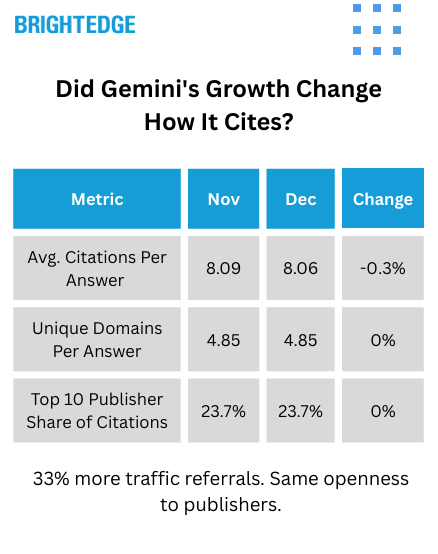
When AI platforms scale rapidly, there's a concern that they'll compress answers, reduce citations, or concentrate traffic to fewer publishers. Gemini didn't do any of that.
Citation Depth:
- November: 8.09 average citations per answer
- December: 8.06 average citations per answer
- Change: -0.3% (effectively flat)
Domain Diversity:
- November: 4.85 unique domains per answer
- December: 4.85 unique domains per answer
- Change: 0%
Top 10 Publisher Concentration:
- November: 23.7% of all citations
- December: 23.7% of all citations
- Change: 0%
Share of Source-Heavy Answers (10+ citations):
- November: 33.6%
- December: 33.3%
- Change: -0.3 percentage points (effectively flat)
What This Means
As Gemini's audience expanded in December, the platform maintained consistent openness to the web. No collapse in citation depth. No concentration to fewer publishers. No reduction in how often it produced highly-grounded, multi-source answers.
For SEOs, this is encouraging: opportunities to be cited in Gemini — regardless of your site's size — remained unchanged even as usage surged.
Under the Hood: Gemini Got More Dynamic
While overall citation volume stayed flat, Gemini's answer composition became more variable week-to-week in December.
Week-to-Week Standard Deviation:
- November: 0.117
- December: 0.156
- Change: +34% increase in relative variability
Coefficient of Variation:
- November: 1.44%
- December: 1.93%
Weekly Citation Fluctuation
| Week | Avg Citations | WoW % Change |
| Nov Wk 1 | 8.06 | — |
| Nov Wk 2 | 8.20 | +1.7% |
| Nov Wk 3 | 7.90 | -3.6% |
| Nov Wk 4 | 8.08 | +2.3% |
| Nov Wk 5 | 8.07 | -0.1% |
| Dec Wk 1 | 7.88 | -2.3% |
| Dec Wk 2 | 7.99 | +1.3% |
| Dec Wk 3 | 8.21 | +2.8% |
| Dec Wk 4 | 8.18 | -0.4% |
What This Means
The increased variance suggests active tuning and optimization as usage ramped. Gemini wasn't just scaling volume — it was adjusting how it composed answers week-to-week. This is consistent with a platform in active development, testing what works as adoption accelerates.
Query Intent Changes Everything
The most actionable finding: Gemini's citation increases were concentrated in specific query types.
How-To / Instructional Queries:
- November: 8.34 average citations
- December: 8.77 average citations
- Change: +5.2% (the largest category-level increase)
Travel & Planning Queries:
- November: 9.88 average citations
- December: 9.90 average citations
- Change: +0.2%
Comparison / Shopping Queries:
- November: 6.14 average citations
- December: 6.11 average citations
- Change: -0.5%
The Pattern
Gemini increased source grounding in "decision-support" moments — the queries where users move from exploration toward action. How-to queries, travel planning, instructional content. These are high-value research stages where users are learning, evaluating, and forming intent.
Meanwhile, transactional queries (comparison shopping, pricing, "best deals") saw no increase in citation exposure. Gemini held flat in checkout-adjacent moments.
What This Means
If you're only optimizing for transactional queries, you're missing where Gemini is building its connective tissue to the open web. The opportunity is in the research phase — the how-to's, the planning queries, the instructional content that helps users move from awareness to decision.
Why This Matters Beyond Gemini
Gemini isn't just the standalone Gemini app. It's the foundational model powering Google's AI products:
- Google AI Mode runs on Gemini
- Google AI Overviews runs on Gemini
- Apple's Siri is set to be powered by Gemini
Understanding how Gemini cites and connects users to the web matters beyond just one product. As Gemini's reach expands across Google's ecosystem and into Apple's, the citation behaviors we're tracking now will have implications across multiple surfaces where users encounter AI-generated answers.
What This Means for SEOs
Gemini Scaled Without Closing Off: 33% more referral traffic, but citation depth, domain diversity, and publisher concentration all stayed flat. The open web stayed open.
Decision-Support Moments Are the Opportunity: How-to queries (+5.2%) and travel/planning queries (+0.2%) saw citation increases. Transactional queries stayed flat. Optimize for the research phase, not just the purchase moment.
Active Tuning Means Active Opportunity: The 34% increase in week-to-week variance suggests Gemini is still testing and optimizing. Citation patterns aren't locked in — there's room to earn visibility as the platform evolves.
Monitor Gemini Now: With Gemini set to power Siri and already powering AI Mode and AI Overviews, this platform's citation behavior is about to matter a lot more. Anyone with AI Catalyst can track how Gemini's patterns are shifting in their own vertical.
Technical Methodology
Data Source: BrightEdge AI Catalyst™
Analysis Approach:
- Gemini citation data analyzed across November and December 2025
- Weekly aggregation of average citations per answer
- Query intent categorization: How-To/Instructional, Travel & Planning, Comparison/Shopping, and others
- Volatility measured using week-over-week standard deviation and coefficient of variation
- Domain diversity and publisher concentration tracked across the analysis period
Time Period: November 2025 (Weeks 44-48) through December 2025 (Weeks 49-52) and early January 2026 (Week 1)
Key Takeaways
Gemini Scaled as an Open Discovery Layer: Despite 33% referral growth, citation depth (-0.3%), domain diversity (0%), and publisher concentration (0%) all remained flat. Gemini grew without becoming more closed, more shallow, or more concentrated.
Week-to-Week Variance Increased 34%: Overall citation volume stayed flat, but answer composition became more dynamic. Gemini was actively tuning as usage scaled.
Research Queries Saw the Biggest Gains: How-to/instructional queries: +5.2% citation increase. Travel & planning: +0.2%. Comparison/shopping: -0.5%. The increases are concentrated in decision-support moments.
Gemini Powers More Than Gemini: AI Mode, AI Overviews, and soon Siri all run on Gemini. Citation behavior here has implications across Google's AI ecosystem and beyond.
The Opportunity Is in the Research Phase: Gemini is strengthening its role as connective tissue to the open web during learning, planning, and evaluation moments. Brands that optimize for these stages — not just transactional queries — will capture more visibility as Gemini scales.
Download the Full Report
Download the full AI Search Report — Gemini's December Surge: What Citation Data Reveals About Where It's Sending Traffic
Click the button above to download the full report in PDF format.
Published on January 22, 2026