How to Get the Most SEO Benefit Out of Your Content

ssharma@brightedge.com
M Posted 11 years 4 months ago
t 9 min read

By now most marketers know that content marketing is a huge key to SEO and marketing success, but not everyone gets everything they can out of their content. A good piece of content can go far, but a good piece of optimized content will always go further. This is because optimized content will help content get shared more, linked more, ranked higher, and will indirectly bring more traffic. For these reasons it's beneficial to talk about how optimizing content and using tools like long-tailed keyword research, internal linking and open graph markup is key to making your content really work for you.

Keyword research

First we'll talk about keyword research—not so much how to do it, but why. Marketers know that keyword research is helpful for PPC and SEO efforts, but why stop there? Ranking for the right keywords is integral to the success of your site, partly by not only getting visitors to your site, but by getting the right kind of visitors. Digital marketers can and should apply their keyword research toward content marketing. A lot of the time, marketers spend a lot of time dreaming up the perfect piece of content and then try to incorporate keywords.

To be more effective and use your content to its potential, this strategizing should really be done the other way around. Research long-tailed keywords first and incorporate them from the beginning of the process so that your content is shaped around the keywords you need to use. Deciding on which long-tailed keywords to use before producing the content helps to ensure that the content gets seen by the right audience. Doing keyword research early on also lets you know where to internally link the copy of the content.

how to get seo benefits - brightedge

Internal linking

Internal linking is not only beneficial because it helps Google figure out your website, but it helps users discover more content on your site. Users will find what initially brought them to the site but also other related content. As your content gets more and more interactions and earned links, it will build up authority for the keywords you initially researched. But to get even more benefits out of your content—and to pass authority on to other pages on your site—make sure to internally link to other pieces of content. If you have the ability to take your piece of content and do internal linking to your landing pages or to other blog posts (and do it naturally), take advantage of that. Use caution when doing this, though, and keep the user in mind; if an internal link is or even just looks unnatural, it may hurt rather than help in the long run.

Ultimately, responsible internal linking is helpful for building the structure of your site and for spreading link juice, but it is also helpful in increasing rankings and making your content more easily discovered. However, to get your initial piece of content seen by more people (and those more qualified), it needs to be optimized. This is where open graph markup comes into play.

Open graph markup

Open graph markup is the part of code found in the HTML <head> tag that tells social media what pieces to pull out onto the webpage when shared. It's likely that you've seen, for example, an infographic on Facebook or other social media platform that pulls the entire infographic rather than just the title section. And you've probably also seen the opposite: a link is shared and it automatically shares just a specific piece of the infographic. Open graph markup is what causes this difference. Of course, adding open graph tags to your website won't directly affect your on-page SEO.

These tags are mostly useful to increase performance of your links on social media, including increasing social shares and interactions. And again, it's true that social media doesn't have a huge direct influence on SEO, but the more times a post on social media is shared, the more likely it is that it will be seen by the right person—the person that will convert. Using open graph markup is the key to getting your content shared and even linked to other influencers. This is what will have lasting impacts on the SEO of your site. It's fairly transparent how these three tools for better content optimization work together to help and support the others, and all contribute to SEO. By effectively optimizing content from the ideation through the publishing of the content, you will earn more links, rank higher for the keywords you want and earn more and higher quality traffic, thereby effectively contributing to your site's overall SEO.  

Secure Search: Where Does It Stand Today?

Default avatar
Andy Betts
M Posted 11 years 5 months ago
t 9 min read

A little over a year ago in September 2013, Google eclipsed all search query data globally, representing one of the most dramatic changes ever to the SEO landscape. SEO practitioners were forced to adapt to the loss of their keyword data, and with it, a good portion of their traditional keyword-driven strategy. As BrightEdge CEO Jim Yu observed in his Search Engine Land article of December 2013, it was no coincidence that Google’s switch to 100 percent secure search occurred with the announcement of its new infrastructure, Hummingbird. “Hummingbird asks marketers to think about the meaning of words on the page, and to create content around topics rather than keywords,” he wrote. Secure search created a new need – the need for page-centric, content-centric analytics (p.s. BrightEdge offered that before 100 percent secure search!). The new norm would be page-level performance, and SEOs would quickly pick up the pieces and move forward.

Secure search insights from the Share14 event

Secure search was discussed by several speakers presenting at BrightEdge’s Share 14 event (in August), including Jordan Kasteler, senior SEO manager of Red Door Interactive and Ken Shults, managing director - global consulting of Global Strategies. Let's briefly go over how these two professionals said they were handling SEO in a post-secure search world. Jordan Kasteler said he believes Google’s motivation for encrypting all search data was to get the SEO industry to think about keywords less and searcher needs and intent more (we agree). He listed several ways SEOs have adjusted to secure search, including:

  • Persona development
  • Site search data
  • Landing page traffic and engagement analysis
  • Conversion optimization and analysis
  • Grouping keyword buckets and ranking monitoring by keyword size (single or two-word keywords vs. longtail key phrases), topic, buying stage and intent (transactional, informational, commercial investigation and navigational)

Jordan presented a search query classification funnel, showing the breakdown of search intent as it relates to search volume:

secure search is very important. discover why - brightedge

Keyword-based optimization was now intent-based optimization, he said, which identifies the primary topics and questions users are looking to answer when searching for “xyz,” and creating content to address the user’s needs on the target landing page. Jordan then shared keyword research tools that are still useful today, including:

  • Google Webmaster Tools
  • Bing Webmaster Tools
  • AdWords’ paid and organic report
  • Site search (which you can set up in GWT)
  • The BrightEdge Data Cube (for competitive ranking intel)

Ken Shults said the biggest impact secure search has had on Global Strategies is in the areas of insights and measurement. Global Strategies has now employed a page-level data performance model that tracks metrics such as engagement, direct and trending views when assessing page performance. Adding engagement data at the page level helped them refine content in alignment with the interests of searchers, he said.

A new twist to secure search in August

In August, Google announced a new twist to the secure search saga that went beyond the keyword (“not provided”) situation; now, sites that were HTTPs would see a boost in ranking. Google said that for now, it would be a “lightweight signal” in its ranking algorithm that could carry more weight in the future. At the SMX East event, a Google rep said it affected less than 1 percent of queries. But for those who want to prepare and stay on the leading edge, it’s still important to be acquainted with the signal and what it could mean for the future of organic search ranking.

5 resources on secure search

We'll continue to keep our eye out on this issue, and present any unique research we might forge in the future. Until then, you can read up on the history and many facets of secure search with these five resources:

  1. Google Hummingbird & The Keyword: What You Need To Know To Stay Ahead by Jim Yu, Search Engine Land
  2. A New Direction for SEO in 2014: The Secure Search Manifesto by Jim Yu, Search Engine Watch
  3. The 3Ps of Content Measurement: Page Rank, Traffic & Engagement by Jim Yu, Search Engine Watch
  4. Securing the Future of SEO: Global Brands & 5 ‘(Not Provided)’ Solutions by me, Andy Betts, Search Engine Watch
  5. Secure Search and HTTPS collated content on Search Engine Land

5 Common SEO Failures and How to Fix Them

ssharma@brightedge.com
M Posted 11 years 6 months ago
t 9 min read

It's clear that SEO can bring additional traffic and revenue to a website, but with constant algorithm updates and changes from Google—like Penguin, Panda, and the infrastructure update, Hummingbird—it can be difficult to know how to prioritize your SEO plan.

In this post, I’ll talk about five of the most common SEO failures in having a quality, search-optimized site so you can begin to organize where you’ll focus your SEO efforts and how to go about fixing those SEO failures.

  • Duplicate content
  • Failing to link internally
  • Outdated sitemaps
  • Overly dynamic URLs
  • Low-quality links

1. Duplicate content

Duplicate content typically originates from other websites scraping content from one website and posting it on their own site. Put simply, the best practice is to locate and remove duplicate content from a site. Google's main objective is to provide a good user experience, and duplicate content tells Google that the content is not unique and therefore less valuable. Duplicate content can occur if a site has both plain and secure protocol URLs (HTTP and HTTPS). The solution? Use BrightEdge to perform a site audit and locate duplicate content. 

2. Failing to link internally

Good content will earn links and authority which will earn more organic traffic. Sites that fail to link blog posts internally to other webpages within their site are not passing this authority throughout the site. It's important to find ways to link to other parts of your website within your blog posts, especially to your landing pages. If a blog post naturally mentions specific keywords a website is trying to rank for, it should link to the corresponding landing page. This will pass authority from a blog post to other webpages, especially landing pages. Internal linking is a crucial process to maintain the health and authority of a website.

3. Outdated sitemaps

XML Sitemaps assist search engine crawlers to index a site in an organized fashion. Websites are usually large, and Google's crawlers don't have time to constantly crawl sites. A dynamic Sitemap helps these crawlers prioritize their indexing process. It's crucial to verify that a Sitemap is readable by search engine crawlers. To do this, log onto your Google Webmaster Tools account and submit your XML file. First, your site must be registered with Google Webmaster Tools. Once your site is registered, under the "Crawl" section, click on "Sitemaps." There is a button labeled "Add/Test Sitemap." It will ask for your Sitemap URL; simply provide GoogleWebmaster Tools the URL, and you'll get your results shortly. 

4. Overly dynamic URLs

There are situations where a content management system (CMS) creates long URLs; this is usually the result of tracking parameters. Not only do they just not look good, but they also takeaway from the user's experience, which is Google's No. 1 priority. Clean up the URLs to make them more SEO-friendly. Use keywords and dashes to clearly explain the content of the page to Google and users. Here are two examples, one bad and the other good:

• Bad URL: https://www.example.com/white-socks/i/cid=bl140705&utm_source=example
• Good URL: https://www.example.com/white-socks

5. Low-quality links

While link-building campaigns can be beneficial for SEO purposes, Google algorithms like Penguin have resulted in thousands of sites dropping rankings as a direct result from low-quality links. Services like paid link farms or press releases with followed links that get scraped and republished rapidly are examples of low-quality links. These practices will result in dramatic decreases in rankings and even formal penalties from Google. That's why it's always important to know where your backlinks are coming from. One way to discredit low-quality links is to formally request a link disavowal through Google Webmaster Tools. However, it's important to note that this disavowal process should be handled by an experienced professional.

Another approach to cleaning up those links is to contact the webmasters of other sites that are directing low-quality links at your site and ask that they be removed. You may want to try this method first before going through the disavow process. Use these 10 backlink building ideas to create a strong backlink portfolio that can significantly improve your SEO results. So there you have it: five common SEO pitfalls on your website and how to remedy them. These simple steps to making your site more search friendly may not take a lot of time but can have a big impact on the crawlability and quality of your site.  

5 Tips for Pinterest SEO

Mark Mitchell
Mark Mitchell
M Posted 11 years 6 months ago
t 9 min read

Pinterest, the visual social network launched in March 2010, has evolved far beyond its humble scrapbooking and recipe-sharing origins. Advancements such as “Rich Pins” and cross-platform sharing in Twitter and Facebook, plus the explosion in visual marketing in general, has dramatically increased Pinterest’s viability as a marketing tool, and transformed it into a powerful social referral engine.

Pinterest’s social traffic referral share grew a quantum 48 percent in the first quarter of the year and is now second only to Facebook in total social media traffic referrals, according to Shareaholic’s 2014 Q1 Social Media Traffic study. In this post, we’ll look at who uses Pinterest, and five ways to create a Pinterest presence and work on your Pinterest SEO for your brand, plus some bonus tips for engagement.

Who uses Pinterest?

Citing demographic data from Pew Research, MarketingCharts shows that users are predominantly educated, affluent women between ages 18 and 29. They tend to live in the suburbs rather than cities, and are also generally active on Facebook. For brands targeting this particular market segment, optimizing for Pinterest is a no-brainer. Digital marketers in general should find Pinterest a compelling social media platform, given the overall Web trend towards rich media - images and video – as BrightEdge CEO Jim Yu recently wrote for Search Engine Land. While Pinterest isn’t appropriate for every sector, e-commerce companies and those organizations that lend themselves to visually appealing marketing campaigns will find Pinterest an ideal venue for showing off their brand’s products or messaging (think grassroots non-profit social causes, for example). Let’s go over best practices for leveraging the Pinterest platform for your brand.

Five steps for your Pinterest SEO efforts

1. Create and verify your business profile

The first step for businesses wanting to leverage Pinterest is to create a corporate profile. Once you’ve created your brand’s profile, you’ll then need to verify your website. Doing so adds a “check sign” icon to your site’s images that shows Pinterest has officially confirmed your site. This can be done easily from your account’s settings page.

learn how to do pinterest seo - brightedge

2. Add Pinterest buttons to your website

Next, you’ll want to add the “Pin It” button to your site’s product pages and those landing pages that lend themselves to image sharing. You’ll also want to add the Pinterest “Follow” button to these pages, so your site’s visitors can readily track your Pinterest boards. Pinterest walks users through a simple process for uploading all of their buttons to your site’s pages via its “widget builder.”

3. Create and optimize Pinterest boards

You can think of Pinterest boards as virtual bulletin boards, each displaying a separate category of pictures aka “Pins” that represent your brand’s information or products. As Pinterest’s Kevin Knight recently wrote on the company’s blog for businesses, you can approach boards either as a source of content distribution or as a destination for your content. No matter your approach, a best practice is to create several boards focused tightly around specific topics for more targeted engagement with your followers. For instance, rather than just a “clothing” board, you would want to narrow it down to “work fashion” for one board and “casual fashion” for another. You’ll increase both search visibility and user engagement by enriching the board titles themselves, adding keywords to the titles and repeating them in board descriptions (within reason – avoid “keyword stuffing”).

Elaborating on your boards’ descriptions make them far more compelling, as well. Simply illustrated, a board title of “Healthy Recipes” with the description of “Deliciously healthy recipes that make trying to lose weight a little less miserable” conveys specific product benefits (and is far more search savvy) than a title of “Recipes” followed by a description of “Mmmmm … dinner.” In his post, Knight offers three examples of brand boards demonstrating best practices:

4. Optimize your images

First and foremost, start with good, quality images that are clear and represent your brand well. And, just as with Pinterest boards, a best practice is to optimize individual Pins by adding keywords to the image file name and description. Other image optimization tips include:

  • Make Pins Twitter-friendly by adding a hashtag (#) to the image’s alt attribute (and further encourage cross-platform sharing by checking off the “Facebook” box as well).
  • Add a URL back to your site or specific product pages, depending on the image and what it represents.
  • Limit the length of the image to 5,000 pixels (although there is no limit to the size of images, those longer than 5,000 will require users to scroll down)

5. Leverage rich pins

"Rich Pins" are designed to make your business stand out from your competitors on Pinterest. If you’re in the ecommerce biz, you may consider employing Rich Pins so users can see the price and availability of a product right on the Pin itself.

discover how to do pinterest seo - brightedge

Rich Pins work by including extra details on the Pins from your website. There are now five category (“board”) types supporting Rich Pins: movie, recipe, article, product and place. There are three steps to enabling Rich Pins for your site:

  1. Add Meta tags to your website (such as Schema.org or OpenGraph)
  2. Test your Rich Pins
  3. Apply to get them on Pinterest

More detailed information for website developers can be accessed by links provided on the Rich Pins page.

Bonus: top seven tips to increase engagement from Pinterest SEO

Just like any social network, you need a consistent publishing schedule to create an engaging experience. And, you need inspiration to do so. Here are seven tips to get you started:

  1. Add Pins weekly from a variety of sources, and include new Pins and re-pins from Pinterest. Do a Pinterest search to see what people are pinning, and get ideas for what you might pin or re-pin.
  2. Focus on creating Pins that empower users and facilitate re-pinning. How-to guides, DIY activities and recipes are most likely to go viral if you’re in any of those sectors.
  3. Create contests that engage your online visitors via Pinterest. Read up on the guidelines for contests here.
  4. Find out what people have been pinning from your site, and learn which of your products or content is most popular. To find your source page, go to: pinterest.com/source/yourdomain.com
  5. Browse the popular feeds to see what Pins are trending on Pinterest, then tailor what you offer on your website or blog.
  6. Follow the “Pinterest For Business” board for new ideas.
  7. Review Pinterest case studies to see what’s worked well for successful users like Etsy.

And, for more information on leveraging Pinterest for your brand, check out its business and Web developer pages, as well as its business blog.  

How Brands Use SEO Content to Drive Traffic

Default avatar
Andy Betts
M Posted 11 years 6 months ago
t 9 min read

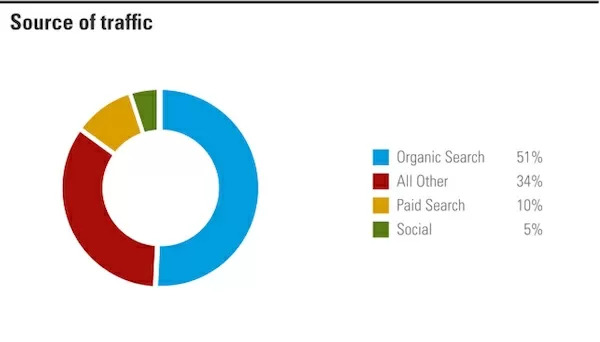
The latest findings from the BrightEdge Data Cube released not too long ago show SEO content marketing efforts are paying significant dividends for B2Bs, as measured by both Web traffic and revenue. Specifically, insights from our data repository show that as of August, organic search leads as the primary channel for website organic traffic, driving 51 percent of searchers to sites:

see how seo content is changing serps - brightedge

From our report:

All non-organic search channels combined – paid search, social, display, email and referred – don’t stack up to the impact that organic search alone commands across all industries. Search’s dominance may come as no surprise. After all, search has become the dominant user interface to discovering content on the Internet.

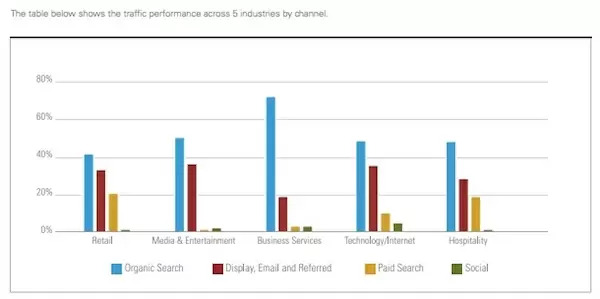
Here’s the breakdown of the industry verticals we studied: retail, media and entertainment, business services, technology/internet, and hospitality, and we compared the performance of organic versus non-organic search channels within each sector:

see how seo content is changing industries and the content they write - brightedge

Of the five major industry sectors studied, we found that organic search led in all but one in revenue performance.

As we noted in our report, although organic search clearly drives the most traffic overall, our data support a hybrid approach of organic and paid search for achieving optimum ROI.

B2B brands and SEO content

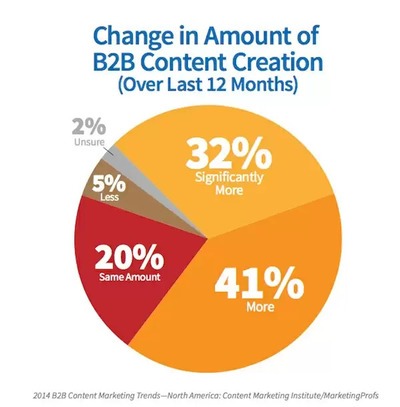
“Today's business buyers do not contact suppliers directly until 57 percent of the purchase process is complete.” Those words were uttered by Google in its “B2B’s Digital Evolution” article, and they offer real motivation “to influence the 57 percent of the sale that occurs mostly on the Web,” the article states. But it does seem that the B2B sector increasingly embraces not only content marketing, but also content for the organic search channel. According to our findings, the business services (B2B) sector showed organic search was the primary driver of traffic and revenue – above and beyond other sectors studied. And according to other data, like research coming from the Content Marketing Institute’s 2014 B2B Content Marketing report, 93 percent of B2B brands indicated they were implementing content marketing , with 81 percent saying they used articles on their websites and 76 percent indicating they used blogs. The report also highlighted the fact that B2Bs are creating 41 percent more content, with 32 percent citing “significantly more,” than the previous year:

b2b content changes with seo content creation - brightedge

The B2B content marketing challenge

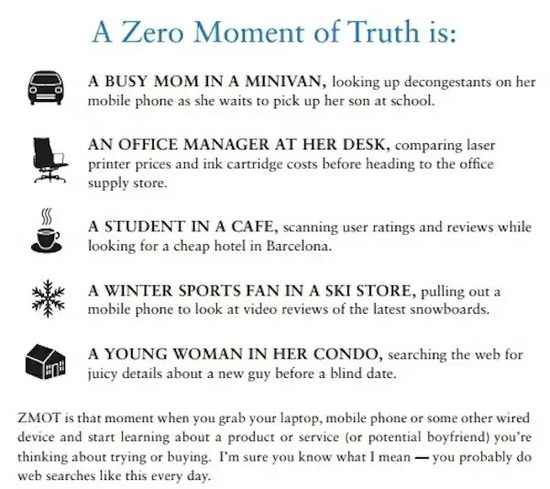
In the “B2B's Digital Evolution” article, Google cites one of the biggest challenges brands face is “matching customer need with channel,” noting the “fragmented approach” most B2Bs take with their content creation efforts. Alluding to its “Zero Moment of Truth” (ZMOT)  initiative of delivering the right message to the right person at the right time, the article states that the “challenge for marketers is to be present in these channels at all times with content that educates buyers and helps guide commercial decisions.”

utilize seo content like this brand - brightedge

Indeed, Google’s ZMOT is a challenge. As BrightEdge CEO Jim Yu wrote for Marketing Land:

If you’re taking a true content marketing approach, your content should be fueled by data about topics and your audience, then created with a laser focus on relevance and expertise. Distribution of content should be done across multiple channels … Those approaching content marketing without a background in organic search may not understand what it takes for content to compete in what’s arguably among the most profitable online channel.

A future-looking approach to B2B content marketing

Mobile-friendly Web design, semantic markup and rich media (e.g., images and videos) should be content marketing priorities going into 2015. Let’s go over a few of those now.

  • Mobile search: Be prepared for the surge in mobile search traffic. The mobile channel is ideal for reaching busy executives and other key decision-makers who often use their tablets or smartphones to research products and services on the fly. 
  • Semantic search: When Google’s webmaster trends analyst, John Mueller, announced the end of its authorship experiment (covered in detail here), he wrote: “Going forward, we’re strongly committed to continuing and expanding our support of structured markup (such as schema.org). This markup helps all search engines better understand the content and context of pages on the web, and we’ll continue to use it to show rich snippets in search results.” Google’s dedication to semantic search means that adopting structured markup will be essential for your brand’s organic search visibility.
  • Rich media: Our Data Cube research (cited above) discovered that rich media – images and videos – amplifies search visibility and drives Web traffic. More compelling still is our finding that videos and images elicit a 13 percent higher click-through rate than written content alone.

As BrightEdge CEO Jim Yu concludes in a recent post for Marketing Land:

Content for the organic search channel has staying power. It can build authority for your brand, and help B2Bs remain a relevant part of the customer’s purchase journey, which often starts with search. As the research shows, B2Bs are embracing content for organic search, and seeing great results. What comes next is refining those strategies, and optimizing the content plan for maximum results in the coming year. 

Real-Time Marketing, Search and Social

Default avatar
Andy Betts
M Posted 11 years 7 months ago
t 9 min read

Real-time social media marketing can be a powerful way to engage with your brand’s followers by tapping into current events or trending topics. In this post, we’ll look at ways to stay relevant through real-time marketing, and how search and social data can work together to boost results.

Real-time marketing with Twitter

While the World Cup is long over, real-time marketing lessons from the sporting event live on. Twitter emerged as the clear winner in its social media battle with Facebook for dominance in World Cup coverage, announcing that there were 672 million tweets related to #WorldCup, setting an all-time Twitter record for an event. Of all the brands vying for real-time Twitter engagement, Adidas emerged as the most successful “with over 1.6 million tweets, retweets and replies mentioning the brand” – but not without months on end of careful preparation and planning for each and every possible scenario, according to this report by AdAge. You don’t have to be an Adidas-sized brand to leverage Twitter for real-time marketing, or depend on an event as globally anticipated as the 2014 World Cup. However, you do need a real-time marketing strategy that incorporates your brand’s message, and the right tools to execute it successfully.discover how to work search and social together for better results - brightedge

Check out this post from Twitter on how to use its tools to engage in real-time marketing around events, as well as several case studies showing how others succeeded with their campaigns to help you get started with yours. And keep in mind the other tactics you can use to be a part of the conversation in real time. Besides events-driven Twitter conversations, there are also spontaneous discussions around news. Referred to as “news-jacking,” brands have been known to use current events to be a part of the discussion on Twitter. However, the principle remains the same: a well thought-out brand message that informs and engages, as opposed to a sales blast. Check out these fails for what not to do.

Twitter trending for SEO

An informed social media strategy that incorporates SEO can also drive organic search results. In collaboration with Twitter, BrightEdge developed an innovative tool, “Twitter Trending,” within its S3 platform that allows brands to leverage Twitter for effective real-time marketing and SEO. By tracking topics that are trending on Twitter aligned with your brand’s Web content, you can drive traffic to your site by tweeting that content relevant to those conversations. As this BrightEdge case study of Tiny Prints shows, the online boutique realized a 47 percent increase in organic search rankings on long-tail keywords and URLs that were trending on Twitter by utilizing search and social data together.

This post on Twitter about Tiny Prints’ success highlights the ROI: “Follower engagement on pages and keywords grew 300 percent over a month long campaign that aligned Tweets with digital content.” More data from the case study show how search and social worked together to create great results:

Visibility across search and social — Tiny Prints used BrightEdge Twitter Trending to measure and track the influence of social engagement on organic search rankings. They were able to easily track page and keyword level social sharing on Twitter and correlate these against search ranking of the same pages. Actionable Opportunities — With visibility across social and search, Tiny Prints was able to identify keywords and URL opportunities where rich social engagement and exposure could influence organic search performance. Armed with this data Tiny Prints created compelling tweet content that engaged followers who subsequently retweeted them.

BrightEdge CEO Jim Yu details how Twitter Trending SEO technology (which he refers to as an “SEO-Social super group”) works in this article for Search Engine Land.

An integrated SEO-social strategy: Adobe case study

Beyond Twitter Trending, BrightEdge’s S3 platform informs brands on how social media as a whole drives search results. As Susan Kuchinskas reports for ClickZ, while speaking at the BrightEdge Share 12 conference, Adobe Systems senior manager of global search marketing, David Lloyd, said the following:

Adobe uses the BrightEdge search optimization platform to understand how social media drives organic search results. For example, the platform allowed Adobe to see that seven tweets improved Adobe's rank on the keyword phrase "social analytics" from twenty-eighth to second in one case. In another case, the organic search rank went from fourth to second after 28 tweets and six Facebook actions.

Describing how Adobe achieves its SEO-Social synergy, David said that its content optimization efforts go beyond keyword, URL and link analysis, as the SEO team “organizes its content into ‘product stories,’” which then become a “messaging kit for editorial staff” so “the people doing the writing have search data to back up their stories.” From the report:

Keywords and URLs are shared with the social media team, so that they can optimize blogs, video and help pages, among other content. Social teams link back to the highest-converting target pages on Adobe.com where revenue can be captured. This strategy creates a virtuous circle in which search keywords inform some social media content. Those social conversations drive search equity and help the team make enhancements. These enhancements then improve social ranking, while social conversations inform the keyword strategy.

Leveraging search and social data plus the power of real time in Twitter is a win-win for multiple channels and your brand’s marketing strategy. If you’re not yet combining channels and tactics like organic search and social, start thinking about how you’ll incorporate your multichannel campaigns in 2015 using the data that’s available to you.

Mining Data for SEO and Content at Scale

enewton@brightedge.com
M Posted 11 years 7 months ago
t 9 min read

Sure, you’ve got content – but how is it performing? Is it targeted to what our users are searching for? Is it producing results? These are the questions explored in this session at the BrightEdge Share 14 event, which wrapped up last Friday. Brands like Adobe, OpenTable, Rosetta and SearchLaboratory all gave tips on how to mine data for content and SEO performance insight. Denis Scott of OpenTable was up first. Just some of the questions data can answer, he says, are as follows:

  • Business trends
  • Types of customers
  • Sources of traffic and impact on results

He’s going to focus on the last point. At one point, OpenTable and toptable needed to do a brand/site migration when OpenTable acquired the other. They had a lot of work ahead of them, says Scott.

OpenTable created a forecast for what the traffic might look like first on a line graph. They needed to show the strategy was working, so apart from traffic data, they wanted to look at other factors like PageRank, Scott says. And the team created weekly dashboards in BrightEdge to organize it visually.

The data showed that even though there were traffic dips, there were positive SEO signs. And data was measured in other channels, too, like PPC and email, during the rebrand. Scott says they put together PPC and SEO campaigns to see how it looked year over year, and found where SEO dipped, PPC picked up.

The takeaways, says Scott, are:

  • Start with what you need to answer
  • More data will exist than you need
  • Tell the obvious story which is usually the answer

Next up was Chris Attewell (@twitter) of SearchLaboratory. He used Wal-Mart as an example for his talk on keywords. For a large retail sitelike Wal-Mart, each category may have multiple subcategories on the site. So, where do you focus? he asked. What keywords do you look at?

You need a strategic view to know where you can get the best ROI, says Attewell. The challenge is that there is a lot of data coming from multiple data sources, and putting it together into a meaningful, actionable system is key, says Attewell. SearchLaboratory used the “opportunity forecasting” tool in BrightEdge often to get a better picture of strategy.

Here are some tips, says Attewell, that came from how they went about mining keywords: Build new keyword groups – break it down into words, like “dresses” or “maxi” or “maternity,” then look at keyword group search volume. Measure the effectiveness of keyword groups right within BrightEdge, he says.

Then, mine the long-tail terms to uncover some great trends when doing so. In their research, they found “peplum” as a great opportunity that they weren’t even tracking.

Attewell says they also group keywords for seasonality, and prioritize for international markets. Here’s a tool that SearchLaboratory created a tool that allows people to slice and dice keyword data, available on their site, here. The next speaker was Kirill Kronrod from Adobe. Kirill’s talk is centered on the search impact lifecycle, and how SEO data fits into it. [Side note: Check out Kronrod’s guest post on the search impact lifecycle for the BrightEdge blog, here.]

He shared a content case study. He had a product that had only one page on features, and was dense in content. Because of all the topics on one page, Google could not distinguish the theme, he says. So, the SEO team wanted to spin out 15 pilot feature pages, each focused on a specific feature, to see if it moves the needle.

Based on pilot findings, the team expanded the pilot to 30 pages, says Kronrod. The results were a growth in traffic and conversions, and a greater Share of Voice showing in the BrightEdge data. Another case study in utilizing data was targeting Hreflang. They used BrightEdge to see rankings for targeted keywords across geos. As soon as they implemented Hreflang, they saw significant ranking improvements, more than a 720 percent daily visit boost.

A third case study Kronrod shared in data mining was migrating to a CMS, and determining if it would be a good move. They used the BrightEdge Data Cube to validate the impact of the migration of pages. They also used BrightEdge for rankings and looked in Adobe Analytics for conversions. They were able to determine that the move was a good idea.

The takeaways, says Kronrod:

  • Focus on the right data
  • Align reporting to the stakeholders
  • Prioritize recommendations
  • Do a pre- and post-analysis, tell the story

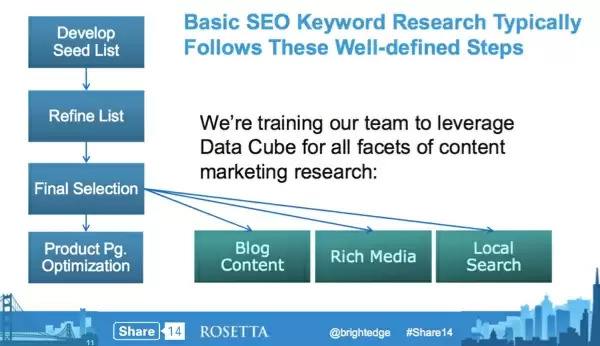
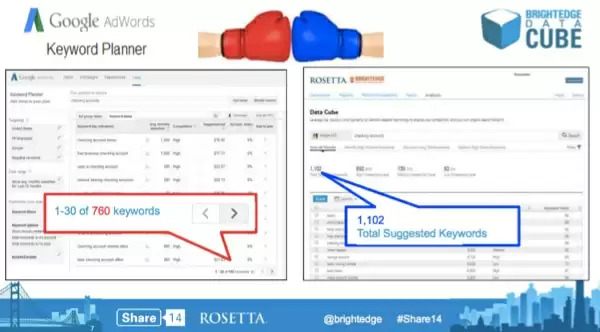
Matt Saunders of Rosetta was the final speaker. He talked how to mine big data quickly. Big data: where to start? Go to the BrightEdge Data Cube, he says. It’s a complex gathering of information, and makes it easy to get insights, says Saunders. Here, he shows the Data Cube going head-to-head with a keyword tool:

check out brightedge data cube

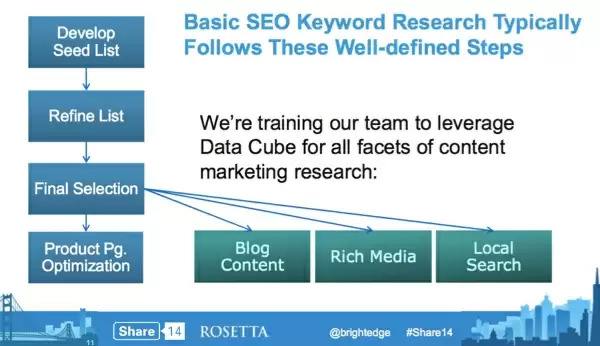
Saunders said the basic strategy for keyword research and analysis is outlined in the following slide:

keyword research understanding with brightedge

Next, he shared four use cases in data mining. The first was competitive gap analysis. His team needed to identify content expansion opportunities around wedding bands. So they checked out the Share of Voice report, and found Overstock.com had a significant share of voice due to one particular URL. If you dig down into the tool, he says, you can see what a page that is doing well is up to and what they are ranking for. You can identify a handful of new terms you may not have tracked before.

Another scenario on the content marketing side. Look at a URL for the competition, and paste it into the BrightEdge Data Cube, and you can see how you stack up against competitors.

Another scenario is gauging rich media opportunity, says Saunders, through the BrightEdge tool.

And, finally, Saunders shared a use case for local optimization and Google’s local carousel results. He says you can build out a strategy to see which terms trigger carousel results in the aftermath of Pigeon, for example.  

The BrightEdge Winter Release: Our Gift to You

A BrightEdger
A BrightEdger
M Posted 12 years 3 months ago
t 9 min read

BrightEdge’s Winter Release has arrived. Want to know what’s inside? How about a bunch of new features to prep you for SEO in 2014? At BrightEdge, we work hard all year developing innovative technology that empowers you to stay ahead of the changing search landscape. Every five weeks like clockwork, we release new product features, and we’re happy to say, our Winter Release wraps up the tenth release of 2013.  

Three months, thousands of customers managing secure search

Less Than 3 Months After the Announcement of Secure Search, Thousands of Customers Have Unwrapped our Technology to Address This Change. How is that possible? At BrightEdge our top value is customer success, and we saw change on the horizon. Over the past two years we have invested and innovated ahead of the curve to ensure that our clients are fully equipped to deal with revolutionary changes (Google’s shift to 100% secure search) in the SEO landscape.  

Unwrap more data with page reporting

At Share13, in August, we previewed Page Reporting, and in September introduced this innovative technology to our clients in limited release. Today, we are thrilled to announce that Page Reporting is generally available to all our clients with active Google Analytics integrations! Page Reporting provides you with real (not estimated) business metrics at the page level including traffic, conversions, and revenue.  As previously mentioned in a past blog post, we’ve also empowered all our users with a seamless self-service Google Webmaster Tools integration.  

ROI shines in the content performance dashboard

If we could sum up digital marketing in 2013 in one word, it would be “content.” Content is at the heart of every digital marketing strategy, and spans channels and mediums. That’s why we’re pleased to introduce a Content Performance Dashboard, which includes Page Reporting powered charts. The Content Performance Dashboard provides a comprehensive overview of how your most important content is performing. Included in the Content Performance Dashboard:  

Connect business metrics to SEO

In a world of secure search, without keyword correlated metrics, the only way to measure search performance is by looking at traffic and conversions across pages on your site. With BrightEdge’s unique and proprietary Page Reporting, you have the ability to understand the business performance for your most important pages, and measure the specific metrics that matter most to your business. Page Reporting pulls revenue, conversions, and traffic from your analytics platform at the page level, providing a complete and accurate view of content performance. Page Reporting is available across all search engines reported by your web analytics platform, and across all device types (desktop, smartphone, and tablet). Performance can be rolled up into Page Categories/Business Units (i.e. Men’s Apparel, Women’s Apparel, Baby Apparel, etc.) as well as at a total site level. With Page Reporting you gain insights into business performance changes, understand the root cause, and can take action.   

Restore visibility

Google Webmaster Tools Integration (GWMT) helps you better understand organic search performance by restoring partial keyword visibility that is no longer available due to secure search. With GWMT integration you gain a granular way to understand demand for your business, and uncover keywords that you may be unaware of. You can view GWMT clicks, impressions, and CTR information side by side with BrightEdge’s keyword, rank, page, and search volume data, providing in-depth keyword insights all in one place. GWMT integration provides detailed analysis of top-clicked keywords and pages, which can be viewed weekly, monthly, or long-term trended over time (BrightEdge stores data beyond the 90 day limit in GWMT).   

Take action with page manager

Page Manager provides a comprehensive solution for optimizing your most valuable content. Gain a 360 degree into your page performance including, on-page, backlink, internal links, and social factors. Uncover the successful strategies your competitors are leveraging, and take action. With prescriptive and actionable recommendations, you can discover which of your pages, and site categories have the most opportunity, and determine where to invest resources.   

Put a bow on it: your logo on BrightEdge reports

Your brand means everything. And we get that. We want to help you create a more personalized experience when you use BrightEdge S3 by enabling you to co-brand reports with your logo. Now you can upload your logo, for a co-branded experience in the BrightEdge platform header, and within Dashboard PDFs and emails. We hope you enjoy all the goodies in BrightEdge’s Winter Release, and we look forward to being your partner in digital marketing in 2014.        

Share13: The Premier Event By SEO and Digital Marketer | BrightEdge

Jim
Jim
M Posted 12 years 8 months ago
t 9 min read

Following on from a fantastic year for BrightEdge, I am delighted to share more details on Share13, our premier industry event to be held August 22-23 at the stunning Palace Hotel in San Francisco. 2013 has been an epic year for Digital Marketing. The convergence of search, social and content marketing, technical changes, increased local and mobile adoption and the fusion of big data have resulted in massive impact and a positive shift for our industry. Share13 is focused on aligning the key drivers of digital marketing and the central role of content within this market shift and bringing together leading minds, brands and talent to learn about the resulting technology changes, trends, best practices and case studies. 

SEO and earned media are the CMOs imperative

These two channels have become the most efficient, measurable and profitable channels for reaching new and existing customers. Share is the only event focused on exploring the synergies between the two.

The Agenda

SEO – From Rank to Revenue

 Search has evolved to become the largest digital marketing channel. In our 2013 Search Marketers Survey, 98% of respondents confirmed that search is a strategic imperative for the CMO. But with the fragmentation of search results by device, locale, and algorithm updates, how do you measure and optimize revenue in addition to rank? In this track you'll hear from leading global enterprise SEO marketers how they achieve success today.

Earned Media: Maximize your Impact

Marketers have an ever increasing number of channels to understand and influence customers. Your initiatives can reach further than ever, enabling you to drive awareness, demand and revenue. But where do you start, and what channels deliver the greatest return? In this track digital marketing innovators share how they drive measurable business results with earned media and search. 

Please feel free to view the detailed agenda on the Share13 site by visiting http://www.brightedge.com/share13-agenda and check back often because we are adding speakers at a staggering rate.

Star-studded lineup of speakers & attendees

Share13 features some of the most accomplished and visionary search marketers including:

  1. Abe Thomas - General Manager, Microsoft.com
  2. Mike Grehan, Publisher of Search Engine Watch & ClickZ; Producer of SES international conferences
  3. Elisabeth Osmeloski, Director of Audience Development, SEL, Marketing Land and SMX
  4. Eric Papczun, US President, Performics
  5. Jim Brigden - Global Chief Client & Commercial Officer, iProspect
  6. Simon Heseltine, -  Director of Audience Development, AOL Inc / Huffington Post Media Group (HPMG)
  7. Anthony Ha, Techcrunch
  8. David Lloyd - Sr. Manager, Global Search Marketing, Adobe
  9. Christopher Birkholm-Program Manager (SEO & Site Optimization), Digital River
  10. Michael Kirchhoff - Director SEO & Product Support, PennWell Publishing
  11. Steve Krull - CEO, BeFoundOnline
  12. John Schulenburg - Director of SEO, Electronic Arts
  13. Molly Scofield - Managing Director, Global Consulting, Global Strategies
  14. Ken Shults - Managing Director, Global Consulting, Global Strategies
  15. Lisa Williams - Director, Paid, Owned & Earned Media, Rosetta
  16. Julia Gause - Director of Search Marketing, Scripps Networks
  17. Kirill Kronrod - SEO Manager, Adobe
  18. David Whitworth, SEO Manager, Rackspace
  19. Marty Muse - Vice President, Client Solutions & Success, Relevance
  20. Leo Haryono -  VP, Acquisition Marketing, Macy's
  21. Dave McAnally, Director, Content Solutions,  Resolution Media
  22. Jason Tabeling - Partner, Rosetta
  23. Robin Francis -  Senior Manager, Search & Web Content, Autodesk
  24. Holland Dauterive - SEO Specialist, ModCloth
  25. Vincent Wehren,Bing Webmaster Tools Senior Program Manager, Microsoft
  26. Mel Carson, Majestic SEO
 

Just a few of the 400 brands attending include Cisco, Citrix, Hilton, Humana, Netflix, Nike, Synopsis, Target and Western Union.

Training & Certification

BrightEdge Share13 - Training & Certification Share13 is about learning from accomplished marketers on how to succeed in earned media. In addition Share is also a place for BrightEdge customers to share best practices on getting more out of the BrightEdge platform. This year, we are enabling that experience by introducing the BrightEdge Certification Program at Share13. I invite you to sign up for this training in-person training taught by leading experts from the BrightEdge Client Services and Professional Services teams. For more details, please visit - http://www.brightedge.com/share13-certification-training. Feel free to test your knowledge with BrightEdge Digital Marketing Quiz or SEO Quiz.

Networking

Needless to say, with the presence of the accomplished marketers from different industries, backgrounds and geographies, Share13 offers an excellent networking opportunity. Share is exclusively for search and digital marketing practitioners at leading brands making the networking that much more enriching! I would like to personally invite you all to be a part of this industry-shaping event. To give you a preview of what to expect at Share13, we will profile and interview the speakers at Share13 on this blog. Look out for these interviews and updates on more speakers in the coming weeks. Jim Yu Share13 is in San Francisco on August 22-23 Information and Registration: http://www.brightedge.com/share13 Follow updates on Twitter @brightedge #share13 Contacts: Asidana@brightedge.com  Abetts@brightedge.com

Mike Grehan Talks SEO, Social & Connected Marketing

Nag
Nag
M Posted 13 years 4 months ago
t 9 min read

Mike Grehan |  Mike Grehan | SEW & ClickZ Publisher, SES Producer, Incisive Media This week Andy Betts had an opportunity to catch up with the multi-talented Mike Grehan, publisher of Search Engine Watch and ClickZ and producer of the SES international conference series. Mike shared his thoughts on the successful SES Chicago conference, the CMO agenda, the role of reputed digital marketing evangelist Avinash Kaushik at SES, the importance of social, authorship and integrated marketing, and, of course, DJing!  

SES Chicago – The Hidden Diamond

Andy: First of all, Mike thanks for taking the time to talk today. How was SES Chicago?

Mike: Absolutely fantastic. The great thing about SES Chicago is that it’s a hidden diamond. In the US, everybody seems to know what they call the larger shows, which are New York and San Francisco as it is now, San Jose previously. I think people have had this tendency to think of Chicago as being the smaller show with anywhere between 1,500 & 3,500 people. It’s sometimes easier to network and work with people at a show this size than it is at New York or San Francisco, where you might even be talking about 6,000 people. Certainly the networking, the content and feedback has been fabulous.

Andy: Any common theme that you managed to pick out there?

Mike: We’ve been working with Avinash Kaushik, a major industry blogger, a bestselling author and, more notably, Google’s digital marketing evangelist. He’s the keynote speaker for the first time ever doing the whole series globally, and he changes the presentation often. He’s spoken about mobile, local and, in Chicago, he had a heavy focus on Facebook. This was interesting because we also had a session on the new Facebook Exchange as well. So, there was great content around, ‘How do we do better marketing with Facebook’?

From Search To Social

Andy: Social’s definitely a hot topic. You’ve got a new book coming out soon called “From Search To Social: Marketing To The Connected Consumer”. Is that where you see the market heading? Away from search and into social or is it more a convergence of search and social?

Mike: It is more about the convergence. I’m not really saying that you either do search or you do social. I don’t believe that anybody actually wakes up in the morning and says, “I think I’ll go and do some searching.” Everybody’s task oriented. Sure, we’ve gone to places like Google, Yahoo, Microsoft or Bing to look for answers, and it’s been a little bit of a solitary thing. But it’s becoming much more of a group event more than anything else, and there’s a lot more research that goes on. People tend to tap into their own networks first of all, and these are the kind of networks where people feel confident because they are friends and the information is much more verifiable. It’s probably easier for them to ask a bunch of people that they know about the best pizza place In New York than it is to look at ten blue links in a search engine and try to figure out themselves. So, I think search is always going to be in there. It’s just going to be a different kind of search. I think it’s more about social search. The title as I say, it’s not meant to be misleading, but it’s how we’ve moved and progressed or evolved from using a search engine into what you would call social search now.  

Optimize For Humans, Not Machines

Andy: Another question that I’ve got which is more about the big picture. We talk about SEO, social and full on digital market integration, which is very internal-focused. What about the notion of connected marketing, looking at the consumer before marketing techniques? Do you think, in 2013, we will look at not what online discipline that we use and, instead, focus on optimizing for the consumer, not a search engine?

Mike: I believe that we’ve moved a long way from working in silos. I’ve been known as an online marketer but, frankly, I don’t know whether I am online marketer, digital marketer, web marketer. Maybe we’ll come up with a terminology one day.

Andy: We are what the client wants us to be!

Mike: Exactly. I’ve been online for 18 years. When I started my online marketing consultancy, email was the killer app. So, we were all email marketers and then search, which had been geeky, became the big deal. For that ten-year period, the reason that everybody went to Google to do marketing, and SEO and paid search became so big is that’s where the audience was. Because the audience would wake up and they’d say, I want to find stuff online and Google was the answer. Now you can go to Facebook, you can go to Twitter, you can go to LinkedIn. You can do some search over at Google or at Bing. The opportunities are much greater in terms of the way we kind of interact. Just going back to what we said before, the whole notion of social media didn’t exist before. When you think about it we spend a lot of time optimizing web pages. I always thought that SEO was a very strange term, Search Engine Optimization. I’ve never met anybody who’s optimized a search engine! So, we optimize web pages and we’ve been doing that to get beyond some technical barriers that search engines had with crawlers back in the early day. And I think that was like the coolest thing to do to be the SEO. Now, search engines have become a lot smarter. Content management systems are a lot easier to work with than they used to before. I think we start thinking now about how do we optimize for human beings, and not for search engines. How do we develop something that’s beyond even just talking about content? How do you create an experience for the user? We should be thinking about how can we create a great experience for the end user as opposed to how do we just throw some content at them.  

Online Is Not Different – Just Bigger, Faster, Better!

Mike: We talk about online marketing as if it was something so remote and something entirely different from offline and yet it’s not - it’s the same human beings that we’re getting to. So, everything that we did offline before whether it was personal selling, public relations, advertising, trade show, outdoor advertising or PR- they all exist online. We’re doing basically the same thing. We may be able to do it bigger, better and faster, but it’s basically the same thing. I think what we were talking about just a few seconds ago about SEO and doing search and being an expert in that field, you do have to broaden it out and become much more of a marketing expert. Before I came online, I was working for advertising agencies and mainly buying press, radio, and television. If I’d sat down with one of our clients and said, “Right, we’re going to do PR and that’s it,” they would have been saying, “Well, what about advertising and what about sales promotions and those kind of things.” That’s why I think we’re moving away from people just being an expert at one thing. We have to become kind of multi-talented.  

The CMO Cares About Search

Andy: Shifting gears - as we see the growth of search and as it becomes more visible in the CMO’s office, what are CMOs saying to you about search and the future of search? Is it on their agenda now?

Mike: It is strange that we have this discussion now - I was just talking about how 70-75% of the people that come into SES are actually new to search. That doesn’t mean they’re new marketers, but they’re actually new to digital or online. We see a lot more brands coming in now, big brands and a lot of the titles that we see have moved from being the SEO Consultant to the Marketing Manager or the Marketing Director. And those titles are very interesting because when we talk to them as they come into the conference, they’re only now beginning to take all of this very seriously. So, I think the mindset is changing from, “Yeah, we have our press. We have our radio. We have our TV over here so we’re doing our marketing and then over here we’ve also got the internet.”  

Panda, Penguin & Too Many Eggs In A Basket

Andy: One of the things, in the light of Panda and Penguin, I hear a lot is the move to content marketing now, something that should go beyond the SEO side into all traditional, digital, or offline channels as described in the article 'SEO – Content | Confusion | Clarity'. Content and authorship are two very important things for next year. Have you got any thoughts on that? Is that the new SEO?

Mike: Let’s tackle the SEO side of it first of all. I believe with whatever Matt Cutts talks about Panda or a Penguin should worry only those who are trying game Google. We also hear a lot of people saying well I got hit by Panda or I got hit by Penguin and I’m just an innocent guy. Nine times out of ten if you talk to that innocent guy, they’ve tried something that was beyond the guidelines. If marketers think way beyond that and go back to what we were saying before - think about creating a great end user experience and just do good marketing, the likelihood they’re not going to get penalized for that is high. Post-Penguin, I hear a lot of ‘how do we get rid of links?’ Previously it was about paying for links. If you stop thinking about links so much and instead think about doing great marketing, that’s probably more productive. Do you know what you’ll get from great marketing? As a byproduct you will get good quality links and you’ll get great business. The other thing is, and this is really, really important, that if you spend so much time worrying about Google and Panda, the likelihood is that your business is not geared correctly. And what I mean by that is that somebody else owns more of your business than you do. We talked to some of the people who are hit by Panda and Penguin and they say they’ve lost up to 80% of their traffic. I would never as a marketer allow anybody to own that much of my business. People should have a good balance. You need to think about traffic from Google, Facebook, Twitter, offline efforts and other channels.  

Authorship, not having 20K followers, matters

Mike: Getting back to authorship - I don’t think it’s actually to do with the guy who writes the piece and who has the most Twitter followers. I don’t think it’s about who is the number one writer in the industry or the number one blogger. I actually think it’s more about the source, which is the author. I read a paper years and years ago about information retrieval and citation analysis. After digging in deeper, it was apparent that the source of where a publication appeared is what really matters. I think that Search Engine Watch is the author, not the guy who wrote the piece. From an information retrieval point of view, Google or any of the search engine look at a source as being the author. We write some great stuff over at Search Engine Watch. You write some great stuff over at Search Engine Watch, and the audience approves in terms of page views, usually the number of people that read that. All of those signals are a big thing for Google to go to. Search Engine Watch is a resource location. That’s more about the authorship I think than like, “Well that guy should get number one because he’s got 20,000 Twitter followers.  

SES, ClickZ, Search Engine Watch

Andy: You’ve given us great insight here Mike. I’d like to talk now about the SES series, Click Z and Search Engine Watch. I always looked at Click Z as broader and more strategic. It looks at digital. It looks at news. Search Engine Watch is more focused on search and social and tactics. Are you seeing an overlap in these audiences now and is there going to be a convergence of some of that content down the line?

Mike: I think there’s a very strong overlap with the audience and to be quite frank, the name and domain Search Engine Watch is a blessing and a curse at the same time. It’s a problem area because we don’t write only about search as Search Engine Watch used to and we cover search, social and broader digital marketing now. The name indicates otherwise. I guess the best way to sum it up is - Click Z has always been much more geared towards the bigger picture. It’s always been more about strategy than anything else, and Search Engine Watch has always been quite tactical. So, if you look at Click Z, you will probably see that our relationships and our content is definitely more towards people who are building and working with brands and also with agencies who are working and managing those brands. That’s more the buy side. If Click Z was saying this is what you should be doing, Search Engine Watch talks about how you should do it. In all likelihood, SES will look a lot more like Click Z Live, in terms of content, with the broadening of the audience profile.  

Big Brands vs Small Brands

Andy: You mentioned brands a few times today. I am curious to know your take on the whole debate about Google favoring big brands.

Mike: I’ll take an example, which just flashed, through my mind. Some time ago, there was this big furore in the industry with SEOs because Eric Schmidt said that If you want to do well at Google, then stop and build a brand, that it was more about brands. Maybe he was talking about the trust there than anything else, but a lot of people in the SEO industry started to say ‘wow, they’re only for the big brands’. And that’s not specifically what he was saying, but they seem to be so anti-brand while most SEOs spend a lot of their time on social media networking sites trying to build their personal brands!

Andy: Yeah, they’re trying to build their brand. In a sense, over the years gone by, they’ve worked with these brands and taught these brands how to build their companies. And the brands are slowly taking over which is why we see a change in the shift in the way that people manage and approach SEO from a consultancy or an agency perspective. I saw a lot of that at BrightEdge Share12 - brands talking about their approach to search and social, and how it fits in with their big brand and all their other departments. It will be interesting to see in 2013 how that develops.

Mike: I think companies like BrightEdge are enabling large corporations, enabling companies who are not essentially necessarily doing anything from a technical point of view that hasn’t been done before but educating them on how to do it to make online marketing work, to make it effective and to make it accountable. I think there’s a lot of stuff about search that people are beginning to realize now. This is how you do it on an enterprise level and instead of the CMO looking at search as being something much further down the line, he or see sees it as being the middle of the marketing mix.

Andy: Exactly and I think that’s why the format at Share12 worked well. Jonathan Allen from Search Engine Watch moderated the keynote and was excellent, it was a great discussion about Google and the Black Box. What made it more insightful was the fusion of the brand and expert perspectives.  

Musings On Being An Author & DJ

Andy: Writing a book must be a pretty daunting task with so much content and information out there. Have you got any tips? So, how did you get started?

Mike: I thought about where am I going to put all this information in my head. A book is the obvious thing. It has a lot to do with my background way before I got into marketing, I was in broadcasting in the UK and I worked in radio and television for a long time. I was actually a radio DJ and a club DJ before that and it’s a similar kind of thing. Why did I become a DJ? I use to have all of this great music and I knew so much about these artists and this entire music trivia that I carried around inside my head. I used to think, ‘where am I going to put this?’ So, I become a DJ to put it out there. Likewise with books! I’ve been threatening to write another book since ‘Search Engine Marketing and the Essential Desk Practice Guide’, and I’ve talked to a lot of publishers, who all want me to write another search book. I keep saying, “No I’ve done that”. ‘From Search To Social: Marketing To The Connected Consumer‘ is different. It looks at network theory, the way we come together as human beings. It’s about how the end user is changing, how we have a trans-media phenomenon. We consume media in an entirely different way than the way that we use to. So, marketing is changing not so much because of the technology or the devices that people are connected with. It’s changing because the consumer is changing and we have to adapt to that greater need from the consumer.

Andy: If it weren’t search, would you carry on as a DJ? Mike: I never thought of it that way. I remember after working for ten years in radio and television, and I was sitting in a studio and there was a commercial break. I was thinking to myself, ‘Just as this commercial break finishes, I shall push the fade on this mixing disc, some music will start, and I will say something totally banal’. At that point I thought, ‘Grehan, get yourself a proper job!’ So, I came out of it and now you have no idea how much I miss just being able to sit in that studio, play that music and say something banal again.

Andy: You never know in the future. It could be Mike Graham radio show.

Mike: Follow the golden oldies, exactly. Look at my eighties hairdo back again.

Andy: You can watch the development of search over the last ten year with a soundtrack of your times. You could soundtrack to it.

Mike: The Google soundtrack. Very good.

Andy: Then, a sort of mashup of all these different channels. So, you will have to do a bit of mixing and stuff like that towards the end.

Mike: We’re doing a bit of that now with your talk radio show here.

Andy: Yes. Well thanks a lot Mike. That was a great chat!  

About Mike Grehan

Mike Grehan is publisher of Search Engine Watch and ClickZ and producer of the SES international conference series. He is the current president of global trade association SEMPO, having been elected to the board of directors in 2010. Formerly, Mike worked as a search marketing consultant with a number of international agencies, handling such global clients as SAP and Motorola. Recognized as a leading search marketing expert, Mike came online in 1995 and is author of numerous books and white papers on the subject. He is currently in the process of writing his new book “From Search To Social: Marketing To The Connected Consumer” to be published by Wiley in 2013.  

About Andy Betts

Andy Betts has 12 years marketing, digital media and search marketing based experience working with many of the industry’s leading agencies and brands working across key strategic and marketing growth functions. Andy has been part of some the industries largest acquisitions such as Latitude (5years) £50m – DoubleClick Performics (2 years) $3.1bn – Google – Publicis/Vivaki Andy has worked at VP/Director level with brands such as – Google, MSN, Apple, HP, HSBC, United Airlines, Lexis Nexis, Saxo Bank, Motorola, American Express, Fidelity and Fidelity International. Andy also consults for start-ups on marketing and digital strategy whilst writing for many of the industries leading publications. You can reach Andy on Twitter as@andybetts1 and on LinkedIn.      

,