Welcome to Part 2 of our 3-part SEO basics series, designed to help you “speak SEO” with your team by becoming better acquainted with the basic SEO concepts most often discussed. Part 1 of our series covered basic on-page SEO terms and definitions. In this segment, we’ll define essential SEO linking concepts and search engine directives. […]

The post Guide to Basic SEO Concepts: Part 2 appeared first on BrightEdge SEO Blog.

In this third and final segment of our guide to basic SEO concepts, we’ll touch on the more advanced SEO definitions and concepts of website “crawlability,” including basic search engine directives, common client and server errors, best practices and web developer resources. You can access Part 1 of our series, covering on-page SEO concepts, and […]

The post Guide to Basic SEO Concepts: Part 3 appeared first on BrightEdge SEO Blog.

This year’s SMX Advanced has come and gone. We share some of our main takeaways. Much of the focus at this year’s SMX was on subjects that have been on the community’s radar for awhile, such as machine learning and AI, the mobile-first index, voice agents, and voice search, but as is often the case, […]

The post BrightEdge at SMX Advanced 2018 appeared first on BrightEdge SEO Blog.

What is an SEO Platform?

An SEO platform is an online marketing software solution featuring multiple tools to manage ranking, analysis, research, creation, measuring, and managing content for the purpose of optimizing organic rankings

What is the Difference Between an SEO Platform and an SEO Tool?
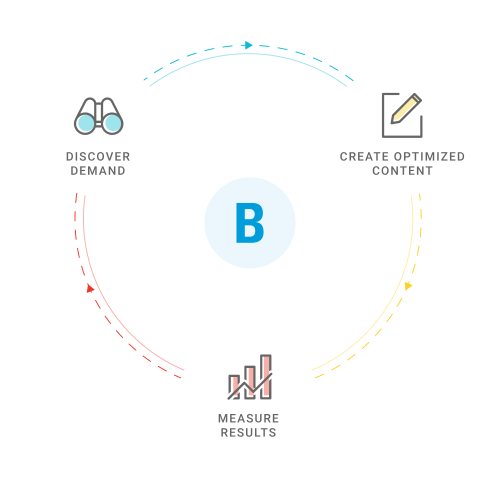
Best SEO Platform Agency, seo platforms, seo software, seo platform

An SEO platform offers multiple SEO tools in a suite for more efficient management of tasks relating to organic search optimization. Platforms tend to cater to enterprise SEO needs and are built for end-to-end SEO management. 

There are additional significant differences and understanding the distinction between the two will help you choose the best solution for your business needs.

SEO Platforms

An SEO platform provides a holistic solution to a number of digital marketing and organic search needs through built-in technology to optimize workflow, productivity, user management, and advanced reporting capabilities. Additionally, SEO platforms can integrate data and processes that span departments or teams (often including access to an API) and easily and reliably integrate with the major analytics providers, like Google Search Console, Google Analytics, Adobe Analytics, Coremetrics, and Webtrends, as well as content mangement systems like Adobe Experience Manager, web backlink software like Majestic SEO, and a variety of social platforms. 

Another aspect of enterprise-grade SEO software is seen in the team of support provided to customers. These range from SEO experts to experts on the technology itself and include customer success managers, solutions managers, online support, and professional services consultants. 

See the BrightEdge SEO Platform in Action!

SEO Tools

Most SEO tools serve a single purpose and are designed to help with one specific area of your business or SEO. For example, it's easy to find tools that help marketers with keyword research, link analysis, or analytics, but it's rare that one of these tools would provide more than one function let alone all the functions needed to run a successful SEO practice. SEO tools sometimes have limits restricting their ability to scale up to the volume of keywords and pages an enterprise user might need. This means users will need to toggle between different tools and manually manipulate data from different sources in order to gain a holistic view of the true performance of your website content. 

What Should an SEO Platform Provide?

The best SEO platforms should address the following functionality:

  1. Managing keyword and content discovery
  2. Creating optimized content
  3. Analyzing backlinks
  4. Auditing the site for technical and performance issues that affect SEO 
  5. Measuring SEO rank and business results on a site-wide and page-by-page basis
  6. Creating compelling dashboards that help elevate SEO wins
  7. Forecasting the ROI of tactics and strategies
  8. Enabling collaboration and coordination across teams
  9. On-platform and live human support
  10. Assigning and tracking tasks and events
  11. Self-guided certification
  12. Integration with other software and analytics

Search engines aim to deliver results that best address their audience's needs. Because of this, the SERPs are constantly updating, creating both opportunities and challenges for SEO and content marketers. Successful SEO is the result of proper digital marketing where every element of your marketing strategy is fully optimized. Succeeding in SEO requires that your web pages are relevant, original, and authoritative to satisfy the search engine's algorithms for specific topics. 

Matching your content to search ranking factors and user intent means the amount of data you need to track and analyze can be overwhelming. To be effective at scale requires an SEO platform to decipher the data in a way that allows you to take action. Your enterprise SEO solution needs to not only show your ranking position for each keyword, but also provide actionable insights in an instant given the ever-changing world of SEO.  

key Features of Enterprise SEO Platforms

Enterprise SEO Workflows Built Into the Platform

Modern SEO platforms must support complex enterprise workflows spanning multiple teams.

BrightEdge workflow automation includes:

  • Automated task triggers based on ranking changes or technical issues
  • Custom approval chains for content publication and brand consistency
  • Native integrations with Jira, Asana, and Monday.com
  • Role-based workflows for content creators, developers, and SEO specialists
  • Bulk task assignment across teams and projects

AI-Powered Content Intelligence

AI transforms how enterprise platforms optimize content at scale.

Key AI capabilities:

  • Copilot AI - Generates SEO-optimized content drafts (70% time savings)
  • Performance Predictions - Forecasts content success before publication
  • Content Gap Analysis - Automatically identifies missing topic coverage
  • Real-time Scoring - Instant feedback on SEO potential
  • NLP Intent Matching - Ensures content aligns with search intent, not just keywords

Intuitive Platform Design for All Skill Levels

For SEO Beginners:

  • Guided onboarding with interactive tutorials
  • Pre-built report templates and dashboards
  • One-click recommendations with clear actions
  • Visual SERP previews and drag-and-drop editors
  • Tooltips and help documentation throughout

For Advanced Users:

  • Custom API access for sophisticated integrations
  • Advanced filtering with RegEx support
  • Bulk operations for enterprise-scale changes
  • Custom scoring models and KPI frameworks
  • SQL access to raw data

Comprehensive Training and Support Ecosystem

Included with Every Plan:

  • 24/7 technical support (chat and phone)
  • Weekly office hours with SEO experts
  • 20+ hours of certification courses
  • Quarterly business reviews
  • Online knowledge base and community forum

Enterprise Support Benefits:

  • Dedicated Customer Success Manager
  • Custom team training (onsite or virtual)
  • Priority support queue (1-hour SLA)
  • Beta feature access
  • Direct input on product roadmap


SEO Platform Framework

Every website is different and your SEO strategy will be unique to your business' objectives and goals. However, there is a basic framework you should consider when evaluating SEO platforms. The following 6 capabilities are essential to executing a successful SEO strategy. Ensure the SEO platform you select will help you succeed at each of these critical functions.

1. Technical SEO

First and foremost, an SEO platform should identify and prioritize site errors, so your content outperforms the competition on search engines.

BrightEdge ContentIQ is an advanced site auditing solution that can support site crawls for millions of pages. ContentIQ helps by prioritizing website errors based on how they impact site performance. With the BrightEdge SEO platform, this technical SEO auditing solution is fully integrated into reporting and recommendations, allowing for automated error alerts and direct integration into analytics reporting. 

2. Discover Search Demand

At the heart of every successful SEO campaign is research. Strong SEO platforms help you discover, prioritize, segment and track keywords easily. This is a distinct advantage over SEO tools which may provide one or two of these functions, but rarely all four. 

Data Cube is the industry’s most powerful SEO research solution to help you prioritize and formulate successful search and content strategies. Conduct keyword research, evaluate a website's organic presence and rank and conduct competitive analysis all from one easy-to-use interface. Powered by DataMind, Data Cube reveals which web page URLs and content types are winning the top spots on the SERP (search engine results pages) for any keyword.

The SERP layout is always changing with various content types taking over the precious above-the-fold space on the SERP. Your SEO platform should be able to evaluate the true organic ROI for every keyword and judge whether your content is strong enough to win the top positions. That way you can easily segment your target SEO keywords into smaller groups and build strategies to defend your winning content, optimize existing content, create new content or pull in PPC team to maximize high-quality traffic acquisition for the website.

Additionally, if your business operates in multiple cities you'll need to conduct specific research in each market. This is where Hyperlocal helps differentiate the BrightEdge SEO platform from the competition. The same search query from two adjacent cities will often yield different search results and have different search volume. HyperLocal provides the search volume and ranking data for each keyword in every city or country that Google Search supports. HyperLocal helps you connects the dots between online search behavior and increased foot traffic to your locations.

Finally, your SEO platform should feel like an organic data analyst pulled together everything relevant to your website’s performance and laid out the recommended strategies to improve content, ranking and technical issues so you can improve your website with confidence.

3. Benchmark the Competition

In SEO, it's important to know your competition and stay a few steps ahead of them at all times. A good SEO platform should give you an easy way to understand the search landscape and identify who is winning the top spots for the keywords you want to own. Ideally, it can help you discover high-performing keywords that your competitor owns and provide actionable insights as to how they're outranking you.

Keyword Gap Analysis is an indispensable tool that helps marketers do just that. By comparing the keywords of a domain or a URL of a competing site against your own site, you're able to quickly identify gaps in your content. Use tools like this to create a content strategy and outrank your competition. 

BrightEdge's SearchIQ technology allows you to pinpoint the ranking factors and characteristics of the sites you compete with in organic search results.  Not only can you see what factors matter today, but the Time Machine functionality allows you to see how the characteristics of your competitors have changed over time.  

Another key way to analyze the competition is through Share of Voice. Calculating your organic Share of Voice based on the ranking position of you, your competitors and the total addressable search market can be a daunting task. A robust SEO platform should make this easy by doing the heavy-lifting for you and giving you a snapshot of where you stand amongst your competitors on the SERP. Find your organic competitors for any keyword and content category with a click of a button. In the BrightEdge SEO platform, the Share of Voice tool automatically dissects competitors' web page content to help you ideate content strategies to win back the market share in organic search. 

Backlinks are a useful measuring stick for search engines to grade the relevance and authority of websites. BrightEdge provides page-level backlink recommendations based on the top-10 ranking pages on the SERP, helping you identify authoritative links you might not have. Using artificial intelligence, the BrightEdge SEO platform automatically surfaces authoritative backlinks recently acquired by you or new competitive backlinks for you to target.

4. Create and Optimize Content

Improving the organic performance of an enterprise-sized site can be hard, but with an SEO platform you get prescriptive instructions for every page. This makes scaling content improvements and increasing organic rank easy. As SEO and content operate hand in hand, knowing what content to create or optimize and which technical enhancements to launch will make your organic strategy successful.

In the BrightEdge SEO platform, Recommendations compares each page vs. the top-10 ranking pages in the SERP to give prescriptive page-level recommendations. By pairing multiple keywords per page for the highest impact, Recommendations will help you improve organic visibility and relevance for your content.  In addition, Copilot leverages generative AI to act as your digital assistant to create content briefs and even generate SEO friendly drafts.  Learn more about how Copilot can save you time and scale your SEO and marketing efforts. 

5. Measure Results

An effective SEO platform needs robust reporting. With organic search constantly changing, you need to know where you are winning, where you can grow and what optimization plans worked, so you can scale further. The basic reports should provide key metrics and KPIs for every keyword you track. Sophisticated SEO platforms will go deeper and provide customizable reports pulling from multiple data sets. There should also be dashboards that make it easy to report wins and losses to colleagues and executives.

The best marketers are storytellers and SEO marketing is no exception. BrightEdge StoryBuilder has robust and flexible visualization capabilities to help you advocate the importance of the website and the contribution of SEO. Using executive dashboards to showcase the positive impact on brand equity and revenue from website optimization efforts will help you build convincing business cases for additional resources.

BrightEdge Opportunity Forecasting makes it easy to develop projections of SEO initiatives by calculating the total addressable market and your potential gains in revenue or site traffic with the push of a button. Building quantifiable business cases is critical to help secure the resources necessary for organic search success.

6. Workflow and Automation

SEO Platforms must reduce the manual work needed to execute SEO.   Artificial Intelligence (AI) enables platforms to do this at scale, while connecting applications through a uniified platforms makes workflows more efficient.  At BrightEdge, DataMind powers multiple AI applications such as Insights and Copilot.  Insights leverages AI to analyze all the data flowing through the platform to surface the most important ares to focus on, while Copilot leverages generative AI to assist in content creation.  These assets work together to automate repetitive work and empower teams to scale in ways that wouldn't be possible using standalone tools.  

In addition to AI and automation, SEO Platforms should provide a workflow system to easily manage tasks and collaborate with team members.  BrightEdge accomplishes this with the Task system which is a powerful task assignment application that automates task assignment and tracking across teams.  This simplifies project management and ensures that updates and optimizations are documented throughout all the platform reporting.  Furthermore, the Task system seamlessly integrates with popular workflow management tools such as Monday, Jira, Wrike and Asana to ensure SEO work is connected to broader company initiatives. 

Security and User Controls Needed in an SEO Platform

It is critical to have the highest data securtity standards and reliability. It is also important that the platform is easy to use for advanced user management, so each platform user is focused on their areas of work. 

Security - Look for ISO 27001 Certified, audited and confirmed to meet ISO standards. Look for a platform that offers flexible password policies, sophisticated session settings, and trusted IP address ranges.

Integrations/Partnerships -  Web marketing requires a full understanding of the impact of SEO on the outcome of the website. Toggling between SEO platform, web analytics, and Google Search Console or manually attempting to combine data in one place requires significant time and resources. The platform should do the heavy lifting for you by integrating web analytics data, social data, and Google Search Console data into the platform, providing a complete view and single source of truth for your organic programs. 

Enterprise SEO capabilities - If you have global operations or manage a number of domains for a large corporation, you need your SEO platform to also have extensive capabilities to support the needs of enterprise SEO. Capabilities you want to look for include global support, flexible password management policies, custom fiscal year, ability to audit sites with custom rules using RegEx.  

What's Next?

Are you ready to learn more about how BrightEdge could be the best SEO platform for your business?

Schedule Your Demo Of BrightEdge Today!

Semantics for SEO, Conversions, and UX - Part 1

mkirchhoff
mkirchhoff
M Posted 7 years 11 months ago
t 9 min read

Michael Kirchhoff, one of BrightEdge's top SEO minds, wrote this series of articles on the semantic web and what it means for SEO. It is one of the best set of advanced SEO content we have, so we updated it and are publishing them again for the community. Be sure to read all three:

  1. Semantics and the Future for SEO
  2. Content Silo-Value for SEO
  3. Taxonomies and Technical SEO and UX Strategy

BrightEdge Marketing Since its birth in 1998, Google has been continually evolving and improving its ability to match users with the websites that answer their needs. The Internet has grown from just over an estimated 17,000 websites in 2000 to well over a billion now. This tremendous growth has put an enormous amount of pressure on Google and the other major search engines to be able to interpret what people are looking for and better understand the value and depth of the websites available. This pressure pushed Google to introduce semantic search into its algorithm.

Beginning with the Knowledge Graph in 2012 and the Hummingbird Update in 2013, Google stopped looking at strings of letters in a sequence and trying to match them to the strings of content on a website. Instead, the algorithm began to understand the ‘meaning’ within the query and on the website.

The search engine was working to understand context and intent and then match the idea that the user was looking for with the best website, rather than just matching the words. Semantics, SEO -- BrightEdgeWhile Google has been working on improving its algorithm, there has also been simultaneous growth in the content marketing industry and the number of people who use the Internet when researching products and services.



An estimated 94% of B2B buyers and 81% of customers currently use online research while determining what product they want to purchase. Within the marketing sphere, an estimated 88% of B2B marketers and 76% of B2C marketers use content marketing.

This exponential growth in competition and demand - an estimated 90% of the data available has been produced in the past two years alone - along with the improvement of digital technology has also led to increased expectations on behalf of the search engine users.

People now require sophisticated and user-friendly sites that quickly meet their needs. If you fail in this task, they will just click off and go to the next one on the SERP.

For sites to meet the needs of these users and the modern Google algorithm, we believe that logical organization (taxonomy) and content silos are the key.

This structural system allows you to organize and classify your available content in a way that helps both search engines and users navigate your content and understand the depth of your knowledge on the topic at hand.

Silo Structuring and LSI

Silo structuring ties closely with Latent Semantic Indexing (LSI), which has been around for several years. A few notable resources that can introduce you to LSI and the role it plays in site building can be found on SEOBook’s excellent post on LSI or Bruce Clay’s post. In short, and to paraphrase SEOBook, the benefits of LSI and its ties to semantics and silo structuring are the following:

  • The LSI system will first record the keywords contained within a document
  • It will then record the keywords used throughout the silo
  • It will then compare the keywords used in the document with those used throughout the silo
  • The documents that contain large amounts of common keywords are considered semantically similar, those that do not are considered semantically different.

There is some debate as to whether or not the major search engines directly use LSI in their algorithms; however based on studies and my personal experience, I believe they do. Regardless, silo structuring and LSI work from the audience perspective. Therefore, the question of, “does Google use LSI?” becomes less significant. When you add the value of silos and content organization to your website and products for improved UX, you have created a meaningful and purpose-driven website that aligns content to the audience. This is what Google has been telling us is the key to success from the beginning. Constructing an efficient silo therefore requires a careful look at your user experience, your content coverage, the linking structure between content and pages in the silo, the keywords used in the silo, and your taxonomy. This is just part 1 of a 3-part series that will break down for you the principles of content silos and how you can use this strategy to boost your click-through rate, conversions, and ranking.

How Google is pushing semantics forward

LSI, the Knowledge Graph and Hummingbird laid the foundation, but Google continues to push the issue of semantics forward, calling on webmasters to conform to improve or maintain their rankings. In 2015 they introduced RankBrain, their first leap into the world of artificial intelligence. The engineers for the search engine aimed to create a system that not only would be able to understand how different concepts were related because of manual inputs, but would actually be able to learn how different concepts relate.

RankBrain was specifically designed to help Google return useful results for the roughly 450 million completely unique queries it receives each day. Shortly after RankBrain, Google stopped participating in the announcement and naming of algorithm updates and encouraged the community to focus on quality and relevance with the implication that RankBrain would be able to recognize and reward that focus.

Learn about the impact of SEO topic clusters. Semantics content strategy - brightedge

This push towards semantics has changed the way SEO is done. Now, rather than trying to match the keywords and vocabulary that your targeted audience is using, you want to match to the topics that they are asking about. Suddenly, related vocabulary terms are not only relevant but often important as a way to demonstrate your depth.

Establishing silos on your site takes a little effort, but it will prepare you for the changes Google continues to make to the algorithm. Each section of this series will help you understand the topic on a deeper level and will make it easier to understand how to build your silos yourself.

Here is what we will cover in each section the this blog series. Look for future posts.

Part 2 - Technical SEO and Content Strategy

In this part, we will explore how semantic search helps Google understand your site organization and how site silos influence Google’s idea of your domain authority and competence. As you create your content silos, you will also work on aligning each step to the buyer’s journey and a keyword group. Here we will explore the value of using technical SEO as a part of your overall authority and why it can help influence your rank. Read Part 2

Part 3 - Creating a UX and SEO-Based Taxonomy

In part 3 we will dive deeply into the taxonomy - your classification categories - of your project. We will see how you can use your terms to align your content and then manage your created system. You will look at how to do a taxonomy markup and how create a system that works specifically for your needs. Learn more about SEO technology in the BrightEdge platform.

Read Part 3 Login to the BrightEdge platform to get started today, or request a demo to learn more. 

SEO for Voice Search: Are We Doing it Correctly?

maspillera
maspillera
M Posted 8 years ago
t 9 min read

Voice represents a significant transformation to the way end users interact with Search. The convergence of Voice, vertical search engines, and mobile will accelerate the fragmentation of Search and the need for agile and targeted SEO for voice.

Organic continues to be a critical channel for marketers. The expansion and modification of paid search placements on Google, implementation of the Knowledge Graph, featured snippets, local results, and now question-answer SERPs have all come and gone. Despite all of that we know that in 2017 Organic still comprised 51% of all web traffic on average. People continue to browse and engage with organic listings on the SERP. There is one technological development that seems to pose a fundamental shift to the way people interact with and navigate through search engines, and that's voice search. By speaking a query to your mobile or home device, the user effectively bypasses the SERP and is delivered an answer without ever having to browse search results, click through to a new site, or, in some cases, even look at a screen. This is the true "Position 0" reality that SEOs have been talking about for a while now. It's obvious that we need to start optimizing for voice, but there are extra levels of nuance beyond simply, "let's go after more Quick Answer boxes," that are worth considering.

Why is voice search important for digital marketing?

In one way, voice search results are simply a continued evolution of the featured snippets that now sit at the top of the SERP for a number of query-based search terms. Google itself has stated that featured snippets help with appearing in voice search queries, and Quick Answers featured snippets are often the source for the answers delivered by Google Voice Search and Google Home for voice queries. The significance of this relationship is even more apparent when you factor in that in 2016, Google SEO Sundar Pichai said a full 20% of Google searches made on mobile and Android devices are voice searches. The proliferation of voice search-enabled devices has also been dramatic. One in six adults in the United States owns a "smart speaker" device as of 2017, according to NPR and Edison Research. Additionally, a Northstar Research study commissioned by Google in 2014 found that 55% of teenagers and 41% of adults included in the survey used voice search more than once a day. It's for these reasons and more that we believe Voice will be a tidal wave that search marketers should be prepared to surf. Of course, the extent to which that's actionable depends partly on how much data is available to work off of, which is - at least for now - one of the main challenges.

What kind of voice search data do we have?

One of the biggest challenges SEOs and digital practitioners have in terms of optimizing for voice search is that we simply don't have very much tangible data on itseo for voice with brightedge yet. Back in 2016 John Mueller, Senior Webmaster Trends Analyst at Google, said in a Webmaster Central office hours session that Google had been in discussions to add voice search traffic data to Google Search Console. The amount of data that's been made available since then, however, has been limited. Mueller did subsequently mention that voice query data would likely be presented as a separate dataset from standard GSC keyword data, but not much else. This isn't out of any desire to withhold information on the part of Google. Rather, as Mueller himself has said, the challenge on the search engine side has been to figure out the optimal way to parse and display this huge new dataset in a way that will be intelligible to the marketer. Despite this, based on best practices for featured snippets and aforementioned Quick Answers we do know enough to have a good sense of how to position for Voice:
  1. Analyze your search reporting for question queries and long queries
  2. Find the 100 most popular questions in your industry, site, CS, or, help section
  3. Ask the question in the title, answer the question in the body
  4. Focus on answers and getting position 1 and Quick Answers or “position 0”
  5. Check for popular answers in Yahoo Answers and Quora
  6. Enhance use of structured micro-data and schema
  7. Enable voice-to-text to search your site to match context query was made in
  8. Use conversational language on pages to map to queries coming from digital assistants

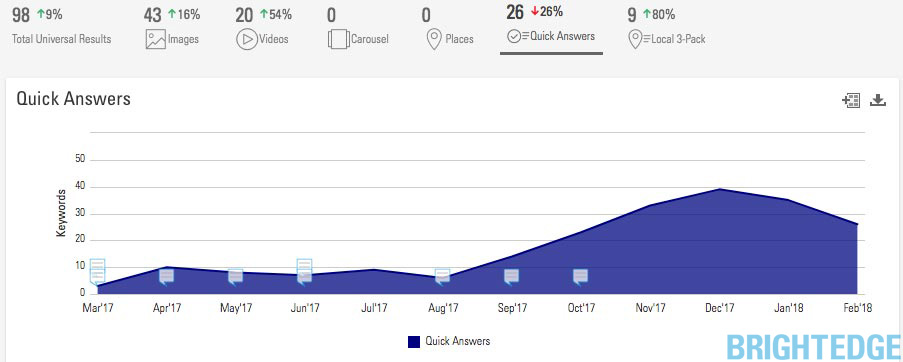
BrightEdge can help you to better identify and target these Quick Answer and featured snippet and, by extension, voice search opportunities. By using the Universal Search Results view in the Keyword Reporting module, as well as looking up your own domain in Data Cube, you can track which Quick Answer boxes you already possess as well as SERPs where you do show up, but don't have Quick Answer placement.Data Cube Universal Results Quick Answers report Additionally, the Insights solution can elevate Quick Answers opportunities to you based on your existing list of tracked keywords. There is also a whole other additional layer of abstraction (and potential for growth) in SEO for voice: The ever-growing universe of vertical search engines.

Voice search and vertical search engines

There's a layer of complexity to voice search that's easy to miss, and that's that Voice is fragmented. There are two separate points of fragmentation worth pointing out: Firstly, there's a whole universe of other search engines out there. Major examples include Amazon, Facebook, LinkedIn, and YouTube. Depending on your industry and business model, many of these vertical search engines can be of significant value. The need for SEOs to start thinking about vertical search engines is something we've talked about before, but the rise of Voice makes it all the more important. Secondly, when we talk about Voice as a whole we often use the term to refer just to voice searches conducted on Google, and we don't factor in device type. Devices, however, are a vital aspect of how voice search will be delivered to and conducted by end users. Consider how it was only around September of 2017 when Apple switched the default search engine of Siri, the voice-activated digital assistant of iOS, from Bing to Google. Compare this to the Amazon Echo, which uses Bing. There are also narrower, but just as powerful examples, such as how Bixby, Samsung's virtual assistant for Galaxy devices, offers a visual search feature, which can identify brands and products and direct the user to ecommerce listings, uses Pinterest's Lens tool. While these individual examples may not be relevant to every search marketer, they are indicative of how the confluence of Voice, mobile device proliferation, and vertical search engines can drastically affect the angles of attack in SEO for voice search. Observe this example of a mundane voice search query using Alexa that delivers results solely for Amazon-branded products.

Different vertical search engines equal different search intent

Not all search engines are created equally. There are many potential scenarios where a brand may be better served focusing its SEO efforts on one search engine or a set of search engines versus another. It's clear that Voice is transforming organic search as we know it. This transformation isn't the end of Organic, it's another layer of complexity that will make savvy SEOs and digital marketers who understand user intent and approach it using a smart content framework more important than ever. If you're hoping to gain more information on the topic, download BrightEdge's POV on voice search.

Search Engine Optimization 101

Search Engine Optimization 101

This webinar will help you build a strong foundation of SEO knowledge.

Available on-demand

Whether you're new to the world of SEO or looking to help educate others in your organization, this webinar will help you build a strong foundation of knowledge. We will talk through real-world example and best practices.

  • What is SEO?
  • How do search engines work?
  • How to succeed in SEO?
  • How to identify quick wins?

Download now.


CAPTCHA
Solve this simple math problem and enter the result. E.g. for 1+3, enter 4.
This question is for testing whether or not you are a human visitor and to prevent automated spam submissions.

The Internet evolves at breakneck speed, companies change, technology gets better, and strategies adjust. It’s inevitable that at some point in your marketing career, you’re going to face the challenge of overhauling your website. All of those files, all of that content, all of that technology you and your team has been working on for […]

The post 7-Step Guide to Site Migration and SEO Success appeared first on BrightEdge SEO Blog.

SEO with a Small Team Part 2: Making Your Plan

maspillera
maspillera
M Posted 8 years 5 months ago
t 9 min read

Running an effective digital marketing campaign and SEO with a small team can seem daunting. It's doable, however, with planning, training, and technology. This two-part series will offer advice to help brands see how to maximize the resources they have in their small teams. You can read Part One here.

When you have the members of your team performing different digital marketing skills and functioning as hybrid professionals, you can be sure that time is of the essence. SEO with a small team must understand how to work quickly and effectively. To accomplish this, and to produce content that ranks well and draws in customers, understanding how to make a digital marketing plan with your small team in mind remains a critical piece of the equation.SEO with a small team how to - brightedge

Determining how micro-moments look for your business

In the modern customer journey towards a purchase, there are four main micro-moments that can appear in any order at any time:

Through desktop and mobile devices, customers can make searches that fall into one of these intent headings at any time. Rather than following a predictable path like the customers of the past, the modern, digitally connected consumer will access them randomly and sometimes progress towards a purchase within a few hours, other times not for months.

Google, in an effort to better serve its end users, has worked to better understand the intent behind user queries and where those queries fit within the micro-moments. The search engine then works to take this understanding to create a SERP that displays content tailored towards customers with these understood intentions. Given that the SERP changes depending upon the micro-moment, brands need to understand how these micro-moments manifest themselves for their particular customers and the significance of each for their business.

A local restaurant, for example, might have a big emphasis on that I-want-to-go micro-moment, while an ecommerce store will look at the I-want-to-buy micro-moment with particular interest. A software provider may take a special interest in the I-want-to-do and the I-want-to-know micro-moments. It's important to note that although a certain micro-moment captures the attention of particular organizations, that does not mean that the other three do not also play a role in their customer’s journey. The better you understand how the micro-moments look for your customers and which ones will most closely impact your bottom line, the easier it will be for you to determine where your focus should lie. You will be able to make a better judgement call about the types of content that will be the most important and how you should strategize your campaigns, thus boosting the effectiveness of your SEO with a small team.

Managing priorities

When managing SEO with a small team it's impossible to effectively manage every facet of an online presence, so prioritization is critical to success. Once you know the micro-moments and how they impact your business, you can start to look at the types of content that will have the greatest impact for the brand. Analyze the Google SERP to see how the search engine displays content for the popular queries for your target audience and how you can maximize your brand’s presence. Google often uses a combination of video, images, written content, paid, and local listings in the creation of the SERP. Seeing the prominence of each will shape your strategy. You will also need to prioritize your presence and activity on other online platforms, including social media. Countless social platforms now exist for brands to consider, so think about where your customers most expect to see you. A B2B brand, for example, will likely look at LinkedIn as their top priority, often with Facebook as the second priority, and Twitter behind that. On the other hand, a fashion designer will want to place their emphasis on visual platforms, like Instagram and Pinterest with Facebook, LinkedIn, and Twitter playing less of a role.

Bringing in analytics

For a small SEO team, analytics are a critical means of ensuring that all the energy and time expended to create content is productive and useful. As a small team, you cannot afford to waste time creating content that misses the target audience or does not accomplish the goals designed for it. Incorporating analytics into all website analysis will allow you to see the success of your campaigns as well as weaknesses, so you know where to focus your attention to enhance the efficiency and effectiveness of your efforts. To productively use analytics, you should look at a variety of different factors, including rankings, traffic, engagement metrics, and the revenue generated from the campaigns. This will provide you with more insight into how to target your audience and create the content they want to see. Keep in mind that you will also find value from not only looking at the analytics of your own site, but also those of your competitors. By looking at their content strategies, you can see what has and has not worked for others within your industry, sparking ideas for you moving forward. 

Creating a content schedule

Determine first the types of content that will likely be the most effective for your audience based upon your analysis of the SERP and the analytics you have for your site and competitors’ sites. You'll then want to determine a reasonable rate for the content creation. Remember that you want to focus on balance. Although publishing a few blog posts a week might be ideal, you do not want to spend all the time focusing on blogs to the detriment of other types of content. Have content that is gated as well as some that exists in other formats, such as infographics or videos. Focus on creating quality material that you can be confident will rank well rather than just creating more content for its own sake. SEO success with a small team is totally possible for professionals who stay dedicated and are willing to press forward. By incorporating the proper training and then moving forward with a solid plan, you then just need to focus on incorporating the right technology and coordination to see success that will grow your organization.

Google called for “HTTPS Everywhere” (secure search) at its I/O conference in June 2014 with its Webmaster Trends Analyst Pierre Far stating: “We want to convince you that all communications should be secure by default,” and it anticipated some resistance and skepticism from the SEO industry. In 2016, 2 different Google representatives advocated for HTTPS: […]

The post HTTP vs HTTPS and SEO : HTTPS Chrome Warning Starting in October 2017 appeared first on BrightEdge SEO Blog.

,