E-E-A-T Implementation for AI Search

lpark
lpark
M Posted 1 year ago
t 9 min read

Understanding E-E-A-T: The Cornerstone of Quality Content

Google's quality guidelines emphasize E-E-A-T (Experience, Expertise, Authoritativeness, Trustworthiness) as the framework for evaluating content quality, especially as AI-generated content becomes more common.

In 2022, Google added "Experience" to the previously known E-A-T framework, highlighting the importance of first-hand, real-world knowledge. This means successful content should demonstrate the author's actual experience, such as personal product use or location visits.

E-E-A-T isn't a single ranking metric but rather a framework that influences how algorithms evaluate content. Google's systems look for signals of each component:

  • Experience: Content showing first-hand expertise and depth of knowledge
  • Expertise: Clear demonstration of subject matter knowledge
  • Authoritativeness: Establishing credibility through author bylines, bios, and references
  • Trustworthiness: Clear sourcing, evidence of expertise, and background information about authors or sites

This framework is crucial because it underpins Google's helpful-content standards. Google has clarified that content quality matters more than who (or what) created it—meaning even AI-generated content must earn trust by meeting E-E-A-T criteria

Low-quality, automated content created merely to manipulate rankings is treated as spam, while original content demonstrating E-E-A-T is more likely to rank well. Remember: quality over quantity is key, as Google prioritizes content providing real value.

The Impact of AI on Content Creation and SEO

AI content tools are transforming how marketing teams generate and scale content. BrightEdge users have used Copilot for Content Advisor to generate millions of briefs and drafts to aid in optimized content creation. It assists in automated content drafting, on-page optimization, and keyword research. Generative AI can dramatically speed up content production – for example, writing a page that might take hours can be done in seconds with a prompt.

These technologies must be coupled with original human elements. This means infusing AI drafts with original anecdotes, examples, and strategic thinking that set your content apart.

Challenges and Opportunities in the AI Era

The Growing Impact of AI Tools

SEO professionals are increasingly adopting AI tools for content creation and optimization, seeing significant improvements in publishing speed and content iteration capabilities. While AI delivers clear benefits, many professionals still prioritize maintaining content quality and authenticity when leveraging these technologies.

Quality Standards Remain Paramount

Google's position is straightforward: using automation isn't prohibited, but automated content must be high quality and "helpful and people-first." Content generated solely to manipulate search rankings violates spam policies. The best approach is using AI to enhance your strategy—BrightEdge's Copilot for Content Advisor exemplifies this balanced approach, helping teams generate idea lists or first drafts while maintaining focus on user value.

Evolution of Search Behavior

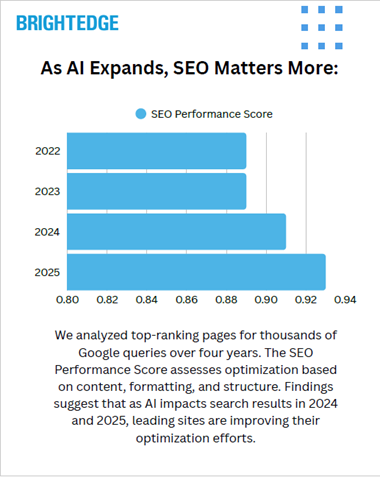
AI is transforming how users interact with search. Generative AI features like Google's AI Overviews are appearing more frequently. These direct-answer features can reduce clicks to traditional results since users often find their answers without leaving the search page. This doesn’t mean AI-assisted content can’t serve AI and traditional results. In fact, maintaining strong organic rankings helps ensure your content appears in AI-generated answers as well.

Overall, AI offers tremendous opportunity to create and optimize content at scale, but it raises the bar on quality. Marketers must use AI tools strategically, uphold E-E-A-T, and adapt to new search formats. Done right, AI can free teams to focus more on strategy and user needs, while continuing to build content that humans and algorithms alike trust.

Implementing E-E-A-T Principles in AI-Generated Content

Infusing Human Expertise and Experience

Building true E-E-A-T into AI-assisted content requires deliberate steps to demonstrate expertise, authority, and trust. Google's quality criteria specifically look for content that shows first-hand expertise and depth of knowledge, such as actual product usage or location visits. To achieve this:

  • Incorporate real experiences: Add case studies, personal anecdotes, or data analysis that only knowledgeable professionals could provide.
  • Include subject-matter experts: Have specialists write or review content to ensure accuracy and add unique insights.
  • Showcase credentials: Always include author bylines with relevant qualifications to help users judge credibility.
  • Support with authority: Link to recognized sources, official research, and reputable websites to boost authority.
  • Ensure accuracy: Fact-check all AI-generated statements and remove unsupported claims.
  • Consider transparency: When appropriate, disclose AI assistance while ensuring human oversight is emphasized.

By blending AI efficiency with real expertise, demonstrating clear authoritativeness, and building trust through accuracy, AI-assisted content can meet Google's highest quality standards.

Optimizing Content for AI Search

As search evolves, strategies must adapt to align with how AI systems interpret and present content:

  • Use structured data: Implement schema markup (FAQ Page, HowTo, Product) to help AI systems recognize authoritative answers.
  • Format for clarity: Use clear headings and bullet points so AI can easily parse your content.
  • Prioritize page experience: Ensure fast loading times and follow Core Web Vitals for better user engagement.
  • Create concise answers: Structure content with key answers immediately visible, as AI-driven interfaces often pull short summaries.
  • Monitor engagement: Track metrics like click-through rate and session duration to gauge content effectiveness.
  • Update regularly: Refresh top-performing content to stay aligned with evolving AI patterns.

The most successful approach combines structured content, excellent user experience, and data-informed updates while always prioritizing user needs and questions. This human-centered strategy ensures content thrives in the AI-driven search landscape.

Measuring E-E-A-T Success in AI Search Environments

As AI search features become more prominent, measuring E-E-A-T effectiveness requires specialized metrics that reflect both traditional SEO and AI-specific performance:

AI Feature Inclusion

Track how often your content appears in AI search features like Google's AI Overviews or generative answer boxes. Being consistently cited in these AI-generated summaries indicates your content demonstrates the expertise and authority that AI systems recognize. Monitor which specific pages and topics receive the most AI citations to identify your strongest E-E-A-T content.

Organic Traffic Patterns with AI Integration

Analyze traffic changes as AI features expand. Look for correlations between strong E-E-A-T signals and content resilience against potential traffic declines from AI answer boxes. Pages with robust expertise signals often continue receiving clicks even when competing with AI summaries, as users seek deeper information from trusted sources.

Query Intent Satisfaction

Measure how well your content addresses the complete user journey in AI-first search. AI systems evaluate content based on how thoroughly it answers user questions and anticipates follow-up needs. Track whether users who land on your page from AI-influenced search results engage deeply or quickly return to search results (indicating incomplete answers).

AI-Specific Engagement Signals

Track new engagement patterns emerging in AI search interactions. This includes metrics like zero-click searches (where users get information directly from AI summaries) versus full-content engagement. Content with strong E-E-A-T often drives users to seek more detailed information beyond AI summaries.

Structured Data Effectiveness

Measure how your schema implementation impacts AI feature inclusion. Content with proper structured data (FAQPage, HowTo, etc.) that aligns with E-E-A-T principles is more easily parsed by AI systems. Track whether improvements in structured data lead to better representation in AI search features.

Authority Recognition in Competitive Analysis

Compare your AI feature inclusion rate against competitors for the same queries. If your content appears more frequently in AI-generated answers for shared keywords, it suggests your E-E-A-T signals are stronger. Use this comparative data to identify opportunities for enhancing expertise and authority markers.

For successful measurement, combine traditional analytics with AI-specific tracking tools that monitor your content's performance across emerging search features. This holistic approach ensures your E-E-A-T strategy remains effective as search continues its evolution toward AI-first experiences.

Finally, adopt a mindset of continuous improvement. Regularly review performance data to spot underperforming content. A drop in traffic or engagement might mean E-E-A-T elements need strengthening (e.g., adding expert quotes, updating references, or clarifying trust signals). Use this feedback loop: refine content based on metrics and re-test. In summary, E-E-A-T implementation for AI search is not a one-time task but an ongoing strategy. By grounding content in real expertise and trust now, you’ll be ready for whatever AI-driven search engines bring next.

This webinar was presented live on May 14, 2025, and is now available on-demand.

AI Search represents a major opportunity for marketers—but how can organizations take advantage of it when teams are already stretched thin? Can you build a strong brand presence in AI Overviews without a large, dedicated SEO team?

Join us for an engaging session with Teradata, a leading B2B brand doing exactly that. Discover how agile teams are using AI to win in AI—even in competitive, resource-constrained environments.

You’ll also learn how they’re communicating the value of AI Overviews across their organization—translating technical success into clear business impact that gets everyone aligned.

You’ll walk away with:

  • Practical workflows that reduce manual effort while driving results in organic and AI search
  • Success metrics that help your leadership team understand the impact of AI Search
  • Real-world examples of how BrightEdge’s AI capabilities help marketers win in the evolving search landscape

Featured Speakers:

Dave McAnally

Dave McAnally
Product Marketing Consultant

Shalini Desai

Shalini Desai
Digital Marketing Director

Matt Winninger

Matt Winninger
Global Director of Digital Operations

Watch On-Demand Webinar

* indicates required


One Year Into Google AI Overviews, BrightEdge Data Reveals Google Search Usage Increases by 49%

One Year Into Google AI Overviews, BrightEdge Data Reveals Google Search Usage Increases by 49%

Despite fears of disruption, data indicates the era of AI discovery continues to propel growth across traditional and AI search engines


San Mateo, Calif. — May 14, 2025


BrightEdge, the global leader in AI-driven organic search, content, and digital marketing automation, released new research on the anniversary of Google AI Overviews showing the advent of AI-powered search engines isn't diminishing Google's dominance, but rather fueling an unprecedented expansion of overall search activity. BrightEdge found total search impressions increased by over 49%, with Google experiencing substantial growth alongside the emergence of AI-driven discovery platforms, underscoring a powerful shift in how people seek and find information in the AI era.

The findings arrive ahead of the one-year anniversary of Google’s AI Overviews on May 14, 2024, marking a pivotal milestone in the evolution of search. BrightEdge’s report offers one of the first comprehensive views into how generative AI is impacting real-world search behavior—and reveals a counterintuitive insight: rather than cannibalizing Google, the AI era is expanding it.

Key Insights from the Report

  • In the last month, ChatGPT grew 21%, with Perplexity and Gemini remaining about 1/10 of its size, and other AI search engines like Claude, Meta, and Grok another 1/10 smaller. Meanwhile, Google still maintains over 90% of market share.
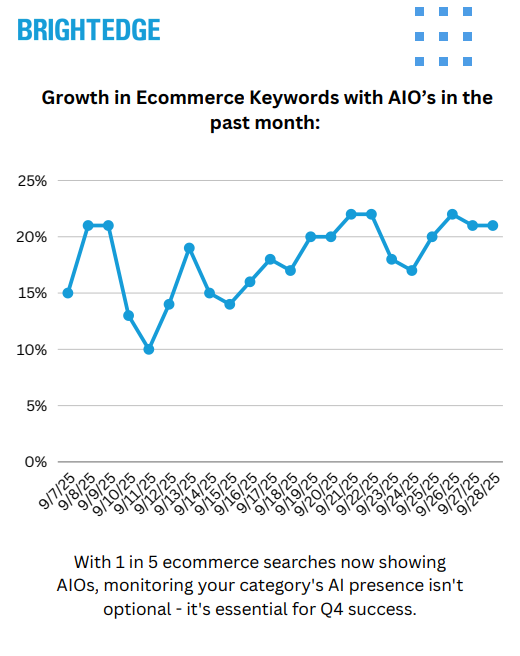
  • AI Overviews (AIOs) now appear in over 11% of Google queries, a 22% increase since debuting last year.
  • Longer, complex queries have grown 49% in AI Overviews since May 2024, while ranking-style content and comparison queries have decreased, down 60% and 14% respectively.
  • Impressions on all content have skyrocketed by over 49% since the launch of AI Overviews, while click-throughs have steadily declined, with a nearly 30% reduction since May 2024.
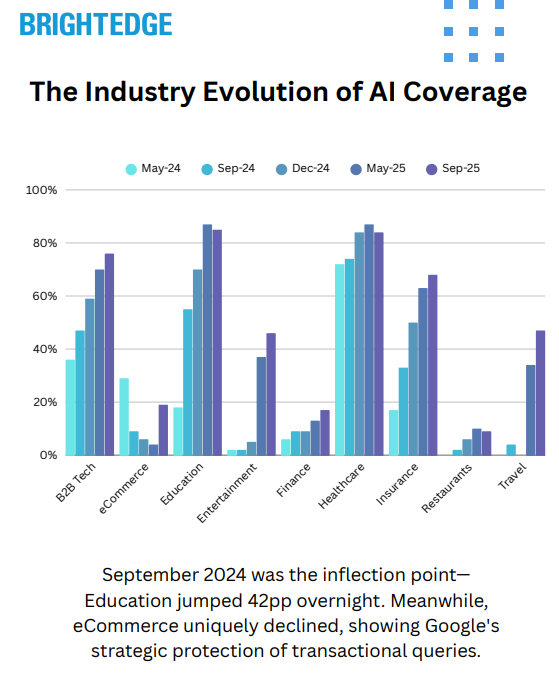
  • BrightEdge data shows the industries with the strongest AI Overview presence are Healthcare, Education, B2B Tech, and Insurance. Travel and Entertainment are on the rise, while Ecommerce has not seen rapid growth in the past year.

“The assumption was that AI would kill traditional search," said Jim Yu, Founder and CEO of BrightEdge. "But our data tells a different story: search is not disappearing, it’s expanding. Google is not being replaced; it’s being reimagined. The rise of AI agents has created a new battleground where visibility is no longer about rankings or clicks; it’s about presence across a new class of interfaces. Brands need to understand how and where they’re being interpreted by AI. The rules of engagement are changing, and this data is an early signal of where things are heading."

From Clicks to Impressions, From Discovery to Decision-Making

The rise of AI search engines and autonomous agents is fundamentally reshaping how discovery works and how brands and publishers measure success. Traditional metrics like click-throughs have steadily decreased since the launch of AIOs, while AI-driven impressions surfaced via technology such as AI Overviews are surging. As generative engines guide users through personalized conversations, visibility in the AI layer becomes the new imperative. BrightEdge data confirms that while Google remains the main battleground for search performance, there is a growing need to rethink performance not in terms of click-throughs, but influence, appearing in the right context, at the right moment, in the AI experience.

The shift does not stop at discovery. As AI agents increasingly connect to payment platforms, the line between recommendation and transaction is dissolving. This shift demands businesses rethink marketing to consider AI as a direct channel to consumers. The future of commerce will hinge on understanding and influencing AI agents.

The Path For Future-Proofed Brand Strategies

Brands must urgently adapt SEO for an era of buying within AI search. Future-proofing means optimizing for clicks and AI agent visibility and preference, and shifting focus to new KPIs. To find success in AI search, brands need to attend to their mentions within AI outputs, sentiment behind those mentions, and the likelihood of AI systems prioritizing their content in the buyer journey.

Not all AI platforms treat content the same, and different attributes matter for different AI search engines, and differ in how they cite their sources. In ChatGPT, it’s easy to get mentioned, but citation links are rare (every 2 in 10 mentions are cited). Perplexity leans heavily on citations, averaging over 5 citations per answer, but mentions brands less frequently—only 1 in 5 answers include any brand reference at all. Google AI Overviews exist in the middle of this spectrum, blending brand recall with source attribution. This fragmentation is a complex, new frontier: brands only have one website, yet must optimize for many AI engines with different rules.

BrightEdge’s AI Catalyst solves this problem, delivering unified visibility, sentiment intelligence, and actionable insights across platforms in real-time, so marketers can adapt quickly and keep pace with the evolving search landscape. Since its release, over 750 organizations, including many Fortune 500 brands, rely on AI Catalyst daily to monitor their brand presence across AI search engines.

You can view the full report here: BrightEdge Report – AI Overviews One Year Review Research Paper and Deep Dive

BrightEdge’s AI Catalyst is available for all customers at: https://www.brightedge.com/ai-catalyst.

About BrightEdge

BrightEdge, the global leader in Enterprise SEO and content performance, empowers digital marketers to transform online opportunities into tangible business results. Its all-in-one platform provides organizations with crucial market insights and intelligent AI-driven solutions. The BrightEdge platform contains the industry's most unique and extensive data set that connects key search, social, content, and digital media data points. Its deep-learning engine, DataMind, has been powering SEO AI-driven solutions since 2015, allowing marketers to benefit from high-fidelity data-led insights and automated action. Over 57% of Fortune 100 companies and nine of the top ten international agencies trust BrightEdge to help them provide the best performance by becoming an integral part of the digital experience.

Press Release Date

2025 Guide to a Successful Site Migration: How to Protect Your SEO and Grow in the Era of AI Search

lpark
lpark
M Posted 1 year ago
t 9 min read

Site migrations have always been one of the riskiest moments for organic search—but in 2025, the stakes have grown higher. Search isn’t just about rankings anymore. It’s about how you appear in AI-generated answers, summaries, and recommendations. Whether you’re rebranding with a new domain, launching a redesign, or moving to a new CMS, the wrong migration decisions can erase years of hard-earned search visibility across both traditional SERPs and AI search.

This guide was created to reflect the new search reality—where AI models not only crawl and rank your content but decide whether to cite it in high-visibility summaries. We wrote a step-by-step migration guide helped thousands of marketers navigate the basics. But this new guide is for 2025: which requires the fundamentals but you must also have an AI-focused strategy which will require some specific capabilities.

Site Migrations Happen Regardless of Experience Levels

This guide is written for digital marketers—not just technical SEOs— who are tasked with leading or supporting a website migration. Whether you're planning a full domain switch or relaunching a mobile-first redesign, there are fundamental steps required which ensure your transition is smooth.

We’ll walk you through:

  • Major Migration Types
  • What to do pre-launch, during launch, and post-launch
  • How AI search engines like Google’s AI Overviews and SearchGPT evaluate and cite content differently from traditional engines
  • The capabilities within BrightEdge and OnCrawl that can help you prepare, execute, and monitor your migration successfully

What Is a Site Migration?

A site migration is any substantial change to your website’s domain, structure, or platform that affects how it appears and performs in organic search. The changes may be technical, content-driven, or structural—but all of them impact how Google, Bing, and now AI engines crawl, interpret, and cite your pages.

Here are common types of migrations digital marketers may oversee:

  • Domain name change or rebrand (e.g., oldbrand.com → newbrand.com)
  • Protocol shift (HTTP → HTTPS)
  • URL structure changes, like removing .html, restructuring categories, or shifting from subdomains to subfolders
  • Platform or CMS migration, which can introduce new templates, URL formats, and rendering behavior
  • Website redesign or code overhaul, often changing content hierarchy, page templates, and load times
  • Mobile migration, such as moving from m.example.com to a fully responsive single site
  • International site migration, such as consolidating ccTLDs into a subfolder model
  • Site consolidation, combining multiple brand sites or microsites into one
  • Host or server migration, where speed, uptime, and crawlability could be affected

Each of these scenarios is technically different—but they all require you to preserve one thing: your SEO equity, including rankings, links, citations, crawl paths, and topical authority.

In 2025, you also need to preserve your AI equity: the structured signals, schema, and associations that feed your presence in AI search results.

The AI Search Changes the SEO Migration Playbook

AI-powered search—like Google’s AI Overviews, Bing’s Copilot, and tools like Perplexity—don’t just index your site. They summarize, synthesize, and cite content from across the web.

That means your visibility isn’t just about where you rank anymore. It’s about whether AI systems trust your content enough to include you in answers.

During a site migration, you risk losing that trust if:

  • Previously cited content is removed or merged without maintaining its identity
  • Schema or structured data is dropped
  • Pages are slower to render, load behind JavaScript, or fail to meet accessibility standards
  • Redirects are misconfigured, creating loops or soft 404s
  • Internal link structures are weakened, breaking topical authority chains

To win in AI search after a migration, you must go beyond traditional redirects and rankings. You need to:

  • Maintain clarity, structure, and speed in every new page
  • Monitor how your visibility in AI summaries and citations changes
  • Use schema markup and semantic consistency to reinforce your topical authority

With BrightEdge Data Cube X, you can track how your site is cited and how changes affect your visibility—across both keyword-based and AI-driven search results.

Pre-Migration: Planning, Benchmarking, and Risk Assessment

Whether you’re running a site redesign, consolidating properties, or migrating to a new CMS, the planning phase is where you make or break success. Here’s what digital marketers need to do before launch:

1. Run a Complete Content and URL Inventory

Use BrightEdge ContentIQ or OnCrawl to crawl your site and export:

  • All active URLs
  • Title tags, meta descriptions, and H1s
  • Canonical tags and schema markup
  • Internal link structures and click depth

This becomes your working document to map redirects, ensure metadata preservation, and retain content integrity. Combine with BrightEdge Data Cube X to overlay performance data: which pages rank, convert, or appear in AI panels?

2. Set Benchmarks: Traditional + AI Search

Don’t just track keyword rankings. Track:

  • Organic traffic by page
  • AI Overview citations by query (using Data Cube X)
  • Backlinks and top referrers
  • Indexed URLs in Search Console

Use this to create KPIs: “Preserve 95% of AI citations and 90% of organic traffic within 60 days post-migration.”

3. Create Your Redirect Map

Depending on the type of migration, you may use:

  • 1:1 redirect mapping (old URL → new URL)
  • Wildcard redirects (entire path structures moved with patterns)

Use 301 redirects exclusively, not 302s. Test them in staging. Create a spreadsheet with columns: Old URL, New URL, Redirect Type, Schema Preserved (Y/N).

4. Audit Your Structured Data Strategy

Preserving schema types—Product, Article, FAQ, etc.—is now an AI priority. Confirm that your schema will:

  • Remain intact post-migration
  • Be upgraded if templates change
  • Align with what’s cited in AI results (e.g., using FAQPage for common questions)

5. Crawl and Validate Your Staging Site

Run ContentIQ or OnCrawl on your staging site before go-live. Check:

  • Canonicals reflect the new domain/structure
  • Page speed meets Core Web Vitals
  • Schema validates cleanly
  • All test redirects function correctly
  • Meta tags and headers are carried over

Lock the staging environment with robots.txt and noindex, but verify all pages render cleanly—especially JS-heavy templates.

Migration Day: Execute with Precision

Launch isn’t just a technical handoff. It’s an SEO and AI visibility event.

Key Tasks:

  • Enable all 301 redirects and test top 100 legacy URLs
  • Update internal links and canonical tags to reflect the new domain or structure
  • Submit updated XML sitemaps in Google Search Console and Bing Webmaster Tools
  • Use Google’s Change of Address tool if you’ve changed domains
  • Validate that schema, meta tags, hreflangs, and mobile tags have transitioned correctly

Monitor crawl behavior with OnCrawl log analysis in real-time to confirm that bots are hitting the new URLs and following redirects properly.

Post-Migration: Monitor, Fix, and Optimize

The weeks after migration are your window to catch and fix issues before they become long-term visibility losses.

What to Watch:

  • Redirect coverage (ContentIQ + GSC Coverage report)
  • Indexation shift (Old site index down, new site index up)
  • Keyword rankings + AI citations (Data Cube X + SearchIQ)
  • Traffic anomalies (BrightEdge’s Anomaly Detection)
  • Bot crawl paths (OnCrawl live logs)

If you notice a major page drop in AI summaries or organic rankings, use:

  • BrightEdge Copilot to rewrite content or metadata inline with AI patterns
  • Autopilot to automatically optimize underperforming pages

Also, use SearchIQ to see what technical or content-related shifts may be affecting how you’re cited in AI Overviews.

Final Thoughts: Modern Migrations Require Modern Strategy

Migrating a website has always required planning. But in 2025, you’re not just migrating URLs. You’re migrating your relevance, your trust, and your AI presence.

The best migrations don’t just preserve—they improve. With capabilities like ContentIQ, Data Cube X, SearchIQ, Copilot, and Autopilot from BrightEdge—and technical analysis from OnCrawl—you can:

  • Plan and map with confidence
  • Migrate without SEO loss
  • Monitor and recover post-launch
  • Prepare your site to win across both search and AI systems

Search is no longer one-dimensional. Your next migration should be built for the AI-first era.

2025 SEO Site Migration Checklist

Preserve SEO performance and AI search visibility across domain, CMS, and site structure changes.

Pre-Migration Planning

Content & Technical Preparation

  • Crawl and inventory all current URLs (BrightEdge ContentIQ / OnCrawl)
  • Identify top-performing pages (SEO traffic, conversions, backlinks, AI citations)
  • Export and map all title tags, meta descriptions, H1s, canonicals, and schema
  • Benchmark rankings and AI citations (BrightEdge Data Cube X + SearchIQ)
  • Document baseline metrics: indexed pages, traffic by URL, CTR, page speed
  • Assess structured data coverage and plan to preserve/expand it
  • Run a full technical SEO audit and address crawl issues on the old site
  • Set site migration KPIs (e.g. “recover 95% of traffic within 60 days”)

Redirect Strategy

  • Create a detailed 301 redirect map (Old URL → New URL)
  • Use wildcard redirects only when structure is unchanged
  • Ensure no redirect chains or loops
  • Validate redirect logic in staging environment

Staging Site Validation

  • Block indexing (robots.txt disallow + noindex meta)
  • Run full crawl (ContentIQ / OnCrawl) to validate:
    • Internal links
    • Canonical tags
    • Meta data
    • Schema markup
    • Page speed
    • Mobile rendering

Migration Execution

Go-Live Checklist

  • Launch all 301 redirects at go-live (not after)
  • Switch internal links and canonicals to new URLs
  • Submit updated XML sitemap to Google Search Console + Bing
  • Use Change of Address tool (if applicable)
  • Verify schema, hreflangs, and structured data are live
  • Check robots.txt and remove staging disallow directives
  • Validate analytics tracking is working on all pages
  • Announce relaunch across owned channels (blog, social, email, PR)

Post-Migration Monitoring

Week 1–4 Tasks

  • Monitor 301s and crawl errors (Search Console + ContentIQ)
  • Track indexation trends: old URLs dropping, new URLs rising
  • Compare traffic and rankings to pre-migration benchmarks
  • Watch for anomalies using BrightEdge Anomaly Detection, such as:
    • Sudden drop in organic clicks or impressions for high-priority pages
    • Drop in keyword rankings for target terms
    • Spike in 404 (Not Found) errors from old URLs not redirecting
    • Any 5xx (server) errors indicating instability or downtime
    • Crawl rate drops or delays in sitemap processing by Google
  • Track AI search presence in Overviews and summaries (SearchIQ)
  • Monitor server logs for unexpected bot behavior (OnCrawl):
    • Googlebot hitting disallowed or missing URLs
    • Lack of crawl activity on newly launched pages
    • Disproportionate hits to old URLs without follow-through to redirects

Post-Migration Monitoring

Week 1–4 Tasks

  • Monitor 301s and crawl errors (Search Console + ContentIQ)
  • Track indexation trends: old URLs dropping, new URLs rising
  • Compare traffic and rankings to pre-migration benchmarks
  • Watch for anomalies using BrightEdge Anomaly Detection, such as:
  • Sudden drop in organic clicks or impressions for high-priority pages
  • Drop in keyword rankings for target terms
  • Spike in 404 (Not Found) errors from old URLs not redirecting
  • Any 5xx (server) errors indicating instability or downtime
  • Crawl rate drops or delays in sitemap processing by Google
  • Track AI search presence in Overviews and summaries (SearchIQ)
  • Monitor server logs for unexpected bot behavior (OnCrawl):
  • Googlebot hitting disallowed or missing URLs
  • Lack of crawl activity on newly launched pages
  • Disproportionate hits to old URLs without follow-through to redirects

Content & Optimization

  • Reoptimize underperforming pages (BrightEdge Autopilot)
  • Use Copilot to revise titles, descriptions, and schema as needed
  • Run full audit on live site (ContentIQ) to catch missed issues

Ongoing

  • Keep 301 redirects active for 12+ months
  • Reach out to high-value sites to update backlinks to new URLs
  • Track AI visibility monthly to grow beyond pre-migration baseline
 
 
×
Table of Contents
Table of contents

The Ultimate Guide to Claude Search

Claude 3 with Web Search is Anthropic’s real-time, search-enabled AI assistant. Unlike earlier Claude models that relied solely on static training data, the latest version can now browse the live web and cite its sources—functionally blending the roles of a search engine and a conversational AI.

As these capabilities expand, more users are beginning to turn to Claude to research, compare, and explore information—often in place of traditional search engines. For SEO professionals, this creates a new opportunity—and a new challenge: understanding how Claude retrieves and ranks content is essential to ensuring your brand is visible when AI is the interface. If your content is timely, relevant, and discoverable in the right ecosystem, Claude can reference it directly and even link to it in its answers.

This guide addresses what makes Claude’s search capability unique, how it works behind the scenes, compared to similar AI search engines and why it matters as an emerging channel for marketers.

From Closed Model to Search-Enabled Intelligence

Claude was originally built as a conversational large language model trained on pre-2024 data. While its reasoning was strong, it couldn't access new information. With the addition of search, it is now capable of providing fresh results and summarizing them for the user:


Once enabled, Claude can automatically detect when it needs fresh information and perform real-time searches to inform its responses. This search capability is optional and must be toggled on in the settings of Claude’s paid plans. Once enabled, it allows it to:

  • Pull in facts from live sources
  • Cite URLs inline
  • Incorporate up-to-date research, stats, and commentary
  • Go beyond its knowledge cutoff without user uploads


Anthropic describes this as a blend of generative reasoning with search-grounded facts—a major step toward conversational agents that behave like next-generation search engines.

Brave Search: Claude’s Index of Record


One of the most important discoveries about Claude with Search is its underlying search engine. While Anthropic didn’t initially disclose this, it has later been determined that Claude’s searches are powered by Brave Search. This means:

  • Claude is not using Google or Bing results.
  • Its search behavior is shaped by Brave’s process of ranking results.
  • Your content must be indexed in Brave to appear in Claude’s responses. Brave does not offer a formal webmaster submission tool, but its crawler generally follows Googlebot rules. Ensure your site is crawlable and not blocking Brave via robots.txt Brave explains its crawler behavior here: Brave Search Crawler Help Page.

How Claude Search Operates

Claude doesn’t just generate answers—it decides when to search, how to search, and what to cite. Understanding this pipeline is key to earning visibility:

  • Automatic Search: Claude chooses whether to invoke web search based on the query’s freshness, specificity, and intent. Not every query triggers a search.
  • Query Rewriting: Claude reformulates queries into more search-friendly formats. Content that mirrors natural phrasing (e.g., the query “What are some gas powered RC cars and where can I buy one” is repurposed into “best RC cars in 2025”) is more likely to be matched.
  • Brave Ranking: The top ~10 Brave results are returned and scanned. Claude filters, evaluates, and cites content from this pool.
  • Citation Mechanics: Claude uses inline links or brackets to cite sources directly where information is used. There’s no footer list like Perplexity, but links are clickable in context.

Why Marketers Should Care

Claude isn’t a major traffic driver yet—but it’s a signal of where Search is going. Its integration with Brave Search marks a meaningful shift toward AI-driven, citation-based discovery, especially among users seeking alternatives to Google. For SEO professionals, Claude offers an early-stage opportunity to understand how content is selected, cited, and surfaced in AI-generated answers.

Where Claude Fits in the Search Landscape

Claude behaves more like a research assistant than a search engine. It’s especially useful for:

  • Research and Discovery – helping users understand concepts, compare options, or evaluate brands
  • Query types with ambiguity or nuance – such as comparisons, product research, and emerging trends
  • Local and niche queries – Because Brave Search operates on its own independent index and avoids Big Tech ranking systems, it may surface alternative or lesser-known sources that aren’t as prominent on Google or Bing. According to Brave, this independence helps reduce editorial bias and supports diversity in results—especially useful for region-specific or long-tail topics.

While Claude is not yet a high-volume channel, it represents a new class of AI search surfaces that can influence the buyer journey early—even if the last click still goes to Google.

Who’s Using Claude Today?

While Claude’s audience is still emerging, we can infer early adoption patterns by looking at its integration with Brave—a browser known for attracting tech-forward, privacy-conscious users. Brave has seen rapid growth due to its ad-blocking capabilities, tracker prevention, and decentralized rewards system, drawing users who value control, transparency, and alternatives to mainstream platforms.

This profile suggests Claude is being adopted by:

  • Early adopters who are more likely to experiment with new AI interfaces outside of the Google ecosystem
  • Professionals and digital natives using Claude for tasks like summarization, research, and content ideation
  • Users seeking sources and citation transparency, given Claude’s default behavior of citing URLs inline and surfacing attribution (in contrast to models that summarize without showing where information came from)

While not yet a mass-market assistant, Claude is gaining traction among the kinds of users who often influence digital trends early—engineers, marketers, researchers, and creators exploring more thoughtful AI interfaces.

Claude by the Numbers

While still small compared to traditional engines, Claude and Brave are growing:

  • Rapid Adoption of Claude: While small, the adoption has grown to 18.9 million monthly active users worldwide.
  • Brave's Expanding User Base: Brave Browser reported 82.69 million monthly active users in February 2025.
  • High Engagement on Brave Search: With over 1.2 billion search queries per month, Brave Search demonstrates potential for high user engagement.
  • Shift Towards AI-Augmented Search: A study by Anthropic (Claude’s parent company) revealed that 57% of users employ AI tools like Claude for augmentation rather than full automation. This trend underscores the importance of providing accurate, high-quality content that AI tools can reference and cite.

Claude Search: Key Strengths & Weaknesses (At a Glance)

Before diving into how Claude Search performs across specific industries, here’s a high-level view of its consistent strengths and limitations—based on observed behavior across e-commerce, education, and local queries.

Strengths

  • Structured, Thoughtful Responses: Claude excels at organizing information into logical, user-friendly formats—sectioning answers into categories like “Where to Buy” or “Important Considerations.”
  • Citation Accuracy: It only cites what it can verify. Claude avoids hallucination and flags when information is incomplete or uncertain.
  • Query Interpretation: Claude is strong at understanding nuanced query intent—whether it’s informational, local, or product-focused—and tailors its response accordingly.
  • Good for Research & Exploration: Most valuable in the top-of-funnel—helping users compare options, understand concepts, and evaluate possibilities.

Weaknesses

  • Inconsistent Search Invocation: Not all queries trigger a web search, even when fresh or specific data is needed. Claude sometimes defaults to internal knowledge, skipping newer content.
  • No Live Pricing or Inventory: Claude doesn’t show real-time pricing, availability, or reservation data—limiting its usefulness for purchase-driven queries.
  • No Visual Results: It doesn’t surface product images, side-by-side comparison tables, or interactive elements, which limits UX for transactional use cases.
  • Limited Personalization: Claude does not tailor answers based on user preferences, login status, or regional context unless explicitly stated in the query.
  • Relies on Brave’s Index: If your content isn’t indexed in Brave—or lacks strong on-page signals for recency and structure—it won’t be visible to Claude.

In short: Claude is a conversational discovery assistant that helps users get oriented—but not necessarily to act. Brands that focus on clear, structured, and timely content can earn citations during that key research phase.

Claude vs. Other AI Search Engines

How Claude compares with DeepSeek, Perplexity, ChatGPT with Bing, and others
Claude’s ability to cite web sources in real time places it alongside other generative search systems like Perplexity and DeepSeek. But each engine has its own query behavior, source preferences, and citation logic. Here's how Claude stacks up.

E-Commerce – Direct Purchase Query Intent Analysis

Query: “What are some good gas-powered RC cars and where can I buy one?”


Reasoning Summary

Claude interpreted this as a two-part high-intent commercial query: (1) finding quality product options and (2) identifying purchase channels. It structured the response into clearly labeled sections: first listing popular gas-powered RC cars, then outlining where to buy them, followed by important considerations for making a purchase.

Claude used real-time search in this instance and cited multiple external sources such as RC Crush, Road & Track, Horizon Hobby, and major retailers like Amazon and Target. The product recommendations were detailed with model names, engine types, scale sizes, and suitable user types (e.g., beginner, hobbyist, monster truck enthusiasts). The buying section included key retailers and highlighted delivery perks, brand specialization, and price-conscious options.

Rather than offering prices or availability (like a shopping comparison engine), Claude focused on decision support and provided a hybrid of editorial and commercial content. Each citation appeared inline, with source attribution reflecting Brave Search’s rankings and Claude’s summarization.

Implications and Action Items for E-commerce Marketers

  • Publish Product Pages with Full Technical Specs: Claude favors content with rich specifications (engine cc, fuel type, build quality, use case).
  • Include Structured Product Comparisons: Group models by skill level, feature tier (e.g., beginner vs. pro), or use case (bashing, racing, etc.).
  • Maintain an Active Presence in Brave Search: Claude uses Brave’s index—make sure your site is crawlable, and that product pages are not blocked by robots.txt.
  • Blend Review and Commercial Info: Pages that mix specs, reviews, and purchase guidance are more likely to be cited than plain retail listings.
  • Use Schema Markup Where Applicable: Add Product, Offer, and FAQ schema to increase scannability and structured access.
  • Create Clear, Decision-Ready Product Content: In this example, Claude cited sources that didn’t just list products—they explained how different models compared across features like engine size, speed, and user level. Highlight feature comparisons, usage scenarios (e.g., beginner vs. advanced), and technical specs in a way that helps buyers evaluate options within your own product line.

AI Engine Comparative Snapshot

E-Commerce Query: “What are some gas-powered RC cars and where can I buy one?”

AI EngineDescription
ChatGPT SearchPulled Bing results with a blend of retail pages and Wikipedia-style summaries
PerplexityCombined Amazon links, top review blogs, and Reddit discussions with concise output
Google AIODisplayed product carousels with pricing and brief comparisons
DeepSeekProvided structured product recommendations with technical validation across sources
Claude with SearchCited from Brave-indexed retailers and review sites; separated product and buying advice cleanly

Claude – Industry Strengths and Weaknesses

StrengthsWeaknesses
Distinct sectioning of product vs. purchase informationNo price or real-time inventory
Inline citations from multiple credible sourcesNo visual product images or side-by-side comparisons
Useful context like fuel type, engine size, and buyer typeLimited personalization/local availability
Lists multiple retailers with descriptions of their specialtiesDoes not account for regional availability or store-specific offers
Product analysis with buyer-focused commentaryMissing real-world user reviews or pros/cons breakdowns

Claude – Formats

Format TypeDescription
Information StructureSectioned by "Popular RC Cars", "Where to Buy", and "Important Considerations"
Content OrganizationListicle-style product descriptions followed by bulleted retailer info
Presentation StyleHeadings, paragraphs, and short bulleted sections; citation tags used inline
Educational ContextProvides product specs and buying criteria like engine size and price tier
Decision PathResearch support and guidance before purchase decision

Claude – Optimal Use Cases

Use Case CategoryApplicability
Product Discovery✅ Strong – structured list of top-rated models with detailed explanations
Initial Buyer Research✅ Great – buying guides with credible citations and usage guidance
Retail Channel Discovery✅ Strong – retailer list with context and delivery features
Price Comparison / Local Inventory❌ Not included – no live pricing or in-stock status
Visual/UX Shopping Experience❌ Weak – no images, filters, or comparison tables
Influencer/User Review Signals⚠️ Moderate – does not pull from Reddit/YouTube unless prompted or relevant

Marketing Implications

Claude’s performance in this e-commerce query points to a clear takeaway: it’s designed more for research and discovery than for transaction. It helps users compare, understand, and evaluate—but not buy. That places it firmly in the top-of-funnel stage of the buyer journey. For brand marketers, this means the goal isn’t to drive immediate conversions, but to influence product consideration by creating content that educates, compares, and answers real buyer questions.

Education – Informational Research Query Intent Analysis

Query: “What’s a BBS degree?”


Reasoning Summary

Claude treated this as a straightforward informational request and responded without invoking its web search tool—even though search was enabled. Instead, it relied on its internal training data to deliver a well-structured explanation of the BBS degree, covering:

  • A clear definition of the BBS (Bachelor of Business Studies)
  • A general overview of core subjects (e.g., finance, marketing, management)
  • Notes on specialization options (e.g., international business, entrepreneurship)
  • A forward-looking note on career pathways and graduate study options

Notably, Claude did not cite any external sources, likely because the topic is stable, factual, and evergreen. For SEOs, this means that unless the query contains signals of recency, complexity, or ambiguity, Claude may choose not to surface or cite new content—even if your page is up-to-date and authoritative.

Implications and Action Items for Educational Marketers

  • Don’t expect basic definitions to earn citations: When someone asks Claude a simple, factual question (like “What is a BBS degree?”), it often answers from its internal knowledge without triggering web search—meaning your content won’t be surfaced, even if it ranks well on Brave. To increase visibility, marketers should focus on more nuanced or current versions of the query—for example:
    • “Top BBS degrees in 2025”
    • “How a BBS compares to an MBA for job placement”
    • “BBS degree requirements by region”
  • Signal freshness and perspective: Use phrasing like “in 2025,” “updated curriculum,” or “latest changes in business studies” in your H1s, intros, and schema to increase the chance Claude sees your content as relevant for dynamic search responses.
  • Add comparative depth: Claude hinted at deeper exploration by offering to compare BBS vs. BBA. If your content includes comparison tables, career trajectories, or institution-level insights, it’s more likely to be picked up.
  • Structure for semantic scanning: Use headings like “What is a BBS degree?”, “BBS vs BBA”, “Career Opportunities”, “Subjects Covered”, etc. Claude looks for skimmable, labeled sections to extract answers.
  • Target career- or region-specific search paths: Add pages that cover “BBS degree in [region]” or “Careers after BBS in 2025” to trigger Claude’s use of external sources.

AI Engine Comparative Snapshot

Education Query: “What is a BBS degree?”

AI EngineDescription
ChatGPT SearchOffered comprehensive narratives with career context
PerplexityExcelled at practical outcomes integration
Google AIOProvided concise visual definitions
DeepSeekProvides clear, curriculum-focused explanation with emphasis on career pathways
Claude with SearchStructured explanation drawn from internal knowledge; no search triggered; invites follow-up comparison (e.g., BBS vs. BBA)

Claude – Industry Strengths and Weaknesses

StrengthsWeaknesses
Clear academic definition and structured responseNo citations or source transparency
Logical flow from concept to specialization optionsNo data on specific universities or programs
StrengthsWeaknesses
Professional, approachable toneNo cost, admission, or job market details
Summary-level explanation with degree-to-career framingDoesn’t localize or customize for regions
Good at surfacing foundational degree insightsNo examples of course length or student experience
Invites further exploration (e.g., BBS vs. BBA)Reluctant to trigger web search unless forced by prompt complexity

Claude – Formats

Format ElementDescription
Information StructureIntro followed by paragraph-style elaboration
Content OrganizationGeneral → Specific → Optional Comparison Invitation
Presentation StyleAcademic tone, full paragraphs without citations or lists
Educational ContextEmphasizes degree purpose, career applicability, and graduate potential
Learning PathHigh-level summary of what the degree prepares you for

Claude – Optimal Use Cases

Use Case CategoryApplicability
Initial Degree Understanding✅ Strong – explains concept, structure, and purpose clearly
Curriculum Overview✅ Covered at a general level
Career Path Exploration⚠️ Mentioned, but not detailed
Comparing with Other Degrees✅ Hinted at and encouraged (BBS vs. BBA)
Localized Program Discovery❌ Not triggered without region- or institution-specific query
Updated Program Content❌ Did not search, so no 2025-specific changes or trends included

Marketing Implications

Claude’s handling of this education query suggests it is best positioned as a top-of-funnel informational surface, particularly for evergreen academic concepts. Because the query was straightforward and definitional, Claude responded using internal knowledge and did not trigger a web search, even with the feature enabled. That makes it less useful for surfacing updated program content or institutional differentiation—unless the query itself contains signals of complexity, recency, or specificity.

For educational marketers, the takeaway is clear: basic degree definitions alone are unlikely to earn visibility in Claude’s responses. Instead, focus on content that expands the topic—such as comparisons (e.g., BBS vs. BBA), 2025 curriculum updates, career outcome breakdowns, or regional program variations. These angles are more likely to trigger search and present an opportunity for citation.

To increase your chances of being cited, structure content with semantic clarity (e.g., “Career Opportunities with a BBS” or “Top BBS Programs in India”), use year-specific phrasing to signal freshness, and offer clear value beyond what Claude can generate from its model alone. Claude is excellent at summarizing stable academic concepts—but if your content adds perspective, depth, or specificity, it’s more likely to show up in its answers.

Restaurants – Local Search Query Intent Analysis

Query: “What restaurants have Tuesday specials near me?”


Reasoning Summary

Claude interpreted this query as a local, time-sensitive discovery query with two core signals:

  1. A location-specific intent (“Elmhurst, IL”)
  2. A calendar-specific filter (“Tuesday specials”)

It used web search (powered by Brave) to gather results from local sites, restaurant listings, and customer reviews. Claude did cite sources like Pints Elmhurst, Modern Plate, and 151 Kitchen | Bar, but acknowledged gaps in structured availability of Tuesday specials. Instead of surfacing confirmed offers, it inferred potentially relevant venues based on event type (“Trivia Tuesdays”) or partial information (“half-price bottle day”).

Notably, Claude:

  • Prioritized named venues with localized relevance
  • Offered partial matches when exact special info was unavailable
  • Highlighted the ambiguity and invited the user to refine or broaden the search
  • Did not hallucinate offers—it transparently noted what wasn’t available

This signals Claude’s conservative citation logic, likely to avoid misinformation if structured data isn’t present in Brave's index.

Implications and Action Items for Local SEO / Restaurant Marketers

  • Publish Structured, Dated Specials: Clearly list “Tuesday Specials” or “Weekly Specials” with dates and times on the restaurant website. Claude can only cite what Brave can crawl and index.
  • Use Schema for Menus and Events: Implement Menu, Event, or Offer schema with dayOfWeek properties to enable clear weekday-specific markup.
  • Local Listing Accuracy Matters: Ensure your business has consistent Name, Address, and Phone number (NAP) information across your website, Google Business Profile, Yelp, and Facebook. Claude cited venue details and user-generated content (UGC)—specifically customer reviews—when structured data wasn’t available.
  • Build Landing Pages for Weekly Events: Claude cited “Trivia Tuesdays” as a relevant activity—so events, not just discounts, can rank. Dedicated “What’s Happening Tuesdays” content can increase citation opportunities.
  • Avoid Relying on Third-Party Pages Alone: Claude may not fully trust aggregators like Yelp or TripAdvisor unless they present structured, crawlable content. Make sure your own site hosts the specials.
  • Encourage Customer Reviews to Mention Specials: Claude picked up on phrases like “half-price bottle day” from review sites. Consider prompts that encourage happy diners to mention weekday promos.

AI Engine Comparative Snapshot

Local Search Query: “What restaurants have Tuesday specials near me (Elmhurst, IL)”

AI EngineDescription
ChatGPT SearchRelied on Bing local listings; sometimes returned outdated Yelp or Google reviews
PerplexityListed restaurants with menus and operating hours; weak on weekday-specific specials
Google AIOPulled from Google Maps listings and restaurant sites with carousel or link previews
DeepSeekFocused on top restaurants, but filtered based on structured menu mentions and local intent
Claude with SearchUsed Brave-indexed local results; transparently flagged missing special-day data; cited trivia/event matches when available

Claude – Industry Strengths and Weaknesses

StrengthsWeaknesses
Transparent when exact data isn’t availableNo real-time menus or booking integrations
Pulls from local sites, reviews, and event calendarsDoes not surface structured menus unless directly embedded
Recognizes related event value (e.g., Trivia Tuesdays)Partial reliance on indirect info like user-generated content
Promotes venue discovery even without exact matchDoesn't include photos, open table links, or reservation options
Encourages clarification/refinement in conversational flowMay miss restaurant pages without schema or clear weekday structure

Claude – Formats

Format ElementDescription
Information StructureVenue-by-venue listing, based on relevance and activity (not just specials)
Content OrganizationShort summaries with brand names, offerings, and availability signals
Presentation StyleBulleted and paragraph format with inline citations
Contextual AwarenessRecognizes day-of-week filters, location-specific terms, and event-based intent
Fallback BehaviorOffers related events or venues when direct match is unavailable

Claude – Optimal Use Cases

Use Case CategoryApplicability
Weekly Local Promotions⚠️ Moderate – only when clearly stated or indexed
Neighborhood Discovery✅ Strong – good for surfacing lesser-known but relevant local options
Event-Night Planning✅ Strong – trivia, raffles, and other day-based themes are surfaced
Menu/Offer Lookup❌ Weak – does not reliably extract from PDFs or images
Reservation Support❌ Not integrated with real-time systems like OpenTable
Contextual “Near Me” Search✅ Strong – understood query’s location intent and searched locally

Marketing Implications

Claude’s handling of the restaurant query highlights its utility as a local discovery tool—but with clear limits. It accurately understood both the location (“Elmhurst, IL”) and the calendar-based filter (“Tuesday specials”), and it used Brave Search to surface local venues and contextual matches. However, when exact weekday specials weren’t published in structured form, Claude didn’t guess. Instead, it transparently surfaced partial matches, like trivia nights or “half-price bottle” references pulled from customer reviews.

For local marketers, this underscores the importance of structured, crawlable content. If your Tuesday (or other weekday) specials aren’t clearly published on your website—or embedded using schema—Claude is unlikely to cite them. It may fall back on event mentions or user-generated reviews, but it won’t invent or speculate.

To improve visibility, restaurant brands should publish weekly specials and events in plain HTML, use schema for menus and offers, and maintain consistent local listing data. Additionally, content like “What’s Happening on Tuesdays” landing pages can expand your discoverability beyond deals alone. Claude is not a transactional assistant—it’s a discovery engine that rewards clarity, consistency, and contextual signals.

SEO Strategies for Claude Visibility

To earn visibility in Claude’s responses, SEO professionals need to ensure their content is both discoverable and citation-ready. Claude pulls from Brave Search, scanning the top 5–10 results and selecting content that directly answers the query—favoring sources that are structured, skimmable, and up to date. The first step is confirming that your content is indexable by Brave. Check your robots.txt for BraveBot access and verify that key pages are publicly accessible (no login gates, dynamic session URLs, or personalization that varies by user).

While Brave doesn’t offer a manual URL submission process like Google Search Console, inclusion in its index is influenced by activity from users of the Brave browser. Specifically, Brave’s Web Discovery Project requires that a page be visited by at least 20 unique Brave users who have opted into data sharing before it becomes eligible for indexing. For enterprise sites with strong organic performance, this threshold is typically met passively. That said, it’s important to ensure that high-priority URLs are structured for crawlability, drive consistent organic visibility, and are technically stable when visited—so they’re ready for indexing when those conditions are met.

Our observed examples reinforce this approach. In the e-commerce query about RC cars, Claude excluded outdated 2022 models and surfaced recent, 2025-specific products—demonstrating a preference for current content when a query implies time sensitivity. In contrast, the education query about BBS degrees didn’t trigger search at all—Claude relied on its internal model, likely due to the evergreen nature of the topic. For the local restaurant query, Claude searched Brave and listed venues with contextual clues about Tuesday specials, but declined to invent or misstate details it couldn’t verify—showing clear discipline in source selection.

To increase your likelihood of being cited:

  • Your content must appear in the top results on Brave Search
  • It must align closely with the user’s phrasing and intent
  • It must offer concise, current answers—particularly for queries involving time-sensitive or product-specific details

Claude doesn’t cite every result, nor does it always search—but when it does, it evaluates sources based on usefulness, clarity, and direct relevance to the question. The best strategy is to treat your most important content as AI-visible assets: indexable, query-aligned, and ready to be cited when it counts.

Tips for Claude Friendly Page Formats

While the following formats are effective across most AI-powered search engines, they are particularly useful when optimizing for Claude’s behavior in Brave-powered search. In the examples we tested, Claude tended to cite content that was clear, extractable, and matched the structure of its own answers—often drawing directly from pages that used formats like these:

  • FAQs – Claude frequently provides direct, conversational answers to question-style prompts. If your page includes common user questions in a Q&A format, especially near the top or in an FAQ section, it increases the chance Claude can lift and cite your content cleanly.
  • Lists – “Top 10” posts, comparison lists, and steps-to guides match many of the ways Claude addresses queries.
  • Glossaries & Definitions – If the query asks “What is…?”, make your definition concise and prominent.
  • Schema – While we can’t confirm that Claude reads structured data directly (e.g., JSON-LD), Brave Search may use schema for context and result enrichment. Because Claude pulls from Brave’s top results, implementing schema could still help indirectly by influencing what Claude sees.

Conclusion

As more users turn to conversational AI tools for information, marketers need to think beyond traditional search engines. Claude with Search is part of this shift—but it brings a unique angle. Instead of relying on Google or Bing, Claude pulls from Brave Search, an independent index with its own signals and ranking logic. That makes it a distinct surface to optimize for—one that data suggests is just getting started in its growth trajectory.

What sets Claude apart isn’t just its language model, but how it filters and cites web content. When a query triggers search, Claude selects sources that are relevant, clearly written, and easy to extract from. It favors current information when the question calls for it and avoids citing vague or mismatched pages. That means your content doesn’t just need to rank—it needs to deliver value in a format Claude can use.

As Anthropic expands access to search and continues to refine how Claude retrieves and presents information, the ability to be cited in these responses will become more competitive—and more valuable. SEO professionals who adapt early, monitor how their content appears in Claude, and build with these behaviors in mind will be better positioned to gain visibility across this new class of AI-powered search.

×
Request a demo

Request a Personalized Demo

 
* indicates required
 
 
Hero Image
To access on-demand videos please provide your name and email
(We respect privacy. Your personal information will not be shared with any outside parties.)
* indicates required
Please fill out the above form to access your on demand videos.
Hero Image
To access on-demand videos please provide your name and email
(We respect privacy. Your personal information will not be shared with any outside parties.)
* indicates required
Please fill out the above form to access your on demand videos.
ACCESS ON-DEMAND RECORDINGS

In the first quarter of 2025, AI really took off with expanding AI search capabilities and new AI-first search engines causing the landscape to change faster than ever. As this continues, how users are engaging with these platforms and AI features is growing. We’re watching AI fundamentally reshape how we perceive the world in real time! BrightEdge’s Spark AI event on April 9th will help you explore this changing landscape, how AI search is reshaping brand influence, and what you need to know to stay ahead.

After November’s successful launch of Spark, BrightEdge’s trusted experts and featured speakers are back to share the most current information about AI and search to our customers, with exclusive research on how AI search engines impact brand visibility, a new framework for measuring presence, and actionable strategies to stay ahead as AI rewrites the rules.

Agenda at a Glance
Keynote

Founder and CEO Jim Yu shared current expertise and insight on how AI search has radically changed markets, measurement of brand influence and performance, and how technologies like DeepSeek, ChatGPT Search, and Google’s expanding AI search capabilities are shaping customer experiences and engagement.


Founder and CTO Lemuel Park delivered BrightEdge’s latest innovations designed to help drive greater impact and understanding of your performance in the transformed SERP landscape.


VP of Strategic Innovations Ken Shults held an in-depth conversation with Mellissa Jensen, Director of SEO at Cisco, sharing expert opinions on topics like how AI engines have led to need broader AI visibility and monitoring, redefining of metrics and internal workflows, and expansion to consider GEO alongside SEO.

Google AI Search Shift Leaves Website Makers Feeling ‘Betrayed’

English, British
News Item Title
Google AI Search Shift Leaves Website Makers Feeling ‘Betrayed’
News Item Author Name
Bloomberg
News Item Published Date
,