enewton@brightedge.com
M
Posted 9 years 3 months ago
t
9 min read
Google's solution to offensive, incorrect, and vulgar content has been termed Project Owl. Read on to learn how this will impact you, and what you should know.
Search quality problems have always concerned Google. Although problematic searches comprise a relatively small percentage of the queries that Google processes each day, they have been attracting a considerable amount of media attention lately. When they do appear, they also greatly detract from the user experience, launching them to a higher position on the list of Google priorities. The search engine has recently announced their plan for tackling these problematic search results with an effort that has been termed Project Owl.
It is important to first outline precisely what Google wants to weed out with Project Owl. Problematic searches do not refer to spam or pirating sites-- Google already has protections and updates in place that target these types of sites. Instead, Project Owl focuses on factually incorrect or heavily biased content.
The two areas of search where Google will focus their efforts with Project Owl are the autocomplete suggestions, when a person types in the search bar, and the featured snippets, the rich answers appearing at the top of the SERPs for certain queries. The auto-complete suggestion problems have arisen from people searching too often for rumors, opinions, myths, and offensive topics, thus influencing what the Google algorithm interprets as ‘popular’ searches to offer as suggestions. These website hits as well as the number of people producing content that aligns with particular worldviews that are contrary to widely accepted facts also contribute to the creation of featured snippets that are untrue.
In an effort to combat this problem, Google has developed Project Owl with a three-pronged approach that will not only help the user experience, but also has the potential to impact marketers developing content online.
How Project Owl plans to deal with the problem
For the autocomplete suggestions and featured snippet answers, Google's Project Owl has developed reporting features that will allow users to offer feedback to Google. The search engine will then use the reports to try and algorithmically remove problems and improve the search results.
Since the results of the reports will be compiled and then used to update the algorithm, users who make these reports may not see the results from their actions right away. If the search engine receives numerous reports about particular autocomplete suggestions, it is possible that they will be moved into a higher priority position, but generally users should expect a delay between the report and the result.
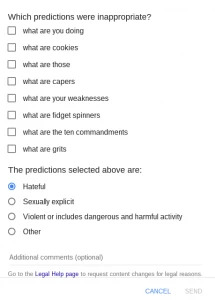
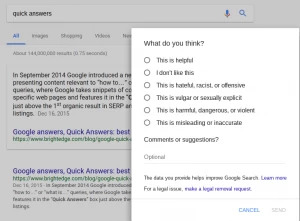
It is important to note that this report differs from what users had available before. For example, previously you had the option to report rich snippets for being irrelevant or unhelpful. Now, however, you can also flag it as vulgar, violent, or offensive, which will help Google better weed out bad content.
Google’s Project Owl increased emphasis on authoritative content
In addition to the report forms, which will now be available for users to employ, Google has also shifted towards an increased emphasis on authoritative content.
Our algorithms help identify reliable sources from the hundreds of billions of pages in our index. However, it’s become very apparent that a small set of queries in our daily traffic (around 0.25 percent), have been returning offensive or clearly misleading content, which is not what people are looking for. To help prevent the spread of such content for this subset of queries, we’ve improved our evaluation methods and made algorithmic updates to surface more authoritative content. --from the Google blog
Not only will Project Owl improve the quality of the rich snippets displayed, but it will also potentially impact all search results.
Beginning in March, they instructed their search quality raters to begin flagging content that is upsetting or offensive. It is important to note that these search quality raters do not have the power to single-handedly change the algorithm. Instead, Google compiles their reports similar to how stores compile reports from mystery shoppers.
It is important to note that Google has specifically said the increased emphasis on authoritative sites will not place smaller brands or newer sites at a disadvantage.
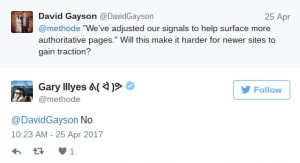
Overall, Google is being relatively tight lipped about how they determine the authority of pages. They have specifically mentioned the efforts of their search quality raters when asked, but that is likely not the entire solution.
It is important to note that back in 2015 eight Google engineers published a paper on the potential of Knowledge-Based Trust in search engine algorithms. Although this process has not been employed before by the algorithm, the paper described a process of crawling millions of websites to extract concrete facts and then using the facts to determine the accuracy of sites on the web.
The system would only compare the facts a site contained, so that sites containing few facts would not be penalized, provided the facts it did have were accurate. This system could help Google better rank sites according to their level of trust. Since Google has not released precisely how they will update their algorithm to account for page authority, we think it is worthwhile to keep this strategy put forth two years ago in mind.
What does Project Owl mean for marketers?
As long as you publish reputable content, you should not have to worry about losing rich snippets because of Project Owl. Since Google will not manually remove snippets or autocomplete suggestions based upon reports, and these changes will only occur in response to large amounts of data helping the algorithm better select answers, it should not be possible for competitors to sabotage other sites.
Marketers, however, should pay close attention to the increased emphasis on site authority. This means establishing themselves within their industry, providing quality insights to build trust, and making sure that any facts reported on the website are accurate.
Here are a few things you can do to build trust for your site:
Pay attention to backlinks - Cultivate strong ones from trusted publications to bolster your site and remove any association with poor-quality links-- including both inbound and outbound links. Although it is disputed how much of an impact poor-quality backlinks have on a site, given the shift towards authority and directly targeting sites promoting false facts or heavily biased opinions, we believe brands should do everything possible to distance themselves from these types of sites.
Establish a reputation on other highly-regarded websites - This might include, for example, respected industry publications, reputable news sites, or the websites of industry leaders. Writing guest posts, providing interviews, or publishing research that interests others in the industry are all quality means of building your relationship and association with these stronger sites.
Creating only high-end content. Although we emphasize this point regularly, its importance has increased. Content needs to align with user needs and it needs to include quality insights. Any facts included in the content should be from trustworthy sources so that you can be completely confident in their accuracy.
Google has decided to tackle the problem of false facts and other offensive or vulgar content that sometimes appears in their rich snippets or autocomplete suggestions through their Project Owl. Although the queries impacted represent a small overall percentage of the questions plugged into Google each day, their ability to detract from the user experience and the reputation of the search engine has forced Google to act.
While these actions should be a net benefit for users and quality websites alike, brands should pay close attention to the increased emphasis on authority and make sure their websites measure up to the standards.





 THE RESULTS