The Future of AI and Search: Authority, Citations and Your Brand's Right to Win

Jim
Jim
M Posted 2 years 4 months ago
t 9 min read

The world of search is undergoing a massive transformation, driven by the rapid advancements in artificial intelligence (AI) and generative AI models. Like most, I have been closely monitoring these developments and their potential impact on the search landscape. 

In a recent post on AI and SEO, I wrote about the evolution of search behaviors and the development of new generative AI-based experiences. Today we see a massive influx of new investment and innovations from traditional and non-traditional search players, signaling that we are entering the next generation of search and AI. 

You can learn more on How AI is reshaping Google’s search page via Fast Company.

The Evolution of Search in a Post-Generative AI World 

One of the most significant changes we are witnessing is the integration of AI into search engines. Generative AI models, like ChatGPT and others, make the average searcher much more proficient at finding relevant information. These models can take a single keyword and expand it into multiple related queries, providing a comprehensive and well-summarized search experience. 

This is a momentous change for the end user, as it enhances their ability to find what they are looking for.

Search engines can utilize AI to take a single search query and turn that into many formats of answers. They do this is by assembling the entire related areas of conversation, run those searches, summarize that with the AI, and give you a well-researched and summarized point of view. As I mentioned in an interview with Forbes recently, it makes the average person that searches 100 times better at search.

You can learn more on How Google’s AI Search Will Change Marketing Strategy via Forbes

Moreover, the rise of AI-powered search engines has created a massive opportunity for disruption in the industry. Companies like Google, OpenAI, and Microsoft are investing heavily in developing their own AI-driven search experiences. 

Each of these players brings unique assets and capabilities to the table, setting the stage for a new era of innovation and competition in search.

Last week I had a great conversation with Kanad Bahalkar, Co-founder of Potion. I want to summarize our discussion on how AI is reshaping search and what it means for businesses, entrepreneurs, and marketers.


As AI continues to advance, I believe we will see search engines become increasingly specialized in different use cases. 

Google, for example, has a strong advantage in real-time indexing, location-based information, and user reviews. On the other hand, platforms like Perplexity are focusing on the research use case, providing powerful tools for citation and information summarization.

Just as people today use different search engines for specific purposes (e.g., Google for general queries, Amazon for products, YouTube for videos), I anticipate that the AI-driven search landscape will further fragment, with users turning to different AI engines for diverse types of searches. 

I share more of my thoughts on this below, including BrightEdge Generative Parser™ research on Perplexity showing 40% MoM growth in referrals. 

Read more: Perplexity’s growth upends SEO fears, reveals crack in Google’s dominance, VentureBeat. 

The Importance of Being an Authority

For businesses and marketers, the rise of AI in search underscores the importance of being an authoritative source in your domain. As AI models become more adept at surfacing and citing the most relevant and trustworthy information, it is crucial to establish your brand as a go-to resource in your area of expertise.

This means doubling down on your core competencies and creating high-quality, informative content that highlights your unique value proposition. Whether it is Google's AI engine or Perplexity's, if you are consistently producing valuable content in your niche, you will be well-positioned to be cited as an authoritative source.

The Challenges of Content Moderation

Of course, the integration of AI into search also presents new challenges, particularly in the realm of content moderation. As platforms like Reddit begin licensing their datasets to train large language models, questions arise about how to effectively police the quality and appropriateness of the content being used.


Moreover, as AI engines start to assert their own informed opinions and present pros and cons for various queries, there is a risk of bias and misinformation. Striking the right balance between surfacing diverse perspectives and maintaining accuracy and credibility will be a key challenge for AI-powered search engines moving forward. This is something I discussed with the team at TheNewStack just last week. 

The Future of Search and AI is Bright 

I am incredibly excited about the future of search and the role that AI is playing in shaping it. We are entering a new era of innovation and disruption, where the boundaries of what is possible are being pushed every day. 

At BrightEdge we are committed to helping you stay at the forefront of these developments and helping businesses navigate this rapidly evolving landscape.

By understanding the implications of AI for search, focusing on your core strengths, and consistently producing high-quality, authoritative content, you can position your brand for success in the age of AI-powered search. 

The future is bright, and I cannot wait to see what it holds.


You can read more of my vision for the future and how BrightEdge is innovating to keep marketers ahead below, or follow me on LinkedIn.

Helping you Navigate the New Multi-Search Universe with New Perplexity Research

Reinventing Search in an AI-First World

Helping You Stay Ahead of Changes in AI and Search in 2024

BrightEdge Copilot: Interacting and Collaborating with Generative AI

Pioneering the Generative AI Future


Generative AI for SEO:
Mastering Speed, Scale, and Authenticity

This webinar was presented live on April 24, 2024.

In the aftermath of Google's March Core Update and the rise of AI-first search engines, the demand for content has never been greater. SEO professionals must act swiftly, leveraging generative AI effectively without sacrificing quality. How can you create and optimize content without compromising on scale or speed?

Join Dave McAnally, BrightEdge Senior Customer Success Manager Natalie Corkos, and Jeffrey Pe Benito Digital Marketing Director for Vertiv.com, us they we delve into how leading SEO experts are enhancing their SEO efforts to stay ahead of the competition, while leveraging generative AI.

What You Will Learn:

  • Key trends impacting SEO workflows in the second quarter
  • How experts utilize generative AI to boost productivity without sacrificing authenticity
  • Practical methods to leverage generative AI technologies such as BrightEdge's Copilot for accurate, rapid optimization of hundreds of pages, reducing manual effort and benefiting both users and search engines.

5 Important Observations about the Evolution of Google SGE in March 2024

agouyet
agouyet
M Posted 2 years 4 months ago
t 9 min read

This has been an exciting past month in Generative AI and Search! We released exclusive findings on Perplexity. Our Generative Parser™ does more than just delineate the intersections between SGE and Perplexity; it also highlights key focus areas for digital marketers aiming to boost referral traffic and develop robust strategies for generative search engine optimization.

It wasn’t just Perplexity that kept Generative Parser™ busy in March. There has been a hive of activity for Google SGE as well. We're currently observing signs that it’s ready to emerge from the experimental confines of Google Labs, which is a thrilling development. This past month has provided insights into Google's strategic direction as they prepare for the highly anticipated widespread release of SGE. Throughout March, five notable developments further suggest Google's steady progress toward the public rollout of SGE.

1. A New Intent-Based Module Emerged

In March, BrightEdge Generative Parser™ unveiled a new SGE feature—a module that empowers users to craft an itinerary through a singular query. This functionality started to emerge towards the month's end, signifying another leap in search intelligence. Now, users can input highly specific travel instructions into SGE, and it delivers. For instance, if you're planning a three-day exploration of downtown Chicago and require a daily schedule of activities, SGE can now comprehend this request and generate an intuitive, logical itinerary that aligns with your location and interests. This advancement showcases SGE's increasing sophistication in providing tailored and contextually relevant search results.

This strategic development in SGE is pivotal, particularly as intent-based results stand as a cornerstone of Perplexity. Integrating such nuanced, intent-driven functionalities into SGE not only enhances its competitive edge but also aligns with evolving user expectations for search technologies that comprehend and cater to specific needs with precision.

2. A More Concise Display for SGE Results

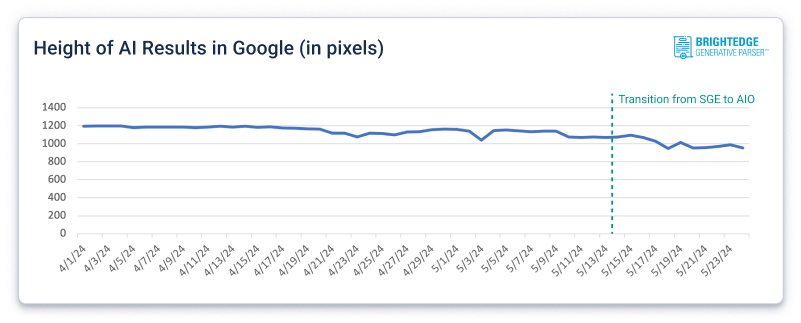
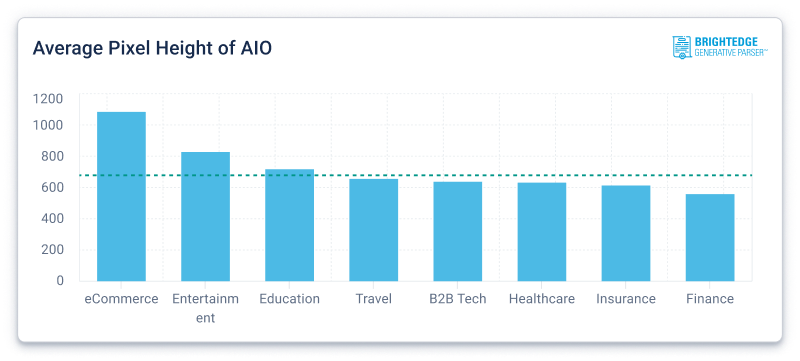
One nuanced but significant adjustment observed was the reduction of SGE’s on-screen real estate by an average of 12%. This streamlining is presumed to be Google's initiative to allocate more space to traditional organic search results. This act of rebalancing the innovative with the established could be a nod to user feedback or part of a larger scheme aimed at refining the overall search experience. It may also signal Google's preparation to integrate SGE more harmoniously with traditional search outputs in the public domain, ensuring that both paid and organic results retain their visibility without compromising the valuable screen area.

3. Personalization with Specific Features

Google's foray into personalization was observed with the resurgence of the 'Listen' button — a tool enabling users to engage with content audibly. Our BrightEdge Generative Parser Technology™ has ascertained that this feature is selectively displayed, and for the chosen users, it's quite prominent, appearing in up to 60% of their search results on March 14. Its targeted reintegration hints at Google's aim to craft a more individualized search journey, adapting SGE to the unique preferences and patterns of its users. This development suggests that an intricate understanding of audience characteristics, extending beyond mere search interactions, will become increasingly important for SGE optimization. Moreover, it underscores the potential necessity for content to be adaptable and optimized across diverse formats, positioning it favorably within the scope of SGE.

4. Testing with Reducing Product Viewer Visibility

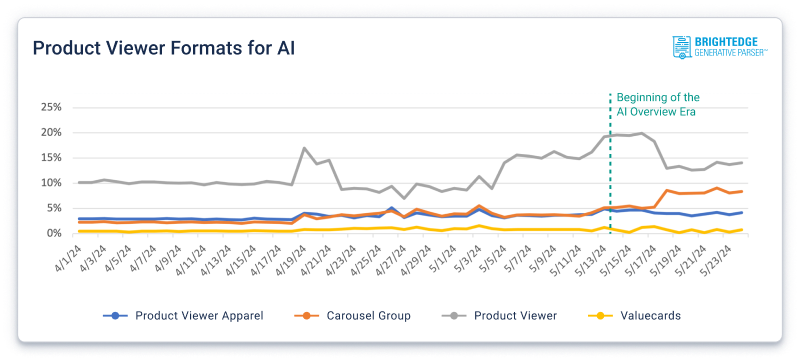
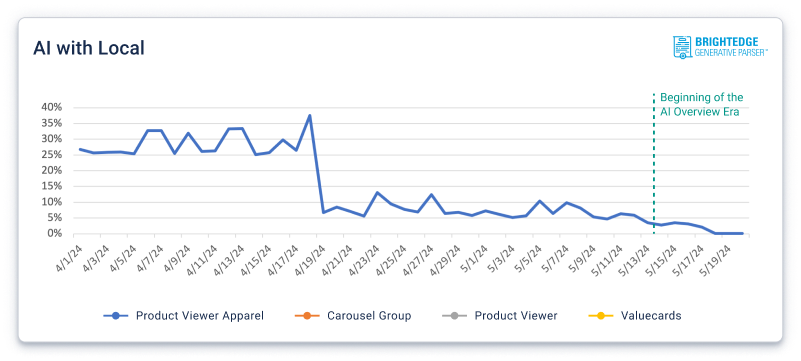
Google’s exploration into optimizing the presentation of SGE continues, particularly evident in the ways products are displayed. The BrightEdge Generative Parser™ has recorded notable declines in views on March 15th and again on the 19th. These declines paralleled a shrinkage in the overall pixel size of the SGE displays and occurred amidst a broader contraction in the quantity of SGE results shown. While Google has not explicitly explained these adjustments, they imply that alongside downsizing SGE results, the temporary decrease in product viewer variations could be indicative of a strategy to accommodate ad placements within these SGE spaces.

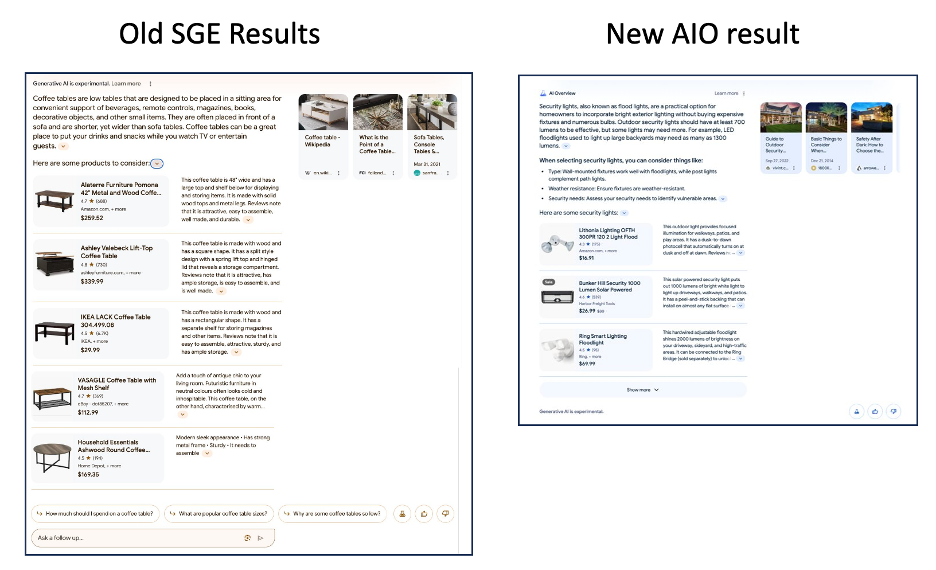
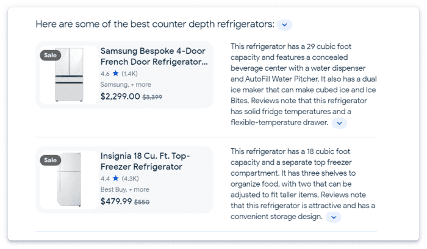
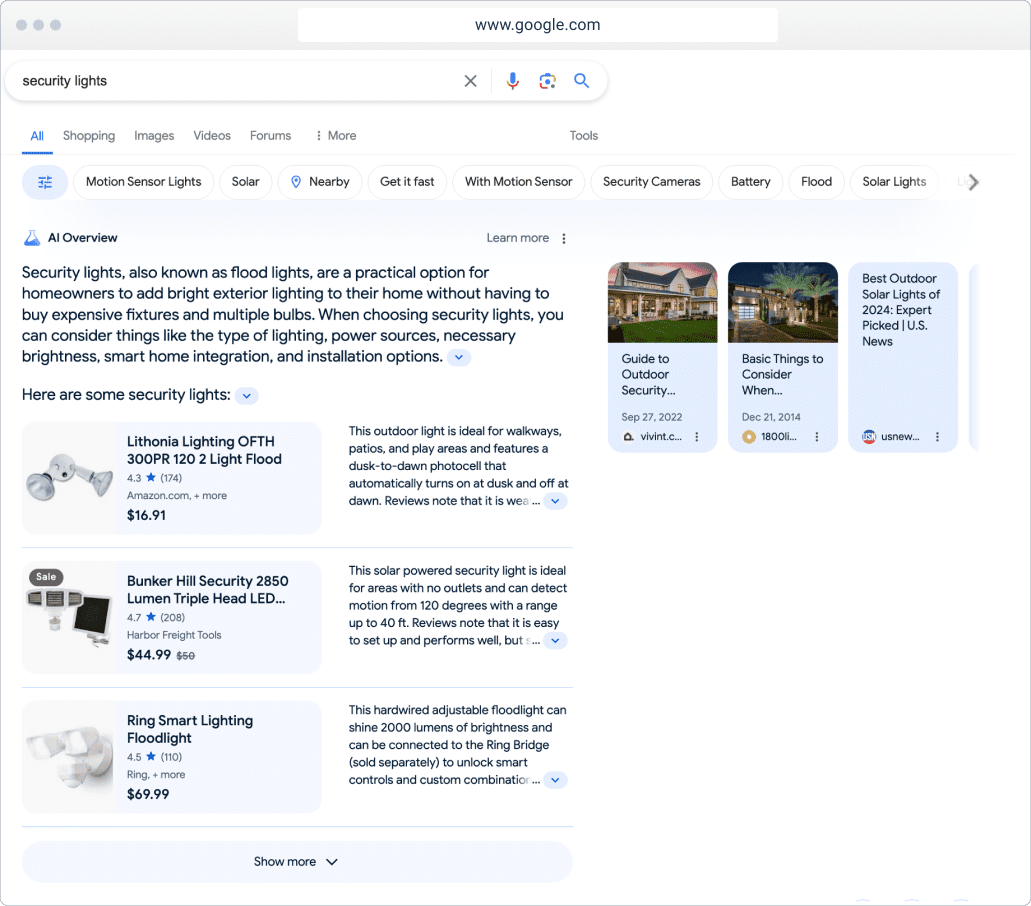
Historically, product viewers (shown in the yellow bar above) have been the predominant style for showcasing products within Search Generative Experiences (SGE). Our comprehensive Google SGE Guide offers an in-depth look at their manifestation and provides strategies for SEO professionals to harness referral traffic through them. These vibrant viewers serve as a rich source of product details, encompassing images, pricing, and review excerpts. Notably, due to their detailed text and visual content, they command a substantial portion of the screen real estate.  

Google's trials involving the temporary removal of these product viewers from search results may signal an openness to experimentation with alternative formats, such as integrating paid results that share similar characteristics, like shopping carousels. This potential shift could indicate a strategic realignment within Google's SGE, possibly aiming to enhance revenue streams or streamline the user experience with a blend of organic and paid content.

5. A Brief Decrease in SGE Visibility

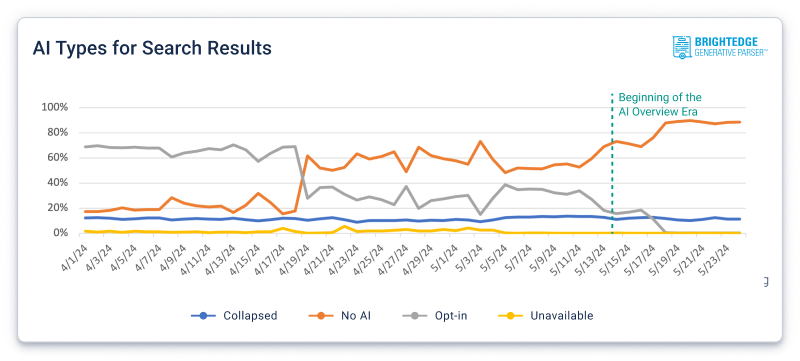
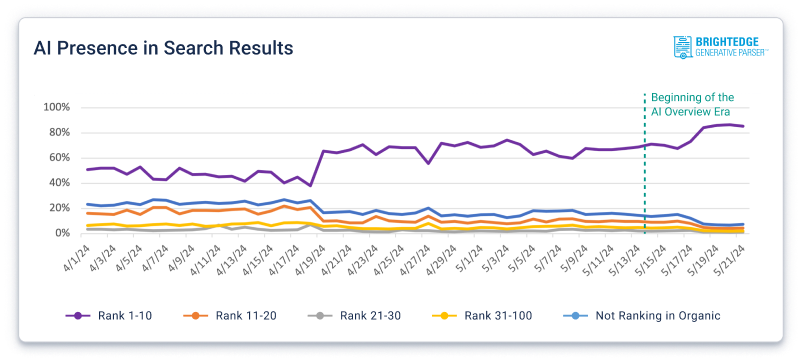
After the core update announcements in the first week of March, we at BrightEdge were among the first to detect a peculiar shift: nearly 40% of keywords unexpectedly stopped triggering Search Generative Experiences (SGE) results. This marked pause indicated a potential re-tuning of Google’s indexing strategies, possibly to integrate SGE more seamlessly with its primary search algorithms. Over the subsequent weeks, we observed the gradual reinstatement of SGE results, showcasing Google's rigorous process of trial and refinement. These updates, with a focus on combating spam and enhancing the quality of content surfaced in search results, hint at Google's commitment to ensuring that both SGE and conventional search results are equally reliable and valuable for users. This interruption in SGE result display may very well be an indicator of Google's efforts to synchronize SGE with the latest core update enhancements.

When will SGE Go to General Release?

In a significant leap toward a broader release, AI-generated results from SGE have started appearing for users outside the confines of Google Labs. This first began on March 22; however, these views were only shown to specific users before they disappeared. While there's widespread speculation about an official launch date, Google has yet to provide concrete details. Nevertheless, data from BrightEdge Generative Parser™ throughout March—highlighting a temporary reduction in AI-generated results, adjustments in product presentation, the introduction of new user-intent modules, and a streamlined search experience—suggests that Google is methodically preparing SGE for seamless integration with traditional search outcomes.

The future of search, particularly with the rise of Generative Engine Optimization, looks promising. We eagerly anticipate the innovations this will bring to the field. To keep abreast of these advancements, we recommend regularly consulting our Ultimate Guide to SGE and our newly introduced Guide to Perplexity, ensuring you have access to the latest insights and thorough analyses.


Helping You Navigate the Multi-Search Universe with New Perplexity Research

Jim
Jim
M Posted 2 years 4 months ago
t 9 min read

There has never been a more exciting time to be in search than today.  

As the broader industry moves towards personalized, AI-informed search experiences, the $200bn search market is attracting new investments, new entrants, and the creation of multiple types of search engine models. 

As this market trajectory skyrockets, time is moving fast for those at the forefront of AI and search. 

At BrightEdge, our commitment is to keeping marketers and the community ahead of the evolving landscape and the post-generative AI world. This is precisely why we built BrightEdge Generative Parser™ (BGP) and have regularly released new insights on the evolution of SGE since last fall.

It’s great to see that SGE has now been gradually rolled out into regular search results. 

However, did you know that BGP also tracks and monitors multiple AI-based search engines?

That is why we have released some exciting new research on Perplexity AI today. 

Perplexity referrals are growing almost 40% month over month, and 60% of Its citations overlap with the top 10 organic Google results. 

Perplexity is carving its niche into how marketers should approach optimizing content for AI-first search engines. The good news for organizations that have already leaned into SEO is that many of the technical best practices and guidelines around good and authoritative content apply universally, as 60% of citations overlap.

However, optimizing for multiple AI-led search engines also involves many nuances. This is especially true as citations become a new form of ranking. 

As we did with SGE, we have built a free community guide to Perplexity that explains all the differences between SGE and Perplexity, where overlaps lie, and how to prepare and optimize to win with this fast-growing new entrant.

You can learn all about it here: The Ultimate Guide to Perplexity 

As we look toward the future, my goal is to ensure that your brand wins where it deserves to win and becomes one of the ‘cited sources’.

I am so excited to see how this dynamic industry develops, and I want to thank our customers and the BrightEdge team for helping drive the market forward with these insights and innovations.

Together, we evolve and win in a post-generative AI environment. 

We have more insights to follow soon!


×
Table of Contents
Table of contents

Perplexity and AI Powered Search

Generative AI is revolutionizing numerous industries. For Search, the traditional search engines are incorporating AI-generated answers alongside the paid and organic results. In parallel, we are seeing the emergence of AI-first search engines: innovative platforms designed to provide answers with citations generated by a large language model, differing from the conventional web index's link-based results.

These AI-first search engines are rapidly gaining popularity. Users highlight benefits such as an enhanced “conversational experience,” superior quality answers for certain inquiries, and ad-free responses.

As these innovative search engines attract more users, your website will begin receiving referrals from them. In the same way marketers mastered content optimization to get visibility in Google’s search results, we will embark on a comparable journey to fine-tune our content for visibility in these new engines’ citations.

At BrightEdge, our mission is to help marketers understand and make the most of all search platforms, both established and emerging. This guide serves as your introduction to Perplexity.ai, the leading AI-driven search engine, equipping you with the knowledge to understand the new “AI-first citation factors” and create content that excels across conventional and AI-first search engines alike.

Why is Perplexity Important for Digital Marketers?

Perplexity AI is reshaping the search industry with its revolutionary approach, marked by a staggering month-over-month growth rate of over 40%. As of early 2024, this innovative platform is capturing the attention of SEO experts and brands alike, driven by its unique method of delivering search results. Perplexity’s business model relies on premium subscriptions as opposed to advertising which could be a potential attraction for new users.

Perplexity has captured the interest of the SEO community as well. According to Google Trends, it really began capturing the interest of the public in December of 2023:

A recent survey by BrightEdge highlights the burgeoning interest among SEO professionals, with 17% of respondents from billion-dollar companies already exploring Perplexity's capabilities. When we asked this same question about SGE roughly last summer after its launch, only 5% indicated they were exploring it. The message is clear: to remain competitive, adapting SEO strategies to align with Perplexity's innovative indexing and content interpretation techniques is imperative.

While it remains to be seen whether users will use Perplexity alongside or in place of traditional search engines, the data unmistakably points to its significant early growth.

Why are people turning to Perplexity?

Building on the foundations of generative AI's role in search, Perplexity provides a refined search experience tailored to users who value directness and relevance. Although Perplexity has indicated it will offer an ad program, the platform is rooted in user intents which assuages concerns about sponsorship over substance in results.

The platform's interactive nature marks a departure from the traditional search experiences of the past. Perplexity engages users in an active dialogue, allowing for nuanced questions and in-depth exploration of topics in a conversational format. This modern approach aligns with the growing expectation for immediate, relevant responses.

For more sophisticated users, Perplexity's Pro version expands on these concepts. Incorporating documents and images into queries, it offers a bespoke summarization service, yielding responses that resonate more personally with the user's intent. These advanced features illustrate just one way in which Perplexity could be preferable to users who have turned to it.

Perplexity’s Advantages and Disadvantages

Query that Require Fresh Results

Perplexity AI combines the functions of a traditional search engine with the advanced capabilities of a Large Language Model (LLM) to offer direct and concise responses to queries. According to Perplexity, it prioritizes trustworthiness by sourcing its information from a select group of reputable sources rather than relying on an index as expansive as Google’s. Therefore, the pool of resources Perplexity AI utilizes to formulate answers is smaller when compared to Google's comprehensive index. This means that for certain queries, especially those requiring the latest content, Google may provide more current answers than Perplexity AI.

Perplexity on the latest Madonna Setlist:

Google SGE on the latest Madonna Setlist:

Perplexity’s User-Centric Approach

Perplexity stands apart from traditional engines by providing an ad-free environment that prioritizes user experience over ad revenue. This fundamental difference shapes aspects of its service. For example, users benefit from a customizable search journey, with innovative features like 'Your Threads' to save search interactions and a Copilot feature leveraging GPT-4 for interactive assistance, ensuring a seamless and personalized search process:

Unlike traditional search engines that might prioritize sponsored content, Perplexity's approach is user-centric, guiding individuals through specific questions to refine and tailor results. It deploys long-tail queries in dialogue with the user, resulting in highly personalized outcomes.

SEO Implications for Perplexity’s Interface:

  • Optimize for Buyer Personas: Different buyers are searching for varied attributes. SEO teams must be familiar with the kinds of questions their target audience asks about products, as these will likely guide the AI's prompts and help refine the search queries.
  • Establish Topical Credibility: Perplexity’s LLM and its sources are intentionally limited to those deemed trustworthy. While Perplexity does not disclose the sites in its index, it indicates through its blog that the index is updated daily. By analyzing which sites rank well and ensuring your site is cited by these, you can enhance your site’s chances of being considered trustworthy.
  • Ensure Content is Current: Given that Perplexity relies on a more curated set of data compared to Google’s vast index, it is imperative that the sources display accurate and up-to-date information. This is a critical factor to consider in SEO planning for Perplexity.

How do Perplexity’s Sources Compare to Google SGE?

As noted, Perplexity distinguishes itself in its approach to generating search results by drawing on a pool of what it deems to be trusted sources. Utilizing the BrightEdge Generative Parser™ (BGP), we can discern the similarities and differences between the domains Perplexity uses to source its results and those used by Google SGE.

What Domains Are Sourced the Most?

The BrightEdge Generative Parser™ (BGP) has observed a noteworthy pattern of domain overlaps and exclusions between the citations from Google's Search Generative Experiences (SGE) and those used by Perplexity. Interestingly, four of the top-cited domains are consistent across both Google SGE and Perplexity, with a divergence observed in six others.

This guide features outputs from BGP that highlight the overlap between SGE and Perplexity. The domains shaded in orange represent the top 10 sources on both engines. Across all the keywords evaluated in all industries, this is where we see the most overlap:

Further scrutiny reveals a distinct visibility discrepancy:

  • Domains such as yahoo.com, marketwatch.com, and cnbc.com are prominent within Perplexity, holding the second, third, and fourth positions, respectively.
  • In stark contrast, their standings in Google SGE citations plummet to 95th, 434th, and 168th.
  • This disparity underscores a significant divergence in citation prominence between the two entities.

The Rising Significance of Reddit in AI Search

Reddit's prominence within Perplexity's search environment is a key finding that merits emphasis. Ranking sixth in the BrightEdge Generative Parser's™ (BGP) Analysis, Reddit stands out as a central hub for information and discussion in all but two industries—Finance and Healthcare.

With Reddit's recent partnership with Google, aimed at enriching AI training methods with its vast content reservoir, we anticipate Reddit's influence to amplify within Perplexity and potentially influence Google's citation metrics.
This strategic alliance may enhance Reddit's weight within citation indices and bolster its domain authority across AI-enhanced search platforms. The role of strategic engagement on Reddit, especially through impactful comments, is becoming increasingly crucial. It not only aids in gaining traction within Perplexity's citations but also could serve as a lever to enhance visibility on broader platforms.

Industry experts are keenly observing this development, predicting that effective participation on Reddit could become a more significant factor in gaining prominence within AI-influenced search ecosystems.

SEO Implications for Top Domains in Perplexity

  • Communities have authority - Actively manage and participate in Reddit communities related to your brand, as engagement on reddit.com may increasingly influence AI-powered search outcomes. Include monitoring discussions, reputation management, and keyword tracking on Reddit as integral components of your AI-Powered SEO strategy.
  • Align with Experts - Keep knowledge-based content about your organization on leading platforms like MarketWatch and Yahoo Finance current and precise. Accuracy in these domains is crucial for maintaining credibility and visibility.
  • Partnerships are Critical - For Original Equipment Manufacturers (OEMs), it's important to recognize that top retailers may play an amplified role on Perplexity. Ensure that product descriptions across these retail platforms are detailed, up-to-date, and accurate to enhance product visibility.

Enhanced Shopping Experience

Perplexity's latest innovation in AI-powered shopping introduces several key features that transform the online shopping experience:

  • One-Click Checkout with Buy with Pro
  • Available to Pro users in the U.S.
  • Seamless checkout directly on Perplexity's platform
  • Free shipping on all Buy with Pro orders
  • Direct merchant redirects when Buy with Pro isn't available
  • Visual Search Capabilities
  • Snap to Shop feature enables photo-based product search
  • Visual recognition technology for product identification
  • Streamlined product discovery process
  • AI-Powered Product Recommendations
  • Unbiased product recommendations through AI analysis
  • Clear, visual product cards with key details
  • Simplified comparisons in everyday language
  • Integration with Shopify for current product information

This shopping experience is currently available in the U.S. market, with plans for global expansion.

How to Prepare for Perplexity

As digital landscapes evolve, the emergence of AI-powered search engines like Perplexity presents a new frontier for digital marketers and SEO professionals. The key to mastering this domain is Generative Engine Optimization (GEO), a sophisticated approach to ensuring visibility in AI-driven search ecosystems. Perplexity's unique algorithmic preferences necessitate a tailored GEO strategy. Here's how to navigate this terrain:

Understanding Domain Authority in Perplexity

Perplexity prioritizes certain domains across various industries, from healthcare to travel. Recognizing these preferences is the first step in crafting a GEO strategy. For example, in B2B tech, leverage authority sites like techtarget.com, while in eCommerce, Amazon's dominance in Perplexity cannot be overstated.

Actionable Steps:

  • Analyze domain overlaps: Identify and target high-value domains that Perplexity favors, ensuring your content aligns with these trusted sources.
  • Create partnerships: Where possible, form content partnerships with these domains to harness their established trust and boost your own authority.

Leverage Industry-Specific Platforms

Each industry has a distinctive set of platforms that Perplexity favors, from review sites in restaurants to aggregator platforms in travel. GEO requires a nuanced approach, tailoring content to the specific platforms preferred by your industry.

Actionable Steps:

  • Optimize for industry giants: TripAdvisor for travel, Yelp for restaurants, and Amazon for eCommerce, to name a few.
  • Develop specialized content: Create industry-specific content that resonates with the themes of the favored platforms, be it travel guides or restaurant reviews.

Optimize for Shopping Features

With Perplexity's new shopping capabilities, merchants should consider these strategic approaches:

  • Merchant Program Participation
  • Join Perplexity's Merchant Program for enhanced visibility
  • Provide detailed product specifications
  • Integrate with Buy with Pro checkout system
  • Utilize free API access for custom search experiences
  • Product Information Optimization
  • Ensure comprehensive product details are available
  • Maintain accurate, current pricing and availability
  • Optimize product descriptions for AI interpretation
  • Include high-quality product imagery for visual search
  • Performance Monitoring
  • Utilize merchant dashboard insights
  • Track search and shopping trends
  • Monitor product recommendation performance
  • Analyze conversion patterns through the platform

Monitor and Adapt to Algorithmic Trends

The partnership landscape, such as Google's collaboration with Reddit, can signal upcoming shifts in Perplexity's algorithmic preferences. Keeping a pulse on these developments is crucial for adaptive GEO.

Actionable Steps:

  • Stay informed on partnerships: Understand how strategic partnerships may affect domain authority within Perplexity. Follow this guide!
  • Be ready to pivot: Develop a flexible content strategy that can quickly adapt to new algorithmic trends.

Utilize Generative Content Techniques

GEO involves more than traditional keyword optimization; it's about creating content that aligns with how AI engines generate search results. This means predicting user intent and providing comprehensive, authoritative responses.

Actionable Steps:

  • Embrace AI-friendly content: Structure content in a way that's easily digestible for AI, with clear headings, structured data, and succinct answers to common queries.
  • Invest in rich content: Beyond text, incorporate varied media like images and videos that align with Perplexity’s content preferences.

Foster Credibility and Trust

In industries like finance and insurance, Perplexity places significant weight on credible sources. Your GEO strategy must emphasize establishing trust through authoritative content and reliable information.

Actionable Steps:

  • Highlight expertise: Showcase credentials, certifications, and expert opinions to build credibility.
  • Accurate information: Ensure all published content is fact-checked and reliable, with citations from authoritative domains.

Engage with Local SEO

Perplexity, like other search engines, values localized content. For industries where decisions are location-based, such as restaurants and healthcare, local GEO is essential.

Actionable Steps:

  • Optimize for local search: Ensure your business is listed accurately on maps and local directories.
  • Localize content: Publish content that speaks directly to local audiences, including local keywords and region-specific information.

Incorporate User-Generated Content

Perplexity values community-driven insights, as seen in its preference for platforms like Reddit and TripAdvisor. Encouraging user interaction and incorporating user-generated content can bolster your GEO efforts.

Actionable Steps:

  • Encourage reviews: Implement strategies to drive customer reviews on key platforms recognized by Perplexity.
  • Engage with the community: Actively participate in community discussions and forums related to your industry.

How does my industry appear in Perplexity and SGE?

In our labs, BrightEdge has evaluated the industries most likely to feel the effects of SGE, results of which are detailed in our SearchQuake infographic. While Perplexity's impact seems less clear-cut than Google SGE, due to its established user base, we've identified domain overlaps between the two. This analysis sheds light on shared trusted sources and insights into the LLMs' preferences for sourcing information in both engines.

The accompanying chart provides a normalized index, ranging from one to ten, illustrating the domain overlaps for SGE and Perplexity. It focuses on domains that both platforms commonly source to answer queries related to these nine industries:

Exploring domain overlap across industries reveals strategic parallels and departures between Google SGE and Perplexity. In Healthcare and Education, both platforms similarly prioritize esteemed sites like mayoclinic.org and coursera.com, known for their authoritative content in their respective domains.

Divergence becomes apparent in the eCommerce and Finance sectors. While acknowledging the general importance of Wikipedia and Amazon, Perplexity distinguishes itself by valuing the communal insights of reddit.com for consumer perspectives, whereas Google opts for the expert-driven content of quora.com and consumerreports.org.

In Finance, Perplexity's preferences are starkly distinct, with a clear inclination towards yahoo.com and marketwatch.com, indicating a focus on timely market insights and comprehensive financial journalism.


The focus on Perplexity's strategic citation choices, particularly its use of reddit.com, highlights the platform's valuation of collective knowledge and user-contributed content. With the unfolding partnership between Google and Reddit, we might see Perplexity's citation patterns, especially its reliance on Reddit, start to sway or increasingly resonate with Google's own citation framework. This potential development points to a shift toward recognizing the significance of community-driven information in established citation practices.

SEO Implications for Industry Domain Overlap:

  • Diverse Impact of Backlinks and Co-Citations: SGE and Perplexity each have their own set of high-authority domains they favor by industry. In Healthcare and Education, both platforms value trusted sources like mayoclinic.org and coursera.com, aligning SEO strategies with these domains can be effective. In contrast, for sectors like eCommerce and Finance, Perplexity shows a preference for domains such as reddit.com, yahoo.com, and marketwatch.com. SEO efforts should be adapted to these preferences, utilizing backlinks or co-citations to boost SEO performance.
  • Tailored Strategies for AI-Powered Search: The approach to AI-powered search must be customized for each industry. Perplexity’s favor towards reddit.com highlights the value of community insights in eCommerce, while SGE prioritizes established review and Q&A sites like consumerreports.org and quora.com. Marketers and SEOs should devise content strategies that cater to these specific tendencies, like crafting detailed product reviews or fostering Q&A forums for eCommerce brands.
  • Anticipating Citation Landscape Changes: SEO experts need to vigilantly track Perplexity’s favored domains, particularly its use of reddit.com for community-sourced content. With Google's partnership with Reddit, Perplexity may also modify its algorithm to further embrace Reddit’s content, a move that could signal an increased emphasis on content driven by user engagement. SEOs must stay ahead by being proactive and adaptable, ensuring their content strategy remains relevant and effective in light of Perplexity’s changing citation patterns.

In summary, SEO success on platforms like SGE and Perplexity hinges on a sophisticated strategy that considers each platform's distinct citation preferences and the specific demands of different industries. Staying attuned to the latest developments in digital partnerships and algorithm updates is also crucial. Such vigilance and adaptability are essential for SEO professionals striving to optimize their content's ranking effectively on these evolving platforms.

Industry Overlap Analysis

At a broader perspective, we note shared domain overlaps and that the degree of overlap between Perplexity and SGE varies by industry. These subtleties become more pronounced upon detailed examination of the data at the industry-specific level.

B2B Tech:

For digital marketers navigating the B2B tech industry, the alignment of domain citations between Google's Search Generative Experiences (SGE) and Perplexity offers valuable insights. The domains that overlap—techtarget.com, wikipedia.org, ibm.com, amazon.com, microsoft.com, google.com, and cloudflare.com—are pivotal players whose content is recognized as highly authoritative by both platforms.

Key takeaways for digital marketers in the B2B tech industry would include:

  • Establish Long Term Credibility: Creating content or obtaining backlinks from these overlapping domains could boost SEO performance on both platforms, leveraging their established trust and authority within the industry.
  • Syndicate for Quick Wins: Syndicating your content across these recognized platforms when possible may be an accelerated way to have your brand sourced as opposed to using your own domain.
  • Balance the strategy: A balanced marketing strategy should be employed, taking into account the common ground in domain preferences. This means that while marketers should continue to focus on these authoritative sites, their long term goal should be to build authority on their own domains as competition for syndication space increases as AI-powered search proliferates among users.

By aligning strategies with the cited high-value domains, B2B tech marketers can ensure their content is positioned for optimal visibility and authority across both Google SGE and Perplexity.

E-Commerce:

For eCommerce SEO professionals and digital marketers, the data indicates a notable domain overlap between Google's Search Generative Experiences (SGE) and Perplexity: wikipedia.org. However, there's a distinct presence of amazon.com in Perplexity's citations, which isn't reflected in the Google SGE data shown.

Key takeaways for those in the eCommerce space:

  • Prioritize Product Authority: Given Amazon's prevalence in Perplexity, marketers should ensure their products and services are well-represented on Amazon, either through seller or vendor central
  • Leverage Reviews and User-Generated Content: Considering the importance of Amazon on Perplexity, reviews and user-generated content should be a cornerstone of eCommerce SEO strategies. Encouraging satisfied customers to leave positive reviews on Amazon could have a significant impact on search rankings within Perplexity.
  • Promotion Adaptability: Since each platform may weigh content types differently, tailor promotions and ad content to the nuances of each search platform. For instance, focusing on informational content and brand authority for Google SGE, and user engagement and product listings for Perplexity.

Digital marketers and SEO teams working in eCommerce will need to be just as agile with AI-powered search as they are in traditional. However, in Generative Engine Optimization (GEO), this will require adapting their strategies to align with these key domains to optimize their content for discovery and authority in a competitive online marketplace.

With the introduction of Perplexity's native shopping features in December 2024, the platform now offers enhanced e-commerce capabilities including direct checkout, visual search, and AI-powered product recommendations. This development, supported by integration with Shopify and the Perplexity Merchant Program, positions the platform as a more significant player in e-commerce discovery and transactions.

Education:

For SEO professionals and digital marketers working in the Education sector, the data showcases a strong overlap in top domains between Google's Search Generative Experiences (SGE) and Perplexity, including coursera.org, indeed.com, usnews.com, snhu.edu, forbes.com, wikipedia.org, nu.edu, and bestcolleges.com.

Key takeaways for Education marketers:

  • Capitalize on Common Ground: With significant overlap, ensure that your institution or educational platform is featured or has content on these shared top domains. This could improve visibility and authority across both search platforms.
  • Course and Institution Listings: For domains like Coursera and US News, maintain up-to-date listings of courses and institutional rankings to leverage their SEO clout, which appears to be a common value for both SGE and Perplexity.
  • Optimize Job Placement Content: With Indeed.com’s overlap, highlight your institution’s job placement success stories or career-related services, which could, through proxy, help your brand be more visible when Indeed is sourced.

By acknowledging these overlaps and focusing their SEO and content marketing strategies around these commonalities, education marketers can potentially increase their visibility and credibility on both Google SGE and Perplexity.

Finance:

In the finance sector, SEO experts and digital marketers should note the domain overlaps between Google's Search Generative Experiences (SGE) and Perplexity: investopedia.com, nerdwallet.com, and fool.com. As mentioned, there is less overlap in finance for top domains than many other industries analyzed. However, we do identify common threads between them that SEO’s and Digital Marketers can use to build their Generative Engine Optimization strategy.

Here are key takeaways:

  • Capitalize on Credible Finance Resources: Domains like Investopedia and NerdWallet are trusted sources for financial information. Content partnerships or mentions on these sites can enhance credibility and SEO performance on both platforms.
  • Leverage Current Financial News and Trends: CNBC’s presence in Perplexity suggests a preference for up-to-date financial news and market trends. Integrating current events into content can enhance visibility on this platform.
  • Strategic Keyword Optimization: Utilizing keywords and phrases that align with the topics covered by these top domains can help in ranking better on both SGE and Perplexity due to the relevance in content matching.

For digital marketers in finance, aligning SEO and content strategies with the valued domains of both Google SGE and Perplexity is essential for improved search visibility and trustworthiness.

Healthcare:

In the healthcare sector, SEO and digital marketing professionals should take note of the overlap between Google's Search Generative Experiences (SGE) and Perplexity in recognizing mayoclinic.org, nih.gov, and medlineplus.gov as authoritative sources. This is notably where we observed the most overlap between Perplexity and SGE sources. In our SearchQuake Infographic, we also noted that, despite being a Your Money or Your Life (YMYL) category, healthcare is one of the most likely industries to be impacted by the rollout of SGE. Based on the current BGP data on Perplexity, it appears the LLM’s and algorithms associated with it are zeroing in on the same trusted sources as Google for addressing healthcare related queries.

Key SEO takeaways from this overlap:

  • Establish Trust with Authoritative Sources: Incorporating content that aligns or gets recognized by these authoritative healthcare sites increases chances of being present in a sourced healthcare result in Perplexity. Reference and link back to these sites to leverage their domain authority to help your domain be included as a trusted source.
  • Focus on Government and Institutional Domains: The presence of government (.gov) health domains in both lists highlights the importance of official and institutional information. Ensure content is backed by data from these sources to increase credibility.
  • Update with Current Medical Research and Trends: Both platforms value domains that offer current medical information and research, like hopkinsmedicine.org on Perplexity and clevelandclinic.org on SGE. Staying current with medical trends and research can improve content relevance and authority.

For those in the healthcare digital marketing field, prioritizing content development strategies that focus on credibility, comprehensive information, and current research can enhance performance across both Google SGE and Perplexity.

Insurance:

For the insurance industry, the overlap between Google SGE and Perplexity indicates a shared recognition of forbes.com, www.gov.uk, indeed.com, and nidirect.gov.uk as key domains. Since insurance queries can involve financial information, it makes sense that AI powered engines would lean on sources that can be trusted to source answer content from. This will need to be a core part of any Generative Engine Optimization strategy in this space.

Here are the takeaways for insurance SEO experts and digital marketers:

  • Government Sites as a Trust Signal: The presence of government-related sites like  www.gov.uk and nidirect.gov.uk highlights the importance of recognized authority and trust signals in content, which is critical in an industry based on trust like insurance.
  • Employment Opportunities and Education: The citation of indeed.com suggests a demand for content that connects employment opportunities and insurance, perhaps educational content on insurance careers or industry trends that could be valuable to users.
  • Localized SEO: Nidirect.gov.uk's presence implies the value of localized content for regional markets, indicating that SEO strategies should consider geographical relevance, especially for local insurance services.

Digital marketers in the insurance industry should craft their SEO and content strategies to capitalize on the trust and authority associated with these shared domains, while also recognizing the importance of localized and employment-related content.

Restaurants:

In the restaurant industry, there is a clear overlap in domain citations between Google SGE and Perplexity, highlighting yelp.com, tripadvisor.com, wikipedia.org, opentable.com, eater.com, and grubhub.com as significant players. With the industry’s inherent focus on local intent, we are seeing this reflected in how AI powered search is addressing queries. As with traditional search, this needs to be factored in to how Generative Engine Optimization is approached.

Key insights for restaurant SEO professionals and digital marketers are:

  • Utilize Popular Review and Booking Platforms: Yelp and TripAdvisor's presence across both platforms underscores their importance for visibility. Ensuring that restaurants have a strong presence and positive reviews on these sites is essential.
  • Content Richness and Diversity: Wikipedia’s citation suggests that having comprehensive and well-maintained Wikipedia pages can be beneficial. It also implies the importance of content diversity—from menus and services to the history of the establishment.
  • Engage with Food Communities: Eater.com’s inclusion indicates that engagement with niche food communities and content platforms can be advantageous for reaching dedicated food enthusiasts.

By aligning their online strategies with the valued domains recognized by both search engines, restaurant marketers can optimize their visibility and attract more customers through AI Powered search.

Travel:

For travel SEO experts and digital marketers, the overlapping domains between Google SGE and Perplexity are tripadvisor.com, expedia.com, yelp.com, kayak.com, hotels.com, and booking.com. These sites are transactional in nature, in the sense that their primary purpose is for users to book something. Similar to Restaurants leaning on local, this suggests that AI Powered search is leaning heavily on that intent in the travel space. SEO’s and marketers in the travel space should expect that AI powered search will likely expand down the funnel. This needs to inform the Generative Engine Optimization strategy employed in this industry.

Key takeaways for Travel SEO and Digital Marketing:

  • Maximize Presence on Travel Aggregators: The repeated appearance of TripAdvisor, Expedia, Kayak, Hotels.com, and Booking.com signals the high value of these platforms for visibility. Optimize listings and leverage these aggregators for maximum reach.
  • Optimized Booking Experience: The prominence of booking platforms suggests that seamless booking experiences are crucial. Ensure that the booking process on your site is streamlined and user-friendly.
  • Comprehensive Content Strategy: Use comprehensive content strategies that include destination guides, travel tips, and reviews to align with the content-rich nature of the cited domains.

Travel marketers should ensure that their SEO and content strategies capitalize on the strong search presence of these key travel domains across both Google SGE and Perplexity to remain competitive.

Conclusion

Preparing for Perplexity means embracing the nuances of Generative Engine Optimization, with a keen understanding of domain authority, industry-specific platforms, and the evolving landscape of AI partnerships. By integrating these principles into your digital marketing and SEO strategies, you’ll be well-positioned to capture the attention of both Perplexity's algorithms and the audiences they serve.

Glossary

AI-powered Search Engine: A search platform that uses Artificial Intelligence to understand and process natural language queries, providing more contextual and direct responses compared to traditional search engines.

Generative Engine Optimization (GEO): The practice of optimizing content for AI-powered search engines that use generative AI to create responses to queries, rather than solely relying on keyword matching.

Perplexity: An AI-powered search engine that functions like a hybrid of traditional search engines and generative AI chat platforms, designed to interpret and respond to user queries in a conversational manner.

Generative AI Chat Platforms: Platforms that use generative AI models to engage in conversations with users, capable of understanding context and generating human-like text responses.

SGE (Search Generative Experiences): Google's format for presenting search results, which includes modules aligning with different user intents. These experiences are generated by AI to provide a comprehensive answer to the user's query.

Pro Version of Perplexity: A premium version of the Perplexity search engine that offers enhanced features like the ability to ask clarifying questions, support for document and image analysis, and image generation similar to generative AI chat models.

GPT-3.5 and GPT-4: AI language models developed by OpenAI that provide the underlying technology for Perplexity, with GPT-4 being the more advanced version with superior understanding and generative capabilities.

Natural Language Processing (NLP): A field of AI focused on the interaction between computers and humans through natural language, enabling machines to read, decipher, understand, and make sense of human language.

Large Language Model (LLM): A type of AI model trained on vast amounts of text data to generate text that is coherent and contextually relevant to the input it receives.

Clarifying Questions: Questions asked by Perplexity to gain additional context or clarify the user's intent, ensuring that the search results are as relevant and personalized as possible.

Your Threads: A feature in Perplexity that allows users to save their search interactions and threads for easy reference and continuity of context in future searches.

Copilot Feature: An interactive component in Perplexity, powered by GPT-4, which assists users in navigating their search queries by offering suggestions and guiding the search process.
Module: In the context of SGE, a module is a section of the search results page tailored to a specific aspect of the user's query, aiming to address multiple possible intents behind a single search term.

×
Request a demo

Request a Personalized Demo

 
* indicates required


BrightEdge Releases First-Ever Research on Perplexity

BrightEdge Releases First-Ever Research on Perplexity

SAN MATEO, CA – April 3, 2024 – BrightEdge, the global leader in AI-driven organic search, content and digital marketing automation, today announced new, unprecedented data and research on Perplexity, the new AI-first search engine. The BrightEdge Generative Parser™ is the only solution able to track and distill patterns in AI-driven search experiences, and has previously focused its research on gaining a deep understanding of the Google Search Generative Experience (SGE). Today, the same groundbreaking technology offers early insights on how Perplexity compares to SGE, and how AI-first search engines can differentiate themselves.

The generative AI boom has opened the door for a new type of search engine to challenge Google and Microsoft. Perplexity, which launched in 2022 and has raised $102.3M to date, is growing rapidly and gaining a foothold with consumers looking for a conversational alternative to traditional search engines. BrightEdge’s analysis shows that referrals from Perplexity to brand sites are growing at nearly 40% month over month since January. This is the first evidence that Perplexity is not used solely for generative content purposes, but also as a search engine that refers users to sites through citations.

For marketers, who rely on organic search strategies to reach customers, new AI-first search engines like Perplexity and ChatGPT signal a tectonic shift in how brands market and sell their products. However, the newness of these AI-driven platforms means they frequently undergo dynamic changes, making them difficult to track and adapt to.

The BrightEdge Generative Parser™, which was able to uncover early insights about Google SGE, is now accurately measuring and tracking patterns in Perplexity in order to better understand the evolving platform. Today, the company is sharing search result findings and their broader impact by comparing Perplexity’s reference domains, listing ranks and referrals to traditional Google and Google SGE.

Domain differences between Google SGE and Perplexity shed light on which content sources search engines value.

Search engines pull their results from various sources. Those sources highlight which resources hold more weight, how they distill information to consumers, and potential partnership opportunities.

  • Reddit is a top domain across most of Perplexity’s citations by industry for seven of the top nine industries, with Healthcare and Finance as exceptions.
  • For Healthcare, Restaurants, Travel and Education, Perplexity and Google have a similar focus on high authority websites such as the Mayo Clinic, a top-ranked hospital; Yelp and Tripadvisor, trusted restaurant and travel sites; and online course provider Coursera.
  • In E-Commerce, both engines heavily source Wikipedia and Amazon, but the overlap stops there. Google uses Quora and Consumer Reporters for third-party product information, while Perplexity references Reddit. Overall, Perplexity is most likely to reference product sites, whereas Google SGE will also include informational resources such as lifestyle and news sites.
  • In Finance, Perplexity’s citations skew heavily toward Yahoo, MarketWatch and CNN.

Top search results on Perplexity and Google overlap, particularly notable in Healthcare.

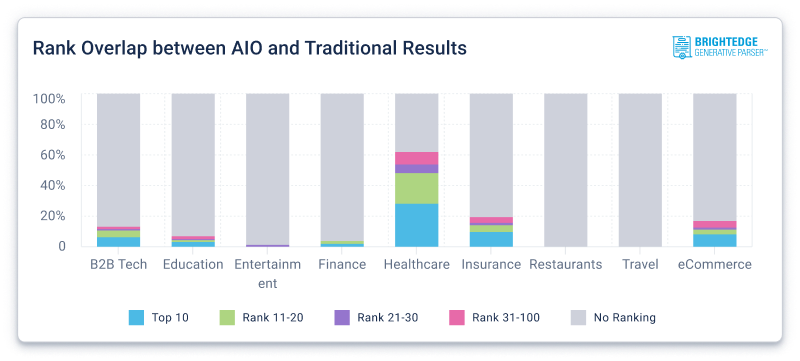
  • 60% of Perplexity citations overlap with the top 10 organic Google results, meaning that Perplexity users are getting similar, relevant responses to Google, but with the added benefit of an AI-generated summary and conversation flow.
  • The highest result overlap is in Healthcare at 82%. This overlap is because both engines give priority to high authority sites such as Mayo Clinic and the National Institutes of Health.

For marketers, Perplexity’s strong referral growth creates a new pathway to optimization.

Perplexity does not generate revenue from ads in the way that Google does, resulting in direct citations without promoted sources in response to searches. For brands, this means that organic search optimization is crucial.

  • Perplexity is seeing organic share rate growth at a rate of 39% month, meaning that more consumers are using and engaging with the platform’s provided responses.
  • Additionally, Perplexity offers 5.28 citations per response. More citations shows a search engine’s commitment to transparency, and creates opportunities for brands to gain referral traffic.
  • Perplexity shows drastically more citations in Restaurant and Travel responses. This indicates potential areas of expertise for the engine.

“Optimizing emerging search platforms is essential for marketers because their impact will be seismic – just 1% of the global organic search market equates to approximately $1.2B in ad revenue per year,” said Jim Yu, Founder and Executive Chairman of BrightEdge. “AI-first engines are steadily gaining ground and carving out their own areas of expertise, making it critical for the marketing community to master multiple search platforms. There is too much revenue at stake to get left behind, which is why we’re closely tracking the development of these engines and all things AI search – from traffic trends and queries to result quality and more.”

For additional information on how your company can prepare for the generative AI search revolution, click here.


About BrightEdge

BrightEdge, the global leader in Enterprise SEO and content performance, empowers digital marketers to transform online opportunities into tangible business results. Its all-in-one platform provides organizations with crucial market insights and intelligent AI-driven solutions. The BrightEdge platform contains the industry's most unique and extensive data set that connects key search, social, content, and digital media data points. Its deep-learning engine, DataMind, has been powering SEO AI-driven solutions since 2015, allowing marketers to benefit from high-fidelity data-led insights and automated action. Over 57% of Fortune 100 companies and nine of the top ten international agencies trust BrightEdge to help them provide the best performance by becoming an integral part of the digital experience.

Press Release Date

Reinventing Search in an AI-First World

Jim
Jim
M Posted 2 years 4 months ago
t 9 min read

In the digital marketing landscape, search is experiencing a profound transformation driven by Generative AI. Traditional search engines are being transformed by AI technologies, with features such as AI-generated summaries and personalized recommendations revolutionizing how users interact with search results. New AI-first search engines like Perplexity.ai and You.com are drawing interest and growing quickly in popularity by offering innovative approaches to search that prioritize AI-driven insights and user experiences.

Going Beyond Keywords

As discussed in a recent conversation with Forbes, the advent of Generative AI is reshaping the landscape of SEO, introducing new complexities beyond mere keyword targeting. In this era, SEO professionals must not only capture the full spectrum of topics that keywords encompass but also engage with the nuanced, evolving factors Generative AI brings into play. This means delving into related subjects and the queries posed by users to accurately gauge the intent behind their searches. Navigating the current search environment, thus, requires a nuanced understanding of topic depth, user intent, and the transformative impact of Generative AI.

Navigating the AI-Enhanced Search Landscape with BrightEdge

BrightEdge stands at the forefront of enterprise SEO innovation, poised for the era of AI-powered search. We offer enterprises the most robust data sets, cutting-edge AI capabilities through Copilot, and sophisticated automation with Autopilot. Here's how our platform gives you the competitive edge:

  • Unmatched Data Insights: With applications like Instant, Data Cube, and SearchIQ, BrightEdge enables users to discern critical topics, keywords, and page attributes to outpace the competition and connect with customers when it counts. These insights are pivotal in creating content that captivates both AI-driven search engines and virtual agents, providing rapid answers to user queries.
  • Advanced AI Content Assistance with Copilot: Copilot transcends typical generative AI, delivering predictive insights and optimization recommendations to ensure content is compelling and optimized for modern methods of discovery.
  • Sophisticated Automation with Autopilot: Autopilot takes over routine SEO tasks, streamlines site optimization in real-time, and empowers your team to concentrate on strategy and innovation. This time-saving benefit allows for reinvestment in strategic insights and proactive optimizations.

Our mission is to leverage these resources to help customers adjust to changes brought about by AI in search engines. For example, we’ve rolled out Copilot for Content Advisor, a generative

AI capability that not only assists SEO teams in crafting compelling, SEO-friendly content but also streamlines the research process to ensure that topics around keywords are thoroughly explored. This approach future-proofs content for AI-powered search. Furthermore, our Ultimate Guide to SGE (Search Generative Experience) reflects insights from the BrightEdge Generative ParserTM on how Google’s SGE is evolving in real-time.

Winning in SEO has always been about developing relevant and authoritative content that connects with readers. Generative AI does not change this core principle but adds new factors that are crucial to consider for developing content that aligns with the sophisticated ways AI interprets and references content. At BrightEdge, our unparalleled data insights, cutting-edge AI content assistance, and advanced automation provide marketers with the essential tools needed to produce content that is authoritative, pertinent, and deeply resonant in the evolving landscape shaped by Generative AI. By leveraging these capabilities, marketers are empowered to navigate the intricacies of AI-driven search with confidence, ensuring their content stands out, today and in the future.

,