How to Utilize Other Departments for SEO Help

ssharma@brightedge.com
M Posted 11 years 6 months ago
t 9 min read

As people come to understand the value of doing quality SEO, it becomes obvious that time and resources should be devoted to doing SEO. What people might not realize, however, is that real success comes when all departments are working together for SEO help. SEO marketing efforts should not be left solely to a digital marketing team because huge advances can be made when other departments are utilized and kept in the loop. Chances are, though, that departments apart from a digital marketing team don't really know how much effect they can have on SEO. While virtually all corporate departments can assist in SEO, several facets of a company, including the PR team, web developers and a content team, can directly influence SEO in a big way. 

PR team for SEO help

PR practitioners mainly focus on raising awareness of the company and building quality relationships with others. This can happen in a variety of ways, whether it be through articles written about the company, in speaking at events, or some other way of getting word out about the company. What PR reps might not realize is that these are great opportunities that can be capitalized on to get huge SEO benefits. When articles are written about the company, they will most likely be published somewhere on the internet (and if not, that should change).

There are a few things good PR practitioners can do to better optimize articles for SEO; using effective anchor text somewhere in the article will make the digital marketer's job much easier. Show your PR reps the importance of a backlink to the site and how to know which URL it should point to. When speaking at events, the speaker representing the company needs to optimize their presentation deck with the right links and then share it. Depending on the subject of the presentation, there are a number of places online where a presentation can be shared to get the most SEO benefits as possible; consider slideshare.net and social media platforms.

Web development team for SEO help

As web developers make changes to the company's sites and working on side projects, it's important that they know how to optimize their projects for SEO. There's a lot that goes into this, including understanding how to use title tags, creating effective UX design that contributes to SEO, taking care of 404 errors, as well as the differences between 301 and 302 redirects. You can even teach them about canonical meta data to improve link and ranking signals.

There's a lot they can do to help in a company's SEO efforts, but ultimately the more they are aware, the more they will be able to do before it even gets to the digital marketer's hands. Having the web developers work on these elements of web design from the get-go will streamline the entire SEO process and perhaps save the digital marketers some time in the process. Essentially, there are many different ways to code a website to strictly function properly and to provide for a secure search; webmasters need to know how to make them SEO compliant. The key is to get the marketers and web developers on the same page so that the web developers will know the best practices for utilizing SEO.

Digital content team for SEO help

It's been said that “content is king,” and while this is a heavily debated topic, it can be agreed upon that good content has an effect on SEO. First pick topics that are trending and have a high likelihood of being shared and discussed. Boring, unoriginal and irrelevant content will do little to further your SEO efforts. Make sure that those producing content for the company know what long-tail keywords to include in their posts. Also teach them about internal linking so that they know to which PLPs they should be linking for which keywords. Share the content in places where it's likelihood of being picked up is high, and the optimized content will do its work.

If a company isn't really sure on how to best integrate other departments into the SEO process, BrightEdge has a tool that makes achieving better SEO success as a collaborative effort possible. This project management tool streamlines time and effort spent managing SEO projects and helps make the SEO process more of a team one. So while it's true that digital marketers can work on their own, the results will be different—and not as good—as what could be accomplished should all the departments work together. Real success will come if everyone is on the same page when it comes to SEO practices.

The Future Is Bright for SEO Industry Leader

Jim
Jim
M Posted 11 years 6 months ago
t 9 min read

In the wake of Share14, our premier marketing event and the largest of its kind in the industry, we’ve experienced exceptional growth and innovation. As we head into the fourth quarter, we’d like to take this opportunity to give you, our customers and community, an update on BrightEdge and where we’re headed. We have reached an exciting point in the evolution of our company and a tipping point in the industry.

BrightEdge has raised $64 million to invest in product innovation and business growth to fuel expansion, which has enabled us to deliver more than 81 product releases to date. This is largely why we’ve seen more than 60 Fortune 1000 customers upgrade to our technology. We are honored to serve so many exceptional companies and proudly boast a rich roster of more than 1,000 direct customers - up from 650 at this time last year.

What’s more, BrightEdge is now working with the Top ten largest online retailers, nine of the Top ten largest hotel groups and eight of the Top ten technology companies. Our company has come a long way since its inception in 2007, and there are no signs of slowing down. Our continued success is in large part due to the core values that BrightEdge was founded upon; a culture of innovation and a commitment to making customers our No. 1 priority. We firmly believe that it is this very innovation and customer focus that sets BrightEdge apart from other solutions, and enables us to not only thrive, but also consistently delight and support our customers.

These values are in the DNA of our company and dictate every decision we make. This commitment to our customers — and the marketing community as a whole — necessitates rapid innovation, so we can help marketers navigate a constantly evolving field. Just this year, we introduced a new perspective on content performance marketing, revealed the Content Optimizer and Data Cube, and made our most powerful technology available to the entire marketing community with the BrightEdge Community Edition. This innovation has spurred our own internal growth at BrightEdge, allowing us to expand to six global offices — including London, Sydney and Tokyo — to support more marketers and helping us reach a major milestone of nearly 300 employees.

Despite all of our progress, our job of providing our valued customers with the best content performance marketing technology is far from over. We’re committed to supporting customers by offering not only content insights, but also educational experiences. This year, an incredible 1,500 marketers worldwide became BrightEdge Certified Professionals. These marketers are providing invaluable insight to their companies, and are helping the industry to progress from an era of “trial and error” to one backed by hard metrics and measurement.

At BrightEdge, we’re passionate about marketing. We know how challenging it can be to find success in this industry, and how great it feels when you do. That’s why we’re committed to supporting our customers at every step of the way — and why we continue to stay cutting edge. As we evolve even further, we’ll always remain dedicated to releasing new products and insights that give our customers the advantage in a crowded marketplace. We look forward to continuing our partnerships with such talented, innovative companies, and can’t wait for what the future holds!

What Do Structured Snippets Mean To Your Page-Level Content Strategy?

English, British
News Item Title
What Do Structured Snippets Mean To Your Page-Level Content Strategy?
News Item Author Name
Jim Yu
News Item Published Date
News Item Summary

In early September, Google was up to something, and some spotted what looked like Knowledge Graph-driven facts being pulled into a web page’s search results listing.

Fast-forward to September 22, and it was official: structured snippets were now a part of Google Search.

But what are they? No, these snippets are not derived from structured markup on the page, nor does it seem that the facts showing in these snippets are pulled via a database in a Knowledge Graph-y type of way.

5 Legitimate and Creative Link-building Tactics

ssharma@brightedge.com
M Posted 11 years 6 months ago
t 9 min read

Most marketers know that earning backlinks and link-building tactics naturally is key to maintaining and increasing rankings, but the difficult part comes in figuring out the best ways to get these links. There are a lot of ways to go about earning them, and some are more questionable than others. Begin to utilize these five creative ideas and start seeing quality links pointing back to your site.

Appeal to egos

One great way to earn backlinks is to appeal to others' egos. A lot of the time you can do this through “Top 10” posts; one example of this would be to create an article like “Top 10 Digital Marketers of 2014.” Articles like these are easily promoted and picked up by those mentioned. Tweet at those in the the article to make them aware and to stoke their egos; hopefully, they will mention the article in a tweet. Ideally they will link back to you, if not now then in future articles on their blog.

Interview or be interviewed

Reaching out to experts in a certain field is like appealing to one's ego, but in a more specific and targeted manner. Crafting a piece of content about someone should gain backlinks from the interviewee since it is promoting them or their company. To get interviewed, reach out to someone who is writing on a subject you know well and offer yourself as an industry expert willing to be interviewed. Be sure to do the required homework on the subject and on the blogger or journalist you reach out to.

Host competitions

Giving away free things is a great way to catch people's attention, and a beneficial way to do this is through giveaways and contests. Reaching out to people after hosting a competition will return better results because they will see you a more favorable light and will be more likely to respond positively. Giving away things for free is enticing, and not just for those looking to win; bloggers and others seeking to attract followers and viewers will be more willing to post a giveaway or contest because there is something in it for them.

Craft high-quality infographics

Webmasters and bloggers are always looking for quality content that will get them noticed. Produce and promote original infographics or other high-quality images and share them across different platforms. After the graphic has been published, check to see if it has been republished elsewhere; if it has been, it's likely that the graphic was embedded but that a link pointing back to you was not given. In this case, you will want to contact the website to ask for the link. Finding where the graphic is being published is not very difficult.

Start by getting a copy of the filename where the graphic is hosted. You want the actual jpg or png filename rather than just the URL. To do this, go to the graphic, right-click, and select “Copy Image URL.” Next, go to Google Images and look for the camera symbol. Click on it and paste in the URL that was just copied. Click “search by image” and the results will show the URLs where the image is being shared. Go to these URLs and make sure that there is a link pointing back to your site. If there isn't, reach out to the website owner and ask them to add a link back to the original source.

Make a quiz

Quizzes are especially useful if you are a B2C business—consumers love them. Getting the most use out of them might require action similar to what you do when hosting giveaways or contests; outreach to bloggers to post the quiz with a backlink to you. Producing a quiz also presents a good opportunity to embed code to put on your site, making the quiz easier for people to share. Quality link-building tactics takes creativity and a little bit of time, but the results from quality backlinks are considerable and too good to pass up. Throughout your link-building tactics for campaigns, you should be conducting SEO competitive analysis to make sure your backlinks are the most beneficial for you. Don't forget, you can analyze your site's backlink profile inside BrightEdge platform under Reports and Backlinks!  

Google’s Structured Snippets: What You Need to Know

Default avatar
Andy Betts
M Posted 11 years 6 months ago
t 9 min read

A couple of weeks ago, Google formally introduced “structured snippets” as a means to incorporate more Web page data in its search results. In its announcement, Google explained this was just another step in its ever-evolving quest to improve the search results:

Google Web Search has evolved in recent years with a host of features powered by the Knowledge Graph and other data sources to provide users with highly structured and relevant data. Structured Snippets is a new feature that incorporates facts into individual result snippets in Web Search.

Structured snippets are relevant bits of information pulled from a Web page into a Web page’s search result listing in an effort to enhance that listing. Google cites a search result for Nikon’s D7100 as an example of how its structured snippets work, stating “interesting and relevant information is extracted from a page and displayed as part of the snippet for the query ‘nikon d7100’:”

discover what structured snippets look like - brightedge

Barry Schwartz reported in a Search Engine Land post that “the structured snippet part of this result are the factual elements,” meaning the information specifying the Nikon D7100’s sensor resolution (type), weight (with battery) and display size/resolution. Search Engine Watch noted in its coverage of the announcement that the snippets work by extracting information from data tables on a Web page and “pairing that with an algorithm to help determine the quality and relevance of which data to display in the snippet.”

In other words, structured snippets work by using an algorithm that pulls what it believes to be relevant data from tables featured on a Web page. As BrightEdge CEO Jim Yu recently wrote at Search Engine Land, “The table aspect is perhaps less surprising when you read the announcement [from Google] that says structured snippets is a collaboration from Google Research and the WebTables research team, and Google Search.” Drawing on the Nikon D7100 search result example given by Google in its announcement, Jim showed the original product page from DPreview.com that was extracted by Google to display the snippet:

see an example of structured snippets - brightedge

At Search Engine Land, Schwartz experimented with the types of queries that trigger Google’s snippets in the search results, and with the exception of the Nikon D7100, his queries all returned structured snippets for Wikipedia. It’s not surprising that Wikipedia shows up with structured snippets often; as Jim noted, Wikipedia makes it very simple for the search engine to parse information out easily.

What do structured snippets mean for you?

Some have speculated that the snippets might cause a decrease in click-through rate from the search results even if it means a better experience for users. (That is, if the searcher sees all the key facts he or she needs from the Google search listings, why click through?) Other industry opinions diverge on this issue. In her interviews with SEOs, Amy Gesenhues at Search Engine Land reports on reactions ranging from concern over Google becoming more of a publisher than a search engine to the possibility of correctly formatted (yet poor) content surfacing to no concern whatsoever. As far as next steps go, there are a few considerations. For those in an ecommerce marketing position, Jim’s post at Search Engine Land (cited above) gives tips for e-commerce CMOs and their page-level strategy for creating and formatting product specifications. That includes:

  • Deciding what the most important specifications are about a product, and organizing the information in a nicely formatted table.
  • Considering the placement and grouping of the facts on a table, and testing to see if placing the most important facts together and first makes a difference in how structured snippets render.

And there could be even more considerations when it comes to responsive Web design (RWD). Keep in mind that because tables have a rigid structure, they’ve been harder to convert to responsive design. While some designers have decided to abandon tables in RWD, this new feature may require a second thought about that, including:

  • Re-evaluating and prioritizing the inclusion of tables in RWD. Do you need to do a multi-page redesign now, or can you make small tweaks to important pages within your mobile configuration?

It remains to be seen how Google’s structured snippets initiative will impact search results, click-through rates and mobile marketing; however, it’s safe to say that this new feature will be yet another item to put on the SEO’s page-level optimization checklist – at least for now.

Link Audits: A Qualitative and Quantitative Approach

ssharma@brightedge.com
M Posted 11 years 6 months ago
t 9 min read

With Google’s next Penguin update potentially right around the corner, there’s no better time to perform a link audit on your site.

Link audits look at the volume and quality of links in your link profile to ensure it’s balanced, healthy (meaning your website is getting good value from the links) and won’t trigger any unwanted penalties by Google. It’s also important to be proactive with your link audit, meaning don’t wait until the next Penguin update hits.

If you haven’t done it in a while – or ever – it should be the first thing you do before investing in other activities like content creation (aka additional link building). After that, you should prepare to do a link audit every three months to stay on top of your link profile.

Approach a link audit in two ways: quantitative and qualitative, which looks at the number of backlinks to your site and the quality of those links.

While quantitative research usually highlights any unnatural recent growth in the total number of backlinks, qualitative often assess the entire health of the link portfolio.

A 4-step process for assessing link quality

Let’s look at four steps you can take to assess the quality of your backlink profile in a link audit. To pull data, you’ll use tools like Majestic and Google Webmaster Tools (GWT). (Remember, GWT and Majestic integrate with BrightEdge’s S3 platform, too.)

1. Look at link growth by month (quantitative)

Look at the link data by month. You can do this by exporting the data from the tools into an Excel spreadsheet. The following graph shows an example site; the sharp increase in link growth over two month’s time is alarming: discover how to assess a link audit - brightedge The next step of this type of analysis is asking, “Why?” Oftentimes, you won’t find an immediate answer to the unnatural link growth you’re seeing.

If you work in an enterprise-level company, the answer may be even harder to uncover when multiple teams have a hand in the website. Oftentimes, it can be the result of some marketing activity that wasn’t pre-approved or assessed by the company’s SEO team. Perhaps someone paid for links or had sponsored content go live on a large number of publishers.

Whatever the cause, it’s your job as a link auditor to uncover it, and assess if it truly is something of concern.

2. Look at the link's AC rank (qualitative)

“AC Rank” aka “a citation rank” is an important performance indicator in Majestic’s reporting that checks the quality of backlinks. Therefore, AC Rank is a simple measure of how important a particular Web page is. AC Rank assigns a number from 0 (lowest) to 15 (highest), depending on the number of unique referring external root domains.

In other words, it assesses how many backlinks the website has that’s linking to your site. In order for a page to have an AC Rank of 1 or higher, it needs to have at least one external backlink. You can download a report that shows AC Rank in Majestic. In the following example, you can see the majority of the site’s backlinks come from other sites with an AC Rank of 0. working on link audits for better seo - brightedge

While there isn’t a strict guideline on what percentage of a site’s backlink profile should contain links with an AC Rank of any number, you may want to look at your competitors to gauge a benchmark. And then consider building links with a higher AC Rank. There’s a manual review process involved here as well.

Once you identify the low AC Rank sites, you’ll want to visit at least some of the links and do a quality check to see if the site looks OK, or if it is of concern. Are there too many ads? Too many links pointing out? Create a checklist of how you might assess the quality of the site.

3. Conduct anchor text analysis (qualitative)

Anchor text is the word or words used in the link (the clickable text in a hyperlink). Anchor text helps search engines understand what the page is about that they are going to visit. The search engines used to view anchor text as a strong signal in ranking websites. Because of this, spammers attempted to manipulate search engine rankings by creating a large volume of unnatural links that contained a specific keyword pointing to a site. When the Google Penguin update first hit in April 2012, it essentially put the kibosh on those spammer activities. With Penguin, Google reduced the amount of weight that the anchor text has, and even penalized some sites that had too many anchor text links with the same keyword pointing to them. Let’s quickly go over the different types of anchor text.

  • Exact match anchor text: The keywords in the link are the exact keyword you are trying to generate more visibility for in the search engines.
  • Partial match anchor text: The links include the keyword you are trying to generate more visibility for, in addition to other words.
  • Zero match (or generic) anchor text: Links that don’t include any mention of the keyword you are trying to generate more visibility for. Example: “click here.”
  • Branded anchor text: Links with the brand name or URL of a website in them.
  • All variations of naked URLs: Such as www.example.com, example.com and http://www.example.com.

There isn’t any rule on the percentage mix for having different types of anchor text pointing to your site. But stay away from emphasizing only one or two types of anchor text. A healthy anchor text profile should be a mixture of all of the above. As a general rule of thumb, branded (including branded naked URLs) should make up four out of your top five anchor texts. In the following image, you can see there were too many exact match anchor text for this sample site (keywords blurred out to protect the brand): increase seo efforts with a link audit - brightedge

4. Perform a backlinks analysis by IP address

Too many backlinks from the same IP address will not give any value to the site. And, too many backlinks from different domains but the same IP address (when brands own multiple websites, for example) could hint at a possible link scheme network of sites, which is classified as a bad SEO practice by Google.

For more on what Google thinks is a link scheme, see its documentation here. In this step, you’ll want to document all the links coming from a single IP address, and assess whether or not the mix of links is quality. You can do so with Majestic’s reporting. The result of all the steps in this four-step process will show you which domains are “bad” domains to have links from, and then you’ll decide how to handle them next.

How to handle bad links?

You now have a good picture of the volume and quality of your backlink profile – now what? Sometimes this next step in the process can be long and methodical, since you have no control over who links to your site. But, there are a few ways you can go about cleaning up those links you want to get rid of.

  1. Contact the webmaster of the site that’s linking to you. Put together a template that you will use for every site’s webmaster, and ask that the link either be taken down or nofollowed, depending on the severity. You’ll want to try this several times.
  2. Hire an agency to clean up your links. There are agencies that specialize in link audits and pruning your site’s backlinks for you. This saves you time and resources.
  3. Use Google’s disavow tool. Google gives webmasters a tool to use as a last resort to disavow links pointing to their sites. Google was very specific about how and when to use this tool, and you can read the guidelines here.

Here’s a video by Google’s Matt Cutts explaining how the disavow tool works: I hope this link audit process helps you keep your site healthy and your links working to your advantage. Remember, a link audit can be a time-intensive process, but it’s worth the effort being proactive rather than waiting to deal with a penalty that will catapult you into the same process anyway.  

Up Close @ SMX: Making Mobile SEO Perform For You – Design, Approach & Speed

English, British
News Item Title
Up Close @ SMX: Making Mobile SEO Perform For You – Design, Approach & Speed
News Item Author Name
Andy Betts
News Item Published Date
News Item Summary

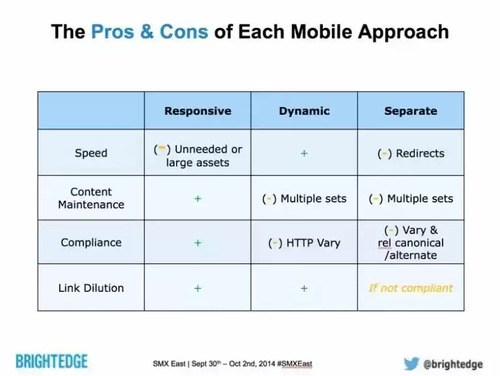
Mobile SEO is very different from desktop SEO; therefore, ensuring you take the right approach to implementation is critical to success.

This was the overarching mobile message at SMX East in New York this past week. I was lucky enough to attend the session titled, “What SEOs Should Be Doing With Mobile,” which was jam-packed with insights from Google, BrightEdge, Mobile Moxie and Covario. Below are some key takeaways.

For many years now – seven, according to Michael Martin of Covario — marketers have been saying that it is the year of mobile. In fact, 40% of search is now conducted on a mobile device. Gary Illyes from Google expanded on this by stating that 77% of mobile users research products and services on their mobile phones.

"Content Performance Marketing" – 3 Steps to Future Success

English, British
News Item Title
"Content Performance Marketing" – 3 Steps to Future Success
News Item Author Name
Jim Yu
News Item Published Date
News Item Summary

From more humble beginnings of White Hat SEOs touting "content is king" to massive campaigning from search engines and marketers around the idea of quality "content marketing," content marketing has come a long way.

However, the path we’ve been on is coming to an end. As brands and marketers, we’re at a fork in the road when it comes to content; the next path we take will either elevate our journey to the next level, or throw us into a never-ending roundabout that takes us nowhere.

The right path is marked "content performance marketing," and it’s less about how we get there and more about what we’ve accomplished along the way. In this post, we’ll talk about three key components of content performance marketing, where you’re not just creatingquality content, but also anticipating demand, optimizing content, and most importantly, measuring it.

Google Panda 4.1: How it Impacted Sites Organically

A BrightEdger
A BrightEdger
M Posted 11 years 6 months ago
t 9 min read

Google’s Panda update, which is aimed at filtering out low-quality content from the Google search results, has yet again rolled out, this time affecting 3 percent to 5 percent of search queries. The news hit on September 25, and early analysis of the results here at BrightEdge yielded some interesting findings. More on that in a bit. You may remember in 2013 that Google said it would no longer be announcing Panda updates, as it would be baked into the algorithm as a more regular, gradual rollout. But this announcement comes with a note from Google that the infrastructure to Panda has changed a bit. From the announcement on Google+:

Based on user (and webmaster!) feedback, we’ve been able to discover a few more signals to help Panda identify low-quality content more precisely. This results in a greater diversity of high-quality small- and medium-sized sites ranking higher, which is nice.

Historically, Panda went after sites with different types of weak content such as thin content, which is basically a lack of content; duplicate content, usually at scale; and machine-generated content, like spun content. But according to BrightEdge’s initial analysis of sites that have been impacted after Google Panda 4.1, we’re seeing some interesting observations that may go beyond the initial criteria of Panda and could hint at the new signals working together to surface higher quality sites in the search results.

How Google Panda 4.1 impacted sites organically in three patterns

BrightEdge tracks a large set of independently researched queries across several verticals on a daily basis, and its professional services team has been monitoring movements closely over the past week to identify trends. We observed some interesting patterns amongst the sites that did not fare well after Google Panda 4.1, and wanted to share that data along with some tips with readers. We also want to stress that we have not yet had time to form definitive conclusions about what we’re seeing. Our starting point was to pivot our data in different ways to see which sites experienced dramatic gains and losses in first page rankings and Top 100 rankings, plus loss or gain in Share of Voice. We then analyzed the heavily impacted sites for notable characteristics. Here’s what we found in terms of types of sites and patterns that emerged for those websites that did not fare well.

1. Infotainment and media sites: image heavy, ad heavy

Several negatively impacted sites, particularly in media, dedicate valuable real estate above the fold to ads, and also packed a lot of images on the page – and sometimes a lot of ads as well. Just some of those sites included:

  • EOnline.com
  • Essence.com
  • HollywoodLife.com
  • Independent.co.uk

Generally, the editorial-to-ad ratio was low, and the image count was high, which could impact page load time and thus user experience, especially on mobile devices.

Remember Google’s page layout algorithm has set the tone for sites that use a lot of ads at the top of their pages; pair that with the fact that Google is placing a high value on sites that offer a good mobile experience in general, and you can see how sites like this might be negatively impacted. With the latest Panda rollout, we think your content-to-ad ratio and image heaviness may count more than ever. While visuals are great for engagement, use them with the right intent and mind their placement. Invest in high-quality images, but not at the expense of high-quality copy. Ensure the page loads quickly, and that ads and images augment rather than obstruct the site’s experience. On that note, there were some image-heavy sites that actually seem to have gained ground like USMagazine.com (search is a zero sum game, after all), and they do seem exercise at least a little more moderation with images and ad units.

2. General informational sites: generic content

Once again, we see a set of mostly informational sites amongst those most negatively impacted by Panda. The topical reach of each of these sites is extensive, but the length and quality of the content is not always uniform. Some of those sites include:

  • Answers.com
  • HowStuffWorks.com
  • HubPages.com

Of those that benefited were a combination of highly recognizable media brands and more targeted niche media (these would be some of the small and medium websites that Google mentioned would benefit):

  • GlassDoor.com
  • NYTimes.com
  • OrganicGardening.com
  • Slate.com

Share of Voice continues to shift to rich informational sites, even for queries that are more transactional in nature. To compete, brands need to get creative, leveraging proprietary data and new ideas, and putting their communications team to work to create differentiated, compelling content.

3. eCommerce sites: thin content

Again, we see rich, vertically oriented information sites competing with more commercial sites for the eCommerce Share of Voice. Thin content comparison sites and e-tailers did not fare well in many cases. Some of those sites included:

  • CheaperThanDirt.com
  • FindTheBest.com

That said, richer content around products is typically rewarded. Smaller sites can compete if they focus on best-in-class content and experience that aids in the shopping experience, like the following sites:

  • Cabelas.com
  • CNet.com
  • Nike.com
  • Otterbox.com

Odds are that the comparison shopping site will have to invest in substantial content (detailed reviews or articles, for instance), in order to provide a significant value and compete. Google stated that the latest Panda update should be rolled out by the end of this week. So if your site has been impacted, you should be able to tell right around now. We’ll keep a close eye on the data here at BrightEdge, and let you know what we find out when we’ve been able to analyze the data further. Thanks to Justin Thomsen at BrightEdge for driving the data analysis for this piece.

5 Common SEO Failures and How to Fix Them

ssharma@brightedge.com
M Posted 11 years 6 months ago
t 9 min read

It's clear that SEO can bring additional traffic and revenue to a website, but with constant algorithm updates and changes from Google—like Penguin, Panda, and the infrastructure update, Hummingbird—it can be difficult to know how to prioritize your SEO plan.

In this post, I’ll talk about five of the most common SEO failures in having a quality, search-optimized site so you can begin to organize where you’ll focus your SEO efforts and how to go about fixing those SEO failures.

  • Duplicate content
  • Failing to link internally
  • Outdated sitemaps
  • Overly dynamic URLs
  • Low-quality links

1. Duplicate content

Duplicate content typically originates from other websites scraping content from one website and posting it on their own site. Put simply, the best practice is to locate and remove duplicate content from a site. Google's main objective is to provide a good user experience, and duplicate content tells Google that the content is not unique and therefore less valuable. Duplicate content can occur if a site has both plain and secure protocol URLs (HTTP and HTTPS). The solution? Use BrightEdge to perform a site audit and locate duplicate content. 

2. Failing to link internally

Good content will earn links and authority which will earn more organic traffic. Sites that fail to link blog posts internally to other webpages within their site are not passing this authority throughout the site. It's important to find ways to link to other parts of your website within your blog posts, especially to your landing pages. If a blog post naturally mentions specific keywords a website is trying to rank for, it should link to the corresponding landing page. This will pass authority from a blog post to other webpages, especially landing pages. Internal linking is a crucial process to maintain the health and authority of a website.

3. Outdated sitemaps

XML Sitemaps assist search engine crawlers to index a site in an organized fashion. Websites are usually large, and Google's crawlers don't have time to constantly crawl sites. A dynamic Sitemap helps these crawlers prioritize their indexing process. It's crucial to verify that a Sitemap is readable by search engine crawlers. To do this, log onto your Google Webmaster Tools account and submit your XML file. First, your site must be registered with Google Webmaster Tools. Once your site is registered, under the "Crawl" section, click on "Sitemaps." There is a button labeled "Add/Test Sitemap." It will ask for your Sitemap URL; simply provide GoogleWebmaster Tools the URL, and you'll get your results shortly. 

4. Overly dynamic URLs

There are situations where a content management system (CMS) creates long URLs; this is usually the result of tracking parameters. Not only do they just not look good, but they also takeaway from the user's experience, which is Google's No. 1 priority. Clean up the URLs to make them more SEO-friendly. Use keywords and dashes to clearly explain the content of the page to Google and users. Here are two examples, one bad and the other good:

• Bad URL: https://www.example.com/white-socks/i/cid=bl140705&utm_source=example
• Good URL: https://www.example.com/white-socks

5. Low-quality links

While link-building campaigns can be beneficial for SEO purposes, Google algorithms like Penguin have resulted in thousands of sites dropping rankings as a direct result from low-quality links. Services like paid link farms or press releases with followed links that get scraped and republished rapidly are examples of low-quality links. These practices will result in dramatic decreases in rankings and even formal penalties from Google. That's why it's always important to know where your backlinks are coming from. One way to discredit low-quality links is to formally request a link disavowal through Google Webmaster Tools. However, it's important to note that this disavowal process should be handled by an experienced professional.

Another approach to cleaning up those links is to contact the webmasters of other sites that are directing low-quality links at your site and ask that they be removed. You may want to try this method first before going through the disavow process. Use these 10 backlink building ideas to create a strong backlink portfolio that can significantly improve your SEO results. So there you have it: five common SEO pitfalls on your website and how to remedy them. These simple steps to making your site more search friendly may not take a lot of time but can have a big impact on the crawlability and quality of your site.  

,