
B2B Financial Service Company Increase Performance and Leads with BrightEdge

Joey Lampe of CBIZ uses BrightEdge to simplify day-to-day SEO, track ROI metrics and build overall support for SEO

Transcript of CBIZ's SEO Story:

Right now, some of the challenges with SEO is just differentiating our various service lines. We provide somewhere upwards of 20 to 30 different services. So just differentiating those services and ranking highly for each of those services is one of our main challenges. Organically, we range anywhere from 50% to 70%. It's a very large percentage and that's why we're really focused on SEO for our site.

Traffic - we try to funnel it into B2B lead gen. Just to capture their information to further nurture them through drip campaigns to kind of warm up the lead before we close our sale.

We've been gaining in our gap analysis from competitors. It's extremely challenging, just because the number of players in the space, but we've definitely gained some traction on some key keywords for various service lines.

The ease of, especially the reporting side for BrightEdge, has been extremely crucial for us. In my position, I have to work with various service line marketing managers. And BrightEdge allows me to really show a more visual picture of what their SEO is doing. Instead of showing spreadsheet after spreadsheet, it's just a nice way to convey dense information in a simplified way.

Our support for SEO has really skyrocketed in the past probably two and a half years once I got in this position.

SEO was kind of on the back burner for a little while, but we realized the importance of how much traffic is coming from organic - that we really needed to focus on and do pretty much an entire sweep of how our SEO is doing across the website and that's kind of where BrightEdge helped. It allowed us to pull all of our on-page SEO for all of our hundreds of pages on our site.

BrightEdge provides a quick look to see certain pages are doing well. But if they're not, even more importantly, just to make sure to see where we need to put our resources to increase those pages that might be falling off.

I probably do SEO somewhere between five to 10 hours a week. I'm in the platform, close to that amount of time.

The gains could be anywhere from tens of thousands to hundreds of thousands of dollars per client. And that's where the importance from differentiating our service lines from one another and making sure we're ranking highly on each of those service lines is extremely important.

Without BrightEdge, it would just make everything a lot more difficult. 

Request a demo of the BrightEdge platform and see how you can utilize Recommendations for your company!

80% of CEOs Do Not Trust Their CMO

Learn how to use BrightEdge Opportunity Forecasting to convert executives into SEO supporters

It’s true. A study polling 1200 large corporation and SMB decision-makers revealed that 80% of CEOs do not trust and value the opinions of their CMOs. 

And it’s no surprise, especially when marketers make these common mistakes:

  • Failure to align strategy with business objectives
  • Failure to understand ROI
  • Failure to predict, forecast, and fully own outcomes

In this webinar led by Scott McAndrew, Chief Digital Officer at LaneTerralever, you will learn:

  • How to become adept at BrightEdge Opportunity Forecast to build a winning plan for executives
  • What it takes to earn the respect that SEO deserves in the C-suite and beyond
  • How to deliver a convincing plan that will turn any skeptical CEO into an SEO believer excited to boost the SEO budget

This webinar will give you the framework you need to receive high-level support for your SEO initiative. You’ll learn how to set the foundation necessary to attain the results you already know are possible, so that no matter what level you are in your marketing organization, you’ll look like a hero.  

Download webinar assets now.

This is a joint webinar by LaneTerralever and BrightEdge. By downloading assets you are giving consent for your contact information to be shared with both companies.

CAPTCHA
Solve this simple math problem and enter the result. E.g. for 1+3, enter 4.
This question is for testing whether or not you are a human visitor and to prevent automated spam submissions.

5 BrightEdge Customers Discuss ROI

The BrightEdge Platform has helped customers, including Move, Seagate, Experian, adidas, and Wiley, realize significant increases in search traffic. The platform allows them to track increases and attribute those increases to content creation efforts. These wins create buy-in not only from decision makers, but also team members and the company as a whole.

Here's how a few clients have seen success using the BrightEdge Platform:

  • Move - Improvement of 10-20% Year over Year traffic increasing search channel to 70% of overall traffic across their 20-40 million monthly users
  • Seagate - 20% increase in overall website traffic and steadily contiuing to increase due to the ability of tracking content performance
  • Experian - 30-40% Month over Month search traffic increase
  • adidas - Over 300% search traffic growth Year over Year
  • Wiley - 28% increase in traffic from search

How to Increase SEO ROI?

seo management white paper banner

Deep Dive Search Insights

ssharma@brightedge.com
M Posted 11 years 1 month ago
t 9 min read

The SEO team at LendingTree works to improve pages across multiple sites in a variety of areas, including home loans, mortgage refinance, auto loans, auto refinance, student loans and home services. Today they share their favorite SEO audit tools and suggestions. On-Site Health Check with Sam Ruiz

"I like to run a BrightEdge SEO site audit to get an overall look at on-site health--duplicate content, broken links and other details that can affect your site's performance on SERPs."

The diagnostic report allows you to set priorities on items, and then breaks down all the issues by priority: severe, moderate, minor. I go to work on the severe problems first and work my way down the priority list. Here are some examples:

  • Missing or empty page title, meta description, or H1 tag
  • Duplicate page title or content
  • Missing or empty H2 tags
  • Poor text to code ratio
  • Bold and italics tags
  • Page size too large
  • Page title too short or too long
  • Page URL too long
  • Image tags without alt attribute
  • 404 errors (reclaim links to pages that were moved or removed)

Further Reading: Basic SEO Concepts.

Google Tools with Erika Sturino

"I like to dig into some of the less-used features in Google Analytics and Webmaster tools to find some really interesting things during an SEO audit."

Under-Utilized GA Reports for an SEO Audit Audience:Technology:Network:HostName

Hostnames--the most boring GA report ever, right? Well, maybe not, since I find things like:

  • A domain that scraped your entire site and all the code including your GA tracking. This is a good time to send a Cease & Desist letter to some of those very blatant copiers.
  • Someone who hand-coded their GA code could have fat-fingered or mistyped their tracking code, accidentally putting in yours. You may start seeing strange lifts in traffic or keywords and pages that don’t make sense. You can reach out to these people and let them know (typically, they’ll be pretty grateful someone told them!).

Audience:Mobile:Overview

  • Check if bounce rate is similar across device categories
  • Do pages/session and average session duration vary by device category? If so, start digging in and seeing how you can optimize your lower performing device category or find some learnings from your higher performing one.

Audience:Mobile:Devices (Mobile Device Info, Mobile Device Branding, and Operating System)

  • If a certain brand, device or operating system has a bounce rate significantly higher than the others, you should dig in and figure out if something is broken.

Behavior:Site Speed:Page Timings

  • Which pages on your site are the slowest? Find out here. Flip into this report and switch to Avg Page Load Time (sec) in both columns.
  • You can see the avg load time for all your pages and how that compares to the site average.
  • Try changing the first drop-down to pageviews to see how your top trafficked pages compare in speed to the rest of your site.

Behavior:Site Speed:Speed Suggestions

  • Pick your top trafficked pages and put the page speed suggestions in place.
  • Pick your top target pages that AREN’T performing as well as you’d like and put the suggestions in place.

Behavior:Site Search:Search Terms

If you use Site Search, jump in and look for terms people are commonly searching for on your site. If you don’t have a great page for those search terms, make one now. Give the people what they want.

GWMT

I use GWMT regularly. Check your messages and look at the search queries report and links to your site.

Search Appearance: Structure Data

Do you have structured data across a large number of pages? If so, check this report. Even if it was perfect when it was implemented, I’ve found that something usually breaks along the way. Check for errors and get fixes in place.

Search Appearance:HTML Improvements

Here, Google's actually telling you how to improve your HTML to make them happier. They tell you the exact page and HTML to change. Why wouldn't you do this? Also, this is a great way to find accidental duplicate content on your site.

Search Traffic: Mobile Usability

Not sure if your site should be improved for mobile? Google wants to tell you that, too. They tell you the potential mobile error, how many pages have the error, which pages have the error, when the error was last detected and what to do about it. Thanks, Google!

Crawl: Crawl Errors

This is an amazing report and should be used regularly. My favorite use is fixing internal links (I don’t like 404s. 301, 302 or 410 them -- 404s mean you are lazy) and finding opportunities for link reclamation.

Crawl: Sitemaps

Check for errors. Make sure all your pages are there. Don’t send Google to pages that don’t exist. And the biggest thing: what percent of your web pages submitted are also indexed? If you don’t have most of the pages in your sitemap indexed, figure out why. Figure out which pages Google doesn't want to index and make them better. Further Reading: Google Webmaster Tools for SEO Efficiency.

Classy Content with Ralph Miller

Classy content captures the intention of your audience, answering deeper questions they haven't even thought to ask Google yet.

Intention

Classy content starts by understanding a searcher's intentions. Ask yourself these questions:

  • When you Google "things to do in Phoenix," are you looking for one thing to do or a list?
  • When you search "how to become a teacher," are you also interested in teacher salaries?
  • When you need to refinance your car, would a refinance calculator be useful?

Your answers help define your intention for these searches. Your website visitors may have a variety of intentions that relate to where they are in your conversion cycle. Failing to provide the type of content and tools they need for the stage they're at is not only a disservice but a killer of UX, rankings and conversion. Therefore, user intention should dictate the content you offer on a page. Words and content that speak to a visitor's needs, along with links to additional content that takes them deeper into what they're looking for ultimately makes visitors feel like you understand them and builds the trust you need to make them a customer. One of the first questions I ask when auditing content is: "What elements are needed on this page to provide the best experience possible when someone searches on a keyword phrase?" This often leads to a lot of work for the dev team, who has to implement calculators, rates tables and other useful features. But if you're thinking like this from the beginning, you'll see a lot of opportunities to improve a page that go beyond just thinking about title tags, meta descriptions, and keyword usage.

Googling

Typing your keyword phrase into Google and seeing what comes up is another great way to discover user intention. Look for the related terms that appear in the titles and descriptions and pay attention to the Google suggestions and related searches. Click on the top pages and take a look. Determine what elements on the page are contributing to a positive user experience and either replicate or improve on them for your own page. Classy content starts and ends with the user in mind. Keep your visitor first and foremost in your mind as you audit your content, and your success rate with Google will improve. Further Reading: How to Perform an SEO Content Audit.

Link Audit with Tom Sumrak

Why go through a long list of individual links when you can automatically and neatly sort all of the domains into actionable groups?

IP Clusters

I use referring IPs for sorting lists of domains and links. Not only are IP addresses useful for finding dangerous link networks, but they can also help quickly sort through similar websites. This helps you quickly find groups of beneficial domains as well as domains that will need a more thorough inspection. Further Reading: Link Audits: A Qualitative and Quantitative Approach.
The SEO and PPC Management Handshake

Default avatar
Andy Betts
M Posted 11 years 9 months ago
t 9 min read

Have you heard of the old saying, “One hand doesn’t know what the other is doing”? You’ve most likely experienced the frustration that comes with that when dealing with large organizations and government bureaucracies.

For example, sending a payment well ahead of the cable provider’s due date, only to receive a bill demanding payment immediately. Or diligently forwarding your mail to your new address, but somehow it isn’t arriving. The list goes on and on.

This phenomenon also applies large brands and their marketing, when separate branches or divisions do not communicate with one another. They’re simply “not on the same page,” and more often than not, the company suffers as much as the customer.

When heading up an enterprise-level search marketing strategy, you understand that you can’t afford to waste precious resources on duplicate efforts, much less counterproductive ones. When this manifests as paid and organic search teams that don’t collaborate, it can mean a muddled, disjointed search marketing strategy that’s not making the most of the website’s presence in the search results.

Managing PPC and SEO working together

One of the smartest ways to both streamline and coordinate the search marketing strategy for your company - and maximize its ranking, conversions, and ROI - is to have your SEO and PPC management teams “on the same page” (literally).

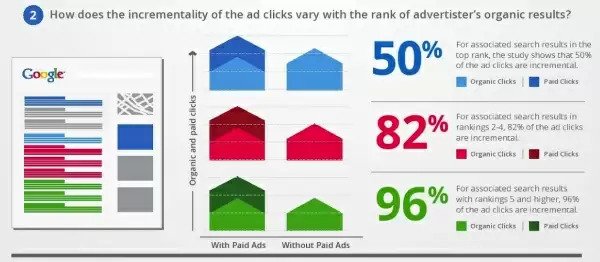
A 2012 study by Google focused on the interactions between organic search results and paid ads found that even for sites claiming a No. 1 organic ranking, paid ads provided 50 percent incremental clicks (meaning, half of the top-ranking site’s visits would not have happened without the presence of paid ads).

The authors of Google’s study further noted that PPC percentages increased as a page’s rank in organic decreased, with paid ads providing 82 percent incremental clicks for sites ranking between two and four, then jumping to 96 percent for brands ranking five or lower:

An example of SEO and PPC management - brightedge

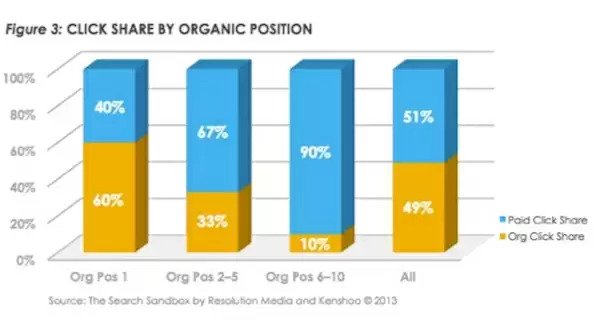
Google’s findings were reinforced by a September 2013 report by Kenshoo, which also analyzed the interplay between paid and organic search (for a major retail division of Hewlett-Packard in the U.S.). For a site ranked No. 1, click share percentage ratios for organic versus paid were 60:40.

In the No. 2 through No. 5 position in the SERP, the correlation dramatically shifted to 33 percent organic to 67 percent paid. The numbers for SERP positions No. 6 through No. 10 were more dramatic still, with organic search clicks at 10 percent to paid search’s 90 percent.

Kenshoo Study for seo and ppc management - brightedge 

With these two studies, we see PPC traffic rising and falling in conjunction with the organic search results position in a concerted effort to help boost visibility. A great way to access data that shows the relative contributions of SEO and PPC management is through the Google Analytics (GA) multi-channel funnels report.

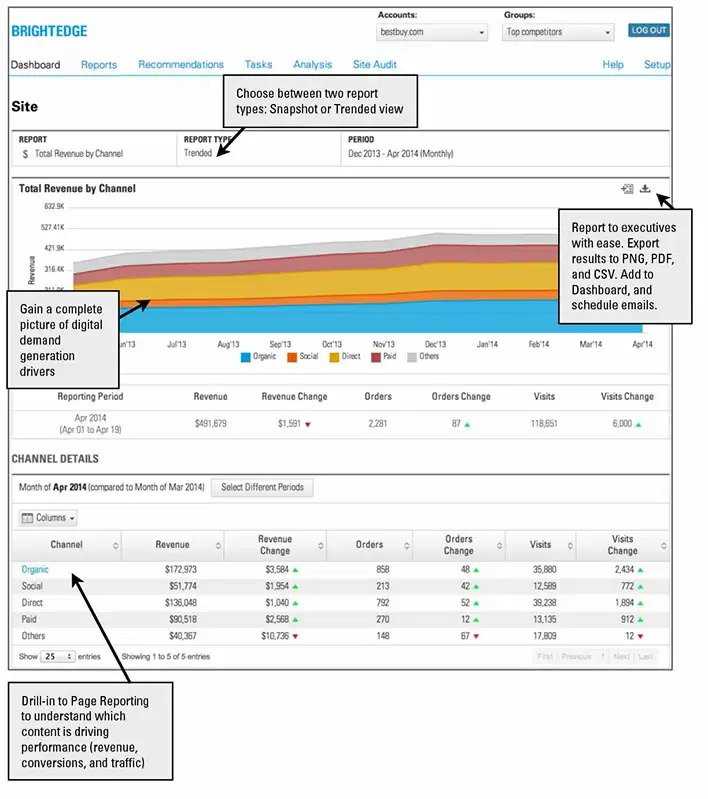
Generated from conversion paths, this GA report can show you not only which channels contribute to your overall conversions, but also how. BrightEdge also has a fantastic report in its SEO platform that tracks channel performance across organic, paid and much more.

Channel Reporting for seo and ppc management - BrightEdge

How SEO Informs PPC Strategy

Just as PPC can do some heavy lifting when the organic search results drop, SEO can inform PPC. Now that Google has all but eclipsed keyword search query data from its analytics with the “secure search” initiative, the Web page is now the best unit by which to measure your SEO.

In absence of keyword data, you likely still have high-converting Web pages. BrightEdge S3 helps marketers identify their most valuable Web pages. (If you’re not a BrightEdge customer, GA has data you can mine, too.)

An analysis of this data can lend insight into how your PPC landing pages might be improved, or help you to make decisions about which pages to drive PPC traffic to if two pages could be just as relevant to an ad. However, you can still gain insights into important keywords to your website from other places, Google Webmaster Tools being one of them, and you can use that data to inform your PPC strategy.

SEO also impacts PPC in other ways, for example, AdWords Quality Score, which rates how relevant a page is for an ad. Basic on-page optimization of PPC landing pages helps ensure this type of relevancy. You can also leverage organic rank to determine and control your PPC spend. If you claim the top position in the SERP organically, you might decide there’s no need to also secure the No. 1 position in PPC for a keyword.

Clearly, the relationship between organic and paid search means that your SEO and PPC management teams have valuable information to share, which could lead to better site performance in terms of rankings, click-through rates (CTR), conversions and ROI. The best way to secure that friendly handshake between SEO and PPC management is to ensure your organization’s organic and paid teams have the data they need to support the relationship, and know how to collaborate using that data.  

The Search Marketer Survey Results Are In!

A BrightEdger
A BrightEdger
M Posted 12 years ago
t 9 min read

The BrightEdge 2014 Search Marketer Survey report is here! This year, we surveyed SEO practitioners from 8,500+ global brands in December 2013 and January 2014 to compile research in the areas of content and content budgets; rank and ranking variables; data integration and technology providers; and much more. We’ve compiled a few of the highlights here.

To download the full report, check out this link.

Search Marketer Survey Data: Top 10 Takeaways

The world of SEO was rocked in 2013, with more Google Panda and Penguin updates; a release of “Hummingbird,” the Google search engine's updated infrastructure; the Google Knowledge Graph expanding to include “Carousel” results; and, of course, Google's secure search announcement.

In light of the changes we saw in 2013, this year’s research highlighted the following takeaways:

  1. Connecting your content efforts to ROI is at the top of the agenda
  2. The Web page is the center of the new content and SEO universe
  3. Rank still matters, and is the stepping stone for page-level success
  4. Tracking and measuring mobile rank across all devices is a must
  5. Data and analytics are the key source of truth
  6. All data is relevant and connected
  7. Integrated SEO and content starts with optimizing at the author level
  8. To be successful, you need to innovate ahead of the curve
  9. Focusing on content accelerates career growth
  10. SEO is now embedded in the content marketing process

These takeaways are aligned with the SEO industry’s new creed, the “Secure Search Manifesto,” which outlines the principles that the SEO community need today. You can get a copy of that here.

Let’s take a closer look at some of the survey data.

Content

Seventy-eight percent of SEOs say connecting content efforts to ROI will be “more” or “much more” important in 2014. The next step then, is for those marketers to make this goal tangible, and our search marketer survey respondents agreed.

In fact, 93 percent of SEOs said they would increase content budgets by at least 10 percent this year if they could identify what content is the most effective for engaging their audience.  If content is a priority for you in 2014, you’re in good hands with BrightEdge!

Our content-centric data allow you to understand how your content is driving business value.

Rank

Tracking where pages rank in the search results is ever more complex when so many factors are at play, including rank in various areas like Universal Search results, Google’s Knowledge Graph and Carousel results.

That’s likely why 95 percent of search marketer survey respondents said gaining access to accurate rank data in 2014 is important.  

Speaking of Carousel results, are you part of the 44 percent of SEOs who reported that Carousel results were served for keywords in their industry? If so, you may also side with the 72 percent who reported that measuring rank on those results will be more important for them in 2014.

Good news: BrightEdge is committed to giving our customers real insight into their true rank across all types of search results. With our blended rank technology, our platform is the first and only of its kind to provide this level of information.

Technology Providers

In order for brands to succeed today online, it’s vital they have access to reliable data that provides actionable insight. Marketers agree. Of the search marketer survey responders, the majority said that when choosing a technology provider, key aspects included a provider that had a global customer base, a provider that was led by accomplished software veterans, and a provider backed by reputable investors.  

Marketers also wanted their technology providers to innovate on a regular basis according to Brightedge's search marketer survey. Sixty-four percent said monthly product innovations that kept up with the changes in search was going to be important in 2014.  

Here at BrightEdge, we work hard to stay ahead of the curve. In fact, every five weeks, BrightEdge releases a slew of new functionality, improving on our software on a quarterly basis by understanding the trends on the horizon, listening to what our customers want and studying the intricacies of the search and social channels through search marketer surveys, and how they impact a brand’s visibility online.

What Will 2014 Bring?

As SEOs embrace the change that occurred in 2013, they brace for the impact 2014 may bring.

Our industry is never a dull one, and marketers continue to be resilient with chameleon-like adaptation in the ever-changing world of Web marketing. But one thing will remain constant: tying SEO to business value is essential. This is, and will continue to be, the driver of successful marketing campaigns in 2014.

In order to make the connection between SEO and business value, brands need to invest in accurate and actionable data. Each step of the way, BrightEdge is that data solution, and your partner for success.

Here's to a great year!


,