It’s no secret that retailers are making multimillion-dollar investments in content. From creating new branded magazines to social media “tweet shops,” retailers are using countless resources and big bucks to move the needle.
However, even with all the effort and energy, I’ve found that retail marketers are estimating negative ROI because they are unsure of what generates revenue and what doesn't.
Content marketing is tricky, and it presents its own set of unique challenges for retailers in particular. Retailers typically have millions of pages, products, and categories to consider in their content marketing efforts. With such high numbers, it can seem impossible to create quality content on the massive scale that’s required.
Each year, SEO evolves to become a more sophisticated discipline. As marketers refine their skills sets, as search engines improve their search products, and as brands across industries continue to see the impact that organic search can have on their growth, search engine optimization has come from humble beginnings to become a recognized strategic field of marketing.
6 Degrees of SEO Separation – From Data to Content Performance
News Item Author Name
Jim Yu
News Item Published Date
News Item Summary
Something significant has been happening in the world of SEO for some years. Most of us are aware of the shift, even if we’re not able to quite put it in words. As the SEO discipline grows, the borders and gaps between other disciplines grow smaller.
In fact, if we were to look at SEO in terms of the "six degrees of separation" (for example, how far away SEO is from another marketing discipline) we’d likely find that it’s very closely tied with each and every marketing and business goal in some way.
LPO Intelligence Integration for Adobe Experience Manager | BrightEdge
Latest Machine Learning Innovation Empowers Marketers With Deep Competitive Insights and Mobile Recommendations to Boost Landing Page Performance
SAN MATEO, CA--(Marketwired - Mar 10, 2015) - BrightEdge, the essential content performance marketing platform, today announced that it will preview LPO Intelligence at Adobe Summit 2015. LPO Intelligence will integrate seamlessly with Adobe Experience Manager, offering landing page ideas that marketers should consider when using AEM's new performance targeting capabilities, powered by Adobe Target, to test landing page variations.
LPO Intelligence empowers marketers with unmatched and immediate web-wide competitive insights to inform creation of high-performance landing pages. Powered by the BrightEdge Data Cube, machine learning automates decisions and democratizes landing page testing. LPO Intelligence helps marketers boost conversion rates and deliver impactful business results.
Machine Learning - Gaining The Competitive Edge On The Content Battleground
In today's content battleground it's increasingly important for marketers to understand the performance of their content within the context of the broader marketplace. Today, marketers have data visibility limited to their own content, but no insight into competitors'.
Following the latest release of Content Optimizer 3.0, LPO Intelligence is specifically designed to improve landing page performance.
"LPO Intelligence is powered by BrightEdge Data Cube intelligence. The Data Cube uncovers opportunities at web-wide scale and delivers valuable insights to marketers in the form of specific, actionable recommendations," said Jim Yu, CEO of BrightEdge. "With LPO Intelligence, for the first time ever, marketers will be able to automatically optimize landing pages to win on the content battleground."
The BrightEdge Data Cube -- the industry's largest dataset of web-wide content that includes rich media, search terms and social signals -- powers both innovations. Historically marketers have been forced to rely on first person data, which gives them an incomplete view of how their content is performing. Marketers who use LPO Intelligence alongside Content Optimizer 3.0 will now have access to an industry-first complete set of data, actionable insights and recommendations for all types of content.
Michael Kirchhoff, Director at PennWell Media stated, "Adobe continues to lead innovation in the Marketing Cloud and Adobe Experience Manager makes it easy for me to create and manage content across all my digital marketing channels. As a data-driven marketer, I am very excited about the BrightEdge LPO Intelligence integration in the Adobe Experience Manager environment. BrightEdge Machine learning and the subsequent data-driven insights will further empower me in my role to ensure that content marketing performs with maximum efficiency and scale."
"In any customer acquisition strategy, optimized and relevant landing pages are a competitive advantage, especially as brands vie for consumer attention. Marketers need strong content, analytics, and personalization capabilities to come out on top," said Aseem Chandra, Vice President, Adobe Experience Manager and Adobe Target. "Our customers will be confident knowing that they are delivering the best digital experiences with Adobe Marketing Cloud and innovations from partners such as BrightEdge."
Key LPO Intelligence features include:
Competitive Insights: BrightEdge LPO Intelligence provides value where other solutions traditionally fall short. It not only analyzes a brand's own webpage, but it also provides unique insights into their top competitors' landing pages. This is an inside look into the strategies, failures, and winning experiments that marketers at these companies are taking. This value is unique to the BrightEdge Data Cube, as it delivers to marketers the same level of web-wide intelligence at massive scale that Facebook and Twitter bring consumers.
Mobile Best Practices: By analyzing mobile websites across all major industries, BrightEdge has identified the most effective page elements across each vertical, as well as a set of common mistakes that negatively affect page performance. Tailored industry insights -- such as needing an effective mobile top bar layout for ecommerce sites -- allow marketers to bring their landing pages closer and closer to the ideal performance. BrightEdge couples those competitive insights with website optimization best practices for desktop and mobile lading pages, and provides actionable recommendations that marketers can integrate into an A/B test.
Landing Page Experimentation and Optimization: BrightEdge technology identifies and dissects page layouts by industry and by competitors. These insights will unlock specifics like the minimum spend required for free shipping across all of a given ecommerce company's competitors, or elements like effective CTA text, color, and size. Instead of iterating with no resulting improvements, marketers can get prescriptive knowledge for how to boost the performance of their landing pages. These insights can then be used to inform landing page optimization efforts through AEM's performance targeting features.
Internet Categorization powered by Machine Learning: Though most businesses leveraging machine learning are limited in scope to their own experiments across their own websites, BrightEdge LPO Intelligence leverages sophisticated natural language processing to identify all the headlines and CTAs across the web. Additionally, search volume trending capabilities spot trends to see what works. BrightEdge's predictive analytics offer data-driven insights and recommendations to take a company's landing pages to the next level.
About BrightEdge
BrightEdge is the essential content performance marketing platform for modern business. It transforms online content into tangible business results such as traffic, revenue and engagement. BrightEdge's S3 platform is powered by a sophisticated big data analysis engine and is the only company capable of web-wide, real-time measurement of content engagement across all digital channels, including search, social and mobile. BrightEdge's 8,500+ global brands include leaders like 3M, Microsoft, Netflix and Nike. The company is based in San Mateo, CA with offices in New York City, Chicago, London and Tokyo.
BrightEdge Equips Marketers to Drive Content Performance With 3.0 Tech
Content Performance Vision Fuels Product Adoption and Record Growth for Fifth Consecutive Year
SAN MATEO, CA--(Marketwired - Feb 12, 2015) - BrightEdge, the essential content performance marketing platform, today announced the release of Content Optimizer 3.0 that integrates with Adobe Experience Manager. With 50 percent customer growth and new offices opened in Tokyo, Seattle, Sydney and Chicago, BrightEdge is now empowering more than 1,000 customers to win in the increasingly competitive battleground of digital content. Content Optimizer 3.0 delivers on BrightEdge's content performance vision by arming marketers with deep competitor insights to gain a competitive edge with exceptional content.
The Shift To Content Performance Marketing
Content measurement and performance have become the No. 1 priority for brands with over 79 percent stating that connecting content marketing activity to business outcomes will be much more important this year. As brands shift to become publishers and content is created and shared at an alarming rate -- more than 27 million pieces are shared each day -- consumers are becoming less tolerant to low quality content.
Today, brands are eager to understand what content performs and measure how that content impacts their business. BrightEdge has discovered a fundamental flaw in existing content marketing solutions that inhibits brands from doing just that: marketers have an abundance of information surrounding their own content, but when it comes to competitors' content, they remain in the dark. With Content Optimizer 3.0, BrightEdge enables brands to address this challenge head on and create content that wins. As a result, in 2014 over 50 household brand names adopted Content Optimizer. Those brands share the vision that content doesn't just exist, but also performs.
"I think if you're not doing Content Performance Marketing, you're missing the boat," said Sean Kainec, Home Depot.
Empowering Brands To Win In Competitive Environments With Content Optimizer 3.0
"Today, people spend their lives on devices interacting with and consuming digital content. The key to success in such a competitive ecosystem lies in the creation of targeted content that is optimized fully at the time of creation and built to win," said Jim Yu, CEO at BrightEdge. "To remain competitive, marketers need to understand performance data and what their competitors are doing to gain actionable insights for optimizing their own content. Content Optimizer 3.0 provides that crucial competitive edge: the ability to tap into web-wide competitor content data. When you know where the competition is succeeding and failing, you can be significantly more strategic."
Available today, Content Optimizer 3.0 harnesses Data Cube intelligence to enable marketers to better understand how their content performs against competitors. Content Optimizer 3.0 is powerful enough to be a standalone solution in its own right. With competitive analysis alongside actionable recommendations, Content Optimizer 3.0 helps marketers to produce quality content that is targeted for the user, optimized at the time of creation and measured at scale.
Key features of Content Optimizer 3.0 include:
Competitor Analysis: Marketers have access to a detailed analysis of competitors' digital content. It's presented in a beautifully designed interface that offers immediate insights to quickly take action. Content Optimizer is the only content marketing technology that looks at competing content, breaks it down in detail, and provides recommendations so marketers can create content that wins from day one.
Consumer Demand Targeting: The easy-to-navigate dashboard makes Content Optimizer 3.0 more configurable to the unique needs of every marketer, regardless of industry, geography or scale. Content Optimizer 3.0 guides content authors to better understand consumer demand around specific keywords and topics, so they can take action and boost the performance of their own content.
Content Optimization Progress Bar: The new progress bar feature offers marketers a detailed look at the momentum of their content optimization process, while also providing real-time best practices that allow marketers to optimize all content at point of creation.
Tailored Content Solutions: Content Optimizer 3.0 operates within the constraints of mobile and stubborn website templates to help content authors generate tailored content solutions to maximize the performance of their content within the boundaries in which they work.
About BrightEdge
BrightEdge is the essential content performance marketing platform for modern business. It transforms online content into tangible business results such as traffic, revenue and engagement. BrightEdge's S3 platform is powered by a sophisticated big data analysis engine and is the only company capable of web-wide, real-time measurement of content engagement across all digital channels, including search, social and mobile. BrightEdge's 8,500+ global brands include leaders like 3M, Microsoft, Netflix and Nike. The company is based in San Mateo, CA with offices in New York City, Chicago, London and Tokyo.
As an organic content marketing leader, BrightEdge supports the community by investing in content for enablement, including the Share conference, Bright Ideas Blog, the annual marketing survey, white papers, research papers and now webinars. The webinars are usually about 20 minutes of content and 10 minutes of questions and answers. Registration, attendance and engagement have been strong, so we continue to invest and expand the webinar channel and the delivery frequency to meet the demand. We look forward to hosting you at one soon.
The Fathom Education SEO team decided to conduct an experiment to leverage local search to understand ranking differences in various markets. Often educational institutions have difficulty understanding search-engine optimization at the national level, due in large part to the competitive nature of the digital education space. Instead of going up against 3-5 competitors, as is common in many industries, educational institutions and their marketers often contend with hundreds of competitors for each program offering. Understanding how rankings fluctuate from local market to local market would provide a clearer sightline into the educational marketing landscape and opportunities for optimization.
Experiment Scope:
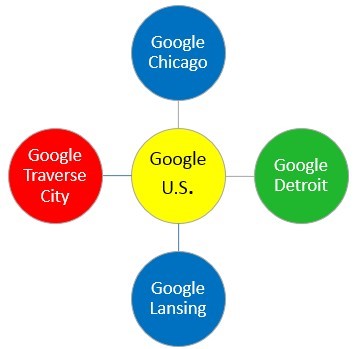
The team identified an ideal client and looked at its tracked keyword set to identify which keywords would be nominated for local-level tracking. Utilizing marketing leading technology from BrightEdge, they identified relevant Google local search engines: Google Chicago, Google Detroit, Google Lansing, and Google Traverse City (fig. 1.0). They then created custom dashboards to track and visualize keyword movement.
With the help of the customer success team at BrightEdge, data collection for this experiment occurred between September 2014 and December 2014. Only keywords which were ranked for each of the tracked weeks were included in the data set; if a keyword went unranked during one of the weeks, it was excluded.
Fig. 1.0 – Google Search Engines
Experiment Subject:
The subject of Fathom Education’s local search ranking research was Central Michigan University, a public institution in Mount Pleasant, Michigan, 150 miles northwest of Detroit. Offering over 200 academic programs, with an undergrad enrollment of 20,000+ students, Central Michigan University is one of the country’s 100 largest universities. It was ranked as the #194 national university by U.S. News & World Report in its most recent college edition.
Experiment Hypotheses:
Certain markets would emerge stronger than others, particularly in the search engines closest to campus. Non-branded terms would have larger ranking variances than branded terms.
Findings:
Branded vs. Non-Branded
The Fathom Education team initially grouped keywords into two segments: One bucket for branded keywords, and the other for non-branded keywords. This segmentation was important to test the hypothesis that branded keywords would be less prone to ranking shifts across the timeline of the project.
Central Michigan University’s branded keywords maintained similar rankings in the local search engines compared to the Google US baseline. On average, branded keywords in the local search engines remained within 1.43 positions of Google US rankings.
Detroit saw the largest positive branded ranking variance from Google US, and Chicago saw the largest negative variance (figure 1.01).
Figure 1.01 - Branded keyword ranking variance from Google US baseline
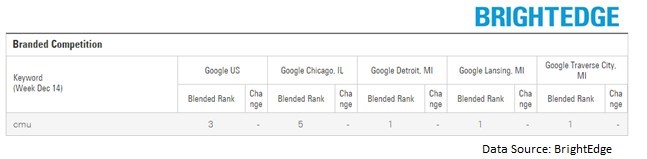
The most consistently variable branded keyword was the acronym CMU, where lower rankings were observed in local search engines due to competition from Carnegie Mellon University (https://www.cmu.edu/index.shtml) (fig. 1.02).
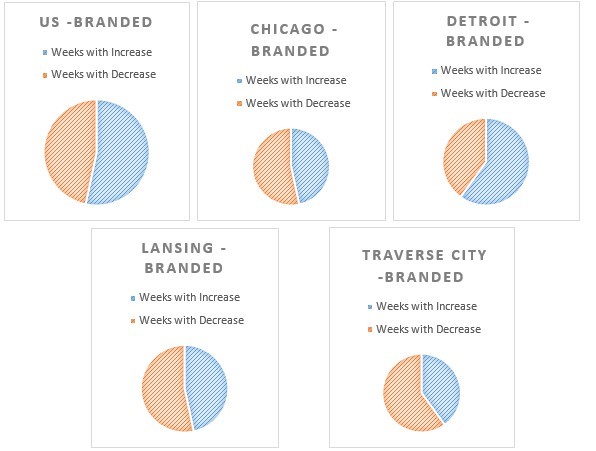
When examining branded keywords in each search engine across the timeline of data collection, Detroit saw the most weeks with ranking increases, while Traverse City had the most weeks with ranking decreases (fig. 1.03).
Figure 1.03 – Branded performance by week
Much larger ranking variances were noted in the local search engines from the non-branded keyword segment. On average, non-branded keywords experienced an 11.06 position ranking difference from their Google US ranking baseline.
The Lansing search engine had the largest positive non-branded ranking variance from Google US, whereas Chicago had the largest negative ranking variance (figure 1.04).
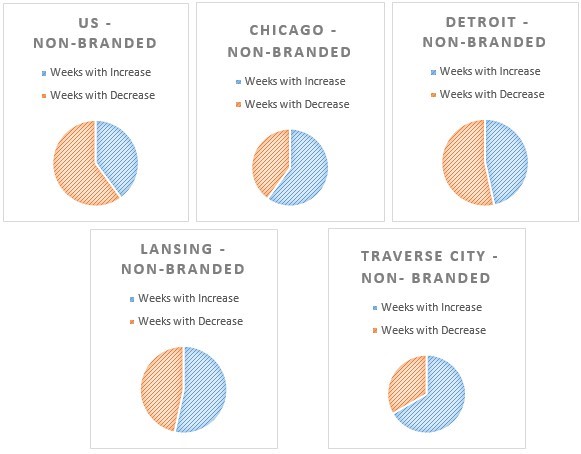
When compared to initial non-branded keyword rankings, Traverse City experienced the most weeks with ranking increases, and Google US experienced the most weeks with ranking decreases across the research timeline. (fig. 1.05).
Figure 1.05 – Non-branded performance by week
Stability vs. Volatility
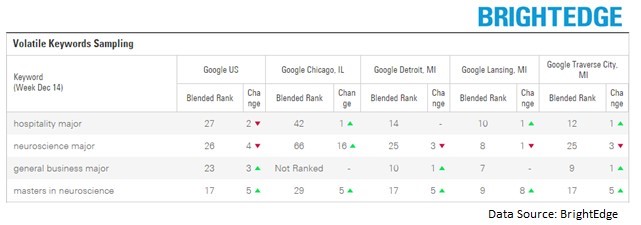
As the experiment continued, the team noticed ranking trends and created two additional keyword segments: stability and volatility. The stability segment was made up of branded and non-branded keywords with very little ranking variances; these words were predominately situated on the same search results page across the 5 tracked engines. The volatility segment was populated with non- branded keywords that had varied page rankings in the different search engines, or significant swings in rankings week over week (fig. 1.06).
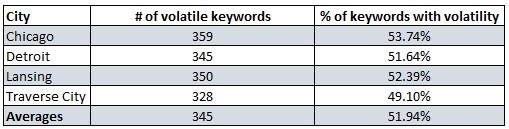
Tracking these two segments was important in calculating what percentage of our focus keywords were “volatile.” In total, the following non-branded keyword volatility percentages were exhibited throughout the course of the experiment: Chicago – 53.74%, Detroit – 51.64%, Lansing – 52.39%, Traverse City – 49.10%. On average, 51.94% of tracked non-branded keywords were volatile (fig. 1.07).
Figure 1.07 – Volatile keyword percentages
Universal Search:
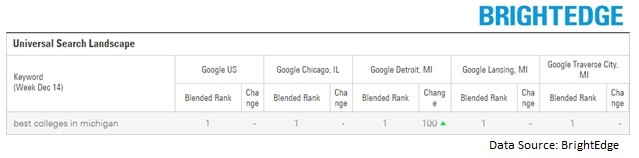
In addition to fluctuations in traditional search results, the team also recognized variations in universalsearch results. At times Central Michigan University had universal listings ranking in the first position in the local engines, then dropped into lower positions in subsequent weeks. This back-and-forth demonstrated shifts in Google’s algorithm and highlighted how search results can be affected (fig. 1.08, fig. 1.09).
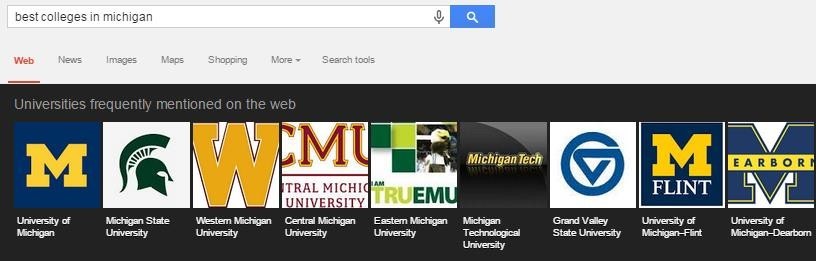
(Central Michigan University gained 100 ranking positions in the Detroit search engine week-over-week with a “carousel” listing in the universal search results.)
Fig. 1.09 – Universal Search Carousel Listing
Summary
Experiment Wrap-Up:
Examining the data and findings, Fathom Education was able to confirm its hypotheses. In fact, non- branded keywords did display a higher risk of volatility than branded keywords, and the search engines closest to the physical campus typically resulted in higher rankings for these keywords than the Google U.S. results.
Expanding on these insights, Fathom developed a set of guidelines and local-search best practices for colleges to consider as part of a comprehensive digital marketing strategy.
Local Search Practical Application:
We recommend reviewing and implementing the following to improve your own institution’s local search presence
1. The first thing you’ll need in order to have a successful local search strategy is localized rank tracking. Without knowing your baseline ownership of the local search results, gauging improvements will be hard. We recommend BrightEdge for ease of functionality and the most in-depth reporting.
a. If you’re trying to settle on which keywords you need to invest in for local rank tracking, start by looking at your branded keywords. If your college has a strong brand presence and generally sees little branded competition, leaving branded tracking at the national level is probably ok.
b. Looking at Fathom Education findings for Central Michigan University, just over 50% of the tracked non-branded keywords were considered “volatile,” and displayed larger variances between the national and local engines. Knowing that, consider nominating 50% of your non-branded keywords as critically important to success, and start tracking them geographically.
c. Start near home. Recent ACT data suggest that the average student will travel less than 50 miles to attend college, with 78% of students remaining in-state for their education. Therefore, honing in on local search engines will help keep focus on the most potentially valuable sources of new students.
2. Next, you’ll want to define pertinent goals for local search. All local engines will not necessarily perform the same, and seeing wins across the board will be doubtful. So, setting realistic benchmarks is important to help you celebrate each individual feat. Whether an increase in traffic to a new program page, a boost in applications for the fall session, or more social shares for a premium video, knowing what you want to accomplish will help provide a clearer picture of your success.
a. Once those determinations have been made, set up goals and/or event tracking in Google Analytics and utilize annotations to mark important changes and achievements.
3. Cover your on-site foundation. Ensuring the following basic pieces are in place will give you the best chances of seeing success in the local engines:
a. Utilize geographic modifiers in the title tags of relevant pages. Including your city or state in your title tag will signal local relevance to both the search engines and the searchers. Doing the same in your meta descriptions will help click through rate on your organic listings.
b. Optimize your college’s ‘location’ pages. Beyond the title tag and meta description, include the following information on your location pages: schema location mark-up, embedded Google Maps, zip codes, distances from other regional cities, detailed directions, and local landmarks. All of these will provide semantic location details to the search engines and help increase your chances of achieving first-page rankings.
c. Utilize all your available content. Images, videos, and PDFs should be treated the same as other on-site content. Optimize them accordingly with alt attributes and meta- descriptions.
4. Be mindful of universal search. Beyond images and videos, think of the other types of results that are appearing in the search engines: Specifically for colleges, "carousel" and "places" listings. Optimize your Google Places presence by creating a page for each satellite or regional campus. Additionally, consider marking your upcoming events with schema code so the search engines will pull them directly into the results pages.
5. Understand your existing rankings and tailor content towards the locations where your institution is struggling the most. Consider developing a landing page or microsite where you can house localized content to help address the issue. Taking advantage of offsite advertising such as radio spots or billboards in areas of concern could also drive traffic to a website and increase engagement.
6. Build credibility with local institutions. Is your city known for its hospitals? Or maybe its theater district? Form relationships with these organizations to signal strength in the eyes of the local search engines. Earning a relevant link from credible sources to your program pages or promotional content will result in more traffic to your site, as well as boosted ranking potential.
7. Let paid search be your friend. While paid search does not represent the answer to organic local search needs, creating a unified approach to digital marketing can assist in achieving goals.
a. Support struggling organic rankings with increased bids in paid search campaigns. While waiting for the effects of SEO, searchers in your underperforming locations will be able to see your content in the top slots of the results pages.
b. By contrast, current leaders in organic search who consider increased domination of the search results page with enhanced paid bids could help combat pressure from both existing and up-and-coming competitors.
8. Build awareness outside your core market. As we saw throughout the analysis, there’s a greater likelihood of variability in rank position in local markets outside of that which the university is actually located. Search engines take into account the importance of content to users in a specific locale – therefore localized citations (i.e. brand mentions and links) originating from sites with a footprint associated closely to a location can influence your rankings across markets.
a. For example, consider that CMU saw a higher negative variation in rank in the Chicago market vs. Google US. In order to increase relevance for the targeted terms in the localized Chicago search results, we might suggest utilizing existing partnerships or marketing initiatives to gain additional citations in that market. One such practical example might be to launch additional press around a booth at a college fair in Illinois. Or, if CMU is partnering with a hospital in the Chicago area on cutting-edge medical research you can take that as an opportunity to generate powerful localized citations.
*During the duration of this project, some, but not all pages of the subject site were edited. The Fathom team tracked a variety of non- optimized keywords to limit the effects of site modifications on the experiment. Looking at the trend of the results instead of one metric or data set provides a clearer perspective on the landscape.
The goal of SEO is to boost the visibility of particular websites and increase the number of visitors who find the site. Rich snippet SEO helps websites attract more attention when they appear on SERPs, catching the eye of users, so that they become more likely to click on the search result.
Google first started allowing websites to display rich snippets in 2009. According to Google, “Snippets give users convenient summary information about their search results at a glance.” These snippets are perfect for attracting the attention of users in organic SERPs.
When Google first started allowing rich snippets, many website developers saw immediate impacts on conversion rates. Since the snippets provide users with a preview of the type of content available on the website, they help to boost the click-through rates of qualified traffic. Customers click on the website with a stronger interest in what the site has to offer. Focusing on rich snippet SEO helps conversion rates and company success.
The confusing role of the video rich snippet
Google has several rich snippet seo options, but one that has attracted a considerable amount of attention over the past year has been the rich snippet seo for video. When a website is marked up to let the search engine giant know that they want to promote a video, then the search result appears with a small thumbnail of a video.
Users will be drawn to the video thumbnails in the SERPs and BrightEdge custom research shows that in some positions that the CTR will be 50% higher with a video thumbnail. Users who like video are likely to click through to the site to watch the video. Videos are excellent marketing tools.
Videos have been shown to increase a customer’s understanding of a product or service by 75 percent
Website visitors are 64 percent more likely to make a purchase on an online retail site after watching a video
Many organizations were learning how to maximize their video offerings and taking advantage of rich snippet SEO for videos when the summer of 2014 saw a major change to the SERPs. Countless brands suddenly had their video rich snippets disappear. The entire snippet itself did not disappear as they still appeared with certain sites, such as YouTube, but they were not showing up with a marked-up page for a standard company.
After careful research and polling of different sites, it was realized that Google most likely adjusted when and where the snippet appears to ensure that it was helpful for customers.
Snippets draw attention to the websites they appear on, and Google does not want to draw attention to low-quality sites who just happened to figure out how to successfully markup their page. According to Phil Nottingham, rich snippet SEO for video changes may have been caused by a few different factors.
The snippets were very easy to spam, since all a site needed was the correct markup, leading to a poorer user experience
The video rich snippets were not working well on mobile devices, which have become increasingly important
Google may want to encourage people to use their sub-menu navigation for images and videos
It is important to note that companies can still have their video rich snippets appear when a user performs a video search on Google. For its standard search, Google seems to be focused on only providing rich snippet SEO video results for sites that fit the following criteria:
The snippet is relevant to the search performed
It must be a high-quality website
It must be a site that is known for its videos
Unfortunately for many business websites, their lack of expertise in video production has led to the departure of video snippets for their SERPs. Companies who want to capitalize on video SEO, however, still have ways to use the rich snippets to attract visitors.
How professionals can still leverage video rich snippets
YouTube is now critically important for companies who want to use rich snippet SEO to optimize their videos. As the owner of the vast majority of video rich snippets available on Google, companies who want to entice customers to come visit their site with a video must work on building their platform on YouTube. The site has more than 1 billion users and 300 hours of video are uploaded every minute. As the leader of the online video industry, YouTube has also established a video platform that makes it possible for companies to use the site to drive visitors towards conversion.
YouTube does not have a fantastic referral rate back to the company website, but it does make it significantly easier for businesses to get their content in front of prospective clients and increase visibility and brand recognition.
Videos produced for YouTube should have the following characteristics in common:
The video can stand-along so that customers can learn from it without visiting the company site
The video is valuable for those who are not familiar with your brand
YouTube offers companies the chance to build a professional video site where they can attract followers who are interested in what they have to say, demonstrating their expertise in the industry.
Building a successful YouTube video requires the use of keywords in the meta tags. They should be included in the description, title, and video transcript for the video. Ideally, the most important keywords should be at the beginning of the title. You should also develop custom thumbnails of the videos rather than relying on the auto-generated versions. Giving your channel an authority boost by linking between your company website and YouTube channel can also help establish credibility and boost the video rank. You should test on-screen annotations and links in the YouTube videos to increase site visits by video watchers.
Competitive SEO technology, such as that produced by BrightEdge, can help companies identify video-related target keywords where they can boost their ranking. Optimizing keyword usage can help videos rank higher both within YouTube and for rich snippet SEO results.
If you want to host videos on your own website and provide the right mark-up so that the video rich snippet will at least appear in video results, it is highly recommended that you use a schema.org markup. This markup has been designed to provide a common system for Google, Bing, Yandex, and Yahoo!
Video rich snippets have undeniable value for companies looking to attract attention to their websites, but they can be extremely difficult to obtain. Although the algorithm might adjust in the future to reduce the rich snippet domination of YouTube, for now the video powerhouse offers the best solution for companies interested in taking advantage of video rich snippet SEO.
There are more than 1.5 billion mobile internet users worldwide and roughly 80 percent of internet users own a smartphone. If these numbers do not encourage you to take advantage of the growing trend of mobile search, then Google’s recent announcement should give you the final push you need.
The changes coming to Google 2015
On February 26, 2015 Google broke with tradition and gave marketers incredible insight into changes they have planned for their search algorithms and the exact day they will go into effect. Specifically, they announced that on April 21 mobile search engine results pages (SERPs) will be impacted by the mobile-friendliness of a website.
Google wants to make it easier for people using mobile devices to access websites that have been optimized for use on that device. In less than three weeks their algorithms for mobile search will shift to reflect this desire.
This is the first time that Google has given website owners forewarning about an impending change and the day the change will occur.
As site owners head back to their site dashboards, here is what they should know about the importance of this announcement.
What website owners should expect
When describing the effect these changes will have on mobile SERPs, the Google developers specifically said that there will be a ‘significant impact on search results’.
Google has encouraged website owners to take into account mobile users for a while now, hinting that they would be prioritized, but until recently it has been possible for websites to perform well without worrying too much about mobile optimization, including that for the mobile e-commerce. That will quickly change.
Now site owners who have not taken steps to ensure that their sites are mobile-ready can expect to have their mobile rankings hit hard. For businesses receiving steady customers from internet searches, this can result in a major drop in income. Google has made this announcement early so that sites have the opportunity to prepare. Remember that the goal of the search engine is to provide end users with the information they seek and a good user experience consuming it.
If your site has valuable information that performs well because customers find you helpful, they want you to continue to rank well. They simply want to ensure that their users have an optimal experience no matter what device they use.
How should companies prepare?
Google itself offers two fantastic tools that allow you to test your website to see how well it performs on mobile devices.
Use these two tools to gain a better understanding of how mobile-friendly your site already is and where your main challenges lie. Remember that a well-optimized mobile website will make it easy for customers to find the information they seek and complete their desired tasks on mobile devices. Think about your desired customer and the actions they are likely to perform on your mobile site. Are they there to research or find merchandise? Are they looking up an address or phone number on the way to your restaurant?
Mobile search now accounts for about 60 percent of online traffic to websites, and people use their devices to complete a myriad of tasks. Consider all the possible actions customers might take from a mobile device and use these ideas to guide the planning of the mobile site and the navigation menu. Navigation should be intuitive and easy to use with fingers instead of with a mouse. A desktop site optimized for mobile will also have a responsive web design.
Responsive web design has removes the need for alternate mobile versions of websites and gives you the ability to host a single website that automatically adjusts to the size screen that it is displayed upon. Page visitors do not want to have to scroll to the side to read a news article or have to perpetually zoom in to read the text on the page. The mobile-friendly web design removes this potential hassle. In addition to the responsive web design, Google will be looking at elements such as:
whether or not the fonts scale for easy ready on smaller screens
if the touch elements, such as buttons, are easy to use and spaced away from other touch elements
if the website relies on Flash, which tends to not play well in mobile browsers
It is also important for companies to carefully consider how the demands of internet users differ depending upon where they are and the type of device they are using. The optimized mobile SEO tools used by BrightEdge, for example, allow customers to get a close look at the share of voice in their industry across various devices, such as smartphones and tablets, and compare them.
BrightEdge was the first to release Mobile SEO technology in August 2013, including mobile analytics, Mobile Share of Voice, and Mobile Site Audit. And, BrightEdge has continuously paved the way with technology and research to assist brands in defining a mobile search strategy.
BrightEdge 2014 mobile research has found that 62% of search results vary from mobile to desktop, and that tablets and smartphones make up 35% of organic search traffic. More importantly, misconfigured websites lost 68% of smartphone traffic.
Today in 2015 many brands are concerned about the impact of Google’s Mobile Algorithm update. Meanwhile, BrightEdge customers have had technology in-place for two years to help them understand their rank and the competitive landscape across 605 local, global and mobile search engines - equipping them to win in the competitive mobile battleground.
How BrightEdge Helps with Mobile Optimization
BrightEdge takes mobile reporting beyond the webmaster and to the marketer with reporting that helps brands understand their SEO and content performance by device.
BrightEdge’s mobile SEO reporting allows users to track and measure mobile device performance with things like:
Measuring true rank by device in Universal Search (image, video, social).
Visibility into local SEO performance by keywords and keyword groups across cities.
Tracking and reporting on keyword trends and rankings across device type.
Optimizing mobile campaign performance for ecommerce.
Understanding the competitive SEO landscape and “share of voice” for a brand across mobile devices.
BrightEdge has offered a complete mobile solution for over 2 years that includes, rank and actual performance by device type used. Using this information, website designers can gain a better understanding of how to cater to their mobile customers and how to optimize their site to attract them.
Not only will this now help to attract customers, but it can also now demonstrate to the Google spiders that this website takes mobile optimization seriously, which will boost search engine rankings. Google continuously works to update its search algorithms to better meet the needs of their users while websites engage in a perpetual struggle to optimize their content according to the latest Google algorithms.
With this unprecedented announcement, Google has provided site owners with the time they need to prepare for upcoming changes and everyone should take advantage of it.
Considering that mobile now comprises of more than 1/5 of the ecommerce market, making these changes should not only help companies successfully navigate the changes, but also help them capitalize on the ever-growing mobile marketplace.