

BrightEdge Data Finds AI Accounts for Less Than 1% Search, Organic Traffic Continues to Dominate

BrightEdge Data Finds AI Accounts for Less Than 1% Search, Organic Traffic Continues to Dominate

While AI search may be the fastest-growing channel, the smartest marketers are winning by combining AI readiness with proven SEO strategies.

San Mateo, Calif. – September 12, 2025

BrightEdge, the global leader in AI-driven organic search, content, and digital marketing automation, today released new research spanning January through August 2025 that shows AI search is experiencing explosive growth. The data underscores that visits from AI search platforms surged at double-digit rates month over month, demonstrating how rapidly AI is reshaping discovery.

Yet BrightEdge data also reveals a critical distinction: while AI search is growing fast, it only accounts for less than 1% of referral traffic, while organic search remains the primary driver and delivers significantly stronger conversions.

“AI search is the fastest-growing channel we’ve ever tracked,” said Jim Yu, Founder and CEO of BrightEdge. “But growth and quality are two different things. Organic search continues to outperform on conversions and remains the engine of digital growth. The most successful marketers aren’t choosing one over the other — they’re adapting for AI while doubling down on the organic strategies that have always driven results.”

BrightEdge analysis of thousands of queries and top-performing websites, including many Fortune 100 brands, shows that leading marketers are reinforcing SEO best practices in the age of AI discovery, from improving site performance for faster, more user-friendly experiences to adding contextual signals like schema that help AI engines and search platforms better interpret content.

BrightEdge Launches Two New Innovations to Help Marketers Win in the Age of AI

To help brands navigate this ongoing shift, BrightEdge announced two major product innovations:

AI Early Detection System – The next generation of analytics reporting that reveals, in real time, how AI search is contributing to traffic, leads, and revenue. The capability allows marketers to separate signals from noise, detect shifts early, and prove the ROI of AI. Instead of guessing whether a spike in AI referrals matters, marketers can see when it drives real downstream engagement and adjust their strategy accordingly.

AI Catalyst Recommendations – BrightEdge AI Catalyst identifies where competitors are appearing in AI results, then translates those gaps into actionable steps. It not only shows what’s missing, but why others are winning — whether it’s page structure that makes content easier for LLMs to interpret, deeper topic coverage, or clearer user signals that help models surface the right answers.
 

What makes Catalyst especially powerful is that it also shows where AI engines source their answers. For example, BrightEdge data shows:

  • 34% of AI citations pull from sources that brands can influence through PR.
  • Nearly 10% of citations come from social platforms, like LinkedIn and Reddit, and because BrightEdge pinpoints the exact forum (even down to a subreddit), marketers know exactly where to engage.
  • User-generated content sites are cited seven times more often than general business sites, and BrightEdge identifies the exact sources of authority so that marketers can act with precision.

By pinpointing which third-party voices shape AI results, BrightEdge AI Catalyst gives marketers precision targeting. It identifies the sources that matter most, analyzes why they influence AI, and generates clear action items — even down to what content resonates and who inside an organization to reach. The result: a faster, easier way to strengthen presence in AI search and tie activity directly to specific channels and broader business outcomes.

“These innovations give marketers a roadmap for the future,” Yu added. “They can finally measure AI’s impact, act on insights in real time, and influence the sources that shape AI results — all while continuing to build on the proven power of organic search.”

Learn more about BrightEdge's findings and download the full report Here. 

About BrightEdge

BrightEdge is the global leader in Enterprise SEO and AI-powered content performance. For more than 18 years, BrightEdge has helped thousands of brands and digital marketers, including 57% of the Fortune 500, transform online opportunities into measurable business results. Its industry-first platform integrates the most comprehensive dataset in search, combining insights from traditional SEO, digital media, social, and content with cutting-edge generative AI capabilities, including its deep learning engine DataMind and AI Catalyst platform. Trusted by enterprises, mid-market companies, and leading digital agencies, BrightEdge continues to set the standard for innovation in search and AI, enabling brands to win by becoming an integral part of the digital experience.

Contact:
press@brightedge.com 

Press Release Date

AI Overview Citations Now 54% from Organic Rankings

16-month study reveals AI Overview citations increasingly overlap with organic rankings, growing from 32% to 54%. See industry breakdowns and strategy tips.

Data Collected: Monitored AI Overview citation overlap with organic rankings across 9 industries from May 2024-September 2025 using BrightEdge Generative Parser™ to analyze:

  • Citation source patterns
  • Overlap progression over time
  • Industry-specific convergence rates
  • Algorithm evolution phases

Key Finding: AI Overview citations increasingly come from pages that rank organically—overlap grew from 32.3% to 54.5% (+22.3 pp), but individual industries vary wildly from E-commerce's flat 0.6 pp change to Education's massive 53.2 pp surge.

The Big Numbers

  • 54.5% of AI Overview citations now rank organically (up from 32.3%)
  • 69% relative increase in overlap over 16 months
  • 53.2 pp increase for Education (largest industry shift)
  • 0.6 pp increase for E-commerce (only flat industry)
  • 75%+ overlap for Healthcare and Education (highest convergence)

The Convergence Timeline

May 2024: Launch Baseline

  • Overall overlap: 32.3%
  • Healthcare leads at 63.3%
  • Travel/Entertainment/Restaurants near 0%
  • Most citations from non-ranking sources

September 2024: Public Rollout Catalyst

  • Overlap jumps to 39.1%
  • Acceleration begins (+5.4 pp in 2 months)
  • Education and Insurance surge
  • Clear shift toward ranked content

January 2025: New Year Acceleration

  • Overlap reaches 45.2%
  • Fastest growth period (~3 pp/month)
  • Most industries showing convergence
  • E-commerce remains flat

September 2025: Current State

  • Overlap stabilizes at 54.5%
  • Healthcare at 75.3%
  • Education at 72.6%
  • E-commerce still at 22.9%
  • Pattern appears to be stabilizing

Industry Breakdown

High Convergence (68-75% overlap)

  • Healthcare: 75.3% (started high, modest gains)
  • Education: 72.6% (explosive +53.2 pp growth)
  • B2B Tech: 71.0% (strong +32.4 pp growth)
  • Insurance: 68.6% (major +47.7 pp surge)

Low Convergence (<33% overlap)

  • Finance: 32.2% (steady but below average)
  • Entertainment: 25.9% (late starter, catching up)
  • Travel: 23.6% (started near zero)
  • E-commerce: 22.9% (anomaly - virtually no change)
  • Restaurants: 19.2% (started at zero)

The Three Phases

Phase 1: Testing (May-Aug 2024)

  • Flat at ~32-34% overlap
  • Google experimenting with sources
  • Some industries had AIOs disabled
  • No clear pattern emerging

Phase 2: Acceleration (Sep 2024-Jan 2025)

  • 34.6% → 45.2% (+10.6 pp in 4 months)
  • September public rollout triggers shift
  • Fastest growth: ~3 pp per month
  • Clear move toward ranked content

Phase 3: Convergence (Feb-Sep 2025)

  • 45.2% → 54.5% (+9.3 pp)
  • Crossed 50% threshold in May 2025
  • Growth slowing, pattern stabilizing
AI Search Report IllustrationAI Search Report Illustration

Takeaways from Data

  1. The Convergence is Real but Uneven While overall overlap grew 22.3 pp, individual industries range from 0.6 pp (E-commerce) to 53.2 pp (Education). Your strategy depends entirely on your vertical.
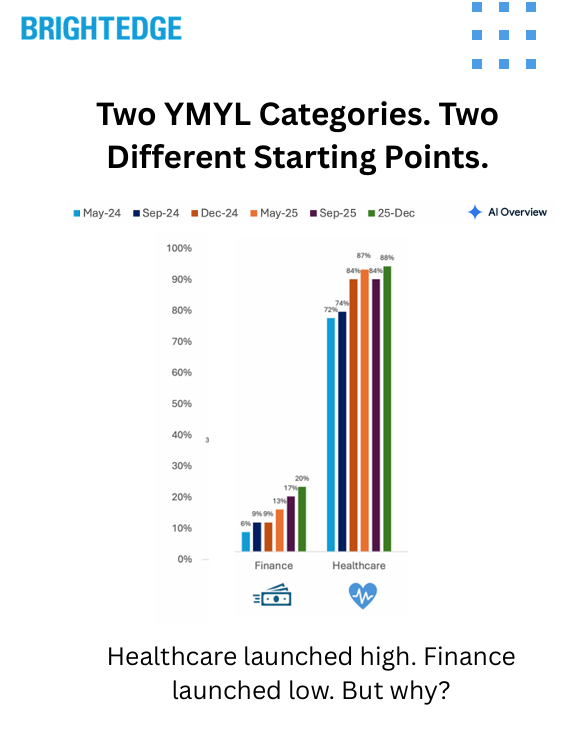
  2. YMYL Content Drives Convergence Healthcare, Insurance, and Education show 68-75% overlap—when trust matters, Google strongly prefers content that already ranks well organically.
  3. E-commerce is the Exception The only industry where overlap stayed flat (0.6 pp) and AIO coverage actually decreased (-7.6 pp). Google appears to intentionally keep transactional queries separate from AI Overviews.
  4. Position 21-100 is the Sweet Spot Most overlap growth comes from pages ranking 21-100, not top 10. Only 16.7% of citations come from top 10 results, suggesting Google seeks diversity within ranked content.
  5. September 2024 Changed Everything The public rollout marked a clear inflection point—overlap jumped 5.4 pp in two months. This is when Google committed to favoring ranked content for AI Overviews.


Download the Full Report

Download the full AI Search Report — 16-month study reveals AI Overview citations increasingly overlap with organic rankings, growing from 32% to 54%. See industry breakdowns and strategy tips.

Click the button above to download the full report in PDF format.

Published on September 18, 2025

Hero Image

BrightEdge AI Search Summit Melbourne — Highlights & Replay

Exclusive insights from David Jones, Torrens University, Fiji Airways

Theme: Optimise AI Search for Enterprise

Date: Thursday, 13 November 2025

Time: 10:00 – 4:00 PM AEST 

Location: The Langham, Melbourne ,1 Southgate Ave, Southbank VIC 3006

Access On-Demand Recording


Note: We respect your privacy. We'll only use your info to send event updates.


Filmed live at The Langham, Melbourne, Melbourne — 13 November 2025

Speakers

Bevan Morris

General Manager E-commerce,
David Jones

Anastasiia Zakharenkova

Senior Marketing Manager,
Torrens University

Jameel Mohammed

Senior Manager Digital & Ecommerce,
Fiji Airways  

Ran Van Riper

SVP, Cust Success,
BrightEdge

Kylie Tabrett

Head APAC,
BrightEdge 

Highlights from November 13

Keynote presentation icon

Keynote

Ran Van Riper on where AI search is headed and how to operationalize it

Customer success story icon

Customer Spotlight

Bevan Morris (David Jones), Anastasiia Zakharenkova (Torrens University), and Jameel Mohammed (Fiji Airways) on what’s working now and what’s next.

Live demo icon

Market Snapshot

Current trends, buyer behavior, and adoption signals shaping AI search locally.

Why AI Search Summit Matters

AI-first Execution, Proven Results

Case studies from Fiji Airways, David Jones, Torrens University.

Practical Innovation
 

Real discussions, real impact.
 

Community & Networking
 

100+ digital leaders came together
 

BrightEdge team collaboration

Be part of the conversation shaping AI-powered search.

Need help? event_planning@brightedge.com 

Access the On-Demand Recording

ChatGPT vs Google AI: 62% Brand Recommendation Disagreement

ChatGPT, Google AI Overview, and AI Mode disagree on brand recommendations for 62% of queries. Google AIO mentions 2.5x more brands than ChatGPT, while following opposite citation strategies.

Data Collected: Analyzed tens of thousands of identical prompts across ChatGPT, Google AI Overview, and Google AI Mode using BrightEdge AI Catalyst to compare brand recommendations and citation patterns.

Key Finding: Platforms disagree on brand recommendations for 61.9% of queries. Only 17% of queries result in the same brands across all three platforms, revealing massive untapped visibility opportunities.

Platform Disagreement Patterns

  • 61.9% of queries get different brand recommendations across platforms
  • Only 33.5% of queries trigger brands from all three platforms
  • Just 17% result in the same brands across all three
  • Only 4.6% of queries get zero brands from all platforms
  • Google AIO dominates mentions in 36.8% of queries
  • ChatGPT beats both Google platforms in only 3.9% of queries

Brand Mention Averages

  • ChatGPT: 2.37 brands per query
  • Google AI Overview: 6.02 brands per query (2.5x higher than ChatGPT)
  • Google AI Mode: 1.59 brands per query
  • ChatGPT silent on 43.4% of queries
  • Google AIO silent on only 9.1% of queries
  • Google AIM silent on 46.8% of queries

The Citation Paradox

  • ChatGPT: Mentions 3.2x MORE than cites (2.37 mentions vs. 0.73 citations)
  • Google AIO: Cites 2.4x MORE than mentions (14.30 citations vs. 6.02 mentions)
  • Google AIM: Cites 6x MORE than mentions (9.49 citations vs. 1.59 mentions)
  • ChatGPT = trust/training data patterns
  • Google = transparent source trails

Same Brand Alignment Triggers

  • “Compare” queries: 80% same-brand agreement (highest)
  • “Buy” queries: 62% same-brand agreement
  • “Where” queries: 38% same-brand agreement
  • “Best” queries: 23% same-brand agreement
  • Overall: Only 17% of queries get same brands across platforms

Industry Disagreement Rates

  • Healthcare: 68.5% disagreement
  • Education: 62.1% disagreement
  • B2B Tech: 61.7% disagreement
  • Finance: 57.9% disagreement
  • E-Commerce: 57.1% disagreement (lowest)
AI Search Report Illustration

Strategic Insight: Marketers cannot assume brand visibility translates equally across AI platforms. ChatGPT operates like a brand recommender with minimal sourcing, while Google positions itself as citation-first with wide coverage. This mismatch creates opportunities for brands that can align to both trust-driven recommendations and source-backed visibility.

Download the Full Report

Download the full AI Search Report — platform disagreements, brand mentions vs. citations, and strategies to win visibility across ChatGPT and Google AI

Click the button above to download the full report in PDF format.

Published on August 27, 2025

AI Engines Choose YouTube 200x More Than Any Other Video Platform—Your Brand Could Be Missing Out

We analyzed citation patterns across ChatGPT, Perplexity, and Google's AI products. YouTube isn't just winning—it's the only video platform that registers, creating massive opportunity for brands already creating video content.

Data Collected: Monitored YouTube citation patterns across AI search engines from May 2024-September 2025 using BrightEdge AI Catalyst to analyze:

  • Citation rates across platforms
  • Video platform competition
  • Query type patterns
  • Week-over-week changes

Key Finding: YouTube averages 20% citation share across AI platforms—making it the most cited video platform with 200x more citations than any other video platform, despite no obligation from non-Google engines to favor it.

The Big Numbers

  • 20% average YouTube citation share across platforms
  • 200x advantage over nearest video competitor (Vimeo at 0.1%)
  • 29.5% of Google AI Overviews cite YouTube (#1 domain)
  • 100% week-over-week growth for ChatGPT (though from small base)
  • -32.8% recent decline in AI Overviews (but still dominant at #1)

The Platform Breakdown

Google AI Overviews

  • 29.5% YouTube citation share
  • #1 cited domain (ahead of Mayo Clinic at 12.5%)
  • -32.8% week-over-week change
  • Average rank position: 6.3

Google AI Mode

  • 16.6% YouTube citation share
  • #1 cited domain
  • -3.2% week-over-week change
  • Average rank position: 9.7

Perplexity

  • 9.7% YouTube citation share
  • #5 cited domain
  • +4.8% week-over-week growth
  • Average rank position: 9.7

ChatGPT

  • 0.2% YouTube citation share
  • Minimal but growing (+100% week-over-week)
  • Average rank position: 5.2

The Video Platform Monopoly

YouTube Dominance:

  • 20% average citation share
  • Present across all AI platforms
  • #1 domain in Google AI Overviews
  • Growing on independent platforms (Perplexity, ChatGPT)

Competition Non-Existent:

  • Vimeo: 0.1% (AI Overviews only)
  • TikTok: 0.1% (AI Overviews only)
  • Dailymotion: 0%
  • Twitch: 0%
  • All others: 0%

Query Types That Trigger YouTube Citations

High YouTube Citation Rate:

  • Platform-specific tutorials ("TD Ameritrade post-merger")
  • Medical education with action components
  • Current pricing/deals ("Is Home Depot having a sale?")
  • Financial tool demonstrations
  • Product reviews and comparisons

Low/Lost YouTube Citations:

  • Strategic planning questions
  • Career advice and academic selection
  • Abstract financial concepts
  • Technical architecture decisions
  • Pure informational without visual benefit

Takeaways from Data

  1. YouTube Has Absolute Video Monopoly With 200x more citations than any competitor, YouTube isn't just the preferred video platform—it's the only one that matters for AI citations. Even non-Google platforms (ChatGPT, Perplexity) choose YouTube almost exclusively.
  2. Platform-Agnostic Trust ChatGPT and Perplexity have no obligation to favor Google properties, yet they still choose YouTube for video citations. This validates YouTube's position as the universal video authority for AI.
  3. Supplementary Not Primary YouTube typically ranks in positions 3-10 (average 6-10 across platforms), indicating AI engines use video as supporting evidence rather than primary sources. This creates opportunity for brands to complement text authority with video demonstrations.
  4. The August 31st Shift A clear inflection point where multiple platforms simultaneously increased YouTube citations—Google AI Mode and Perplexity both jumped from 0% to double digits, suggesting industry-wide recognition of video value.
AI Search Report Illustration

Strategic Insight: Your brand's YouTube channel represents untapped AI citation potential. While competitors focus solely on website optimization, YouTube offers a different path to AI visibility—one where demonstration and visual explanation complement text authority. The data shows AI engines already trust YouTube content; they just need to find YOUR videos. With YouTube dominating video citations by 200x and ranking as the #1 domain in AI Overviews, brands that optimize their YouTube content for AI discovery gain access to a citation channel that's both massive and underutilized.

Download the Full Report

Download the full AI Search Report — AI Engines Choose YouTube 200x More Than Any Other Video Platform Your Brand Could Be Missing Out

Click the button above to download the full report in PDF format.

Published on September 25, 2025

 
Please reach out to your CSM or event_planning@brightedge.com for any questions/comments/suggestions.
Hero Image

BrightEdge AI Search Summit London — Highlights & Replay

Exclusive insights from Nestlé, RS Group, and BrightEdge leaders on winning in the AI era.

Date: Thursday, September 11, 2025

Time: 1:30 – 4:00 PM BST | Networking: 4:00 – 4:30 PM BST

Location: 15-25 Artillery Lane, London, E1 7HA.

Agenda will be shared with confirmed registrants by email and calendar invite. For questions,
contact: event_planning@brightedge.com

Access On-Demand Recording


Note: We respect your privacy. We'll only use your info to send event updates.


Filmed live at Wallacespace Spitalfields, London — 11 September 2025

Speakers

Jim Yu

Jim Yu

Founder & CEO,
BrightEdge

Christopher

Christopher Ford

Global SEM & Digital Marketing Manager,
Signify

Georgian

Georgian Tanaselea

Head of Holistic Search,
Intuit Mailchimp

Mark

Mark Mitchell

Vice President EMEA,
BrightEdge

Highlights from September 11

Keynote presentation icon

Keynote

Jim Yu on the future of AI and practical strategies.

Product spotlight icon

Product Spotlight

AI Catalyst updates, Autopilot for Schema, new analytics reporting.

Customer success story icon

Customer Spotlight

Nestlé & RS Group on AI-first execution and results.

Live demo icon

Live Demo

Tracking AI Overviews + visibility across AI engines

Why AI Search Summit Matters

AI-first Execution, Proven Results

Case studies from Nestlé & RS Group.

Practical Innovation

Real demos of Catalyst, Autopilot, and reporting.

Community & Networking

50+ UK digital leaders came together.

BrightEdge team collaboration

Be part of the conversation shaping AI-powered search.

Need help? event_planning@brightedge.com 
Follow the conversation: #BrightEdgeSummitLondon25 | @BrightEdge

Access the On-Demand Recording

BrightEdge Spark 25 Banner - AI Search Event September 3

Access On-Demand Recording

* indicates required


AI isn't new—but what's happening now is different.

AI Overview graphic showing search evolution

Google's AI Overviews and immersive AI Mode are reshaping search at scale. At the same time, new engines like ChatGPT, Claude, and Perplexity are accelerating change with their own logic, rankings, and citation systems.

Through all of this, one truth holds: your foundation matters more than ever.

At BrightEdge Spark, we'll share exclusive insights from BrightEdge Research. Plus, a look at new innovations including enhancements to AI Catalyst and some next generation innovations we're rolling out to navigate this exciting new ecosystem. Get one unified view of traditional and all AI search to future-proof your brand. It is imperative to understand how they work, and how they present, perceive, and cite your brand differently across the whole ecosystem, so your brand can:

  • Stay optimized as AI evolves
  • Connect AI visibility to business outcomes
  • Win across every engine, with one strategy

Search is evolving fast. BrightEdge keeps you ahead in both traditional and AI search

Speakers

Mark

Mark Mitchell

Vice President EMEA,
Brightedge

Kylie

Kylie Tabrett

Head APAC,
Brightedge

Highlights from October 15

Keynote presentation icon

Keynote

Mark Mitchell, VP of EMEA at BrightEdge, shared how enterprises across APAC can prepare for the future of AI Search and win in a changing landscape.

Product spotlight icon

Product Demo

Exclusive look at BrightEdge AI innovations — including how to detect, measure, and act on AI Search impact across engines

Customer success story icon

Q&A

Interactive audience discussion with answers from the BrightEdge team.

Why Spark Matters

Fragmented Engines, One Strategy

Google, AI Overviews etc. — one strategy works everywhere.

New Data, Real Results

See how AI insights translate into measurable visibility and growth.

Unified Measurement

Track performance across both AI search and traditional engines in one place.

What's Next

  • Melbourne AI Search Summit – 13 November 2025
    In-person flagship APAC summit featuring Torrens University & Fiji Airways.
    Register Now: Click here
  • Global Webinar Series
    Monthly sessions on AI Search Strategy and BrightEdge product innovations.
    View Upcoming Webinars: Click here
BrightEdge team collaboration

Be part of the conversation shaping AI-powered search.

Spark took place on September 23, 2025. watch the full recording and explore the highlights on demand.

Access the On-Demand Recording


Brand Visibility | ChatGPT and Google AI Approaches by Industry

Where Similarities Lie and Different User Paths Appear

Healthcare | B2B Tech | Education | Finance

Google AI ChatGPT
BrightEdge AI Catalyst

Executive Summary

Today, we released new research revealing a critical turning point in the evolution of search: ChatGPT and Google AI Mode increasingly reveal two distinct paths when users ask how to take action. ChatGPT's task-first approach contrasts sharply with Google's information-first model, highlighting not just a technical difference but a pivotal shift in how consumers find, trust, and act online.

Analyzing thousands of real-world prompts across four major industries—finance, healthcare, B2B technology, and education—BrightEdge found that ChatGPT and Google AI Mode disagree primarily when queries are action-driven. For task-oriented prompts, ChatGPT overwhelmingly suggests tools and apps directly, while Google continues to link to informational content.

We are at a critical turning point in the evolution of search. ChatGPT and Google AI Mode are increasingly taking two distinct paths when users ask how to take action.

"AI search is no longer one thing---it's splitting into at least two distinct philosophies," Jim Yu, Founder and CEO of BrightEdge.

For brands to thrive in this evolving AI landscape, understanding how models interpret and utilize content is crucial. ChatGPT, with its "trusted coach" approach, processes information differently than Google's AI, particularly for bottom-of-funnel questions that demand immediate utility.

But most critically, with Google still commanding approximately 90% of global search market share, brands cannot afford to choose between AI optimization and traditional search presence; nor can they use disparate solutions to address each platform piecemeal — they need a comprehensive solution that excels across the entire search ecosystem.

ChatGPT and Google Disagree on How to Act

Our research reveals a clear pattern across industries.

1. When users compare options, both platforms tend to agree.

2. When users want to act, they part ways---ChatGPT surfaces products, apps, and task-based tools, and Google surfaces guides, articles, and institutional content.

ChatGPT's task-first approach contrasts sharply with Google's information-first model, highlighting not just a technical difference but a pivotal shift in how consumers find, trust, and act online.

In task-oriented prompts, ChatGPT overwhelmingly suggests tools and apps directly, while Google continues to link to informational content.

While Google thrives as a research assistant, ChatGPT acts like a trusted coach for decision making, and that difference shapes which tool users instinctively choose for different needs.

Google AI vs ChatGPT logos

Key Research Findings by Industry

Healthcare Shows Highest Divergence:

At 62% divergence, healthcare demonstrates the most significant split between platforms.

  • When prompts pertain to symptoms or medical information, both ChatGPT and Google will mention the CDC and The Mayo Clinic.
  • However, when prompted to help with things like "How to find a doctor," ChatGPT pushes users towards Zocdoc, while Google points to hospital directories.

B2B Technology Follows Close Behind:

With 47% divergence, B2B tech shows substantial platform differences.

  • When comparing technology, such as cloud platforms, both suggest AWS and Azure.
  • When asked "How to deploy things (such as specific apps)," ChatGPT relies on tools like Kubernetes and the AWS CLI, while Google offers tutorials and Stack Overflow.

Education Sector Demonstrates Consistent Patterns:

At 45% divergence, education follows the same trend.

  • When comparing "Best online learning platforms," both platforms surface Coursera, EdX, and LinkedIn Learning.
  • When a user’s prompt pertains to learning a skill such as  "How to learn Python," ChatGPT recommends Udemy, whereas Google directs users to user-generated content hubs like GitHub and Medium.

Finance Shows Lowest but Still Significant Divergence:

Even at 39% divergence, finance maintains the pattern.

  • When comparing "Best credit cards," both suggest major institutions like Chase, Wells Fargo, and Citi.
  • When asked for "How to create a budget," ChatGPT pushes to apps like Mint and YNAB, while Google drives users to NerdWallet and blog articles.

Implications for Industry Marketers

The findings reveal a fundamental shift in how AI platforms approach user intent, creating new challenges and opportunities for marketers.

With Google maintaining a 90% market share while key players like ChatGPT continue to grow, brands face the imperative of optimizing for multiple, distinct AI philosophies rather than a single search paradigm.

The pattern is unmistakable: when users ask what to do next, ChatGPT suggests tools while Google provides more content to read.

This divergence forces marketers to reconsider their content strategies, moving beyond traditional SEO to embrace intent-aware AI optimization.

Google AI vs ChatGPT logos

Example

Prompt: “What are some resources to help plan for retirement?”

The prompt above illustrates how ChatGPT offers tools and calculators, which are very specific, whereas Google selects topics to research.  

Google AI vs ChatGPT logos

For brands to thrive in this evolving landscape, understanding how these new models interpret and utilize content becomes crucial. ChatGPT's "trusted coach" approach processes information differently than Google's AI, especially when answering bottom-of-funnel questions that demand immediate utility.

This distinction requires developing content that optimizes performance across both AI environments and beyond.

The Path Forward

This is precisely where BrightEdge’s AI Catalyst provides an unparalleled advantage.


Relied upon by leading Fortune 500 companies, BrightEdge is uniquely trusted and integrated and holds the playbook for how brands can win now and secure their future.


AI Catalyst allows marketers to bridge gaps, delivering a complete and comprehensive search presence picture. In the last quarter alone, AI Catalyst adoption by BrightEdge customers has surged, with 27% now leveraging the platform daily to optimize across Google, ChatGPT, and beyond.

AI Catalyst Has You Covered to Optimize Once and Rank Everywhere

1. Track your AI and Brand Presence Across Multiple AI Engines

See how your visibility evolves over time through citations and mentions. Monitor your presence across AI Overviews, ChatGPT, and beyond.

2. Understand Variations in Brand Mentions Across Key Prompts

Quickly identify which prompts from ChatGPT and AI Overviews - and all types of AI Search Engines – generate brand mentions so you can optimize content efficiently.

3. Dive Deeper into Prompts to See Why AI is Recommending Specific Brands

AI Catalyst's advanced sentiment analysis provides precise insights into which brand attributes are favoured by each AI Engine. Concentrate your efforts on these attributes to enhance your recommendations.

Google AI vs ChatGPT logos

BrightEdge AI Catalyst

As the need for comprehensive AI search awareness continues to grow among marketers, BrightEdge's AI Catalyst enables them to bridge the gaps between platforms. Customers utilize the solution to equip teams with the technology to evolve in lockstep with the expanding AI and search space.

With the most thorough, data-driven solutions available, BrightEdge helps marketers navigate the complexity of multi-platform AI optimization, ensuring comprehensive visibility regardless of which AI philosophy users prefer.

About the Research:

BrightEdge conducted the research in July 2025, analyzing thousands of real-world prompts across four major industries: finance, healthcare, B2B technology, and education. Using BrightEdge's AI Catalyst platform and its index of billions of data points, the study measured how ChatGPT and Google AI Mode responded to identical prompts, extracting the brands most mentioned by each AI search engine and analyzing citation patterns across platforms.

To explore BrightEdge's AI Catalyst, visit: https://www.brightedge.com/ai-catalyst

Download the Full Report

Download the full research report—including visuals, cross-industry insights, and expert guidance to help you lead in the evolving world of AI-powered search.

Further Resources

BrightEdge Blog: From AI search trends to content strategy tips, the blog is where we break down what’s happening—and what’s next.

Webinar Library: Catch up on our latest webinars—whether you're looking for platform walkthroughs, customer success stories, or strategy sessions with SEO leaders.

Media and News Updates: From mainstream business and technology media - like The Washington Post, Forbes, BBC News, Wired, and Fortune - to leading search and digital publications such as MediaPost, SearchEngineLand, and SearchEngineJournal – view a blend of coverage, research, insights, and industry thought leadership.

Google AI vs ChatGPT logos

www.brightedge.com

,