
Schneider Drives SEO Maturity and Adoption Through BrightEdge
Fisher scaled to huge SEO program and results, ran smooth and effective site migration

500
BrightEdge Users Worldwide
Schneider Drives SEO Maturity and Adoption Through BrightEdge
Fisher scaled to huge SEO program and results, ran smooth and effective site migration
THE PROBLEM
Schneider Electric is the global leader in energy management and automation, operating in over 100 countries with over 170,000 employees and selling BtoB and BtoC. They already have over 500 registered users of the BrightEdge platform. Fisher’s goal is to permeate SEO and content performance into every aspect of website ownership, development, and content creation, and to make SEO experts out of everyone who touches the site.
THE SOLUTION
“The transformation that I’m really trying to bring about is that today marketers are data scientists. If you’re not running your process by the numbers, it may not be an issue now, but you run the risk of being eclipsed by your competitors who are. One of the ways that we’re trying to run the business by the numbers is by making the numbers more easily available. We’ve worked closely with the analytics team to integrate everything into BrightEdge. We use dashboard features to automatically deliver this data in a really consumable format at regular intervals, which takes the pressure off a person to make reports and gives the task to BrightEdge to do it best.” See David's video.
THE RESULTS
 “BrightEdge helps us in globalizing and standardizing our approach to SEO so we have standard topics and standard keywords groups that each country and language can leverage, which makes sure that there are no content gaps or misses as we globalize and localize our SEO approach. In our first six months with the BrightEdge platform we had 500 users logging in regularly to check their statistics. We also underwent a massive web migration to an entirely new platform, entirely new design, and entirely new brand. We used BrightEdge professional services to help us with that migration and as a result we’ve seen an increase in organic traffic each month since then.”
BrightEdge has really helped me elevate the SEO program at Schneider Electric to generate not just adoption but excitement.
Noble Studios Drives YoY Gains in Organic Across Client Base
The company uses the Data Cube 1000 times per day on behalf of its clients

40%
increase in organic traffic
THE PROBLEM
Noble Studios needed a consistent and efficient means to drive organic search results across its agency client base. They started using BrightEdge approximately three years ago as they started growing their search and specifically their SEO practice. They have found BrightEdge indispensable in centralizing that effort and standardizing the process and see results across the client base consistently improving. “We attribute that success a great deal to the partnership with have with BrightEdge,” said Noble Studios’ CMO Michael Thomas.
THE SOLUTION
“We follow a methodology that has included BrightEdge across every step of the process from competitive research to establishing goals. And I think what BrightEdge does better than any platform that we’ve used to date is the ability to customize reporting and customize results. BrightEdge ran some results for us and indicated that our company uses the Data Cube about 1,000 times per day on behalf of the clients that we represent. It’s a great stat. It shows that it’s become engrained in our culture.” “The BrightEdge platform is constantly innovating. I think listening to customers about what tools they need allows you to do that. And it’s very clear that BrightEdge listens to their customers and anticipates where they’re going, not just providing what they’re asking for.” See Michael's video.

“BrightEdge is the reason that Noble Studios is having a great success for our clients in organic search. We saw that across the board our clients had a 40% year-over-year increase in organic traffic on the BrightEdge platform. They love those results."
And ultimately it is about performance. The C-suite is incredibly busy and so if you can’t succinctly tell your story it’s probably not going to be heard.
Noble Studios Case Study
Wellbiz Brands Masters Local Search for Hundreds of Local Locations
Danielle Yuthas helped many locations achieve highly visible Local 3-Pack results for key terms
THE PROBLEM
WellBiz Brands manages three separate franchise entities: Fitness Together, Elements Therapeutic Massage, and Fit 36, with a total of over 400 locations in 36 states. The parent company looks to provide marketing and guidance to support the growth and revenue of its franchisees.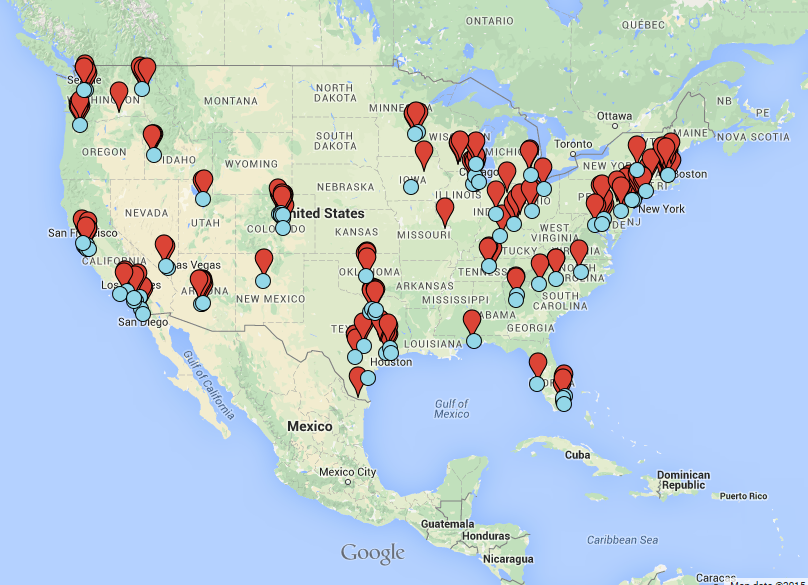
Yuthas’ challenge was to customize reporting and search engine optimization recommendations to each location or website within a brand in unique markets. She wanted each franchise owner to receive custom reports highlighting SEO successes and opportunities at a brand level as well as an individual studio level. She also wanted to give them the ability to improve the SEO on studio microsites and track results.
See Danielle's Share video.
THE SOLUTION
Yuthas took the following approach:
- Create a dashboard for each location
- Create a location-filtered Data Cube report for each location
- Map each location to the local Google search engine in BrightEdge
- Create local Share of Voice reports for each location
- Add keyword tracking progress reports for each location
- Train and enable each franchise representative to use the reports
 THE RESULTS
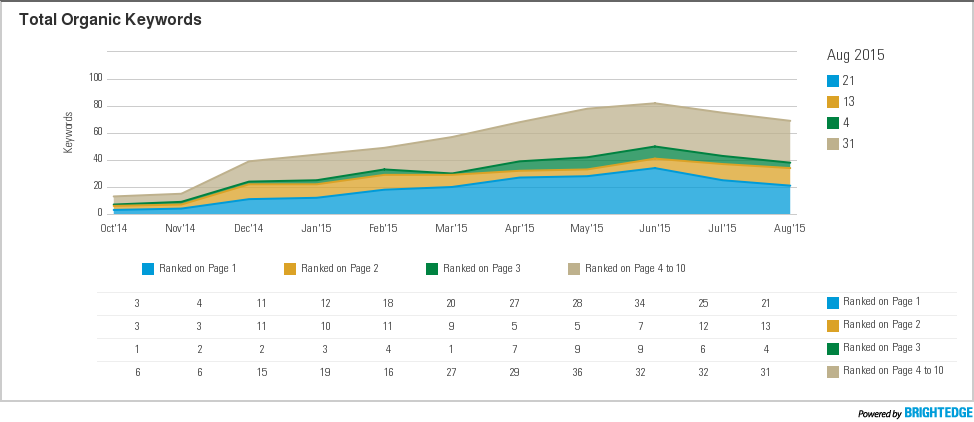
Individual franchises saw dramatic improvement on targeted keywords and started appearing in the first page of the search results. Many locations achieved highly visible Local 3-Pack results for key terms, increased site traffic, store traffic, and revenue.
Educating the franchisees on SEO was a huge challenge. I made training videos on how to use the reports. BrightEdge shows the business value of impacting the Google search results.
WellBiz Brands Case Study
The Network Increases Organic Traffic by 226%
Pia Adolphsen saw a 41,600-visitor increase to the site and a 50,500-visitor increase to the expanded blog

90%
increase in blog traffic
100%
increase on top position keywords
The Network Case Study
The Network Increases Organic Traffic by 226%. 41,600 visitor increase to the site and 50,500 visitor increase to the expanded blog
THE PROBLEM
The Network Inc., now a Navex Global Company, is the leader in providing integrated governance, risk, and compliance (GRC) solutions that help organizations mitigate risk, achieve compliance, and, ultimately, create better, more ethical workplaces. The Network was competing with larger, better-funded providers and needed to be smart and efficient with their content to generate organic search results.
THE SOLUTION
Adolphsen approached the problem with a competitive content assessment to identify new content ideas, content gaps, the best content types, content mix, and what was working best for competitors. She did the content assessment by running a competitor content audit, creating a competitor dashboard in BrightEdge, and, most importantly, performing a keyword audit of competitors. “This is something our fantastic customer success reps at BrightEdge did for us.” Adolphsen said. She recommends selecting 3 content ideas you could add to your content calendar for the coming quarter to get started.
THE RESULTS
The thorough competitor content analysis paid off as Adolphsen, despite her smaller team and more-limited resources, produced a range of high-performing content that achieved higher rank, more than doubling words in positions 1-3 on major search engines. This led to a 41,600-visitor increase to the site and a stunning 50,500-visitor increase to the expanded blog, which contributed substantially to the revenue objectives and business growth. See Pia's Share video.
Are there topics or audiences out there that we are not addressing? Should we be providing more ungated or branded content? We used BrightEdge to answer these questions and we saw a 226% increase in traffic. Our blog had a 90% increase in traffic. Great news all around.
The Network Case Study
Kroll Increases Share of Voice by 285%
Whitney Parker of Kroll used BrightEdge site recommendations to identify specific on-page tactics to address

71%
of traffic comes from page one results
$300,000
in additional revenue earned
THE PROBLEM
Kroll is in the business of asset investigations, intelligence, risk analysis, cyber security, data breach response, and e-discovery. Their campaign objective was to increase lead generation for their asset search service by 50% for the year.
THE SOLUTION
Kroll decided to invest their efforts in the organic search channel. Looking at the BrightEdge dashboards, Parker identified their “striking distance” keywords on Pages 2 and 3. She then looked at how to improve on-page optimization and increase site content and backlinks. The BrightEdge site recommendations capability identified the specific on-page tactics to address. The campaign metrics were Share of Voice, Visitors, Form Fills, Won Cases, and New Revenue.
THE RESULTS

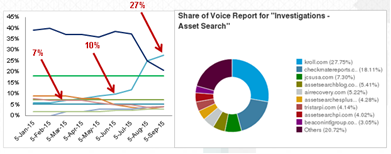
71% of traffic goes to Page 1 of the search results. Getting from Position 2 to Position 1 doubles the traffic we get to our site and that translates into another $300,000 in revenue. That is a powerful message for a CEO.
Kroll Case Study
Container Store Increases Organic Traffic Revenue 96%
Cade Burk captures 30% increase in keywords in 1st rank position and 68% increase in organic traffic conversion

93%
increase in organic traffic
68%
increase in organic traffic conversion
BACKGROUND
The Container Store is the leading specialty retailer of storage and organization products in the United States and the only national retailer devoted solely to the category. The company has strong roots in physical retail and ecommerce is an emerging channel for them.
The Container Store did not have a methodical approach to content marketing and for capturing organic traffic. Prior to hiring a dedicated SEO manager, the website development and marketing groups didn’t focus on organic search. They needed to leverage technology to capitalize on the organic traffic opportunity.
THE SOLUTION
SEO Manager Cade Burk used the BrightEdge platform to create page groups, populate with logical keywords, on-page  recommendations, and identified the best pages to map the keyword topics. In addition, he took an active role in content generation and HTML tagging and used BrightEdge backlink technology to map backlinks and target new sources of links.
THE RESULTS
In just 7 months, the results were dramatic: 30% increase in keywords in 1st rank position (more than 1000 keywords), 93% increase in organic traffic, 68% increase in organic traffic conversion, and 96% increase in organic traffic revenue.
BrightEdge is programmed to help with business SEO efforts at any level, know what kind of content is being searched, and enables us to create better-performing pages.
The Container Store Case Study
Wiley Captures Additional $1,860,000+ Annually
Austin Kane, SEO Strategist of Wiley overcame severe algo penalty, increased traffic by over 6 million page views

90%
growth in SEO traffic
6 million
additional monthly page views
THE PROBLEM
Wiley is a 208-year old content publisher that is addressing a seismic transformation in the industry’s history -- digitization. They have a wealth of content and face the critical need to develop strong online visibility and traffic to their web sites and products. Their challenge is to capture search traffic for both existing and new content while dealing with growing competition and the ever-changing search environment.
SEO Strategist Austin Kane recently faced a search engine algorithm update and penalty that wiped out virtually half of the natural search traffic to one of his websites.
In addition, he needed to prove the value of investment in content marketing and SEO to secure support and resources from management to remedy the penalty and grow organic search as a primary marketing channel.
THE SOLUTION
On Dummies.com, Austin used BrightEdge to identify and isolate the various technical issues that caused the algorithmic penalty. Utilizing the platform, Austin was able to make the development teams aware of the issues by assigning tasks for implementation. On the next crawl and re-index, the team witnessed a full recovery and even higher levels of visibility than in pre-penalty periods.
On EfficientLearning.com, Austin used BrightEdge to analyze competitors, conduct a thorough site audit, optimize existing content, and launch numerous link-building campaigns. The platform helped the team prioritize SEO initiatives, create a strong workflow, and implement tactics according to schedule. This allowed the team to reap the benefits of enhanced visibility prior to their peak season of business.
 THE RESULTS
On Dummies.com they’ve seen growth in organic search visibility and organic search traffic increased by more than 6 million additional page views per month. This resulted in approximately $360k more in programmatic ad revenue when annualized. On EfficientLearning.com SEO traffic grew by 90% and contributed to incremental annualized revenue gains that exceed $1,500,000.
Being able to identify opportunities and track changes and results in BrightEdge have helped us generate big ROI and get stakeholders ‘on-board’ with SEO best practices.
Wiley Case Study
Fathom Leveraged Local Search to Research Ranking Differences
Read Fathom's set of guidelines and local-search best practices for colleges to consider as part of a comprehensive digital marketing strategy

52%
of Non-Branded KWs are Volatile
Local Search for Colleges & Universities: What You Need to Know
1 Introduction
1.1 Experiment Objective
1.2 Experiment Scope
1.3 Experiment Subject
1.4 Experiment Hypotheses
2 Findings
2.1 Branded vs. Non-Branded
2.2 Stability vs. Volatility
2.3 Universal Search
3 Summary
3.1 Experiment Wrap-Up
3.2 Local Search Practical Applications
Introduction:
Experiment Objective:
The Fathom Education SEO team decided to conduct an experiment to leverage local search to understand ranking differences in various markets. Often educational institutions have difficulty understanding search-engine optimization at the national level, due in large part to the competitive nature of the digital education space. Instead of going up against 3-5 competitors, as is common in many industries, educational institutions and their marketers often contend with hundreds of competitors for each program offering. Understanding how rankings fluctuate from local market to local market would provide a clearer sightline into the educational marketing landscape and opportunities for optimization.
Experiment Scope:
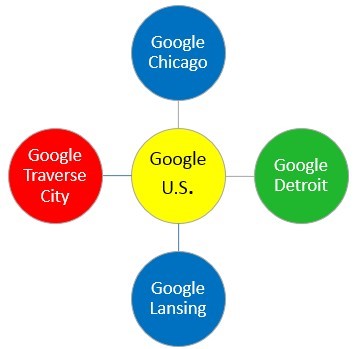
The team identified an ideal client and looked at its tracked keyword set to identify which keywords would be nominated for local-level tracking. Utilizing marketing leading technology from BrightEdge, they identified relevant Google local search engines: Google Chicago, Google Detroit, Google Lansing, and Google Traverse City (fig. 1.0). They then created custom dashboards to track and visualize keyword movement.
With the help of the customer success team at BrightEdge, data collection for this experiment occurred between September 2014 and December 2014. Only keywords which were ranked for each of the tracked weeks were included in the data set; if a keyword went unranked during one of the weeks, it was excluded.
Fig. 1.0 – Google Search Engines
Experiment Subject:
The subject of Fathom Education’s local search ranking research was Central Michigan University, a public institution in Mount Pleasant, Michigan, 150 miles northwest of Detroit. Offering over 200 academic programs, with an undergrad enrollment of 20,000+ students, Central Michigan University is one of the country’s 100 largest universities. It was ranked as the #194 national university by U.S. News & World Report in its most recent college edition.
Experiment Hypotheses:
Certain markets would emerge stronger than others, particularly in the search engines closest to campus. Non-branded terms would have larger ranking variances than branded terms.
Findings:
Branded vs. Non-Branded
The Fathom Education team initially grouped keywords into two segments: One bucket for branded keywords, and the other for non-branded keywords. This segmentation was important to test the hypothesis that branded keywords would be less prone to ranking shifts across the timeline of the project.
Central Michigan University’s branded keywords maintained similar rankings in the local search engines compared to the Google US baseline. On average, branded keywords in the local search engines remained within 1.43 positions of Google US rankings.
Detroit saw the largest positive branded ranking variance from Google US, and Chicago saw the largest negative variance (figure 1.01).
Figure 1.01 - Branded keyword ranking variance from Google US baseline

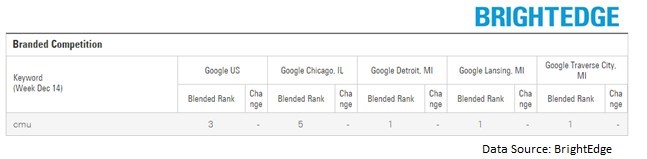
The most consistently variable branded keyword was the acronym CMU, where lower rankings were observed in local search engines due to competition from Carnegie Mellon University (https://www.cmu.edu/index.shtml) (fig. 1.02).
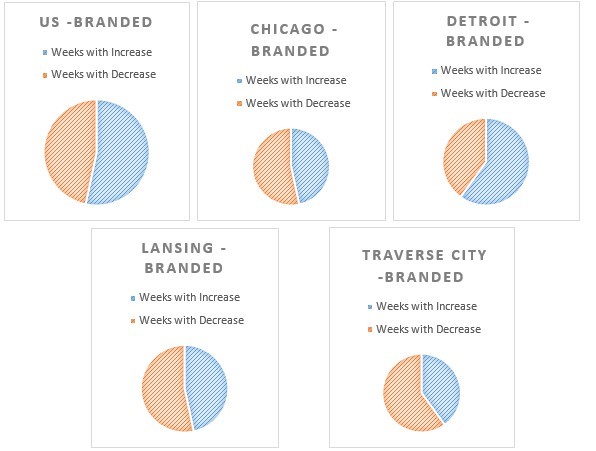
When examining branded keywords in each search engine across the timeline of data collection, Detroit saw the most weeks with ranking increases, while Traverse City had the most weeks with ranking decreases (fig. 1.03).
Figure 1.03 – Branded performance by week
Much larger ranking variances were noted in the local search engines from the non-branded keyword segment. On average, non-branded keywords experienced an 11.06 position ranking difference from their Google US ranking baseline.
The Lansing search engine had the largest positive non-branded ranking variance from Google US, whereas Chicago had the largest negative ranking variance (figure 1.04).

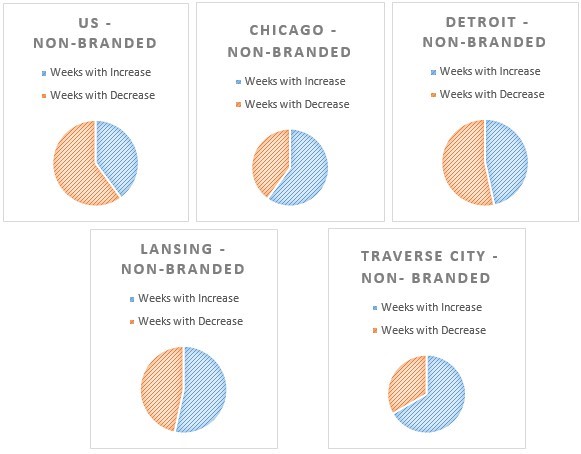
When compared to initial non-branded keyword rankings, Traverse City experienced the most weeks with ranking increases, and Google US experienced the most weeks with ranking decreases across the research timeline. (fig. 1.05).
Figure 1.05 – Non-branded performance by week
Stability vs. Volatility
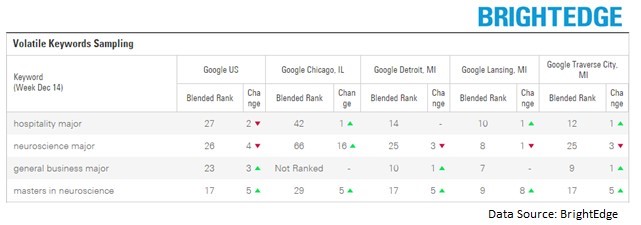
As the experiment continued, the team noticed ranking trends and created two additional keyword segments: stability and volatility. The stability segment was made up of branded and non-branded keywords with very little ranking variances; these words were predominately situated on the same search results page across the 5 tracked engines. The volatility segment was populated with non- branded keywords that had varied page rankings in the different search engines, or significant swings in rankings week over week (fig. 1.06).
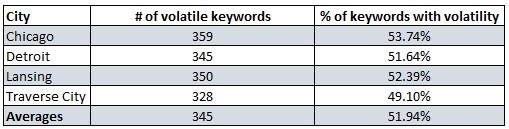
Tracking these two segments was important in calculating what percentage of our focus keywords were “volatile.” In total, the following non-branded keyword volatility percentages were exhibited throughout the course of the experiment: Chicago – 53.74%, Detroit – 51.64%, Lansing – 52.39%, Traverse City – 49.10%. On average, 51.94% of tracked non-branded keywords were volatile (fig. 1.07).
Figure 1.07 – Volatile keyword percentages
Universal Search:
In addition to fluctuations in traditional search results, the team also recognized variations in universal search results. At times Central Michigan University had universal listings ranking in the first position in the local engines, then dropped into lower positions in subsequent weeks. This back-and-forth demonstrated shifts in Google’s algorithm and highlighted how search results can be affected (fig. 1.08, fig. 1.09).
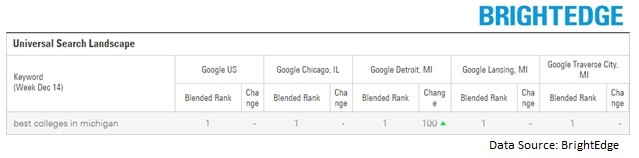
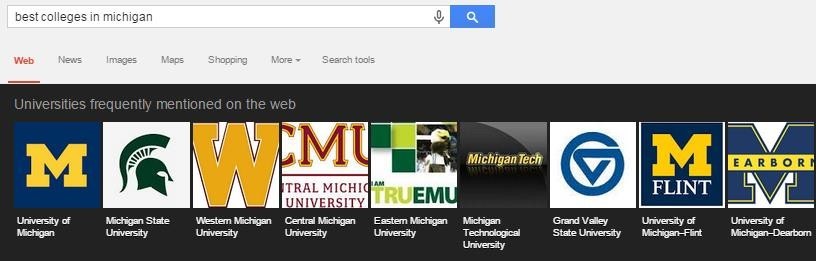
(Central Michigan University gained 100 ranking positions in the Detroit search engine week-over-week with a “carousel” listing in the universal search results.)
Fig. 1.09 – Universal Search Carousel Listing
Summary
Experiment Wrap-Up:
Examining the data and findings, Fathom Education was able to confirm its hypotheses. In fact, non- branded keywords did display a higher risk of volatility than branded keywords, and the search engines closest to the physical campus typically resulted in higher rankings for these keywords than the Google U.S. results.
Expanding on these insights, Fathom developed a set of guidelines and local-search best practices for colleges to consider as part of a comprehensive digital marketing strategy.
Local Search Practical Application:
We recommend reviewing and implementing the following to improve your own institution’s local search presence
1. The first thing you’ll need in order to have a successful local search strategy is localized rank tracking. Without knowing your baseline ownership of the local search results, gauging improvements will be hard. We recommend BrightEdge for ease of functionality and the most in-depth reporting.
a. If you’re trying to settle on which keywords you need to invest in for local rank tracking, start by looking at your branded keywords. If your college has a strong brand presence and generally sees little branded competition, leaving branded tracking at the national level is probably ok.
b. Looking at Fathom Education findings for Central Michigan University, just over 50% of the tracked non-branded keywords were considered “volatile,” and displayed larger variances between the national and local engines. Knowing that, consider nominating 50% of your non-branded keywords as critically important to success, and start tracking them geographically.
c. Start near home. Recent ACT data suggest that the average student will travel less than 50 miles to attend college, with 78% of students remaining in-state for their education. Therefore, honing in on local search engines will help keep focus on the most potentially valuable sources of new students.
2. Next, you’ll want to define pertinent goals for local search. All local engines will not necessarily perform the same, and seeing wins across the board will be doubtful. So, setting realistic benchmarks is important to help you celebrate each individual feat. Whether an increase in traffic to a new program page, a boost in applications for the fall session, or more social shares for a premium video, knowing what you want to accomplish will help provide a clearer picture of your success.
a. Once those determinations have been made, set up goals and/or event tracking in Google Analytics and utilize annotations to mark important changes and achievements.
3. Cover your on-site foundation. Ensuring the following basic pieces are in place will give you the best chances of seeing success in the local engines:
a. Utilize geographic modifiers in the title tags of relevant pages. Including your city or state in your title tag will signal local relevance to both the search engines and the searchers. Doing the same in your meta descriptions will help click through rate on your organic listings.
b. Optimize your college’s ‘location’ pages. Beyond the title tag and meta description, include the following information on your location pages: schema location mark-up, embedded Google Maps, zip codes, distances from other regional cities, detailed directions, and local landmarks. All of these will provide semantic location details to the search engines and help increase your chances of achieving first-page rankings.
c. Utilize all your available content. Images, videos, and PDFs should be treated the same as other on-site content. Optimize them accordingly with alt attributes and meta- descriptions.
4. Be mindful of universal search. Beyond images and videos, think of the other types of results that are appearing in the search engines: Specifically for colleges, "carousel" and "places" listings. Optimize your Google Places presence by creating a page for each satellite or regional campus. Additionally, consider marking your upcoming events with schema code so the search engines will pull them directly into the results pages.
5. Understand your existing rankings and tailor content towards the locations where your institution is struggling the most. Consider developing a landing page or microsite where you can house localized content to help address the issue. Taking advantage of offsite advertising such as radio spots or billboards in areas of concern could also drive traffic to a website and increase engagement.
6. Build credibility with local institutions. Is your city known for its hospitals? Or maybe its theater district? Form relationships with these organizations to signal strength in the eyes of the local search engines. Earning a relevant link from credible sources to your program pages or promotional content will result in more traffic to your site, as well as boosted ranking potential.
7. Let paid search be your friend. While paid search does not represent the answer to organic local search needs, creating a unified approach to digital marketing can assist in achieving goals.
a. Support struggling organic rankings with increased bids in paid search campaigns. While waiting for the effects of SEO, searchers in your underperforming locations will be able to see your content in the top slots of the results pages.
b. By contrast, current leaders in organic search who consider increased domination of the search results page with enhanced paid bids could help combat pressure from both existing and up-and-coming competitors.
8. Build awareness outside your core market. As we saw throughout the analysis, there’s a greater likelihood of variability in rank position in local markets outside of that which the university is actually located. Search engines take into account the importance of content to users in a specific locale – therefore localized citations (i.e. brand mentions and links) originating from sites with a footprint associated closely to a location can influence your rankings across markets.
a. For example, consider that CMU saw a higher negative variation in rank in the Chicago market vs. Google US. In order to increase relevance for the targeted terms in the localized Chicago search results, we might suggest utilizing existing partnerships or marketing initiatives to gain additional citations in that market. One such practical example might be to launch additional press around a booth at a college fair in Illinois. Or, if CMU is partnering with a hospital in the Chicago area on cutting-edge medical research you can take that as an opportunity to generate powerful localized citations.
*During the duration of this project, some, but not all pages of the subject site were edited. The Fathom team tracked a variety of non- optimized keywords to limit the effects of site modifications on the experiment. Looking at the trend of the results instead of one metric or data set provides a clearer perspective on the landscape.
Fathom Case Study
Rackspace Increases Organic, Non-Branded KW Traffic 212%
Rackspace realizes gains through on-site changes and launching an earned media campaign

1100%
increase in keyword position
212%
increase in site traffic
THE PROBLEM
Rackspace’s SEO campaign has been active since 2011 and is driving a significant percentage of visitors to the company’s website. Rackspace’s overall goal is to increase revenue through lead generation and customer education. It can attain that goal by constantly improving search rankings on a large scale and continually increasing organic traffic to its website. Despite having hundreds of thousands of clients and an international reach, Rackspace still faces formidable competitors like Amazon Web Services (AWS), GoDaddy, Terremark, SOFTLAYER and Microsoft. These real-world competitors often translate to online competitors and can outrank Rackspace in the sheer volume of specific and targeted keywords. These heavy-hitters also can earn a greater share of voice for several targeted keywords. Using competitive analysis, Rackspace revealed a content gap with its largest competitor. The on-site content gaps are most acute with white papers, guides, videos, catalogs and FAQs.
THE SOLUTION
Increasing on-site production and launching an earned media campaign are necessary for Rackspace to realize movement on its chosen keywords. The earned media campaign leverages both syndicated and non-syndicated methods to place content across a wide variety of relevant online domains. Through targeted and persistent outreach, the PR team earns the placement of feature articles on blogs and other digital media outlets. This earned media is always relevant to the website’s content as well as its readership. The article usually features a link to Rackspace’s site and may include a brand mention. Other types of earned media can potentially include static or interactive infographics, social media mentions and shares, as well as traditional digital PR. PR specialists stay up to date on industry news in order to produce the most relevant content for both Rackspace and the audience of the site it is placed on. Specialists maintain regular correspondence with niche influencers in addition to identifying new opportunities; personalized outreach is done primarily through email and social networks. BrightEdge is used to help track the relationships established. It serves as an indicator that highlights specific sites where industry-specific audiences gather. Using BrightEdge, Rackspace is able to track more than 1,000 targeted keywords and determine share of voice for each keyword, receive recommendations for landing pages, and identify link-building opportunities.

THE RESULTS
Rackspace is an organization that already had a known brand, vast reach, and clientele, so moving keyword rankings to top 6 takes the right resources and expertise. Rackspace’s SEO and content campaign aims to rank for a wide range of keywords. Rackspace increased rank for 6 non-branded keywords an average of 61 positions, moved all onto the first page to average position 5.6, and increased traffic to their site by 212%.
We’re shifting from being very keyword-centric to focusing more holistically around the user experience and how the user interacts.
Request a demo of the BrightEdge platform today!
Rackspace Case Study
Rosetta Utilizes BrightEdge Data Cube to Mine Big Data
Data Cube revealed how large an opportunity can be with rich media based on competitive insights and SERP landscape

60 seconds
to find new opportunities in Data Cube
THE PROBLEM
Mining data can be nebulous, overwhelming, confusing, and geared toward paid media. It can also be difficult to figure out where to start. Once you pick a place to start, mining for scale can be difficult among the team. Internally, SEO teams need to figure out a way to find a balance between the right tools and the right training to drive scalability.
THE SOLUTION
Matt Saunders, Director, SEO Strategist at Rosetta agency, faced this issue with his global team. He decided to leverage BrightEdge’s Data Cube to mine big data for all facets of content marketing research, including blog content, rich media, and local search. His first step was finding colleagues across the teams to determine who could benefit from the platform and who would be a good advocate for it. Creating that core group of people, training them daily, and getting them all BrightEdge certified allowed valuable knowledge transfer to all of the other SEOs in the company instead of Saunders being the single point of contact for mining big data.
THE RESULTS
Matt successfully got several members of his team ramped up to scale data mining and found multiple ways to gain valuable insights each within 60 seconds. Using BrightEdge’s Share of Voice report, the team was able to find content expansion ideas by taking competitor URLs, putting them in Data Cube, and finding new keyword and page opportunities, which resulted in 6 new target keyword representing 37k monthly searches. Aligning rich media with the SERP landscape, Data Cube revealed how large an opportunity can be with rich media based on competitive insights and SERP landscape. For Local SEO optimization knowing which queries trigger local listings is half the battle. Saunders quickly saw in the data that local points of interest were a substantial untapped opportunity. The Google SERP carousel has ramped up the urgency for local optimization as prominent competitors become more visible across a substantial number of carousel results. Putting  competitor names into Data Cube yields keywords that trigger local listings which in turn can substantially increase your local footprint.
That’s really what Data Cube is built on... Doing all of this complex gathering of information and making it super easy for you to get actionable insights out of it.