Google Local Best Practices and How-Tos

ssharma@brightedge.com
M Posted 10 years 4 months ago
t 9 min read

You've undoubtedly heard it before: if your business has a physical location, you need local SEO. This is especially true if you've found that most of your business comes from local customers or clients. You might even be already well-versed in the elements needed to actively compete in the Google local game, but there are a few things you need to make sure you aren't overlooking. Read on for three things you need to be utilizing to get the most out of your Google local SEO.

1. Google Local SEO On-site
better understand Google Local Listings for your business - brightedge

Make sure that your site is set up for Google local SEO. This means that you need to be using the city/state in the title tag, H1 tag, URL, content, image alt tags and meta descriptions. An optimal landing page will include the company's name, address and phone number, or NAP. The NAP on your landing page needs to match the NAP on the Google+ Local listing. Consider using a local phone number as opposed to an 800 number or call tracking; local customers like to see a local number. It's a good idea to also include things like a Google map and a photograph of the building on the landing page.

2. Google Local and Citations

Add structured citations to directories like Yelp, Urbanspoon, Zagat, etc. A structured citation looks like the following: Hash House A Go Go 6800 West Sahara Ave Las Vegas, NV 89146 (702) 804-4646 An unstructured citation is usually found on blogs, written by customers or clients of the business. It most likely consists of a few sentences in which the author mentions specific information about the business. Look at this example:

While in Las Vegas last weekend, we went to eat at the Hash House A Go Go. They've got the best chicken and waffles on this side of the country! Give them a call at 702-804-4646 to see what specials they have and to check on how busy they are—this place is pretty popular.

You should be aware that citations exist whether you put them there or not. Whenever someone talks about your business, mentioning the name, address and phone number (NAP), a citation is created. Directories work to make a citation of every business, and Google will index these citations. For that reason, work hard to make the citations consistent. Inconsistencies in name, address or phone number, however small they may be, will hurt your rankings. When changing your company's phone number, switching and cleaning up citations should be your #1 priority. A great way to do this is to check citations by phone number in Whitespark, bit.ly/citationfinder.

3. Google Local and Google+

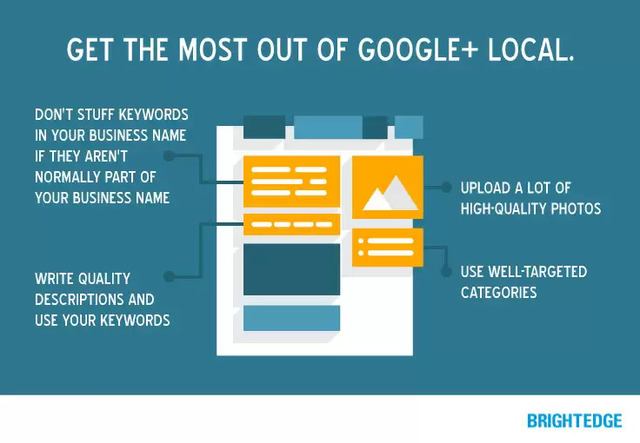
Make good use of Google+ Local. There a few things you'll want to be doing here to make the most of the service:

  • Write quality descriptions and use your keywords.
  • Upload a lot of high-quality photos.
  • Don't stuff keywords in your business name if they aren't normally part of your business name.
  • Use well-targeted categories.

To see a star rating (out of five stars), your company has to have at least five reviews. Fewer than five reviews and you won't see any stars. It's a good idea to focus on getting approximately ten reviews on Google Reviews. After that, target places like Yelp and Urbanspoon. Keep in mind that it takes time to receive reviews. If you're getting one or two reviews a month, you're right up there. Don't use Google+ Local to do fake reviews. It's easy to spot these and they will only hurt your rankings. A review is probably fake if it has the below:

  1. There were a number of other reviews left the same day with the same amount of stars (usually 5)
  2. There are duplicate reviews showing up
  3. Certain reviewers left multiple reviews
  4. An obvious keyword shows up once or twice in a review

Keep in mind that the Google Carousel is in play in some sectors; businesses are shown at the top of the SERP with a photo, stars, number of reviews, and price. Watch for how Google displays your photo, because a good photo will attract customers and clients. Creating Google local listings and keeping up on those local listings is a challenge, and with search results tending to favor local result packs more, it's critical to have a local SEO management system to manage these listings. BrightEdge provides in-depth city by city local SEO analysis along with your competitors' city by city local SEO data. Data is the key to smart decision making when it comes to SEO, especially Google local SEO. With BrightEdge's local SEO management system, there's never any guessing on how to do Google Local right. All the data is in one place.  

Mobile and Local: Insights for a Multi-Device

Matt Saunders
Matt Saunders
M Posted 11 years 1 month ago
t 9 min read

Did You Know… That the BrightEdge platform offers more ways to track visibility than any other competing software on the market? BrightEdge is committed to providing you the insights you need across mobile devices and local markets in both a daily and weekly cadence. Daily Rankings for local and mobile - brightedge

Daily Rankings: If you’ve ever optimized for highly-competitive heads terms that show wild variability in rank, then you’re familiar with the “Google Dance.” BrightEdge can help you to track performance of volatile keywords and help you understand how you’re performing every day of the week. Not using daily rankings today? Start with a small sub-set of your most important keywords (or those you’ve identified as unstable) and begin tracking performance at a more granular level.

Mobile Rankings: The “year of mobile” is so 2014… or was it 2013. Any way you slice it, mobile search is here in a big way! Do you know how your client’s site visibility differs on tablet and smartphone devices? A 2014 study from BrightEdge determined that mobile rankings differ from that of its desktop roughly 62% of the time. Not tracking rankings on smartphone and tablet devices? Select a sub-set of head, mid- and long-tail keywords and compare variance by device then devise a plan for improving mobile site experience per Google’s best practices.

Local US & International Rankings: Google is personalizing results today more than ever before. It’s not only what you search for but where you search from that influences search results. Whether your client has brick-and-mortar locations or is online-only, localization will have an impact on visibility. BrightEdge can track rankings across hundreds of US cities. Have an international client? We do international too. Ask us about our capabilities in tracking your client’s performance worldwide.

The Best Local SEO Techniques

Mark Mitchell
Mark Mitchell
M Posted 11 years 6 months ago
t 9 min read

Local SEO has undergone a number of changes over the past few years, led by both Google and the overall trend towards mobile search. Among the more notable of local SEO changes initiated by Google is its introduction of Google Places (now called “Google My Business”) and its local “Carousel” - and most recently, its update (“Pigeon”) to the local search algorithm. As a search trend in general, mobile has rushed to the forefront, carrying with it significant implications for local SEO.

First, a brief history: Google Places was first introduced with Google Plus (Google+) in 2011, becoming Google+ Local about a year later, which made it essential for businesses to create Google+ pages and profiles to which to tie their sites’ URLs directly.

The most recent name change to “Google My Business” came in June. Google My Business also integrates Google Maps and the Google+ platform (including G+ reviews) within its local search results. Then came Google’s interactive “Carousel,” unveiled for desktop in June 2013, which proved to be a game-changer with local search listings represented side-by-side at the top of its traditional top-down results, and incorporating details such as review-based scores as well as the physical addresses and photos of local businesses.

Most recently, Google’s update to its local search algorithm in July (dubbed “Pigeon” by Search Engine Land in the absence of a formal name by Google) has meant a shifting local SEO landscape that BrightEdge CEO Jim Yu recently discussed at Search Engine Watch.

The local-mobile connection

Alluding to its “Zero Moment of Truth” (ZMOT) directive, Google states on its “My Business” page (referenced above): “Give customers the right info at the right time, whether that be driving directions to your business in maps, hours of operations in search or a phone number they can click to call you on mobile phones.” Google elaborates on the local-mobile connection with its November 2013 “Mobile Path to Purchase” study, in conjunction with Nielsen. The report reveals key findings:

Consumers are spending time researching on their smartphones (15+ hours a week), their research starts with a search engine (vs. a mobile site or app), proximity is important (69% expect businesses to be within five miles of their location), immediacy is key (more than half want to purchase within the hour) and mobile influences their purchase decisions (93% go on to buy).

Jim Yu has also discussed the boom in mobile search extensively within the past few months. Citing data from the BrightEdge 2014 Mobile Share Report, he wrote for his Huffington Post column in July:

Mobile is commanding more of the organic search market today than ever before. Smartphones account for 23 percent, and combined with tablets' 12 percent share, mobile now equates to fully a third of today's organic search traffic. And in the coming year, smartphone share is poised to balloon by at least another 50 percent.

Now let’s explore some tips to help you optimize for the best local SEO techniques, and ways BrightEdge’s Local SEO Management tool can help.

Best local SEO techniques

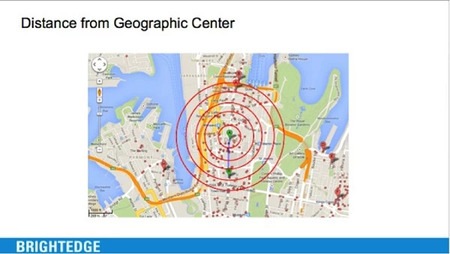
1. Distance from geographic center: having a physical address for your locale matters!

discover the best local seo techniques - brightedge

2. Consistency in your business name, address and phone number (N.A.P.) across your website’s local URL and Google My Business pages, as well as within local directory listings, is essential. 3. Prominence of your business page: To calculate the local prominence of business, Google looks to local “citations,” or Web pages mentioning your business. It gauges the quality of these citations as well as the quantity. Generating user reviews on your “Google My Business” page and other sites (such as Yelp) improves your business’s credibility and in turn, its prominence.

Google My Business optimization

Optimize your Google My Business by considering the following steps:

  • Name: Business name
  • Categories: Carefully choose the five most important categories based on important keywords
  • Description: Contains the business name and keywords
  • Additional details: Keywords for products and services, as well as local information
  • Business related photos and videos
  • Reviews
  • Manual verification

On-site optimization for local

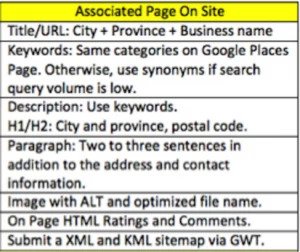
You should also perform on-page optimization for any local-focused pages on your site. Check out the following table for tips on how to optimize those Web pages:

learn the best local seo techniques for your website - brightedge

Don’t forget about Schema.org markup as well in order to help boost the search engine’s understanding of the content on the page. For contact pages, you can communicate things like address, phone number, hours of operation and so on. Check out the LocalBusiness markup here.

How BrightEdge can support local SEO

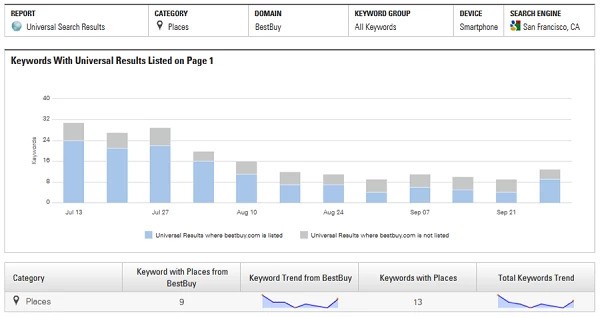
Details on optimizing your local Web page and its corresponding page in Google My Business, as well as local competitive analysis resources, are available through BrightEdge’s Local SEO Management. For instance, with Google My Business, you’d be able to generate reports like this using BrightEdge tools. learn what the best local seo techniques are - brightedge

Using BestBuy.com in San Francisco, as an example, this report shows Universal Search result listings for all keywords in Google My Business accessed via a Google search on a mobile phone. Digging deeper, the report can break results down by image, video, shopping, Places and Carousel results. This helps you to not only understand which keywords you currently have visibility on in Universal Search results, but also identifies opportunities - for example, how many of your keywords show any Universal Search results that your site is not showing up for at present.

All of the information available through the BrightEdge SEO platform can be tracked easily by creating a dashboard. Among the valuable insights you can glean is identifying high-priority keywords within Google My Business where your business is not ranking. While there is a host of local ranking factors, and what we’ve discussed today still only scratches the surface, optimizing the basics is the very first step in any long-term local SEO strategy.  

,