Long-Tail Keywords: A Comprehensive Guide

monique.johnson
monique.johnson
M Posted 4 years 3 months ago
t 9 min read

Updated: February 2022

Long-tail keywords account for over 90% of search queries. 

Accessing that traffic pool can be incredibly profitable. The good news is that identifying, targeting and ranking for long-tail keywords is a straightforward and cost-effective process. 

In this post, we’ll clear up some common misconceptions about long-tail keywords, cover the benefits of having a dedicated long-tail strategy, and describe how to conduct thorough, extensive keyword research. 

Where Does the Idea of the “Long Tail” Come From?

The concept of the “long tail” has been instrumental in shaping how organizations understand markets. Chris Anderson popularized the concept  in his 2004 book The Long Tail: Why the Future of Business is Selling Less of More but statisticians have been studying it in various forms since at least the 1950s. 

In his now-famous article on Wired and his subsequent book, Chris Anderson argued that there is more profit to be made by selling lots of different products, each with low demand and few competitors, than by attempting to create one big hit that relies on leveraging unified demand in a crowded space. The advent of democratized marketplaces with low barriers to entry - just like the good ol’ internet - has made this approach possible.

Applied to search engine optimization, the idea is simple: target lots of low-volume, low-competition keywords instead of wastefully expending resources on highly competitive, high-volume counterparts. 

Now, while that strategy looks uncomplicated on paper, it’s a little more multifaceted in practice. So let’s dig into the specifics. 

What Are Long-Tail Keywords? 

There is no shortage of definitions of the term “long-tail keyword” on the web. But despite its importance and uniqueness, search engine experts still get things wrong when describing the concept. 

Long-tail keywords are search queries that have relatively low search volumes compared to high-volume “head keywords.” You can understand this idea in terms of specific, thematically related groups of keywords, say around the topic of “home improvement,” or as applied to the totality of Google search queries over a given time (or any other search engine).
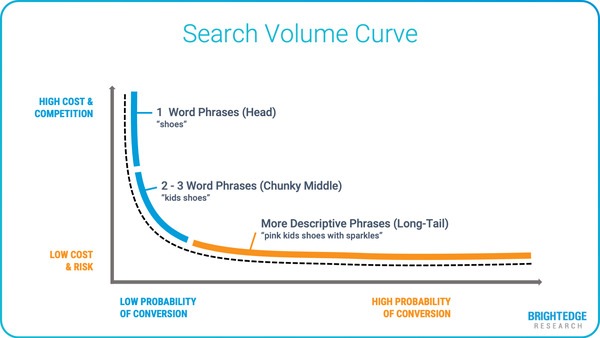
Low-volume queries sit on the “tail” of a curve of a graph that maps search volumes on the y-axis against keywords on the x-axis. If you could see the whole graph, the long-tail would stretch for miles. 

High-volume keywords comprise what is called the “head.” Middle-volume keywords are sometimes said to constitute the “thorax” or “chunky middle.” 

Misconceptions About Long-Tail Keywords

To say that long-tail keywords are phrases of multiple words with search volumes of ten or less isn’t entirely accurate, although this is often the case. There are many single-word long-tail keywords. What’s more, the term “low” has to be understood relatively for the concept of the long tail to make sense.

Another common mistake people make is to define long-tail keywords as always being highly specific. While this is usually true, there are exceptions. For example, the low-volume keyword “bog snorkeling” (yep, it’s a recognized sport) is just as semantically general as “golf.”

The key takeaway here is that long-tail keywords should be understood primarily in terms of volume (or number of monthly search volume). Applying other attributes just serves to needlessly muddy the waters and is usually unhelpful from a marketing perspective. 

Why Are Long-Tail Keywords Important?

Long-tail keywords are important because they are effective at driving traffic. A well-executed long-tail keyword strategy can result in significant amounts of new visitors and high value leads.

Here’s a quick rundown of the main reasons that long-tail keywords are worth your attention: 

1. Long-Tail Keywords Have Low Competition

Long-tail keywords tend to be less competitive from a search perspective than high-volume keywords. As such, they are easier to rank for. 

This is due to a mix of reasons. First, many companies focus exclusively on high-volume terms, leaving long-tail keywords wide open. Moreover, the sheer number of long-tail keywords means that competitor activity is more widely distributed. 

2. Long-Tail Keywords Are Easy to Target From a Practical Perspective

Creating content for long-tail keywords is a relatively straightforward process. Specific terms typically only require short and precise explanations. For example, a query like “radiators” easily lends itself to an article of thousands of words of content, with numerous sub-sections. A term like “where to buy cheap radiators in Honolulu,” on the other hand, can be targeted with a comparatively brief piece of text. 

It’s also possible to target numerous long-tail keywords within a single webpage or piece of content. Using long-tail keywords to structure content will enable your website to rank for terms that might otherwise have been missed. Additionally, there is little cost required to  optimize longer-form content for long-tail traffic. 

3. Long-Tail Keywords Have High Conversion Rates

Consider the difference between the keywords “water bottle” and “two-liter blue water bottle with a folding cap.” The second one carries a highly specific intent. As a result, the searcher responsible for tabbing it into Google is more likely to follow up by purchasing a product related to the keyword.

Because long-tail keywords are usually very precise, companies can tailor highly-targeted offers and opt-in incentives to capture site visitors. 

4. The Pool of Long-Tail Keywords Is Large

There are billions of long-tail keywords. You can’t see it on a typical graph because it has to be truncated for practical reasons, but the long tail goes on for miles. If you’re in a well-known industry, it will be practically impossible to run ou

t of keywords. And even niche organizations will have their work cut out for them in attempting to capture even a portion of all available long-tail traffic. 

How to Find and Use Long Tail Keywords: A 5-Step Guide 

Here are five general steps that can help form the basis of your long-tail keyword strategy: 

1. Create Buyer Personas and Identify Broad Keyword Topics

Before you dig deeper and pinpoint specific terms, you need to identify the broad topics you will be researching. This definition will normally be in terms of generic keywords. Having clearly-defined parameters will enable you to stay on track during the later stages of this process. 

In particular, you should ask two questions:

  • Who is your target audience?
  • What topics are they interested in?

Keep in mind that your answers will likely be different depending on which part of the customer journey you’re considering. Profiles for first-time searchers will be different to those of returning visitors, and your long-tail keyword targeting should account for this. 

2. Use a Keyword Research Tool Like Data Cube

Once you’ve identified “tier one” terms, enter them into a research solution like BrightEdge’s Data Cube. Data Cube has dedicated functionality for discovering long-tail keywords. You can use it to sort potential target queries by volume, competition, potential value, and more. 

While it’s not unusual for SEOs to use ancillary tools and apps, particularly those that specialize in semantic keyword and long-tail query generation, it is good practice to leverage one high-quality solution as the basis for finding and organizing long-tail keywords. In this way, your workflow will have a central, easily accessible hub. 

3. Evaluate Competitors

Competitor tracking is another effective way of identifying profitable long-tail keywords. The Share of Voice functionality within the BrightEdge platform allows you to uncover long-tail terms for which other sites are ranking.

Many of your competitors’ search results will not be the outcome of actively targeting a particular long-tail keyword. Often, existing content will be ranking “accidentally.” This presents you with an opportunity to create content of a greater quality and achieve better results.  

4. Collect Questions From Community Spaces

Analyzing user-generated content on sites like Reddit, Quora, Facebook, Amazon and topical forums can give you a range of insights into the ways potential customers are talking about their interests and problems. 

Trawling through forums and discussion boards is a time-consuming process, and you will still need to run gathered terms through your software. That said, you can find lots of hidden gems this way and, depending on their value to your company, it may be worthwhile as a long-term approach. 

5. Organize and Rank Long-Tail Keywords

Once you’ve collected a set of “raw” keywords that show promise, you should organize them into a coherent structure that can act as a guide for creating content. Metrics to consider when undertaking this process include value, relevancy, competition and, of course, volume. 

You should also account for the following semantic distinctions:

  • Synonyms - The terms “how to get over the January blues,” “feeling down in January,” and “tips for beating January blues” are synonymous. They all mean the same thing. Google is smart enough to recognize this. Rather than creating individual pages for each one, you should target synonyms in the same piece of content. 
  • Primary terms - These terms will act as the main subjects of individual pieces of content. Some primary terms, like “how to dye curly hair naturally” or “how to revive a dying spider plant,” will be obvious in the sense that they cover quite a lot of ground. Others may look like secondary terms but actually warrant their own page. “How to dye curly hair naturally for women” could be added as a subtopic to an article about dying hair, for example, but will probably be targeted more effectively individually. 
  • Secondary terms - Secondary terms should constitute part of a larger piece of content. One of the best ways to decide whether or not to designate a term as a primary or secondary keyword is by checking existing results and seeing whether Google is ranking dedicated pages or ones covering a broader topic. 

Organizing keywords semantically and topically isn’t an exact science. The decision of whether to create a new piece of content or update an existing one will often come down to personal judgment. 

Conclusion: What’s Next?

So you’ve done your research and built a jam-packed list of long-tail keywords. What’s next? 

Well, it’s time to start creating content. A long-tail strategy is an invaluable business asset. But it’s nothing without a well-developed content plan. 

SEOs that can target high-value, low-competition keywords can guarantee a steady stream of website visitors and leads. Dedicating time and resources to ongoing research will pay dividends well into the future. 



Web Log Analysis is Essential to a High-Performing Website

tvura
tvura
M Posted 4 years 8 months ago
t 9 min read

Any web page, from a search engine optimization (SEO) perspective, has two distinct audiences, one real and one virtual. For the real audiences – the people who visit your pages, consume your content and transact on the site – surface-level content is king. What you say, how you say it and how you present it visually is the focus for real visitors. The virtual audiences – search engine spiders or search bots – help bring people to your site by mapping and understanding your content. To do that well, they rely largely on the technical structure, links and other components of your pages and overall website. Technical errors or deficiencies limit their ability to properly locate and understand your content. 

Your web logs capture every interaction with your pages, and within them are potentially thousands of useful signals that can be used to identify and resolve issues. However, the scale and complexity of log files can make them difficult to parse without some level of automation. That’s where a web analyzer, also known as a log file analyzer or log parser comes in.  

What is a log file analyzer? 

In your log files there is valuable information from every time a search bot visits your site. A log file analyzer pulls out information from your log files about visits from search bots, so that you can identify issues with the site that could be hurting your position in search results, or, alternatively, so you can identify opportunities for content creation and optimization. It saves the work of either manually reviewing what could be millions of lines from your log files or custom coding an app to do it for you. 

What can a log file analyzer tell me?   

Like an automotive code reader or a specialized blood test, log file analyzers help you quickly uncover underlying issues that may not be otherwise readily apparent.  By identifying issues, a log file analyzer equips you or your technical SEO team to prioritize and address the problems for better search optimization. 

A log file analyzer can help: 

  • IDENTIFY WEBSITE ERRORS AND ISSUES 

A log analyzer can pull out the response codes the search bot is receiving for the pages and sections of your site. By pinpointing missing pages, broken links or pages with unintended permission issues, a website developer or dev team can efficiently target fixes to implement in the next round of site updates. 
 
Additionally, a log analyzer will identify file types and assess bandwidth usage. Are search engine spiders encountering mostly html files? Images and videos? PDFs and other documents? Most importantly, are any of those files larger than necessary? Oversize files detract from or hurt the user experience, consume too much crawl budget and result in lower rankings.  

  • UNDERSTAND AND OPTIMIZE CRAWL BUDGET 

SEO is largely about managing and improving the visibility of your content, and log analyzers help fine-tune that process. Especially on sites with lots of pages, search engines will visit only a portion of your content on any given day. By knowing which pages the search bots visit, it becomes possible to direct the crawlers toward more important content and away from less important content. For example, when launching new content, you can focus your crawl budget on the new content to more quickly expose it to the search engines.  

  • PREPARE FOR SITE UPDATES AND SITE MIGRATIONS 

When content on your site moves, you risk losing traffic from search engines unless it is properly redirected to the new destination using permanent 301 redirects. During a full site migration, Google estimates that a website will see a 5-20% decrease in organic traffic. Log analyzers can help prepare for migrations by identifying what content needs to be redirected, and what redirects need to be maintained. 

Use a Log Analyzer to Gain a Peek Behind the Curtain of SEO 

Log analysis for SEO is essential to maximizing the visibility and effectiveness of your content. That starts with knowing what the search engines see when they crawl your site. Which content is the search bot prioritizing? Is the search engine encountering any issues finding certain content or navigating from one page to another? Which search engines are consuming your bandwidth and how much of it are they consuming?  

A log file analyzer gives you visibility into search spider activity, so you can better direct search engines to the content that matters in your SEO strategy.    

BrightEdge Log Analyzer 

BrightEdge Log Analyzer pulls together data from your website logs and combines it with BrightEdge SEO data to provide actionable insights, fully integrated within the wider BrightEdge platform. This integration amplifies the value of log analysis by simplifying workflows for identifying and addressing site errors, and making it possible to pinpoint and leverage your best opportunities for improved rankings. By matching crawl activity in your logs to ranking data in BrightEdge Data Cube, you can quickly fine tune your striking distance opportunities and improve your rankings in the search engines.    

Contact us for more information or schedule a demo today. 


SEO Rank Checkers: Know Where You Stand in the SERPs

tvura
tvura
M Posted 4 years 9 months ago
t 9 min read

A central truth of search engine optimization (SEO) is that not all optimization opportunities are created equal. Additionally, because there are usually more keywords relevant to your brand than time to optimize for them, it’s important to identify and prioritize the keywords that have the most potential to drive motivated people to your website. This starts by knowing where your website stands in the search rankings for target keywords. 

By performing SEO rank checking, you can gather valuable insights, like: 

SERP POSITION

Where do your target keywords rank in search overall, and which of your keywords rank highest in the SERPs (search engine results pages)? By knowing this, you can better define a strategy to win higher rankings for essential keywords, and at the same time, protect the position of valuable, high-ranking keywords. 

COMPETITIVE LANDSCAPE

Which pages, including your competitors’ web pages rank above (and below) yours? In SEO, all websites that outrank you in the SERPs are your competition for that keyword, but the impact is magnified when the higher-ranked domain is a business competitor. A higher-ranked business competitor steals not just a click from you, but market share as well.   

IMMEDIATE OPPORTUNITIES

Which keywords are in striking distance of a top position in search? It is easier for SEO to move a keyword from page 2 to page 1 than it is to move a keyword from page 10 to page 1.  

HIGH-VOLUME OPPORTUNITIES

Which keywords, when paired with search volume research, offer the most upside when optimized for a top SERP ranking. By knowing where a keyword ranks and how many searches are performed for that keyword, you can better prioritize ranking improvements with the best chance of driving a higher volume of qualified traffic. 

What is an SEO Rank Checker?  

While it is possible to research your SEO position manually by entering in keywords and scrolling through the SERPs to find your position, the manual approach is neither efficient nor scalable. An SEO rank checker, sometimes referred to as an SEO position checker or SEO keyword rank checker, automates some level of SERP rank research. The most sophisticated solutions go beyond reporting your position to give you rich information that helps drive high-performing content and SEO strategy. 

Choosing an SEO Rank Checker

There are a number of software solutions for rank checking with varying capabilities. At a minimum, a rank checker should permit you to perform batch research for your target keywords. Ideally, however, your rank checker should do much more. Here are a few things to look out for when choosing an SEO rank checker: 

DISCOVERY

How do you know which keywords to research or if your existing keyword list represents the best opportunities for your brand? SEO rank checking is an important aspect of keyword research, but to do it, it is also important to have a meaningful starting point. Look for your chosen solution to help you understand the complete set of keywords for which a website or page ranks.  

BENCHMARKING 

How do you know if your SEO efforts will be targeted and productive? How your content performs in search is relative. It depends on demand for the topic, quality and quantity of competing content, and numerous other ranking factors. Look for your SEO rank checker to provide essential context such as specific competitor ranks, search volume, semantically related topics, overall keyword competitiveness and ranked search result type (Text link, Local 3-pack, Image, People Also Ask, etc.). Bonus points if the rank checker provides an easy-to-understand rank score that accounts for all of the above.  

MONITORING 

How will you measure your success? To understand if an SEO or content initiative is performing well, it is necessary to be able to track the progress of a keyword, page or website. Look for any SEO rank checker to provide rank performance tracking over time for your site, pages, keywords and competitors.  

WORKFLOW INTEGRATION 

How will you integrate the information you get from the SEO rank checker into your SEO workflow? The best solutions offer a short path between insights and action. The less manipulation, exportation and conversion needed to incorporate an SEO rank checker’s output into your SEO and content strategy, the more productive you will be. Look for any SEO rank checker to offer an easy, repeatable method to extract important outputs, such as keyword or competitor lists in a way that can be seamlessly incorporated into your SEO workflow. Fully integrated SEO platforms, like BrightEdge, do this well. 

EASE OF USE 

Will you be able to get what you need from the SEO rank checker? Any tool is only good if it gets used. Even if a tool provides great data, if it is difficult to use or its outputs are unclear, its value will be diminished. Look for the SEO rank checker to offer easy-to-read reports and visualizations. Features and capabilities should be robust, but easy to access and intuitive to use.  

Key Takeaways: Get the Most Out of Your SEO 

The lion’s share of click volume goes to the top positions in the SERPs. In fact, the #1 position enjoys a click-through-rate of 28.5%, while the tenth result captures only 2.5%. Knowing where you rank for your most important keywords is like having GPS for search optimization. 

SEO rank checkers can help you understand which keywords are relevant to your brand, how much potential they have to drive traffic to your site and how much competition you have for that traffic. They can also give you visibility into your progress with SEO over time, helping you identify which content and keywords are winning in the SERPs.  

Using an SEO rank checker is the most important thing, but a close second is choosing the right SEO rank checker. While there are numerous solutions for SEO rank checking, it is important to choose one that is easy to use, delivers rich detail and helpful summary-level info equally well, and integrates seamlessly with your SEO workflow. 

BrightEdge Data Cube 

BrightEdge Data Cube, part of the BrightEdge SEO and content platform, provides users with powerful SEO rank checking capabilities. Learn more about Data Cube or schedule a demo with a BrightEdge representative today.  


How to Build Your Successful Content Strategy

gregalbuto
gregalbuto
M Posted 6 years 7 months ago
t 9 min read

A content strategy provides you with a clear outline of what type of content you need, the content you produce, and how you will deliver and promote the material. A successful content strategy does not refer only to written text, but it also incorporates the images and videos you create to support your material.

A content strategy requires you to have an intimate knowledge of precisely who you want to target. You need to know their pain points, what they want to see from you, and how you can best persuade them to make a purchase. You cannot build a trusting relationship with your readers or a strong content strategy without this insight.

Discover content strategy best practices - brightedge

Your content strategy will help you determine the type of content to create for your target buyers throughout the buyer’s journey. The better you understand what their buyer’s journeys look like and what they want to see at each stage, the more capably you can create effective content and promotional material. This explains why brands that have a documented strategy see greater success than those who do not.

If you have prepared yourself by outlining your customer personas and their buyer journeys, here is what you need to know to build an effective content strategy.

How should you find topics for your content strategy?

To uncover the topics and keywords you will need for your content strategy, you need to lay out your buyer’s journeys along with your target personas. You want to know the types of questions that arise for each persona at different phases of the journey.

Interviewing and speaking directly with your customers can help break down this information. Have your sales team interview incoming and existing customers. Ask them what mattered the most to them as they moved closer to a purchase. Learn more about their obstacles and considerations as part of your content strategy efforts.

Look also at the typical phases people experience as they move through your journey maps. For example, as people move into the consideration stage, they tend to focus more on comparing you to your competitors. Therefore, keywords that focus on gauging your performance compared to others in the sector will play a large role in helping your content strategy.

Take your insight about your customers and their journeys to the Data Cube. Use the information on the rate of competition for different keywords and the traffic to start creating lists of keywords for the different phases of the journey. You can also use the Data Cube to dive deeply into the material produced by your competitors to get a better idea of the keywords that they rank highly for but you do not. This can help you add more keywords to the list.

Once you have your list of topics and keywords, you will be ready to start determining how to create the content strategy that will help your organization.

How do you create content for your content strategy?

Remember that content for your content strategy does not only involve written text. You also want to think about alternate types of content such as videos, images, social media, and infographics. You need to know the type of material that will fit best with your target keyword and topic along with your customer and where they are on the buyer’s journey.

Data Cube can help again with this. When you search for a keyword on Data Cube, you will learn the types of content that appear in the Google SERP for that particular query. For example, you will see if the Google SERP displays images, videos, or Quick Answers. Content creators write what most benefits your content strategy.

Optimize your content as a big part of your content strategy - brightedge

As you create content for this particular query, make sure you go through the process to properly optimize your material. This includes using the keyword correctly and naturally throughout the piece.

Remember to also organize the content properly so that it is easy to read. People browsing material online today tend to scan the content. They do not read every word you have written. Therefore, to make the content more friendly for these readers and your content strategy more effective, you want to make sure you regularly use sub-headlines and bullet points to help people easily digest the material.

How do you promote the content for your content strategy?

Now that the content has been produced, you need to promote it at this stage of your content strategy to get it in front of the intended audience. This is a big step in your content strategy and will require careful consideration of who the content has been created for and where they are on the buyer’s journey.

If you want to reach new prospects through your content strategy, then organic search may be a top priority. If you want to nurture existing leads, then you will want to coordinate with those who produce the email lists so that you can send the material to those targeted leads.

You will also want to work with your sales team and customer support team. Both of these teams will be able to help with content intended for those towards the end of the buyer’s journey as well as existing customers. Remember that the full buyer’s journey incorporates existing customers as well, convincing them to buy again and become brand advocates. Producing content for these customers to help them get the most out of their purchase can help them feel more loyal to your organization, and therefore more likely to purchase from you again in the future.

How do you measure the success of your content strategy?

Work together as part of your content strategy - brightedge

Now that you have created and promoted your content, you need to measure your progress and success rates. You want to watch how your site traffic improves with the publication of your content. Remember that not only will your content need to attract new visitors to your site, but you will also need to make sure that your content strategy effectively engages your existing leads. This means you will want to pay close attention to your conversion rates at each stage of your funnel as well. See if you can do a better job of nurturing leads as they move from one stage to the next.

Similarly, track your response rates to your email campaigns. See how many click-throughs you get and how well this traffic engages with the rest of your site. Keep track of the types of the content and emails that see the best results.

Finally, remain in regular communication with your sales teams and your customer support team to see how well your content helps them do their jobs. Although this data might be harder to quantify, understanding how people seem to respond to your end-of-funnel content strategy can help you better understand your ability to engage users throughout the buyer’s journey.

Your content strategy will help you prioritize the material you make, know what your prospective customers want to read, and how to nurture people through the buyer’s journey. As you develop a concrete strategy, you will see greater success moving forward.

Content Workflow: Discovery, Analysis & Reporting

Matt Saunders
Matt Saunders
M Posted 11 years 1 month ago
t 9 min read

Did You Know… That the BrightEdge platform can provide a one-stop location for content strategy and optimization efforts? Every step of the content workflow from keyword research and competitive analysis to optimization recommendations and reporting can be managed within the platform. Talk with your agency for more ideas on effectively optimizing your content workflow!

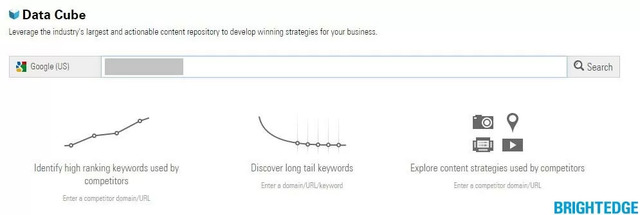
Data Cube – unlock the power of Data Cube by pasting in a competitor domain or individual URL to see the terms they’re visible for, or start with a single keyword and build out a list of semantically related terms to target. Once potential terms are identified, quickly begin tracking them in your account to determine how well your client’s site is performing on those terms today.

brighetdge content workflow - Data Cube Search

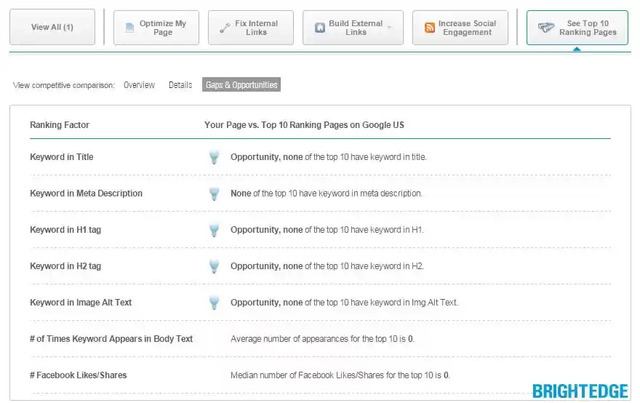
Competitive Insights – once you’ve defined your target terms and mapped them to pages on the site, it’s time to understand how you stack up against the competition. BrightEdge helps you to understand the on- and off-page factors driving first page rankings for most visible competitors.

brightedge content workflow - Competitive Insights

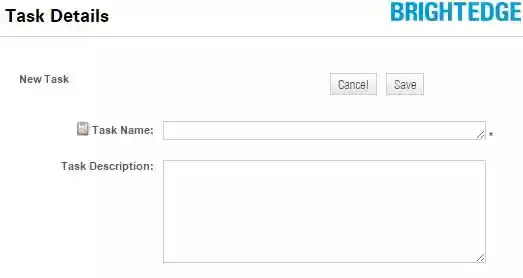
Task Management – now that you know what your competition is doing, it’s time to beat them at their own game. Utilize the BrightEdge Recommendations Engine to ensure that important page elements are appropriately optimized. Assign content writers specific tasks to complete and track progress throughout the entire content workflow.

brightedge content workflow - Task Details

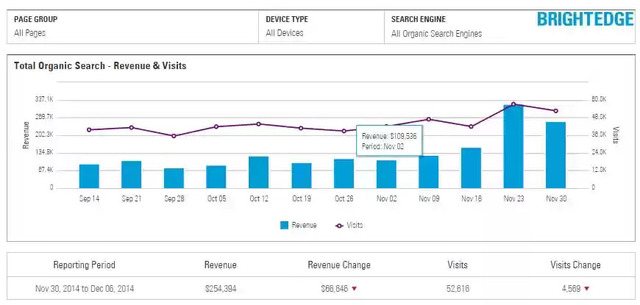
Report on Results – with unlimited customizable dashboards, you can create a story tailored to multiple client stakeholders. Stick to the high-level business metrics that matter to executives and get granular about rankings with brand managers in separate reports then automate delivery.

brightedge content workflow - Report on Results

Competitive Research – Staying On Top In The SEO Space

Kirill Kronrod
Kirill Kronrod
M Posted 11 years 4 months ago
t 9 min read

Performing competitive research to review the competitive landscape is one of the important tasks when running an SEO program. Learning about competitors, their products and offerings, web positioning (optimization focus, messaging, linking, technical SEO) and measuring your progress against theirs will allow you to understand what works for you and them, and what doesn’t – and can help move your SEO forward more effectively and secure a bigger piece of the pie.

Identify

When it comes to competing in SEO, at least for the large established brands, the focus is on the non-branded space, where prospects are searching for the terms related to product features and capabilities rather that branded names (in some cases users just may not be aware that your brand is offering a solution for their needs). There are several steps that can be taken here.

First, talk with your stakeholders (i.e. people in the business unit, sales or marketing teams) to scope companies that they see as competitors. We need to understand that company does not necessarily equal website here. There are cases where one company would span multiple websites, usually with keyword-rich domain names, to compete for specific themes in which case you’ll need to do some domain research (who-is) to get to the business owner behind the domain.

It’s also a good idea to check with the paid search team to see who is bidding on the high-value keywords. Querying search engines for high-volume, non-branded terms is also an effective way to scope the landscape.

Competitor Products and Solutions

Learn about competitor products and solutions to see how they stack up against your company offering. Start by reviewing their site and noting the categories and topics. Note the title tags, meta descriptions and H1 keywords they use. Understand the set of keywords they rank on. You can use a web site scanning tool to assist with this process.

Online Presence and SEO

Review the way competitors optimize their pages and topics and focus to find specific keywords that use that you do not. In some cases competitive information can provide valuable feedback beyond SEO.

For example this research can expose features in competitor products with significant interest and query volume in search that you can bring as a suggestion to the product development teams.

The BrightEdge Data Cube is a robust tool that allows you discover keywords and content based on a url, keyword, rank, or content type. This is an easy way to get a comprehensive view of the full set of competitor keywords.

Examine linking profiles, both in terms of the cross-linking within the competitor sites and also back linking patterns, to better understand what they are doing well. In some cases this research helps identify shady linking profiles.

Technical SEO is one of the key factors, and understanding the ways your competitors address it can help improve your program.

Learn about the social tactics of your competition (blogs, LinkedIn, Facebook, G+, etc.) and implement pieces that make sense for your projects.

Track and Measure

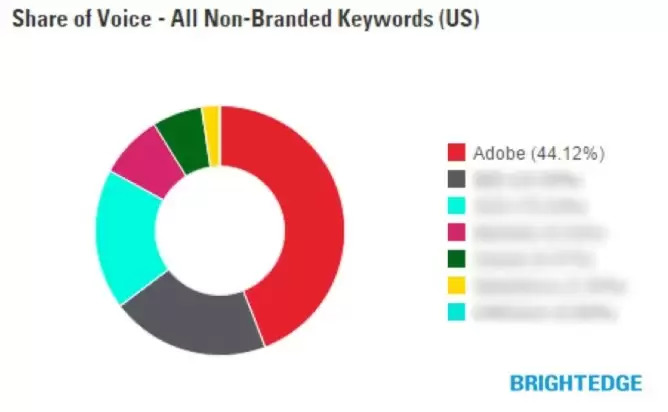
Measuring trends against competitors is a good idea to keep track of how your SEO program is performing against theirs for a set of non-branded keywords, and you can see how big your piece of the pie is. Literally – if you’re looking at the “Share of Voice” competitive research report in the BrightEdge platform.

This competitive research report gives you a sense of where you are at a given point of time.

Share of Voice Non-Branded Keywords - brightedge competitive research

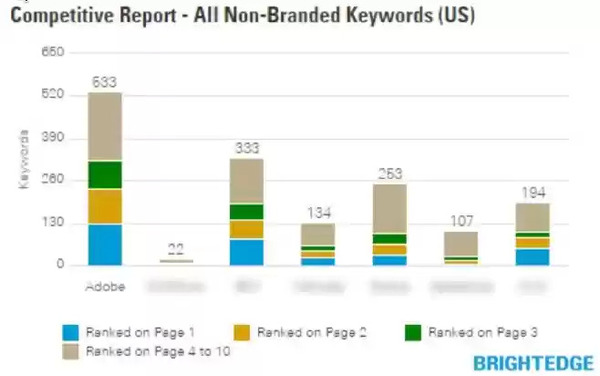
The BrightEdge Competitive Research Report provides a snapshot view of the performance of your keywords in terms of rankings, for example, your site’s presence on page 1-3 and beyond.

Competitive Research Report - BrightEdge Platform

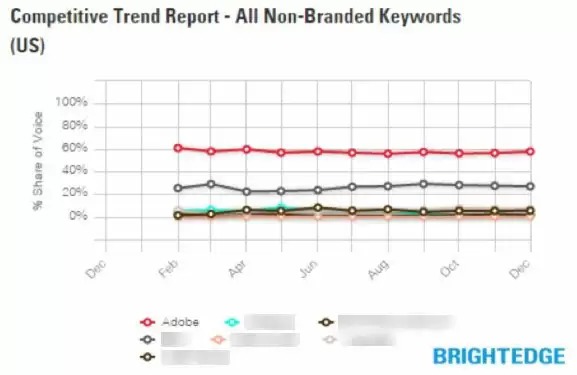
Competitive Research Trend Report provides a historic view of your performance against competition.

Competitive research Trend Report - BrightEdge Platform

Adapt

Like anything else in the SEO world, the competitive landscape is not set in stone which is why competitive research holds such high value. Competitors change their SEO programs, for example, they can migrate sites, acquire other companies to add offerings, change content, linking or technical aspects. Their sites can incur penalties. New competitors can enter and leave the space. Since things are not set in stone, re-visiting competitor research every 6 months can be very useful.

It’s always good to assess others to learn what else you can do on the site. On the other hand, if you learn about something that doesn’t work for your competitors, you certainly don’t want to repeat these mistakes.

Competitive research reports are also a great way to present progress of the SEO program to your stakeholders and show the status of your SEO program vs the competitors.

Your Best Partner for Enterprise SEO Release

A BrightEdger
A BrightEdger
M Posted 12 years 2 months ago
t 9 min read

How cool would it be to tap into a huge data repository and perform on-demand research – just like you would in a regular search engine? Wouldn’t it be great, to gain actionable insights to guide your content marketing plan based on the keywords and topics that drive traffic and conversions? You got it. For more than six years, we’ve been cultivating the BrightEdge Data Cube, which has been at the foundation of BrightEdge S3, powering our Customizable Recommendations, Search Opportunity Forecasting, Page Reporting and much more. With our latest release, we’re pleased to announce that customers now can gain direct access to the Data Cube via our on-demand research capabilities.

What exactly is the Data Cube?

The BrightEdge Data Cube is a massive content repository, the industry’s largest data set made up of billions of pieces of information which includes: keywords, search terms, rich media, and content, along with its performance on the web. BrightEdge now processes more than 100 terabytes of data per week. Hear our CTO and Co-Founder Lemuel Park discuss our story about the BrightEdge Data Cube.

Here’s how the Data Cube works …

You can perform URL-based or keyword-based research in real time. There are two ways to access the Data Cube’s information:

  • Freeform search, which lets you enter a keyword or URL in the same way a Google search is performed. 
  • Goal-based research, which helps you quickly identify the data that matters most, and that aligns SEO and content with business outcomes. Check out the following examples:

Goals You Can Select

Why it Matters

Identify high volume keywords – Find related keywords with volume greater than 1,000 and develop new content to drive traffic and engagement Focus on popular keywords that drive the highest demand
Discover long tail keywords – See results which contain more than 3 words in a phrase that are driving competitive performance Identify less competitive keywords that convert better
Explore high value keywords  – Find keywords with a value greater than 80 and prioritize efforts Hone in on higher converting keywords
Uncover videos and rich content – Identify competitors running successful rich content strategies and find other ways to rank in the SERP Discover new content opportunities and increase visibility in the SERP

But we didn’t stop there with the Data Cube. We know data is only as useful as the actions that can be gleaned from it. So, we’ve taken our Data Cube engine a step further; in addition to being a research tool, information uncovered in the engine integrates into BrightEdge S3. So, for example, after you’ve discovered the keywords that are working well for competitors, you can prioritize them in BrightEdge S3 for your own marketing efforts.

More news: custom security settings in BrightEdge S3

BrightEdge is committed to protecting the security of your most important data. That’s why we built our SaaS technology with security in mind from the start, designed to undergo the same stringent audits companies like Amazon, Microsoft, and Salesforce undergo. Our latest release expands on our pre-existing security solutions with self-service security management. What that means to you is:

  • The ability to extend your existing security policies to your BrightEdge account.
  • Ensuring all your users are following best practices and complying with internal security policies.

Self-service security features include:

  • Flexible password policies: Password management to match your security policies including password expiration, disallowing recycled passwords and enforcing special characters.
  • Sophisticated session settings: Complete control with session-timeout settings and security controls to lock an originating IP address.
  • Trusted IP address ranges: Restrict access to your IP ranges, preventing unauthorized access.

We hope you take advantage of all the new features included in BrightEdge’s latest release. As always, we’re committed to be your best partner in enterprise SEO.  

,