
How Claude Cites Sources: What Marketers Need to Know
Claude names vendors and consumer platforms, but it cites standards bodies, government and reference sources first. Here is what the data shows and what to do about it.
Across nine industry prompt groups, government and education domains accounted for 19.4% of Claude's citations, compared with just 1.4% for social sources.
Being mentioned in an AI answer does not mean your website is being cited as a source. Anthropic's record IPO brought Claude into the spotlight this week. The data on this page comes from AI Catalyst.
In BrightEdge data across nine industries, Claude names consumer platforms and clinical brands most often and cites government, standards and reference sources heavily. In B2B Tech it cites NIST and CISA ahead of vendor sites, while analyst, review and social sources rarely appear in its answers this week.
That makes brand visibility, cited sources and technical content three connected things for an enterprise marketing team to examine, on top of the Google presence that still drives most discovery.
The B2B Technology prompts in this panel lean toward security and compliance. A set built around software purchasing could produce a different source mix.
Why it matters
Claude is small as a traffic source. In BrightEdge's October 2026 AI Market Pulse, Claude accounted for 0.4% of AI-specific search referrals, against 96.0% for ChatGPT, 2.1% for Gemini and 1.1% for Perplexity. October is the latest month that index carries. On the wider picture, the same page has Google at 85.9% of all search referrals and AI engines at 2.2% of the total.
So the case for paying attention to Claude does not rest on clicks. It rests on what Claude says about a brand to someone doing research before a purchase, and on whether the sources behind that answer say what you would say.
This panel shows what Claude cites, not who is asking.
What we measured
BrightEdge AI Catalyst tracks two things that are easy to conflate. A mention is when an answer names a brand. A citation is when it lists a domain as a source. A brand can be named often and cited rarely, and in this data that is exactly what happens to the largest vendors.
| Group | Most mentioned | Most cited |
| B2B Tech | Microsoft | nist.gov |
| eCommerce | Amazon | amazon.com |
| Education | BLS | bls.gov |
| Entertainment | Ticketmaster | wikipedia.org |
| Finance | Yahoo Finance | yahoo.com |
| Healthcare | Mayo Clinic | mayoclinic.org |
| Insurance | HealthCare.gov | healthcare.gov |
| Restaurants | Yelp | yelp.com |
| Travel | google.com |
Which brands Claude names, by category
In seven of the nine prompt groups, the most-mentioned brand's own domain was also the most-cited source. B2B Technology and Entertainment were exceptions. That is a statement about the leaders in each group, not about every brand in it.
Consumer platforms and aggregators
Amazon leads eCommerce on both mentions and citations. Yahoo Finance leads Finance, Yelp leads Restaurants, and Google, Kayak and Skyscanner are the three most-mentioned brands in Travel. Where a category has a dominant aggregator, Claude tends to name it.
BrightEdge classifies brands and domains into publications, social and a third group it labels Other, which mixes retailers, platforms and some government bodies. That Other group accounts for 69% of mentions and 61% of citations. Publications account for 27% and 35%.
Clinical brands in health
Mayo Clinic leads Healthcare on both measures, with MedlinePlus and NIDDK close behind on mentions and medlineplus.gov and nih.gov close behind on citations. Claude reaches for clinical and government health sources rather than consumer health media.
Government and primary sources
Government and education domains make up 19.4% of Claude citations, counted by domain suffix, so they overlap the categories above. SEC EDGAR is the third most-mentioned brand in Finance and sec.gov the second most-cited domain in that group. Where an answer carries risk, Claude cites the authority behind the claim.
Where the pattern breaks: B2B Technology
B2B Technology is one of the two groups where the most-mentioned brand's own domain is not the most-cited source, and it is the one a B2B marketer has to read closely.
B2B Tech: who gets mentioned and who gets cited
Microsoft is the most-mentioned brand in the B2B Tech group, ahead of Google and Amazon. The two most-cited domains in that same group are not vendor domains. They are nist.gov and cisa.gov. Indexed to microsoft.com at 100, nist.gov is cited at 129 and cisa.gov at 107.
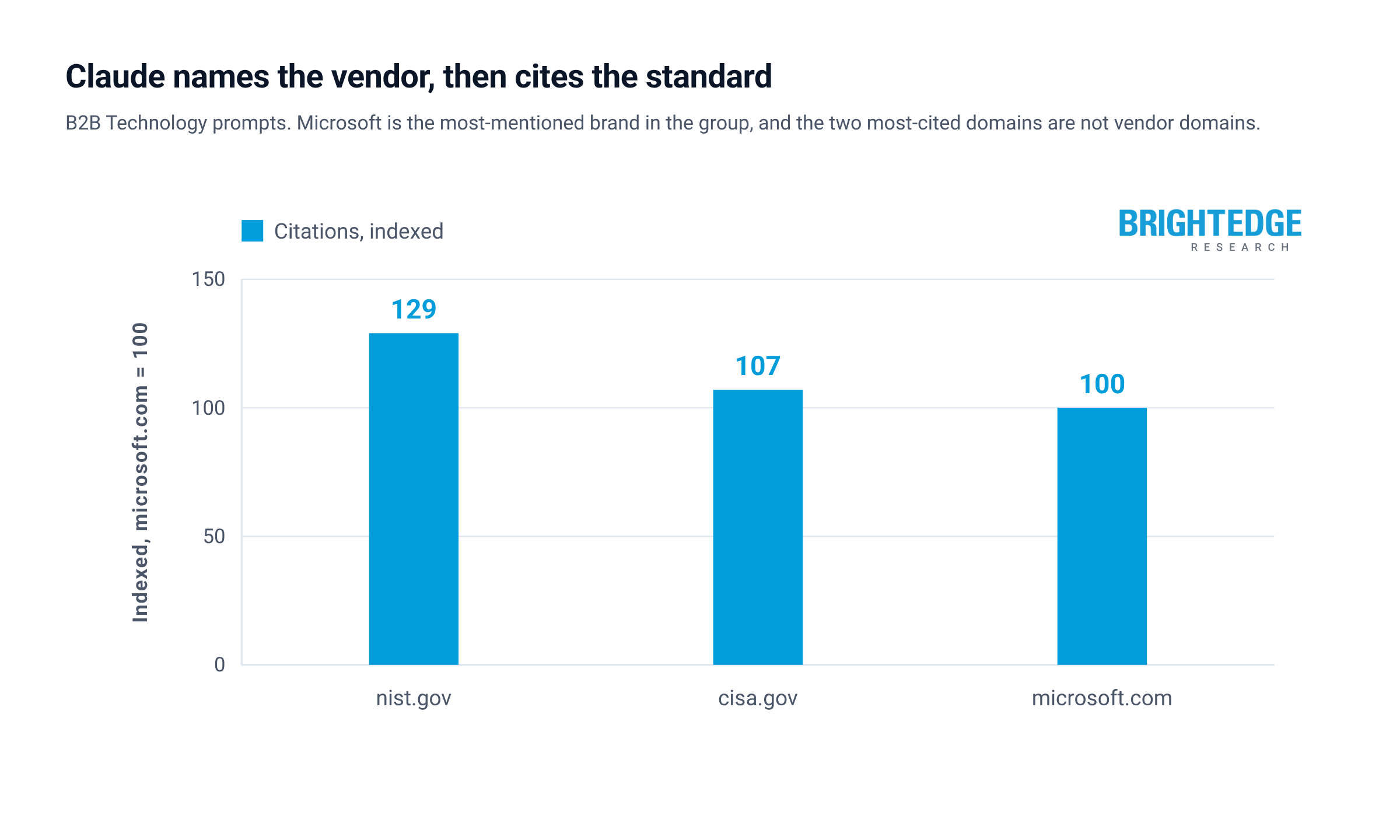
Figure 1. Claude citations in B2B Technology, indexed to microsoft.com at 100. Source: BrightEdge AI Catalyst, Claude, week of November 22, 2026. A single week on one engine, so it shows no trend.
Read it this way: Claude talks about vendors and backs the answer with a neutral authority. The gap between a mention and a citation is wide. Claude mentions Microsoft about 1.9 times for every time it cites microsoft.com.
Standards and documentation earn the citations
In the B2B Technology group, technical standards and documentation featured prominently among Claude's cited sources. Across all nine groups, Claude cites NIST about 16.6 times as often as Gartner, and NIST and CISA together are cited about 12.4 times as often as Gartner, G2 and Capterra combined.
The vendor pages that do get cited are documentation rather than marketing. Microsoft's most-cited pages are Learn documentation, on topics such as data loss prevention and SQL tooling, alongside its investor page. NIST's most-cited page is its Cybersecurity Framework. OWASP and GitHub both appear among cited domains.
Analyst and review sites barely register
Gartner, G2 and Capterra each receive a small number of citations. Forrester, TechTarget and McKinsey receive none at all in this week's data.
One caveat belongs with this section. The B2B Tech prompts in this panel lean toward security and compliance topics, which is visible in the sources themselves: NIST, CISA, OWASP and data loss prevention documentation. A prompt set built around software selection could return a different source mix, and this finding should not be generalized to all B2B buying without checking the prompts.
Where social and user content fit
Social accounts for 1.5% of mentions and 1.4% of citations across the panel. LinkedIn, YouTube and Reddit all appear, and all appear rarely.
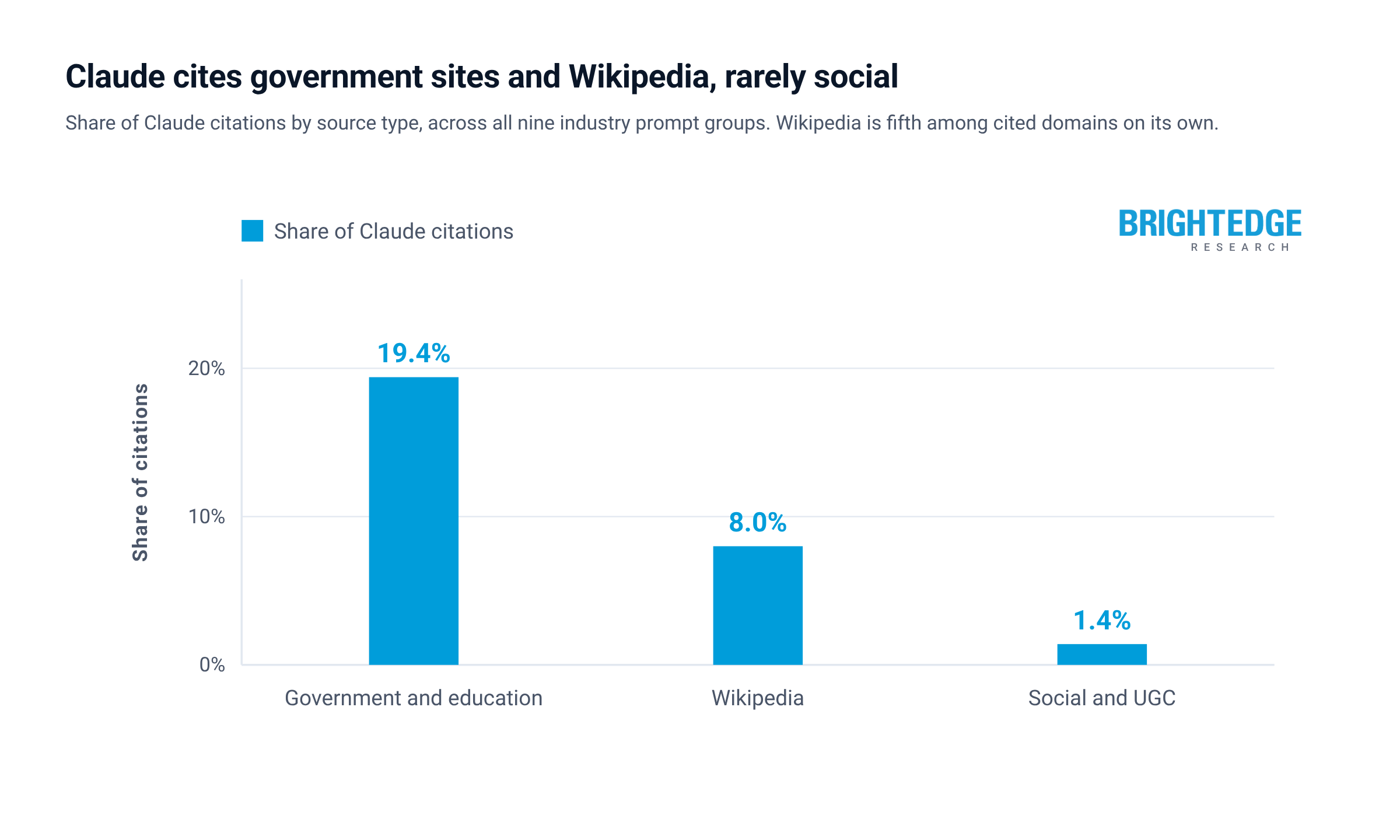
Figure 2. Share of Claude citations by source type, counted by domain suffix. Source: BrightEdge AI Catalyst, Claude, week of November 22, 2026. A single week on one engine, so it shows no trend.
Wikipedia is the exception among reference sources. It is the fifth most-cited domain overall at 8.0% of Claude citations, and on its own it is cited about 23 times as often as LinkedIn, YouTube and Reddit combined.
What marketers should do
1. Publish documentation that maps your product to a named standard or framework. NIST, OWASP and the frameworks your buyers are audited on are the content types earning citations in this data, and they are usually owned by product and security teams rather than marketing.
2. Measure mentions and citations as two separate numbers. The gap is the finding. A brand can hold its place in the answer text while its own domain does not appear among the sources, and a single combined visibility score hides that.
3. Check crawler access before anything else. An engine cannot cite a page it cannot reach, so confirm which AI agents can request your documentation and what they receive.
4. Test which sources Claude cites for your buyers' actual questions. Technical documentation was prominent in this sample, but different prompt types may produce different source patterns.
5. Treat Claude as its own engine in reporting. The source mix here is not the source mix on other engines, so visibility on one does not predict visibility on another.
Frequently asked questions
What is the difference between an AI brand mention and a citation?
A mention is when an AI answer names your brand. A citation is when it lists your domain as a source. They diverge: in B2B Tech, Claude mentions Microsoft about 1.9 times for every time it cites microsoft.com. Earlier BrightEdge research on ChatGPT found a similar gap between mentions and citations.
How does Claude choose which sources to cite?
In this data, Claude cites government, standards, reference and clinical sources heavily, and cites social platforms rarely. Anthropic's documentation states that Claude automatically cites sources from the search results it retrieves.
How can I track brand mentions in AI search?
Track mentions and citations separately, by prompt group and by engine. Start with the questions your buyers actually ask, then measure your mentions and your citations separately. BrightEdge AI Catalyst reports both.
Does Claude cite Reddit, YouTube or LinkedIn?
Rarely in this data. All three appear, and social as a whole accounts for 1.4% of citations in the week measured. Wikipedia, by contrast, accounts for 8.0%.
Next steps
The practical test is your own prompt set. Results differ by industry in this panel, so the group a brand competes in matters more than any panel-wide average.
Run the same cut on the questions your buyers ask with BrightEdge AI Catalyst, check which AI agents reach your documentation with BrightEdge AI Agent Insights, and read the generative engine optimization guide for the wider picture across engines. Google remains the largest discovery channel by a wide margin, and AI search is the layer being added on top of it.
Methodology
Mentions and citations come from BrightEdge AI Catalyst, Claude, across nine industry prompt groups in the week of November 22, 2026. A mention is when an answer names a brand. A citation is when it lists a domain as a source.
Referral shares come from BrightEdge AI Market Pulse, October 2026, read on November 27, 2026. The IPO is described from CNBC, Bloomberg, CBS News and Axios, November 18 to 24, 2026.
This is one week of prompt data on one engine. Mentions and citations are counted, not clicks, leads or revenue. The panel records what Claude names and cites, not who is asking.