
Generative AI in Search
Generative AI has taken a significant role in search technology. The turning point was late 2022, when OpenAI released ChatGPT, demonstrating to the world how conversational AI could generate human-like responses. Google followed by unveiling its Search Generative Experience (SGE) in May 2023, with limited opt-in availability.
By late 2023 and into 2024, the landscape accelerated:
BrightEdge Generative Parser™ shows that AI-first engines like Perplexity and ChatGPT are beginning to send measurable referral traffic to websites, with growth rates already outpacing many traditional channels. Meanwhile, AI Overviews now appear in over 11% of Google queries—a 22% increase since debuting—and impressions have surged more than 49% since May 2024. From the user's perspective, the shift is clear. People no longer need to click ten links; they ask a question and receive a synthesized, paragraph-length response directly on the search results page. In Google’s words, AI Overviews are meant to manage “longer, more complex questions,” especially those that might otherwise require multiple queries.
For marketers, this shift has a major implication: visibility now starts in the answer box. It is no longer just about being in the top 10 organic listings—it’s about whether your content is part of what the AI decides to say.
This is why Generative Engine Optimization (GEO) is quickly becoming a core pillar of SEO strategy for enterprise brands.
How GEO Differs from SEO
Generative AI search engines aren’t just an evolution of classic keyword-based search—they represent a paradigm shift in how content is retrieved, interpreted, and presented. Unlike traditional search, where users scan a ranked list of results, generative AI aims to provide a complete answer, often without requiring a click.
Here’s how major AI search platforms compare, based on internal BrightEdge research and ongoing observation of real-world prompt output behavior: (MAKE THESE APPEAR LEGIBLE WITHOUT BEING TOO BIG THAT THEY CAN’T FIT ON ONE LINE)
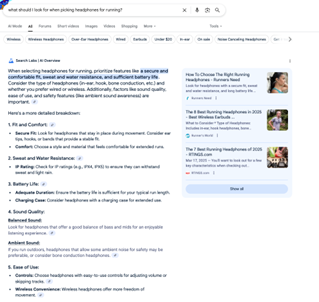
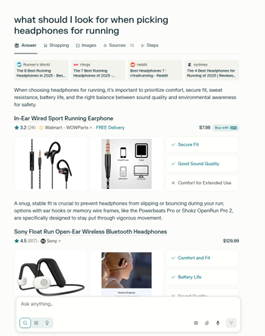
Feature | Google AI Overviews | Perplexity.ai | ChatGPT Search |
Update Frequency | Regular index refresh | Real-time web retrieval | Uses Bing index (delayed updates) |
User Experience | Summary integrated into SERP | Chat-style interface with sources | Assistant-style interface |
Intent Support | Informational-focused | Mixed (info, commercial, exploratory) | Mixed (dialogue-driven) |
Follow-up Prompts | Limited (AI Mode coming) | Available after every answer | Fully conversational |
Commercial Readiness | Rapidly expanding | Strong in product and tech categories | Experimental (plugin-dependent) |
For Greater Detail on each of these AI Engines, refer to our Guides:
Across all platforms, a key commonality is that Generative engines answer, then cite—not cite, then answer. Users get the information they need before clicking on a website. Depending on the prompt, the user may even receive a product recommendation. As a result, if you’re not supporting the answer the AI wants, or your product doesn’t align with what it prioritizes, you may be invisible to the user.
As a result, tracking your brand's presence across these platforms is critical. From there, you can begin to define the prompt intents for your market segments and tailor your content accordingly.
Unlike traditional search engines that match keywords to documents, generative AI uses language models to synthesize answers from retrieved documents.
Here are a few key differences:
- Answers over links: Generative engines like Google AI Overviews, Perplexity Search, and ChatGPT Search prioritize directly answering user queries. Now, marketers have an opportunity to be cited to drive traffic as well as recommended to drive direct engagement.
- Citation logic differs: Citations in AI answers are based on passage-level relevance, not necessarily page rank or traditional SEO content factors.
- Training is Unique: LLMs generate a unique set of source material behind each query, which may vary based on user context, device, or prompt structure.
- Multiple intents in one answer: A single AI Overview may address informational, transactional, and navigational intent simultaneously. Google refers to this as their “query fan-out technique”.
These systems are also evolving rapidly. Google’s AI Mode will introduce conversational follow-ups; Perplexity blends real-time retrieval with chat; and ChatGPT's browsing mode cites sources but often pulls from a narrow set of trusted domains. Understanding these nuances is key to building a comprehensive Generative Engine Optimization strategy.
What Still Matters: Core SEO Principles
While generative AI introduces new dimensions to search, the underlying principles that drive strong organic visibility remain essential. Many of the same signals that have always mattered—such as authority, clarity, and structure—are still crucial, especially because large language models rely on well-structured, crawlable content to compose coherent and trustworthy answers.
How GEO compares to SEO
While Generative Engine Optimization introduces new dynamics that differ from traditional SEO, many of the core concepts map directly to familiar tactics. For nearly every SEO task—like keyword research, content optimization, or rank tracking—there is now a generative counterpart. Most enterprise SEO workflows can be extended into the GEO world by rethinking them through the lens of prompts, citations, and brand recommendations. Below are five areas of GEO work with clear analogues in traditional SEO.
Step | Description | GEO Activity | Traditional SEO Counterpart |
Prompt | What users ask the AI (e.g., "best wireless earbuds for workouts") | Monitor the prompts users are using that are relevant to your business | Keyword Research |
Intent | What the AI interprets (e.g., informational + transactional) | Answer Analysis- Monitor how AI Search engines interpret prompts that matter to your business | SERP Analysis |
Retrieval | What documents are selected behind the scenes (varied by engine) | Ensure your content can be discovered by new AI Search Engines | Indexing / Technical SEO |
Citation | Which brands or domains are surfaced as supporting evidence | Measure the share of citations within an answer to identify key influencers | Share of Voice |
Mentions | Which brands are specifically recommended to the user based on their prompt | Answer analysis and mention tracking | Rank Tracking |
Here’s what still matters in the AI-first world:
- Crawlable content and clean architecture: If your content isn’t discoverable, it can’t be cited. Make sure your site follows technical SEO best practices. This includes a logical page hierarchy, an XML sitemap, and mobile-first rendering. Capabilities like BrightEdge’s Content IQ are essential in pinpointing areas where your content may have indexing issues, just as they are with traditional SEO.
- Schema markup: Structured data helps AI systems interpret your content more precisely. Implementing FAQ, HowTo, and Product schema allows you to clarify context and increase your chances of being selected for snippets or citations in AI Overviews. There are hundreds of Schema Tags a user can use. This can be overwhelming and could even give mixed signals if overused. As a result, capabilities like BrightEdge Search IQ are essential, as they pinpoint what Schema is being used by the most prominent sites in a given space. This insight eliminates guesswork and ensures focus is on the right place.
- Topical authority through content clusters: Generative engines reward sites that demonstrate depth and breadth on a subject. Build content clusters that fully explore related questions, product categories, or customer concerns. Pages should reference one another contextually with internal links and aligned headings. BrightEdge users automate this process with Autopilot by leveraging AI to triangulate the right content clusters and automatically update them as search behavior and content evolve.
- Clear formatting and readability: LLMs favor content that is concise, well-structured, and easy to extract from. They must also address key questions the LLM may be looking to answer. Marketers need ways to scale their content and accurately assess what topics and questions need to be answered. For BrightEdge users, this is achieved with Copilot for Content Advisor, which identifies key questions users have around a topic and then leverages Generative AI to create briefs and first drafts fully optimized for what is required to be cited in AI Search.
These foundational elements don’t just improve your performance in traditional SEO—they also increase your eligibility for AI citation. While GEO introduces new tracking and optimization needs, it builds on a base that successful enterprise brands have likely already been investing in.
Establishing A Baseline
The first step in any Generative Engine Optimization strategy is to establish a baseline. This means understanding how AI engines are currently perceiving and presenting your brand in answers.
You need to answer:
- Are you being cited at all? If so, where?
- How frequently is your brand mentioned or referenced across Google AI Overviews, Perplexity, and ChatGPT?
- What types of prompts (informational, transactional, navigational) generate those citations?
- What’s the tone or sentiment of those mentions—are they positive, neutral, or negative?
- How does your visibility compare to key competitors across the same engines?
Tracking these dimensions provides a foundation for identifying gaps, measuring brand presence over time, and uncovering competitive advantages. Both citations (source-level references) and mentions (brand name usage without a hyperlink) are key to building a reliable AI search profile.
To visualize this baseline clearly, you may want to:
- Chart share of voice by engine (Google AIO, Perplexity, ChatGPT)
- Group citations by prompt type (Persona Type, Intent, Market Segment, etc.)
- Break down mention sentiment over time to monitor brand reputation in AI-generated content.
BrightEdge users can achieve this using AI Catalyst, which consolidates this data in a single dashboard. Catalyst shows:
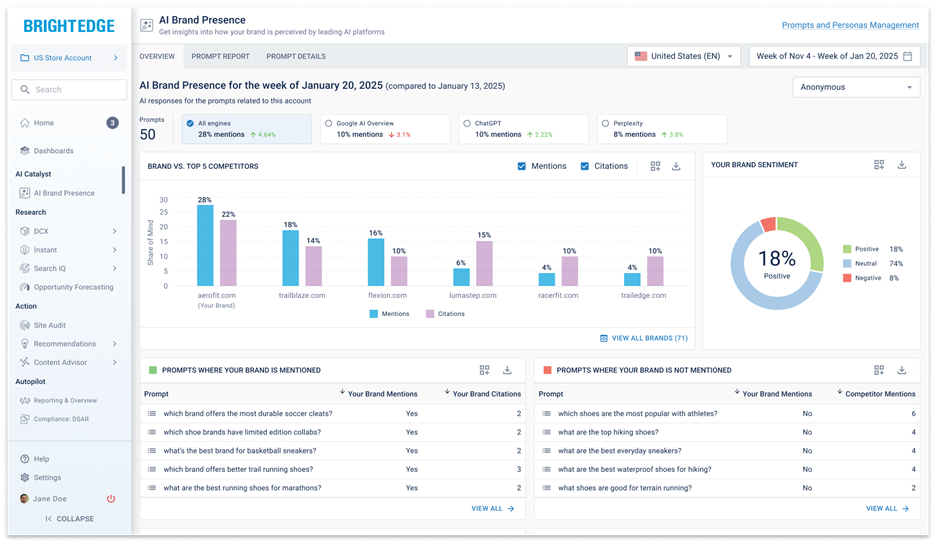
- Where does your brand appear (and where it doesn't)?
- Which prompts are triggering citations?
- Sentiment scoring across all mentions.
- Trends over time for share of voice vs. competitors
Tracking this isn’t just crucial for GEO—it also powers better brand monitoring, reputation management, and messaging alignment. It helps you see not just if you're appearing in AI answers, but how you're being portrayed, and how often. With this context, you can focus on where you need to engage in GEO.
Identifying Gaps and Opportunities
Once you've established a baseline, the next priority is uncovering where your brand is missing—but shouldn't be. These gaps reveal the most immediate and actionable opportunities to improve your visibility across generative search engines.
Common gap types include:
- Informational Prompts where competitors are cited but your brand is not – These could be missed opportunities to shape your customers’ perceptions before they are in the consideration stage of a purchase.
- High-volume or high-intent queries where no brand is mentioned (i.e., generic answers)- This could be a blue ocean where you could build authority and engage with customers before your competitors do.
- Product-related, comparison, or best-of prompts in which your brand category is represented but your site isn’t linked or mentioned- These are critical moments where your customer is discerning between brands. If you aren’t mentioned where your competitors are as a recommendation, you need GEO!
To effectively uncover gaps, you’ll want to:
- Segment queries by intent: informational ("what is..."), transactional ("best tools for..."), and navigational ("[brand name] contact")
- Cross-reference branded vs. unbranded visibility.
- Examine which attributes, features, or product types competitors are being cited for
For example, if Perplexity consistently cites your competitor for "best zero-waste deodorant brands," but your content ranks organically in Google for the same query, this suggests an alignment or authority gap in the AI engine’s training or retrieval logic. To address this issue, you may need to look at what Perplexity is citing to arrive at their recommendation, and identify where you are missing in the consideration set: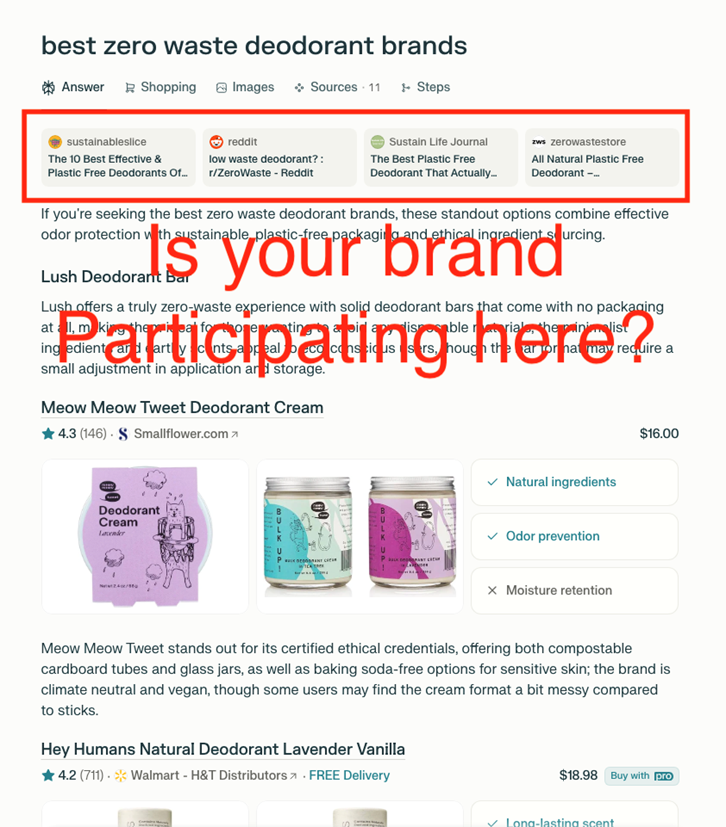
Doing this at scale, prompt by prompt, is not realistic for most brands. As a result, for GEO, it’s critical to have a technology that can aggregate the mentions across all prompts and triangulate who the top citations across AI engines are. This is a similar scale issue with traditional SEO in tracking keywords. For BrightEdge users, AI Catalyst simplifies this process to pinpoint gaps by triangulating all the leading citations across multiple prompts.
In addition to competitive citation gaps, it’s important to identify AI format mismatches where your content exists but is not being pulled into results because it lacks the structure or clarity preferred by LLMs.
For example:
- Google AI Overviews may favor unordered lists or concise FAQs.
- Perplexity may reward pages with deep factual context and internal citations.
By identifying these structure-level gaps, you can align your content with the formats most likely to be referenced.
Lastly, consider prompt volume and trajectory. Just because you aren’t cited today doesn’t mean the opportunity is low value. Use keyword and prompt trend data to identify emerging areas where generative engines are gaining traction—and get ahead of the citation curve by being the most comprehensive, accurate, and helpful result available.
Once you have a baseline, the next step is to identify where your brand is not being cited, but should be.
This includes:
- Prompts where your competitors are mentioned but you’re not.
- Product-related or category-level prompts where your brand is absent.
- Informational queries where your content is not selected for citation despite ranking well organically.
Generative engines respond differently depending on the intent behind a prompt:
- Informational ("What is zero trust security?")
- Transactional ("best headphones under $100")
- Navigational ("who has [products] online")
You need to identify how you're showing up—or being left out—across each of these. Doing this manually is difficult. BrightEdge users can identify these gaps with AI Catalyst, which visualizes brand mentions and citations across prompt types and competitors.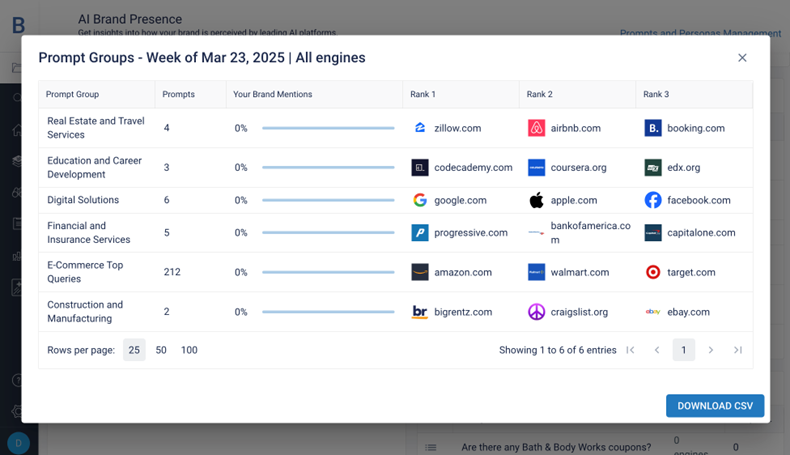
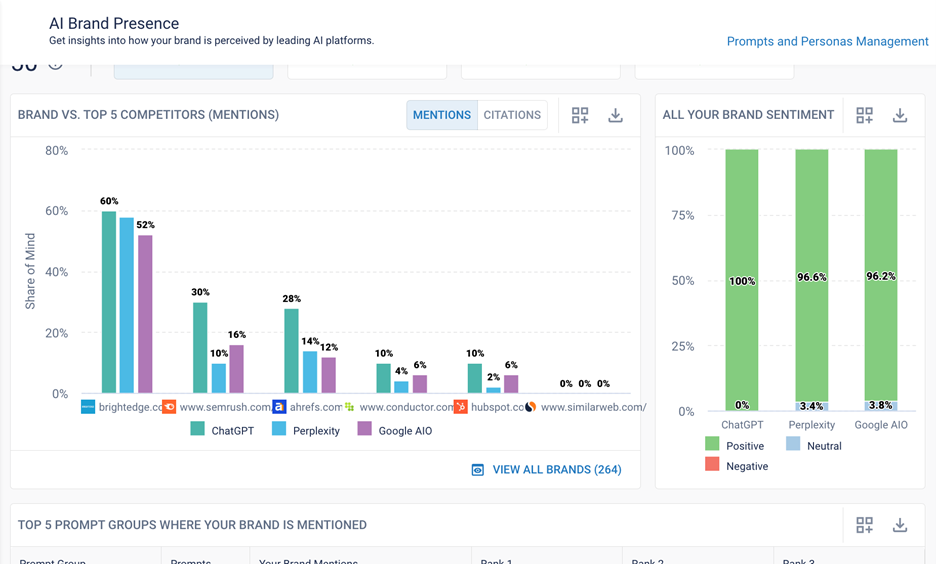
AI Mentions and Citations
Once you understand where your brand is showing up—and where it's missing—the next layer of insight is understanding why brands are selected for citation. Large language models like Gemini, GPT-4, and Perplexity’s proprietary systems choose sources based on both relevance to the query and perceived authority, clarity, and helpfulness.
BrightEdge research shows that different engines emphasize different value signals:
- Google AI Overviews tend to highlight content that is concise, updated, and list-formatted, often citing expert sources, medical institutions, or recognized consumer brands. See BrightEdge AI Overviews Guide
- Perplexity often surfaces results with dense factual content, detailed comparisons, and citations to external sources, which could allow you to showcase depth over brevity. Learn more
- ChatGPT with browsing favors domains with recency and consistent authority, but you need to be indexed in Bing. Learn more.
Brand Mentions
There are numerous aspects of an AI-generated answer that can determine why certain brands are mentioned.
In our specific AI Search Guides, we’d identified reasons such as:
- Unique positioning (e.g., "best for sensitive skin")
- Awards and certifications (e.g., USDA Organic, FDA Approved)
- Customer sentiment ("highest rated on Trustpilot")
- Expert reviews or recognitions
- Freshness (last 6–12 months)
- Passage-level clarity (short, accurate supporting text for generation)
AI search engines are synthesizing not just pages, but brand narratives from what they observe across the web. This includes your website, review platforms, media mentions, third-party comparisons, and even FAQ pages.
How to Align Your Content and Reputation
To increase your likelihood of being cited:
- Audit your top pages for extractable brand attributes: Are you showcasing what makes your brand unique?
- Ensure you’re creating content that reinforces the attributes AI engines already associate with top competitors.
- Build out answers to common user follow-ups ("What’s the best [product] for...?") in your content structure.
BrightEdge users can use AI Catalyst to track not just which prompts mention brands, but what attributes the AI highlights in those citations. This data serves as a critical insight into the aspects of products or services that AI engines deem critical. You can use this insight to ensure your brand is optimized to address the attributes AI is showcasing:
Prompt: “What sites are the best for craft supplies?”
| Key Attributes for Brands in AI Overviews | Key Attributes for Brands in ChatGPT |
|---|---|
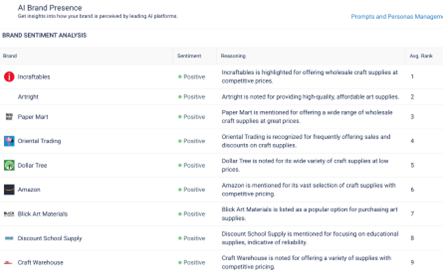 | 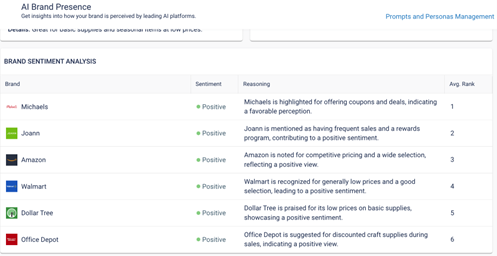 |
While Google AI Overviews lean toward affordability and deal-related messaging, ChatGPT highlights specialty, wholesale, and educational value. Marketers can’t build separate sites for each engine, but they can structure their content to surface multiple value propositions. That means clearly showcasing unique positioning, updating content regularly, and using formats that are easy for all engines to extract and cite. A unified content strategy ensures brands show up consistently, no matter the engine.
You can also monitor sentiment shifts in how AI talks about your brand over time. For example, if you’re gaining traction in educational prompts but not product-related ones, that insight can inform your content, messaging, or outreach strategy.
This brand insight layer connects content, SEO, PR, and product marketing into one unified view, crucial in an era where AI is increasingly acting as the customer’s first impression.
Building an Optimization Strategy
Once you understand how you’re perceived and where you’re visible, it’s time to take action. A comprehensive Generative Engine Optimization strategy should build on SEO fundamentals while aligning with the nuances of AI content retrieval and answer generation.
Importantly, GEO isn’t just about earning citations. The real value comes from being recommended by the AI, positioned as the answer, not just the footnote. Citations alone often result in low click-through rates. That’s why your brand’s mentions, sentiment, and recommendation positioning matter just as much—if not more—than being linked.
As with any other marketing channel, there are stages of the customer purchase lifecycle that AI addresses. Your measurement and your optimization strategy need to be aligned with these in order to effectively reach users in these moments and assess the success of your GEO program. The following table is an overview of key metrics that correspond to different stages of the customer purchase cycle:
(NEED TO FORMAT THIS TO FIT ON THE PAGE EVENLY)
| Metric | Description | Influence | Attract | Engage | Convert |
| AIO Presence | Impact of AIO presence on a target keyword landscape | x | x | ||
Brand Mentions (AIO, AI Mode, ChatGPT, etc.) | Brand visibility for our brand and others in the AI search engine answer text | x | |||
Citations (AIO, AI Mode, ChatGPT, etc.) | Ranking visibility for our site and others within Citations in AI Overviews, AI Mode, ChatGPT | x | x | ||
| Brand Sentiment | Sentiment assessment of brand mentions in the AI search engine answer text | x | |||
LLM Prompt Volume | Estimate of the volume of entries in LLMs for a given Prompt or related Prompt Topic | x | x | ||
| Search Volume | Approximate Search Volume each month for a specific keyword in traditional search | x | |||
| Impressions | Clickable links for our site are presented to searchers in traditional and AI search engines. Not currently available from AI engines (AI Mode, ChatGPT, etc.) | x | x | ||
| Clicks/Referrals | Visits to our site from traditional and AI search engines | x | |||
| SERP Rankings | SERP position for tracked keywords in traditional search engines | x | |||
| CTR% | Clicks/Referrals divided by Impressions | x |
| Engagement | Metrics associated with engagement of visitors on our site, such as Time on Site, Page Views, Scroll depth, etc. | x | |||
| Conversions | Metrics associated with completion of a desired action by a user, such as Form Fills, Purchase, etc. | x | |||
| Share of Search/Share of LLM | % of available search demand expected to be captured by our site/other sites based on ranking visibility in traditional and AI search engines | x | x |
To analyze how SearchGPT compares to other AI search platforms, we conducted a comprehensive analysis across nine key verticals: Finance, B2B Technology, Education, Entertainment, Healthcare, Insurance, Restaurants, Travel, and E-commerce. We compared identical queries across SearchGPT, Google's AI Overview (AIO), and Perplexity to assess strengths, weaknesses, and overall user experience
Building a GEO Strategy to Influence, Attract, Engage, and Convert Your Audience.
Generative Engine Optimization assumes that success is no longer just about rankings or clicks—it’s about being present, persuasive, and preferred in how AI systems speak about your brand. To do that effectively, GEO must address all four phases of the modern search journey:
1. Influence: Shape AI Understanding of Your Brand
The goal here is to ensure that AI systems associate your brand with the right themes, attributes, and intent categories—even if a user doesn’t search for you directly.
What to optimize:
- Strengthen your presence in AI-generated content by reinforcing brand mentions, product attributes, and unique positioning across your pages.
- Include reviews, awards, trust signals, and certifications that can be cited.
- Use clear, factual language that LLMs can extract cleanly for summary use.
- Track your brand visibility in both traditional and AI search engines.
Key metrics:
- Brand Mentions (unlinked + linked)
- Brand Sentiment
- AIO/ChatGPT/Perplexity/Etc. Presence
2. Attract: Earn a Spot in the Answer Layer
Attraction is about being selected when the AI compiles an answer. This requires content formatting, topical alignment, and freshness.
What to optimize:
- Use schema to guide extraction and give the AI Hints for how it could use your content.
- Ensure content is presented in formats that AI engines can easily pull into answers: bulleted lists, comparison tables, and short summaries.
- Update content regularly, especially in fast-moving verticals like health, finance, and consumer electronics.
Key metrics:
- Citations
- Prompt Volume
- Impressions
3. Engage: Create Post-Click Experiences That Support the AI Journey
Being cited is only the beginning. Once users click, the content must satisfy the AI-influenced query, often a more complex or blended intent than classic search.
What to optimize:
- Structure landing pages to support exploratory behavior: quick summaries, follow-up questions, related tools or products.
- Improve page speed and mobile usability to reduce bounce.
- Build content clusters to guide users deeper into your site.
Key metrics:
- Clicks and Referrals
- Engagement (scroll depth, time on site)
- Returning vs. Unique visitors
4. Convert: Turn Generative Exposure into Real Business Outcomes
The ultimate goal is to move beyond visibility into real conversions, even if the journey started with a brand-agnostic AI query.
What to optimize:
- Ensure product and conversion pages mirror the attributes that LLMs surface in answers (e.g., “best value,” “eco-friendly,” “most reviewed”).
- Include trust markers, testimonials, and streamlined calls to action.
- Build a list of the key influencers (usually not competitors), lists, and publications that are trusted by the AI.
- Use analytics to correlate AI visibility with bottom-funnel actions like form fills or purchases.
Key metrics:
- Conversions
- Share of Search / Share of LLM
- Brand lift by prompt type
Summary
The landscape of search is evolving at an extraordinary pace. AI-powered search engines like Google’s AI Overviews, Perplexity, and ChatGPT are reshaping how users discover brands, content, and products. In this new environment, simply ranking well is no longer enough—brands must now earn visibility within the AI-generated answer itself.
The good news: while the technology behind these experiences is complex, the path forward is not. Generative Engine Optimization builds on many of the same foundational principles of SEO—structured content, authority, and relevance—while expanding the playbook to include prompt analysis, citation tracking, sentiment awareness, and brand alignment.
What has changed is the scale and complexity of the challenge. You are no longer optimizing for a single set of rankings in a linear search engine.
You are now:
- Competing across multiple AI systems, each with different citation logic
- Managing brand perception across a distributed network of generative experiences
- Responding to new forms of user behavior that unfold in conversation, not just clicks.
To do this effectively, you need visibility. You need to be able to track citations and mentions, understand sentiment, map prompts to content opportunities, and tie it all together in a strategy that moves with the market.
Steps for GEO:
- Establish your baseline visibility in AI search engines.
- Identify gaps and brand opportunities across prompts and platforms.
- Refine your strategy around the formats and values AI systems elevate.
- Measure what matters, from mentions to influence to share of AI voice.
Doing this manually, or with disconnected tools, is not scalable.
Integrated enterprise platforms like BrightEdge ensure brands can optimize once and rank everywhere—across traditional listings and generative results alike. Unified insight, measurement, and action allow teams across SEO, content, PR, and product to collaborate around a shared understanding of how their brand is showing up in AI.
GEO isn’t a departure from SEO—it’s its next evolution. And with the right systems in place, it's not only achievable, it's a competitive advantage.
By integrating GEO into your existing strategy and using capabilities like AI Catalyst, enterprise marketers can take control of how their brand is understood and represented in AI search.