What is DeepSeek?
DeepSeek is a generative AI-powered platform that combines advanced reasoning and search capabilities to interact with users, answer complex questions, and provide intelligent, context-aware solutions. What sets DeepSeek apart from other AI models is its ability to produce detailed, contextually rich responses while using significantly less power and processing resources. It has the ability to reason and demonstrate how it is reasoning, creating transparency that hasn’t always been visible in other LLMs (note, OpenAI updated its latest ChatGPT o3 model to show more reasoning after the release of Deepseek). So far, Deepseek’s answers and reasoning capabilities have been found to be competitive with major AI players such as AI Overviews, Perplexity and ChatGPT at a fraction of the cost. Its rapid adoption and expanding global influence signal a broader shift toward more intelligent, context-aware search experiences.
Founded in 2023 by Liang Wenfeng, a former hedge fund entrepreneur from Guangdong province and co-founder of High-Flyer, DeepSeek relies on algorithmic efficiency and open-source collaboration to get to its outstanding results. Liang’s background in quantitative trading and AI development shaped the company’s focus on creating models that deliver high performance without the massive capital investment typical of U.S. tech giants. This focus on efficiency and new ways of operating a LLM could be a glimpse into the future of search technology, where efficiency, structured information, and authoritative content take center stage.
What DeepSeek Means for Search Industry Players
While BrightEdge found that January referrals exceed November levels for all AI search engines, except for Claude, which has experienced three consecutive months of decline,
DeepSeek's new standard for AI discoverability carries profound and lasting implications for the search industry. With its technology freely available for adaptation and implementation, some, like Perplexity, are already integrating DeepSeek into their search engine. Others, like OpenAI, must reckon with whether DeepSeek's approach disrupts its current footprint or if it can continue innovating without compromising profitability.
But despite ChatGPT and Perplexity seeing month-over-month increases of 17% and 16%, respectively, BrightEdge found no signal of any single competitor—or group of competitors—eroding Google's dominance of nearly 92% of market share.
What is DeepSeek
DeepSeek is a generative AI-powered platform that combines advanced reasoning and search capabilities to interact with users, answer complex questions, and provide intelligent, context-aware solutions.
What sets DeepSeek apart from other AI models is its ability to produce detailed, contextually rich responses while using significantly less power and processing resources. It can reason and demonstrate how it is reasoning, creating transparency that has not always been visible in other LLMs (note OpenAI updated its latest ChatGPT o3 model to show more reasoning after the release of DeepSeek).
DeepSeek sharing its reasoning in real-time
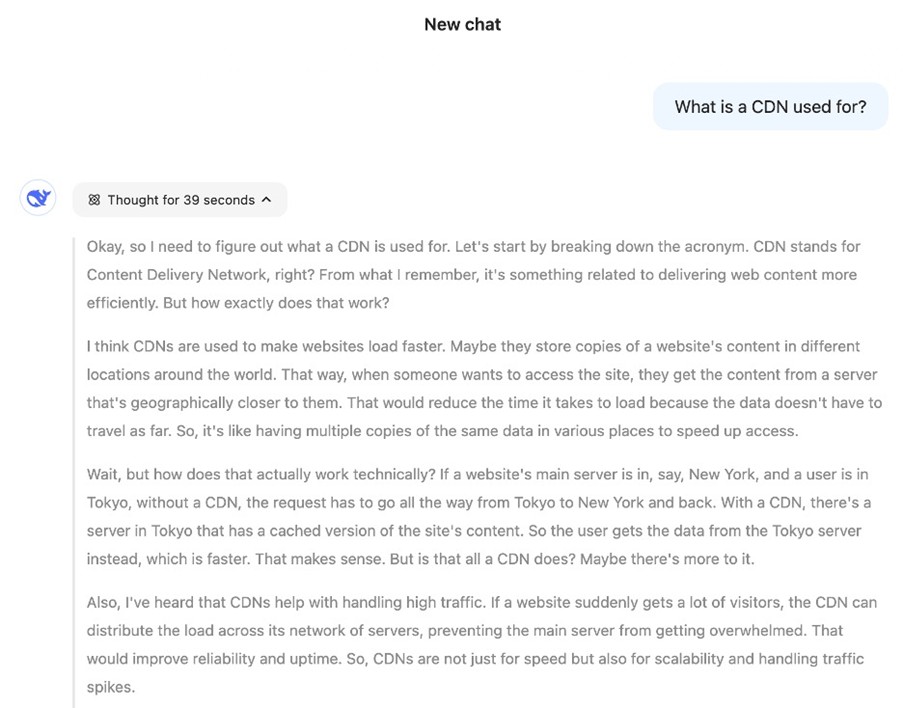
So far, DeepSeek's answers and reasoning capabilities have been found to be competitive with major AI players such as AI Overviews, Perplexity, and ChatGPT at a fraction of the cost. Its rapid adoption and expanding global influence signal a broader shift toward more intelligent, context-aware search experiences.
Founded in 2023 by Liang Wenfeng, a former hedge fund entrepreneur from Guangdong province and co-founder of High-Flyer, DeepSeek relies on algorithmic efficiency and open-source collaboration to get outstanding results. Liang's background in quantitative trading and AI development shaped the company's focus on creating models that deliver high performance without the massive capital investment typical of U.S. tech giants.
This focus on efficiency and new ways of operating an LLM could be a glimpse into the future of search technology, where efficiency, structured information, and authoritative content take center stage.
Why DeepSeek is Gaining Attention
The Three Main Factors
- A "Think First" Approach: Before beginning its search process, DeepSeek will consider how to find the best answer to a question. For example, DeepSeek's understanding of recency or immediacy will shape where it looks for answers to a query. This differs from other AI Search platforms that take a "Get Content First, Think Second" approach.
- Real-Time, Multi-Source Content Exploration: Once DeepSeek begins its search, it does not pull from a singular search index and does not have a proprietary search index like Google, Perplexity, and other AI search engines. Instead, it navigates multiple sources in real-time to construct a more comprehensive response.
- Transparent Thinking: When ready with an answer, DeepSeek shows its reasoning and where it is collating information by providing citations, a major shift from black-box AI models that offer little visibility into their decision-making. This approach will likely increase trust in the results and help users rephrase their search or follow-ups if needed.
DeepSeek's rise in prominence can be broken down into additional factors such as:
- Explosive Growth and Market Impact: Since its global launch on January 20, 2025, the DeepSeek chatbot app has been downloaded over 10 million times on Google Play, surpassing ChatGPT in popularity on the iOS App Store. This surge in user engagement highlights DeepSeek's growing influence in the AI-driven search landscape.
- Influence on Global Markets: The rapid adoption of DeepSeek's AI assistant even contributed to a significant sell-off in tech stocks, impacting major companies like Nvidia and underscoring its disruptive potential in the AI ecosystem.
- Structured Content Delivery: DeepSeek provides meticulously organized information, making it easy for users to navigate complex topics.
- Authoritative Responses: DeepSeek fosters trust among users seeking reliable information by prioritizing factual accuracy and depth.
- Educational Focus: Its content style resembles a well-curated knowledge base, which resonates with professionals, educators, and researchers.
- Multilingual Capabilities: DeepSeek's ability to process content in multiple languages, mainly English and Chinese, broadens its global appeal.
- Cost-Efficient AI Development: Unlike many competitors, DeepSeek was developed with a focus on optimization, achieving high performance with lower capital investment.
Why DeepSeek Matters for Marketers
DeepSeek demonstrates sophisticated reasoning capabilities at a fraction of the computational cost of major competitors. This efficiency, combined with its transparent reasoning process and rapid user adoption, suggests a potential shift in how AI search will evolve.
Three key factors make DeepSeek particularly significant:
- Efficient, Transparent Reasoning: DeepSeek achieves competitive results with just 10-20% of the computing power of other leading LLMs while showing its reasoning process in real-time. This combination of efficiency and transparency could signal a new standard for AI search.
- Systematic Knowledge Building: Unlike other AI search technologies, DeepSeek constructs understanding by systematically building knowledge frameworks. Our analysis shows it excels at educational queries, local information validation, and complex purchase decisions - areas where comprehensive understanding matters more than quick answers.
- Market Innovation Signal: DeepSeek's ability to deliver sophisticated search capabilities with minimal computational investment suggests we'll see more efficient, focused AI technologies emerging. This could accelerate the adoption of AI search across different market segments and use cases.
For business leaders, this means preparing for a world where being discoverable increasingly depends on helping AI systems build an accurate, comprehensive understanding of your business and offerings.
DeepSeek's approach - emphasizing efficiency, transparency, and systematic knowledge construction - may indicate where AI search is heading.
Imagine you are a marketer for a company that sells 60-inch TVs, and you want your product to be cited in DeepSeek for the query:
"What are some good 60" TVs to consider for my house?"
Here is what the DeepSeek search result looks like: it features detailed, structured content with clear headings, bullet points, and direct citations from specific sources.
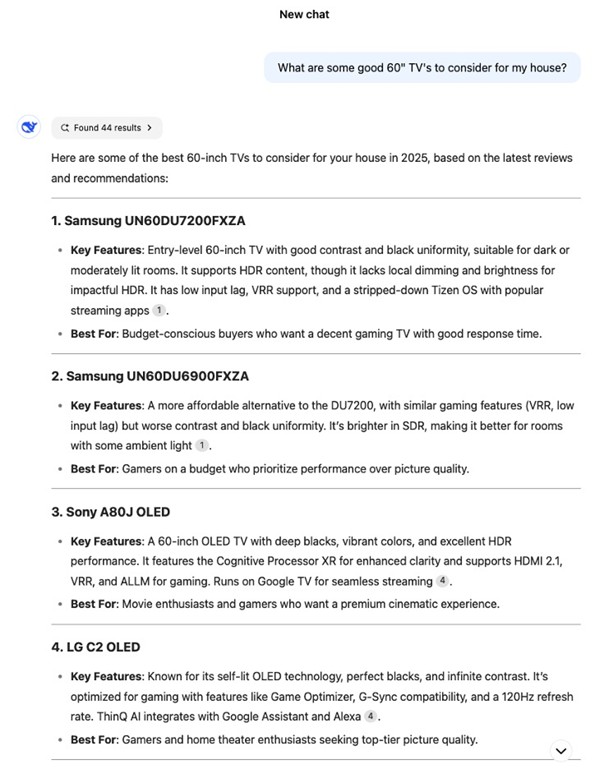
DeepSeek's "DeepThink" button displays the chain of thought and reasoning used to derive this answer.

Before generating this answer, some of the considerations DeepSeek went through when looking at results include:
Question Interpretation & Scope Definition
- Immediately clarified the search intent (60-inch TVs, not 1960s TVs)
- Established the specific size requirement (60-inch) as a strict filter
- Noted the temporal context (2025 models)
Source Credibility Assessment
- Cross-referenced information across multiple sources
- Paid attention to publication dates (e.g., noticed 2023 vs 2025 listings)
- Prioritized recent sources (e.g., "webpage 2's date is 2025-01-27")
Data Verification & Validation
- Consistently double-checked size specifications
- Flagged potential discrepancies ("need to confirm if they are indeed available in 60-inch")
- Questioned assumptions ("But sometimes manufacturers skip 60-inch")
Categorization & Organization
- Grouped TVs by technology type (OLED, QLED, etc.)
- Organized options by price tier (high-end to budget)
- Created logical groupings of features and specifications
Information Reconciliation
- Addressed contradicting information (e.g., when some sources said 60-inch TVs were rare while others listed many models)
- Compared overlapping information across sources
- Synthesized consistent information while noting discrepancies
Context-Specific Feature Analysis
- Evaluated features relevant to home use
- Considered various use cases (gaming, viewing quality, etc.)
- Noted special features that might affect the home viewing experience
This analysis reveals how DeepSeek employs a systematic, multi-layered approach to information processing before formulating its response. Each of these considerations helps ensure the final answer is comprehensive, accurate, and relevant to the user's needs.
DeepSeek's response format reveals what content is most likely to be cited in its answers. In the next section, we will examine how DeepSeek handles various queries. Then, we will address strategies for marketers to optimize their content for AI citation.
How DeepSeek Works
DeepSeek's Novel Approach: Searching on User's Behalf
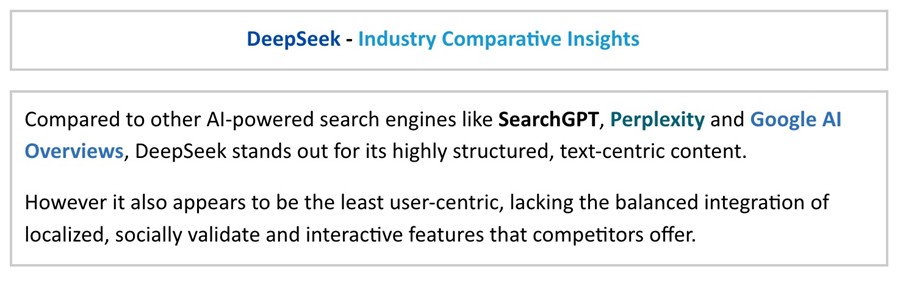
Unlike AI search platforms like Google AI Overviews, ChatGPT, Perplexity, and Bing Copilot, DeepSeek takes an open-source approach while prioritizing contextually rich responses and lower processing power. But beyond these differences, our analysis reveals three other fundamental ways DeepSeek disrupts the search experience:
- A "Think First" Approach: Before beginning its search process, DeepSeek will consider how to find the best answer to a question. For example, DeepSeek's understanding of recency or immediacy will shape where it looks for answers to a query. This differs from other AI Search platforms that take a "Get Content First, Think Second" approach.
- Real-Time, Multi-Source Content Exploration: Once DeepSeek begins its search, it does not pull from a singular search index and does not have a proprietary search index like Google, Perplexity, and other AI search engines. Instead, it navigates multiple sources in real-time to construct a more comprehensive response.
- Transparent Thinking: When ready with an answer, DeepSeek shows its reasoning and where it is collating information by providing citations, a major shift from black-box AI models that offer little visibility into their decision-making. This approach will likely increase trust in the results and help users rephrase their search or follow-ups if needed.
How DeepSeek Addresses Queries Across Different Industries
The AI determines how to source answers to the query, and then, similar to a traditional ranking algorithm, it goes through a series of factors to determine how to construct an answer.
Based on the type of question asked to DeepSeek, this reasoning can vary greatly. Below are some differences in DeepSeek's reasoning for generating answers that have material impacts for marketers who want to ensure content is eligible to drive referral traffic from DeepSeek.
E-Commerce – Direct Purchase Query Intent Analysis
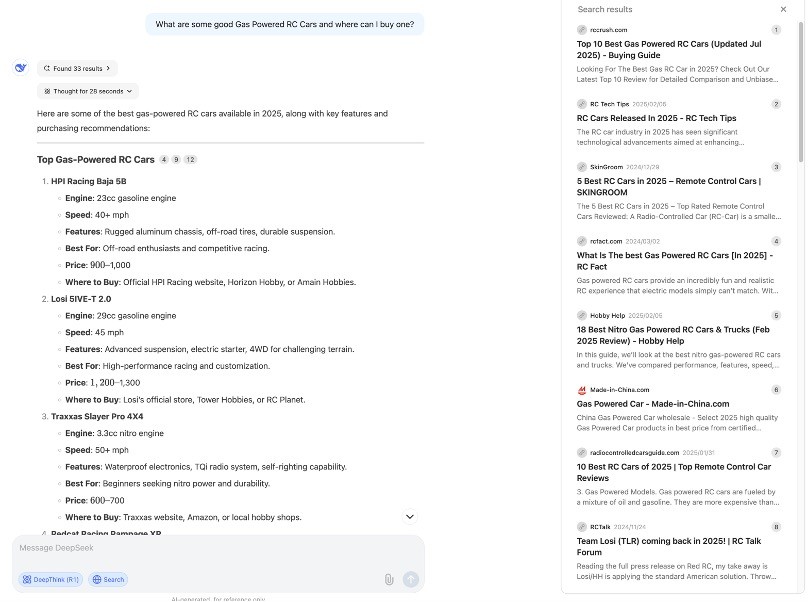
"What are some good gas-powered RC cars?"
Reasoning Summary
DeepSeek uses a systematic approach to address both product recommendations and purchase channels. The AI-first gathered model information across multiple sources, filtering out outdated listings (2022 models) and irrelevant procurement channels (industrial suppliers).
It prioritized establishing product credibility by cross-referencing models that appeared in multiple sources and collecting key purchase-decision data points like engine specifications, speeds, and prices. It also recognized the need to differentiate between various buyer personas by noting features like "Ready-to-Run" for beginners. When addressing the "where to buy" component, DeepSeek showed awareness of channel appropriateness by filtering out bulk/industrial suppliers and instead focusing on channels suitable for individual consumers, including both online retailers and local hobby shops, for hands-on support.
This demonstrates how DeepSeek attempts to provide comprehensive, practical purchasing guidance while maintaining relevance to individual buyers.
Implications and Action Items for E-commerce Marketers
- Structure product listings with complete technical specifications and clear categorization (e.g., beginner-friendly, professional grade). DeepSeek repeatedly cross-referenced specific model details and grouped products by user expertise level.
- Ensure your product pages are indexed in Bing, as DeepSeek may use Bing's API for search results. This is crucial for being included in the initial data set DeepSeek analyzes.
- Include current-year designations and clear product dating, as DeepSeek actively filtered out older models (2022) in favor of current offerings. The AI appears to prioritize temporal relevance.
- Provide clear purchase channel information and buyer guidance. DeepSeek distinguished between different purchasing options (online retailers, local shops, direct) and matched them to appropriate buyer segments.
- Include comparative product specifications that enable cross-referencing. DeepSeek repeatedly validated product features across multiple sources, suggesting it values information that can be corroborated.
AI Engine Comparative Snapshot
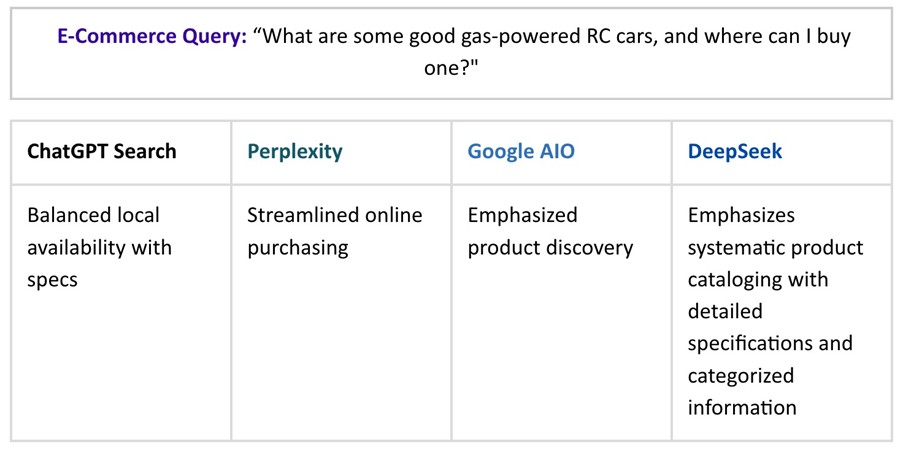
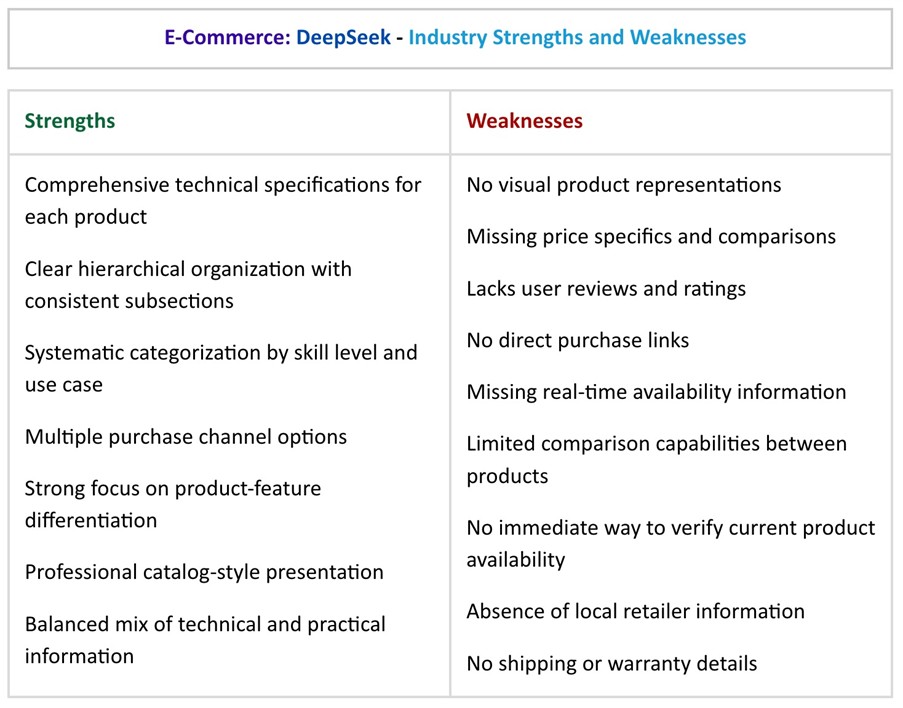
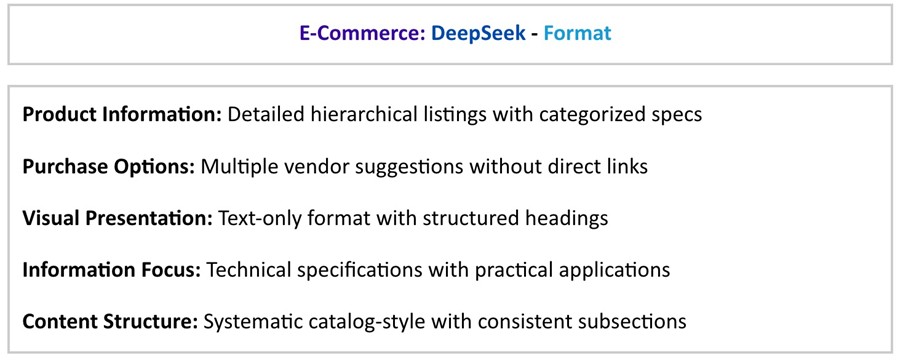
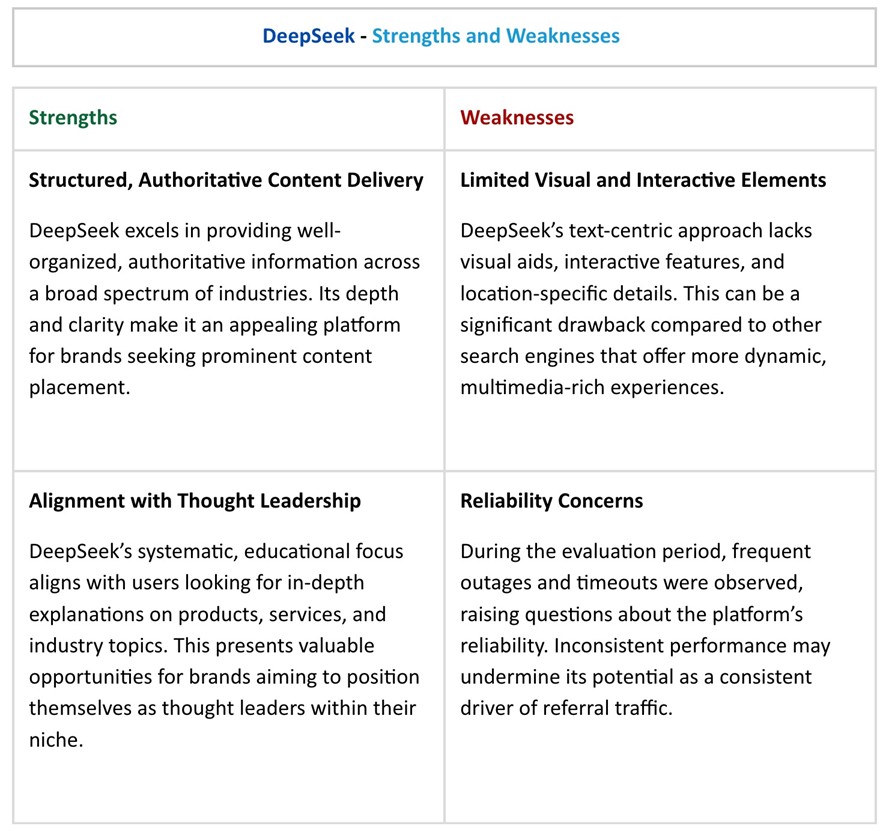
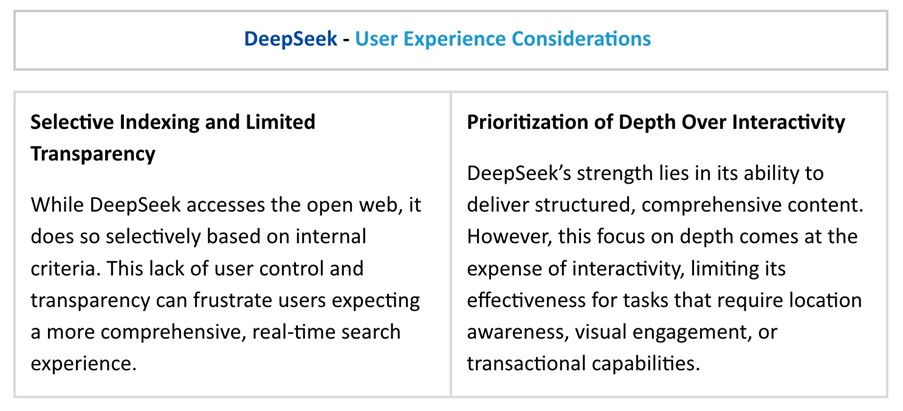
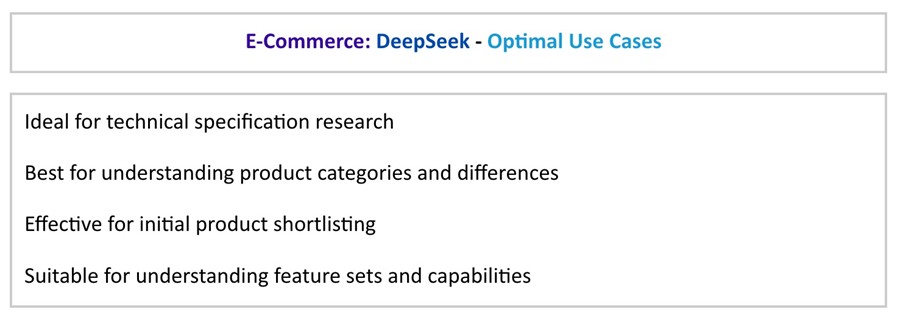
Overall, DeepSeek's response to the e-commerce query seems to emphasize providing a structured, comprehensive catalog of product details and purchase information.
While it lacks visual aids and real-world context that could enhance the user experience, its systematic approach and focus on technical specifications make it well-suited for research and product discovery.
Education – Information Research Query Analysis
"What is a BBA degree?"
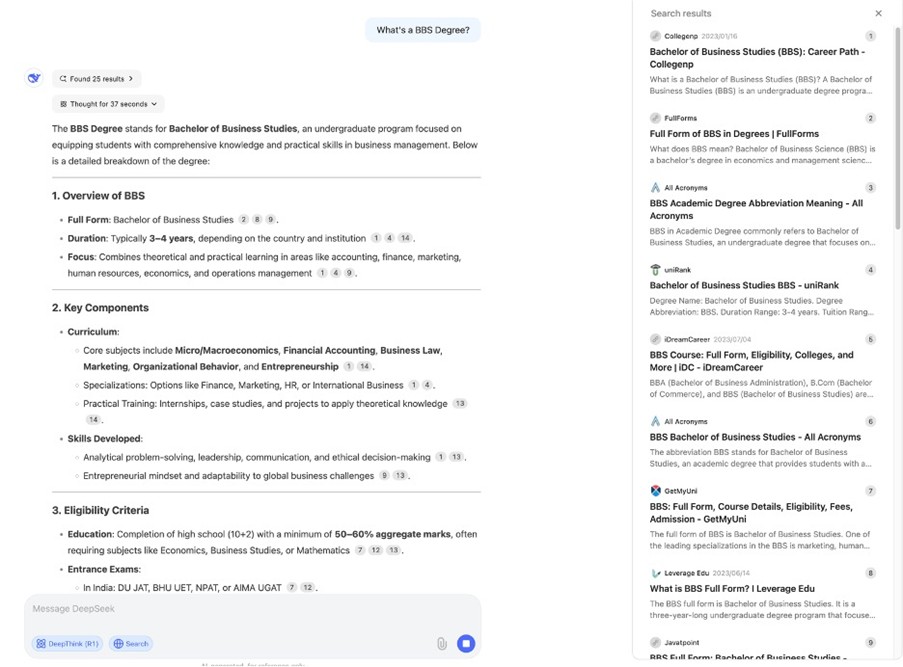
Reasoning Summary
The AI demonstrates a pattern of building comprehensive understanding rather than just collecting facts.
First, it establishes fundamental definitions, actively seeking agreement across multiple sources about what BBS stands for. It then systematically builds layers of understanding - from basic program structure to variations across regions to practical outcomes.
Notably, DeepSeek places high value on content that helps position concepts within their broader context, actively seeking comparative information (like BBS vs. BBA) and regional variations in how concepts are applied.
This reveals that for informational queries, DeepSeek prioritizes sources that help construct complete understanding rather than just providing isolated facts.
Implications and Action Items for SEO's and Marketers Focusing on Informational Content
- Build foundational content that clearly defines and explains basic concepts - DeepSeek actively seeks these building blocks before adding complexity.
- Include contextual comparisons (like "how X compares to Y" or "how X varies by region") as DeepSeek specifically searches for this relationship-building information.
- Connect theoretical concepts to practical outcomes - DeepSeek consistently seeks to bridge the gap between what something is and how it is applied in the real world.
- Ensure content aligns with commonly accepted facts while adding unique depth or perspective - DeepSeek validates basic information across multiple sources.
- Maintain a presence in Bing's index to ensure your content is available for DeepSeek to consider when building these knowledge frameworks.
AI Engine Comparative Snapshot
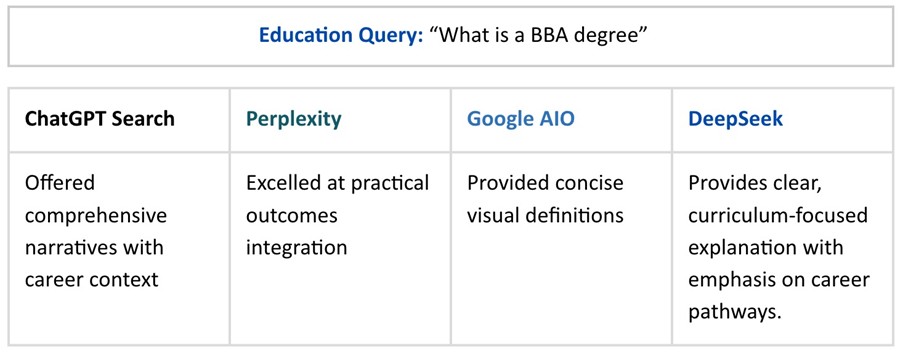
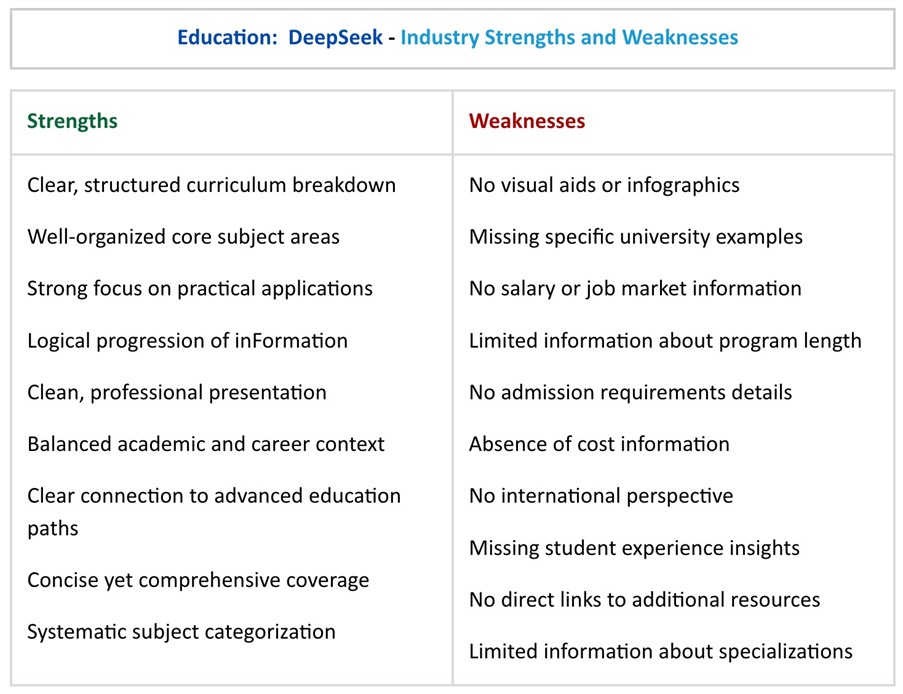
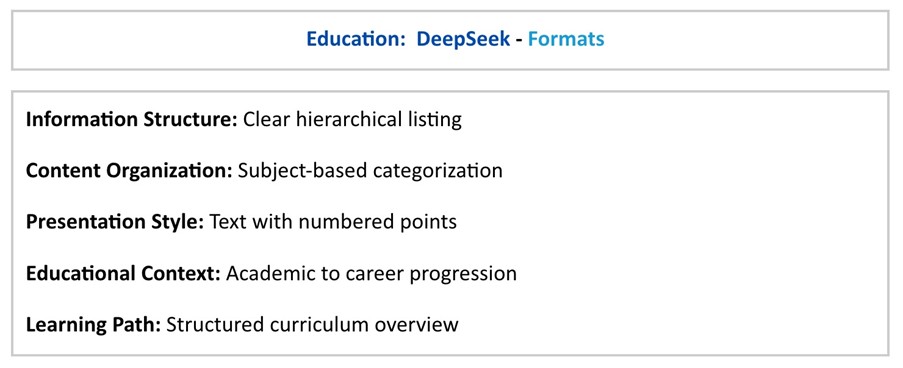
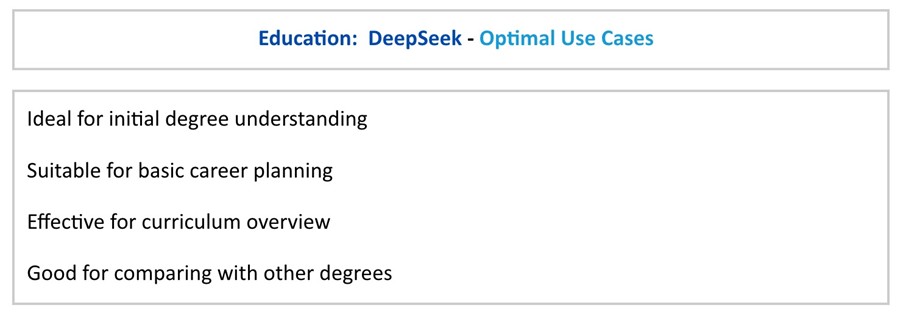
Overall, DeepSeek's response to the education query seems to provide a clear, structured overview of a BBA degree program, with a strong focus on practical applications and career pathways. While it lacks some visual elements and specific institutional details, its systematic approach and balanced coverage make it a helpful starting point for understanding the core aspects of this business degree.
Restaurants - Local Intent with Specific Timing Query Analysis
"What restaurants have Tuesday specials near me?"
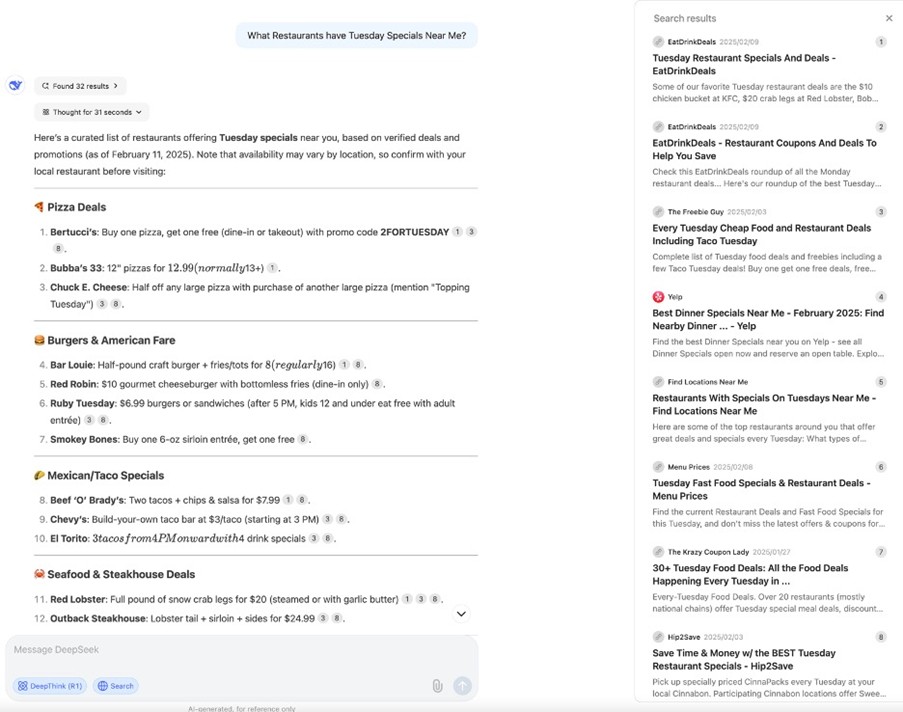
Reasoning Summary
DeepSeek's AI reveals sophisticated handling of both temporal and geographic constraints. The AI demonstrates clear prioritization between different types of local content: permanent business information (like locations and categories), recurring time-based content (like weekly Tuesday specials), and one-time events (like Super Bowl promotions, which it actively filtered out).
It cross-references deals across multiple sources for validation and to build a complete picture of availability and restrictions. Notably, it relies heavily on established local platforms like Yelp and Google Maps as authoritative sources while still pulling specific details from individual business websites or promotional pages.
The AI also shows awareness of the need to categorize local offerings (grouping by cuisine type) while maintaining strict relevance to both time constraints ("Tuesday") and implied geographic bounds ("near me"). Additionally, it recognizes the difference between chain-wide promotions and location-specific offers, suggesting a hierarchy in how it processes local business information.
Implications and Action Items for Marketers and SEOs Working with Location-Based Content
- Ensure your business information is accurately represented in major local aggregators (Yelp, Google Business Profile, TripAdvisor), as DeepSeek actively pulls from these platforms for local queries.
- Structure time-sensitive content clearly with dates, times, and any location-specific variations - DeepSeek prioritizes current, verifiable information and distinguishes between recurring and one-time events.
- Include category-specific information that helps DeepSeek organize offerings (like how it grouped restaurant deals by cuisine type) - this applies to any local business category.
- Maintain a presence in Bing's index and keep information updated across all platforms to ensure consistency when DeepSeek cross-references.
- Include clear disclaimers about location availability and verification requirements - DeepSeek appears to value transparency about local variations and chain vs. location-specific differences.
This demonstrates that successful local SEO is not just about individual business listings but about maintaining consistent, current information across all major platforms that AI might reference.
AI Engine Comparative Snapshot
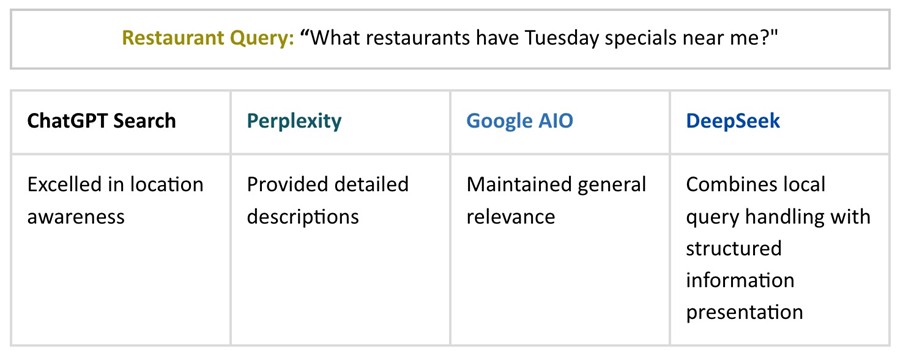
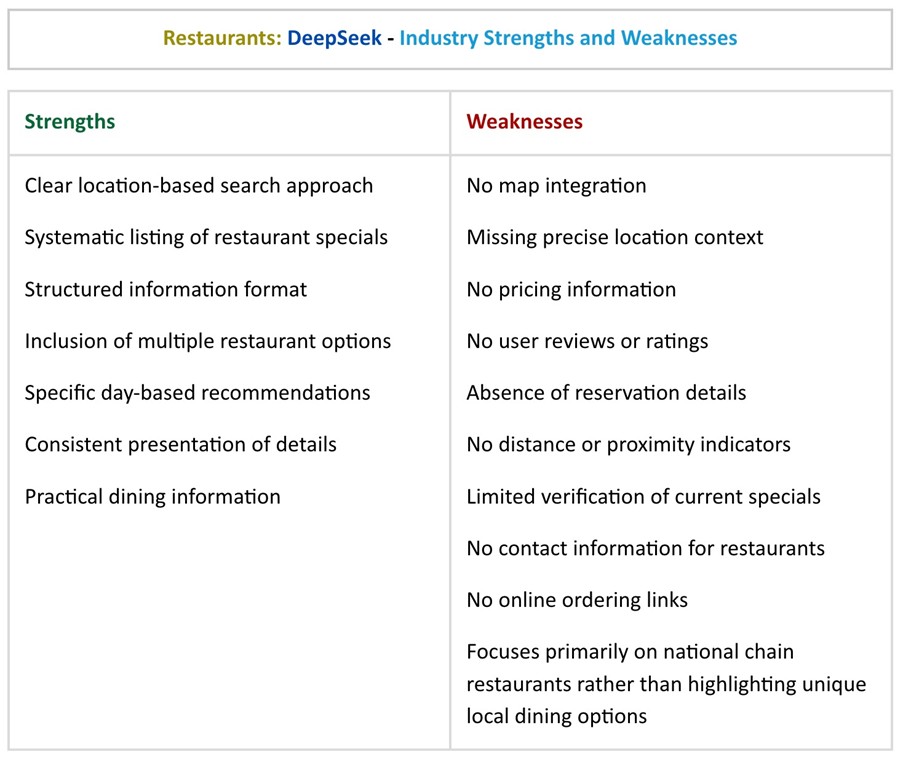
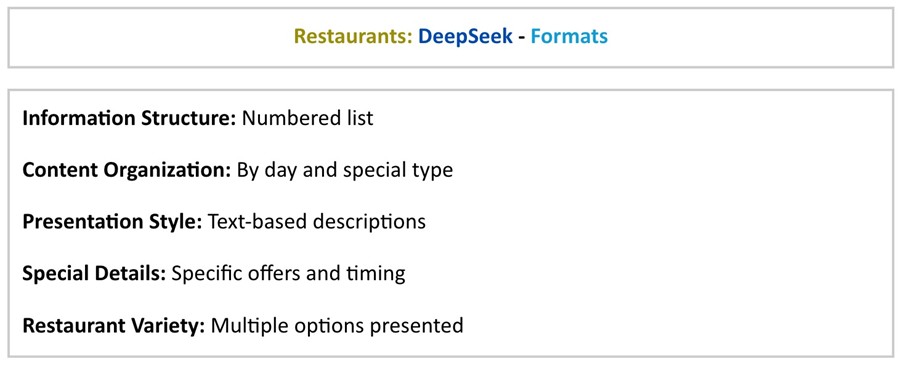
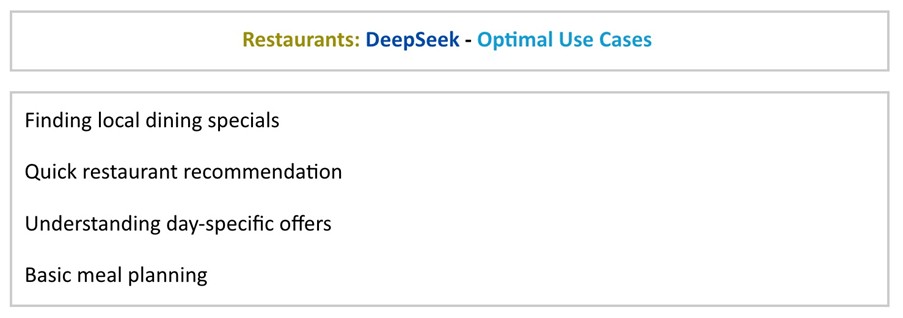
Overall, DeepSeek's approach to the restaurant's query seems to emphasize providing structured, day-specific 'specials' information across multiple options.
However, its focus on national chains rather than unique local establishments and the lack of key contextual details like locations, pricing, and user feedback limit its comprehensiveness for users looking to make informed dining decisions in their area.
Optimizing Content for DeepSeek
Understanding AI-Driven Source Selection
While traditional SEO focuses on keywords and rankings, succeeding with DeepSeek requires understanding how it builds comprehensive knowledge from multiple sources. Our analysis of DeepSeek's reasoning process reveals distinct patterns in how it selects and cites sources for different types of queries.
What DeepSeek Prioritizes in Content
- Knowledge Framework Building: DeepSeek builds understanding systematically, preferring sources that:
- Establish clear foundational definitions before adding complexity
- Create explicit connections between related concepts
- Bridge theoretical knowledge with practical applications
- Acknowledge and explain variations across different contexts
- Contextual Validation: DeepSeek actively cross-references information across sources, valuing content that:
- Aligns with commonly accepted baseline facts
- Adds unique depth or perspective beyond basics
- Provides clear geographic or industry-specific context
- Explicitly compares related concepts or approaches
- Information Architecture: To help DeepSeek process and cite your content effectively:
- Has clear hierarchies of information
- Build explicit relationships between related topics
- Organizes information in logical categories
- Include clear temporal markers for time-sensitive content
Maximizing Your Chances of Being Cited by DeepSeek
Example: If you are writing about CRM software, do not just list features. Ensure you have content that establishes what CRM is, how it works, how it differs from email marketing platforms, specific use cases, and measurable business outcomes.
Tip: Automate your connections between related concepts and instantly build topical authority across your site with BrightEdge's Autopilot. Its AI identifies key concepts expressed in content to find and connect all the related topics on your site.
Example: When discussing social media metrics, use standard industry definitions for engagement rates. However, add unique insights from your experience or research about what these metrics mean for different business types.
Tip: Leverage BrightEdge Copilot for Content Advisor's AI to generate briefs that encompass the holistic concepts around topics users are interested in to ensure you build a knowledge base DeepSeek requires for informational queries.
Example: A restaurant should maintain consistent information about hours, specials, and menus across their website, Google Business Profile, Yelp, and other platforms DeepSeek might reference.
Tip: For local or time-sensitive content, maintain consistent information across platforms like Google Business Profiles with BrightEdge Local and leverage AI to respond to reviews all in one platform rapidly.
- Build Complete Understanding: DeepSeek builds knowledge systematically, like constructing a building. Start with your foundation and work up:
- Begin with clear, simple definitions that anyone can understand
- Progress to how your topic works or is applied
- Show how it connects to related concepts
- Include real-world examples and outcomes
- Address common variations or different applications
- Enable Cross-Referencing: DeepSeek validates information across multiple sources. Make your content both verifiable and valuable:
- Ensure your basic facts match industry standards
- Add unique insights beyond the basics
- Include relevant data and statistics
- Acknowledge regional or industry differences
- Update facts and figures regularly
- Maintain Platform Presence: DeepSeek pulls from multiple sources to build comprehensive answers:
- Maintain accurate listings in major industry directories and Bing
- For local businesses, keep information current across all local platforms
- Update time-sensitive content promptly
- Remove outdated information
- Structure for AI Processing: Help DeepSeek understand and categorize your content
- Use clear, descriptive headings that show relationships
- Group-related information logically
- Mark time-sensitive content clearly
- Create explicit connections between related topics
- Use consistent terminology throughout
Example: Rather than just discussing "email marketing best practices," structure your content to show clear relationships: "Email Marketing > Deliverability > Authentication Methods > DKIM Setup Guide."
Tip: Give the AI hints about how your content is structured with Schema Tags. BrightEdge's SearchIQ can help you prioritize the Schema types that you should focus on based on what your top competitors are using.
Remember: DeepSeek is not just looking for information but building understanding. Your content should help it construct that understanding logically and verifiably.
Conclusion: A New Approach to Search Optimization
Success with DeepSeek requires shifting focus from traditional SEO metrics to helping AI build comprehensive understanding. By creating content that contributes to knowledge construction rather than just providing information, you increase your chances of being cited as an authoritative source across various types of queries.
The Reality of Optimizing for DeepSeek
Understanding how DeepSeek processes information reveals that success is not about traditional SEO metrics or platform-specific optimization. Instead, it is about helping an AI system comprehensively understand topics.
Our analysis shows that DeepSeek actively builds knowledge by synthesizing information across multiple sources, validating facts, and constructing logical frameworks.
The Path Forward
For marketers and SEOs, this means shifting focus from traditional optimization to:
- Creating content that helps construct understanding rather than just providing information
- Maintaining consistent, verifiable information across multiple platforms
- Structuring content to show clear relationships and hierarchies
- Building comprehensive knowledge frameworks that connect theory to practice
Success with DeepSeek is about creating content that genuinely helps DeepSeek build and validate understanding across different types of queries - whether informational, transactional, or local.
DeepSeek's approach will also have a rippling impact on SEO strategies. Because AI uses the same engines, index approaches, and understanding of site and content authority, established SEO practices are a great foundation to build from. However, brands must expand their focus beyond how they appear in traditional search results and into how they fit within the broader conversations that AI systems understand. Marketers must understand the various touch points of AI discovery and maximize their brand's share of conversation.
By focusing on these fundamentals rather than platform-specific tactics, you will be better positioned to have your content cited as DeepSeek and other AI search engines continue to evolve.