7 Steps to Using a Social Media Marketing Strategy to Drive Success

ksoosOLD
ksoosOLD
M Posted 6 years 9 months ago
t 9 min read

An estimated 79 percent of Americans have at least one social media account, making these platforms an immensely popular means of engaging with friends and family as well as businesses. The engagement people have on these platforms has paved the way for organizations to build a strong social media marketing strategy if they want to ensure they take advantage of all opportunities to find leads and customers.

Social media has evolved into an important part of e-commerce and digital marketing. Seventy one percent of customers are more likely to make a purchase based upon referrals and recommendations they receive on social media. Further, more than half of users on Facebook, Pinterest, and YouTube report that they follow brands on social media to help them learn about products and services.

A quality social media marketing strategy opens the doors for you to engage with these consumers and turn them into customers. Here is how to build a social media marketing strategy that works for your brand.

What is a social media marketing strategy?

With such a large percentage of the consumer population on social media, a good social media marketing strategy empowers you to take your promotions to these popular platforms. It provides an excellent channel for incorporating many of the most valuable elements of modern marketing, including personalized marketing and direct engagement.

Through social media, customers feel as though they can get a better idea of the values of a particular business as well as answers to their questions or concerns. It helps to shed the impersonal view of the business as an entity, and instead helps potential customers see the people behind the scenes who work at the organization.

A good social media marketing strategy will understand how to incorporate these optimal, unique elements of social media into a broader marketing strategy that represents the brand well across multiple channels and platforms. If you have not created a quality social media marketing strategy for your organization, here is what we would recommend.

Examine your overall marketing strategy

Begin by examining your current marketing strategy. Remember that you want your marketing channels to integrate seamlessly, creating a consistent experience for customers regardless of where they interact with your organization. A good social media marketing strategy, therefore, will want to understand the precise goals and positioning for the rest of the marketing team so that they can easily align these new platforms.

Consider important factors such as:

  • Who your target audience is
  • The types of channels and platforms this age group appreciates
  • The pain points of this target audience
  • How these prospects and existing customers respond to different types of content and outreach
  • The language and tone you typically take with your customers-- do you focus on being friendly and approachable? Do you take effort to present yourself more formally as an expert?

Look also at the KPIs you want to measure for social media. Before you get started, you need to understand what your goals are concerning social media marketing. Knowing what you want to accomplish will help you understand where to focus your efforts and what to measure. This will guide the rest of your social media marketing strategy.

A social media marketing strategy can help in a variety of ways. It can increase brand exposure, drive leads, help customer service, and build traffic for websites, to name a few. By determining precisely what role you want your social media marketing to play within your greater advertising strategy, you will find it easier to build a plan that will help this goal materialize.

1. Look at competitor strategies

Considering that an estimated 91 percent of businesses use social media marketing, the odds are that your competitors already live on various social channels. Therefore, take the time to dive into their profiles and campaigns a bit to gain a better idea of how they use social media for their organization. You can look at their followers and the engagement with the material they post. You can also use the Data Cube to gain even more insight into how this particular company builds their marketing strategy and the success they see. 

Take this information and start to develop some ideas regarding how you want to create your own strategy. Look at their statistics, such as posting rate, the amount of content they post from their own site versus non-affiliated sources, and how often they interact with their followers. Use these insights to start forming more ideas about a successful social media marketing strategy for your organization.

2. Research your target audience and their social media usage

Assuming you have created a thorough marketing strategy outside of your social media marketing strategy already, you should have a good understanding of your target customer. Knowing important demographics and information about this target customer can now also help you find them on social media.

Make sure you develop your information about where your target audience lives on social media through data, as the demographics on a number of different platforms continue to change.

3. Work with your content marketing team to plan what you want to post through social

Now that you understand where your target audience lives and what you want to accomplish with your main social media accounts, work with your digital and content marketing teams to draft potential posting schedules. Review the types of content that will likely generate the best results on the social media platform. See if you can collaborate to draft some content that will serve the social media audience particularly well.

Remember that your social media marketing strategy should revolve around a conversation with your perspective customers and existing customers. They do not want to log into their social media accounts and find themselves subjected to regular commercials or information coming from a so-called soapbox. Instead, they want to engage in conversations with prospective brands. They want to feel as though organizations care about their needs and answering their questions. Posting content that aligns with these goals, even if it doesn't come from you, can be OK, as it helps to build relationships with these customers.

You can use BrightEdge, along with social listening, to track emerging trends and popular topics. This can help you develop the best posts for engaging with your audience and posting content that resonates best with your customers. Staying on top of the conversations that matter the most to them will help your organization stay relevant in the mind of customers.

5. Incorporate customer service

Remember that an important part of social media is nurturing more direct relationships with your customers. Customer service plays an important role in this goal. Social listening tools can help you pay attention to mentions of your brand or industry across the social platforms. This can help you keep track of conversations and know when a response from your organization might be warranted. Let your customers know that you pay attention, and if they need something, you will be there to help.

6. Measure the results of your campaigns

Once you begin leveraging social media marketing, you now need to regularly measure the results from your campaigns. Look back to the KPIs you wrote down at the beginning of this process. These KPIs will help you track the most important results involved, and thus can help you determine your success rate.

Social media can provide a powerful means of driving traffic back to your website. BrightEdge makes it easy to track the traffic rates and rankings of your website pages, so keep careful track of the pages you post on social media. This will help you see how posting the pages on social media impacts the success of that page. You want to watch your engagement and traffic metrics on this content.

Also monitor your internal social media metrics, such as the number of followers you have and how often people engage with your individual posts. Do not overlook opportunities to engage with people in conversation, but monitor how they respond to your efforts. 

The better you can track the results from your campaigns, the easier it will be to see real progress and continue to evolve your marketing plan to help your business thrive.

7. Make adjustments

Armed with your data from the success and shortcomings of your social media marketing strategy, you should now continue to make regular adjustments to help you improve in the areas where you struggle. Continue to monitor your progress and fine tune your social marketing strategy to keep it well aligned with your business goals.

A good social media marketing strategy empowers you to better engage with prospective customers and join the global watercooler. Brands who understand how to do this effectively can take their branding to the next level. Take advantage of the BrightEdge capabilities in monitoring social media content engagement and tapping into the latest trends and see what these platforms can offer you.


brightedge request a demo banner

How to Track Social Media Marketing Success

gregalbuto
gregalbuto
M Posted 7 years 3 months ago
t 9 min read

Why track social media? Social infiltrates and impacts nearly every aspect of the modern consumer's life. Forty-one percent of users report that they use the social media platforms to keep in touch with friends and family, 40 percent say that they use it to get their news.

Not only does it impact social relationships and the spread of news but retail as well. Forty percent of people in the same report also said that they use social media to follow their favorite brands, and one in four report that they have purchased a product they saw on social media.

track social success with brightedge

The rise of social media has driven marketers to consider carefully the importance of using these platforms in marketing campaigns as a means of engaging users. Considering that 77% of Americans have at least one social media account, its ability to reach target consumers should be clear.

As marketers work to build a social strategy, however, you want to make sure that you understand how to appropriately track social media with the rest of your strategy and know how to measure your results. It is only through this careful analysis that you will be able to accurately determine the success of your efforts and know how to modify and improve them moving forward.

How to use & track social media in conjunction with the rest of your marketing strategy

Social media can provide a powerful means of learning more about your target consumer and capitalizing on new trends and opportunities. The constant conversation and the use of trending topics to track social media can give brands insight into what their customers are most interested in at that moment, which can complement standard keyword research. Producing content that speaks to these trends while they are popular can help brands increase their rankings and grow their reputation.

Twitter trending topics is one way to use social media to uncover topics of interest for users

You can also use social media to get another window in the strategy and content of your competitors. Track social pages to see what they produce and what the target audience responds to best. You can see what types of material gets shared and promoted within your sector and develop a strategy that will help you position yourself better against your competitors.

Finally, social media can be used to promote content and build personal relationships with users. You can let your followers know when you publish new material and make it easier for them to share interesting content with their own connections.

In an era of constant communication, customers rely heavily on personal relationships with brands they do business with. The ability to track social media and provide a platform for people to speak with their favorite brands directly helps to nurture this connection between customers and brands. This boosts loyalty and helps customers feel as though this brand truly cares about them and their pain points and wants to help.

To build this strong social media strategy, brands also want to take the time to establish their tracking metrics.

Measure & track social media success

There are a number of social KPIs you can monitor, both on and off the platforms themselves. Knowing what you want to accomplish from your social media strategy will help you determine which metrics matter the most to you. Here are a few ways you can monitor your strategy.

Track social media metrics in platforms

You can track social media platforms and a number of different metrics that will lend insight into how people respond to your material and your profile overall.

  • Track social engagement with the content you post. Look at how many likes, shares, comments, and other types of engagement your material receives. This will help you see how people respond to your content and how well it captures their interest.
  • Look at how people engage with your profile in general in response to your posts. See how many followers you have on your profile and the rate at which that number grows. When people interact with your content and profile, that activity automatically appears on the feeds of their connections. This means high engagement numbers will get your profile in front of even more people, and encourage interested people to engage with you further.

Track social on your internal site

The key to your social media profile is to generate traffic and attention to your site and capture more leads. Track social media activity on your site to help you better understand how the social platforms impact your buyer’s funnel.

  • Track social traffic sources on your website. This will give you a better idea of how people find your content. If, for example, you see a considerable amount of traffic coming from your social media pages, you know that your content has attracted the interest of many people who follow your brand. As you track social media clicks, check also the bounce rate that occurs from these users. This will provide valuable insight regarding not only if your content headings catch people’s eyes, but also how well the content itself engages them.
  • As you see your traffic start to generate on your site, you can then see how well these new visitors follow through with the rest of your sales funnel. Analyze the percentage of your social media visitors that become leads and how many of them then progress through each stage of the buyer’s journey through journey maps.
  • Look also at the percentage of social traffic who end up making purchases and how large those purchases are. This provides insight into the quality of the leads you gather through social media and the ROI they provide your business. You can then start to gather data about the financial benefit of your efforts, which will then influence future strategy decisions.

Track your position on the SERP

Finally, in addition to seeing how your social strategy helps you build relationships with people on the platforms and generate traffic for your site, you also want to track how your social efforts impact the rest of your SEO. Namely, you want to see if your social media efforts have helped your page improve in the SERP rankings.

Keep in mind that Google reports that they do not track social media signals, specifically. However, marketers have noticed that sites receiving large amounts of traffic and quality engagement numbers tend to see higher rankings--and social media can help you in both areas.

As you promote content on social media, mark this event on the BrightEdge platform. You can then determine if your content sees growing traffic and engagement numbers following promotion. You will also be able to see if this increased engagement then helps to lead to higher rankings.

Boosting rankings can help your material earn more clicks, and therefore more revenue.

Social media can provide you with a powerful means of engaging with prospective customers and building personal relationships with them. No brand, however, wants to waste time and money on efforts that do not bring in a discernible ROI. Learning how to track your social strategies both within the platform, on your site, and on the SERPs can help you better understand your progress and make the optimal decisions for your brand moving forward.

See a demo of what's new in the BrightEdge platform

Creating Content For Social: How Does It All Fit?

Mark Mitchell
Mark Mitchell
M Posted 11 years 8 months ago
t 9 min read

There’s been much discussion about how social media influences SEO, including references to “social SEO.” So what does it all mean, and just how do social media and SEO work together? In this article, we’ll explore some high-level concepts around the social signals used in SEO.

Some background: big data and social media

Over the past few years, there has been an overwhelming amount of data generated online. The sheer volume of global data (referred to as “big data”) produced within this relatively short time span can be largely attributed to social media – 90 percent, in fact.

How do social, content and organic search fit together? As the graphic above indicates, organic rank in search engines is predominantly determined by content quality, and search engine algorithms use content sharing as a primary quality signal. The explosion of social data is reflected by statistics for social media usage and content sharing, which show that as of 2013, there were 1 billion Facebook users accounting for 3.3 billion pieces of content shared each month, while Google Plus accounted for 5 billion Google +1’s per day.

How search enginges are adapting to create content for social

Bing

Bing began its foray into social with its incorporation of Facebook “likes” in its search engine results pages (SERPs) in February 2011. It then expanded its integration of social in its search results in May 2012, when it announced a dedicated social side bar on its SERPs, allowing users to readily view their Facebook friends’ activity as it related to their search query. More recently, Facebook has given way to Twitter in Bing’s search results, as Twitter entered into an “exclusive social partnership” with Bing in November 2013). In June of this year, Bing announced that users could “discover tweets directly in [their] search results.” Bing’s commitment to integrating social signals in its search results is evident in its webmaster guidelines, where it states:

Social media plays a role in today’s effort to rank well in search results. The most obvious part it plays is via influence. If you are influential socially, this leads to your followers sharing your information widely, which in turn results in Bing seeing these positive signals. These positive signals can have an impact on how you rank organically in the long run.

Google

Google first ventured into social with its introduction of “Social Search” in 2009, which it described as an expansion of its personalized search results (instituted in 2007). Social Search highlighted “relevant public content” from the users’ friends and social contacts at the bottom of Google’s SERPs. It wasn’t until June 2011 that Google launched Google+, its own social media platform, which integrates Google+ content into personalized search results. Several months later, in November 2011, the search giant announced it would start adding brands and businesses to Google+ with Google+ Pages. Then in January 2012, it unveiled “Search, plus Your World,” which incorporated G+ profiles and “relevant web results” related to search queries in their SERPs. Marketers have also adapted to social in their SEO strategy. A survey by BrightEdge found 80 percent of marketers indicated that social sharing of their content as a means to improve rank would be “much more important” (31 percent) or “more important” (49 percent) in 2013 than in 2012.

Why brands need to pay attention to social

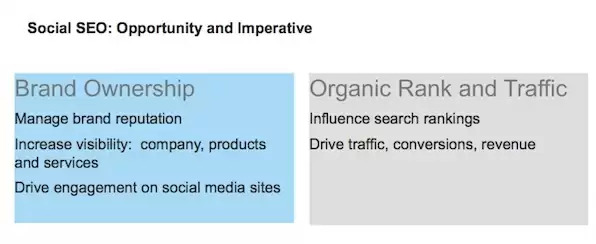
Clearly, social sharing of content represents an opportunity – if not an SEO imperative – for brands to increase their visibility in organic search, including their products, services and solutions. Embracing social also allows brands to “own” and manage their reputation, as well as engage with their followers and fans. Finally, a social presence can drive Web traffic, which in turn can result in increased conversions and revenue: 

discover how to create content for social with brightedge

Case study: SEO and social 'synergy'

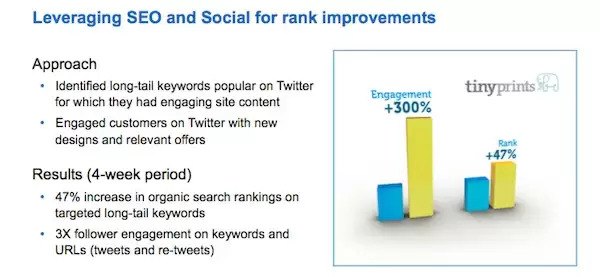
An example of how SEO and social work together to improve search ranking and customer engagement is the case of Tiny Prints, an online boutique specializing in unique designs and stylized cards for occasions. As a brand that relies on organic search to drive Web traffic and revenue, Tiny Prints sought to increase its conversion rate and boost search engine rankings using Twitter and organic search together.

influence customers by creating content for social - brightedge

As the graph shows, the results proved that the strategy worked. By aligning its Twitter strategy with its organic search strategy, Tiny Prints realized a 300 percent increase in customer engagement on its Web pages and “long-tail” keywords, as well as a 47 percent increase in search rankings on those keywords and the individual Web page URLs that were trending on Twitter – all within one month! Stay tuned for our follow-up post on how you can leverage the suite of BrightEdge tools to rock your social SEO!  

,