

How AI Shopping Agents Choose Brands and How to Earn the Recommendation
Shoppers now ask AI assistants to evaluate options, check availability and recommend what to buy. In Google AI Mode and Gemini, AI agents can complete the purchase with approved retailers, and in ChatGPT, shoppers can buy through retailer apps. As a result, AI assistants shape which products make a shopper's shortlist.
This guide explains how agentic commerce works, what BrightEdge research shows about AI recommendations, how commerce protocols fit in and which steps enterprise teams can take now. For the latest holiday research, webinars and coverage, see our agentic commerce hub.
Key takeaways
- Google and AI search work together. Google drove 86.3% of search referrals in September 2026, and AI referrals to ecommerce brands grew 752% in the 2025 holiday season.
- The AI shortlist is shrinking. ChatGPT recommends about 25% fewer brands per answer, and ecommerce answers fell from about six brands to four.
- Product data earns the recommendation. Protocols such as ACP and UCP handle checkout. Accurate product facts that agents can reach decide which brands make the shortlist.
- Few retailers are ready yet. About 3% of the ecommerce companies BrightEdge works with let agents complete purchases.
1. What is agentic commerce?
Agentic commerce is the use of AI agents to shop on a consumer's behalf. The agent researches products, compares options and, where the retailer allows it, completes the purchase.
Take a shopper who wants "a waterproof jacket under $200, suitable for winter hiking, that can arrive by Friday." Without AI, that shopper searches Google, opens retailer sites, compares prices and checks delivery dates. An AI shopping assistant runs those searches, filters out jackets that miss a requirement and returns a shortlist. An AI shopping agent then confirms the chosen jacket is in stock and can arrive by Friday, adds it to a cart and places the order once the shopper approves.
| Search-led ecommerce | AI shopping assistant | Agentic commerce | |
|---|---|---|---|
| Product discovery | Shopper searches | AI suggests options | Agent researches for the shopper |
| Comparison | Shopper compares pages | AI summarizes alternatives | Agent evaluates options against requirements |
| Purchase | Shopper checks out | Shopper usually checks out | Agent builds the cart or places the order with shopper approval |
| Shopper's role | Does every step | Makes the decisions | Sets goals, limits and approvals |
Assistants recommend. Agents act on the recommendation, within limits the shopper sets.
2. Why AI recommendations now shape brand visibility
Brands now compete for visibility in AI recommendations as well as in Google. A product can rank well in Google and still be missing from an AI recommendation. A retailer can publish accurate product details on its own site while an AI assistant picks up conflicting details from a reseller listing or an outdated review.
Google is still the largest source of search traffic
In September 2026, Google drove 86.3% of all search referrals and AI search accounted for 2.25%, up from 1.95% in August, according to BrightEdge AI Market Pulse. In November 2025, BrightEdge ecommerce data showed AI referrals made up less than 1% of organic ecommerce traffic, and Google drove 87.6% of organic search traffic to ecommerce brand sites. Brands that run Google search and AI search as one connected workflow cover both paths shoppers take to a purchase.
AI is growing fast from a small base
Direct AI referrals to leading ecommerce brands grew 752% year over year in the 2025 holiday season, as BrightEdge reported in November 2025. AI agent traffic is rising too. In April 2026, BrightEdge data showed AI agent requests to websites reached 88% of the volume of human organic search visits. The figure measures request volume. One agent task can send many requests, so request counts run higher than the number of shoppers behind them. BrightEdge projects agent requests will pass human organic search visits by the end of 2026. Analytics platforms such as Google Analytics do not capture this agent activity, so it rarely appears in standard traffic reports.
Agents have started to buy, too. BrightEdge estimates that purchases made through AI agents are growing 43% month over month and have about quadrupled since April 2026. Only about 3% of the ecommerce companies BrightEdge works with let agents complete transactions, according to BrightEdge data reported by The Wall Street Journal. Jim Yu, BrightEdge CEO, explains what agent-led buying means for retailers in This Is the First Agentic Shopping Season.
AI visibility and AI referral traffic measure different stages of the purchase. Visibility shows whether your brand enters the shopper's consideration set. Referral traffic shows how many shoppers click through from an AI answer to the site. A shopper can compare brands in an AI assistant and then buy through Google or the retailer's site.
3. How AI agents decide which brands to recommend
AI shopping recommendations draw on search results, product data, publishers, reviews and marketplaces, and each AI platform weighs the sources differently.
Four areas where brands shape AI recommendations
Brands can influence four of the signals AI engines weigh when they recommend a product:
- Product information. Accurate descriptions, specifications, price, availability, delivery and returns.
- Site access. Crawlers and retrieval agents can reach product, pricing and policy pages.
- Outside sources. Reviews, publishers and retailers describe the product correctly.
- Consistency. The same facts appear on the site, in structured data and in product feeds.
AI cites more sources and recommends fewer brands
BrightEdge research shows the number of brands in each answer is shrinking. From June 2025 to June 2026, ChatGPT cited about 89% more sources per answer while recommending about 25% fewer brands, across nine industry categories. Ecommerce saw the steepest decline, from roughly six recommended brands to four.
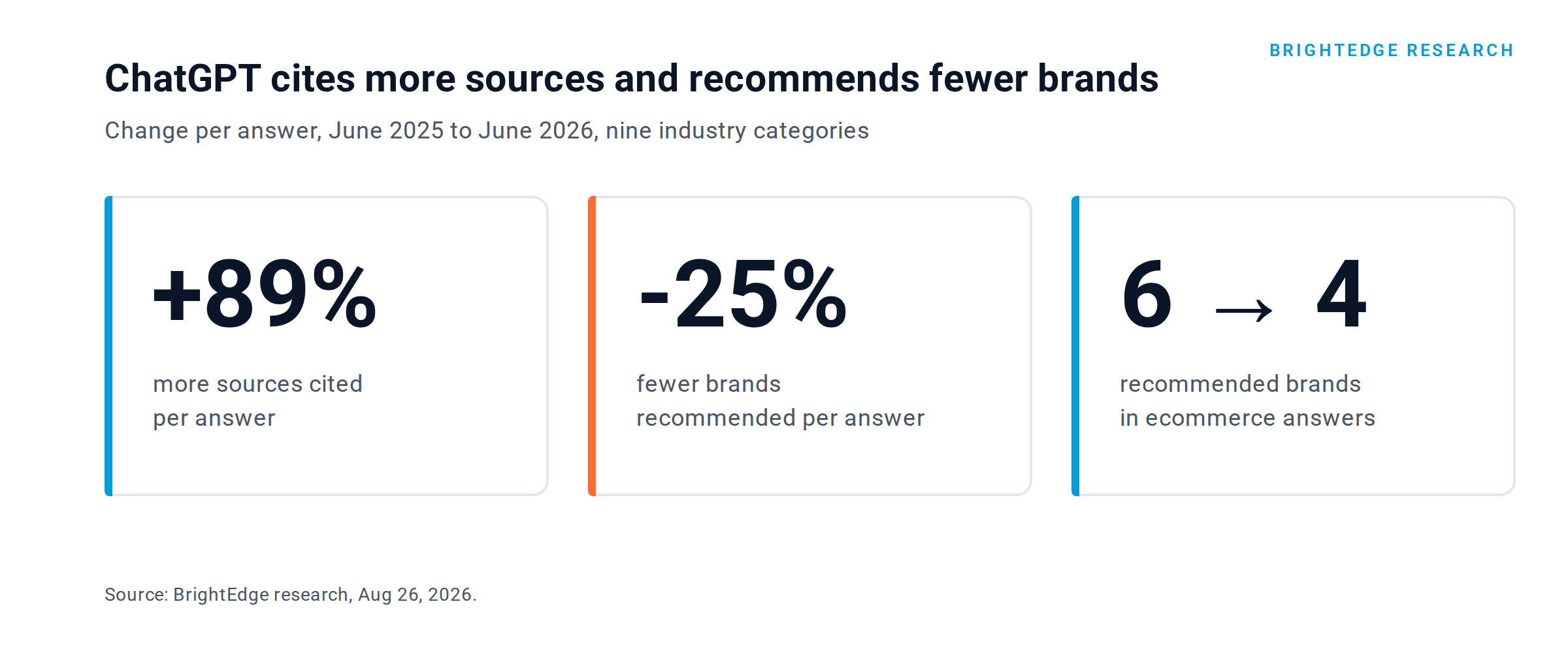
ChatGPT cites more sources per answer and names fewer brands, with ecommerce answers falling from about six recommended brands to four. Source: BrightEdge research, Aug 26, 2026.
Google AI Overviews and ChatGPT draw on different sources. A separate, earlier BrightEdge study of retail prompts analyzed that 30% of Google AI Overviews' transactional citations pointed to a major retailer domain, against 15% for ChatGPT. ChatGPT named an average of 7.5 brands per transactional answer, against 6.1 for AI Overviews. The two studies used different prompt sets and time periods, so their brand counts measure different things. Track your category's shopping questions in each engine separately.
Each engine favors different retailer page types. BrightEdge's October 2026 holiday research found that commercial pages accounted for 64.6% of Google AI Overviews' citation weight. Newsroom and help pages accounted for 51.5% of ChatGPT's citation weight. The study covered the top 50 cited results per retailer for holiday prompts at four US retailers from June to August 2026, so the findings apply to those four retailers.
For a travel example, see how travel brand visibility changes with AI search intent.
Jim Yu, BrightEdge CEO, told The Wall Street Journal that each AI model evaluates potential purchases in its own way. "That makes it more complicated for marketers, but that also makes it very interesting," he said.
4. How agentic shopping works, from discovery to checkout
- Understand the request. The shopper states a goal. The agent reads budget, category, size, use, brand preferences and delivery needs.
- Discover products. The agent finds candidates in search indexes, commerce data and merchant information. A product the agent cannot find at discovery never enters the candidate set.
- Evaluate and recommend. The agent checks specifications, price, stock, reviews and retailer policies, then presents a short list. At this step a brand either makes the shopper's shortlist or drops out of it.
- Prepare or complete the purchase. The agent sends the shopper to the retailer, builds a cart or starts checkout where the retailer allows it. The available actions depend on the platform, the retailer and the shopper's permissions.
- Fulfill and support. The merchant ships the order and handles service and returns.
Agents can loop back at any stage to compare alternatives, recheck availability or ask the shopper to clarify a requirement.
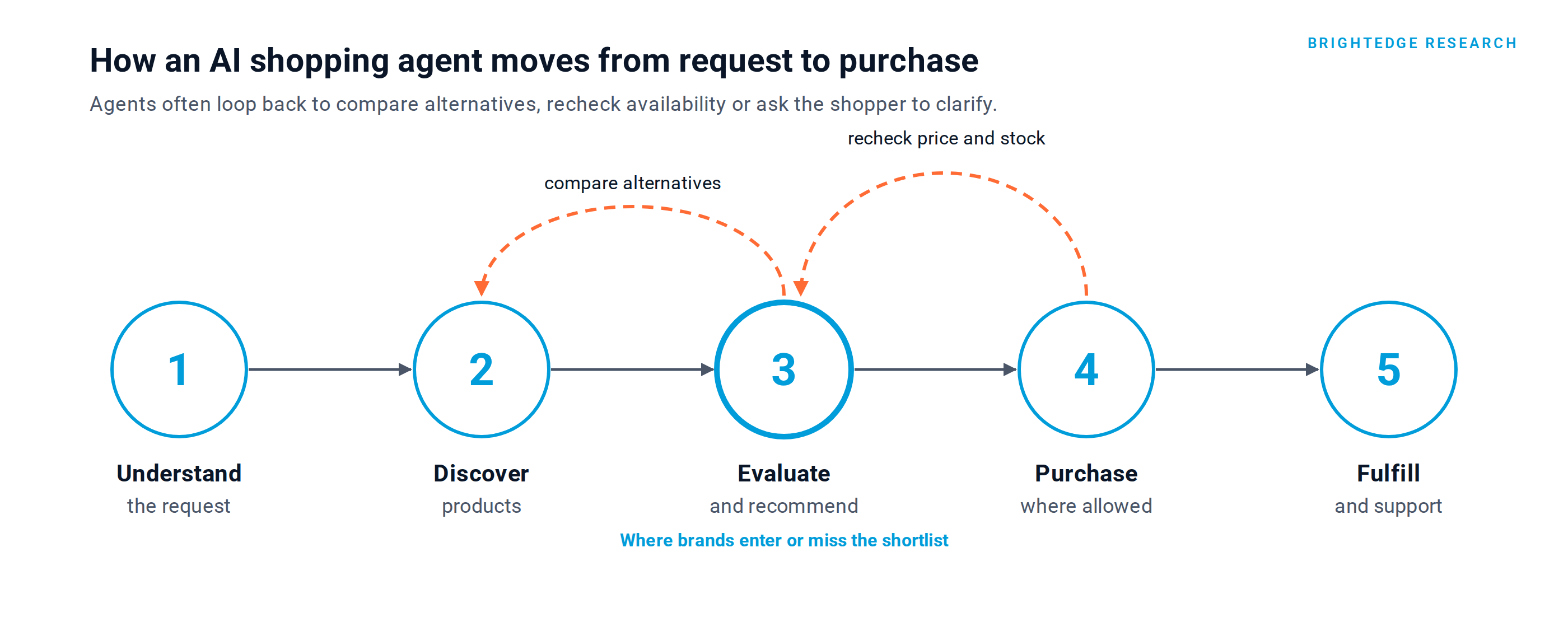
The five stages of agentic shopping. Agents loop back to compare alternatives and recheck price and stock before they buy.
Discovery decides which products enter consideration. Commerce protocols handle checkout and payment. A retailer can be ready for agentic checkout and still be missing from the recommendations shoppers see.
5. Agentic commerce protocols explained: ACP, UCP, AP2 and MCP
Commerce protocols set how AI systems connect to merchants, tools and payments. Each protocol covers a different part of the transaction, from product data to payment.
| Protocol | Primary role | Why it matters |
|---|---|---|
| Agentic Commerce Protocol (ACP) | Agent-to-merchant product data and checkout flows | Lets agents that use ACP start checkout with the merchant |
| Universal Commerce Protocol (UCP) | Connects Google AI surfaces with merchant commerce systems | Enables purchases in AI Mode and Gemini |
| Agent Payments Protocol (AP2) | Payment authorization for agent purchases | Confirms the shopper authorized the agent's payment |
| Model Context Protocol (MCP) | Connects AI applications to tools and data | Lets agents query product, inventory and service systems |
Agentic Commerce Protocol (ACP)
Developed by OpenAI and Stripe, ACP supports commerce interactions between AI agents and merchants, including product data and checkout integrations. In March 2026, OpenAI shifted its shopping strategy toward product discovery and merchant-controlled checkout experiences, while retaining options for deeper integrations through ChatGPT apps and approved checkout partners, as Retail TouchPoints reported. For retailers, ACP offers a route into ChatGPT shopping by sharing product data with the experiences that adopt it. Explore the Agentic Commerce Protocol.
Universal Commerce Protocol (UCP)
UCP is an open standard from Google that connects AI shopping experiences with merchant commerce systems. Google uses it to enable agentic actions in AI Mode in Google Search and Gemini, starting with direct buying for approved merchants in the US. Merchants join a waitlist, and Google approves each integration. Retailers considering UCP should review their Merchant Center feeds, checkout capabilities and current participation rules. Read Google's UCP documentation.
Agent Payments Protocol (AP2) and Model Context Protocol (MCP)
AP2 covers payment authorization when an AI agent takes part in a purchase. MCP is a general-purpose protocol that connects AI applications to external tools and data, such as product, inventory or service systems. Neither one decides which products an agent recommends.
Commerce protocols let AI agents and merchants exchange product data and process orders. Recommendations still depend on accurate, accessible product content, so visibility tracking belongs alongside any protocol work.
6. Seven steps to prepare your site for AI shopping agents
Readiness spans SEO, ecommerce, engineering, merchandising and analytics teams.
- Check which AI agents reach your site. Review server logs for agents hitting product and category pages. Check robots.txt, firewall rules, CDN rules and rate limits, including 429 (too many requests) errors. Confirm that your rules do not block search and retrieval agents such as OAI-SearchBot and ChatGPT-User. Treat training crawlers, search crawlers and live retrieval agents separately, in line with your content and security policies.
- Make key content easy to retrieve. Keep descriptions, specifications and policies in HTML text that agents can read without running scripts. Lightweight versions of key pages, such as Markdown files, give retrieval agents less code to process. A BrightEdge analysis of the top 20,000 websites found that 97% do not serve agents formats such as Markdown, while 61% use schema. These formats are optional for Google visibility. Google states that site owners do not need Markdown or AI-specific files to appear in its generative AI search features.
- Keep product facts consistent. Product IDs, specifications, price, availability, shipping and returns should match across product pages, structured data and merchant feeds. For example, an agent may need to confirm that an item can arrive tomorrow, the selected size is in stock, free shipping applies and loyalty points can be used.
- Keep pages current. Retire outdated dates, expired promotions and broken links. In BrightEdge's analysis of 13,915 holiday prompts across six major US retailers, 11% of ChatGPT holiday prompts cited a page tied to a past year. Best Buy, which keeps one permanent Black Friday hub URL, held its dated-page share to 4.2%. A permanent seasonal hub, updated each year at the same URL, keeps current offers in one place and gives AI engines one page to cite.
- Review commerce integration readiness. Decide whether you need agent-enabled checkout, then check each platform's current requirements for feeds, commerce APIs, authorization and payments.
- Check how outside sources describe you. Monitor how AI engines summarize your products and which sources the AI answers rely on. Correct inaccurate specifications and outdated descriptions at the source.
- Track recommendations across engines. List the shopping questions in your categories. Track mentions, citations, competitors and sources in Google AI experiences, ChatGPT and other engines over time.
Four measures that show AI shopping impact
| Measurement area | Question to answer | Example metrics |
|---|---|---|
| Search visibility | Can shoppers find the brand through Google and other search engines? | Keyword rankings, Share of Voice, organic traffic |
| AI recommendations | Does the brand appear when AI engines compare products? | Mentions, citations, recommendation share, competitor visibility |
| AI agent activity | Do AI agents reach the site successfully? | Agent requests, visited URLs, response codes, access errors |
| Business outcomes | Do visibility and agent activity turn into sales? | AI referrals, conversions, revenue, attributable agentic transactions |
AI referrals undercount AI influence. A shopper can get a recommendation and later return through Google or by typing the brand's URL. Server-side agent requests do not show up as human sessions either. Report measured results, such as referrals and transactions, separately from estimated influence.
Tie every metric to an action:
- Competitors appear and your brand does not: find the sources and product facts behind the competitor recommendations.
- Agents request a product page and hit errors: review access rules and page delivery.
- AI mentions rise without referral growth: check whether the cited pages give shoppers a clear next step, such as a product page with current price and stock.
7. Find and fix AI shopping gaps with BrightEdge
BrightEdge brings Google search performance, AI search visibility and AI agent activity into one connected workflow.
- Demand and Google visibility. Data Cube X and Share of Voice show search demand and your position in Google.
- AI recommendations. AI Hyper Cube and AI Catalyst show how AI engines mention, cite and compare your brand against competitors.
- Agent activity. AI Agent Insights shows which agents visit, what they request and where they hit errors.
- Agent readiness. Agent Edge detects verified AI agent traffic and serves verified agents a lightweight version of each page.
Sites using Agent Edge have seen agent traffic double or triple within weeks, with AI referral traffic up as much as 30%. Results vary by site. Outside retail, Arm, a semiconductor design company, saw verified AI agent traffic to optimized pages more than double within weeks, and Bloomfire, a B2B knowledge management company, saw a 30% lift in direct AI referral traffic, according to the Agent Edge launch announcement.
With all four views in one place, a team can trace a missing AI recommendation back to a blocked agent, an outdated product fact or a stronger competitor source, then confirm the fix in the same view.
8. Frequently asked questions
What is agentic shopping?
Agentic shopping is the consumer side of agentic commerce: AI that researches and compares products for a shopper and, where the retailer allows it, buys them. How much the agent does depends on the platform, its integrations and the shopper's permissions.
How is agentic commerce different from agentic AI?
Agentic AI covers systems that plan and act toward goals. Agentic commerce applies agentic AI to buying and selling.
Can AI agents complete purchases?
Yes, on some platforms and with approved retailers. Google offers checkout in AI Mode and Gemini for approved merchants, starting in the US, through its Universal Commerce Protocol. In ChatGPT, purchases happen on the retailer's own site or through retailer apps inside ChatGPT. Purchases are subject to the authorization and approval requirements of the platform, merchant and shopping experience. Few merchants have switched agent checkout on yet. BrightEdge data reported by The Wall Street Journal shows about 3% of the ecommerce companies BrightEdge works with let agents complete transactions.
How can retailers see which AI agents visit their site?
Server logs show it. Look for the user-agent names of AI agents, such as OAI-SearchBot and ChatGPT-User, then check the response codes those agents receive on product pages. BrightEdge data shows analytics platforms such as Google Analytics do not record AI agent visits. BrightEdge AI Agent Insights reports the same activity without manual log review.
Does implementing ACP or UCP guarantee AI recommendations?
No. Commerce protocols handle checkout and payment on the platforms that adopt them. They do not decide whether a platform discovers, lists or recommends a merchant's products.
Does SEO still matter for agentic commerce?
Yes. BrightEdge AI Market Pulse shows Google still drives most search referrals. BrightEdge research also shows the major AI engines rely on search indexes when they build answers, such as Bing for ChatGPT and Google's own index for AI Overviews. A strong Google ranking does not guarantee an AI recommendation, so run SEO and AEO as one workflow and track both. Our Ultimate Guide to GEO covers the full workflow.
Do brands need Markdown or llms.txt files?
Not as a rule. Google's guidance for its generative AI search features lists llms.txt files and Markdown among the things site owners do not need. Some sites serve Markdown anyway because it gives retrieval agents less code to process. Start with accurate product data, pages agents can reach and regular monitoring of AI answers.
What should retailers do first?
Start with a baseline. Check whether AI engines recommend your brand for your top category questions and whether AI agents can reach your product pages. Section 6 covers the full checklist.
See where your brand appears across Google and AI search
AI shopping agents choose products they can find, understand and trust enough to recommend. BrightEdge measures each of those stages, alongside the Google performance that still drives most discovery.
Identify gaps in AI recommendations and agent access | Request a demo