
When AI Goes Negative on Finance Brands: How Google and ChatGPT Create Completely Different Risk Profiles in YMYL Search
Google amplifies bad headlines. ChatGPT plays devil's advocate. Finance brands need a different strategy for each.
BrightEdge data reveals that Google AI Overviews and ChatGPT both surface negative sentiment about finance brands — but for fundamentally different reasons. Google amplifies bad headlines. ChatGPT plays devil's advocate. Finance marketers need different strategies for each.
Last week, we analyzed how AI goes negative in healthcare — the highest-stakes YMYL category in search. This week, we're putting that same lens on finance: another category where both Google and ChatGPT apply extra scrutiny to the sources they cite and the claims they surface.
The patterns share some similarities with healthcare — and some characteristics that are entirely unique to financial services.
A question we keep hearing from financial services marketers: "AI is careful with finance content. YMYL protects us, right?"
Not exactly. Both engines apply extra caution to finance queries. But that caution doesn't shield brands from negative sentiment — it just shows up differently on each platform. And in finance, the negative sentiment profiles of Google AI Overviews and ChatGPT are almost mirror images of each other.
So we used BrightEdge AI Catalyst™ to analyze brand sentiment across thousands of finance prompts in both ChatGPT and Google AI Overviews — examining what types of queries trigger negativity, where in the buying journey it appears, and what finance brands need to do differently on each platform.
The short answer: Google goes negative when your news is bad. ChatGPT goes negative when your product is being evaluated. Same YMYL category, completely different risk profiles.
Data Collected
Using BrightEdge AI Catalyst™ and our Generative Parser, we analyzed:
Using BrightEdge AI Catalyst™, we analyzed:
| Data Point | Description |
| Brand sentiment in AI responses | Every brand mention classified as positive, neutral, or negative across both Google AI Overviews and ChatGPT in finance queries |
| Query intent classification | Each prompt categorized by user intent: Informational, Consideration, Branded Intent, or Transactional |
| Negative sentiment triggers | Pattern analysis identifying which query types and topics generate negative brand mentions |
| Cross-platform comparison | Head-to-head sentiment and intent analysis on finance prompts appearing in both engines |
| Evaluation query patterns | Specific analysis of "Is [brand] good?" and "Is [product] worth it?" query types across both platforms |
Key Finding
Google and ChatGPT both surface negative sentiment about finance brands — but the composition of that negativity is fundamentally different, driven by different query types, at different stages of the buying journey, and for different underlying reasons.
Google AI Overviews surfaces negative sentiment on roughly 2.4% of finance queries. ChatGPT surfaces it on roughly 4.4%. But comparing the raw rates misses the point — Google only generates AI Overviews for a portion of finance queries, while ChatGPT responds to every prompt it receives. The real insight isn't the volume. It's the shape.
On Google, 57% of negative finance sentiment appears on Informational queries — users learning about a topic and encountering headlines. On ChatGPT, 57% appears on Consideration queries — users actively evaluating options and deciding where to put their money.
Same number. Completely opposite intent. That's the story.
Two Engines, Two Kinds of Negativity
Google AI Overviews: Negative When the News Is Bad
Google's AI goes negative on finance brands primarily through news-cycle amplification. Lawsuits, data breaches, branch closures, regulatory actions, and below-market rates drive the majority of negative sentiment on the platform.
The pattern is recognizable from traditional PR: a single negative news event generates AI responses across multiple related queries, extending the tail of reputational damage well beyond a normal news cycle. A data breach doesn't just surface on the breach-specific query — it shows up on queries about online banking, account security, and even general savings rate comparisons for that institution.
Roughly 10% of Google's negative finance queries trace directly back to lawsuits, breaches, or regulatory issues. Another significant share comes from rates and fees queries — when a user asks about a specific institution's savings or CD rates and those rates fall below competitive benchmarks, Google's AI flags it. This isn't scandal. It's AI doing comparison shopping on the user's behalf.
ChatGPT: Negative When the Product Is Being Evaluated
ChatGPT's negative sentiment profile looks completely different. The dominant pattern is what we're calling the "Is X Good?" gauntlet — evaluation queries where users ask ChatGPT to render a judgment on a financial institution or product.
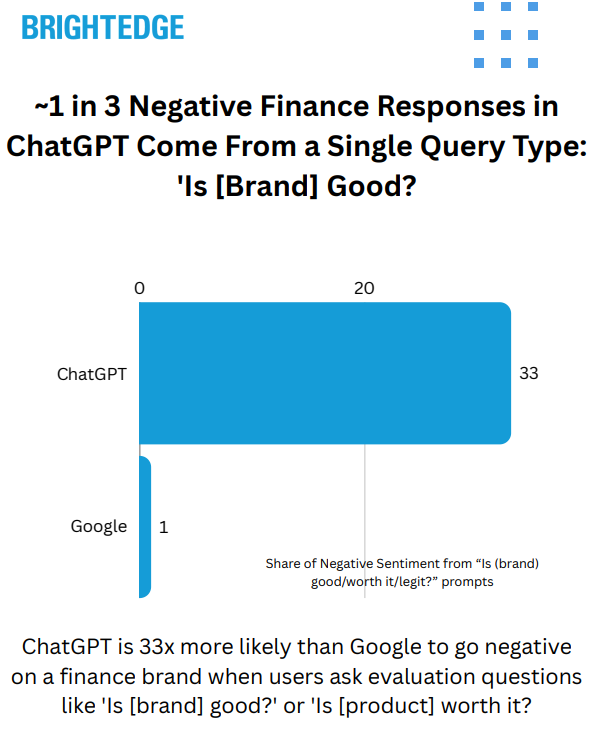
"Is [bank] a good bank?" "Is [product] worth it?" "Is [service] legit?" — roughly one-third of all negative sentiment in ChatGPT comes from this single query pattern. It's the largest source of negative finance sentiment on either platform, and it barely exists on Google.
When users ask ChatGPT these evaluation questions, it synthesizes review platform data and presents a balanced "pros and cons" response. That structure inherently introduces negativity — even for strong brands. ChatGPT is 33x more likely than Google to go negative on a finance brand when users ask evaluation questions.
Where in the Buying Journey Does AI Go Negative?
The intent breakdown reveals how differently these platforms create brand risk:
Google AI Overviews — Negative Sentiment by Intent
| Intent | Share of Negative Queries |
| Informational | 57% |
| Consideration | 27% |
| Branded Intent | 9% |
| Transactional | 7% |
ChatGPT — Negative Sentiment by Intent
| Intent | Share of Negative Queries |
| Consideration | 57% |
| Informational | 36% |
| Branded Intent | 4% |
| Transactional | 3% |
Google goes negative early in the journey — when users are still learning about a topic and encountering headlines. ChatGPT goes negative at the point of decision — when users are actively comparing options and deciding where to put their money.
The implications are significant. Google's negativity affects brand perception and awareness. ChatGPT's negativity affects purchase decisions. Different stage, different business impact, different remediation strategy.
The 5 Risk Zones for Finance Brands
When we categorize the types of queries that trigger negative brand sentiment in finance, five distinct patterns emerge — each weighted differently across the two platforms.
1. The "Is X Good?" Gauntlet (ChatGPT-Heavy)
The single largest source of negative finance sentiment. When users ask ChatGPT to evaluate a financial institution or product, it pulls from review platforms and consumer advocacy sites to build a balanced response. Even strong brands get dinged. This pattern drives approximately one-third of all negative sentiment on ChatGPT, compared to less than 2% on Google.
Example query patterns: "Is [bank] a good bank?" "Is [credit card] worth it?" "Is [financial service] legit?" "Is [investment product] a good investment?"
2. Rates as Implicit Criticism (Both Engines)
When someone asks about a specific institution's savings rate, CD rate, or money market rate and those rates fall below competitive benchmarks, both engines flag the brand negatively. This accounts for approximately 7–8% of negative queries on both platforms.
The mechanism is subtle but powerful: AI is essentially doing real-time comparison shopping for the user. No scandal required — just a product that doesn't measure up on the metric the user is asking about.
Example query patterns: "[Institution] savings account interest rate" "[Institution] CD rates" "[Institution] money market rates" "Which bank offers the highest interest rate?"
3. News-Cycle Amplification (Google-Heavy)
About 10% of Google's negative finance queries trace back to lawsuits, data breaches, regulatory actions, or institutional crises. The risk isn't just the initial story — it's the persistence. A single negative event generates AI responses across dozens of related queries, and those responses stick long after traditional news coverage fades.
What makes this pattern particularly dangerous in finance is the breadth of query contamination. A data breach story doesn't just appear on "[institution] data breach" — it surfaces on queries about that institution's online banking, account security, and general trustworthiness.
Example query patterns: "[Institution] lawsuit" "[Institution] data breach" "[Institution] branch closures" "[Payment platform] fraud"
4. Product Gap Exposure (ChatGPT-Heavy)
When a user asks "Does [institution] offer [product]?" and the answer is no or the offering is limited, ChatGPT frames that absence as a negative. This pattern showed up repeatedly across personal loans, high-yield savings accounts, and specialty financial products.
This is a uniquely ChatGPT-driven risk because of how the platform structures its responses. Google AI Overviews tends to answer the question factually. ChatGPT contextualizes the gap — explaining not just that the institution doesn't offer the product, but what that means for the user and where they should look instead.
Example query patterns: "Does [institution] offer personal loans?" "Does [institution] have a high-yield savings account?" "[Institution] [product type]" when the product doesn't exist
5. Consideration-Phase Comparison Shopping (ChatGPT-Heavy)
Over half of ChatGPT's negative finance queries fall under Consideration intent — users asking "which bank has the best..." or "what's the best [financial product]." When AI ranks options, brands that don't come out on top get implicitly or explicitly dinged.
The sources ChatGPT leans on for these comparisons are primarily review platforms, consumer finance publishers, and editorial rankings — third-party sources the brand may not be actively managing.
Example query patterns: "Which bank has the best savings rate?" "What's the best credit card for travel?" "Who has the best high-yield savings account?" "Best bank for [specific need]"
Healthcare vs. Finance: Same YMYL Framework, Different Fingerprints
Last week's healthcare analysis revealed that negative AI sentiment is driven almost entirely by safety signals — pregnancy contraindications, drug interactions, long-term risk disclosures. It's institutional sources saying cautionary things about specific products, and AI faithfully surfacing those warnings.
Finance follows a fundamentally different pattern. Negative sentiment isn't safety-driven — it's evaluation-driven. AI goes negative when it's assessing whether a brand, product, or rate is competitive. The triggers aren't warnings from medical authorities; they're review platform ratings, below-market rates, and product gaps.
| Dimension | Healthcare | Finance |
| Primary negative trigger | Safety warnings from institutional sources | Product evaluation and competitive comparison |
| What gets dinged | Consumer products (OTC/pharma) | Financial institutions and their products |
| Who's protected | Hospital systems (0.1% negative rate) | No structural protection — all institutions are evaluated |
| Biggest risk query type | "Can I take X while pregnant?" | "Is [institution] good?" |
| Platform split | Similar patterns on both engines | Mirror-image patterns — Google is news-driven, ChatGPT is evaluation-driven |
| Remediation | Publish safety content so AI uses your language | Manage review presence and product competitiveness |
The structural takeaway: in healthcare, AI goes negative when institutional sources say something cautionary about a product. In finance, AI goes negative when it evaluates whether your brand — and your products — measure up.
What This Means for Your Finance Brand Strategy
Google and ChatGPT require two different strategies. Google's negative sentiment is a PR and reputation management problem — monitor how AI Overviews surface your news cycle and for how long. ChatGPT's negative sentiment is a product competitiveness and review management problem — the evaluation queries aren't going away, and AI is pulling from sources you may not be actively managing.
Evaluation queries are the single biggest risk zone. "Is [brand] good?" and "Is [product] worth it?" drive roughly a third of all negative sentiment on ChatGPT. If your rates, products, or customer experience aren't competitive, AI will surface that at the exact moment a prospective customer is deciding where to go. This is the highest-impact negative sentiment in finance AI because it appears at the point of decision.
AI exposes product gaps by name. When users ask whether your institution offers a product and the answer is no, ChatGPT frames that absence as a negative. Map your product suite against the queries users are asking and know where you have holes before AI tells your prospects.
Own your review presence before AI uses it against you. ChatGPT leans heavily on review platforms and consumer finance publishers when constructing evaluation responses. The brand's presence on these third-party platforms is the raw material AI works with. Managing those profiles isn't just a customer satisfaction exercise — it's an AI search strategy.
Monitor both platforms — they tell opposite stories. A brand's AI sentiment on Google can look completely different from its sentiment on ChatGPT. Google may show clean results while ChatGPT surfaces review-driven criticism, or vice versa. A single-platform monitoring approach will miss half the picture.
The news cycle has a longer tail in AI. When negative news hits, Google AI Overviews doesn't just surface it once — it distributes that story across multiple related queries and keeps it visible well beyond the typical news cycle. Financial institutions need to understand which queries are contaminated by a negative story and plan content responses accordingly.
Technical Methodology
| Parameter | Detail |
| Data Source | BrightEdge AI Catalyst™ |
| Engines Analyzed | Google AI Overviews, ChatGPT |
| Query Set | Thousands of finance-related prompts spanning banking, investing, lending, insurance, and personal finance |
| Sentiment Classification | Brand-level sentiment (positive, neutral, negative) for every brand mentioned in finance AI responses |
| Intent Classification | Each prompt categorized as Informational, Consideration, Branded Intent, or Transactional |
| Negative Pattern Analysis | Categorization of negative-sentiment queries by trigger type: evaluation, rates/fees, news-cycle, product gaps, and comparison shopping |
| Cross-Platform Comparison | Head-to-head sentiment and intent analysis on finance prompts appearing in both engines |
Key Takeaways
| Finding | Detail |
| Two Engines, Two Risk Profiles | Google goes negative when news is bad (57% Informational). ChatGPT goes negative when products are evaluated (57% Consideration). Mirror-image intent patterns. |
| "Is X Good?" Dominates ChatGPT Negativity | Evaluation queries drive ~33% of all ChatGPT negative finance sentiment — and ChatGPT is 33x more likely than Google to go negative on these queries. |
| 5 Predictable Risk Zones | Evaluation queries, below-market rates, news-cycle amplification, product gap exposure, and consideration-phase comparison shopping. Each weighted differently by platform. |
| Finance ≠ Healthcare | Healthcare negativity is safety-driven (pregnancy, drug interactions). Finance negativity is evaluation-driven (competitive comparisons, review data). Same YMYL framework, different fingerprints. |
| ChatGPT Goes Negative at Point of Decision | Over half of ChatGPT's negative finance sentiment appears on Consideration-intent queries — when users are actively choosing where to put their money. |
| News Cycle Has a Longer Tail in AI | A single negative story generates AI responses across dozens of related queries on Google, extending reputational impact well beyond the normal news cycle. |
| Review Platforms Power ChatGPT's Negativity | ChatGPT pulls from review sites and consumer finance publishers when constructing evaluation responses. Managing those profiles is now an AI search strategy, not just a customer satisfaction exercise. |
Download the Full Report
Download the full AI Search Report — When AI Goes Negative on Finance Brands: How Google and ChatGPT Create Completely Different Risk Profiles in YMYL Search
Click the button above to download the full report in PDF format.
Published on March 11, 2026