
The AI Agent and AEO Organizational Readiness Gap
BrightEdge uncovers the gaps in AI search readiness, showing what separates leading enterprise teams from those still catching up.
The AI Agent and AEO Organizational Readiness Gap
The shift to AI agents and answer engines is reshaping how enterprise content gets discovered, cited, and acted on. Most organizations are still figuring out who owns it. BrightEdge surveyed more than 1,000 enterprise digital and search marketers over three months to take an honest read on AI agent and AEO readiness across the org: where awareness sits, where ownership lives, and where alignment between marketing, IT, and leadership is breaking down. The result is a clear picture of what separates the teams pulling ahead from the ones still stuck explaining the problem.
Key findings in this report cover:
How marketers would actually answer if their CMO asked tomorrow, "are we ready for AI agents?"
Who inside the enterprise owns the question of whether AI agents can access the site, and why it landed where it did
The single phrase that's moving the needle on internal buy-in faster than any strategy deck
Why a majority of cross-functional conversations with IT and security stall, get blocked, or quietly get avoided
What enterprise teams say they need most right now to move forward (it's not more strategy)
Download the Full Report
Download the full research report—including key findings, data visuals, cross-industry insights, and expert guidance to help your organization navigate the shift to AI agents and answer engine optimization (AEO).
Further Resources
BrightEdge Blog: From AI search trends to content strategy tips, the blog is where we break down what’s happening—and what’s next.
Webinar Library: Catch up on our latest webinars—whether you're looking for platform walkthroughs, customer success stories, or strategy sessions with SEO leaders.
Media and News Updates: From mainstream business and technology media - like The Washington Post, Forbes, BBC News, Wired, and Fortune - to leading search and digital publications such as MediaPost, SearchEngineLand, and SearchEngineJournal – view a blend of coverage, research, insights, and industry thought leadership.
About This Report
As AI search platforms experience explosive growth, marketers face a critical question: How should they balance investment between this emerging channel and proven organic search strategies?
BrightEdge analyzed thousands of queries and top-performing websites, including many Fortune 100 brands, from January through August 2025. The data reveals AI search is experiencing double-digit growth rates month over month, demonstrating how rapidly AI is reshaping discovery. Yet while AI search is growing fast, it accounts for less than 1% of referral traffic while organic search remains the primary driver and delivers the majority of conversions.
Key Content in This Report
- AI Search Referral Traffic Shows Big Month-Over-Month Gains
- Why Organic Search Continues to Outperform AI Search on Conversions
- Content sources used by AI that brands can influence
- Two BrightEdge Innovations that Help Marketers Win in the Age of AI
Google Commands 90%+ Search Market Share, But Key AI Players Are Growing Fast
The data suggests that AI search has had dramatic periods where some months double traffic. This isn't just another incremental change—it represents a period of experimentation- both in how users are connecting to websites and how AI engines are managing how they send referrals.
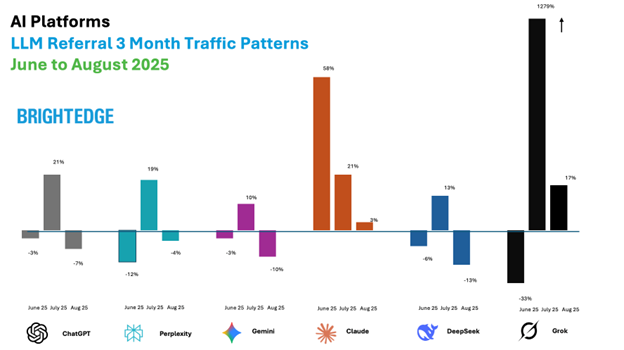
Key Trends in AI Search Referral Traffic:
- Claude's Growth: 58% growth in July followed by 21% in August, demonstrating sustained momentum.
- Grok's Explosive Trajectory: Starting from a small base, Grok achieved 1279% growth in July and could become a serious contender if momentum continues.
- ChatGPT's Position: Over the past three months, ChatGPT significantly outpaces competitors on referral traffic, leading among emerging AI engines.
- DeepSeek's Decline: The Chinese LLM that emerged early this year has steadily lost ground, with sharp declines throughout July.
Why This Matters for Marketers
SEO fundamentals are critical for achieving visibility in AI search. Here's why: First, all major AI engines rely on traditional search indexes as their foundation—ChatGPT often uses Bing, Google AI Overviews and AI Mode are built on Google's index, and Claude leverages Brave's search infrastructure. Second, AI platforms deploy their own crawlers to feed their LLMs and build their search indexes, meaning they need to access and understand your website's content just like traditional search engines do.
This technical reality means robust SEO optimization now delivers compound returns: optimize once, and your content becomes discoverable across traditional search, AI overviews, ChatGPT, Perplexity, and emerging platforms alike.
Rather than fragmenting your efforts, the proliferation of AI search amplifies the value of comprehensive SEO. Leading marketers are reinforcing SEO best practices in the age of AI discovery, from improving site performance for faster, more user-friendly experiences to adding contextual signals like schema that help AI engines and search platforms better interpret content.
Growth and Business Impact Are Two Different Things
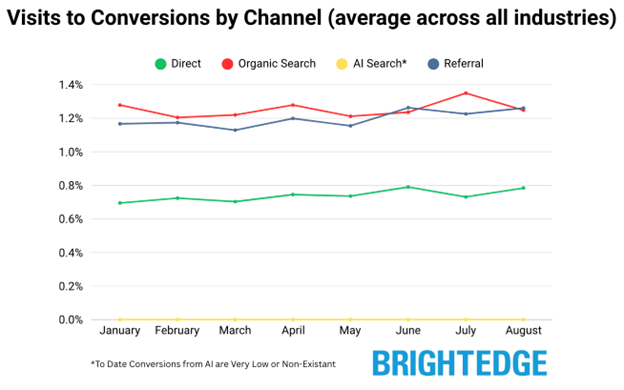
While AI search captures headlines with its explosive growth rates, BrightEdge data reveals a critical distinction: organic search remains the primary driver and delivers significantly stronger conversions. Over the course of the year, AI’s referrals are not translating to conversions yet.
Understanding User Intent Differences
- Organic search delivers the best conversion results - consistently outperforming all other channels
- All traditional channels deliver better conversions than AI search - and this efficiency gap is actually increasing over time
- AI search functions as a research channel, not a conversion channel - with near-zero direct conversions tracked
This performance gap reflects fundamental differences in how users engage with each channel:
AI Search Users: Enter the funnel at the research and exploration stage, asking questions and gathering information to inform their decisions. They're seeking understanding, not yet ready to transact.
Organic Search Users: Demonstrate clearer purchase intent, often searching for specific products, services, or solutions. They know what they want and are closer to conversion.
The Journey Dynamic: Many users begin with AI-powered research but ultimately convert through organic search or direct channels - making AI search valuable for top-of-funnel discovery despite its lack of direct conversions.
Why This Matters for Marketers
While AI search doesn't drive direct conversions today, it matters for two critical reasons:
- It's growing at unprecedented rates - creating new touchpoints with potential customers
- It owns the research phase - influencing decisions that lead to conversions through other channels
The most successful marketers aren't choosing one channel over the other—they're adapting for AI while doubling down on the organic strategies that have always driven results. This dual-channel approach ensures brands capture both the exploratory AI search audience and the high-converting organic search traffic.
How Astute Marketers Drive the Most from Each Channel
Beyond Your Website: Understanding AI Citation Patterns
The good news for marketers: You don't need to change how you develop content on your website. Instead, focus on influencing content outside your website that in turn shapes what AI platforms say about your brand. This approach is simple and low-risk—you're not disrupting anything that's already working.
BrightEdge's analysis reveals the specific sources AI platforms use:
1. Continue with SEO fundamentals for your website All major AI engines rely on traditional search indexes—ChatGPT uses Bing, Google AI Overviews run on Google's index, and Claude leverages Brave. Additionally, AI platforms deploy their own crawlers to feed their LLMs. This means your existing SEO efforts automatically benefit AI discovery.
2. Shape PR and media coverage (34% of AI citations) News sites, industry publications, and media coverage represent significant opportunities. Build relationships with publications in your space that AI frequently references. For example, in the golf industry, Golf.com is heavily cited when AI helps consumers shop for golf equipment. In fashion, Vogue and WWD carry similar weight. Identify and cultivate relationships with the authoritative media sources in your industry.
3. Engage strategically on social platforms (Nearly 10% of citations) LinkedIn articles and Reddit discussions directly influence AI responses. BrightEdge pinpoints the exact forums—even down to specific subreddits—where your industry conversations happen. This precision allows you to engage where it matters most.
4. Monitor user-generated content sites Forums, review sites, and Q&A platforms are also important sources of content for LLMs. BrightEdge identifies which specific communities carry the most authority in your industry, allowing targeted engagement.
The Strategic Opportunity
By understanding these influence patterns, marketers can:
- Maintain strong SEO for direct website visibility
- Build relationships with key publications and journalists in their space
- Participate authentically in the specific forums and communities AI platforms reference
- Ensure accurate, positive information exists across all sources AI systems consult
Why This Matters for Marketers
This multi-channel approach doesn't require rebuilding your content strategy. It's about extending your influence to the sources AI already trusts, while maintaining the SEO foundation that drives both traditional and AI search visibility.
BrightEdge Launches Two New Innovations to Help Marketers Win
To help brands navigate this ongoing shift, BrightEdge announced two major product innovations at the Fall Spark 2025 Event:
AI Early Detection System
The next generation of analytics reporting that shows, in real time, how AI search is contributing to traffic and conversions. Most web analytics treat AI search domains like any other referral, making them hard to analyze. BrightEdge makes this traffic visible, organizes it alongside your other channels, and lets you drill from top-level trends down to individual pages so you you can see performance clearly and know exactly where to optimize to drive results.
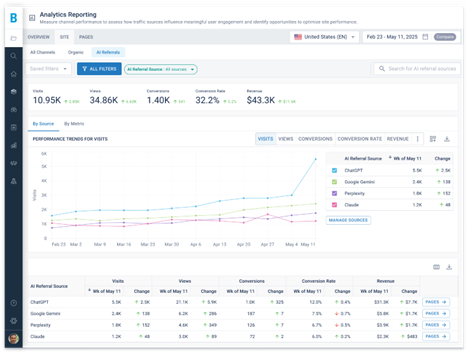
Instead of guessing whether a spike in AI referrals matters, marketers can see when it drives real downstream engagement and adjust their strategy accordingly.
AI Catalyst Recommendations
BrightEdge AI Catalyst identifies where competitors are appearing in AI results, then translates those gaps into actionable steps. It not only shows what's missing, but why others are winning—whether it's page structure that makes content easier for LLMs to interpret, deeper topic coverage, or stronger layout that helps models surface the right answers.
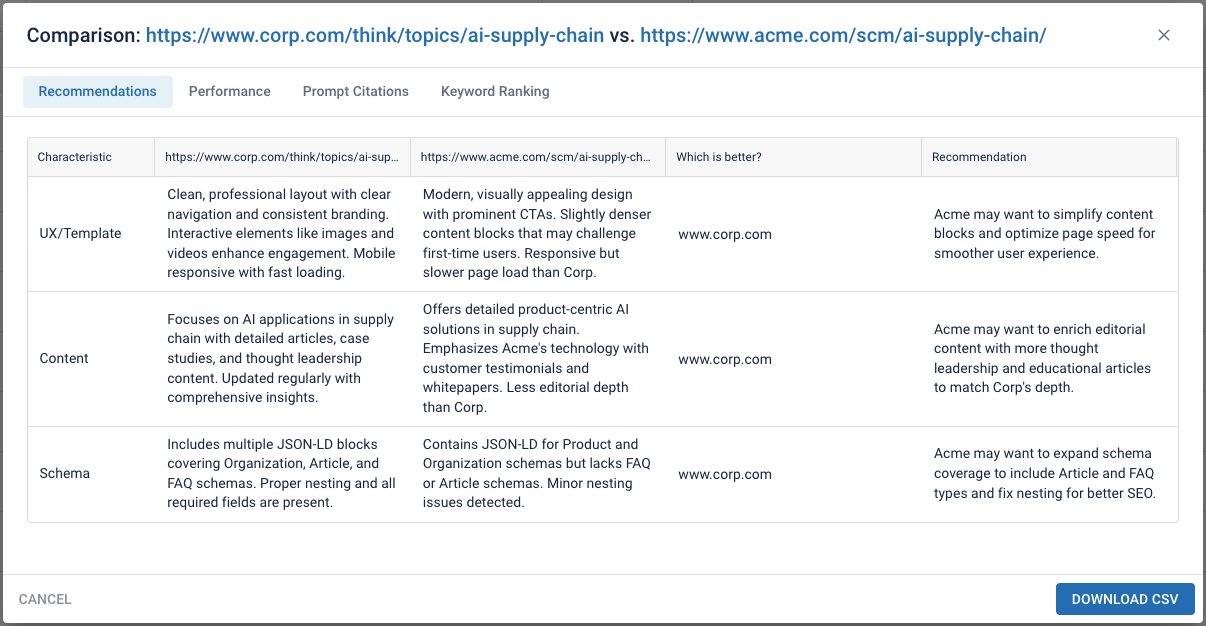
What makes Catalyst especially powerful is that it shows where AI engines source their answers. It identifies the sources that matter most, analyzes why they influence AI, and generates clear action items—even down to what content resonates and who inside an organization to reach.
The result: a faster, easier way to strengthen presence in AI search and tie activity directly to business outcomes
Download the Full Report
Download the full research report—including visuals, cross-industry insights, and expert guidance to help you lead in the evolving world of AI-powered search.
About BrightEdge
BrightEdge is the global leader in Enterprise SEO and AI-powered content performance. For more than 18 years, BrightEdge has helped thousands of brands and digital marketers, including 57% of the Fortune 500, transform online opportunities into measurable business results.
Its industry-first platform integrates the most comprehensive dataset in search, combining insights from traditional SEO, digital media, social and content with cutting-edge generative AI capabilities, including its deep learning engine DataMind and AI Catalyst platform.
Trusted by enterprises, mid-market companies, and leading digital agencies, BrightEdge continues to set the standard for innovation in search and AI, enabling brands to win by becoming an integral part of the digital experience
Learn More
AI Search Visits Surging in 2025—But Organic Search Remains the Cornerstone of Digital Growth
Brand Visibility | ChatGPT and Google AI Approaches by Industry
Where Similarities Lie and Different User Paths Appear
Healthcare | B2B Tech | Education | Finance



Executive Summary
Today, we released new research revealing a critical turning point in the evolution of search: ChatGPT and Google AI Mode increasingly reveal two distinct paths when users ask how to take action. ChatGPT's task-first approach contrasts sharply with Google's information-first model, highlighting not just a technical difference but a pivotal shift in how consumers find, trust, and act online.
Analyzing thousands of real-world prompts across four major industries—finance, healthcare, B2B technology, and education—BrightEdge found that ChatGPT and Google AI Mode disagree primarily when queries are action-driven. For task-oriented prompts, ChatGPT overwhelmingly suggests tools and apps directly, while Google continues to link to informational content.
We are at a critical turning point in the evolution of search. ChatGPT and Google AI Mode are increasingly taking two distinct paths when users ask how to take action.
"AI search is no longer one thing---it's splitting into at least two distinct philosophies," Jim Yu, Founder and CEO of BrightEdge.
For brands to thrive in this evolving AI landscape, understanding how models interpret and utilize content is crucial. ChatGPT, with its "trusted coach" approach, processes information differently than Google's AI, particularly for bottom-of-funnel questions that demand immediate utility.
But most critically, with Google still commanding approximately 90% of global search market share, brands cannot afford to choose between AI optimization and traditional search presence; nor can they use disparate solutions to address each platform piecemeal — they need a comprehensive solution that excels across the entire search ecosystem.
ChatGPT and Google Disagree on How to Act
Our research reveals a clear pattern across industries.
1. When users compare options, both platforms tend to agree.
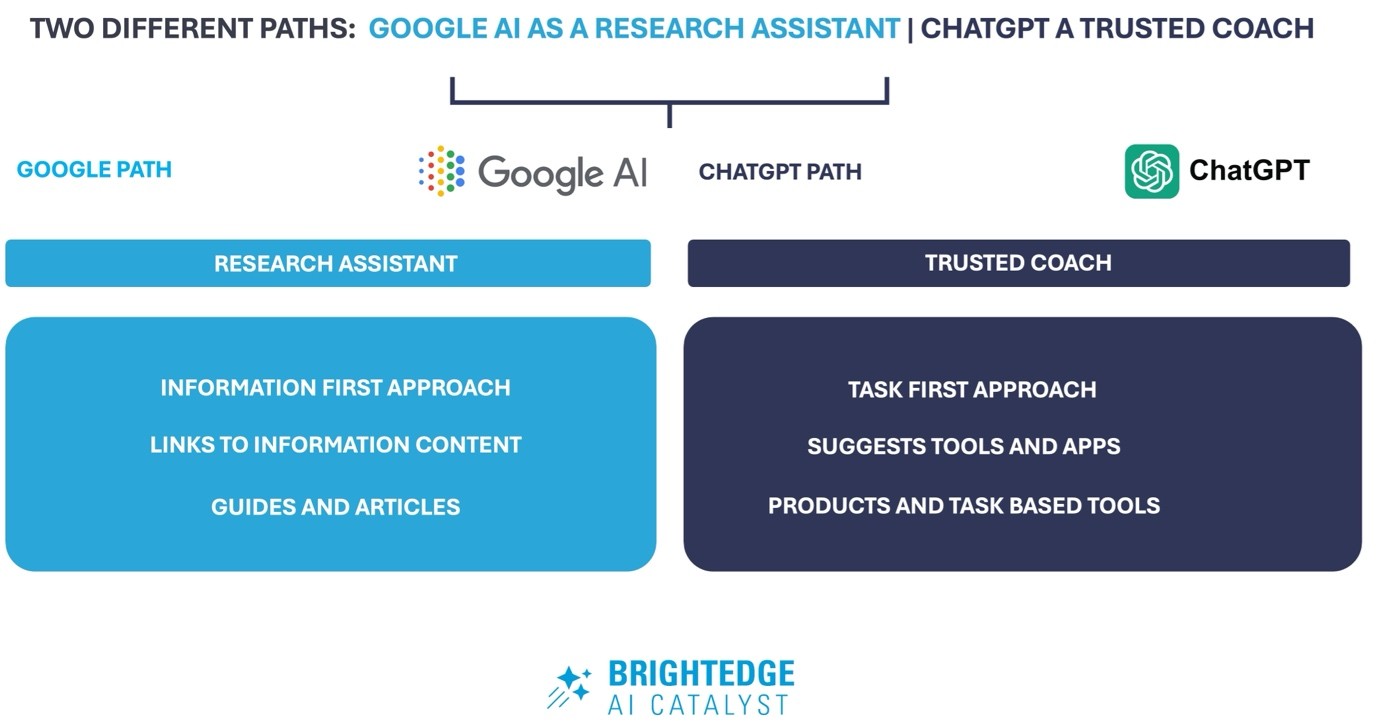
2. When users want to act, they part ways---ChatGPT surfaces products, apps, and task-based tools, and Google surfaces guides, articles, and institutional content.
ChatGPT's task-first approach contrasts sharply with Google's information-first model, highlighting not just a technical difference but a pivotal shift in how consumers find, trust, and act online.
In task-oriented prompts, ChatGPT overwhelmingly suggests tools and apps directly, while Google continues to link to informational content.
While Google thrives as a research assistant, ChatGPT acts like a trusted coach for decision making, and that difference shapes which tool users instinctively choose for different needs.
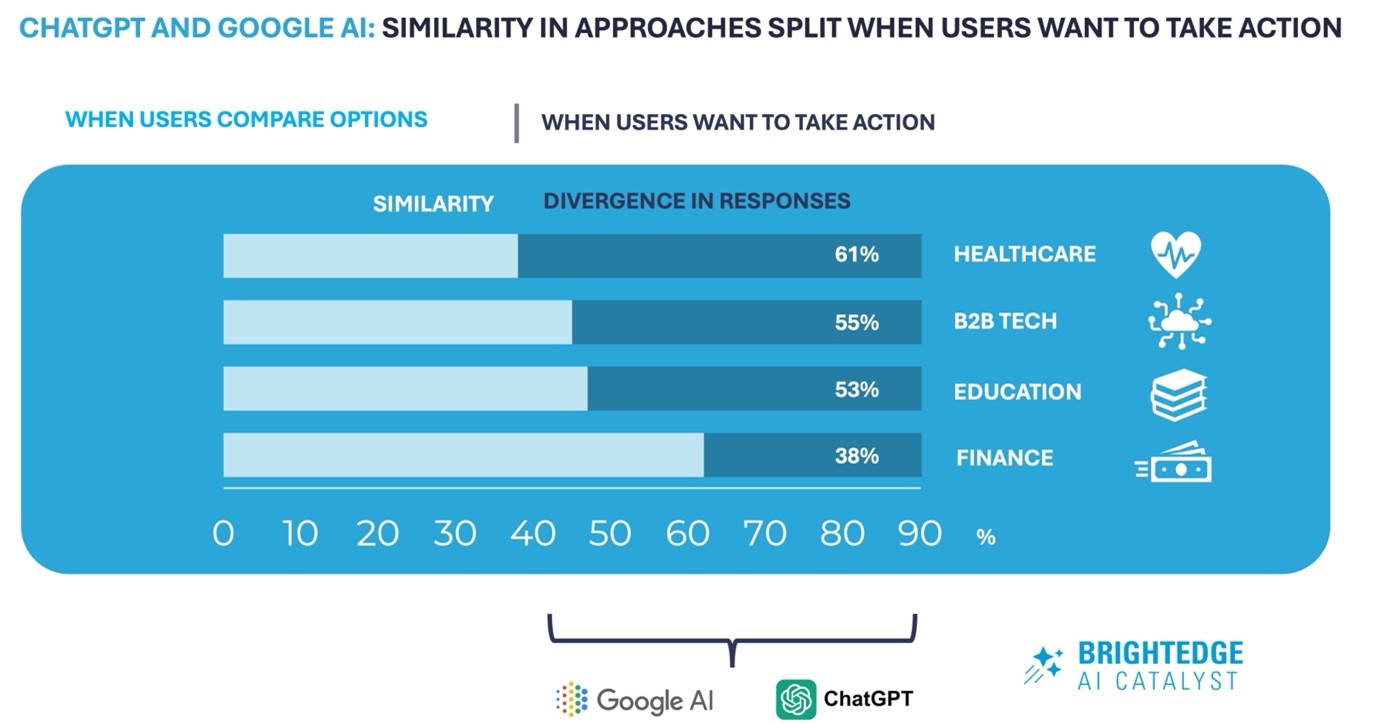
Key Research Findings by Industry
Healthcare Shows Highest Divergence:
At 62% divergence, healthcare demonstrates the most significant split between platforms.
- When prompts pertain to symptoms or medical information, both ChatGPT and Google will mention the CDC and The Mayo Clinic.
- However, when prompted to help with things like "How to find a doctor," ChatGPT pushes users towards Zocdoc, while Google points to hospital directories.
B2B Technology Follows Close Behind:
With 47% divergence, B2B tech shows substantial platform differences.
- When comparing technology, such as cloud platforms, both suggest AWS and Azure.
- When asked "How to deploy things (such as specific apps)," ChatGPT relies on tools like Kubernetes and the AWS CLI, while Google offers tutorials and Stack Overflow.
Education Sector Demonstrates Consistent Patterns:
At 45% divergence, education follows the same trend.
- When comparing "Best online learning platforms," both platforms surface Coursera, EdX, and LinkedIn Learning.
- When a user’s prompt pertains to learning a skill such as "How to learn Python," ChatGPT recommends Udemy, whereas Google directs users to user-generated content hubs like GitHub and Medium.
Finance Shows Lowest but Still Significant Divergence:
Even at 39% divergence, finance maintains the pattern.
- When comparing "Best credit cards," both suggest major institutions like Chase, Wells Fargo, and Citi.
- When asked for "How to create a budget," ChatGPT pushes to apps like Mint and YNAB, while Google drives users to NerdWallet and blog articles.
Implications for Industry Marketers
The findings reveal a fundamental shift in how AI platforms approach user intent, creating new challenges and opportunities for marketers.
With Google maintaining a 90% market share while key players like ChatGPT continue to grow, brands face the imperative of optimizing for multiple, distinct AI philosophies rather than a single search paradigm.
The pattern is unmistakable: when users ask what to do next, ChatGPT suggests tools while Google provides more content to read.
This divergence forces marketers to reconsider their content strategies, moving beyond traditional SEO to embrace intent-aware AI optimization.
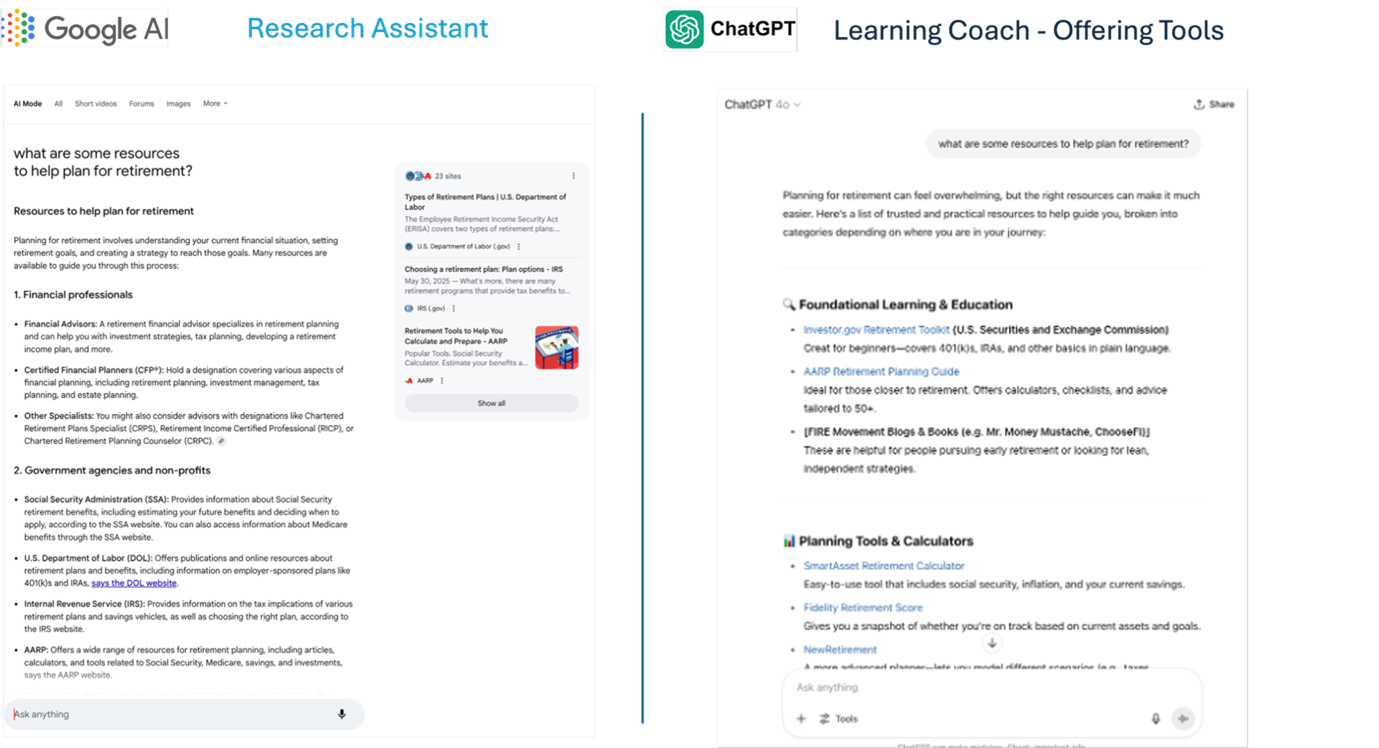
Example
Prompt: “What are some resources to help plan for retirement?”
The prompt above illustrates how ChatGPT offers tools and calculators, which are very specific, whereas Google selects topics to research.
For brands to thrive in this evolving landscape, understanding how these new models interpret and utilize content becomes crucial. ChatGPT's "trusted coach" approach processes information differently than Google's AI, especially when answering bottom-of-funnel questions that demand immediate utility.
This distinction requires developing content that optimizes performance across both AI environments and beyond.
The Path Forward
This is precisely where BrightEdge’s AI Catalyst provides an unparalleled advantage.
Relied upon by leading Fortune 500 companies, BrightEdge is uniquely trusted and integrated and holds the playbook for how brands can win now and secure their future.
AI Catalyst allows marketers to bridge gaps, delivering a complete and comprehensive search presence picture. In the last quarter alone, AI Catalyst adoption by BrightEdge customers has surged, with 27% now leveraging the platform daily to optimize across Google, ChatGPT, and beyond.
AI Catalyst Has You Covered to Optimize Once and Rank Everywhere
1. Track your AI and Brand Presence Across Multiple AI Engines
See how your visibility evolves over time through citations and mentions. Monitor your presence across AI Overviews, ChatGPT, and beyond.
2. Understand Variations in Brand Mentions Across Key Prompts
Quickly identify which prompts from ChatGPT and AI Overviews - and all types of AI Search Engines – generate brand mentions so you can optimize content efficiently.
3. Dive Deeper into Prompts to See Why AI is Recommending Specific Brands
AI Catalyst's advanced sentiment analysis provides precise insights into which brand attributes are favoured by each AI Engine. Concentrate your efforts on these attributes to enhance your recommendations.
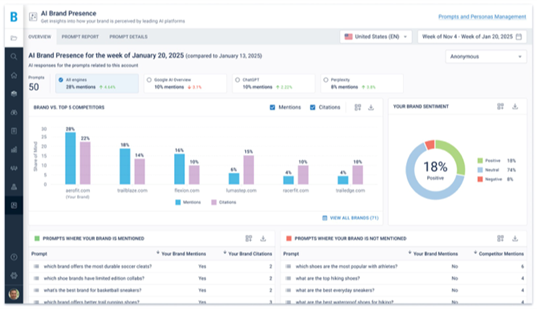
As the need for comprehensive AI search awareness continues to grow among marketers, BrightEdge's AI Catalyst enables them to bridge the gaps between platforms. Customers utilize the solution to equip teams with the technology to evolve in lockstep with the expanding AI and search space.
With the most thorough, data-driven solutions available, BrightEdge helps marketers navigate the complexity of multi-platform AI optimization, ensuring comprehensive visibility regardless of which AI philosophy users prefer.
About the Research:
BrightEdge conducted the research in July 2025, analyzing thousands of real-world prompts across four major industries: finance, healthcare, B2B technology, and education. Using BrightEdge's AI Catalyst platform and its index of billions of data points, the study measured how ChatGPT and Google AI Mode responded to identical prompts, extracting the brands most mentioned by each AI search engine and analyzing citation patterns across platforms.
To explore BrightEdge's AI Catalyst, visit: https://www.brightedge.com/ai-catalyst
Download the Full Report
Download the full research report—including visuals, cross-industry insights, and expert guidance to help you lead in the evolving world of AI-powered search.
Further Resources
BrightEdge Blog: From AI search trends to content strategy tips, the blog is where we break down what’s happening—and what’s next.
Webinar Library: Catch up on our latest webinars—whether you're looking for platform walkthroughs, customer success stories, or strategy sessions with SEO leaders.
Media and News Updates: From mainstream business and technology media - like The Washington Post, Forbes, BBC News, Wired, and Fortune - to leading search and digital publications such as MediaPost, SearchEngineLand, and SearchEngineJournal – view a blend of coverage, research, insights, and industry thought leadership.
Brand Visibility | ChatGPT and Google AI Approaches by Industry
Agentic AI Activity Doubles: Adapt Your SEO Strategy Now
BrightEdge AI Catalyst reveals how the July spike in ChatGPT agent activity is changing search — and how your brand can stay visible.
As the news settles around ChatGPT-5, another significant development has been taking place for months now. New types of AI agents are rapidly reshaping how AI interacts with websites on behalf of users.
Today, BrightEdge released new research showing that AI agents—computers doing work on behalf of a person—are not a future concept. They are already here and are growing at a massive scale.
Key Content in This Report
- The State of AI Marketing Platforms: LLM Growth in Referral Traffic to Websites
- The ChatGPT User Agent Has Become an Active Assistant for Users
- Why This Matters
- Frameworks for Success
AI Engine and LLM Market Overview
AI Search Referral Traffic Shows Big Month-Over-Month Gains
Google Commands Overall Market Share, But Key Players Are Growing Fast
While Google maintains overwhelming market dominance at 90% of search traffic, AI-powered search engines are experiencing unprecedented growth rates that signal a potential paradigm shift in search behavior.
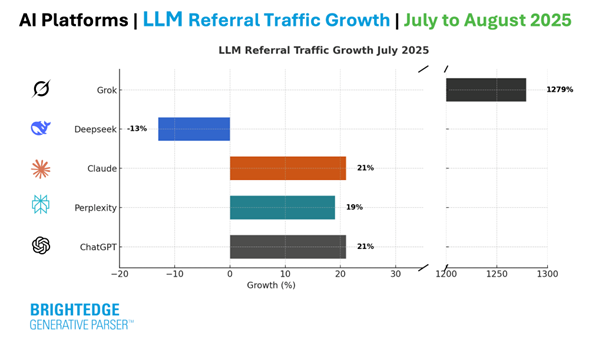
Key Trends in AI Search Referral Traffic
- DeepSeek's Decline: The Chinese LLM that emerged early this year has steadily lost ground, with particularly sharp declines throughout July.
- ChatGPT Dominates: When analyzing website referral traffic over the past three months, ChatGPT significantly outpaces all competitors, solidifying its position as the market leader beyond Google.
- Grok's Explosive Growth: While starting from a small base, Grok achieved a remarkable 1000%+ growth in July. If this trajectory continues, it could emerge as a serious contender in the AI search space.
Why This Matters for Marketers
These explosive growth rates reveal an expanding ecosystem where strong SEO fundamentals have never been more critical. As AI-powered search platforms multiply—from ChatGPT's referral dominance to Grok's 1000%+ growth—each new system relies on crawling and understanding your website's content.
This means that robust SEO optimization now delivers compound returns: optimize once, and your content becomes discoverable across traditional search, AI overviews, ChatGPT, Perplexity, and emerging platforms alike. Rather than fragmenting your efforts, the proliferation of AI search amplifies the value of comprehensive SEO. With agentic AI systems actively browsing websites on users' behalf, every technical improvement—from site speed to structured data—directly impacts your visibility across an ever-growing array of discovery channels.
Agentic AI Website Interaction Goes Mainstream
The ChatGPT User Agent Has Become an Active Assistant for Users With 2X Growth in July
AI agents—computers doing work on behalf of a person—are not a future concept.. In July alone, ChatGPT agent activity doubled.
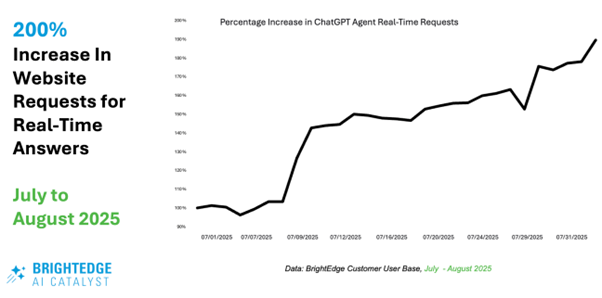
The data tells a compelling story: ChatGPT's user agent activity doubled between July and August 2025, marking a watershed moment in how users interact with the web. This isn't just another incremental change—it represents 2X the number of users asking ChatGPT questions in a single month.
What's Driving This Explosive Growth?
For real-time searches, ChatGPT User Agent now requests non-existent pages only 1% of the time, demonstrating remarkable accuracy in finding and accessing relevant content. This efficiency means users are getting the answers they need, when they need them, driving even more adoption.
The Hidden Cost of Ignoring This Trend
Here's what many brands don't realize: for those not optimizing their websites and content to be seen and cited by AI, this represents a significant missed opportunity. When ChatGPT's User Agent searches for information on behalf of users, slow-loading sites or poorly structured content mean your brand simply doesn't appear in the conversation.
For marketers, these are key opportunities- every one of those searches represents a user with intent, looking for solutions, products, or information. If your content isn't accessible to ChatGPT's User Agent, you're invisible to this rapidly growing audience. With a 200% increase in just one month, the cost of inaction compounds daily.
BrightEdge data reveals agents are rapidly reshaping the web, crawling and indexing websites across major industries at unprecedented levels, and redefining how businesses must think about search visibility in the AI era.
The Shift from Bot to Agents That Act In A User's Behalf
The landscape of artificial intelligence underwent a transformative shift on July 17, 2025, when OpenAI introduced ChatGPT Agent. This launch represented a pivotal evolution, transitioning ChatGPT from its role as a conversational tool into a fully autonomous digital assistant. The development heralds a new era in AI technology—one where systems don't merely provide responses but actively execute tasks on behalf of users.
Critical Findings from BrightEdge Analysis and ChatGPT Data
ChatGPT User Agent Has Become an Active Assistant For Users
- Dramatic Surge in Live AI Search Activity: BrightEdge's examination of ChatGPT's real-time webpage requests throughout July 2025 demonstrated that the ChatGPT User bot's activity levels nearly doubled. This indicates that user dependence on live web search capabilities for obtaining answers experienced an almost 100% increase within a single month.
- ChatGPT's Website Indexing Matches Google Desktop Performance: Analysis from BrightEdge shows that ChatGPT has reached equivalent levels to Google desktop in actively scanning and indexing websites for its search database.
- Lost Engagement Opportunities in AI Search Results: During real-time search operations, ChatGPT’s User Agent attempted to access non-existent pages roughly 1% of the time, generating error responses rather than delivering valuable content. This creates missed opportunities for brands to feature in AI-generated responses.
In contrast to Google's tolerance for slower-loading sites, ChatGPT operates with minimal patience—sluggish website performance means forfeiting the chance to connect with actively engaged, purchase-ready users. This highlights the essential importance of robust technical SEO for success in both AI-driven and conventional search environments.
The Critical Need for AI Platform Brand Visibility and AI Agent Analytics
The continued advancement of AI agents makes understanding their operational patterns and optimizing for their interactions essential for sustaining market competitiveness. A key consideration is acknowledging that AI agents operate under distinct technical specifications.
Take website loading speed as an example: while Google demonstrates patience when accessing your site, ChatGPT shows significantly less tolerance—slow-loading websites prompt immediate abandonment. This reality emphasizes the vital importance of comprehensive technical SEO optimization across both AI-powered and traditional search platforms. Instead of implementing barriers against these systems, strategic marketers must acknowledge three essential requirements for preserving competitive positioning:
- Securing Long-term Brand Presence: With AI search adoption expanding rapidly, blocking crawler access effectively removes brands from the training datasets and knowledge repositories of platforms where consumers increasingly seek information. As internet users increasingly rely on AI Platforms such as Google AI, ChatGPT, and Perplexity, content restrictions become more prevalent, making it unavailable for reference, citation, or recommendation by these platforms, thereby intensifying the brand invisibility challenge.
- Leveraging Citation Benefits: AI platforms regularly cite and suggest content that doesn't achieve high rankings in conventional search results, establishing completely new pathways for discovery. Blocking AI crawlers prevents access to this potentially substantial source of qualified traffic and brand recognition that circumvents traditional SEO competition.
- Attracting Premium Traffic: Referral traffic generated by AI platforms demonstrates superior quality characteristics. These visitors represent users positioned much deeper in the purchase process—well-informed prospects who have conducted thorough AI-assisted research before clicking through. This pre-screening mechanism delivers site visitors with substantially higher conversion probability.
As AI-powered search continues its expansion, restricting AI agent access will ultimately damage brand visibility across platforms such as ChatGPT and Perplexity. Referral traffic from AI platforms typically exhibits high quality, featuring visitors who are often advanced in their purchasing decisions and demonstrate increased conversion likelihood following comprehensive AI-guided research.
While content publishers who monetize their material might justify blocking AI bots, other brands cannot afford to close the door on autonomous agents. Organizations must not only maintain accessibility for agents but also actively welcome their engagement.
The Bright Edge: Leading the AI and Agentic Revolution
As AI agents reshape how people discover content online, it's no longer enough to optimize for traditional search engines. Brands need to understand how these new systems search, interpret, and rank their specific websites.
The Opportunity in AI Recommendation Patterns
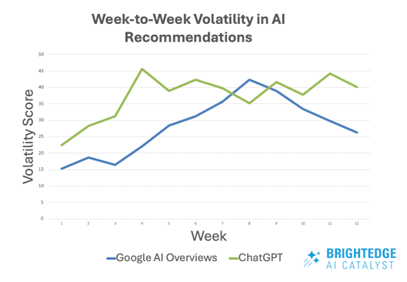
While our analysis shows AI recommendations can vary 15-45% week-to-week, this volatility tells an important story: AI platforms are constantly re-evaluating content to serve users the best possible answers. The brands that maintain consistent visibility aren't chasing every fluctuation—they're building on solid SEO fundamentals that AI systems inherently value.
Think of it this way: the volatility represents AI platforms testing and learning. But beneath these variations, certain brands maintain strong baseline visibility because they consistently deliver what AI agents need: fast-loading pages, comprehensive content, clear structure, and authoritative signals. The peaks and valleys in the chart aren't random—they reflect how well brands meet these core criteria during each crawling cycle.
With AI Catalyst, marketers gain deep, site-specific insights into how AI engines and agents interact with their content. The platform surfaces real-time visibility into what AI sees, and what it doesn't, offering clear guidance to improve discovery, fix issues that hinder indexing, and drive better results in an agent-led world.
AI Catalyst Has You Covered to Optimize Once and Rank Everywhere
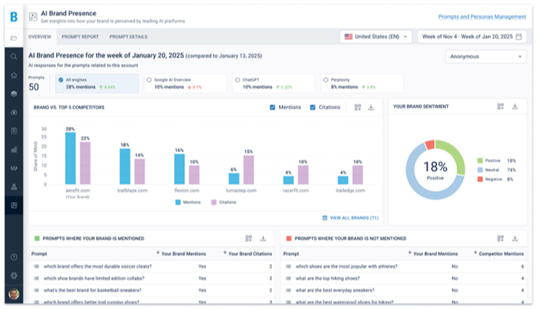
- Track your AI and Brand Presence Across Multiple AI Engines
See how your visibility evolves over time through citations and mentions. Monitor your presence and agentic AI visibility across AI Overviews, ChatGPT, and beyond. - Understand Variations in Brand Mentions Across Key Prompts
Quickly identify which prompts from ChatGPT and AI Overviews - and all types of AI Search Engines – generate brand mentions so you can optimize content efficiently. - Dive Deeper into Prompts to See Why AI is Recommending Specific Brands
AI Catalyst's advanced sentiment analysis provides precise insights into which brand attributes each AI Engine favours brand attributes. Concentrate your efforts on these attributes to enhance your recommendations.
Download the Full Report
Download the full research report — with visuals, cross-industry insights, and expert guidance to keep your brand ahead in the AI-powered search era.
Further Resources
BrightEdge Blog: From AI search trends to content strategy tips, the blog is where we break down what’s happening—and what’s next.
Webinar Library: Catch up on our latest webinars—whether you're looking for platform walkthroughs, customer success stories, or strategy sessions with SEO leaders.
Media and News Updates: From mainstream business and technology media - like The Washington Post, Forbes, BBC News, Wired, and Fortune - to leading search and digital publications such as MediaPost, SearchEngineLand, and SearchEngineJournal – view a blend of coverage, research, insights, and industry thought leadership.
Agentic AI Activity Doubles: Adapt Your SEO Strategy Now
GEO in Coming of Age: Why Winning AI Search Takes More Than Just SEO
New BrightEdge research reveals how 750+ marketers are navigating AI disruption—and what it takes to succeed in a multi-engine generative landscape.
SEO leads the charge—but cross-functional strategy is the key to lasting success
BrightEdge surveyed search, content, and digital marketing professionals to understand how teams are adapting to the rise of generative engines like Google’s AI Overviews, ChatGPT, and Perplexity.
While SEO teams are leading the shift, the most successful organizations are going beyond search—bringing in PR, content, product, and executive leadership to build fully integrated GEO (Generative Engine Optimization) strategies.
Most organizations rely on SEO—but that comes with risk
54% of companies say SEO or digital marketing owns their AI search efforts—more than all other departments combined. But this narrow ownership also highlights a lack of cross-team alignment and support.
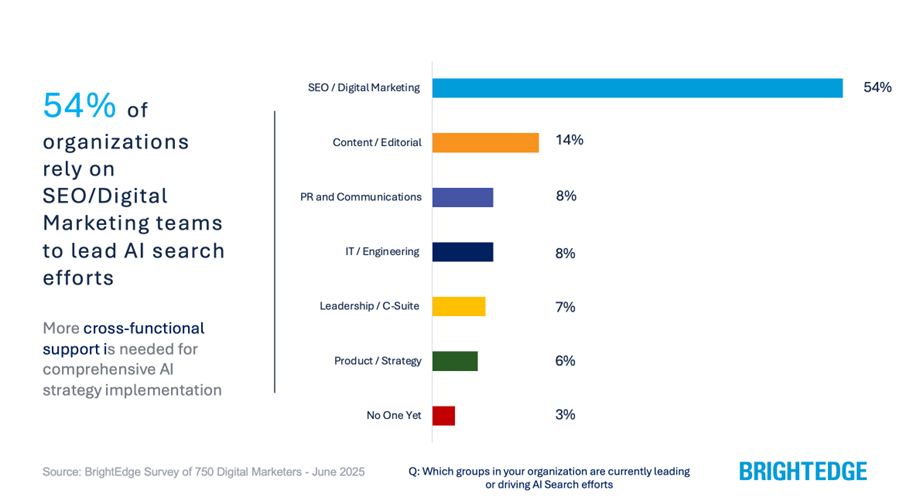
This concentration of responsibility is a double-edged sword: while SEO leaders have the expertise, they often lack the organizational support to execute fully.
Marketers are acting—despite uncertainty
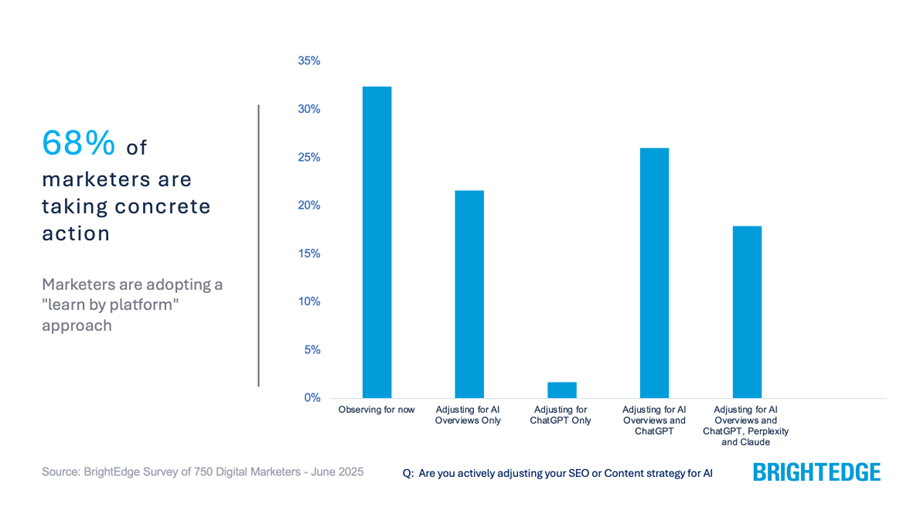
The majority of marketers (68%) are already making strategic adjustments for AI search, even as 57% say they’re still figuring it out. This signals a growing “learn by doing” mindset.
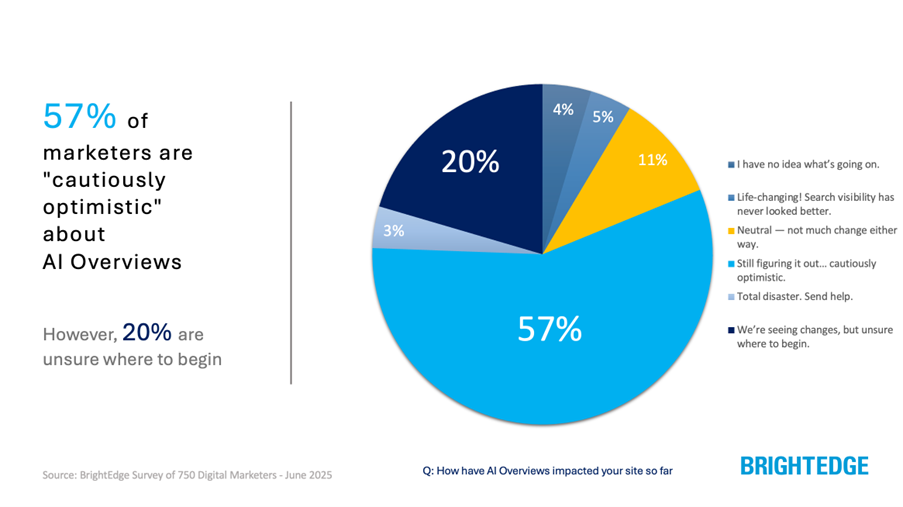
Most are not experiencing massive wins or losses—they’re in a state of cautious experimentation, with a growing appetite to test, refine, and scale what works.
GEO isn’t just a Google play anymore
Nearly half of active marketers are already optimizing for more than one generative engine. 27% are targeting both AI Overviews and ChatGPT, while 18% are also focusing on emerging platforms like Perplexity and Claude.
Generative search is quickly becoming a multi-engine ecosystem. Treating it as a single-platform issue could leave brands under-optimized—and underexposed.
Strategy implications for teams
- For marketing leadership:
The data underscores a need to support SEO teams with frameworks, cross-department coordination, and executive backing. AI search readiness must be treated as an organization-wide initiative. - For SEO professionals:
You’re leading the charge—but you don’t have to go it alone. Collaborating with PR, content, and product will accelerate your GEO efforts and create more durable results. - For organizations still observing:
32% of companies haven’t yet acted. With 68% already moving, those that remain passive risk falling behind the curve—especially as multi-engine optimization becomes standard practice.
Complete the Picture with BrightEdge AI Catalyst
AI search doesn’t stop at Google. BrightEdge AI Catalyst helps you monitor and optimize your brand’s presence across AI Overviews, ChatGPT, Perplexity, and beyond—all in one view.
With AI Catalyst, you can:
- Track your visibility across multiple AI engines and monitor changes over time
- Understand which prompts are driving brand mentions
- Pinpoint what each engine values about your brand using advanced sentiment and attribute analysis
It’s the fastest way to move from reactive to proactive in a rapidly evolving search landscape.
Download the Full Report
Get the full breakdown, complete with data visuals, ownership models, and strategic recommendations for building a GEO strategy that lasts.

GEO in Coming of Age: Why Winning AI Search Takes More Than Just SEO
The Open Frontier of Mobile AI Search
Executive Summary
Despite the meteoric rise of AI-powered search engines, one surprising insight remains: mobile web search is still largely untouched by the AI revolution.
BrightEdge analyzed referral traffic across leading traditional and generative AI search engines in North America and Europe and found a striking pattern — over 90% of all AI referral traffic originates from desktop devices, with mobile lagging far behind. This stands in contrast to broader user behavior, where mobile dominates total web traffic.
In the lead-up to Apple’s WWDC event, this data suggests a critical, underdeveloped opportunity. With Apple controlling a major share of mobile browser defaults and Google still dominating mobile web search, even a single shift in default search behavior could disrupt the current landscape overnight.
AI Referrals: Still a Desktop-First Experience
While mobile accounts for over half of global web traffic, it is desktop where the AI search engines are currently making the most impact when it comes to referring traffic to websites.
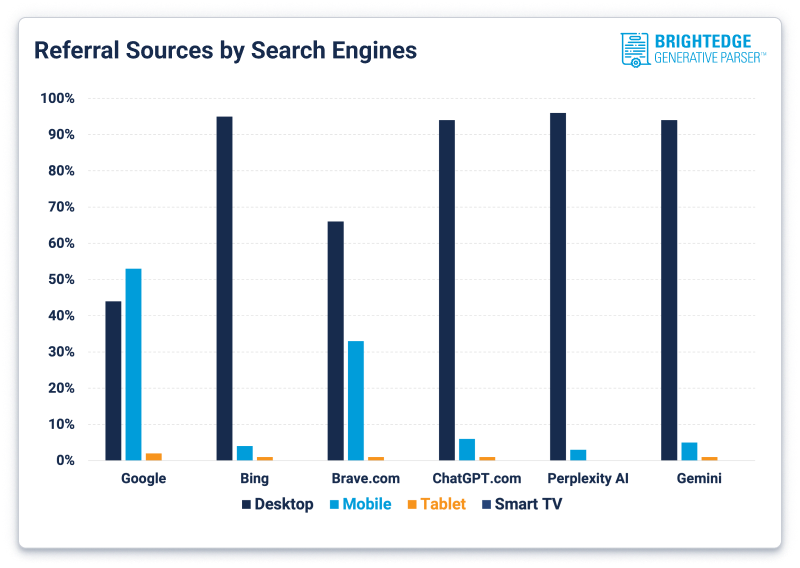
The contrast between platforms is sharp:
- Google Search: The outlier — 44% desktop, 53% mobile
- Bing: 95% desktop, 4% mobile
- ChatGPT.com: 94% desktop, just 6% mobile
- Perplexity.ai: 96.5% desktop, 3.4% mobile
- Google Gemini: 91% desktop, 5% mobile
As Google’s AI features (e.g., AI Overviews) being live on mobile for many users, it currently serves as the only AI-capable search engine with a strong foothold in mobile web referrals — and even then, it barely edges out desktop.
Platform-by-Platform
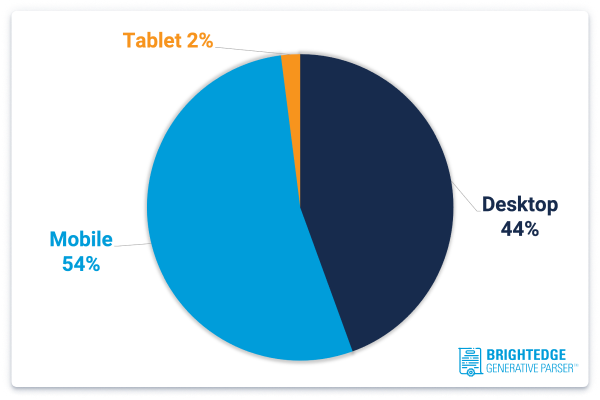
As the entrenched default on most browsers — particularly Safari on iPhones — Google is the only engine where mobile exceeds desktop. According to North American and European BrightEdge data:
- Mobile share: 53%
- Desktop share: 44%
- Tablet: 2%
This mobile strength underscores the importance of Google's partnerships, particularly with Apple. Yet, its AI integrations on mobile (like AI Overviews) still do not dominate mobile web referrals the way desktop does.
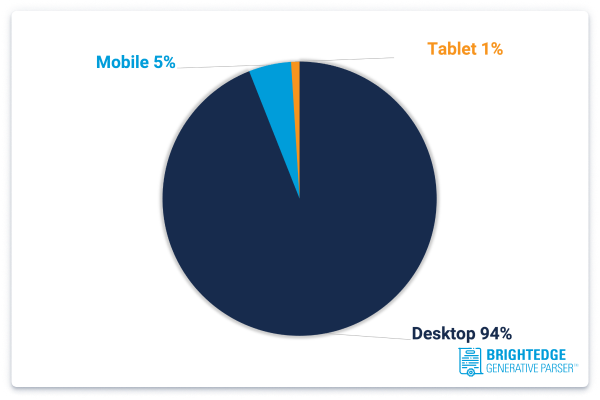
ChatGPT, despite its widespread mobile app usage, sends nearly all its referral traffic via desktop:
- Desktop share: 94%
- Mobile share: 6%
- Tablet: 1%
This pattern likely reflects a key difference in user flow: on desktop, the first click on a ChatGPT citation takes users directly to the source website. But on mobile, the app often intercepts that first click, previewing the content in-app — and only the second click leads to the external site. As a result, ChatGPT drives far more referral traffic from desktop than mobile, even if mobile usage is high.
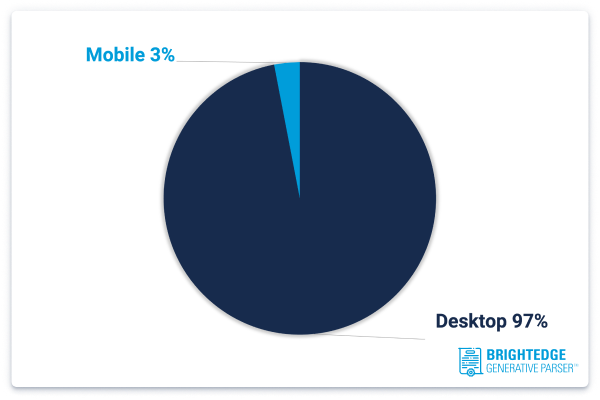
Even more desktop-centric than ChatGPT, Perplexity sees:
- 96.5% of referrals from desktop
- Mobile barely breaks 3%
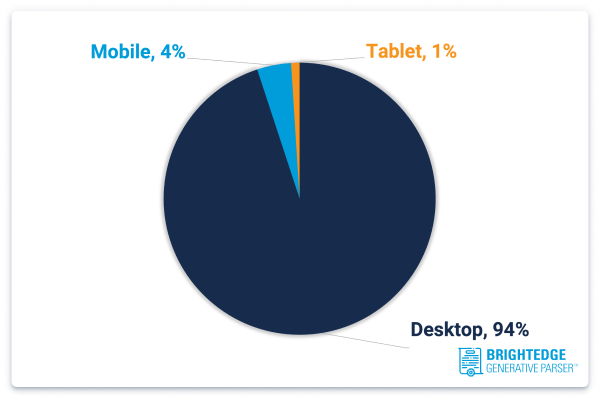
As the default for some Microsoft platforms and now integrated into Copilot, Bing is another major player in the AI space — but on mobile?
- 94.4% desktop
- 4.5% mobile
The Apple Factor
While Google may currently hold the advantage in mobile AI web referrals, Apple’s role as the gatekeeper of the mobile browser experience is pivotal.
BrightEdge data shows:
- 58% of Google’s mobile search traffic to US and European brand websites originates from iPhones
- Safari remains the default browser for nearly a billion users
- Apple has not yet embedded AI-powered search into its mobile web stack
But with the upcoming Apple Intelligence announcements and the potential for deeper AI integration in iOS, even a single change in Safari's default search provider could reshape mobile web search overnight.
Conclusion: Apple Holds the Key to Redistributing AI Search
BrightEdge data from North America and Europe shows that while AI-powered search engines are reshaping referral behavior on desktop, mobile web referrals remain overwhelmingly dominated by Google. Engines like ChatGPT and Perplexity send over 90% of their referral traffic from desktop, with mobile barely registering.
That doesn’t mean AI search isn’t booming on mobile — it likely is. But much of that activity happens inside apps, where outbound referrals are limited or delayed.
This isn’t a gap in capability. It’s part of the ecosystem design.
With Safari as the default mobile browser, Apple is the gatekeeper of mobile web search. And with iPhones driving over half of Google’s mobile traffic to brand websites in these regions, even one change — like swapping the default search engine — could trigger a major redistribution of AI-powered traffic.
The Open Frontier of Mobile AI Search
Google Search Generative Experience Is Coming
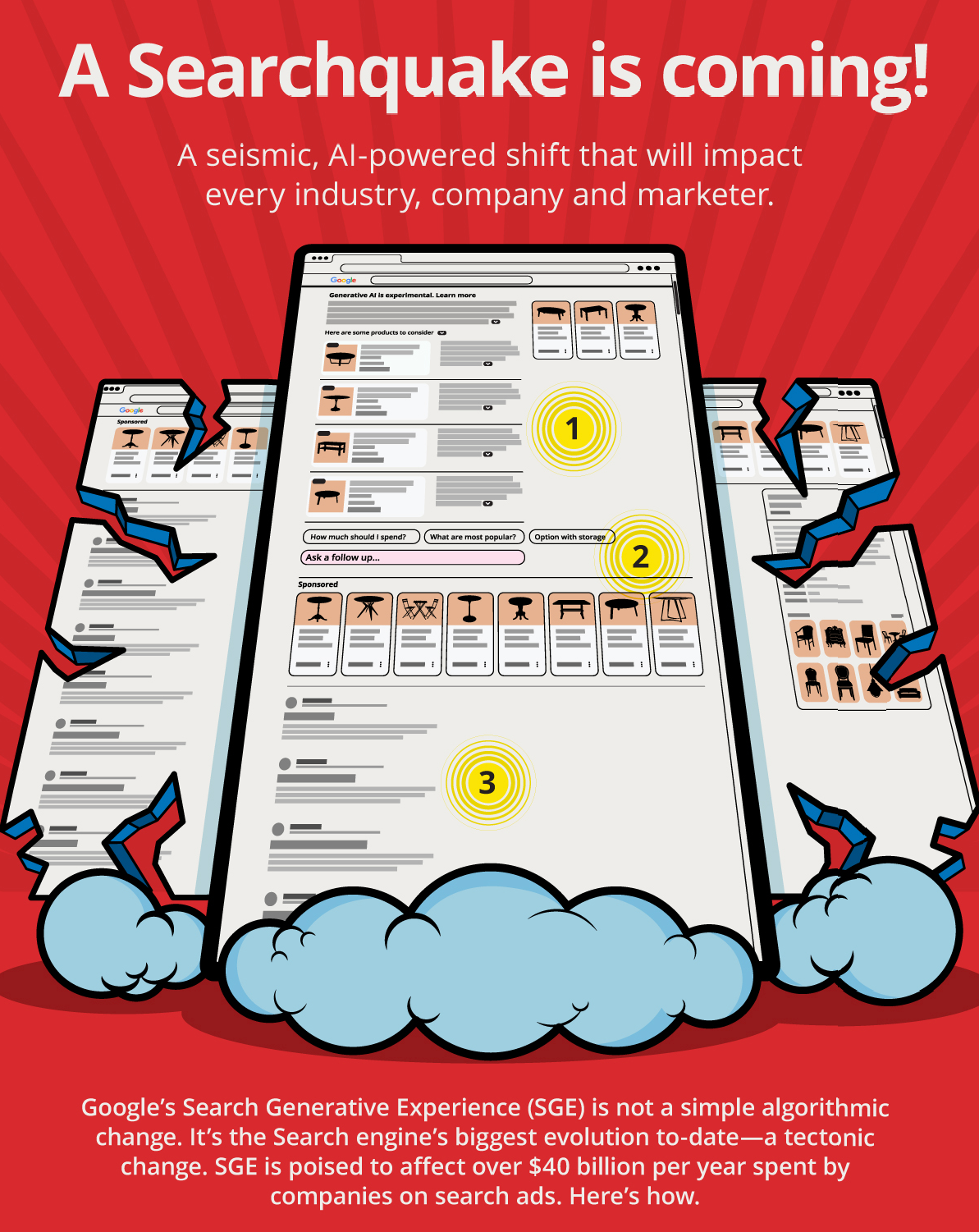
84% of queries will have SGE. Will your business be impacted?
AI-driven Google Search Generative Experiences (SGE) will drive monumental changes in Search. At BrightEdge, we have been at the forefront of understanding and interpreting these changes since Fall of 2023. Our cutting-edge Generative Parser™ technology offers quantitative insights into how SGE will be reshaping the landscape for brands and marketers upon its broad deployment by Google.
This infographic offers marketers a comprehensive analysis of SGE's impact on nine key industries, preparing them for the impending 'searchquake'.
Explore now and secure your advantage in this transformative era.
Google Search Generative Experience Is Coming
Blog Content and SEO:
Winning Factors and Key Correlations
Examining the Correlation Between Superior SERP Rankings and Integral SEO Components
Research shows that blogs are becoming increasingly important in an era of SEO and AI. Blogging remains essential for enterprise brands to ensure they are always in front of their customers, giving them fast and direct access to their questions with answers that resonate and educate.
To gain insights into the role of blogs in search engine results, BrightEdge's SearchIQ analyzed a mix of 10,000 intent, conversational, and transactional keywords across various industries such as banking, insurance, retail, and more.
Based on research conducted in August of 2023, we found that:
- Blogs prominently feature among the top 10 SERP results - setting aside homepage listings.
- Blogs' frequent appearance within the top 3 and top 5 search results.
- Blogs that win in the SERPS mirror many SEO ideals, from in-depth content to an ideal balance of text and coding.
In this paper, we uncover the following;
- The pivotal role of blog content in connecting with consumers in various search scenarios.
- Key SEO elements that impact success.
- Recommendations on using quality data to make precise decisions on topics and content.
- Insights into the strategic importance of blogs for omnichannel marketing.
Blog Content and SEO: Winning Factors and Key Correlations
The 2022 U.S. Education Services Industry Research Report
Reading the Market: Identifying Themes Using Search Trend Data
Using BrightEdge comprehensive search data set and analytical tools, we began by looking at search volume trends for approximately 410 keywords related to the education industry with a combined monthly search volume of more than 1.9 million searches. We analyzed the broad set of terms to determine the makeup of search result types (regular web listing, people also ask, local 3-pack, etc.), which domains are earning the lion’s share of ranked search results and clicks, and then we dug in to assess the nature and intent of the searches. The analysis offers insight into the areas of opportunity, broadly across the education industry.
In this study you'll learn:
- Overall growth trends for the U.S. education industry as they correlate to organic search
- How different types of search results perform within the category of education
- Search intent within three key educational sub-categories:
- Degree/certificate
- Educational subject
- Learning format
- The leading domains capturing click volume for education-related searches
This research report is perfect for educators that are looking to use data to forecast and help make more informed decisions using search data trends.