
How ChatGPT Handles Transactional Intent in Healthcare
BrightEdge AI Hypercube shows that most healthcare queries in ChatGPT are action-driven, with users seeking providers, pricing, symptom management, and benefit support rather than just researching conditions.
BrightEdge AI Hypercube analysis reveals that healthcare-related ChatGPT prompts are dominated by transactional intent, with patients and members using AI not just to research conditions but to find care, price procedures, self-treat, and act on their benefits.
People turn to ChatGPT with health questions every day. But a closer look at the prompts reveals something that challenges a core assumption about how AI search works in healthcare: the majority of transactional prompts aren't about learning. They're about acting. People aren't just researching conditions. They're finding providers, pricing care, managing symptoms, and trying to unlock their benefits.
This is the second installment in our AI Hypercube transactional intent series. Last week we analyzed finance. This week we turned the same methodology on healthcare, looking at queries tied to top U.S. health brands and filtering for transactional intent. The patterns that emerged are consistent, significant, and directly relevant to any healthcare brand thinking about AI visibility strategy.
Data Collected
| Data Point | Description |
| Citation volume by platform | Total query count where major retailer domains were cited as sources in Google AI Overviews vs. ChatGPT |
| Transactional intent filtering | Prompts filtered and cross-referenced by purchase intent across both platforms |
| Citation source classification | Each cited domain categorized by type: major retailer, social/community, editorial/financial, news media, government/academic, other/niche |
| Brand mention tracking | All brand mentions extracted from AI responses and classified by sentiment: positive, neutral, negative |
| Competitive set analysis | Average number of brands surfaced per transactional response on each platform |
| Cross-platform comparison | Head-to-head citation intent and source analysis across both engines using matched query methodologies |
| Data Point | Description |
| Prompt classification | Healthcare-related prompts in ChatGPT filtered to transactional intent using BrightEdge AI Hypercube classification |
| Intent cluster analysis | Transactional prompts grouped into behavioral clusters based on the action type being expressed |
| Volume analysis | BrightEdge monthly prompt volume data applied to identify the highest-frequency transactional query patterns |
| Care-access vs. benefits segmentation | Prompts analyzed for whether users are seeking access to providers, procedures, coverage, or member benefits |
| Agentic prompt identification | Prompts written as direct instructions to an agent isolated and analyzed as a distinct behavioral pattern |
Key Finding
Healthcare is widely treated as a research-heavy, high-trust informational vertical in search strategy. The assumption is that people use AI to learn about conditions, treatments, and providers before taking action elsewhere. The prompt data tells a different story. Transactional intent is present throughout ChatGPT healthcare queries, from finding a family doctor to pricing a dental procedure, checking GLP-1 coverage, self-treating symptoms, and figuring out how to spend an OTC benefits card. Unlike finance, where transactional intent clustered around a single action (applying), healthcare transactional intent fragments across the entire patient and member journey. The implication for healthcare brands is direct: an AI visibility strategy built only around condition content and symptom pages is incomplete.
Five Transactional Intent Clusters in ChatGPT Healthcare Prompts
Finding care is the single largest cluster of transactional healthcare prompts in ChatGPT, accounting for roughly 55% of identified transactional volume. A single prompt, "family doctor near me," drives over 7,000 monthly queries on its own. Variations include urgent care searches, specialist lookups, and "accepting new patients" queries across dental, primary care, and specialty medicine. These are not research prompts. They are front-door prompts from people ready to book. The shift is significant: AI is becoming the discovery layer for care access, replacing traditional provider directory searches and health plan "find a doctor" tools.
Cost shopping accounts for approximately 17% of transactional healthcare volume. People are using ChatGPT to price procedures before committing to them. "How much do veneers cost" drives over 1,600 monthly prompts. Queries for the cost of tooth extraction, dental implants, eye exams, and contact lens fittings appear repeatedly. Dental and vision dominate this cluster, which is consistent with how consumers experience healthcare economics: these are the procedures they pay for most directly. Cost-shopping prompts signal someone who has already decided to act and is now comparing where to do it.
Self-treatment and symptom action represents approximately 16% of transactional volume and is the most distinctive healthcare pattern in the dataset. Prompts like "how to cure neck pain fast," "how to relieve period cramps fast," "how to fix gingivitis," and "how to get rid of cold sores fast" reflect people asking ChatGPT for an action to take, often in place of seeing a provider. The AI is functioning as a first-line care substitute. This is a pattern that has no direct analog in finance, and it reshapes what "content strategy" needs to mean for health systems, pharma brands, and retail health players.
Insurance coverage and enrollment prompts account for approximately 9% of transactional volume, with the pattern heavily concentrated around GLP-1s and weight loss medications. Queries like "Is Ozempic covered by Medicare," "Does Aetna cover weight loss medication," "Will Aetna cover Zepbound," and "How to get insurance to cover GLP-1" reflect users trying to unlock access to a specific drug through their benefits. Parallel queries about buying health insurance on the open market, Medicaid enrollment, and plan selection extend the same access-seeking pattern into the coverage itself.
Benefits card utilization accounts for approximately 2% of volume but represents the most maximally transactional behavior in the dataset. Prompts like "Where can I use my Humana spending account card," "Can I buy toilet paper with my OTC card," and "Can I use my OTC card on Amazon" are from members mid-transaction, trying to determine in real time whether a specific purchase is covered by their benefits card. These are not questions about healthcare. They are questions about completing a purchase. The intent state is closer to a checkout decision than a search query.
Emerging Signal: Agentic Scheduling and Plan Shopping
As in finance, a small but directionally significant pattern of agentic prompts appeared in the healthcare data. These are prompts written not as questions but as direct instructions: "Find a primary care physician accepting new patients in [city]," "How do I find a Medicare Advantage plan with wellness programs in Maryland and Virginia," "Schedule a pediatric specialist visit in [city]." These prompts do not have traditional keyword search equivalents. They reflect a user treating ChatGPT as an agent capable of initiating care access, not just describing how to find it. The behavior is early, but the healthcare version of agentic intent points at two natural use cases: appointment booking and plan shopping. Both are high-stakes, multi-variable decisions that consumers have historically handled through call centers or paid agents, and both are exactly the kind of task an AI agent is well-suited to handle.
Intent Cluster Distribution
| Cluster | Share of Transactional Volume |
| Finding Care | ~55% |
| Cost Shopping | ~17% |
| Self-Treatment and Symptom Action | ~16% |
| Insurance Coverage and Enrollment | ~9% |
| Benefits Card Utilization | ~2% |
The Access Signal
The distinctive finding in healthcare is that transactional intent is distributed across the entire journey of gaining access: access to a provider, access to a procedure at a price the consumer can afford, access to a drug through coverage, access to a benefit the member has already paid for. In finance, intent concentrated around a single action. In healthcare, it fragments across five distinct access moments, each with its own content, page type, and operational owner inside a health organization. That has direct implications for AI visibility strategy. Owning educational content on a condition is no longer sufficient. Brands need to ensure AI can reach the parts of their ecosystem where access decisions get executed: provider directories, scheduling systems, cost and procedure pages, formulary and coverage pages, and member resources.
What Marketers Need to Know
Transactional intent in ChatGPT is real and present in your healthcare category right now. The assumption that AI search is a top-of-funnel channel for healthcare does not hold. People are finding providers, pricing procedures, checking coverage, and acting on benefits inside ChatGPT. Content strategy and AI visibility strategy need to account for where people are in the decision process, not just what condition they are researching.
AI agents need access to the parts of your site where action happens. When someone asks ChatGPT to find a doctor, price a procedure, or figure out what their benefits card covers, the AI needs to be able to surface your provider directory, scheduling pages, cost pages, formulary, and member resources. If your AI-accessible content footprint consists primarily of condition pages and symptom explainers, you are optimizing for the wrong moment.
Coverage and access content drives decisions at the moment of truth. The concentration of GLP-1 coverage prompts, OTC card utilization prompts, and in-network provider prompts shows where benefit-gated decisions are being made. These pages have historically been treated as member-portal content, often behind login walls or buried in PDF formularies. That content needs to be citable by AI.
Self-treatment behavior is a signal, not just a threat. People bypassing the care journey to ask ChatGPT for a remedy are showing exactly where your education-to-action content is weakest. Brands that treat self-treatment prompts as a content opportunity, connecting symptom action content to the appropriate next step (telehealth, urgent care, pharmacy, provider booking), can reclaim that moment.
Agentic prompts are an early signal of where this goes. Prompts framed as instructions to book appointments or compare plans do not carry traditional search volume, but they represent the leading edge of AI-facilitated healthcare decision-making. The brands that build AI-accessible scheduling and plan-comparison infrastructure now will own that conversation as it scales.
Technical Methodology
| Parameter | Detail |
| Data Source | BrightEdge AI Hypercube |
| Engine Analyzed | ChatGPT |
| Query Set | Healthcare-related prompts tied to top U.S. health brands, filtered to transactional intent classification |
| Intent Classification | Transactional intent defined as prompts reflecting a user's goal to initiate, complete, or advance a healthcare-related action |
| Volume Data | BrightEdge monthly prompt volume applied where available across identified transactional prompts |
| Cluster Classification | Prompts assigned to clusters based on the type of access or action expressed (care, cost, self-treatment, coverage, benefits) |
Key Takeaways
| Finding | Detail |
| Healthcare ChatGPT prompts skew transactional | Across clusters, the dominant behavior is action-oriented, not research-oriented |
| Finding care dominates | Roughly 55% of transactional healthcare volume is tied to locating a provider, led by "family doctor near me" |
| Self-treatment is a healthcare-specific pattern | People are asking ChatGPT what to do about a symptom, often in place of seeing a provider |
| Cost shopping concentrates in dental and vision | Consumers price-check procedures they pay for directly, turning ChatGPT into a care-pricing tool |
| Coverage prompts are access prompts | GLP-1, weight loss, and benefits card queries are users trying to unlock specific products through their plans |
| Benefits card usage is maximally transactional | Members are using ChatGPT mid-purchase to determine if their OTC or spending account card applies |
| Agentic prompts are emerging | Direct-instruction prompts signal a shift toward AI-facilitated scheduling and plan shopping |
| AI visibility strategy must span the access journey | Provider directories, cost pages, formulary, and member resources all need to be AI-accessible |
Download the Full Report
Download the full AI Search Report — How ChatGPT Handles Transactional Intent in Healthcare
Click the button above to download the full report in PDF format.
Published on April 16, 2026
How ChatGPT Handles Transactional Intent in Finance
BrightEdge AI Hypercube analysis reveals that a large share of finance-related ChatGPT prompts reflect transactional intent, showing that users are not only seeking information but are actively trying to take action on financial products and services.
People turn to ChatGPT with financial questions every day. But a closer look at the prompts reveals something that challenges a core assumption about how AI search works: a significant portion of finance-related ChatGPT prompts aren't informational at all. They reflect transactional intent. People aren't just learning about financial products. They're trying to act on them.
We used BrightEdge AI Hypercube to analyze finance-related prompts in ChatGPT, focusing on queries tied to the top U.S. banks and financial institutions. The patterns that emerged are consistent, significant, and directly relevant to any financial services brand thinking about AI visibility strategy.
Data Collected
| Data Point | Description |
| Prompt classification | Finance-related prompts in ChatGPT filtered to transactional intent using BrightEdge AI Hypercube classification |
| Intent cluster analysis | Transactional prompts grouped into behavioral clusters based on the action type being expressed |
| Volume analysis | BrightEdge monthly prompt volume data applied to identify the highest-frequency transactional query patterns |
| Branded vs. non-branded segmentation | Prompts analyzed for the presence of specific brand names to determine whether branded or generic queries drive higher volume |
| Agentic prompt identification | Prompts written as direct instructions to an agent isolated and analyzed as a distinct behavioral pattern |
Key Finding
Finance is widely treated as an informational vertical in search strategy. The assumption is that people use AI to research, compare, and learn before taking action elsewhere. But the prompt data tells a different story. Transactional intent is present throughout ChatGPT finance queries, from credit card applications and pre-approval requests to account opening, credit access management, and full agentic requests to initiate financial processes. The implication for financial services brands is direct: an AI visibility strategy built only around educational and informational content is incomplete.
Five Transactional Intent Clusters in ChatGPT Finance Prompts
Credit card applications and shopping represent the single largest cluster of transactional finance prompts in ChatGPT, accounting for roughly 72% of identified transactional volume. Nearly 90,000 monthly prompts reflect people actively comparing or applying for credit cards. The majority are branded, tied to specific co-branded retail cards, airline loyalty products, and hotel programs. A single co-branded retail card drives approximately 66,000 monthly prompts on its own. These are not research prompts. They are decision prompts from people who have already identified what they want and are using ChatGPT to act on it.
Credit card pre-approval is a distinct sub-pattern worth separating out. We tracked 4,465 monthly prompts for pre-approval queries. Pre-approval is the first step in an application process. Someone asking ChatGPT about pre-approval is not exploring options. They are starting the process of applying.
Banking operations prompts reveal a different kind of transactional behavior. Prompts for opening accounts, setting up direct deposit, initiating bill pay, and processing transfers collectively represent approximately 18% of transactional finance volume. These are people using ChatGPT as a step-by-step guide for completing a banking action. The AI is functioning as a procedural concierge, not an information source.
Credit access management prompts, including queries about checking credit scores, unfreezing credit, and resolving credit report issues, account for approximately 4% of transactional volume. The significance here is what these prompts signal about intent state. Unfreezing a credit file is a prerequisite to submitting an application. A person asking ChatGPT how to unfreeze their credit is not casually curious. They are preparing to apply for something.
Agentic prompts represent an emerging pattern that sits apart from the volume-driven clusters. These are prompts written not as questions but as direct instructions: "Help me start a mortgage refinance application," "Find lenders offering competitive rates for a $250,000 loan," "Get me a personalized refinance payment estimate." These prompts do not have traditional keyword search equivalents. They reflect a user treating ChatGPT as an agent capable of initiating or facilitating a financial process, not just describing one. The behavior is early but directionally significant.
Intent Cluster Distribution
| Cluster | Share of Transactional Volume |
| Credit Card Applications and Shopping | ~72% |
| Banking Operations | ~18% |
| Loans and Lending | ~4% |
| Credit Score and Access Management | ~4% |
| Home Buying and Mortgage | ~2% |
The Branded Signal
Branded prompts, those naming a specific financial institution, retail partner, or co-branded product, drive higher average monthly volume than non-branded equivalents. This is counterintuitive. Broad generic queries might be expected to dominate volume. Instead, the data shows people arriving in ChatGPT with a specific brand already in mind, using the AI to help them take action on a decision already made. Brand presence in AI-generated responses matters most at the exact moment of highest intent.
What Marketers Need to Know
Transactional intent in ChatGPT is real and present in your category right now. The assumption that AI search is a top-of-funnel channel does not hold in finance. People are comparing, pre-qualifying, and initiating applications inside ChatGPT. Content strategy and AI visibility strategy need to account for where people are in the decision process, not just what they want to learn.
AI agents need access to the parts of your site where action happens. When someone asks ChatGPT to find a credit card or start a loan application, the AI needs to be able to surface product pages, application entry points, and offer pages. If your AI-accessible content footprint consists primarily of blog posts and educational resources, you are optimizing for the wrong moment.
Branded intent is concentrated at the decision stage. People arriving in ChatGPT with a specific brand in mind are not at the beginning of their journey. They have already done their consideration work. If your brand is not visible at that moment, you are losing customers who were already sold.
Agentic prompts are an early signal of where this goes. The queries without traditional keyword volume are not low priority. They represent the leading edge of how consumers will interact with AI in high-consideration financial decisions. The brands that understand and optimize for this behavior now will own that conversation as it scales.
Technical Methodology
| Parameter | Detail |
| Data Source | BrightEdge AI Hypercube |
| Engine Analyzed | ChatGPT |
| Query Set | Finance-related prompts tied to top U.S. banking institutions, filtered to transactional intent classification |
| Intent Classification | Transactional intent defined as prompts reflecting a user's goal to initiate, complete, or advance a financial action |
| Volume Data | BrightEdge monthly prompt volume applied where available across identified transactional prompts |
| Branded Classification | Prompts scored as branded when containing a named financial institution, retail partner, or co-branded product |
Key Takeaways
| Finding | Detail |
| Finance ChatGPT prompts skew transactional | Across clusters, the dominant behavior is action-oriented, not research-oriented |
| Credit decisions dominate | Roughly 72% of transactional finance volume is tied to credit card applications and shopping |
| Branded prompts outperform generic on volume | People with a specific brand in mind arrive in ChatGPT ready to act, not explore |
| Banking operations are a concierge use case | People use ChatGPT to complete banking tasks step by step, not just to learn about them |
| Agentic prompts are emerging | Direct-instruction prompts signal a shift toward AI-facilitated financial action, not just AI-assisted research |
| AI visibility strategy must go beyond top of funnel | Product pages, application entry points, and transactional content need to be AI-accessible to capture decision-stage intent |
Download the Full Report
Download the full AI Search Report — How ChatGPT Handles Transactional Intent in Finance
Click the button above to download the full report in PDF format.
Published on April 9, 2026
How ChatGPT Handles Transactional Intent in Finance
How Google AI Overviews and ChatGPT Cite Wikipedia Differently
Both engines cite the world's most-referenced source. But the company Wikipedia keeps, and when it gets left out entirely, reveals how differently each engine defines authority.
Both Google AI Overviews and ChatGPT cite Wikipedia across a wide range of queries. Both engines clearly trust it. But trust is only part of the story. When you look at what Wikipedia is cited alongside in each engine, and the queries where it ranks first organically but still doesn't appear in the AI layer, a more nuanced picture emerges about how each platform actually defines authority and when it chooses to use it.
We used BrightEdge AI Hypercube and DataCubeX to analyze the prompts where Wikipedia is cited across both Google AI Overviews and ChatGPT, the sources that appear alongside it in each engine's responses, and the organic ranking data for tens of thousands of keywords where Wikipedia ranks and an AI Overview is present. The patterns are consistent and instructive.
Data Collected
| Data Point | Description |
| Co-citation analysis | For every prompt where Wikipedia was cited, all other brands and domains cited in the same response were extracted and categorized by source type across both platforms |
| Co-occurrence rates | Calculated as the percentage of Wikipedia-cited prompts that also included each named source in the same response |
| Organic rank vs. AIO citation | Cross-referenced Wikipedia's organic ranking position against whether it appeared as a cited source in the AIO for the same keyword, across tens of thousands of keywords |
| Citation rate by rank tier | AIO citation rates segmented by Wikipedia's organic ranking position (top 3, 4-5, 6-10, 11-20, 21+) |
| Exclusion pattern analysis | Keywords where Wikipedia holds a top-3 organic position but does not appear in the AIO, analyzed for query type patterns |
Key Finding
Google AI Overviews and ChatGPT cite Wikipedia in fundamentally different contexts. In AIO, Wikipedia sits alongside social platforms and community sources. In ChatGPT, it sits alongside institutional authorities and credentialed reference sources. Same citation. Two completely different signals about what each engine thinks authoritative means. And separately, even holding the #1 organic position isn't sufficient for AIO inclusion. The format of the content has to match what the query actually needs.
Same Source. Completely Different Neighborhoods.
When Wikipedia is cited in a response, it doesn't appear alone. Both engines surface multiple sources per response, and the pattern of what appears alongside Wikipedia is strikingly different between the two platforms.
In Google AI Overviews, the most common sources cited in the same response as Wikipedia are YouTube, Reddit, and Quora, appearing in 13%, 9%, and 6% of Wikipedia-cited AIO responses respectively. The broader co-citation set includes news outlets, entertainment indexes, sports media, and community discussion platforms. Wikipedia in this context is functioning as a credibility anchor in a broad, socially-validated ecosystem.
In ChatGPT, the landscape is almost entirely different. Encyclopedia Britannica appears in the same response as Wikipedia in 43% of ChatGPT responses. Merriam-Webster appears in 13%. The remainder of the top co-citations are health publishers, legal reference institutions, and scientific databases.
AIO puts Wikipedia in the company of platforms where people engage with content. ChatGPT puts it in the company of sources people use to verify it. Same citation. Two completely different competitive sets.
Top Co-Citations Alongside Wikipedia - Google AI Overviews
| Source | Co-occurrence Rate | Type |
| YouTube | 13% | Video platform |
| 9% | Community discussion | |
| Britannica | 7.5% | Reference encyclopedia |
| Quora | 6% | Q&A community |
| IMDb | 5.2% | Entertainment index |
| 3.8% | Social platform |
Top Co-Citations Alongside Wikipedia - ChatGPT
| Source | Co-occurrence Rate | Type |
| Encyclopedia Britannica | 43% | Reference encyclopedia |
| Merriam-Webster | 13% | Dictionary / reference |
| Cleveland Clinic | 6.3% | Health institution |
| Healthline | 5.4% | Health publisher |
| Mayo Clinic | 4.7% | Health institution |
| 3.3% | Community discussion |
Authority and Citation Are Two Different Decisions.
Across tens of thousands of keywords where Wikipedia holds an organic ranking and an AI Overview is present, Wikipedia makes it into the AIO on fewer than half of those queries. That gap is worth examining closely, because the exclusions aren't random.
When Wikipedia is cited in AIO, 75% of the time it holds a top-3 organic ranking. Median organic position: 2. When Wikipedia is not cited, roughly a third of those cases still have Wikipedia sitting at position #1 organically.
The exclusion pattern reveals why. For live sports queries, real-time events, and navigational searches, Wikipedia holds pages on those topics, but AIO needs a live data feed, not a reference article. The content format doesn't fit the query's immediate need, regardless of how authoritative the domain is. A similar logic applies to certain sensitivity-adjacent topics and queries with strong navigational intent.
Ranking reflects topical authority. AIO citation reflects whether the content format can directly serve what the query needs right now. For Google, those are two separate decisions.
What Marketers Need to Know
The competitive set depends on which engine you're in. If you're competing on queries where Wikipedia appears in AIO, you're competing alongside social platforms, community content, and entertainment sources. If you're competing on queries where Wikipedia appears in ChatGPT, you're competing alongside institutional reference authorities. These require different content investments.
Ranking reflects authority. AIO citation reflects usefulness. Google can rank Wikipedia #1 and still not include it in the AIO, because ranking rewards topical credibility while AIO asks a different question: can this content directly answer what the user needs right now? For real-time and navigational queries, an encyclopedia entry can't, regardless of how authoritative the domain is.
The co-citation data tells you who else is in the room. For any query set where Wikipedia shows up, the co-citation patterns give you an accurate picture of the competitive landscape inside that AI response. That competitive set looks fundamentally different in AIO versus ChatGPT, and mapping it for your own category is the starting point for a differentiated citation strategy across both engines.
Content format is a citation variable. AI Overviews make active judgments about whether a piece of content is the right format to answer a specific query type. Authoritative content that isn't structured to serve the query's immediate need may rank highly and still be excluded from the AI layer.
Technical Methodology
| Parameter | Detail |
| Data Sources | BrightEdge AI Hypercube (prompt-level co-citation analysis); BrightEdge DataCubeX (organic ranking vs. AIO citation cross-reference) |
| Engines Analyzed | Google AI Overviews, ChatGPT |
| Query Set | Tens of thousands of prompts where Wikipedia appears as a cited source across both platforms; separately, tens of thousands of keywords where Wikipedia holds an organic ranking and an AI Overview is present |
| Co-occurrence Calculation | Number of Wikipedia-cited responses also citing that source divided by total Wikipedia-cited responses |
| Citation Rate Analysis | AIO citation defined as Wikipedia's URL appearing as a source in the AI Overview. Non-citation defined as AI Overview present, Wikipedia ranking organically, URL not appearing in AIO sources. |
Key Takeaways
| Finding | Detail |
| AIO's Wikipedia neighborhood is social | YouTube (13%), Reddit (9%), and Quora (6%) are the most common co-citations. The ecosystem skews toward community engagement and social content. |
| ChatGPT's Wikipedia neighborhood is institutional | Encyclopedia Britannica appears in 43% of ChatGPT responses that also cite Wikipedia. Merriam-Webster at 13%. The ecosystem skews toward credentialed reference authorities. |
| Organic rank predicts but doesn't guarantee AIO citation | 75% of Wikipedia's AIO citations come from a top-3 organic ranking. But roughly a third of exclusion cases still have Wikipedia at position #1. |
| Content format determines AIO inclusion | Real-time, navigational, and sensitivity-adjacent queries produce consistent exclusion patterns regardless of organic authority. |
| Two engines, two competitive sets | The co-citation data maps who brands are competing against for AI visibility, and that map looks entirely different in AIO versus ChatGPT. |
Download the Full Report
Download the full AI Search Report — How Google AI Overviews and ChatGPT Cite Wikipedia Differently
Click the button above to download the full report in PDF format.
Published on April 2, 2026
How Google AI Overviews and ChatGPT Cite Wikipedia Differently
How Google AI Overviews and ChatGPT Cite Retailers Differently
When someone's ready to buy, these two platforms take very different paths to an answer.
When someone's ready to buy, these two platforms take very different paths to an answer.
AIO operates inside a commerce-ready SERP. ChatGPT is the whole page. That architectural difference shapes everything about how each platform handles purchase-intent queries and which brands get cited.
When a consumer types a purchase-intent query into Google or ChatGPT, both platforms are trying to do the same thing: give a useful answer. But the path each takes looks remarkably different. And the difference isn't really about the AI. It's about what's around it.
Google AI Overviews sit on top of a SERP that already has Shopping carousels, merchant listings, and organic results. The AI doesn't need to close the transaction on its own. ChatGPT is the whole page. No carousel. No product listing unit. No organic fallback. When someone asks ChatGPT something with purchase intent, the AI has to do all the work itself, including the evaluative work that a full SERP would otherwise distribute across multiple surfaces.
We used BrightEdge AI Hyper Cube to analyse tens of thousands of prompts where the top U.S. retailers appear, tracking mentions, citations, and brand sentiment across both Google AI Overviews and ChatGPT. We filtered to transactional intent to understand how each platform behaves when someone is ready to buy.
The behaviour gap is real. And the architecture explains almost all of it.
Data Collected
| Data Point | Description |
| Citation volume by platform | Total query count where major retailer domains were cited as sources in Google AI Overviews vs. ChatGPT |
| Transactional intent filtering | Prompts filtered and cross-referenced by purchase intent across both platforms |
| Citation source classification | Each cited domain categorized by type: major retailer, social/community, editorial/financial, news media, government/academic, other/niche |
| Brand mention tracking | All brand mentions extracted from AI responses and classified by sentiment: positive, neutral, negative |
| Competitive set analysis | Average number of brands surfaced per transactional response on each platform |
| Cross-platform comparison | Head-to-head citation intent and source analysis across both engines using matched query methodologies |
Key Finding
Google AI Overviews and ChatGPT handle retail and purchase-intent queries in fundamentally different ways. Not because they have different goals, but because the environments they operate in are fundamentally different. AIO can lean on the SERP's existing commerce infrastructure to do the transactional heavy lifting. ChatGPT cannot. That single architectural distinction drives measurable differences in which sources get cited, how many brands get surfaced, and how often negative sentiment appears in the response.
Start With the Environment, Not Just the AI
Understanding the behavioral differences between these two platforms starts with understanding what each platform is embedded in.
Google AI Overviews appear within a search results page that already contains Shopping carousels, merchant product listings, local results, and organic links. A user who sees an AIO response has immediate access to purchase options below it. The AI can gesture toward a retailer, cite their domain, reference their pricing, surface their brand, and the SERP infrastructure does the rest.
ChatGPT has none of that. The response is the experience. If a user wants to act on a ChatGPT recommendation, the AI needs to provide enough evaluative context to justify the action. There's no carousel to fall back on. No organic listing to validate the pick. The AI is operating without a net, and the data shows it responds accordingly.
This isn't a flaw in either platform. It's by design. But it means brands need to understand not just whether they're being cited by AI, but where that citation is appearing and what the platform is being asked to do on its own.
AIO Cites Retailers Directly at Twice the Rate of ChatGPT
The most direct expression of this architectural difference: where citations actually go.
In Google AI Overviews, 30% of transactional citations reference a major retailer domain directly. In ChatGPT, that figure drops to 15%. Same purchase-intent query. Half the direct retailer presence.
The gap reflects the division of labor on each platform. AIO doesn't need to do as much evaluative work before pointing to a retailer because the SERP around it provides the commercial context. ChatGPT, operating without that context, routes citations differently before it arrives at a brand recommendation.
For retailers, this has a concrete implication. Being cited in AIO on transactional queries is a different kind of win than being cited in ChatGPT. AIO citation puts you on a page where the user is already in purchase mode. ChatGPT citation puts you in a response that still has more work to do before the user acts.
AIO Leans on Social Proof. ChatGPT Doesn't.
One of the more striking findings in the data is how differently each platform uses social and community content to anchor purchase recommendations.
YouTube and Facebook together account for nearly 13% of AIO's transactional citations. ChatGPT surfaces that same category at just 3%. A 4x gap. When Google's AI wants to validate a purchase recommendation, it reaches for peer content: video reviews, community discussions, social proof from real users. ChatGPT largely doesn't follow the same pattern.
This reflects a broader dynamic in how AIO handles the consideration layer. Where ChatGPT needs to do its own evaluative work in the text of the response, AIO can point users toward community content that carries that evaluation implicitly. A YouTube review, a community discussion, a video comparison — these are the validation signals AIO leans on. ChatGPT builds its own.
For brands, this matters beyond citation strategy. If your category's purchase journey is anchored in peer validation, and most retail categories are, your presence in social and video content isn't just a community play. It's an AIO citation surface.
ChatGPT Adds a Verification Layer Before It Recommends
Where AIO routes transactional citations toward retailers and social content, ChatGPT takes a different path. It goes to editorial and financial sources first.
Four of the top six most-cited domains in ChatGPT's transactional responses are editorial or financial sources: review outlets, deal-analysis sites, financial comparison platforms. In AIO, four of the top six are retailers. ChatGPT is adding a verification step that AIO largely doesn't need, because AIO's SERP already provides it through organic results and Shopping units.
The implication for brands is significant. A brand that isn't referenced by the editorial and financial sources ChatGPT trusts may be getting filtered out before the recommendation is made. The citation isn't just about whether your domain appears. It's about whether the sources ChatGPT relies on to validate purchases are already vouching for you.
ChatGPT Surfaces Wider Competitive Sets
ChatGPT surfaces an average of 7.5 brands per transactional response. AIO surfaces 6.1. That gap compounds across the buyer journey.
More brands per response means more options presented before a decision gets made. For any individual brand, it means the consideration set is wider and the path from AI response to purchase action is longer and more competitive on ChatGPT than on AIO.
This pattern is consistent with ChatGPT's role as a stand-alone evaluative layer. Without the SERP infrastructure to narrow the field, ChatGPT presents the user with more options and more context, letting the response do the comparison work that a SERP might distribute across multiple surfaces.
ChatGPT Is More Willing to Surface Negative Sentiment
Negative brand mentions in ChatGPT's transactional responses run at nearly double the rate of AIO's. 0.7% vs. 0.4%.
The absolute numbers are small. But the pattern matters. When ChatGPT is the only thing on the page, it bears full responsibility for a complete and balanced answer. That means it's more willing to surface reasons not to choose a brand, including compatibility issues, price concerns, and product limitations, as part of making its response useful. AIO, operating within a SERP that gives users more ways to evaluate on their own, applies a lighter editorial hand.
The practical implication: brands with product or experience weaknesses that are well-documented in editorial and review sources face more exposure in ChatGPT's transactional responses than in AIO's. Monitoring sentiment in AI responses isn't just a brand exercise. It's a transactional visibility issue.
What Marketers Need to Know
The behavior difference is architectural, not algorithmic. AIO and ChatGPT are both trying to answer the same question. The path they take depends on what's around them. Understanding that distinction is the starting point for any AI citation strategy in retail.
Social and video presence is a transactional citation surface on AIO. AIO's 4x higher rate of social and community citations on transactional queries means peer content, including YouTube reviews, community discussions, and video comparisons, is doing citation work in the purchase journey. Brands that don't show up in that content layer are absent at a critical moment.
ChatGPT's verification layer is the editorial web. If the review outlets, comparison sites, and financial sources ChatGPT trusts aren't vouching for your brand, you may be getting filtered before the recommendation is made. Visibility in those sources isn't just an SEO play. It's a ChatGPT transactional citation play.
The good news: the foundation is the same across both platforms. Authoritative content. Trusted source signals. Credibility at scale. The inputs that drive citation visibility on AIO are the same inputs that drive it on ChatGPT. They're just weighted and expressed differently depending on the environment. Brands that build that foundation don't need separate strategies for each platform. They need the visibility to see how each platform is interpreting what they've already built.
Technical Methodology
| Parameter | Detail |
| Data Source | BrightEdge AI Hyper Cube |
| Engines Analyzed | Google AI Overviews, ChatGPT |
| Query Set | Tens of thousands of prompts where top U.S. retailers were mentioned or cited as a source, filtered to transactional intent |
| Intent Classification | Each prompt categorized as Informational, Consideration, Branded Intent, Transactional, or Post Purchase |
| Citation Classification | Cited domains categorized by type: major retailer, social/community, editorial/financial, news media, government/academic, other/niche |
| Sentiment Analysis | Brand mentions extracted and classified as positive, neutral, or negative across both platforms |
| Cross-Platform Comparison | Head-to-head citation source and sentiment analysis across both engines using matched query methodologies |
Key Takeaways
| Finding | Detail |
| 2x Retailer Citation Gap | 30% of AIO's transactional citations go directly to a major retailer. ChatGPT: 15%. Same purchase intent. Half the direct retailer presence. |
| AIO's Social Proof Signal is 4x Stronger | YouTube and Facebook combine for nearly 13% of AIO's transactional citations. ChatGPT surfaces that same category at 3%. |
| ChatGPT Routes Through Editorial First | 4 of the top 6 most-cited domains in ChatGPT's transactional responses are editorial or financial sources. In AIO, 4 of the top 6 are retailers. |
| ChatGPT Surfaces More Competitors | ChatGPT averages 7.5 brand mentions per transactional response vs. 6.1 for AIO. Wider competitive sets mean longer paths to a decision. |
| ChatGPT Carries Nearly 2x the Negative Sentiment | Negative brand mentions run at 0.7% in ChatGPT's transactional responses vs. 0.4% in AIO. When the AI is the whole page, it does more of the evaluative work, including the critical part. |
| The Foundation Is the Same | Authoritative content and trusted source signals drive citation visibility on both platforms. The difference is how each environment expresses them, not what builds them. |
Download the Full Report
Download the full AI Search Report — How Google AI Overviews and ChatGPT Cite Retailers Differently
Click the button above to download the full report in PDF format.
Published on March 27, 2026
How Google AI Overviews and ChatGPT Cite Retailers Differently
How Google AI Overviews and ChatGPT Use YouTube Differently
Google cites YouTube broadly. ChatGPT is selective. What that means for your video and AI search strategy.
Google cites YouTube broadly. ChatGPT is selective. What that means for your video and AI search strategy.
You'd expect Google to favor YouTube — it's a Google property. But when we analyzed how each AI engine actually uses YouTube as a citation source, the story isn't just about volume. It's about editorial intent.
Google AI Overviews surfaces YouTube across an enormous range of queries — roughly 30x more than ChatGPT in absolute volume. But ChatGPT is far more deliberate about when and why it cites it. That selectivity reveals something important: these two engines have fundamentally different theories about what YouTube is for.
The implications for brands go beyond content creation. Before deciding whether to build a YouTube presence, the smarter move is to understand what AI is already citing for your category — and who owns it. A single video you don't control can shape what an AI engine says about your brand across thousands of queries.
We used BrightEdge AI Hypercube™ to analyze YouTube citation patterns across millions of prompts in Google AI Overviews and ChatGPT. Here's what we found.
Data Collected
Using BrightEdge AI Hypercube™, we analyzed:
| Data Point | Description |
| YouTube citation volume | Total query count where YouTube was cited as a source in Google AI Overviews vs. ChatGPT |
| Query intent classification | Each prompt categorized by user intent: Informational, Consideration, Branded Intent, Transactional, or Post Purchase |
| Topic/query type breakdown | Classification of YouTube-citing prompts by content category: how-to/instructional, entertainment/streaming, review/comparison, and general informational |
| Cross-platform comparison | Head-to-head citation intent and topic analysis across both engines |
| Co-citation patterns | Analysis of which other platforms and brands appear alongside YouTube citations on each engine |
| Streaming/discovery query patterns | Specific analysis of “where to watch” and entertainment discovery queries on both platforms |
Key Finding
Google AI Overviews and ChatGPT both cite YouTube — but for fundamentally different reasons, at different stages of the user journey, and for different types of content. Google uses YouTube broadly as a general authority source. ChatGPT uses YouTube selectively, concentrating its citations in two specific use cases: instructional how-to content and entertainment/streaming discovery.
The gap in absolute volume is striking — Google surfaces YouTube in roughly 30x more queries than ChatGPT. But the intent profile of ChatGPT's citations is sharper and more deliberate. Understanding that difference is the starting point for any YouTube strategy in the context of AI search.
The Scale Gap — and Why It Matters
The volume difference between the two engines is significant. Google AI Overviews operates across a far larger query surface and cites YouTube in millions of responses. ChatGPT's YouTube citations, by comparison, are concentrated and purposeful.
This distinction matters for strategy: if you're optimizing for Google AIO, you're trying to be relevant across a broad informational landscape. If you're optimizing for ChatGPT, you're competing for a smaller but more deliberate citation set — which means the bar for what gets cited is higher.
The brands that win on both engines are the ones with YouTube content that is both broad enough to surface across Google's wide citation surface and specific enough to clear ChatGPT's higher threshold.
ChatGPT Sees YouTube as a How-To Library
The most significant single finding in this analysis: 60% of ChatGPT's YouTube-cited queries are instructional — how-to content, step-by-step guides, skill-building queries. Google AI Overviews? Only 22%. ChatGPT is nearly 3x more likely to cite YouTube for instructional content.
For ChatGPT, YouTube isn't a general information source — it's specifically where it sends users to learn something. When someone asks ChatGPT how to build a fence, learn sign language, solve a Rubik's cube, or set up a Gmail account, it reaches for YouTube. That behavior is consistent and predictable across categories.
Google AIO distributes its YouTube citations much more broadly — across general informational queries, topic explainers, cultural content, and reference material that has nothing to do with step-by-step instruction. The how-to use case is important to AIO, but it's one of many.
What This Means
- For ChatGPT visibility, instructional video content is the primary entry point. If your category has significant how-to search volume, find out what videos ChatGPT is already citing before you decide whether to build or partner.
- For Google AIO, topic authority matters more than format. AIO will cite YouTube across a much wider range of content types — the question is whether your content, or content in your category, has the authority signals AIO looks for.
- A YouTube strategy built only around tutorials will perform well in ChatGPT but will capture only a fraction of the AIO opportunity.
ChatGPT Is Also an AI-Powered Streaming Guide
The second major use case where ChatGPT concentrates its YouTube citations: entertainment and streaming discovery. When users ask where to watch something — a show, a sporting event, a live broadcast — ChatGPT frequently surfaces YouTube as a destination alongside traditional streaming platforms.
The data shows this clearly: “where to watch” queries see ChatGPT citing YouTube nearly 7x more often than Google AI Overviews. Entertainment and media queries overall show ChatGPT at 2.5x higher citation frequency than AIO.
In this context, ChatGPT is functioning like a modern cable guide — positioning YouTube in a lineup alongside Netflix, Hulu, Apple TV+, and Amazon Prime Video. It treats YouTube TV as a legitimate streaming platform in its own right, with that co-citation appearing nearly 7x more often in ChatGPT than in Google AIO.
Google AIO largely doesn't play this role. When users ask AIO where to watch something, the response pattern is different — it tends to point to dedicated streaming platforms rather than positioning YouTube as a discovery destination.
What This Means
- For brands in entertainment, sports, live events, or any category with “where to watch” search volume: ChatGPT is the AI discovery layer you need to be present in.
- YouTube TV presence and YouTube channel visibility are directly relevant to how ChatGPT answers streaming and entertainment queries.
- If your content has any video distribution component, ChatGPT’s streaming-guide behavior makes YouTube citation a reachable goal — provided the right content exists to be cited.
Google AIO Owns the Purchase Journey
Where ChatGPT pulls back from YouTube, Google AI Overviews leans in: the research and consideration phase of the buying journey.
Review and comparison queries — “best,” “vs,” “top,” “compare” — see Google AIO citing YouTube 2.5x more than ChatGPT. Consideration-intent queries broadly run 2x higher in AIO. Post-purchase intent queries also skew toward AIO.
When someone is actively evaluating a product, comparing options, or deciding what to buy, Google pulls YouTube into the answer. A product review video, a side-by-side comparison, an “is it worth it” breakdown — these are the formats AIO reaches for at the consideration stage. ChatGPT, for those same types of queries, mostly doesn’t.
This is a meaningful distinction for brand strategy: YouTube content that performs well in the purchase journey — review-style, comparison-style, evaluative — has a clearer path to AIO citations than to ChatGPT. And given AIO’s position at a high-volume point in the consumer research process, that’s a high-value citation surface.
What This Means
- Product review content, unboxing videos, “is it worth it” formats, and comparison-style videos are the highest-leverage YouTube content types for Google AIO visibility.
- Brands that don’t own YouTube presence in their category’s consideration-stage queries may be ceding that AIO citation surface to independent reviewers, competitors, or creators.
- ChatGPT is largely not the channel for purchase-journey YouTube citations — AIO is where that battle is fought.
The Strategic Framework: Audit Before You Build
The instinct when seeing this data is to say “we need more YouTube content.” That may be right. But the more important first step is understanding what YouTube content AI is already citing for your category — and who owns it.
We’ve seen cases where a single YouTube video, not owned by the brand, was controlling what an AI engine said about that brand across thousands of queries. That’s a risk if the framing isn’t favorable. It’s also an opportunity — if you know it’s happening and can act on it.
The strategic question isn’t “should we make more YouTube content?” It’s: which videos is AI already pulling for my category’s key queries, who owns them, and is there a faster path to AI citation through partnership than through production?
The Audit-First Approach
- Identify which YouTube videos are being cited by each AI engine for your category’s highest-value queries
- Determine whether those citations are from owned content, competitor content, or independent creators
- Assess whether influential creators in your category already have AI’s trust on topics you need to own
- Map the gap: is this a content creation problem or a content partnership problem?
| ChatGPT | Google AI Overviews | |
| Primary use case for YouTube | How-to and instructional content; streaming/entertainment discovery | Broad informational authority; review and consideration-stage research |
| Strongest citation surface | Instructional queries (60% of citations), “where to watch” (7x vs AIO) | Review/comparison (2.5x vs ChatGPT), consideration intent (2x vs ChatGPT) |
| Content types to prioritize | How-to tutorials, step-by-step guides, streaming/live content | Product reviews, comparisons, topic explainers, evaluative content |
| Build vs. partner | Find who already owns how-to authority in your category; partnership may be faster | Understand what’s being cited at consideration stage; own or influence that content |
What Marketers Need to Know
- The real strategic question isn’t “should we make more YouTube content?”
It’s: what is AI already citing for your category, and who owns it? A single video you don’t control can shape what AI says about your brand at scale. That’s both a risk and an opportunity — but only if you know it’s happening.
- Google and ChatGPT use YouTube for completely different jobs.
Google cites YouTube broadly across millions of queries as a general authority signal. ChatGPT is selective — concentrating citations in instructional content and entertainment discovery. A YouTube strategy that serves one engine may be largely invisible to the other.
- For ChatGPT, instructional content is the entry point.
60% of ChatGPT’s YouTube citations come from how-to queries. If your category has instructional search volume, find out what videos ChatGPT is currently pulling before you decide whether to build or partner with a creator who already has that authority.
- For Google AIO, YouTube citations run deepest in the purchase journey.
Review, comparison, and consideration-intent queries are where AIO leans on YouTube most. That’s where owned or partnered video content carries the highest strategic value — and where ceding that ground to independent reviewers creates the most risk.
- Partnership is often the faster path.
Creators who already have AI’s trust in a category represent an alternative to building from scratch. Getting your brand into the conversation through an established channel may generate AI citations faster than building a new one — and is particularly relevant in categories where independent creators dominate the current citation landscape.
Technical Methodology
| Parameter | Detail |
| Data Source | BrightEdge AI Hypercube™ |
| Engines Analyzed | Google AI Overviews, ChatGPT |
| Query Set | Millions of prompts (Google AI Overviews) and tens of thousands of prompts (ChatGPT) where YouTube was cited as a source |
| Intent Classification | Each prompt categorized as Informational, Consideration, Branded Intent, Transactional, or Post Purchase |
| Topic Classification | Prompts categorized by content type: instructional/how-to, entertainment/streaming, review/comparison, news/current events, and general informational |
| Co-citation Analysis | Identification of platforms and brands most frequently cited alongside YouTube in each engine’s responses |
| Cross-Platform Comparison | Head-to-head intent and topic analysis across both engines using matched query methodologies |
Key Takeaways
| Finding | Detail |
| 30x Volume Gap | Google AI Overviews surfaces YouTube in roughly 30x more queries than ChatGPT in absolute volume. But ChatGPT’s citations are more deliberate and concentrated. |
| ChatGPT: YouTube = How-To Library | 60% of ChatGPT’s YouTube citations come from instructional queries. Google AIO: only 22%. ChatGPT is nearly 3x more likely to cite YouTube for how-to content. |
| ChatGPT: YouTube = Streaming Guide | “Where to watch” queries see ChatGPT citing YouTube nearly 7x more than AIO. ChatGPT positions YouTube alongside Netflix, Hulu, and Prime as a streaming destination. |
| AIO Owns the Purchase Journey | Review and comparison queries: AIO cites YouTube 2.5x more than ChatGPT. Consideration-intent queries: AIO 2x higher. This is where YouTube content drives the most AIO value. |
| Audit Before You Build | The most important first step is identifying what YouTube content AI is already citing for your category and who owns it. The answer determines whether your strategy is creation, partnership, or both. |
| One Video Can Control the Narrative | A single YouTube video not owned by your brand can shape what AI says about it across thousands of queries. Understanding the current citation landscape is a brand risk exercise as much as a growth opportunity. |
Download the Full Report
Download the full AI Search Report — How Google AI Overviews and ChatGPT Use YouTube Differently
Click the button above to download the full report in PDF format.
Published on March 20, 2026
How Google AI Overviews and ChatGPT Use YouTube Differently
How Google AI Overviews and ChatGPT Use Reddit Differently
Google treats Reddit as a social content signal. ChatGPT treats it as a community authority layer. What that distinction means for your AI search strategy.
Google treats Reddit as a social content signal. ChatGPT treats it as a community authority layer. What that distinction means for your AI search strategy.
Last week we looked at how Google AI Overviews and ChatGPT use YouTube differently. This week, we ran the same analysis on Reddit — and the first finding flips the YouTube story on its head.
Unlike YouTube, where Google cites it in roughly 30x more queries than ChatGPT, Reddit is the one major platform where ChatGPT out-cites Google. ChatGPT surfaces Reddit in roughly 55% more queries than Google AI Overviews in absolute volume. Google dominates YouTube. ChatGPT dominates Reddit. That asymmetry alone tells you something fundamental about how these two engines think.
But the more important story is how each engine uses Reddit — because the editorial role it plays in each is completely different. Google treats Reddit as one node in the broader social and UGC web. ChatGPT treats Reddit as a credibility layer, pairing it with medical authorities, financial publishers, and expert sources as the "what real people actually experienced" counterweight to institutional knowledge.
The implications for brands go beyond deciding whether to "be on Reddit." Before investing in community building or participation, the smarter move is to understand what Reddit content AI is already citing for your category — and who's driving it. A thread you didn't write may already be shaping what ChatGPT says about your brand at the exact moment someone is deciding whether to buy.
We used BrightEdge AI Hypercube™ to analyze Reddit citation patterns across hundreds of thousands of prompts in Google AI Overviews and ChatGPT. Here's what we found.
The short answer: they don't.
Data Collected
Using BrightEdge AI Hypercube™, we analyzed:
| Data Point | Description |
| Reddit citation volume | Total query count where Reddit was cited as a source in Google AI Overviews vs. ChatGPT, drawn from a dataset of 465K AIO queries and 719K ChatGPT queries |
| Query intent classification | Each prompt categorized by user intent: Informational, Consideration, Branded Intent, Transactional, or Post Purchase |
| Topic and query type breakdown | Classification of Reddit-citing prompts by content category: how-to/instructional, health/wellness, finance, recommendation/review, relationships/advice, and general informational |
| Co-citation patterns | Analysis of which other platforms and sources appear alongside Reddit citations on each engine — the most revealing data point in the entire analysis |
| Cross-platform comparison | Head-to-head citation intent and topic analysis across both engines |
| Category authority signals | Identification of the specific verticals — health, finance, major purchases — where ChatGPT most consistently pairs Reddit with authoritative third-party sources |
Key Finding
ChatGPT cites Reddit in more queries than Google AI Overviews — and uses it for a fundamentally different purpose. Google treats Reddit as part of the open social web, a community content signal alongside YouTube, Quora, and Facebook. ChatGPT treats Reddit as a peer review layer, regularly pairing it with clinical and financial authorities as the human counterweight to expert sources.
This distinction has significant implications for how brands should think about Reddit in the context of AI search. The question isn't whether to build a Reddit presence. It's understanding what Reddit content AI is already using to describe your category — and whether your brand benefits from or is exposed by that dynamic.
The Volume Story Is the Opposite of YouTube
The first finding is the structural surprise that frames everything else: ChatGPT cites Reddit in roughly 55% more queries than Google AI Overviews. This is the direct inverse of the YouTube pattern, where Google dominates by a wide margin.
Each engine has a preferred community platform — and they're not the same one. Google's affinity for YouTube reflects its ownership of that platform and its deep integration of video content into search results. ChatGPT's affinity for Reddit reflects something different: a deliberate editorial choice to treat community discussion as a credibility signal, particularly in categories where lived experience matters as much as institutional authority.
Understanding which engine your buyers are using — and which community platform that engine trusts — is the starting point for any platform-specific content strategy in AI search.
How Google AIO Uses Reddit: A Social Content Signal
Google AI Overviews treats Reddit as one node in the broader UGC and social web. When AIO cites Reddit, it almost always does so alongside other social and community platforms — YouTube, Quora, Facebook, Instagram, TikTok. Nearly 29% of AIO's Reddit citations co-appear with YouTube, the highest co-citation rate in the dataset.
The query types where AIO most commonly cites Reddit are broad and general: cultural questions, definitions, niche topics, community-specific terminology, and general informational queries where the "open web discussed this" framing is sufficient. AIO isn't reaching for Reddit as an authority source — it's treating it as part of the ambient social conversation around a topic.
This pattern is consistent with how Google has historically treated user-generated content: as a signal of what people are saying, not necessarily as a definitive source of what is true. Reddit, in AIO's frame, is where communities form and conversations happen. It's valuable for its breadth and cultural relevance, not for its depth or authority on any specific topic.
What This Means
- For Google AIO, Reddit presence matters most in categories with strong community and cultural search volume — niche topics, hobbies, subcultures, and areas where community consensus shapes how people talk about a subject.
- Broad participation across relevant subreddits, over time, is more likely to drive AIO citation than any single highly-upvoted thread.
- AIO treats Reddit alongside other social platforms — so a brand's social web footprint as a whole matters more than Reddit in isolation.
How ChatGPT Uses Reddit: A Community Authority Layer
ChatGPT's use of Reddit is structurally different and strategically more significant for most brands. When ChatGPT cites Reddit, it frequently does so alongside clinical and financial authorities — Healthline, Mayo Clinic, Cleveland Clinic, WebMD, Forbes, NerdWallet. Nearly 20% of ChatGPT's Reddit-citing responses pair it with one of these authoritative sources.
The pattern is consistent and purposeful: ChatGPT uses Reddit as the "what real people actually experienced" counterweight to institutional knowledge. It's not citing Reddit instead of experts. It's citing Reddit alongside experts, in categories where lived experience is as relevant as clinical or financial guidance.
This is a fundamentally different editorial theory than Google's. ChatGPT appears to have concluded that authoritative sources tell you what is clinically or financially correct, but Reddit tells you what people actually encounter in practice — the side effects, the fine print, the edge cases, the community-tested workarounds. Both types of information are relevant, and ChatGPT surfaces both.
Where ChatGPT Concentrates Reddit Citations
- How-to and instructional queries: 32% of ChatGPT's Reddit citations — compared to only 8% in Google AIO, a 4x gap
- Finance queries (mortgages, investments, loans, credit): ChatGPT 2x more likely than AIO to cite Reddit
- Health and wellness: ChatGPT 2.3x higher than AIO
- Post-purchase and ownership queries: ChatGPT 1.7x higher than AIO
- Consideration-intent queries: ChatGPT 11.9% vs AIO 9.8%
The pattern is clear: ChatGPT reaches for Reddit where people are making real decisions — health choices, financial commitments, major purchases. These are the highest-stakes query categories, and Reddit's community authority is most pronounced precisely there.
The Co-Citation Pattern: Reddit's Company Tells the Whole Story
The most revealing data point in the entire analysis isn't which queries cite Reddit — it's what gets cited alongside Reddit on each engine.
| Google AIO | ChatGPT | |
| Top co-citations with Reddit | YouTube (29%), Quora (9.4%), Facebook (8.8%), Instagram (4.3%), TikTok (3.6%) | Healthline (8.7%), Wikipedia (5.0%), Cleveland Clinic (3.9%), Mayo Clinic (3.7%), WebMD (3.4%), Forbes (3.1%) |
| What it signals | Reddit as one voice in the open social web | Reddit as community authority alongside expert sources |
| Editorial theory | "The web talked about this, and Reddit was part of that conversation" | "Here's what experts say, and here's what real people actually experienced" |
This co-citation distinction is the clearest expression of how differently these engines treat Reddit. Google bundles Reddit with social platforms because it sees Reddit as social media. ChatGPT bundles Reddit with medical and financial authorities because it sees Reddit as a community knowledge source — a different and more credible category entirely.
For brands, the implication is significant: Reddit's influence in ChatGPT isn't limited to brand-adjacent subreddits or community discussions about your products. It extends to the category-level conversations in health, finance, and major purchase decisions where your buyers are looking for peer validation of the expert advice they've already received.
The Strategic Framework: Audit Before You Participate
The instinct when seeing this data is to say "we need a Reddit strategy." Maybe. But the more important first step is understanding what Reddit content AI is already citing for your category — and whether your brand is part of that conversation or invisible to it.
Reddit's influence in AI search operates differently from traditional SEO. A single highly-engaged thread from three years ago may be generating more AI citations today than a brand's entire owned content library. A subreddit moderator whose posts consistently appear in ChatGPT responses for your category's key queries may be more strategically important than any paid partnership you're currently running.
The strategic question isn't "should we post on Reddit?" It's: which Reddit content is AI already using to describe my category, my competitors, and my brand — and does that content help or hurt us?
The Audit-First Approach
- Identify which Reddit threads and subreddits AI is citing for your category's highest-value queries on both Google AIO and ChatGPT
- Determine whether those citations are positive, neutral, or negative toward your brand or category
- Assess whether influential community voices already have AI's trust on topics you need to own
- Map the gap: is this a participation problem, a content problem, or a partnership problem?
- Understand which engine matters more for your specific category — and therefore whether Google's social-web framing or ChatGPT's authority-layer framing is the one driving citations for your buyers
| ChatGPT | Google AI Overviews | |
| How Reddit is used | Community authority layer — paired with expert sources in health, finance, and major purchase decisions | Social content signal — grouped with YouTube, Quora, Facebook as part of the open web |
| Highest-citation categories | Health/wellness, finance, how-to instructional, consideration-stage research | General informational, cultural and niche topics, community-specific content |
| Strategic priority | Understand what Reddit content AI is citing at the decision stage. Monitor community authority in your category. | Build broad subreddit presence over time. Social web footprint matters more than any single thread. |
| Build vs. partner | Identify community voices ChatGPT already trusts in your category. Partnership may be faster than building. | Broad, consistent participation across relevant subreddits is more valuable than a single viral thread. |
What Marketers Need to Know
- Reddit is the one major platform where ChatGPT out-cites Google — by a wide margin.
ChatGPT surfaces Reddit in roughly 55% more queries than Google AI Overviews. This is the direct inverse of the YouTube pattern. Each engine has a preferred community platform, and a strategy built for one engine's Reddit behavior will perform very differently on the other.
- ChatGPT doesn't cite Reddit instead of experts. It cites Reddit alongside them.
Nearly 20% of ChatGPT's Reddit citations co-appear with Healthline, Mayo Clinic, Cleveland Clinic, WebMD, Forbes, or NerdWallet. That's not UGC noise. That's AI-recognized community authority — the "what real people actually experienced" layer that ChatGPT treats as a necessary complement to institutional knowledge.
- ChatGPT's Reddit authority is highest where stakes are highest.
Health, finance, and major purchase decisions are the categories where ChatGPT most consistently pairs Reddit with expert sources. If you operate in these verticals, a Reddit thread discussing your category may already be influencing ChatGPT responses at the exact moment your buyers are making decisions.
- The strategic question isn't whether to build a Reddit presence.
It's: what Reddit content is AI already citing for your category, and who's driving it? A thread or subreddit you didn't create may already be shaping what AI says about your brand at scale. That's both a risk and an opportunity — but only if you know it's happening.
- Community authority is often faster to acquire through partnership than creation.
Subreddit moderators, prolific community contributors, and established voices whose posts consistently appear in AI citations represent an alternative to building a Reddit presence from scratch. Getting your brand into the conversation through an established community voice may generate AI citations faster — and more credibly — than any owned participation strategy.
Technical Methodology
| Parameter | Detail |
| Data Source | BrightEdge AI Hypercube™ |
| Engines Analyzed | Google AI Overviews, ChatGPT |
| Query Set | 465,000+ prompts (Google AI Overviews) and 719,000+ prompts (ChatGPT) where Reddit was cited as a source |
| Intent Classification | Each prompt categorized as Informational, Consideration, Branded Intent, Transactional, or Post Purchase |
| Topic Classification | Prompts categorized by content type: how-to/instructional, health/wellness, finance, recommendation/review, relationships/advice, entertainment, tech/software, and general informational |
| Co-citation Analysis | Identification of platforms and sources most frequently cited alongside Reddit in each engine's responses, with special attention to authority source pairings |
| Cross-Platform Comparison | Head-to-head intent and topic analysis across both engines using matched query methodologies |
Key Takeaways
| Finding | Detail |
| ChatGPT Out-Cites Google on Reddit | ChatGPT surfaces Reddit in roughly 55% more queries than Google AI Overviews — the direct inverse of the YouTube pattern. Each engine has a preferred community platform. |
| Two Completely Different Editorial Roles | Google treats Reddit as a social content signal — one voice in the open web alongside YouTube and Quora. ChatGPT treats Reddit as a community authority layer — the peer validation complement to expert sources. |
| The Co-Citation Pattern Is the Story | AIO pairs Reddit with YouTube, Quora, Facebook. ChatGPT pairs Reddit with Healthline, Mayo Clinic, Cleveland Clinic, Forbes, NerdWallet. The company Reddit keeps tells you everything about how each engine values it. |
| ChatGPT's Reddit Authority Peaks at Decision Points | Health (2.3x vs AIO), finance (2x vs AIO), and how-to instructional queries (4x vs AIO) are where ChatGPT concentrates Reddit citations. These are the highest-stakes categories where community authority matters most. |
| Nearly 20% of ChatGPT Reddit Citations Include Expert Sources | Reddit isn't replacing clinical or financial authorities in ChatGPT — it's appearing alongside them. That's a different and more significant editorial role than traditional UGC treatment. |
| Audit Before You Participate | The most important first step is identifying what Reddit content AI is already citing for your category. The conversation may already exist and already be shaping AI responses about your brand. Know where you stand before you decide on a strategy. |
Download the Full Report
Download the full AI Search Report — How Google AI Overviews and ChatGPT Use Reddit Differently
Click the button above to download the full report in PDF format.
Published on March 20, 2026
How Google AI Overviews and ChatGPT Use Reddit Differently
When AI Goes Negative on Finance Brands: How Google and ChatGPT Create Completely Different Risk Profiles in YMYL Search
Google amplifies bad headlines. ChatGPT plays devil's advocate. Finance brands need a different strategy for each.
BrightEdge data reveals that Google AI Overviews and ChatGPT both surface negative sentiment about finance brands — but for fundamentally different reasons. Google amplifies bad headlines. ChatGPT plays devil's advocate. Finance marketers need different strategies for each.
Last week, we analyzed how AI goes negative in healthcare — the highest-stakes YMYL category in search. This week, we're putting that same lens on finance: another category where both Google and ChatGPT apply extra scrutiny to the sources they cite and the claims they surface.
The patterns share some similarities with healthcare — and some characteristics that are entirely unique to financial services.
A question we keep hearing from financial services marketers: "AI is careful with finance content. YMYL protects us, right?"
Not exactly. Both engines apply extra caution to finance queries. But that caution doesn't shield brands from negative sentiment — it just shows up differently on each platform. And in finance, the negative sentiment profiles of Google AI Overviews and ChatGPT are almost mirror images of each other.
So we used BrightEdge AI Catalyst™ to analyze brand sentiment across thousands of finance prompts in both ChatGPT and Google AI Overviews — examining what types of queries trigger negativity, where in the buying journey it appears, and what finance brands need to do differently on each platform.
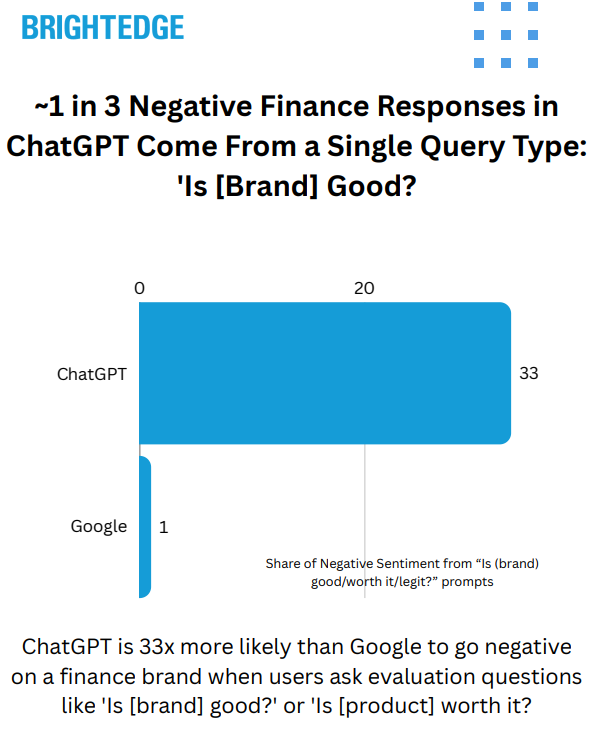
The short answer: Google goes negative when your news is bad. ChatGPT goes negative when your product is being evaluated. Same YMYL category, completely different risk profiles.
Data Collected
Using BrightEdge AI Catalyst™ and our Generative Parser, we analyzed:
Using BrightEdge AI Catalyst™, we analyzed:
| Data Point | Description |
| Brand sentiment in AI responses | Every brand mention classified as positive, neutral, or negative across both Google AI Overviews and ChatGPT in finance queries |
| Query intent classification | Each prompt categorized by user intent: Informational, Consideration, Branded Intent, or Transactional |
| Negative sentiment triggers | Pattern analysis identifying which query types and topics generate negative brand mentions |
| Cross-platform comparison | Head-to-head sentiment and intent analysis on finance prompts appearing in both engines |
| Evaluation query patterns | Specific analysis of "Is [brand] good?" and "Is [product] worth it?" query types across both platforms |
Key Finding
Google and ChatGPT both surface negative sentiment about finance brands — but the composition of that negativity is fundamentally different, driven by different query types, at different stages of the buying journey, and for different underlying reasons.
Google AI Overviews surfaces negative sentiment on roughly 2.4% of finance queries. ChatGPT surfaces it on roughly 4.4%. But comparing the raw rates misses the point — Google only generates AI Overviews for a portion of finance queries, while ChatGPT responds to every prompt it receives. The real insight isn't the volume. It's the shape.
On Google, 57% of negative finance sentiment appears on Informational queries — users learning about a topic and encountering headlines. On ChatGPT, 57% appears on Consideration queries — users actively evaluating options and deciding where to put their money.
Same number. Completely opposite intent. That's the story.
Two Engines, Two Kinds of Negativity
Google AI Overviews: Negative When the News Is Bad
Google's AI goes negative on finance brands primarily through news-cycle amplification. Lawsuits, data breaches, branch closures, regulatory actions, and below-market rates drive the majority of negative sentiment on the platform.
The pattern is recognizable from traditional PR: a single negative news event generates AI responses across multiple related queries, extending the tail of reputational damage well beyond a normal news cycle. A data breach doesn't just surface on the breach-specific query — it shows up on queries about online banking, account security, and even general savings rate comparisons for that institution.
Roughly 10% of Google's negative finance queries trace directly back to lawsuits, breaches, or regulatory issues. Another significant share comes from rates and fees queries — when a user asks about a specific institution's savings or CD rates and those rates fall below competitive benchmarks, Google's AI flags it. This isn't scandal. It's AI doing comparison shopping on the user's behalf.
ChatGPT: Negative When the Product Is Being Evaluated
ChatGPT's negative sentiment profile looks completely different. The dominant pattern is what we're calling the "Is X Good?" gauntlet — evaluation queries where users ask ChatGPT to render a judgment on a financial institution or product.
"Is [bank] a good bank?" "Is [product] worth it?" "Is [service] legit?" — roughly one-third of all negative sentiment in ChatGPT comes from this single query pattern. It's the largest source of negative finance sentiment on either platform, and it barely exists on Google.
When users ask ChatGPT these evaluation questions, it synthesizes review platform data and presents a balanced "pros and cons" response. That structure inherently introduces negativity — even for strong brands. ChatGPT is 33x more likely than Google to go negative on a finance brand when users ask evaluation questions.
Where in the Buying Journey Does AI Go Negative?
The intent breakdown reveals how differently these platforms create brand risk:
Google AI Overviews — Negative Sentiment by Intent
| Intent | Share of Negative Queries |
| Informational | 57% |
| Consideration | 27% |
| Branded Intent | 9% |
| Transactional | 7% |
ChatGPT — Negative Sentiment by Intent
| Intent | Share of Negative Queries |
| Consideration | 57% |
| Informational | 36% |
| Branded Intent | 4% |
| Transactional | 3% |
Google goes negative early in the journey — when users are still learning about a topic and encountering headlines. ChatGPT goes negative at the point of decision — when users are actively comparing options and deciding where to put their money.
The implications are significant. Google's negativity affects brand perception and awareness. ChatGPT's negativity affects purchase decisions. Different stage, different business impact, different remediation strategy.
The 5 Risk Zones for Finance Brands
When we categorize the types of queries that trigger negative brand sentiment in finance, five distinct patterns emerge — each weighted differently across the two platforms.
1. The "Is X Good?" Gauntlet (ChatGPT-Heavy)
The single largest source of negative finance sentiment. When users ask ChatGPT to evaluate a financial institution or product, it pulls from review platforms and consumer advocacy sites to build a balanced response. Even strong brands get dinged. This pattern drives approximately one-third of all negative sentiment on ChatGPT, compared to less than 2% on Google.
Example query patterns: "Is [bank] a good bank?" "Is [credit card] worth it?" "Is [financial service] legit?" "Is [investment product] a good investment?"
2. Rates as Implicit Criticism (Both Engines)
When someone asks about a specific institution's savings rate, CD rate, or money market rate and those rates fall below competitive benchmarks, both engines flag the brand negatively. This accounts for approximately 7–8% of negative queries on both platforms.
The mechanism is subtle but powerful: AI is essentially doing real-time comparison shopping for the user. No scandal required — just a product that doesn't measure up on the metric the user is asking about.
Example query patterns: "[Institution] savings account interest rate" "[Institution] CD rates" "[Institution] money market rates" "Which bank offers the highest interest rate?"
3. News-Cycle Amplification (Google-Heavy)
About 10% of Google's negative finance queries trace back to lawsuits, data breaches, regulatory actions, or institutional crises. The risk isn't just the initial story — it's the persistence. A single negative event generates AI responses across dozens of related queries, and those responses stick long after traditional news coverage fades.
What makes this pattern particularly dangerous in finance is the breadth of query contamination. A data breach story doesn't just appear on "[institution] data breach" — it surfaces on queries about that institution's online banking, account security, and general trustworthiness.
Example query patterns: "[Institution] lawsuit" "[Institution] data breach" "[Institution] branch closures" "[Payment platform] fraud"
4. Product Gap Exposure (ChatGPT-Heavy)
When a user asks "Does [institution] offer [product]?" and the answer is no or the offering is limited, ChatGPT frames that absence as a negative. This pattern showed up repeatedly across personal loans, high-yield savings accounts, and specialty financial products.
This is a uniquely ChatGPT-driven risk because of how the platform structures its responses. Google AI Overviews tends to answer the question factually. ChatGPT contextualizes the gap — explaining not just that the institution doesn't offer the product, but what that means for the user and where they should look instead.
Example query patterns: "Does [institution] offer personal loans?" "Does [institution] have a high-yield savings account?" "[Institution] [product type]" when the product doesn't exist
5. Consideration-Phase Comparison Shopping (ChatGPT-Heavy)
Over half of ChatGPT's negative finance queries fall under Consideration intent — users asking "which bank has the best..." or "what's the best [financial product]." When AI ranks options, brands that don't come out on top get implicitly or explicitly dinged.
The sources ChatGPT leans on for these comparisons are primarily review platforms, consumer finance publishers, and editorial rankings — third-party sources the brand may not be actively managing.
Example query patterns: "Which bank has the best savings rate?" "What's the best credit card for travel?" "Who has the best high-yield savings account?" "Best bank for [specific need]"
Healthcare vs. Finance: Same YMYL Framework, Different Fingerprints
Last week's healthcare analysis revealed that negative AI sentiment is driven almost entirely by safety signals — pregnancy contraindications, drug interactions, long-term risk disclosures. It's institutional sources saying cautionary things about specific products, and AI faithfully surfacing those warnings.
Finance follows a fundamentally different pattern. Negative sentiment isn't safety-driven — it's evaluation-driven. AI goes negative when it's assessing whether a brand, product, or rate is competitive. The triggers aren't warnings from medical authorities; they're review platform ratings, below-market rates, and product gaps.
| Dimension | Healthcare | Finance |
| Primary negative trigger | Safety warnings from institutional sources | Product evaluation and competitive comparison |
| What gets dinged | Consumer products (OTC/pharma) | Financial institutions and their products |
| Who's protected | Hospital systems (0.1% negative rate) | No structural protection — all institutions are evaluated |
| Biggest risk query type | "Can I take X while pregnant?" | "Is [institution] good?" |
| Platform split | Similar patterns on both engines | Mirror-image patterns — Google is news-driven, ChatGPT is evaluation-driven |
| Remediation | Publish safety content so AI uses your language | Manage review presence and product competitiveness |
The structural takeaway: in healthcare, AI goes negative when institutional sources say something cautionary about a product. In finance, AI goes negative when it evaluates whether your brand — and your products — measure up.
What This Means for Your Finance Brand Strategy
Google and ChatGPT require two different strategies. Google's negative sentiment is a PR and reputation management problem — monitor how AI Overviews surface your news cycle and for how long. ChatGPT's negative sentiment is a product competitiveness and review management problem — the evaluation queries aren't going away, and AI is pulling from sources you may not be actively managing.
Evaluation queries are the single biggest risk zone. "Is [brand] good?" and "Is [product] worth it?" drive roughly a third of all negative sentiment on ChatGPT. If your rates, products, or customer experience aren't competitive, AI will surface that at the exact moment a prospective customer is deciding where to go. This is the highest-impact negative sentiment in finance AI because it appears at the point of decision.
AI exposes product gaps by name. When users ask whether your institution offers a product and the answer is no, ChatGPT frames that absence as a negative. Map your product suite against the queries users are asking and know where you have holes before AI tells your prospects.
Own your review presence before AI uses it against you. ChatGPT leans heavily on review platforms and consumer finance publishers when constructing evaluation responses. The brand's presence on these third-party platforms is the raw material AI works with. Managing those profiles isn't just a customer satisfaction exercise — it's an AI search strategy.
Monitor both platforms — they tell opposite stories. A brand's AI sentiment on Google can look completely different from its sentiment on ChatGPT. Google may show clean results while ChatGPT surfaces review-driven criticism, or vice versa. A single-platform monitoring approach will miss half the picture.
The news cycle has a longer tail in AI. When negative news hits, Google AI Overviews doesn't just surface it once — it distributes that story across multiple related queries and keeps it visible well beyond the typical news cycle. Financial institutions need to understand which queries are contaminated by a negative story and plan content responses accordingly.
Technical Methodology
| Parameter | Detail |
| Data Source | BrightEdge AI Catalyst™ |
| Engines Analyzed | Google AI Overviews, ChatGPT |
| Query Set | Thousands of finance-related prompts spanning banking, investing, lending, insurance, and personal finance |
| Sentiment Classification | Brand-level sentiment (positive, neutral, negative) for every brand mentioned in finance AI responses |
| Intent Classification | Each prompt categorized as Informational, Consideration, Branded Intent, or Transactional |
| Negative Pattern Analysis | Categorization of negative-sentiment queries by trigger type: evaluation, rates/fees, news-cycle, product gaps, and comparison shopping |
| Cross-Platform Comparison | Head-to-head sentiment and intent analysis on finance prompts appearing in both engines |
Key Takeaways
| Finding | Detail |
| Two Engines, Two Risk Profiles | Google goes negative when news is bad (57% Informational). ChatGPT goes negative when products are evaluated (57% Consideration). Mirror-image intent patterns. |
| "Is X Good?" Dominates ChatGPT Negativity | Evaluation queries drive ~33% of all ChatGPT negative finance sentiment — and ChatGPT is 33x more likely than Google to go negative on these queries. |
| 5 Predictable Risk Zones | Evaluation queries, below-market rates, news-cycle amplification, product gap exposure, and consideration-phase comparison shopping. Each weighted differently by platform. |
| Finance ≠ Healthcare | Healthcare negativity is safety-driven (pregnancy, drug interactions). Finance negativity is evaluation-driven (competitive comparisons, review data). Same YMYL framework, different fingerprints. |
| ChatGPT Goes Negative at Point of Decision | Over half of ChatGPT's negative finance sentiment appears on Consideration-intent queries — when users are actively choosing where to put their money. |
| News Cycle Has a Longer Tail in AI | A single negative story generates AI responses across dozens of related queries on Google, extending reputational impact well beyond the normal news cycle. |
| Review Platforms Power ChatGPT's Negativity | ChatGPT pulls from review sites and consumer finance publishers when constructing evaluation responses. Managing those profiles is now an AI search strategy, not just a customer satisfaction exercise. |
Download the Full Report
Download the full AI Search Report — When AI Goes Negative on Finance Brands: How Google and ChatGPT Create Completely Different Risk Profiles in YMYL Search
Click the button above to download the full report in PDF format.
Published on March 11, 2026
When AI Goes Negative on Finance Brands: How Google and ChatGPT Create Completely Different Risk Profiles in YMYL Search
When AI Goes Negative in Healthcare: The Safety Signals That Trigger Brand Criticism in YMYL Search
BrightEdge data reveals that AI treats healthcare brands very differently depending on their category — and negative sentiment, while rare, follows predictable safety-driven patterns that consumer health brands need to understand.
BrightEdge data reveals that AI treats healthcare brands very differently depending on their category — and negative sentiment, while rare, follows predictable safety-driven patterns that consumer health brands need to understand.
BrightEdge data reveals that when AI engines mention healthcare brands negatively, it's almost never random — it's driven by safety signals. And the gap between how AI treats different types of healthcare sources is dramatic: OTC and pharmaceutical brands are 58x more likely to receive negative sentiment than hospital systems.
Healthcare is the highest-stakes category in AI search. Both Google AI Overviews and ChatGPT treat it as YMYL (Your Money or Your Life) content, applying extra scrutiny to the sources they cite and the claims they surface. AI Overviews now appear on approximately 88% of tracked healthcare queries, and ChatGPT generates an AI response for every query it receives. Both platforms are actively shaping how consumers understand health brands, medications, and institutions at scale.
But YMYL caution doesn't mean brand safety. When AI surfaces contraindications, safety warnings, or adverse effect data, it names specific products — and that creates a sentiment exposure that many healthcare and pharma marketers aren't yet tracking.
So we used BrightEdge AI Catalyst™ to find out what triggers negative sentiment in healthcare AI, who's most at risk, and where Google draws the line on which health topics get an AI-generated answer at all.
The short answer: AI treats healthcare institutions as trusted authorities. Consumer product brands don't get the same protection — especially on safety-related queries.
Data Collected
Using BrightEdge AI Catalyst™, we analyzed:
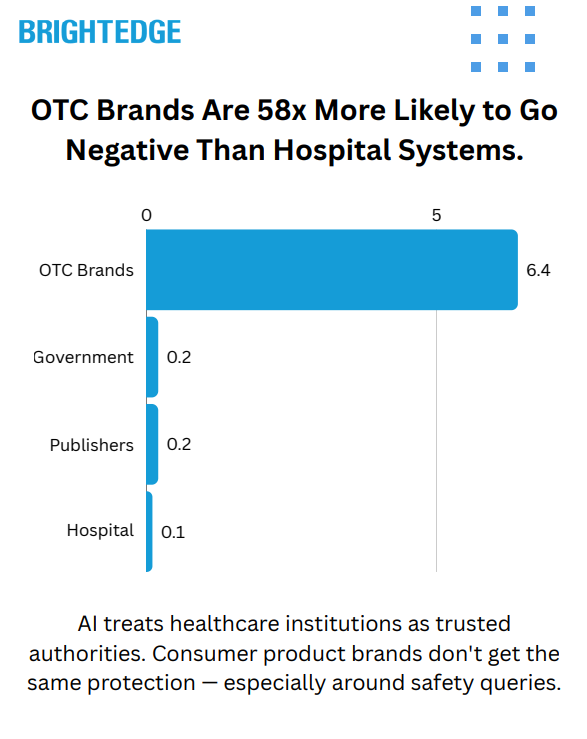
| Data Point | Description |
| Brand sentiment in AI responses | Every brand mention classified as positive, neutral, or negative across both Google AI Overviews and ChatGPT in healthcare queries |
| Citation patterns | Which source types each platform cites for healthcare queries and how citation concentration differs |
| Brand mention visibility | Which healthcare domains are explicitly named in AI-generated responses |
| Sensitive topic analysis | How both platforms handle pregnancy, drug interaction, mental health, sexual health, pediatric, and substance use queries |
| AIO deployment rates | Which healthcare specialties and topic areas trigger AI Overviews — and which Google leaves to traditional organic results |
| Cross-platform comparison | Head-to-head sentiment and citation analysis on healthcare prompts appearing in both engines |
Key Finding
Negative brand sentiment in healthcare AI is rare — but it's structurally concentrated on consumer product brands, triggered almost exclusively by safety-related queries, and absent from institutional sources.
Across both engines, negative brand mentions represent a small share of total healthcare AI references — under 0.5% of all brand mentions carry negative sentiment. But that small percentage is not distributed evenly. OTC and pharmaceutical brands absorb negative sentiment at a rate of 6.4%, while hospital and health systems see just 0.1%. That's a 58x gap.
And the triggers are almost entirely safety-driven: pregnancy contraindications, drug interaction warnings, long-term risk disclosures, and dubious health claim flagging account for the majority of identifiable negative sentiment. AI isn't editorializing about healthcare brands — it's surfacing institutional safety warnings and attaching them to specific products.
The Trust Hierarchy: Not All Healthcare Brands Are Equal
Both platforms treat healthcare sources with a clear hierarchy, and the gap between the top and bottom is enormous.
| Source Category | Positive Rate | Neutral Rate | Negative Rate |
| Hospital / Health Systems | 63.6% | 36.3% | 0.1% |
| Health Publishers | 51.0% | 48.8% | 0.2% |
| Government Sources | 45.0% | 54.8% | 0.2% |
| OTC / Consumer Health Brands | 35.8% | 63.5% | 0.7% |
Hospital and health systems sit at the top of the trust hierarchy on both platforms. They're not just cited frequently — they're framed positively at a higher rate than any other category. At 63.6% positive sentiment in ChatGPT, hospital systems are the most "recommended" source type in healthcare AI.
Government sources skew more neutral — they're treated as informational authorities rather than explicitly endorsed. This reflects an interesting editorial distinction: AI trusts government sources for facts but reserves its strongest positive framing for hospital systems.
OTC and consumer health brands sit at the bottom on every metric. Lower positive rates, higher neutral rates, and a negative rate that dwarfs every other category. When we isolate just the negative rate, the disparity is stark:
| Source Category | Negative Sentiment Rate |
| OTC / Pharmaceutical Brands | 6.4% |
| Tabloid / Lifestyle Media | 3.4% |
| Health Publishers | 0.25% |
| Government / Medical Associations | 0.20% |
| Hospital / Health Systems | 0.11% |
OTC brands face 58x the negative sentiment rate of hospital systems. This isn't a small difference in degree — it's a structural feature of how AI evaluates different types of healthcare authority.
Platform Differences: ChatGPT Is More Opinionated
While both platforms show the same trust hierarchy, they differ in how strongly they express it:
| Metric | ChatGPT | Google AI Overviews |
| Overall positive rate | 45.1% | 33.5% |
| Overall neutral rate | 54.5% | 66.2% |
| Overall negative rate | 0.4% | 0.3% |
| Avg. brands mentioned per response | 5.8 | 3.8 |
| Top 10 domain citation share | 34.3% | 40.1% |
ChatGPT is more willing to take a position — both positive and negative. It frames sources more favorably, mentions more brands per response, and distributes citations more broadly. Google AI Overviews is more conservative: more neutral, fewer sources per response, and higher concentration on a smaller set of trusted domains.
For healthcare organizations, this creates a strategic split. ChatGPT offers more pathways to visibility (more brands cited, more broadly distributed), but also more editorial exposure. Google AI Overviews is harder to break into but more predictable once you're there.
One brand mention pattern is particularly striking. When we look at which brands are explicitly named in AI responses (not just linked, but mentioned by name), a single UK government health service captures 92.6% of all brand visibility in Google AI Overviews — and 68.1% in ChatGPT. Google's trust in government health authorities, when it comes to naming sources, is nearly monopolistic.
The 4 Safety Signals That Trigger Negative Sentiment
When AI does go negative on a healthcare brand, it follows predictable patterns. Nearly all identifiable negative sentiment traces back to safety-related queries — AI surfacing institutional warnings about specific products.
| Trigger Category | Share of Identifiable Negative Mentions |
| Drug Interactions / Dosing Concerns | 14% |
| Pregnancy / Maternal Safety | 13% |
| Quick-Fix / Dubious Health Claims | 7% |
| Long-Term Risk / Side Effects | 3% |
| Substance Effects | 2% |
1. Pregnancy and Maternal Safety
The single largest identifiable trigger. When users ask whether a medication or supplement is safe during pregnancy or breastfeeding, AI cites institutional contraindication guidance — and names the product negatively. Pain relievers, sleep aids, nasal sprays, and cold medications are the most frequent targets.
The pattern is consistent: AI references hospital systems and government health agencies as the authority, and the consumer product takes the negative sentiment hit. The institution providing the warning gets positive or neutral sentiment; the product being warned about gets the negative tag.
Example query patterns: "Can you take [pain reliever] while pregnant?" "What nose spray can I use while breastfeeding?" "What teas are safe during pregnancy?"
2. Drug Interaction and Dosing Concerns
The second major trigger. Queries about combining medications, appropriate dosing, or daily use safety generate negative mentions for the products in question. AI cites medical institutions and government agencies warning about overuse or interaction risks.
Sleep supplements are particularly exposed here — queries about how many to take, whether daily use is safe, and interaction with other medications consistently surface negative sentiment for the product brand while citing hospital systems positively.
Example query patterns: "How many [sleep supplement] gummies should I take?" "Is it OK to take [sleep aid] every night?" "What can I take for arthritis pain while on [blood thinner]?"
3. Long-Term Risk Disclosures
When users ask about the long-term effects of specific medications, AI surfaces published research linking products to adverse outcomes. Certain antihistamines appear negatively in connection with cognitive risk in elderly populations. Statins appear in blood sugar effect discussions. The AI is citing peer-reviewed research — but the brand absorbs the negative sentiment frame.
This is a particularly difficult exposure for pharmaceutical brands because the negativity is evidence-based. AI is accurately representing published research findings, but the brand association is what sticks in the AI-generated response.
Example query patterns: "Medications that increase risk of Alzheimer's" "Long-term use of [benzodiazepine] in the elderly" "Which statin does not raise blood sugar?"
4. Dubious Health Claims
A smaller but notable pattern: tabloid-style health publishers and lifestyle media occasionally receive negative sentiment when AI flags their claims as lacking evidence. Quick-fix health content — "lose belly fat in 1 week," "cure [condition] naturally in 7 days" — gets called out when AI notes the claims aren't supported by medical evidence.
This trigger is unique because it targets content sources rather than products. AI is functioning as a quality filter, distinguishing between evidence-based health information and sensationalized health content.
Example query patterns: "How to lose belly fat naturally in 1 week?" "How to get rid of [condition] fast?"
Where Google Won't Even Use AI: The AIO Deployment Gap
Beyond sentiment, there's a separate dimension of AI caution in healthcare: the topics where Google declines to generate an AI Overview at all, leaving the answer to traditional organic results.
AI Overviews appear on approximately 88% of healthcare queries overall, but the rate varies dramatically by specialty and topic area:
| Healthcare Topic | AIO Deployment Rate |
| Gastroenterology | 95.1% |
| Orthopedics | 94.1% |
| Neurology | 94.2% |
| Urology | 93.8% |
| Cardiology | 92.8% |
| Genetics | 89.3% |
| Primary Care | 68.7% |
| Telehealth | 66.7% |
| Eating Disorders | 65.1% |
| Bullying / Behavioral Health | 65.1% |
The pattern is clear: the more emotionally sensitive the health topic, the less likely Google is to deploy an AI-generated summary. Clinical specialties cluster between 93–95% AIO deployment. But eating disorders, bullying, and behavioral health drop to 65% — a 30-percentage-point gap.
Among the specific queries Google avoids answering with AI: domestic violence, emotional abuse, body dysmorphia treatment, binge eating disorder treatment, and substance abuse topics.
The ~12% of healthcare keywords without AI Overviews cluster into recognizable patterns:
| Non-AIO Pattern | Share of Excluded Keywords |
| Local / navigational queries | ~11% |
| Abuse and violence topics | ~9% |
| Visual / diagnostic queries | ~7% |
| Body image and eating disorders | ~7% |
| Branded / facility-specific | ~3% |
This deployment gap has direct implications for SEO strategy. For behavioral health topics, traditional organic rankings carry disproportionate weight because Google frequently isn't generating an AI summary to compete with. These are the queries where organic SEO still dominates the user experience.
Sensitive Topic Handling: Both Platforms Engage, Differently
Both platforms engage with sensitive healthcare topics at broadly similar rates — the difference is in how many sources they involve and how they frame the answers.
| Sensitive Topic | ChatGPT Query Share | Google AIO Query Share |
| Sexual Health / STIs | 3.5% | 3.1% |
| Pregnancy / Maternal Health | 2.4% | 2.4% |
| Drug Interactions | 2.2% | 3.2% |
| Mental Health | 1.4% | 2.2% |
| Substance Use / Addiction | 1.4% | 1.1% |
| Pediatric Health | 1.0% | 1.2% |
Google AI Overviews shows slightly higher engagement on drug interaction and mental health queries, while ChatGPT shows slightly higher engagement on sexual health and substance use topics. But the key structural difference is that ChatGPT includes 5.8 brands per response vs. 3.8 for Google — giving users more reference points and distributing trust across more organizations for every sensitive query.
Cross-referencing with AIO deployment data reveals the nuance: while Google does answer most sensitive health queries with an AI Overview, it draws clearer lines around abuse, violence, and eating disorder content — where AIO rates drop 30 points below the clinical specialty average.
What This Means for Your Healthcare Brand Strategy
OTC and Pharma Brands Carry the Most Exposure. At 6.4% negative sentiment — 58x the rate of hospital systems — consumer health brands are the primary target when AI surfaces healthcare criticism. This isn't random editorial judgment; it's AI faithfully reflecting what institutional sources say about specific products in safety contexts. The risk is concentrated and predictable.
Safety Queries Are the Trigger — and They're Identifiable. Pregnancy safety, drug interactions, long-term risk disclosures, and dubious health claims account for the majority of identifiable negative sentiment. Brands can map exactly which of their products sit in these query spaces and prioritize proactive safety content accordingly.
Own the Narrative Before AI Writes It for You. When AI goes negative on a consumer health product, it's citing someone else's warning — a hospital system, a government agency, a peer-reviewed study. The brand that publishes transparent, comprehensive safety guidance gives AI its own language to use. The brand that doesn't leaves the characterization to third parties.
Hospital Systems Are in the Strongest Position. With a 0.1% negative rate and 63.6% positive sentiment, hospital and health systems are the most trusted, most favorably framed source category in healthcare AI. The priority for these organizations isn't defending against negativity — it's ensuring they're in the citation set.
Behavioral Health Requires a Different Strategy. The 30-point AIO gap on eating disorders, bullying, and abuse content means traditional organic SEO carries outsized importance for behavioral health organizations. These topics also represent an opportunity in ChatGPT, which does answer these queries and cites broadly.
Monitor Both Platforms — They Tell Different Stories. ChatGPT is more opinionated (higher positive and negative rates) and cites more broadly (5.8 brands per response). Google AI Overviews is more conservative (more neutral) and more concentrated (top 10 domains capture 40.1% of citations). A brand's reputation in one platform may look completely different in the other.
Technical Methodology
| Parameter | Detail |
| Data Source | BrightEdge AI Catalyst™ |
| Engines Analyzed | Google AI Overviews, ChatGPT |
| Sentiment Classification | Brand-level sentiment (positive, neutral, negative) for every brand mentioned in healthcare AI responses |
| Citation Analysis | Domain-level citation tracking including visibility share, citation concentration, and source categorization |
| AIO Deployment Tracking | Separate multi-specialty healthcare keyword set tracking AI Overview presence/absence across clinical and general health categories |
| Topic Categories | Healthcare specialties (gastroenterology, orthopedics, neurology, urology, cardiology, genetics), general health (primary care, behavioral health, eating disorders, telehealth) |
| Sensitive Topic Classification | Pregnancy/maternal, drug interactions, mental health, sexual health/STIs, pediatric, substance use |
Key Takeaways
| Finding | Detail |
| 58x Negative Sentiment Gap | OTC/pharma brands face a 6.4% negative rate vs. 0.1% for hospital systems. AI structurally favors institutional healthcare sources over consumer product brands. |
| 4 Predictable Safety Triggers | Pregnancy safety, drug interactions, long-term risk disclosures, and dubious health claims drive the majority of identifiable negative sentiment. All are safety-signal driven. |
| Hospital Systems Are Most Trusted | 63.6% positive sentiment — the highest of any source category. AI treats hospital systems as the most recommended, most authoritative healthcare source. |
| Government Sources Dominate Brand Mentions | A single UK government health service captures 92.6% of Google AIO brand mentions and 68.1% of ChatGPT mentions — near-monopoly status. |
| 88% of Healthcare Queries Get AI Overviews | But behavioral health topics (eating disorders, bullying, abuse) drop to 65%. A 30-point gap where organic SEO still dominates. |
| ChatGPT Distributes Trust More Broadly | 5.8 brands per response vs. 3.8 for Google. Lower citation concentration. More pathways to visibility for a wider range of healthcare organizations. |
Download the Full Report
Download the full AI Search Report — When AI Goes Negative in Healthcare: The Safety Signals That Trigger Brand Criticism in YMYL Search
Click the button above to download the full report in PDF format.
Published on February 26, 2026
When AI Goes Negative in Healthcare: The Safety Signals That Trigger Brand Criticism in YMYL Search
When AI Goes Negative: How Google AI Overviews and ChatGPT Handle Brand Criticism Differently
BrightEdge data shows that Google and ChatGPT surface negative brand mentions very differently across industries. Knowing where and why this happens is the next frontier of AI search optimization.
BrightEdge data reveals that when AI engines mention brands negatively, Google and ChatGPT follow fundamentally different patterns — and it varies dramatically by industry. Understanding where and why negative sentiment appears is the next frontier of AI search optimization.
As AI Overviews and ChatGPT play an increasingly central role in how consumers research products and make purchasing decisions, one question keeps surfacing in conversations with marketing leaders: if AI is going to talk about our brand, what happens when it says something we don't like?
It's the right question. AI engines are now mentioning brands by name across billions of queries — recommending, comparing, and evaluating them in real time. But that also means they can surface criticism, flag limitations, or steer users toward competitors. Until now, there hasn't been much data on how often this actually happens, what triggers it, or whether different AI engines handle it differently.
So we used BrightEdge AI Catalyst™ to find out. We analyzed prompts across Google AI Overviews and ChatGPT in three industries — Apparel, Electronics, and Education — and tracked every brand mention and its sentiment. We then compared the two engines head-to-head to understand whether they go negative on the same queries, the same brands, and for the same reasons.
The short answer: they don't.
Data Collected
Using BrightEdge AI Catalyst™, we analyzed:
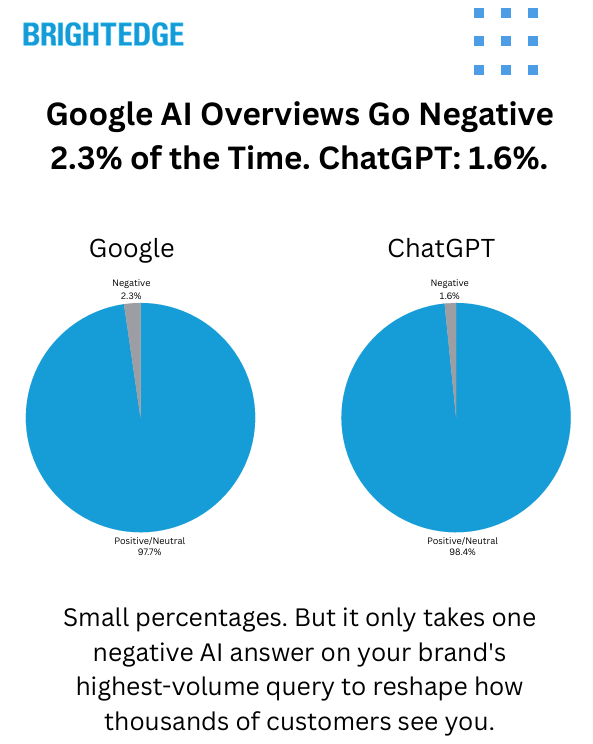
| Data Point | Description |
| Brand sentiment in AI responses | Every brand mention classified as positive, neutral, or negative across both Google AI Overviews and ChatGPT |
| Primary response sentiment | The overall sentiment posture of each AI-generated response |
| Intent classification | Search intent behind each prompt (Informational, Consideration, Transactional, Post Purchase, Branded Intent) |
| Industry segmentation | Separate analysis across Apparel, Electronics, and Education verticals |
| Cross-engine comparison | Head-to-head sentiment analysis on overlapping prompts appearing in both engines |
Key Finding
Negative brand sentiment in AI is rare — but it's real, it's concentrated in predictable query patterns, and Google and ChatGPT go negative for fundamentally different reasons.
Across both engines, negative brand mentions represent a small share of total AI-generated brand references — 2.3% for Google AI Overviews and 1.6% for ChatGPT. But that small percentage is concentrated in specific, high-visibility query types. And when we compared the two engines side by side, the most striking finding wasn't how often they go negative — it was how differently they do it.
Google AI Overviews behaves like an investigative reporter, surfacing negativity around controversies, lawsuits, product recalls, and news-driven events. ChatGPT behaves like a product advisor, more likely to go negative around product limitations, compatibility issues, and evaluative "is it worth it?" queries. The same brand can be treated positively by one engine and negatively by the other — on the same query.
Overall Negative Sentiment: Small but Meaningful
Across both engines, the vast majority of brand mentions are positive or neutral. But negative sentiment, while a small share, is present and consistent:
| Engine | Positive | Neutral | Negative |
| Google AI Overviews | 49.9% | 47.7% | 2.3% |
| ChatGPT | 43.9% | 54.4% | 1.6% |
Google AI Overviews is 44% more likely than ChatGPT to mention a brand negatively. ChatGPT skews more neutral overall — it mentions more brands but takes fewer editorial positions on them, positive or negative.
Another way to frame it: Google's positive-to-negative ratio is roughly 21:1. ChatGPT's is 27:1. Both engines overwhelmingly speak positively about brands — but Google is measurably more willing to surface criticism when it does take a position.
Two Engines, Two Editorial Personalities
This is the core finding. When we isolated the prompts where only one engine went negative (the other stayed neutral or positive on the same query), clear patterns emerged in what triggers negativity for each engine.
Among identifiable negative sentiment triggers:
| Trigger Category | Share of Categorized Negatives |
| Brand Controversies & Legal Issues | 32% |
| Product Limitations & Compatibility | 21% |
| Safety & Recalls | 17% |
| Service Failures & Outages | 11% |
| Product Discontinuation | 9% |
| Price & Value Criticism | 8% |
| Competitive Comparisons | 3% |
Controversies, legal issues, and safety recalls account for the majority of identifiable negative sentiment across both engines combined. But when we split by engine, the editorial personalities diverge sharply:
Google AI Overviews skews heavily toward controversy-driven negativity. When Google goes negative and ChatGPT doesn't, the triggers are overwhelmingly news-driven — lawsuits, boycotts, data breaches, regulatory actions, product recalls. Google is 4.5x more likely than ChatGPT to surface negative brand sentiment tied to news and controversy.
ChatGPT skews toward product evaluation negativity. When ChatGPT goes negative and Google doesn't, the triggers are typically product-focused — compatibility limitations, feature shortcomings, "is it worth it?" assessments. ChatGPT is 3x more likely than Google to go negative on product evaluation queries.
In practical terms: a major retailer might face negative sentiment in Google AI Overviews because of a news story about a lawsuit — while in ChatGPT, the same retailer might face negative sentiment because a user asked whether they accept a specific payment method and the answer is no. Same brand, different engine, different reason for criticism, different risk to manage.
The Same Query, Different Verdict
We identified overlapping prompts that appeared in both engines and carried negative brand sentiment in both. Among those overlapping negative prompts, the two engines disagreed on which brand to flag 73% of the time.
This means that even when both engines recognize a query as carrying negative implications, they frequently assign that negativity to different brands within the same response. One engine might flag the retailer; the other might flag the payment provider. One might criticize the platform; the other might criticize the manufacturer.
Tracking your brand's sentiment on one AI engine gives you, at best, half the picture. The other engine may be telling a completely different story about your brand — on the same query.
Industry Breakdown: No One-Size-Fits-All
Negative sentiment rates vary significantly across the three industries we analyzed, and the relative positioning of Google vs. ChatGPT shifts depending on the vertical.
| Industry | Google AI Overviews | ChatGPT | More Negative Engine |
| Electronics | 2.5% | 1.7% | Google (1.5x) |
| Education | 2.5% | 1.4% | Google (1.8x) |
| Apparel | 0.2% | 0.6% | ChatGPT (3x) ← |
Electronics sees the highest overall negative sentiment rates, driven by product recall coverage, service outage queries, and technology controversy topics. Google leads here because there's significant news and controversy activity for Google to surface.
Education shows a similar pattern, with Google nearly twice as negative as ChatGPT. This is driven largely by institutional and political scrutiny queries — funding decisions, policy controversies, and regulatory actions affecting educational institutions.
Apparel is where the pattern flips entirely. ChatGPT is 3x more negative than Google in Apparel — not because there's more controversy, but because there's less. With fewer lawsuits and recalls for Google to report, the dominant negative triggers in Apparel are product evaluation queries: "Is this shoe good for running?" "Is this fabric durable?" These are the types of questions where ChatGPT is more willing to deliver a critical verdict.
This reversal illustrates why industry-level monitoring matters. A brand monitoring only one engine, or benchmarking against cross-industry averages, would miss the dynamics specific to their vertical.
Where Negative Sentiment Appears in the Buying Journey
The intent distribution of negative-sentiment AI responses reveals where in the customer journey brands are most exposed to AI criticism:
| Intent Type | All Prompts | Negatives (Google) | Negatives (ChatGPT) |
| Informational | 58.7% | 85.1% | 68.5% |
| Consideration | 14.1% | 1.5% | 19.4% |
| Transactional | 8.8% | 1.5% | 4.7% |
| Post Purchase | 8.8% | 0.7% | 3.7% |
| Branded Intent | 5.3% | 4.5% | 3.6% |
Google's negative sentiment is overwhelmingly concentrated in the informational phase — 85% of negative-sentiment AI Overviews appear on informational queries. This is the research and discovery stage, where users are forming impressions and evaluating options before making a decision.
ChatGPT distributes its negative sentiment more broadly. While informational queries still dominate (68.5%), ChatGPT shows meaningfully more negative sentiment in the consideration phase (19.4% vs. Google's 1.5%). This means ChatGPT is more willing to surface brand criticism closer to the point of purchase — when a user is actively evaluating options.
For brands, this distinction matters. Google's negativity hits during early research, potentially shaping initial perceptions. ChatGPT's negativity extends further into the decision-making process, where it may more directly influence purchase choices.
The Balanced Evaluator Pattern
Beyond simple negative mentions, we identified a distinct pattern where AI engines present both positive and negative brand sentiment within the same response — actively praising some brands while flagging limitations of others.
Approximately 1.4% of all prompts with brand mentions showed this mixed-sentiment pattern. These are the moments where AI is functioning as an editorial evaluator, making real-time brand-versus-brand judgments within a single answer.
| Scenario | What the AI Does |
| Compatibility queries | Praises alternative solutions while flagging limitations of the product the user asked about |
| Discontinued product queries | Speaks negatively about the discontinued brand while positively recommending current alternatives |
| Evaluative queries | Highlights strengths of category leaders while noting shortcomings of the specific brand in question |
This pattern represents AI moving beyond simple question-answering into active brand arbitration — a dynamic that didn't exist in traditional organic search results.
What This Means for Your Brand Strategy
Negative Sentiment Is Rare but Concentrated. At 1.6%–2.3% of brand mentions, negative sentiment is not the dominant AI experience. But it clusters around specific, predictable query types. Brands don't need to worry about everything, but they do need to know which queries put them at risk.
Each Engine Requires Its Own Monitoring. Google and ChatGPT go negative for different reasons, on different queries, and sometimes flag different brands on the same prompt. A brand's reputation in Google AI Overviews may look completely different from its reputation in ChatGPT. Monitoring one engine is not sufficient.
Your Industry Determines Your Risk Profile. Electronics and Education face more Google-driven negativity (controversy and news). Apparel faces more ChatGPT-driven negativity (product evaluation). The triggers, the engine, and the severity all depend on the vertical. Cross-industry benchmarks obscure more than they reveal.
The Research Phase Is Where It Matters Most. 85% of Google's negative sentiment and 68.5% of ChatGPT's appears during the informational stage. This is when opinions form. Brands that only monitor their AI presence at the transactional level are missing where the conversation is actually happening.
Sentiment Monitoring Is the Next Layer of AI Optimization. Knowing where you're cited is essential. Knowing how you're described is what comes next. As AI engines take on a larger role in shaping brand perception, sentiment tracking across engines becomes as important as citation tracking.
Technical Methodology
| Parameter | Detail |
| Data Source | BrightEdge AI Catalyst™ |
| Engines Analyzed | Google AI Overviews, ChatGPT |
| Sentiment Classification | Brand-level sentiment (positive, neutral, negative) for every brand mentioned, plus primary sentiment for overall response tone |
| Intent Classification | Informational, Consideration, Transactional, Post Purchase, Branded Intent, Not Applicable |
| Industries Covered | Apparel, Electronics, Education |
| Cross-Engine Analysis | Overlapping prompts appearing in both engines compared for sentiment alignment and brand-level agreement |
Key Takeaways
| Finding | Detail |
| Negative Sentiment Is Present but Small | Google AI Overviews: 2.3% negative. ChatGPT: 1.6%. The vast majority of AI brand mentions are positive or neutral. |
| Different Editorial Instincts | Google skews toward controversy (4.5x more likely). ChatGPT skews toward product evaluation (3x more likely). Same brand, different risks on each engine. |
| Industry Changes Everything | Electronics and Education: Google more negative. Apparel: ChatGPT 3x more negative. No single benchmark applies across verticals. |
| Informational Queries Are the Battleground | 85% of Google's negative sentiment and 68.5% of ChatGPT's appears during the research phase — before purchase decisions are made. |
| The Engines Frequently Disagree | On overlapping negative prompts, Google and ChatGPT flagged different brands 73% of the time. One engine is not enough. |
| AI Is Becoming a Brand Evaluator | ~1.4% of prompts show mixed sentiment — AI praising some brands while criticizing others in the same response. New territory for search. |
Download the Full Report
Download the full AI Search Report — When AI Goes Negative: How Google AI Overviews and ChatGPT Handle Brand Criticism Differently
Click the button above to download the full report in PDF format.
Published on February 19, 2026