Can You Still Win in Organic Search? Yes, You Can!

Default avatar
Andy Betts
M Posted 11 years 7 months ago
t 9 min read

The past year or so has seen quite a shake-up in the organic search world. Those who were not prepared to proactively roll with the punches find themselves in a confused state of affairs. Can you still increase organic search, despite all the changes? Some would speculate that it’s becoming harder, but it’s truly the approach to your increase organic search strategy that will carry you through the algorithm changes, the search engine initiatives and search trends. In this post, we’ll talk about some of the changes we’ve seen, and how to continue to have a winning organic search strategy by focusing on content and mobile.

Mobile marketing

“There is a new phase of content development forming with in-app and mobile experiences. Content is being developed and tailored for device types that fundamentally improve the overall experience. It’s surprising to still see people just digitize content, but not actually tailor it for mobile.” - Darren Pleasance, head of customer acquisition at Google.

Indeed. According to comScore data reported by Rebecca Murtagh at Search Engine Watch, mobile use surpassed that of desktop early this year, forever altering the digital marketing landscape for brands and businesses. Coupled with comScore’s latest (June 2014) smartphone subscriber figures, which forecasts smartphone penetration (in the U.S.) to reach 74 percent by the end of the year, marketers have every incentive to adopt an informed mobile solution for their content.

This surge in mobile use followed Google’s June 2013 announcement that it’d be rolling out ranking changes in its mobile and smartphone search results for sites that provided a poor user experience. According to Google, the two most common mistakes in website configurations for mobile are faulty redirects and smartphone-only errors. Looking for more information on mobile marketing and solutions? Data from The BrightEdge 2014 Mobile Share Report provides insights into the growing mobile search traffic revolution and proper mobile SEO optimization. Also, BrightEdge CEO Jim Yu has written extensively on the subject, including:

  • The Mobile Boom Is Here: Deliver the Best Experience, No Matter the Device at The Huffington Post. Jim notes that “just because you’re ‘doing mobile,’ doesn’t necessarily mean you’re doing it right,” advising brands to optimize for the boom in mobile organic search by choosing their best “mobile path” as determined by the relative performance by of their Web pages by device.
  • Going All Responsive Is Not Always “One Size Fits All” With Mobile at Marketing Land. Citing data from the BrightEdge 2014 Mobile Share Report, Jim states that 27 percent of the websites studied made mobile configuration errors that resulted in an average loss in smartphone traffic of 68 percent. Based on BrightEdge’s Data Cube research, he also cautions that the responsive design (recommended by Google) doesn’t necessarily mean higher search rankings for your site as compared to the other two mobile solution options.
  • Mobile Site Configuration 101: How to Choose at Search Engine Watch. Jim outlines the three mobile site configurations supported by Google, and advises brands to consider their goals and the Web traffic insights culled from their analytics when deciding upon a mobile solution.

Content & semantic search

“This past year will be remembered as the ‘Year of Content.’ [There has been] so much conversation around how important content is, people moving budgets towards content efforts and so on. And yet, for all that talk and action, content has always been important.” – Duane Forrester, head of the webmaster program at Bing.  

As the digital marketing mantra goes, “content is king.” Brands have learned that they must embrace Google’s directive to provide users with the best experience and quality content since the Panda algorithm first arrived on the search scene in 2011. Now, it’s an integral part of Google’s algorithm, rolling out on a continuous basis. Combined with its Penguin update, which targets link schemes, massive guest blogging networks and other attempts to pass PageRank, Google has made its zero-tolerance stance towards such shortcuts clear. “And as if content weren’t enough, more and more companies are starting to hear the message around marking up content, and taking an action towards it. This is a future-proofing tactic that will serve websites well,” Duane notes.

The transition to semantic search, evidenced by Google’s rollout of its “Hummingbird” algorithm as well as improvements to its “conversational” voice search and Knowledge Graph, ushered in a new era of SEO and content development. Coinciding with the search giant’s move to 100 percent secure search, Google unveiled Hummingbird at its 15th birthday celebration in September 2013 (although it quietly rolled out the new infrastructure the month before), marking the beginning of the end of traditional, keyword-driven SEO and content optimization.

As Duane alluded to when he spoke of “marking up content” as “future-proofing tactic,” semantic search is most effectively leveraged when you use Schema.org to markup your digital content. Simply put, Schema.org helps the search engines to better understand your content and what a web page is about, allowing them to deliver better results (think “rich snippets”) to the user. For more information on how semantic search works using the Knowledge graph and structured data, check out these resources and articles:

  • Use Structured Data for Rich Search Results at Google Webmaster Tools Help. A comprehensive, how-to guide on structured data and rich snippets.
  • Google Hummingbird & The Keyword: What You Need To Know To Stay Ahead at Search Engine Land. BrightEdge CEO Jim Yu discusses Google’s Hummingbird algorithm, and what it means for marketers. Coupled with Google’s eclipse of keyword data, Hummingbird represents an improvement in semantic search, allowing Google to better interpret the searcher’s intent and the context of the words used in a query.
  • Introducing the Knowledge Graph: Things, Not Strings at Google Inside Search. In a detailed explanation of the Knowledge Graph, Amit Singhal describes it as the “critical first step towards building the next generation of search, which taps into the collective intelligence of the web and understands the world a bit more like people do.”
  • Knowledge Graph Optimization at Blind Five Year Old. AJ Kohn discusses how brands can leverage the Knowledge Graph by optimizing their website’s connection to it, which can translate into greater search visibility.

Thinking Like a Freak with Stephen Dubner

Default avatar
Andy Betts
M Posted 11 years 8 months ago
t 9 min read

Chances are, you’ve heard of the book, Freakonomics. This book was (and still is) wildly popular because it examined the way our world works in a completely new light. One of the masterminds behind Freakonomics is Stephen Dubner, renowned author, journalist, and media personality. We couldn’t be more excited for Stephen to close out Share14 with the final keynote - now just a few weeks away.

At Share14, he’ll talk about how to apply the ideas from his latest bestseller, Think Like a Freak (2014), to marketing. Learn how to think like a freak with Stephen Dubner - BrightEdgePrior to Share14, Jim, CEO of BrightEdge, had a chance to pick Stephen’s brain on how marketers can “think like freaks” when it comes to their business strategies and creative processes.



Jim Yu (JY): How does “thinking like a freak” help people to solve problems in new ways?

Stephen Dubner (SD): Ah, you are asking me to summarize the whole book in the very first question! Okay, I’ll try:

  • Learn to admit what you don’t know;
  • Be willing to think like a child;
  • Put aside (temporarily) your moral compass;
  • Learn how to shift the framework of your various relationships;
  • Understand the power of incentives, including the possibility that they might backfire; and
  • Learn to appreciate the upside of quitting.

The digial revolution - measurement is key

JY: How can taking this approach specifically benefit marketers?

SD: The digital revolution has been a huge gift to marketing in that what was once only suspected can now be measured. You can’t learn anything if you can’t get good feedback; now, being able to measure all sorts of things allow us to find better solutions to all kinds of problems, including marketing.

JY: What are your top three tactics for changing up your thinking? Any methods or pieces of advice that you always turn to when you’re in a rut?

Change is imperative

SD:

  1. Spend time with people very much unlike you.
  2. Consciously alter your routines/habits, even something as simple as ordering a meal you’ve never had before.
  3. Physical exercise; it’s remarkable how moving your lower muscles will help you move your highest muscle.

JY: Can you give me an example of how you’ve seen “thinking like a freak” benefit a company in terms of marketing or business strategy?

SD: There’s a story we tell in the book about a huge multinational retailer that probably *should* have benefited from our thought process. They were spending tens of millions of dollars in a way that, in our view, wasn’t necessarily fruitful. They didn’t pay us much attention, however.

Content creation and storytelling

(JY): Do you have any advice for how marketers can be more creative in the storytelling and content creation process?

SD: There is much to be said about how to tell a good story, and why a good story is so resonant, and memorable. (I will likely discuss this at Share14.) One of the most powerful hidden strengths of storytelling is that we are all narcissists, and a good story allows each of us to put ourselves in the place of the characters in the story — assessing how they made their decisions, etc. Because of this, a lot of people — whether clients, customers, etc. — are able to learn a lot more via a story than they would by a set or rules or theories.

Stephen Dubner at Share14

JY: What are you most excited to share with marketers during your keynote at Share14?

SD: I love talking to marketers because they are generally an upbeat, creative, driven group of people whose work isn’t so dissimilar from what I do. Plus they are fun to be around. See you soon!

About Share14

Share14 is the must attend event of the year for content, search and digital marketers. Hear what search and social titans from Google, Bing, Microsoft, Twitter and Facebook have to say on the future of content, search and social. Marketing leaders from brands such as Adobe, Macys, 3M, SAP, HP, Marriott and Hilton share insights, case studies, and best takeaways on how to win with content performance marketing. Please note that the event is due to hit 'sell out' status by next week. Register now to avoid disappointment. The full line up of speakers, and links to registration, can be viewed here. REGISTER NOW

Leveraging LinkedIn Marketing Ideas for Branding

Default avatar
Andy Betts
M Posted 11 years 9 months ago
t 9 min read

Even if you’re not an “official” Baby Boomer, you’re likely familiar with that classic ‘70’s show (or its ‘90’s movie spinoff), "The Brady Bunch." Throughout, poor Jan Brady repeatedly laments, “It’s always Marsha, Marsha, Marsha!”

As brand marketers, you may well relate: “It’s always content, content, content!” Indeed it is, and for good reason.

Just as Marsha was the undisputed queen of the Brady brood, so is content the irrefutable king of search and social media – and will remain so for the foreseeable future. And when it comes to using content to build your professional brand on social media, using LinkedIn marketing ideas remains the sovereign option.

LinkedIn: The Content Publisher’s Professional Platform

In a bold move that distinguished itself from the other major social media channels of the time, LinkedIn introduced a content publishing platform in 2012, “LinkedIn Influencer,” whereby it invited the top 150 industry thought leaders to share their original content.

Fast forwarding to February of this year, the company announced that it would open its publishing venue to all of its users, beginning with 25,000 (still relatively exclusive) members. Today, LinkedIn continues to democratize its publishing platform with a slow but steady roll out to all of its nearly 300 million users. (Note: As of the date of its announcement, LinkedIn states that it is offering access to its publishing platform only to English language users, but stipulates it will be expanding access to accommodate multiple languages). What does this mean for your brand? Nothing short of a huge opportunity to position yourself as the go-to resource in your industry’s vertical! Publishing solid, optimized content on LinkedIn allows you the opportunity to showcase your brand, and reach a significant amount of qualified potential customers, not only through LinkedIn’s own site search, but also via the search engines themselves.

LinkedIn Marketing Ideas for the Content Publishing Fast Track

So how do you maneuver onto the fast track for leveraging LinkedIn’s content publishing platform? First of all, if you haven’t done so already, you’ll want to start publishing exceptional content, be it on your own blog or a secondary online forum.

Once you've published a few good quality pieces, follow these 4 LinkedIn marketing ideas:

  • Flesh out your brand’s LinkedIn company page
  • Incorporate search-specific keywords and phrases into your brand’s profile and shared content
  • Create a LinkedIn group relevant to your industry
  • Integrate visual media to accompany your shared content

​1. Flesh out your brand’s LinkedIn company page. Meaning, REALLY flesh it out by satisfying any and every field LinkedIn deems relevant, and then some. This can range from detailing your brand’s track record (think of this as the “professional experience” part of your personal resume) to having a minimum number of industry connections.

If you haven’t yet crafted your brand’s story, or connected with other brands that are related to your vertical, now is the time to start!

Connecting with others is a relatively easy process, and you may be surprised how readily your “invites to connect” are accepted. Given that your brand’s “colleagues” also need to make connections, it usually amounts to a clear win-win transaction … and perhaps even a possible client or potential business partner!

2. Incorporate search-specific keywords and phrases into your brand’s profile and shared content. Think of this task just as you would if you were optimizing your brand’s website content. LinkedIn has a search function, and by integrating search-savvy terms into your company’s tagline (or headline), summary, and updates, your brand will be more readily found on the platform.

When it comes to your brand’s published updates, informed keyword optimization could also serve to boost your company’s overall search engine ranking.

3. Create a LinkedIn group relevant to your industry. Be it pet care, virtual assistance or massage therapy -- each brand has its own audience. From both search and usability standpoints, your job is to make your brand’s company page, updates, and content as finely-tuned and targeted as they can possibly be for its given vertical. How efficient, then, to accomplish both search and usability goals by creating and sharing your best content (as well as that of complimentary brands) with your highly-qualified brand base.

A quick but important word of caution about forming a LinkedIn group: you’ll want to appoint a social media manager or team member to moderate your group.

This is necessary not only to keep it clean of the spammers that dilute and pollute a company’s group page, but also to act as your brand’s “voice” while engaging with its core audience.

4. Integrate visual media to accompany your shared content. Research clearly shows that people tend to respond more to “rich media,” so keep this in mind when posting your ongoing company updates as well as when sharing content: integrate images and photos whenever possible! Also note that LinkedIn is rather fond of SlideShare presentations, having bought the visual platform in 2012, about the same time it introduced company pages. And of course, you can also supercharge your content by adding video!

Happy content publishing!

Content & Social Media: Lisa Williams, Rosetta

Default avatar
Andy Betts
M Posted 12 years 8 months ago
t 9 min read

As Google shifts its focus to quality and relevancy, content marketing adoption has soared. It is no coincidence that the increasing focus on content marketing closely follows the significant Google algorithmic changes aiming to give users a better search experience. The convergence of paid, owned, and earned media caused many a debate on how people pitch SEO. The rise of Earned Media is all about content and engagement driven through new technology. Lisa Williams, Director of Paid, Owned and Earned Media at Rosetta shared some insights into the relationship between these channels.

Here is what Lisa had to say:

Search isn't just about the search engines anymore. It's about the discovery process people embark upon. They do it in a lot of channels, on a lot of platforms, and on a lot of devices. I'm really inspired that search is becoming more and more connected to content and story telling.

When I began working in online marketing in 1996, the content team would create an anchor piece and then rework it for product content, email, catalog, the auction, and even print pieces. Starting with the communication first, then how that communication gets shared in multiple channels, where the target market lives, allows for a more holistic approach of being in the customer journey - in the right place at the right time. I really see a big opportunity in 2013 to build upon the integration of Paid, Owned and Earned Media. It's powerful and impactful when marketers leverage Owned and Earned Media. It helps push the big "aha" moment for clients when they realize the revenue potential of "Earning" and "Owning" market share.

When a client says "we want to rank number one for this keyword (or phrase)" and we ask "what have you done as a brand to Earn or Own that position?" it helps recalibrate their thinking about gaining market share from Earned and Owned Media. That holistic approach ensures the brand is present in the customer journey. The other "aha" moment is the recognition that Earned and Owned Media have longevity, and that you don't pay for every single click the way you do with Paid Media. That said, the Paid and Display co-exposure with Natural Search is a powerful combination. This image from Altimeter Group helps illustrate how Paid, Owned and Earned Media are integrated. This should impact not only how we execute, but how we measure.

Providing great content that is relevant, linked to, shared, and endorsed fuels a winning strategy. Great content strategists, like Joe Pulizzi of The Content Marketing Institute (CMI), understand that the value of content isn't only in measuring the performance of just a single piece of content, but includes a body of work that adds enormous value for the target customer. It is important to show customers how content generates links, engagement, endorsement and sharing, and how that, in turn, influences Natural Search and Search Discovery. That type of measurement also helps clients understand that content isn't perfectly transactional like Paid, but it does generate KPI's the CMO can comfortably share. That makes content not just a mission-critical business asset, but also a strategy against which CMO’s can measure.

About Lisa Williams

Lisa’s past experience includes 17 years as an online marketer with a focus on strategic planning and implementation of Search and Owned Media. Lisa works with Fortune 500 clients to help bridge the gap between content, search and social, as well as integrating personas with targeted search marketing outreach. Lisa is on the SEMpdx Advisory Board and President and Founder of SEMCLE. Lisa will be speaking on the Social and Search panel at Share13 alongside Todd Friesen from Salesforce and Sarah Synder from Google.

Share13 is in San Francisco on August 22-23.


Autodesk on Aligning Content and SEO at Share13

Default avatar
Andy Betts
M Posted 12 years 8 months ago
t 9 min read

SEO is no longer purely a technical issue. There is a very significant marketing aspect to SEO. SEO is becoming more content centric. Brands that learn how to evolve their approach to SEO and content put themselves in a winning position. SEO is about technology and human behavior. Content marketing and content management systems play a large part in this relationship.  

Last week BrightEdge had the opportunity to catch up with Robin Francis, Senior Manager of Search at Autodesk. Robin is a panelist on the “Aligning Content and SEO” session and is going to talk about how web content strategy is critical in order to scale SEO. Below are some extracts and comments from our interview with Robin:

BrightEdge: Welcome to Share13 Robin. This is your 2nd year at the event and we would love to know more about your thoughts on Share12 and how you are looking forward to Share13. It is great to be part of such an awesome event once more! Search performs best in the gray areas of digital marketing. The nice thing about Share 12 was that those areas could be hashed out on subject matter from experts - at scale. I’m really looking forward to Share13 to focus on the future and how we can take advantage of content and social opportunity today and, most importantly, how to tie our hard work to ROI and revenue.

Q: What are your thoughts on the impact of not provided on search marketing?

Not provided was scary at first - even though it was less than 5% of results. Now that is has ballooned to at least 40% of keyword data, I’m not sure that it has ruined my life like I thought it would. I treat the data as directional and make informed decisions based on my other invaluable tools, the most important being the actual SERP itself. You can learn a lot from what Google is and isn’t telling you. But hey, that’s how we all got our start isn’t it? Watching search engines from a million miles away and trying to reverse engineer their signals is fun.

Q: How has content evolved to be the focus of search and digital marketing?

Content has always been the focus of search and digital marketing. We care about the entire user experience from when they land on the page including the words and messages delivered to them and the links that take them elsewhere. That has not changed on the ground. However, companies themselves are now starting to realize that their search marketers aren’t just working to appease the search engines. There are actual people behind those searches and ‘every move they make’ is being evaluated, by search engines, in order to make their product better. Some countries won’t even entertain your product unless you “speak their language” in your content. Without great content you can’t get to personalization, effective responsive design, and many other cool tactics. All search engines have done is reinforce this behavior through the forcing function of Panda, Penguin, and so on.

Q: What is your approach to publishing content and measuring performance across channels like site, social, search?

There are three things you must take a good hard look at to succeed across channels.

1. On-page SEO factors. If you focus on the basics, it’s scalable and has far reaching benefits. However, you can’t do it alone. You must understand business and visitor needs and work together with your peers to deliver great content that meets both. Keep collaborating to get these factors prioritized until it’s second nature. Show them lots of data on how it is working FOR THEM and you will win hearts and minds to get more work done.

2. Focus on the words. Are you delivering on the user intent first, marketing descriptions second? If not, then you’ve got a problem. Run A/B, usability, or even SEM or creative social tests. This will show folks quickly if the words are resonating or just plain confusing. Then you can make the case to give users what they want in the copy. This is added data to show your peers in the previous step on how it is working FOR THEM.

3. Help me help you. PR, social media and other parts of the business that has great content but no marketing love, or groups or initiatives with aggressive goals are great places to build alliances.

Call them up. Find out what they need and show them how content and/or search can help specifically. No one cares about the best practices. They care about making their goals. Run a pilot and dig up the data on how it is performing across channels FOR THEM. This will help pave the way to bigger and better content programs that move the needle.

Q: How important is mobile search in 2013?

It is very important. Google has said, in no uncertain terms, that sites delivering a poor mobile experience will be dealt with. Even if your mobile traffic is low you have to ask if that is because the experience is currently not good enough. You’ve got a bit of time to clean it up, but not a lot!. The last thing you want is to explain how the “Cheetah” update whittled your mobile traffic down to nothing because you thought you had more time.

About Robin Francis    

Robin Francis currently works as the Senior Manager of Search & Web Content at Autodesk. Francis specializes in search strategy, search analytics, SEO copywriting, SEO for content, technical SEO, linking, training, site audits, at-scale SEO tool creation, and managing teams, vendors and freelancers.

Cheapflights, OMD, Performics, Starcom on Content Marketing

Cheapflights, OMD, Performics, and Starcom MediaVest Group discuss Content Marketing


A New Era of Content - Develop Content That Measurably Performs

A new era of content white paper

Content Optimizer

As brands become publishers, content is being created, consumed, and shared at unprecedented scale. Now more than 27 million pieces of content are shared each day— making content marketing more strategic for businesses than ever. Brands are eager to understand what content performs and measure how that content impacts their business.

Win in the Content Battleground

Content Optimizer

We believe that the digital world is a battleground. As consumers interact with dozens of brands, every brands’ content is fighting a battle. To remain competitive, marketers need to understand who they are competing with, and what their competitors are doing to succeed. BrightEdge has built technology that enables brands to address this challenge head on and create content that wins in the content battleground.  What’s unique about BrightEdge is that we don’t just rely on first party data, instead we analyze the web at scale to provide actionable insights of what it takes to win.

With Content Optimizer 3.0, BrightEdge brings the power of BrightEdge directly inside Adobe Experience Manager (AEM) to support proactive content optimization during the content creation process. Content Optimizer 3.0 provides that crucial competitive edge: the ability to tap into web-wide competitor content data. With competitive analysis alongside actionable recommendations, Content Optimizer 3.0 helps marketers to produce quality content that is targeted for the user, optimized at the time of creation, and measured at scale. When a marketer knows where their competition is succeeding and failing, they can be significantly more strategic.

BrightEdge + Adobe

BrightEdge is an Adobe Accredited Application Partner, with a five-year history of developing several integrated technology offerings. BrightEdge Content Optimizer brings the most powerful features and the intelligence of BrightEdge seamlessly into Adobe Experience Manager through an enterprise ready integration.

Content Authors: Bridge the Gap Between Content and Performance at the Time of Content AuthorshipContent Optimizer - Keywords
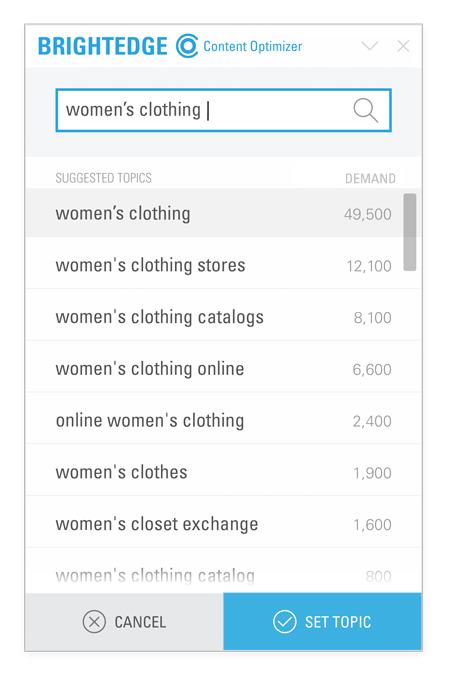
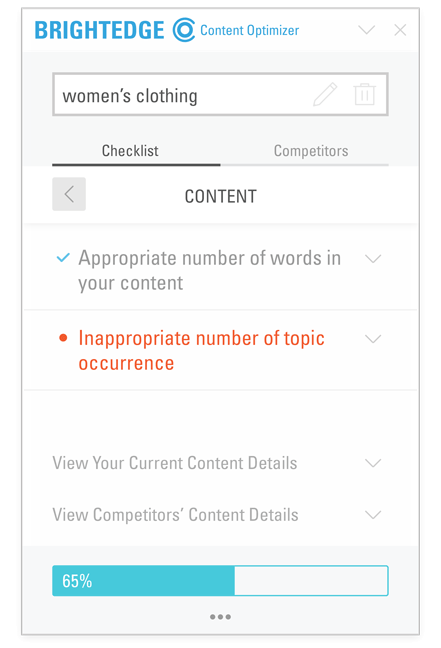
Now, for the first time content writers can increase the impact of their content while at the same time increasing their productivity. Armed with the machine learning insights into demand from BrightEdge (powered by the BrightEdge Data Cube), authors can focus on the right topics. Through an intuitive user interface, Content Optimizer guides writers in a step-by-step fashion to create content that is optimized for maximum traffic, conversions, and revenue without breaking or slowing down their content creation flow in AEM. Key benefits for content authors:

  • Integrated Workflow — Access Content Optimizer’s step-by-step guided user interface within the existing AEM page-editing menu sidekick (AEM 5) or within the top navigation Content Optimizer icon (AEM 6), enabling seamless optimization in parallel with the content creation process.
  • Competitor Analysis — With the BrightEdge Data Cube, utilize a detailed analysis of competitors’ digital content, with immediate insights to quickly take action. Webpage content is broken into page components, along with recommendations to create content that wins from day one.
  • Consumer Demand Targeting — Guides content writers to topics that are highest in demand and lowest in competition, ensuring content is optimized from day one.
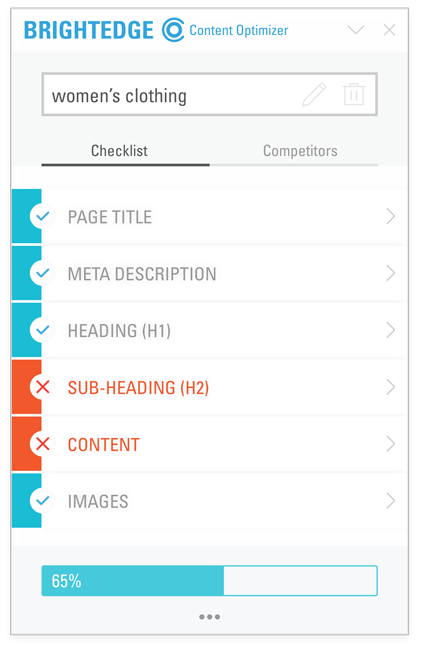
  • Content Optimization Progress Tracking — Focus on what matters with up to 16 on-page recommendations that have the most impact on search performance. Recommendations guide content authors seamlessly through each step directly within AEM, prompting optimization recommendations for highly effective content.

Recommendations show the steps needed to drive performance – before authoring content
Content Optimizer - ChecklistContent Optimizer - Recommendations

Online Marketers: Maximize Revenue From Content
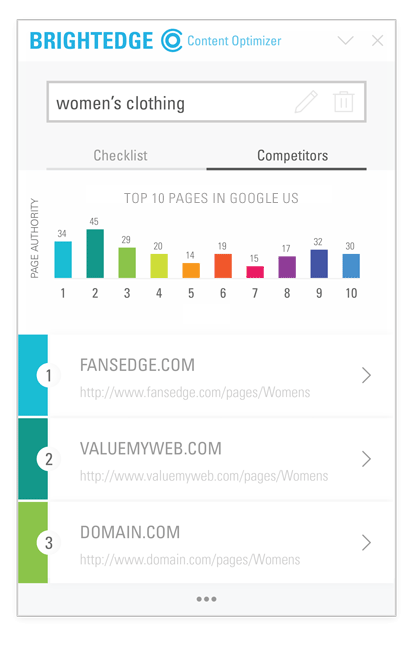
Content Optimizer - CompetitorsWith BrightEdge Content Optimizer, organizations are provided with recommendations that evolve along with the search landscape, and are compliant with the complex structure of large websites. Key benefits for online marketers:

  • Policy Compliance Across an Organization — Manage policies with out-of-the-box support for multiple teams, templates, websites, and policies. Set guidelines at the account level, or for all site-wide content and enforce compliance across multiple teams and templates.
  • Page to Content Pairing — Pair content with targeted web pages to rank in organic search for the correct content without cannibalizing other pages.
  • Powerful Competitive Insights — Track top competitor strategies on page elements and use the insights to optimize pages for best performance.

Administrators: Leverage a Flexible, Seamless, and Adaptive Integration

Organizations can easily customize the impact level of content for their different business units with automated web content policy management, all while maintaining a secure enterprise environment.

  • Designed for Enterprise Architecture — Working with current infrastructure and IT investments, data is transferred through HTTP proxy and standard package share installation.
  • Enterprise Grade Security — Secure API access with government level encryption policies.
  • Trusted Technology — BrightEdge actively supports over 7,200 account integrations via the BrightEdge Connect API.

Online Marketers: Measure Compliance Across Your Content Authoring Team
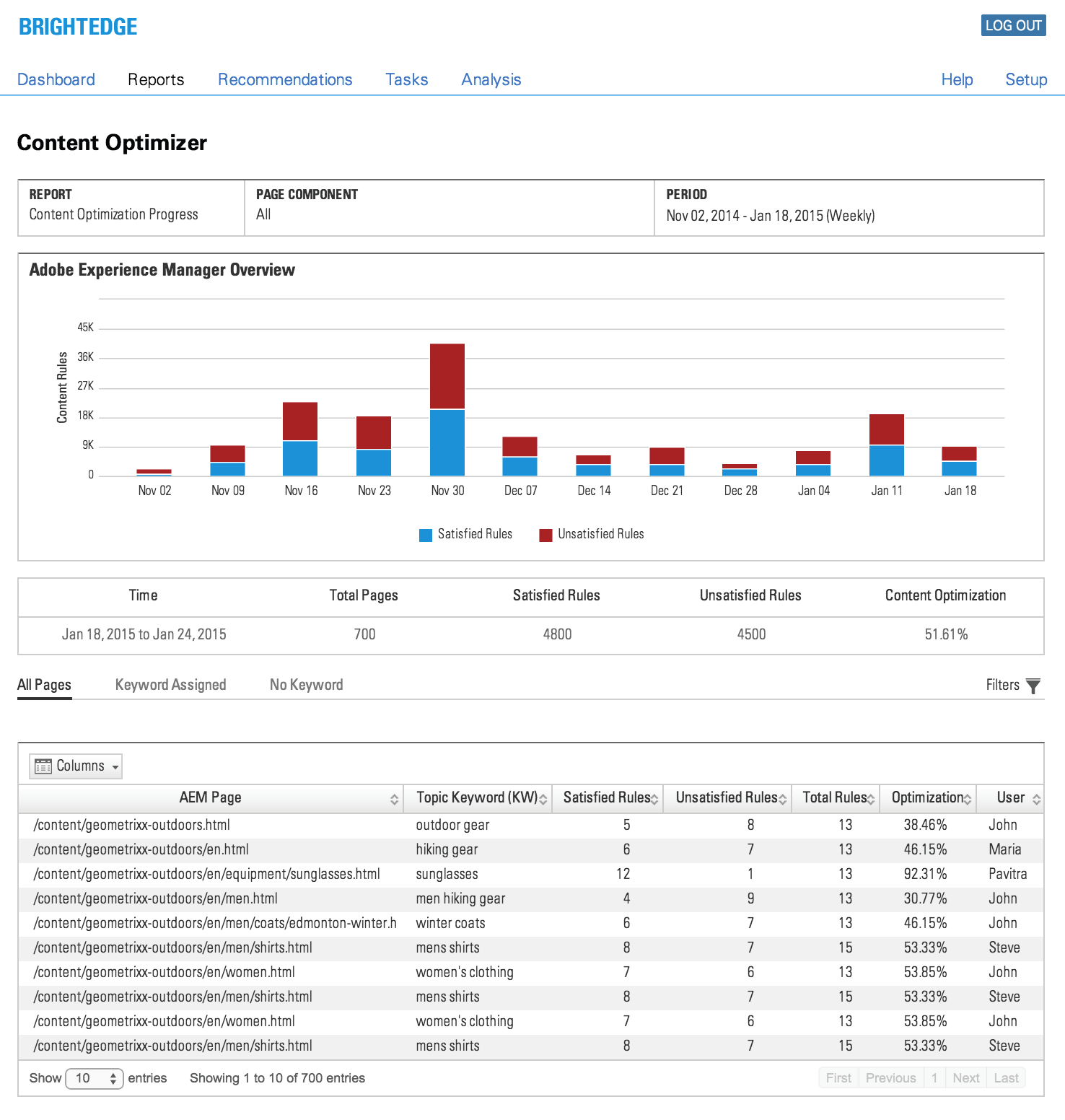
Content Optimizer - AEM Overview

Understand specific areas of your site where optimizations are being made, or still need to be made, and create a culture of content optimization

This is big. Now we can optimize 100% of our landing pages for organic search performance and drive more revenue on day one.

quote

Content Centric Marketing

<p>Search engines focus on delivering the best possible user experience, by providing <a href="https://www.brightedge.com/glossary/improve-content-quality&quot; target="_blank">high-quality content</a> and relevant results. Last year, Google made waves with their broad sweeping <a href="/content/google-panda-update">Panda </a>and Penguin <a href="/glossary/major-google-updates">algorithm updates</a>, rewarding those websites with a solid content strategy with improved rankings and visibility.</p>

<p>In the current search climate, it’s more important than ever to invest in unique, compelling, web friendly content, and optimizing for search performance. Consistent with a history of innovation, BrightEdge has developed unique technology enabling marketers to take a content and page based approach to managing content performance.</p>

Understanding how our content is reached by users is completely useful and viable to our team, and since we are a very content heavy website … Page Manager helps inform us in how well we’re doing from an SEO perspective.

quote
,